Archive for the ‘Space News’ Category
 Author:
  January 20th, 2022
Credit: Ding L., et al.
Data and images collected by China’s Yutu-2 rover indicate it has experienced varying degrees of mild slip and skid. The lunar terrain trod by the six-wheeled, off-road robot, is relatively flat at large scales but scattered with local gentle slopes.
“Cloddy soil sticking on its wheels implies a greater cohesion of the lunar soil than encountered at other lunar landing sites,” reports Ding Liang with the Harbin Institute of Technology.
The Moon machinery uses four steering motors on the corner wheels with a meshed surface.

Credit: Ding L., et al.
Cloddy soil, gel-like rocks
Researchers from Harbin Institute of Technology and Beijing Aerospace Control Center analyzed the locomotive data and images collected by Yutu-2, presenting their findings in the peer-reviewed journal, Science Robotics.
China’s Chang’E-4 mission successfully targeted the Moon’s farside and deployed the teleoperated Yutu-2 rover to investigate inside the Von Kármán crater in the South Pole-Aitken Basin. The robot has encountered cloddy soil, gel-like rocks, and fresh small craters inside the Von Karman crater in the South Pole-Aitken Basin.

Credit: Ding L., et al.
Rolling past designed lifetime
The Moon mission – a lander and the rover – touched down on January 3, 2019. The rover has operated for three years, rolling past its initial three-month designed lifetime.
Researchers used the rover wheel as a trenching device to approximate the properties of the lunar soil.

Cover photo credit: Beijing Aerospace Control Center (BACC)
Ding Liang, the paper’s first author, State Key Laboratory of Robotics and System, Harbin Institute of Technology, said that the findings are helping shape in-depth studies for China’s subsequent lunar missions.
To read the study – “A 2-year locomotive exploration and scientific investigation of the lunar farside by the Yutu-2 rover” – go to:
 Posted in
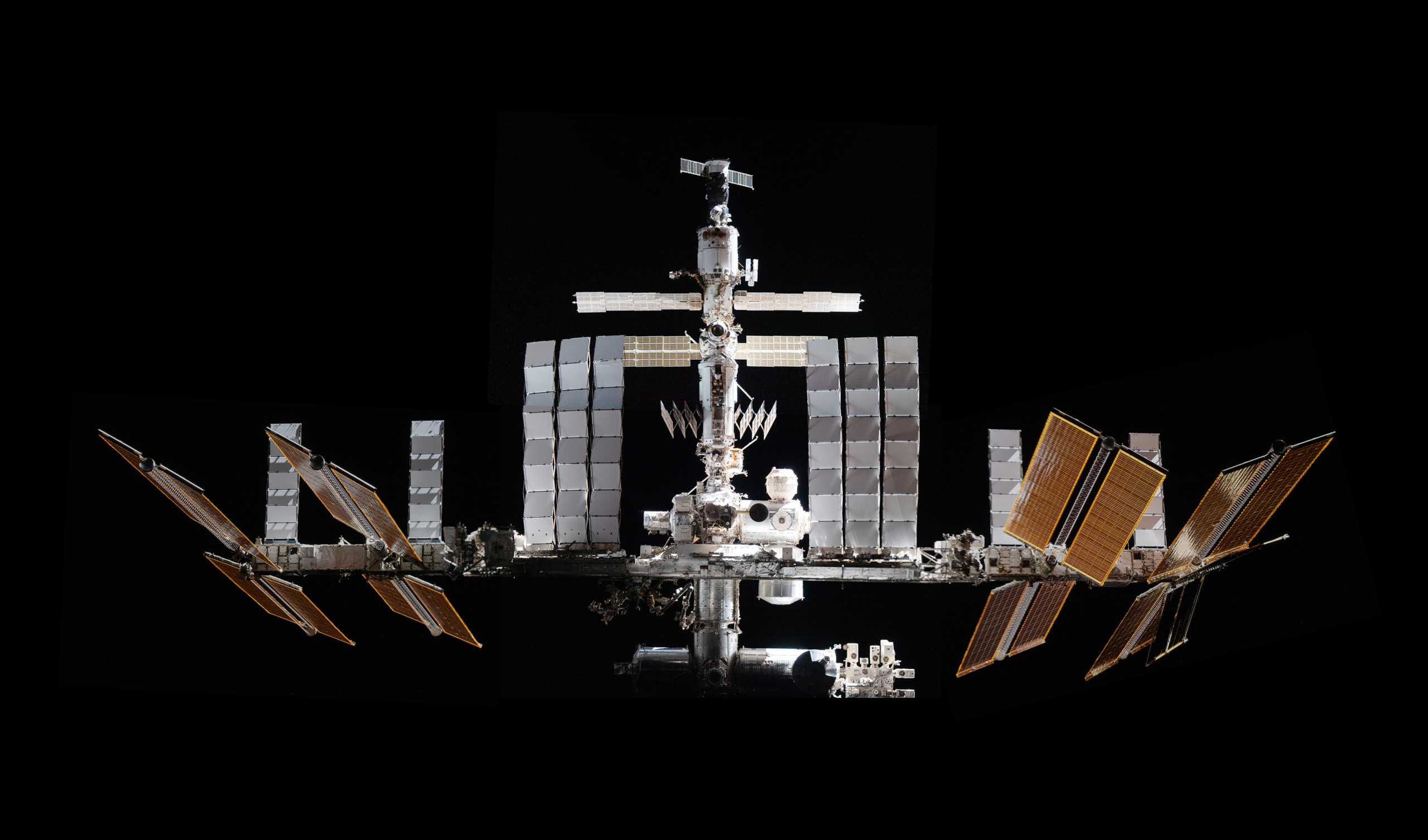
The International Space Station, home-away-from-home and a social, cultural study site. ISS mosaic created with imagery from Expedition 66.
Credit: NASA
A worldwide group of researchers is engaged in a unique, archaeological study of crew culture within the International Space station, focused on the orbiting habitat as a “microsociety in a miniworld.”
This global inside look at the ISS is called The International Space Station Archaeological Project (ISSAP) and is expected to supply new insights regarding human life in space and issues of habitation design.

Watch this space! Archaeological research is underway.
Credit: NASA
Findings of the ISSAP could prove useful to other mini working cultures here on Earth, be they Antarctic research stations, long-deployment nuclear submarines, and on a more outer space-oriented note, future Mars expeditions.
Go to my new Space.com story – “’Space archaeology’ research on the ISS will help design better space habitats – The new project could aid NASA’s crewed push to Mars” – at:
https://www.space.com/space-archaeology-iss-crew-culture-project

Future human missions to the Red Planet and the voyage back to Earth are expected to take two to three years.
During those lengthy sojourns, significant amounts of waste will be generated.
A crowdsourcing competition is seeking innovative approaches to repurpose, recycle, and reprocess the waste generated onboard to enable mission sustainability.
HeroX is a platform and open marketplace for crowdsourced solutions and had launched the competition: “Waste to Base Materials Challenge: Sustainable Reprocessing in Space”
The challenge
NASA’s Waste to Base Challenge asks the larger community to provide inventive approaches to waste management and conversion in four specific categories:
- Trash
- Fecal waste
- Foam packaging material
- Carbon dioxide (CO2) processing
“Since the logistics of supply ships to support a Mars mission are very difficult, the spacecraft needs to be as efficient and self-sufficient as possible,” explains a HeroX statement.

Any humans to Mars expedition will require spacecraft as efficient and self-sufficient as possible.
Credit: Bob Sauls – XP4D/Explore Mars, Inc. (used with permission)
“This challenge is all about finding ways to convert waste into base materials and other useful things, like propellant or feedstock for 3D printing. The challenge is looking for your ideas for how to convert different waste streams into propellant and into useful materials that can then be made into needed things and cycled through multiple times,” the HeroX statement continues.
Although a perfectly efficient cycle is unlikely, ideally, competitive solutions will result in little to no waste.
NASA could eventually integrate all the different processes into a robust ecosystem that allows a spacecraft to launch from Earth with the lowest possible mass.
Prize money
Multiple winners in each category will each be awarded a prize of $1,000. Additionally, judges will recognize four ideas as “best in class,” each with a prize of $1,000. A total prize purse of $24,000 will be awarded.
The prize is open to anyone aged 18 or older participating as an individual or as a team. Individual competitors and teams may originate from any country, as long as United States federal sanctions do not prohibit participation (some restrictions apply).
For more information, and to accept the challenge, visit:
https://www.herox.com/WasteToBase

Curiosity’s location as of Sol 3359. Distance driven 16.78 miles/27.01 kilometers
Credit: NASA/JPL-Caltech/Univ. of Arizona
NASA’s Curiosity Mars rover at Gale Crater is now performing Sol 3361 tasks.

Curiosity Left B Navigation Camera image taken on Sol 3361, January 19, 2022.
Credit: NASA/JPL-Caltech
“We continue to document rocks similar to what we saw at ‘The Prow,’ a dark appearing rock outcrop with amazing sedimentary structures and details,” reports Catherine O’Connell-Cooper, Planetary Geologist at University of New Brunswick; Fredericton, New Brunswick, Canada.

Curiosity Left B Navigation Camera image taken on Sol 3359, January 17, 2022.
Credit: NASA/JPL-Caltech
“To do this, we need to get as close as possible to an outcrop surface but that has called for some short multi-plan drives, as we maneuver to a new feature called ‘Panari’ – a length of roughly [65-feet] 20 meters away from The Prow.”

In the last plan, the robot edged towards the inclined rock in the front right corner of the image, ending on some flatter rock a safe distance back.
This image was taken by Left Navigation Camera on Sol 3356, January 14, 2022.
Credit: NASA/JPL-Caltech
Flatter rock
In the last plan, the robot edged towards an inclined rock, ending on some flatter rock a safe distance back.
“This end of drive,” O’Connell-Cooper adds, “allows the rover planners to vet the inclined rock, finding the optimal location to place us for up close contact science after a short ‘bump’ or drive (less than [10-feet] 3 meters in total) on the third sol of this plan [Sols 3357-3360].”

Curiosity Mast Camera (Mastcam) Left photo acquired on Sol 3359, January 17, 2022.
Credit: NASA/JPL-Caltech/MSSS

Curiosity Mast Camera (Mastcam) Left photo acquired on Sol 3359, January 17, 2022.
Credit: NASA/JPL-Caltech/MSSS

Curiosity Mast Camera (Mastcam) Left photo acquired on Sol 3359, January 17, 2022.
Credit: NASA/JPL-Caltech/MSSS
First however is documenting the flatlying rock underneath the rover. The target “Chimata” in front of the rover will be brushed to clear the dust and then analyzed by both the Alpha Particle X-Ray Spectrometer (APXS) and Mastcam.
Tonal differences
“This material is a somewhat paler color than The Prow and the inclined rocks at Panari, so we are investigating to see if the tonal differences are reflected in the composition,” O’Connell-Cooper notes.
Curiosity’s Chemistry and Camera (ChemCam) will use the Laser Induced Breakdown Spectroscopy (LIBS) instrument to target two smaller targets (“Mataui” and “Kamarang”) and the Mastcam targets “Auyan” and “Uei” look at sand movement overlying fractures and along the side of flatlying bedrock.

“Chimata” in front of the rover is brushed to clear the dust. Curiosity Mast Camera (Mastcam) Right image taken on Sol 3359, January 17, 2022.
Credit: NASA/JPL-Caltech/MSSS
Changing dust levels
ChemCam will also target the inclined block with LIBS (“Apparam”) and its imaging tool, the Remote Micro-Imager (RMI) (target “Karwai”), whilst Mastcam will image a similar block “Quino” a bit further in the distance, O’Connell-Cooper says.

Curiosity Left B Navigation Camera image taken on Sol 3359, January 17, 2022.
Credit: NASA/JPL-Caltech
There are also multiple monitoring activities, looking at changing dust levels in the atmosphere, and a full day of Rover Environmental Monitoring Station (REMS) only activities of the last day of a recent, but crammed, four sol plan, O’Connell-Cooper concludes.

On the prowl at Vera Rubin ridge Credit: NASA/JPL-Caltech/MSSS
Research carried out by NASA’s Curiosity rover at Gale Crater point to the possible ultraviolet degradation of biologically produced methane.
The robot has permitted scientists to analyze carbon isotopes in sediment samples taken from half a dozen exposed locations, including an exposed cliff.
According to a just-published paper led by Christopher House, professor of geosciences at the Pennsylvania State University, researchers single out three plausible explanations for the carbon’s origin: cosmic dust, ultraviolet degradation of carbon dioxide, or ultraviolet degradation of biologically produced methane.
The researchers note in a new issue of the Proceedings of the National Academy of Sciences that: “All three of these scenarios are unconventional, unlike processes common on Earth.”
That third possible method of producing carbon-13 depleted samples has a biological basis.

Credit: NASA
Unusual carbon cycle
According to a Penn State research story, here on Earth, a strongly carbon-13 depleted signature from a paleosurface would indicate past microbes consumed microbially produced methane.
“Ancient Mars may have had large plumes of methane being released from the subsurface where methane production would have been energetically favorable. Then, the released methane would either be consumed by surface microbes or react with ultraviolet light and be deposited directly on the surface,” the research statement explains.
“However, according to the researchers, there is currently no sedimentary evidence of surface microbes on the past Mars landscape, and so the biological explanation highlighted in the paper relies on ultraviolet light to place the carbon-13 signal onto the ground,” the statement continues.

The image shows the Highfield drill hole on Vera Rubin Ridge. Drill powder from this hole showed carbon isotope values indicating a carbon cycle that includes either subsurface life, intense UV radiation penetrating the atmosphere, or Interstellar dust. The image was taken by the Mars Hand Lens Imager on sol 2247. Credit: NASA/Caltech-JPL/MSSS via Penn State.
“All three possibilities point to an unusual carbon cycle unlike anything on Earth today,” said House. “But we need more data to figure out which of these is the correct explanation. It would be nice if the rover would detect a large methane plume and measure the carbon isotopes from that, but while there are methane plumes, most are small, and no rover has sampled one large enough for the isotopes to be measured.”
House says that finding the remains of microbial mats or evidence of glacial deposits could also help clear things up. “We are being cautious with our interpretation, which is the best course when studying another world.”
To read the full research statement from Penn State, written by the university’s A’ndrea Elyse Messer, go to:
https://www.psu.edu/news/research/story/newly-discovered-carbon-may-yield-clues-ancient-mars
Also, go to Paul Voosen’s Science magazine article — “Mars rover detects carbon signature that hints at past life source Dramatically “light” carbon could also be explained by atmospheric reactions or cosmic dust” at:
https://www.science.org/content/article/mars-rover-detects-carbon-signature-hints-past-life-source?

Credit: China National Space Administration (CNSA)/China Media Group(CMG)/China Central Television(CCTV)/Inside Outer Space screengrab
China’s Chang’e-4 probe was launched on December 8, 2018, making the first-ever soft landing within the Von Kármán Crater in the South Pole-Aitken Basin on the Moon’s far side on January 3, 2019.

Von Kármán crater (186 kilometer diameter), a treasure house of geologic landforms. Image taken by NASA’s Lunar Reconnaissance Orbiter’s LROC Wide Angle Camera.
Credit: NASA/GSFC/Arizona State University
The Chang’e-4 lander deployed the Yutu-2 rover that has now wheeled over 1,000 meters of lunar landscape. The lander and rover have so far operated for three years since its landing at the far side of the Moon – much longer than its designed service life of three months, according to a China Central Television (CCTV) broadcast.

Chang’e-4 farside mission – lander and Yutu-2 rover.
Credit: CNSA/CLEP
Surpassed expectations
As for why the lunar mission has surpassed expectations, Fu Qiang, chief designer of the Chang’e-4 ground application system, told CCTV:

Fu Qiang, chief designer of the Chang’e-4 ground application system.
Credit: CNSA/CMG/CCTV/Inside Outer Space screengrab
“As early as the beginning of the design, we had required high reliability in selecting each component…therefore there was a guarantee of a long service life and high reliability.”
Since the lunar surface temperature is between 160 degrees Celsius and minus 180 degrees Celsius, a difference of more than 300 degrees Celsius, the designers created two rest modes for Chang’e-4—sleep mode and hibernation mode—so that it could better adapt to the harsh climate.

Credit: CNSA/CMG/CCTV/Inside Outer Space screengrab
“After 38 lunar days of testing, the program and procedure of our design work have proven to be very reasonable,” said Fu.
Radiation resistance
A lunar day is equal to 14 days on Earth, and a lunar night is the same length.

Credit: CNSA/CMG/CCTV/Inside Outer Space screengrab
Because the Moon has no protective layer, lunar hardware can be affected by various space particles.
Radiation resistance was enhanced for Chang’e-4 and Yutu-2. These protections not only extend the service life of the spacecrafts but also guarantee the accuracy of the collected data.
The Chang’e-4 lander and the Yutu-2 rover are in good working condition, with the rover travelling northwest to a basalt region.

Credit: CNSA/CMG/CCTV/Inside Outer Space screengrab
Mystery hut
Recently, imagery taken by Yutu-2 caused a stir, with a “mystery” object spotted on the Moon.

Credit: CNSA/CMG/CCTV/Inside Outer Space screengrab
The object, shaped like a hut, was imaged by the robot. It was seen over 260-feet (80-meters) away from the rover’s location.
Close-up imagery of the feature show the “mystery hut” to be a rock situated on the edge of a crater.
Go to this video detailing the Chang’e-4 mission at:

Credit: Blue Origin/Dylan Taylor
Dylan Taylor is a “space angel,” an investor in NewSpace and last December he reached a new career high, quite literally. He flew onboard Blue Origin’s New Shepard suborbital rocketship on its NS-19 mission.

Credit: Blue Origin/Dylan Taylor
Blue Origin successfully completed its third human spaceflight on Saturday, December 11, 2021 the first with six passengers to make the trek.
Go to my exclusive Space.com interview with Taylor at:
Launching with Blue Origin: Q&A with spaceflight veteran Dylan Taylor
“Looking out the window, I think I said, ‘Oh my god … oh my god!’ It literally took my breath away.”
https://www.space.com/dylan-taylor-blue-origin-spaceflight-interview

Credit: CNSA/CLEP
China’s Yutu-2 far side lunar rover has taken over 1,000 photos since it landed on the Moon three years ago.
The robot is exploring the Von Kármán crater, a large lunar impact feature that is located in the South Pole-Aitken Basin.
Yutu-2 was deployed from the Chang’e-4 lander that touched down on the far side of the Moon on January 3, 2019.

Chang’e-4 lander taken by Yutu-2 rover.
Credit: CNSA/CLEP
According to a China Central Television (CCTV) report, the Yutu-2 has wheeled itself over 3,280 feet (1,000 meters) as of January 6, 2021.
“From the high-resolution photos taken by Yutu-2, we can see many typical landforms, such as some fresh craters, (the diameter of which) range from tens of meters to tens of centimeters. We also see many rocks of different sizes,” Ren Xin, deputy chief designer of the Chang’e-4 ground application system, told CCTV.

Ren Xin, deputy chief designer, Chang’e-4 ground application system.
Credit: CCTV/Inside Outer Space screengrab
Scientific data
The rover is equipped with six scientific payloads, including the panoramic camera and the infrared imaging spectrometer, aiming to explore the lunar topography and the composition of the lunar soil. It has already collected 3,800GB of scientific data.
The Yutu-2 would often take considerable time to survey the craters it encounters. Ren said it once spent nearly three lunar days to measure the details of one crater.

Ren Xin details Yutu-2 imagery to CCTV reporter.
Credit: CCTV/Inside Outer Space screengrab
The Yutu-2 has now completed tasks for its 38th lunar day and is currently hibernating for the lunar night. A lunar day is equal to about 14 days on Earth, and a lunar night is of the same length. The solar-powered probe switches to dormant mode during the lunar night.
Next, Yutu-2 will travel northwest away from the landing point.
“Right now, [the rover] is heading northwest to a basalt region with no ejecta, around one kilometer away from the current position, which may take a longer time to reach,” Ren said.

Credit: CNSA/CLEP

Yutu-2 rover moves toward crater inspection.
Credit: CGTV/CNSA/CLEP

London-based Sen has announced that its first satellite able to stream Ultra High Definition videos of Earth is now in orbit.
Sen’s ETV-A1 was launched January 13 aboard the SpaceX Falcon 9 rideshare. On board this launch were 105 commercial and government spacecraft, including CubeSats, microsats, PocketQubes, and orbital transfer vehicles.
The Sen satellite is equipped with four video cameras, designed to image Earth with different spatial resolutions, from continents and oceans to regions and cities.
Sen’s cameras are capable of streaming recorded and live Ultra High Definition (UHD) video including 8K video from its highest resolution camera which can see down to around 5 feet (1.5 meters) of the ground.
Planned constellation
ETV-A1 is the first in Sen’s planned constellation of video satellites in low Earth orbit.

Credit: Sen
“The successful launch of our first satellite represents a key milestone on our journey to democratize space using video,” said Charles Black, Founder & CEO of Sen in a company statement.
Sen’s mission is to stream real-time videos from space to billions of people, gathering news and information about Earth and space and making it universally accessible and useful.
Range of markets
Sen’s global Earth monitoring will address a range of markets, including: environmental, disaster and emergency response, meteorological, shipping, asset monitoring, news media, future and commodity traders, human and robotic space exploration.
Sen is a private company, funded by over 50 investors and founded in 2007 by Black.
Sen will capture its unique video content using both hosted video cameras and its own constellations of small satellites.
For more information, go to:

Curiosity Front Hazard Avoidance Camera Left B image taken on Sol 3355, January 13, 2022.
Credit: NASA/JPL-Caltech
NASA’s Curiosity Mars rover at Gale Crater is now performing Sol 3356 duties.
Ken Herkenhoff, a planetary geologist at USGS Astrogeology Science Center in Flagstaff, Arizona, reports that a rover “bump” has moved the Mars machinery closer to “The Prow” outcrop. The short drive placed the front wheels very close to the base of the outcrop.
“From this new position, the arm can reach the top of the outcrop,” Herkenhoff adds, so the Alpha Particle X-Ray Spectrometer (APXS) will be placed on a couple of upper outcrop targets named “Angasima” and “Kamuda” on Sol 3355.
Lens imager issue
Unfortunately, the Mars Hand Lens Imager (MAHLI) had an issue reading data from their memory a couple sols ago, so MAHLI imaging is precluded while engineers take a closer look at MAHLI.
“Instead, the Right Mastcam will image the APXS target to allow the chemical measurement to be placed in geologic context,” Herkenhoff points out.

Curiosity Chemistry & Camera (ChemCam) Remote Micro-Imager (RMI) photo acquired on Sol 3355, January 13, 2022.
Credit: NASA/JPL-Caltech/LANL
Curiosity’s Chemistry and Camera (ChemCam) will also sample the elemental chemistry of the outcrop at “Cerro la Luna” and use its Remote Micro-Imager (RMI) to acquire a high-resolution 5×2 mosaic of a bedrock exposure called “Paso de las Lagrimas.”
Next drive target
“Mastcam is also planning a stereo mosaic of the outcrop and will acquire mosaics of the next drive target and the Mirador butte toward the south. Navcam and Mastcam will be used to characterize the amount of dust in the atmosphere, which has increased lately, and Navcam will search for dust devils,” Herkenhoff reports.

Curiosity Rear Hazard Avoidance Camera Left B image taken on Sol 3355, January 13, 2022.
Credit: NASA/JPL-Caltech
Before dawn on Sol 3356, Navcam will search for clouds.
“Later that morning, Navcam will again look at the content of dust in the atmosphere and search for dust devils, then watch for clouds just above the horizon,” Herkenhoff adds. “Then ChemCam will fire its laser at the “Quebrada de Jaspe” target on the right side of the outcrop and acquire an RMI mosaic of another bedrock target dubbed ‘Vale dos Cristais.’”
Heading east
The Right Mastcam will then document both of the ChemCam targets and the APXS targets. Mastcam will then take two stereo mosaics, extending coverage of The Prow, and Navcam will again look for clouds above the horizon.
“The rover will then pack up and drive toward the east, stopping along the way to image interesting outcrops using Navcam and Mastcam. After the drive and the usual post-drive imaging, MARDI will take another twilight image,” Herkenhoff concludes by noting: “Overall, a busy plan.”

Curiosity Mast Camera (Mastcam) Left and Right imagery taken on Sol 3354, January 12, 2022.
Credit: NASA/JPL-Caltech/MSSS

