Archive for the ‘Space News’ Category
 Author:
  February 7th, 2022
Credit: ISRO
India appears ready to rekindle its Moon exploration program, apparently eyeing this August to loft the country’s Chandrayaan-3 mission.
Jitendra Singh, Minister of State, Science and Technology, has stated that the Indian Space Research Organization (ISRO) is readying its third lunar exploration mission.
“Many related hardware and their special tests are successfully completed, the launch is scheduled for August 2022,” Singh said in a statement to India’s lower house of the Parliament.

Credit: ISRO
Landing location
Reportedly, India’s GSLV Mk 3 booster will hurl the Chandrayaan-3, consisting of a lander and rover, from the Satish Dhawan Space Center.

India’s Chandrayaan-2’s Vikram lander and its rover.
Credit: ISRO
The lunar South Pole site that saw the crash landing of Chandraayan-2 is being targeted, according to some reports.
In 2019, India’s Chandrayaan-2’s Vikram lander and its rover plowed into the lunar landscape and were destroyed. In that mission, an orbiter was successfully placed into lunar orbit. Still operating, it will help in communications for the upcoming Chandrayaan-3 landing attempt.
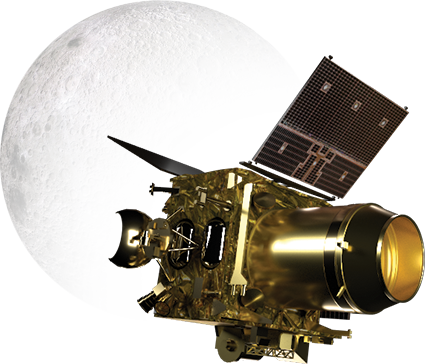
Chandrayaan-2’s Moon orbiter.
Credit: ISRO
According to the ISRO website: “The Lunar South pole is especially interesting because of the lunar surface area that remains in shadow is much larger than that at the North Pole. There could be a possibility of presence of water in permanently shadowed areas around it. In addition, South Pole region has craters that are cold traps and contain a fossil record of the early Solar System.”
 Posted in

Curiosity’s location as of Sol 3376. Distance driven since landing is 16.82 miles/27.06 kilometers
Credit: NASA/JPL-Caltech/Univ. of Arizona
NASA’s Curiosity Mars rover at Gale Crater is now performing Sol 3378 tasks.
Reports Abigail Fraeman, a planetary geologist at NASA’s Jet Propulsion Laboratory, the robot is leaving “The Prow” in its rearview mirror.

Curiosity Left B Navigation Camera image acquired on Sol 3377, February 4, 2022.
Credit: NASA/JPL-Caltech
“We’ll be checking off the last item on our ‘Prow vicinity investigation’ to-do list” with Mars Hand Lens Imager (MAHLI) and Alpha Particle X-Ray Spectrometer (APXS) observations on two bedrock targets named “Aji” and “Erico,” as well as Chemistry and Camera (ChemCam) observations on a tilted block named “Cucurital” and bedrock target named “Rockstone.”

Curiosity Right B Navigation Camera photo taken on Sol 3377, February 4, 2022.
Credit: NASA/JPL-Caltech
Lots of images
“We’re also collecting a lot of images at this location,” Fraeman adds, with five planned Mastcam mosaics consisting of 494 individual frames between them, a 5×1 ChemCam Remote Micro-Imager (RMI) mosaic, and Mastcam context images of the Cucurital and Rockstone ChemCam targets.
“Not enough imaging for you? We’ll snap even more Mastcam photos after our drive, with a 180 degree mosaic (that’s an additional 55 Mastcam frames for those keeping score at home) on top of our standard suite of post-drive images,” Fraeman explains.

Curiosity Right B Navigation Camera photo taken on Sol 3377, February 4, 2022.
Credit: NASA/JPL-Caltech
Weekend plan
The weekend plan rounds out with some observations to monitor the environment around the rover, Fraeman adds, including a ChemCam passive sky observation on the third sol of the plan that will measure the composition of gases in the atmosphere.

Curiosity Right B Navigation Camera photo taken on Sol 3377, February 4, 2022.
Credit: NASA/JPL-Caltech
Now that Mars researchers have wrapped up their activities in the area, the planned drive is sending the rover several meters north, back the way it came.

Curiosity Right B Navigation Camera photo taken on Sol 3377, February 4, 2022.
Credit: NASA/JPL-Caltech
“We are aiming for a passageway that will allow us to ascend back onto the Greenheugh pediment. Once we climb up, we’ll leave the Mt. Sharp group rocks behind for a while and get to explore the very different period of Mars’ history that is preserved in the Greenheugh pediment and superposed Gediz Vallis ridge,” Fraeman concludes.

Credit: CCTV/Inside Outer Space screengrab
China’s Mars orbiter, the Tianwen-1, has sent a selfie video showcasing the Beijing Olympic, Paralympic emblems that are attached to the spacecraft.
The video released on Friday celebrates the official opening of the Beijing 2022 Olympic and Paralympic Winter Games via the Red Planet mission.

Technicians place emblems on the Tianwen-1 Mars orbiter prior to spacecraft launch in July 2020.
Credit: CNSA
The Tianwen-I probe carries the Five Stars Red Flag, as well as the other emblems.
For a short video, go to:

SpaceX Starlink satellites over Carson National Forest, New Mexico, photographed soon after launch.
Credit: Mike Lewinsky/Creative Commons Attribution 2.0
The International Astronomical Union has announced the creation of a new
“Centre for the Protection of the Dark and Quiet Sky from Satellite Constellation Interference.”
The International Astronomical Union (IAU) is deeply concerned about the increasing number of launched and planned satellite constellations in mainly low Earth orbits.
IAU has chosen the SKA Observatory (SKAO) and National Science Foundation’s NOIRLab to co-host the new center.
Leading voice
The new center will coordinate collaborative multidisciplinary international efforts with institutions and individuals and works across multiple geographic areas “to help mitigate the negative impact of satellite constellations on ground-based optical and radio astronomy observations as well as humanity’s enjoyment of the night sky,” an IAU statement explains.
The center is to become the leading voice for astronomical matters that relate to the protection of the dark and quiet sky from satellite constellations.

SpaceX Starlink constellation pass overhead near Carson National Forest, New Mexico, photographed soon after launch.
Credit: Mike Lewinsky/Creative Commons Attribution 2.0
Global coordination
Debra Elmegreen, IAU President, notes: “The new Centre is an important step towards ensuring that technological advances do not inadvertently impede our study and enjoyment of the sky. I am confident that the Centre co-hosts can facilitate global coordination and bring together the necessary expertise from many sectors for this vital effort.”
NSF’s NOIRLab is the U.S. center for ground-based optical astronomy, and the SKA Observatory is an intergovernmental organization headquartered in the UK tasked with delivering the world’s most powerful networks of radio telescopes in Australia and South Africa.
For more details, go to: https://www.iau.org/news/pressreleases/detail/iau2201/

Mars Hand Lens Imager (MAHLI) photo of a small part of the Toron block in front of the rover. MAHLI is located on the turret at the end of the rover’s robotic arm. Photo produced on February 2, 2022, Sol 3374.
Credits: NASA/JPL-Caltech/MSSS.
NASA’s Curiosity Mars rover at Gale Crater is now performing Sol 3376 duties.
Scientists continue to marvel at the Toron chunk of bedrock, reports Susanne Schwenzer, a planetary geologist at The Open University, Milton Keynes, United Kingdom. “We arrived here two sols ago and didn’t drive away just yet to get some second servings.”

Curiosity Mars Hand Lens Imager photo produced on Sol 3375, February 2, 2022.
Credit: NASA/JPL-Caltech/MSSS
There was another sol to add rover investigations on this block and in the area.
Awesome details
In detail, the robot’s Chemistry and Camera (ChemCam) is looking at the target “Apocaila” to document the most common rock in the area, and the one which the rover is currently parked upon.

Curiosity Chemistry & Camera Remote Micro-Imager (RMI) photo acquired on Sol 3375, February 2, 2022.
Credit: NASA/JPL-Caltech/LANL
This so-called bedrock is also the target of Mastcam, with a large mosaic to be taken starboard of Curiosity.
ChemCam is also turning its attention back to the Toron block for the second servings investigating the target “Paure,” which is on a different part of the Toron block from what was recently imaged, so the plan calls for one more set of Mars Hand Lens Imager (MAHLI) photos of all those awesome details, Schwenzer adds.

Curiosity Mast Camera Right imagery mosaic, taken on Sol 3374, February 1, 2022.
Credit: NASA/JPL-Caltech/MSSS
Intriguing structures
Looking slightly further afield, ChemCam will get an Remote Micro-Imager (RMI) mosaic on the target Paure to “document even more of all those fascinating sedimentary structures,” Schwenzer explains.

Curiosity Mast Camera Right imagery mosaic, taken on Sol 3374, February 1, 2022.
Credit: NASA/JPL-Caltech/MSSS
“Even further afield the landscape looks equally exciting, and therefore ChemCam has a long distance RMI in the plan to get images from an area in the distance to get a closer look at some intriguing structures that look like thicker bedding or maybe something else,” Schwenzer points out. “That’s for the new images to reveal as the ones we have do not quite have the resolution to make that decision. But that’s what long distance RMIs are for!”

Curiosity Right B Navigation Camera image taken on Sol 3375, February 2, 2022.
Credit: NASA/JPL-Caltech
New parking position
Schwenzer says that the rover is going to drive, and after that the standard set of navigation camera images will help the next planning and of course they are also the first ones to reveal science details of the new parking position.
ChemCam will add an AEGIS observation. AEGIS stands for Autonomous Exploration for Gathering Increased Science) – a software suite that permits the rover to autonomously detect and prioritize targets.
“Throughout the plan there are observations of the atmospheric conditions, too, Schwenzer concludes. “It’s a busy two sols (Sols 3376-3377) for Curiosity!”

A high-definition image of the Mars Australe lava plain on the Moon taken by Japan’s Kaguya lunar orbiter in November 2007.
Credit: JAXA
There is increasing interest in that wayward SpaceX Falcon 9 upper stage and its impact on the Moon next month.
In 2015 the Falcon 9 placed the National Oceanic and Atmospheric Administration’s (NOAA) DSCOVR climate observatory around the L1 Lagrange point.
That’s one of five such gravitationally-stable points between Earth and the Sun. Having reached L1, the mission’s upper stage ended up pointed away from Earth into interplanetary space.

Artist’s impression of DSCOVR on the way to L1 atop its Falcon 9 upper stage in 2015.
Credit: SpaceX
“This rendered a deorbit burn to dispose of it in our planet’s atmosphere impractical, while the upper stage also lacked sufficient velocity to escape the Earth-Moon system. Instead it was left in a chaotic Sun-orbiting orbit near the two bodies,” according to the European Space Agency.
Regulatory regime
Human-made objects have intentionally impacted the Moon before, starting as early as the 1950s, including Apollo upper stages used to induce “moonquakes” for surface seismometers. The SpaceX upper stage slamming into the Moon marks “the first time that a human-made debris item unintentionally reaches our natural satellite,” ESA has pointed out.

Credit: ESA
“The upcoming Falcon 9 lunar impact illustrates well the need for a comprehensive regulatory regime in space, not only for the economically crucial orbits around Earth but also applying to the Moon,” says Holger Krag, Head of ESA’s Space Safety Program.
“For international spacefarers, no clear guidelines exist at the moment to regulate the disposal at end of life for spacecraft or spent upper stages sent to Lagrange points,” said ESA in a statement. “Potentially crashing into the Moon or returning and burning up in Earth’s atmosphere have so far been the most straightforward default options.”

Credit: Advanced Space/Michael Thompson
Credible forecasts
There are credible forecasts when the upper stage will strike the Moon: March 4 at 12:25:39 UTC at a point on the lunar far side near the equator. Follow-up observations should sharpen the accuracy of forecasts.
One such calculation comes from astrodynamics engineer, Michael Thompson, of Advanced Space in Westminster, Colorado. He’s generated a plot and visual to capture where the upper stage may crash.
Thompson built upon the work by Bill Gray of projectpluto.com who collects and aggregates optical observations on near Earth objects. It was Gray that discovered the crash course of the SpaceX upper stage.
ProjectPluto.com posts (a subset) of raw observations from users around the world
Using these observations, Thompson performed his own orbit determination process in addition to the processes run by Bill Gray.

The lunar far side as imaged by NASA’s Lunar Reconnaissance Orbiter using its LROC Wide Angle Camera.
Credit: NASA/Goddard/Arizona State University
Advanced Space generated predicts (and samples of uncertainty) currently showing an impact west of the Sea of Tranquility, very similar to the predict generated by Bill Gray.
Impact is near the lunar limb as viewed from Earth – most of the distribution lays slightly on the Moon’s far side. Based on current data, the impact is not expected to be near any NASA Apollo or China lunar exploration sites.

Looking back to Earth from DSCOVR’s Falcon 9 upper stage on the way to L1.
Credit: SpaceX
Uncertainties: attitude, solar radiation pressure
Thompson notes that this upper stage impact may or may not be visible from Earth.
The center of the distribution is (9.31, -95.86), which is pretty far off from the current location of China’s Chang’e-4 lander/rover (-45.46, 177.59) and much closer to the lunar limb than fully over on the far side.
But even with large uncertainties in the attitude of the spacecraft and the resulting uncertainties in the solar radiation pressure that can affect the upper stage, an impact much further south towards Chang’e-4 would be unlikely, Thompson adds.
The uncertainty will come down a good bit more once there are additional observations this month.

NASA’s Lunar Reconnaissance Orbiter (LRO).
Credit: NASA/GSFC
Assessing observations
“NASA’s Lunar Reconnaissance Orbiter (LRO) will not be in a position to observe the impact as it happens,” a NASA statement sent to Inside Outer Space explains.
“However, the mission team is assessing if observations can be made to any changes to the lunar environment associated with the impact and later identify the crater formed by the impact. This unique event presents an exciting research opportunity,” the NASA statement adds.
“Following the impact, the mission can use its [LRO] cameras to identify the impact site, comparing older images to images taken after the impact. The search for the impact crater will be challenging and might take weeks to months.”

Curiosity’s location as of Sol 3372. Distance driven since landing: 16.81 miles/27.05 kilometers
Credit: NASA/JPL-Caltech/Univ. of Arizona
NASA’s Curiosity Mars rover at Gale Crater is now performing Sol 3374 duties.
“We continue to characterize ‘The Prow,’ which stands proud above nearby flat lying dust coated bedrock,” reports Catherine O’Connell-Cooper, a planetary geologist at the University of New Brunswick; Fredericton, New Brunswick, Canada.

Curiosity Left B Navigation Camera image taken on Sol 3373, January 31, 2022.
Credit: NASA/JPL-Caltech
“Our sedimentologists are very keen to get grain size measurements, as this can give very valuable insights into conditions at the time the sediments were laid down,” O’Connell-Cooper adds.
A change in grain size can show researchers there are changing conditions over time, so getting the Mars Hand Lens Imager (MAHLI) on rocks here is the highest priority so scientists can obtain a solid measurement of grain size.

Curiosity Mast Camera Left image taken on Sol 3372, January 30, 2022.
Credit: NASA/JPL-Caltech/MSSS
Underlying bedrock
“Unfortunately, the underlying bedrock is very dusty making grain size identification difficult,” O’Connell-Cooper notes, so getting the robot up close to The Prow is proving very difficult. “However, we have had a couple of lucky breaks … literally!”

Curiosity Mast Camera Left image taken on Sol 3372, January 30, 2022.
Credit: NASA/JPL-Caltech/MSSS
Team members have identified a float block “Toron,” which broke off The Prow but whose original location up on The Prow can be identified, O’Connell-Cooper adds
A recent plan has Curiosity driving to this block, which was analyzed by the rover’s Chemistry and Camera (ChemCam) earlier, and will hopefully be in a position to analyze grain size for The Prow.

Brushable target “Suapi”; Curiosity Mars Hand Lens Imager photo produced on Sol 3372, January 30, 2022.
Credit: NASA/JPL-Caltech/MSSS
Brushable target
“We were able to find a brushable target “Suapi” in our current workspace,” O’Connell-Cooper, explains, clearing the dust and analyzing the target with MAHLI and the Alpha Particle X-Ray Spectrometer (APXS).
“Additionally, the rover wheels broke apart some bedrock as we drove to our current workspace, so we are getting a six image MAHLI mosaic on the freshly exposed ‘The Test’ bedrock target,” O’Connell-Cooper adds.

Curiosity Mars Hand Lens Imager photo produced on Sol 3372, January 30, 2022.
Credit: NASA/JPL-Caltech/MSSS

Curiosity Mars Hand Lens Imager photo produced on Sol 3372, January 30, 2022.
Credit: NASA/JPL-Caltech/MSSS
The rover’s ChemCam was slated to analyze the targets “Sororopan” and “Parime” in the underlying bedrock, “Yuruani” up on The Prow and “Paikwa” on the Toron block.
“We complement the geological analysis with a full suite of atmospheric measurements, monitoring dust content in the atmosphere and looking for dust devils on the horizon,” O’Connell-Cooper concludes.

Curiosity Right B Navigation Camera image acquired on Sol 3373, January 31, 2022.
Credit: NASA/JPL-Caltech

Curiosity Right B Navigation Camera image acquired on Sol 3373, January 31, 2022.
Credit: NASA/JPL-Caltech

Curiosity Right B Navigation Camera image acquired on Sol 3373, January 31, 2022.
Credit: NASA/JPL-Caltech

Curiosity Right B Navigation Camera image acquired on Sol 3373, January 31, 2022.
Credit: NASA/JPL-Caltech

Credit: CMS/CCTV/Inside Outer Space screengrab
China’s high-flying Shenzhou-13 crew — Zhai Zhigang, Wang Yaping and Ye Guangfu, have decorated the space station core module with traditional Chinese paper-cuts, red lanterns, and Spring Festival Couplets – all in preparation to welcoming the Chinese Lunar New Year.
Commander Zhai, a Chinese calligraphy aficionado, displayed a pair of couplets.

Credit: CMS/CCTV/Inside Outer Space screengrab
The taikonaut trio, who have now spent three and a half months on the in-construction space station, also plan to eat dumplings with three fillings to celebrate the Year of the Tiger, which starts on Feb. 1.

Credit: CMS/CCTV/Inside Outer Space screengrab
The space travelers have written Chinese poems and, according to China Central Television (CCTV), are watching the 2022 Spring Festival Gala on the network.
The Shenzhou-13 crew were launched on October 16 of last year, headed for a projected six-month mission to take part in constructing the country’s space station, due to be completed by end of this year.

Credit: CMS/CCTV/Inside Outer Space screengrab
Zhai and Wang have set records for the most number of days living and working in space by a Chinese man and woman respectively, and will hold the records until at least 2023, reports China’s Xinhua news agency.

Credit: CMS/CCTV/Inside Outer Space screengrab
To watch a video describing the festive festival activities by the crew, go to:

Artwork of Tianwen-1.
Credit: CNSA
China’s Tianwen-1 Mars orbiter has produced video selfies as it circles the Red Planet.
The China National Space Administration (CNSA) released the videos on Monday.
One shows a glimpse of the Martian north polar ice cap captured by the orbiter, also recording the process of the orbiter adjusting its solar panels.

Photo credit: CNSA/PEC/Inside Outer Space screengrab
The second footage records the entire process of how the connecting bar between the orbiter body and the camera is unfolding. The selfie stick is over 5 feet (1.6 meters) long when unfolded. This ultra-light bar weighs only 0.8 kilograms and is made of shape memory composite that can unfold itself at a certain temperature.

Photo credit: CNSA/PEC/Inside Outer Space screengrab
One-year anniversary
As noted by China Central Television (CCTV), the permanent caps at both Martian poles consist primarily of water ice. Frozen carbon dioxide accumulates as a comparatively thin layer about one meter thick on the north cap in the northern winter.
The Tianwen-1 Mars probe, as of Monday, has been working in space for 557 days. Its one-year anniversary is coming up; the craft reached Mars orbit on February 10, 2021.
Go to these videos at:

Credit: China National Space Administration (CNSA)/China Media Group(CMG)/China Central Television (CCTV)/Inside Outer Space screengrab
China has issued a sweeping and lengthy white paper that outlines the next five years of planned space activities.
The State Council Information Office of the People’s Republic of China published “China’s Space Program: A 2021 Perspective” on Friday.

Credit: CCTV/Inside Outer Space screengrab
Among highlights in the paper:
China will continue to improve the capacity and performance of its space transport system, and move faster to upgrade launch vehicles. It will further expand the launch vehicle family, send into space new-generation manned carrier rockets and high-thrust solid-fuel carrier rockets, and speed up the R&D of heavy-lift launch vehicles.

China’s space station expected to be completed around 2022.
CMS/Inside Outer Space screengrab
It will continue to strengthen research into key technologies for reusable space transport systems, and conduct test flights accordingly. In response to the growing need for regular launches, China will develop new rocket engines, combined cycle propulsion, and upper stage technologies to improve its capacity to enter and return from space, and make space entry and exit more efficient.
Human spaceflight
- China will continue to implement its human spaceflight project. It plans to: launch the Wentian and Mengtian experimental modules, the Xuntian space telescope, the Shenzhou piloted spacecraft, and the Tianzhou cargo spacecraft.
- Complete China’s space station and continue operations, build a space laboratory on board, and have astronauts on long-term assignments performing large-scale scientific experiments and maintenance.
- Continue studies and research on the plan for a human lunar landing, develop new-generation manned spacecraft, and research key technologies to lay a foundation for exploring and developing cislunar space.

Photo taking during Chang’e-5 surface sampling.
Credit: CCTV/Inside Outer Space screengrab
Lunar and planetary exploration
In the next five years, China will continue with lunar and planetary exploration. It will:
- Launch the Chang’e-6 lunar probe to collect and bring back samples from the polar regions of the Moon.
- Launch the Chang’e-7 lunar probe to perform a precise landing in the Moon’s polar regions and a hopping detection in lunar shadowed area.
- Complete R&D on the key technology of Chang’e-8, and work with other countries, international organizations and partners to build an international research station on the Moon.
- Launch asteroid probes to sample near-earth asteroids and probe main-belt comets.
- Complete key technological research on Mars sampling and return, exploration of the Jupiter system.
- Study plans for boundary exploration of the solar system.

Artist’s view of China/Russia International Lunar Research Station to be completed by 2035. Credit: CNSA/Roscosmos
Lunar research station
The white paper also notes that China launched the international lunar research station project together with Russia, and initiated the Sino-Russian Joint Data Center for Lunar and Deep-space Exploration. It is working with Russia to coordinate Chang’e-7’s lunar polar exploration mission with Russia’s LUNA-Resource-1 orbiter mission.

Wu Yanhua, Deputy Director of the China National Space Administration
Credit: CNSA/CMG)/CCTV/Inside Outer Space screengrab
Additionally, China will advance cooperation on the international lunar research station project. It welcomes international partners to participate in the research and construction of the station at any stage and level of the mission.
To read the full document (in English) — China’s Space Program: A 2021 Perspective — go to:
http://en.people.cn/n3/2022/0128/c90000-9950712.html
Go to this video detailing the document that includes music: “The New Order” by Aaron Kenny, along with Star Wars-like scroll of words!
Go to: https://youtu.be/6LTdQREvMBg

Credit: CNSA/CMG)/CCTV/Inside Outer Space screengrab

