Archive for the ‘Space News’ Category
 Author:
  February 13th, 2022
Liftoff ofCZ-3C GJ-II Y12 carrier rocket in 2014.
Via Seger Yu
According to Bill Gray of Pluto Project software:
Corrected identification of object about to hit the Moon – not a SpaceX upper stage.
“Short version: back in 2015, I (mis)identified this object as 2015-007B, the second stage of the DSCOVR spacecraft. We now have good evidence that it is actually 2014-065B, the booster for the Chang’e 5-T1 lunar mission. (It will, however, still hit the moon within a few kilometers of the predicted spot on 2022 March 4 at 12:25 UTC, within a few seconds of the predicted time.)”

Chang’e 5-T1 lunar mission took this image during its flight.
Via Seger Yu
Convincing evidence
Gray adds that “in a sense, this remains ‘circumstantial’ evidence. But I would regard it as fairly convincing evidence. So I am persuaded that the object about to hit the moon on 2022 Mar 4 at 12:25 UTC is actually the Chang’e 5-T1 rocket stage.

Chang’e 5-T1 lunar spacecraft was precursor mission for China’s step-by-step Moon exploration program.
Via Seger Yu
Eric Berger, senior space editor at Ars Technica, has an updated article on this topic .
Go to:
https://arstechnica.com/science/2022/02/actually-a-falcon-9-rocket-is-not-going-to-hit-the-moon/
China space watcher, Seger Yu, has posted a set of photos related to the CE-5 T1 probe, noting that the upper stage is from the CZ-3C GJ-II Y12 carrier rocket.
 Posted in

The second Long March-8 launch vehicle, Long March-8 Y2, is being prepared to be launched from the Wenchang Spacecraft Launch Site, Hainan Province, China.
Credit: China Media Group(CMG)/China Central Television (CCTV)/Inside Outer Space screengrab
China is pressing forward to send over 50 spacecraft into space in 2022.
The country plans to launch the Long March-8 Y2 rocket, a two-stage medium-lift rocket between late February and early March this year.
Long March-8 will depart the Wenchang Spacecraft Launch Site in south China’s Hainan Province – the first launch of China’s new configuration of the Long March-8 rocket without boosters.
According to the developer, the rocket will be carrying 22 commercial satellites in the coming mission, the largest number of satellites to be launched in one flight by China.

Credit: China Media Group(CMG)/China Central Television (CCTV)/Inside Outer Space screengrab
“Now the Long March-8 Y2 is undergoing sub-system testing. Judged from the progress of our sub-system testing and data interpretation, the current testing results are normal, and the entire rocket is in a controllable condition,” said Wu Yitian, deputy chief designer of the Long March-8 rocket in a China Central Television (CCTV) interview.
Space station completion
China plans to make a record six launches in 2022 to finish building its space station, according to a blue paper released by the China Aerospace Science and Technology Corporation (CASC), the main contractor of China’s space program, on Wednesday.

Credit: CCTV/Inside Outer Space screengrab
The launch vehicles scheduled to dock with the space station are standing by, including the Long March 2F Y15, designed to carry three crew members to the station in November this year.
“The Y15 rocket is undergoing testing for final assembly in the workshop, and it will be transported to the Jiuquan Satellite Launch Base for the launch mission after all the jobs are done,” said Jing Muchun, chief designer of the Long March 2F, the carrier rocket system of Tiangong-1, which was China’s first prototype space station.
Go to videos at:

Image Credit: NASA/JPL-Caltech
NASA’s Ingenuity Mars Helicopter acquired these images using its navigation camera, acquired on Feb. 8, 2022 (Sol 345 of the Perseverance rover mission). This was the date of Ingenuity’s 19th flight.

Credit: NASA/JPL-Caltech

Credit: NASA/JPL-Caltech
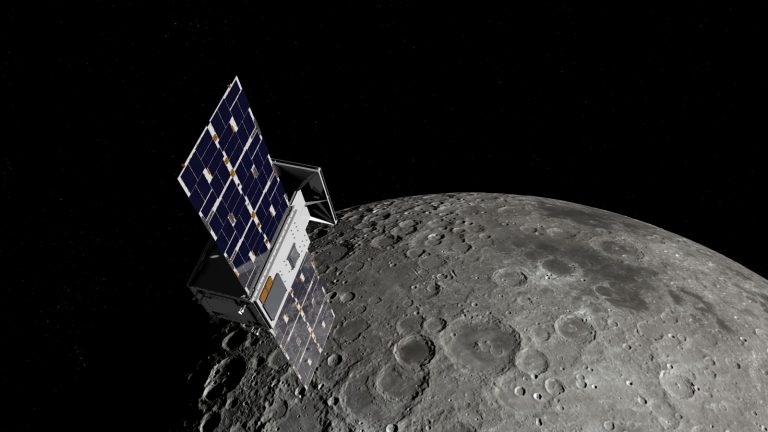
CAPSTONE
Credit: NASA
A soon-to-launch cubesat will be one of the first ever to fly in the unique Near Rectilinear Halo Orbit (NRHO).
Advanced Space owns and operates the Cislunar Autonomous Positioning System Technology Operations and Navigation Experiment (CAPSTONE) mission going to the Moon in the early part of 2022.
CAPSTONE is a pathfinder mission for NASA’s Artemis program using a small spacecraft.
The planned NASA Lunar Gateway station will be in a NRHO around the Moon.

Orion spacecraft pulls up to Gateway.
Credit: NASA
Advanced Space of Westminster, Colorado has entered into a Cooperative Research And Development Agreement (CRADA) with the U.S. Air Force Research Laboratory (AFRL), Space Vehicles Directorate, and the Spacecraft Technology Division to share data collected from cislunar space through the CAPSTONE mission.
Data sharing
The CRADA focus is to share data collected from the CAPSTONE cubesat as it treks between the Earth and Moon. The opportunity to analyze data retrieved from the mission will be beneficial for future mission design and navigation strategies for defense and other customers, according to an Advanced Space statement.

Credit: Advanced Space
Significant amounts of data are anticipated to be collected while the CAPSTONE’S Cislunar Autonomous Positioning System, or CAPS, allows the spacecraft to explore and maneuver the orbit.
The CAPSTONE mission will provide “invaluable insight to fortify our space domain awareness of cislunar space, a domain of increased importance,” said James Frith, AFRL’s program manager for Cislunar Space Domain Awareness.

Credit: University of Würzburg/IFEX
A center has been established that includes the study of Unidentified Aerial Phenomenon, or UAPs.
The Interdisciplinary Research Center for EXtraterrestrial Studies (IFEX) is anchored at Julius-Maximilians-Universität Würzburg (JMU), one of the largest universities in Germany.
IFEX focuses on extraterrestrial research projects in the context of science and technology and their innovative application on Earth and in space.
“We want to promote the research on UAP in an interdisciplinary framework, carry out our own projects and seek cooperation with relevant institutions and authorities, such as the Max Planck Society, the German Aerospace Centre DLR, the Luftfahrt-Bundesamt LBA, or the Deutscher Wetterdienst,” says IFEX chairman Hakan Kayal, professor of space technology at the University of Würzburg.

SkyCAM-5 camera system.
Credit: Hakan Kayal/Universität Würzburg
Camera system
Kayal has a long-standing interest in UAPs. Recently, he installed a new camera system on the Hubland campus in Würzburg to detect unknown celestial phenomena using artificial intelligence methods.
Overall, the IFEX work area includes exploration of space, objects in our solar system, stars, galaxies, and the universe as a whole, search for signs of life, search for extraterrestrial intelligence (SETI), research on Unidentified Aerial Phenomena (UAP) as well as further interdisciplinary cooperation and dissemination of extraterrestrial studies.
The research on Unidentified Aerial Phenomena involves development and operating systems for detection, evaluation and analysis, including the investigation of outstanding cases.
Since January 25, 2022, research on UAP has been one of the center’s official goals, put in motion after the JMU Senate approved a corresponding extension of the IFEX statute.
For more information, go to:

Russia’s Luna-25 Moon lander.
Credit: RSC Energia/Roscosmos
Russia is ready to reactivate its moon exploration agenda, a former Soviet Union enterprise that ended decades ago. The last in the row of pioneering USSR lunar missions was Luna 24 – lobbing back to Earth in 1976 roughly six ounces of near-side collectibles.
The country’s Luna-25 is set to kick-start a sequence of lunar outings that also involves Europe as well as China. A larger plan now being scripted is Russian collaboration with China on building an International Lunar Research Station, intended to be operational by 2035.
For more details, go to my new Space.com story – “Russia aims to rekindle moon program with lunar lander launch this July – Luna 25 will touch down in the moon’s south polar region” – at:
https://www.space.com/russia-rekindle-moon-program-luna-25-launch

Curiosity’s location as of Sol 3381. Distance driven since landing is16.9 miles/27.19 kilometers.
Credit: NASA/JPL-Caltech/Univ. of Arizona
NASA’s Curiosity Mars rover at Gale Crater is now wrapping up Sol 3382 duties.
Catherine O’Connell-Cooper, a planetary geologist at the University of New Brunswick; Fredericton, New Brunswick, Canada, reports the robot is continuing its trek towards the “Greenheugh pediment.”

Curiosity Left B Navigation Camera image taken on Sol 3381, February 9, 2022.
Credit: NASA/JPL-Caltech
“We passed along this area on our detour to The Prow, and our sedimentologists have a long list of imaging wishes, features which caught their eyes on the initial pass through and which we now get the chance to really examine in detail as we skirt along the base of the pediment.

Stitched together from 28 images, this view was captured on April 9, 2020, Sol 2729 after the rover ascended a steep slope, part of a geologic feature called “Greenheugh Pediment.”
The rover’s Mast Camera, or Mastcam, provided the panorama.
Credit: NASA/JPL-Caltech/MSSS
New vantage point
From a new vantage point, the rover’s Mastcam and Chemistry and Camera (ChemCam) are imaging the buttes and hills around it, Mastcam focusing on the “Blackcraig” and “Maringma” buttes, and ChemCam taking long distance imagery of the pediment.

Curiosity Left B Navigation Camera image taken on Sol 3381, February 9, 2022.
Credit: NASA/JPL-Caltech
“We are also adding to our geochemical analyses along here too,” O’Connell-Cooper adds.

Curiosity Left B Navigation Camera image taken on Sol 3381, February 9, 2022.
Credit: NASA/JPL-Caltech
Curiosity’s Alpha Particle X-Ray Spectrometer (APXS) and the Mars Hand Lens Imager (MAHLI) are to analyze the bedrock target “Tantallon Castle” and ChemCam will examine the target “Corpach Wreck.”

Curiosity Left B Navigation Camera image taken on Sol 3381, February 9, 2022.
Credit: NASA/JPL-Caltech
Retraced steps
“Our past couple of drives have been in the order of [164 -197 feet] 50-60 meters as we retraced our steps over known terrain, but as we get closer to the pediment and the steep climb up, our drives will slow down,” O’Connell-Cooper adds.
Recently, an all star, all female, rover planning team planned a drive of nearly 80 feet (24 meters) drive, O’Connell-Cooper reports, “shorter than recent drives, but which will take over an hour as we slowly pick our way forward!”

Credit: SpaceX/Starlink
What goes up…comes down. That’s the case for dozens of just-lofted SpaceX Starlink satellites.
SpaceX issued this statement about the situation:
On Thursday, February 3 at 1:13 p.m. EST, Falcon 9 launched 49 Starlink satellites to low Earth orbit from Launch Complex 39A (LC-39A) at Kennedy Space Center in Florida. Falcon 9’s second stage deployed the satellites into their intended orbit, with a perigee of approximately 210 kilometers above Earth, and each satellite achieved controlled flight.
SpaceX deploys its satellites into these lower orbits so that in the very rare case any satellite does not pass initial system checkouts it will quickly be deorbited by atmospheric drag. While the low deployment altitude requires more capable satellites at a considerable cost to us, it’s the right thing to do to maintain a sustainable space environment.

Starlink satellites.
Credit: SpaceX
Warming atmosphere
Unfortunately, the satellites deployed on Thursday were significantly impacted by a geomagnetic storm on Friday. These storms cause the atmosphere to warm and atmospheric density at our low deployment altitudes to increase. In fact, onboard GPS suggests the escalation speed and severity of the storm caused atmospheric drag to increase up to 50 percent higher than during previous launches. The Starlink team commanded the satellites into a safe-mode where they would fly edge-on (like a sheet of paper) to minimize drag—to effectively “take cover from the storm”—and continued to work closely with the Space Force’s 18th Space Control Squadron and LeoLabs to provide updates on the satellites based on ground radars.
Preliminary analysis show the increased drag at the low altitudes prevented the satellites from leaving safe-mode to begin orbit raising maneuvers, and up to 40 of the satellites will reenter or already have reentered the Earth’s atmosphere. The deorbiting satellites pose zero collision risk with other satellites and by design demise upon atmospheric reentry—meaning no orbital debris is created and no satellite parts hit the ground. This unique situation demonstrates the great lengths the Starlink team has gone to ensure the system is on the leading edge of on-orbit debris mitigation.

Curiosity’s location on Sol 3379. Distance driven at that time is 16.86 miles/27.14 kilometers.
Credit: NASA/JPL-Caltech/Univ. of Arizona
NASA’s Curiosity Mars rover at Gale Crater is now performing Sol 3381 duties.
Reports Michelle Minitti, a planetary geologist at Framework in Silver Spring, Maryland: “After our adventures further uphill, Curiosity is backing down hill to get to the start of the path she will take up to the “Greenheugh Pediment.” We are still surrounded by amazing stratigraphy and have the benefit of having been through here before.”

Curiosity Mast Camera Left image taken on Sol 3379, February 7, 2022.
Credit: NASA/JPL-Caltech/MSSS

Curiosity Mast Camera Left image taken on Sol 3379, February 7, 2022.
Credit: NASA/JPL-Caltech/MSSS

Curiosity Mast Camera Left image taken on Sol 3379, February 7, 2022.
Credit: NASA/JPL-Caltech/MSSS
Mars researchers are eager to fill in missing pieces of terrain, and follow up interesting observations.
Curiosity’s Mastcam and Chemistry and Camera (ChemCam) imaging fills both needs.

Curiosity Mast Camera Left image taken on Sol 3379, February 7, 2022.
Credit: NASA/JPL-Caltech/MSSS

Curiosity Mast Camera Left image taken on Sol 3379, February 7, 2022.
Credit: NASA/JPL-Caltech/MSSS
Maringma butte
“Mastcam will acquire stereo mosaics across the base of “Maringma” butte, and across another butte east of our current location,” Minitti adds. “Both mosaics are aimed at imaging sedimentary structures in these vertical exposures.”
In complementary fashion, ChemCam will cover the eastern butte layering with a 10×1 Remote Micro-Imager (RMI)
mosaic. “Mastcam will also image a stretch of tilted bedrock layers, dubbed “Plomo,” that stretch uphill away from the rover,” Minitti explains.

Curiosity Front Hazard Avoidance Camera Right B image taken on Sol 3379, February 7, 2022.
Credit: NASA/JPL-Caltech
Closer to the rover, ChemCam, the Mars Hand Lens Imager (MAHLI)
And Alpha Particle X-Ray Spectrometer (APXS) were also busy at this stop.
Spread the wealth
Typically on a “touch and go” sol, scientists look at a given target with APXS and MAHLI, and then shoot another target with ChemCam to, in effect, Minitti says, “spread the wealth of data we acquire across a workspace.”
In part, because scientists have ChemCam, APXS, and MAHLI data from this area from their first pass, researchers had the opportunity to focus all three instruments on “El Dorado.”

Curiosity Left B Navigation Camera image acquired on Sol 3379, February 7, 2022.
Credit: NASA/JPL-Caltech
“We hope between APXS, MAHLI, and ChemCam, one instrument strikes gold at this prominent bedrock layer,” Minitti reports.
Down hill
After the robot’s drive down hill, the Dynamic Albedo of Neutrons (DAN) will acquire both active and passive measurements, the Mars Descent Imager (MARDI) will acquire an image of the terrain under the left front wheel, ChemCam will autonomously shoot a target in the rover vicinity, and Mastcam will acquire a sky survey, Minitti explains.

Front Hazard Avoidance Camera Left B image taken on Sol 3378, February 6, 2022.
Credit: NASA/JPL-Caltech
Curiosity’s Rover Environmental Monitoring Station (REMS) and
Radiation Assessment Detector (RAD) will continually monitor the environment as the robot starts to move out of winter in Gale Crater, Minitti concludes.

Credit: Dewesoft
The research team at Dewesoft analyzed data as to which governments, organizations, and companies own the most satellites in our orbit.
How many satellites are in space?
As noted by the Dewesoft team, there are thousands of satellites in the sky above us at this moment, orbiting Earth.
Satellites have many uses for the government, military, and even civilians. They provide us the ability to have things like Internet access, television, GPS, and much more.
They also have scientific purposes such as Earth and space observation and provide the means for high-level technology development.
SpaceX – in the lead
More than half of the 4,550 satellites orbiting Earth are used for communications purposes, and that number will continue to rise as tech billionaires look to bring high-speed Internet access to every corner of our planet.
Dewesoft analyzed data collected by the UCS Satellite Database, ESRI, and the Space Foundation to create a list of the 50 owners of the most satellites orbiting Earth.
Credit: SpaceX/Starlink
As of Sept. 1, 2021, SpaceX is leading the race, with their Starlink satellite program planning to send more than a thousand new satellites into orbit every year. SpaceX owns an incredible 36% of the satellites in orbit around Earth.
Dewesoft develops and manufactures versatile, easy-to-use data acquisition systems – tools for test and measurement engineers. They are headquartered in Solovenia in southern Central Europe.
For detailed information from Dewesoft, go to:
https://dewesoft.com/daq/every-satellite-orbiting-earth-and-who-owns-them

