Archive for the ‘Space News’ Category
 Author:
  February 27th, 2022
Starship and Super Heavy Stack.
Credit: SpaceX
A petition from the American Bird Conservancy is telling SpaceX and the Federal Aviation Administration (FAA) to prioritize birds and wildlife habitat at SpaceX’s Boca Chica operations facility.
That sprawling facility is home base for development of the SpaceX Starship.
“SpaceX is putting vulnerable birds and other wildlife at risk in the coastal region of Boca Chica, Texas. In its rush to launch the massive Starship rocket, the aerospace manufacturer has ignored its destructive impacts on sensitive surrounding habitat,” explains Michael J. Parr, President of the American Bird Conservancy in The Plains, Virginia.

Banner photos: SpaceX Debris by Kendal Keyes; Piping Plover by Ray Hennessy/Shutterstock via American Bird Conservancy
Parr adds that the area is inhabited by several imperiled species and used by hundreds of thousands of birds throughout the year, including the federally Threatened Piping Plover and Red Knot.
Ongoing construction, along with fires, and rocket debris falling from the sky have already impacted important habitats, Parr says, putting at-risk bird species in peril.
Little oversight
“Despite the area’s ecological importance,” Parr continues, “SpaceX has expanded operations with little oversight from the FAA.”
Rather than circumventing the appropriate environmental review process, Parr says that SpaceX should work with the FAA to conduct a full-scale environmental impact statement, as required by the National Environmental Policy Act.

Starship test flight.
Credit: SpaceX/Inside Outer Space screengrab
“The FAA is currently reviewing an environmental assessment of SpaceX’s Boca Chica operations facility. The draft assessment failed to provide a full picture of the facility’s environmental impacts, and it’s critical that we push for a comprehensive study,” Parr suggests. “Demand a full-scale, in-depth analysis of SpaceX’s environmental impacts before the FAA concludes its environmental assessment review.”
The project review has already been delayed by a deluge of comments from the public over 19,000 responses submitted, Parr points out, “showing the power of raising our voices.”

Habitat of the threatened Piping Plover in Boca Chica, littered with debris from SpaceX operations.
Photo credit: Coastal Bend Bays & Estuaries Program
Action alert
In Parr’s “action alert,” he writes that SpaceX continues pushing boundaries to meet an ambitious development plan that requires birds and the environment to pay too high a price. “The company has increased its scope well beyond what the FAA authorized in 2014, including testing a new 400-foot ship, much larger than originally specified, as well as the development of a natural gas facility to extract and deliver fuel to the site.”

Credit: SpaceX
While the American Bird Conservancy supports space exploration, Parr adds that it should not come at a high cost to the environment and wildlife here on Earth. “Too much sensitive public land has already been impacted by the SpaceX facility — and much more is at risk if we don’t raise our voices now.”
It is not too late to hold SpaceX accountable, Parr concludes.
The petition can be found here at:
https://act.abcbirds.org/a/take-action-petition-spacex?source=22_MoJo_SpaceX&ms=cpm
For more information on the American Bird Conservancy, go to:
 Posted in

Credit: China Media Group(CMG)/China Central Television (CCTV)/China Aerospace Science and Technology Corporation (CASC)
China launched a Long March-8 rocket on Sunday from the Wenchang Spacecraft Launch Site in the southern Hainan Province.
Tagged as a new generation carrier rocket, the Long March-8 Y2 placed 22 satellites into Earth orbit, setting a domestic record for the most spacecraft launched by a single booster.
A two-stage medium-lift carrier rocket, the Long March-8 is 165 feet (50.3 meters) long, with a takeoff weight of 356 tons. It uses liquid propellants with a 5-ton capacity for sun-synchronous orbit at an altitude of 435 miles (700 kilometers).

Credit: CCTV/Inside Outer Space screengrab
Designed for both land and sea takeoff, the rocket made its maiden flight on Dec. 22, 2020 from the Wenchang coastal launch site.
Long March-8 Y2 is the second Long March-8 launch vehicle and the first to be launched without boosters.

Credit: Twitter image via Seger Yu
According to sources, the 22 satellites “will be mainly used for commercial remote sensing services, marine environment monitoring, forest fire prevention and disaster mitigation.”
For video of the launch, go to:

A sweeping look at futuristic space technology concepts has been advanced by the NASA Innovative Advanced Concepts (NIAC) program.
Whether a Venus atmosphere and cloud particle sample return to Earth, a “digital thread” idea to make a custom-fitted Mars suit, or quick-action kinetic penetrators that pulverize and disassemble an Earth-threatening asteroid or small comet – these are a few of the novel ideas supported by a new round of grants awarded by NIAC.
These studies will assess technologies that could support future aeronautics and space missions. The new slate of awards will provide a total of $5.1 million to 17 researchers from nine states.

Credit: Bonnie Dunbar
Spacesuits for Mars
Among the awardees is former shuttle astronaut, Bonnie Dunbar, now at Texas A&M. Her proposal investigates the feasibility of manufacturing “custom” cost-effective high performance exploration spacesuits for Mars and beyond utilizing the Digital Thread (DT), which integrates digital analytic components for manufacturing in development of the final spacesuit.
“A return to custom EVA suits seems warranted,” Dunbar’s proposal explains. “But how to do this in a rapid cost effective manner? Is it possible to utilize current scanning technologies, human factor studies, physiological data, additive manufacturing, robotics, and modern digital design and analysis tools?”

Credit: John Mather
Powerful planet finder
John Mather of NASA’s Goddard Space Flight Center envisions the first hybrid observatory using a 100-meter starshade that works in tandem with a telescope on the Earth. The result: the most powerful planet finder capability yet designed.
“No other proposed equipment can match the angular resolution (image sharpness), sensitivity (ability to see faint objects in a given time), or contrast (ability to see faint planets near bright stars),” suggests Mather.

Credit: Sara Seager
Search for Venus life
Sara Seager of MIT has proposed a Venus sample return mission focused on that planet’s atmosphere, snagging both the gas component and cloud particles.
“The mission goal is to bring back the sample for Earth-laboratory-based study to assess the habitability of the cloud-region of the atmosphere and search for signs of life or even life itself in a much more robust way than possible in situ,” Seager’s proposal points out.

Credit: Elena D’Onghia
Protective space habitat
Another creative proposal is the CREW HaT, a new concept for a Halbach Torus (HaT) by Elena D’Onghia of the University of Wisconsin, Madison.
The idea is protect humans from the damaging effects of cosmic rays and energetic solar radiation. “This configuration produces an enhanced external magnetic field that diverts cosmic radiation particles, complemented by a suppressed magnetic field in the astronaut’s habitat.”
To access the 2022 Phase I and Phase II NIAC selections, go to:
https://www.nasa.gov/press-release/nasa-selects-futuristic-space-technology-concepts-for-early-study
For a list of the 2022 awardees, go to:
https://www.nasa.gov/directorates/spacetech/niac/2022/
Also, go to this informative video detailing BREEZE, the Bio-inspired Ray for Extreme Environments and Zonal Exploration.
Go to:

Curiosity Right B Navigation Camera photo acquired on Sol 3396, February 24, 2022.
Credit: NASA/JPL-Caltech
NASA’s Curiosity Mars rover at Gale Crater is now performing Sol 3397 duties.
Reports Mariah Baker, a planetary geologist in the Center for Earth & Planetary Studies at the Smithsonian National Air & Space Museum:
“If all goes according to plan, the rover’s drive on sol 3397 will position us at the edge of the rocks that cap Greenheugh Pediment. This drive was pushed back from sol 3395 in order to collect even more data on the sedimentary rocks in our current workspace before we leave this rock formation and enter into a new one.”
Three full hours of contact and remote science activities were planned prior to the drive.

Curiosity Mast Camera Right image taken on Sol 3395, February 23, 2022.
Credit: NASA/JPL-Caltech/MSSS
Bedrock target “Scousburgh” will be analyzed with Alpha Particle X-Ray Spectrometer (APXS), the Mars Hand Lens Imager (MAHLI), Chemistry and Camera (ChemCam) Laser Induced Breakdown Spectroscopy (LIBS), and Mastcam multispectral after being brushed with the Dust Removal Tool (DRT).
APXS, MAHLI, and ChemCam LIBS data will also be acquired on a concretion feature called “Blackthorn Salt.”

Curiosity Mars Hand Lens Imager photo produced on Sol 3396, February 24, 2022.
Credit: NASA/JPL-Caltech/MSSS
Float rock
ChemCam passive observations will be collected on a float rock called “Carn Chuinneag,” as well as on the bedrock target “Galdenoch” that was DRT’ed on sol 3395. “The latter target will also be imaged with a Mastcam multispectral to collect additional data on this patch of cleaned bedrock,” Baker adds.
Four image mosaics will provide a closer look at far-field rock targets: A Mastcam mosaic will be acquired covering rock outcrop “Auchinleck Tip,” and another will extend coverage over the Stimson formation contact.
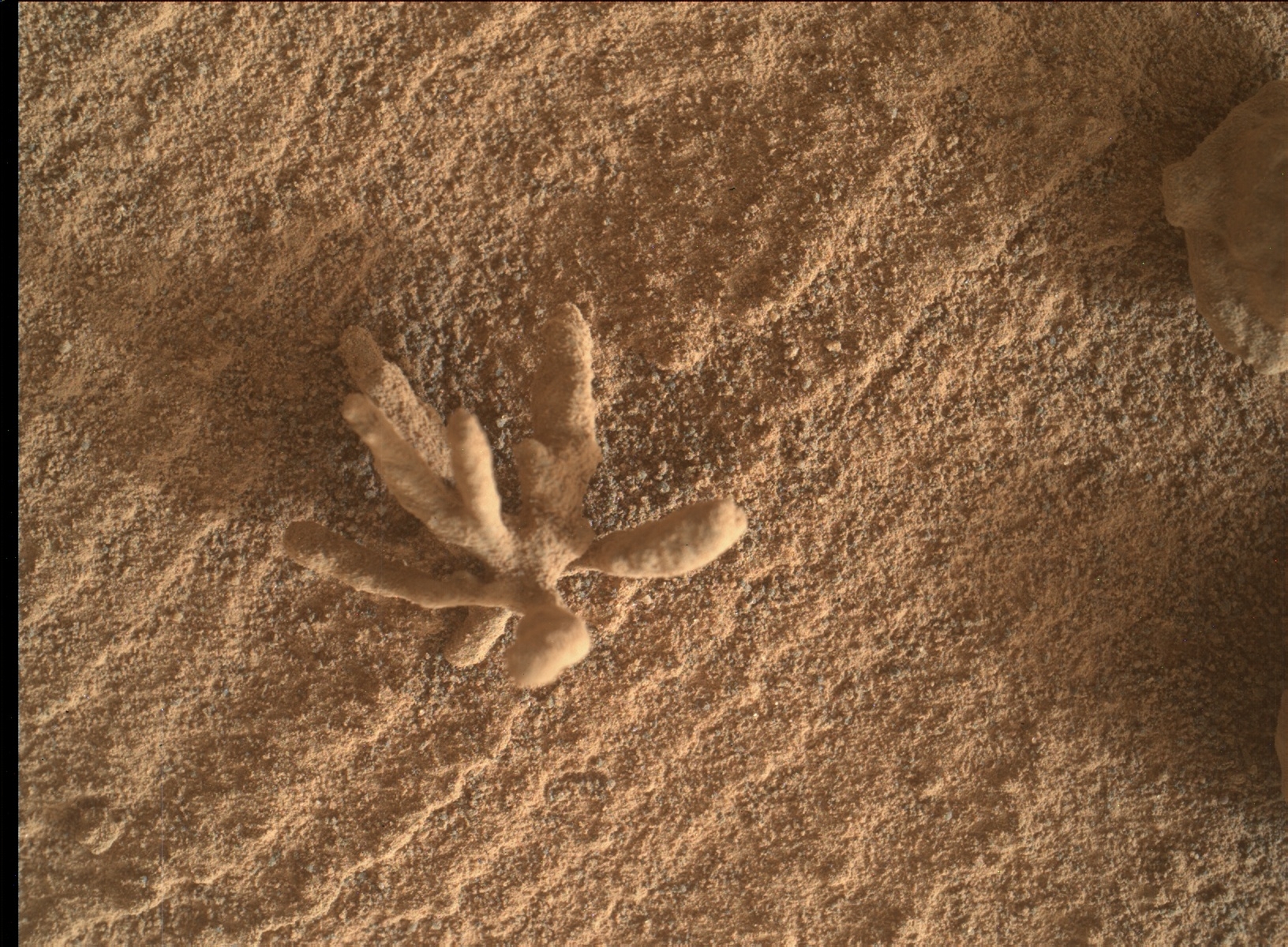
What’s this? Curiosity Mars Hand Lens Imager photo produced on Sol 3396, February 24, 2022.
Credit: NASA/JPL-Caltech/MSSS
An interesting observation by Curiosity at Gale Crater is demanding some attention, as seen in new imagery:

Mars Hand Lens Imager (MAHLI) photo produced on Sol 3397, February 25, 2022.
Credit: NASA/JPL-Caltech/MSSS
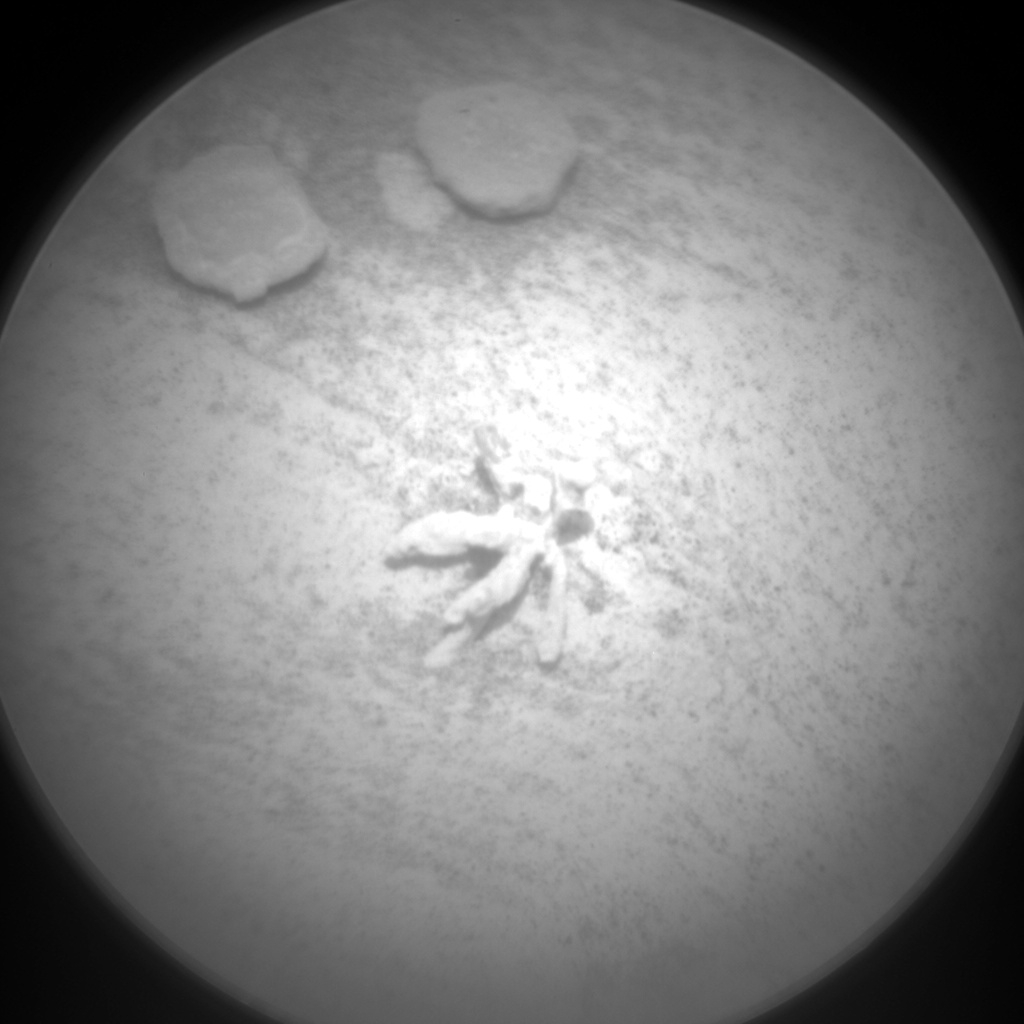
Curiosity Chemistry & Camera Remote Micro-Imager (RMI) photo taken on Sol 3397, February 25, 2022.
Credit: NASA/JPL-Caltech/LANL
The distant Gediz-Vallis Ridge will also be imaged with Mastcam and ChemCam Remote Micro-Imager (RMI). Two additional Mastcam images of a sand deposit in front of the rover called “The Souter” will be used to search for wind-driven sand motion during Curiosity’s stop at this location, Baker explains.
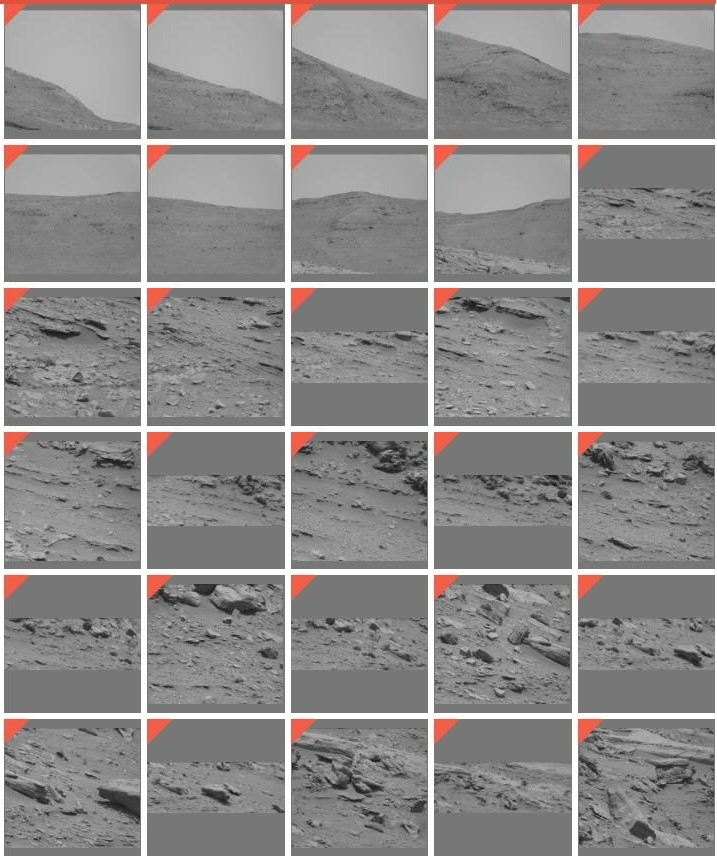
Curiosity Mast Camera Right and Left imagery taken on Sol 3395 February 23, 2022
Credit: NASA/JPL-Caltech/MSSS
Rim shots
Lastly, a set of environmental monitoring observations were scheduled before the rover’s drive, including a Navcam line of site image, Navcam dust devil movie, Navcam suprahorizon movie, and Mastcam crater rim observation.
“A Mastcam image to assess dust in the atmosphere will also be acquired on sol 3397 after the rover’s drive towards the pediment,” Baker concludes. “This plan will likely be our last opportunity to study the sedimentary rocks that built Mt. Sharp before we transition into a new geologic formation that caps the pediment, so the team made the most out of it!”

Curiosity Right B Navigation Camera image acquired on Sol 3397, February 25, 2022.
Credit: NASA/JPL-Caltech

Curiosity Right B Navigation Camera image acquired on Sol 3397, February 25, 2022.
Credit: NASA/JPL-Caltech

Credit: ISRO
The upcoming Moon rush by government and private groups offers the prospect of “lunar traffic jams.”
However, at this moment in time, nobody is keeping a tracking eye on how many artificial objects are already up there, or where they are at any given moment. Without a way to keep track of traffic, the orbital space surrounding the Moon may grow crowded.
That’s the assessment of University of Arizona researchers. They have been awarded $7.5 million in funding from the Air Force Research Laboratory’s Space Vehicles Directorate to get a handle on the issue.

Roberto Furfaro (left) of the Department of Systems and Industrial Engineering and Vishnu Reddy of the Department of Planetary Sciences at the Biosphere 2 Space Domain Awareness Observatory.
Benjamin Seibert, Space Control Mission Area lead for the Air Force Research Laboratory, or AFRL, explains that capabilities to detect, track and catalog objects from the Earth to the Moon and beyond enable “freedom of navigation” critical to civil and commercial use of space.
Detect, characterize and track
Principal investigators Roberto Furfaro, professor of systems and industrial engineering, and Vishnu Reddy, an associate professor in the College of Science’s Lunar and Planetary Laboratory, are developing ways to detect, characterize and track objects in cislunar space, or the space between Earth and the Moon.
Furfaro and Reddy estimate there are dozens of payloads orbiting the Moon at present. But given a salvo of lunar probes in the offing, congestion is an increasing concern.

“Re-booting” the Moon involves multiple nations. Credit: CNSA
According to a university statement, the UArizona team will create cyber-infrastructure to characterize and identify the objects, paving the way for a well-organized path to the Moon. While they are not trying to increase the efficiency of “roads,” they are studying the early sources of traffic to better inform decision making before the roads even exist.
Suite of equipment
The Lunar and Planetary Laboratory use dedicated sensors at the University of Arizona Biosphere 2 research facility in Oracle, Arizona to characterize objects in space. Their suite of equipment includes several telescopes dedicated to space domain awareness.

University of Arizona Biosphere 2 research facility in Oracle, Arizona.
Credit: University of Arizona
Tracking human-made objects in cislunar space, rather than natural objects such as asteroids, comes with its own challenges. Objects in cislunar space are harder to see, not only because they’re farther away than objects orbiting Earth, but because they can be lost in the Moon’s glare, according to the UArizona statement.
As the work moves into high-gear, Reddy is concentrating on detection and tracking. Furfaro will create methods to analyze and catalog the data.
The team will also partner with future missions sending objects into cislunar orbit, so new objects can be tracked and cataloged from the start of their journeys.

The search is on to find innovative engineering approaches that will integrate power transmission and energy storage to accommodate long-duration robotic and human missions to the Moon.
NASA has launched the Watts on the Moon Phase 2 Challenge today and will award up to $5 million across the two phases.
HeroX, a crowdsourcing platform, is working with NASA on the challenge via the space agency’s Centennial Challenges Program.

Long-term lunar habitation
This challenge is focused on re-planting boots on the Moon under NASA’s Artemis program. The intent of Artemis is to establish a long-term human presence at the Moon and to do so there’s to integrate power transmission and energy storage to support astronauts, hardware, and systems in the extremely challenging thermal and lighting conditions on the lunar surface.
Phase 1 of Watts launched in September 2020 and focused of energy management, distribution, and storage solutions. In May 2021, seven winners were awarded a total of $500,000 in prize purses.
Because Phase 1 showed that there are a number of promising approaches to address this need, Phase 2 will be launched to allow these approaches and others an opportunity to vie for part of the $4.5M prize purse to develop and demonstrate their performance in simulated lunar conditions.
Phase 2 is a three-level competition that will award up to 17 prizes across the challenge.

Lunar south pole – future Moon base location?
Credit: NASA
Wired and wireless transmission
NASA has significant interest in both wired and wireless transmission, and the Challenge seeks to incentivize and demonstrate both types of solutions: Energy storage that can (1) power mission operation loads when intermittent power generation is not available and (2) survive and operate in extreme cold environments.
“Challenges like Watts on the Moon give us the chance to utilize the creativity of industry, academia, and the public to power our return to the Moon,” said Jim Reuter, Associate Administrator for NASA’s Space Technology Mission Directorate at NASA Headquarters in Washington.
Reuter adds in a HeroX statement that the solutions in this challenge may also have important applications here on Earth and help advance similar technologies for terrestrial application and commercialization.
Eligibility to compete and win prize(s)
Individuals must be U.S. citizens or permanent residents of the United States and be 18 years of age or older. Organizations must be an entity incorporated in and maintaining a primary place of business in the United States (some restrictions apply).
To accept the challenge and access additional information, go to:

The lunar far side as imaged by NASA’s Lunar Reconnaissance Orbiter using its LROC Wide Angle Camera.
Credit: NASA/Goddard/Arizona State University
There’s an on-going saga regarding what object will smash into the Moon’s far side next month.
First thought to be a SpaceX upper stage, it was then tagged as a leftover from China’s Chang’e 5-T1 lunar mission in 2014.
But China has indicated it’s not their hardware, a flat fact coming from Foreign Ministry Spokesperson Wang Wenbin’s in a regular press briefing on February 21st.
However, sticking to his guns about identifying the object as related to the Chang’e 5-T1 mission is Bill Gray of Project Pluto.
“There really is no good reason at this point to think the object is anything other than the Chang’e 5-T1 booster. Anybody claiming otherwise has a pretty large hill of evidence to overcome,” Gray told Inside Outer Space.
Small mystery
“We do have a small mystery, in that the [U.S.] 18th Space Control Squadron lists this booster (the same one I’m saying will hit the Moon) as having instead hit the Earth’s atmosphere in October 2015, almost a year after launch,” Gray explains. “But the only trajectory data they provide are for shortly after launch. If that’s all they had to work with, then the re-entry date is a prediction a year ahead of time and is not particularly meaningful.”

18th Space Control Squadron logo
Credit: 18th Space Control Squadron
It’s sort of like trying to predict weather a year ahead of time, Gray adds.
Re-entry computation
“But as best I can tell, this particular error didn’t involve tracking data,” he tells Inside Outer Space. “I think it just involved confusion about two similarly named missions,” China’s Chang’e 5-T1 mission in 2014 and the country’s Chang’e-5 Moon sample effort in December 2020.
“Basically, I don’t think 18SPCS tracked the object much after launch,” Gray says. “If they had, they probably would have posted updated trajectory data. If the re-entry computation is based on just that initial tracking data, with no further observations taken into account, it’s not going to be any good. You can’t run an orbit for an object of this sort out a year and get anything meaningful.”
Also, during much of that year, the Chang’e-5T1 booster would have been well beyond the range of radar. “So I very much doubt 18SPCS were actually tracking it. But asteroid observers did keep track of it several times over that year, and in the years afterward, such that I was able to say it would hit the Moon in March,” Gray says.

Off the hook? Artist’s impression of DSCOVR on the way to L1 atop its Falcon 9 upper stage in 2015.
Credit: SpaceX
Wanted: better tracking
All of this confusion raises a flag in Gray’s view.
“Well, we should indeed do a better job of tracking these objects. First step would be to release ‘last known positions and velocities’ for objects going into high Earth orbits or solar or lunar orbits. That would have avoided the initial identification issue, where I thought this was the [SpaceX] DSCOVR upper stage.”
Bottom line for Gray is the need for better tracking of high-orbiting objects.
NASA looksee

NASA Lunar Reconnaissance Orbiter (LRO).
Credit: NASA’s Goddard Space Flight Center Conceptual Image Lab
Meanwhile, NASA’s Lunar Reconnaissance Orbiter will monitor the Moon’s exosphere for any changes due to the March 4th impact, and looking for the crater in the months to come.
According to a NASA statement provided to Inside Outer Space:
“NASA’s Lunar Reconnaissance Orbiter will not be in a position to observe the impact as it happens. However, the mission team is assessing if observations can be made to any changes to the lunar environment associated with the impact and later identify the crater formed by the impact. This unique event presents an exciting research opportunity. Following the impact, the mission can use its cameras to identify the impact site, comparing older images to images taken after the impact. The search for the impact crater will be challenging and might take weeks to months.”
According to one researcher, “a pizza is still a pizza, even if you don’t know where it came from.”
For more information on this upcoming, smashing event, go to:
- March Madness! Upper Stage Hitting the Moon: Will the Real Owner Please Stand Up?
https://www.leonarddavid.com/upper-stage-hitting-the-moon-will-the-real-owner-please-stand-up/
- The Case of the Wayward Booster Headed for the Moon
https://www.leonarddavid.com/the-case-of-the-wayward-booster-headed-for-the-moon/
- SpaceX Upper Stage: Hitting the Moon Update
https://www.leonarddavid.com/spacex-upper-stage-hitting-the-moon-update/
The lunar far side as imaged by NASA’s Lunar Reconnaissance Orbiter using its LROC Wide Angle Camera.
Credit: NASA/Goddard/Arizona State University
That errant upper stage set to impact the Moon’s far side needs a name!
First thought to be a SpaceX upper stage, then tagged as a left over from China’s Chang’e 5-T1 lunar mission, China appears to have indicated it’s not their hardware.
Off the hook? Artist’s impression of DSCOVR on the way to L1 atop its Falcon 9 upper stage in 2015.
Credit: SpaceX
From Foreign Ministry Spokesperson Wang Wenbin’s Regular Press Conference on February 21, 2022
Associated Press question:
On March 4th, a rocket booster will crash onto the far side of the moon. An analysis led by NASA indicates the large object is likely from a lunar mission launched from China in 2014. Could you confirm and provide any more details?
Wang Wenbin: “The Chinese side has noted experts’ analysis and media reports on the matter. According to China’s monitoring, the upper stage of the Chang’e-5 mission has fallen through the Earth’s atmosphere in a safe manner and burnt up completely. China’s aerospace endeavors are always in keeping with international law. We are committed to earnestly safeguarding the long-term sustainability of outer space activities and are ready to have extensive exchanges and cooperation with all sides.”
On the other hand, Wang’s detailing the “upper stage of the Chang’e-5 mission” is not the same as the Chang’e 5-T1 lunar mission upper stage – so that needs clarification.

Off the hook? China upper stage of CZ-3C GJ-II Y12 carrier rocket in 2014.
Via Seger Yu
However, SpaceNews reporter, Andrew Jones, notes that space tracking data from the Space Force’s 18th Space Control Squadron suggests that 2014-065B—the rocket stage in question—did fall into the Earth’s atmosphere in October 2015, a year after launch – and that bolsters China’s claim.
Despite uncertainty about who owns the hardware, it will still slam into the Moon on March 4 at 12:25 UTC, within a few seconds of the predicted time.
Go to the SpaceNews Andrew Jones story — “China claims rocket stage destined for lunar impact is not from its 2014 Moon mission” — at:
For earlier information about this Moon impact object, go to:
https://www.leonarddavid.com/spacex-upper-stage-hitting-the-moon-update/
https://www.leonarddavid.com/the-case-of-the-wayward-booster-headed-for-the-moon/

Escaping Gravity: My Quest to Transform NASA and Launch a New Space Age by Lori Garver; Diversion Books (2022); 304 pages; Hardcover: $28.99
Wow!
This must-read book is divided into 3 parts: “Gravity,” “Force,” and “Motion.” More to the point, this behind-the-scenes account mixes that trio into a powerful, explosive concoction that blows the lid off the labyrinth of aerospace companies, lobbyists, astronauts, trade associations, self-interested Congressional delegations, and, of course, NASA itself.
Lori Garver was the principal advisor on aerospace issues to three presidential candidates and led the NASA transition team for President Obama. She served as the Deputy Administrator of NASA from 2009 to 2013. She is a highly-regarded champion of the new era of commercial partnerships, documenting what she terms as “the epic battle” that pitted traditional space loyalists against a new generation of space advocates, indeed, “space pirates” as she calls them, who argued that NASA had been hijacked, needed rescuing, and challenged the status quo.
“I’m proud of the accomplishments I’ve made in my career, and this book is dedicated to one of the most meaningful – driving reforms at NASA that are leading to more valuable and sustainable space activities,” the author explains. “Disrupting a paradigm as ingrained as the space industrial complex means risking one’s career and financial future to drive change.”
There’s a no-holds-barred, kick-ass and taking names feel to the book.
Garver spells out those that characterized her as a “Bond-like villain” and that she was the biggest disaster in NASA history for science. She was labeled by some as a harebrained political appointee with a scarcity of actual space experience. Even worse!
Government service, she responds, requires integrity and “many of the behaviors I saw should not have been tolerated.” Unveiled and underscored are instances of illicit and unethical behavior of a few senior leaders at NASA.
Garver drove policies and funding that enabled commercial competition just as the capabilities and resources of the private sector began to mature. Spotlighted in the book, the reader will find insights about Elon Musk’s SpaceX, Jeff Bezos’ Blue Origin, Richard Branson’s Virgin Galactic, and countless other commercial space efforts – some of which have long-been forgotten, but shouldn’t be.
As author Walter Isaacson notes in his foreword to the volume: “Transformative change in government is often sought, but rarely achieved. In this revealing and personal book, Garver tells the fascinating story of how she helped a band of dreamers, rogue bureaucrats, and billionaires usher in a new space age.”
I definitely think the reader will benefit – and appreciate to a greater degree — the U.S. space industry at a transformational period of time…and the need to keep an eye on those space pirates.
For more information about this book, go to:
https://diversionbooks.com/books/escaping-gravity/
Also, go to:
https://www.amazon.com/Escaping-Gravity-Quest-Transform-Launch/dp/1635767709

Mars Perseverance Sol 353: Left Mastcam-Z Camera. This image was acquired on Feb. 16, 2022 (Sol 353).
Credit: NASA/JPL-Caltech/ASU
This image I posted of hardware on the surface of Mars generated quite a number of comments:
A few folks got close, or provided a partial ID…others were far afield!
Some of my favorites:
“I hope it wasn’t something mission critical.”
“Looks like a camera lens or a Starbucks cup.”
“Looks like a part fell off one of the vehicles we’ve sent there.”
“Space debris is really getting out of hand.”
“Empty can of Centauri Lite.”
“Proof that robots are just as messy as teenagers.”
“Flashlight or beer bottle.”
“The fine for littering on Mars is very, very steep. Who’s ever it is had best come pick it up.”
“Lightsaber hilt.”

However, a tip of the space helmet visor for a more complete description goes to Philip J. Stooke, Professor Emeritus and Adjunct Research Professor, Department of Geography, and Institute for Earth and Space Exploration, University of Western Ontario.
Stooke reports:
“It is the Flight Abrading Bit which was discarded on sol 148. During flight and landing it occupied the drill bit slot to keep it from being contaminated. It was discarded shortly before the first abrading and sampling operations.”

