Archive for the ‘Space News’ Category
 Author:
  April 11th, 2022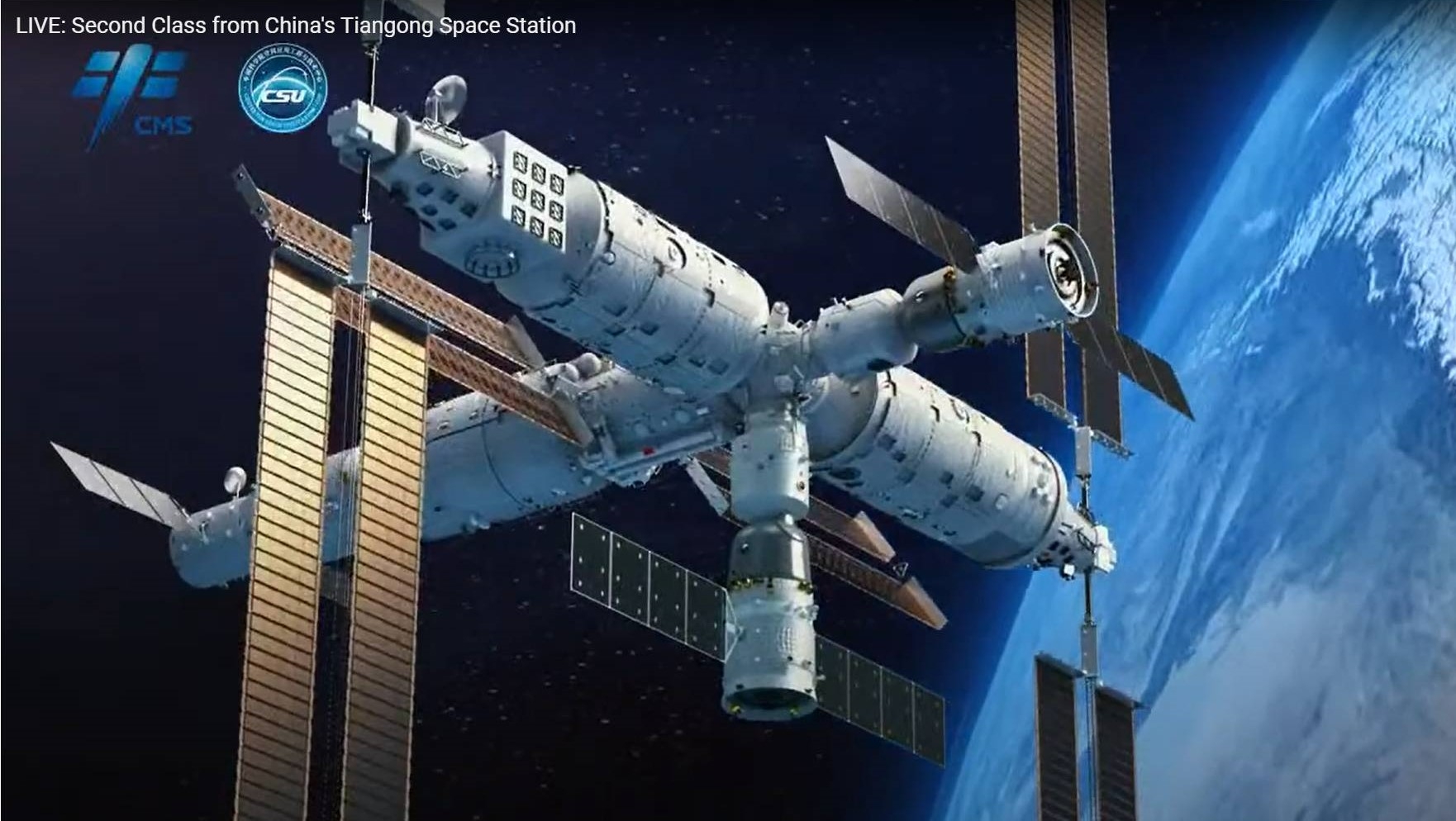
CCTV Video News Agency/Inside Outer Space screengrab
The next step in China’s building of its space station arrived Monday at the launch site in the southern island province of Hainan.
China’s Long March-7 Y5 rocket will loft the automated Tianzhou-4 cargo craft to the country’s orbiting facility. The rocket, alongside the Tianzhou-4 cargo craft, is now at the Wenchang Spacecraft Launch Site, where it will be assembled and tested, announced the China Manned Space Agency (CMSA).
Facilities at the launch site are in good condition, added CMSA, and preparations for all systems involved in the mission are proceeding smoothly.
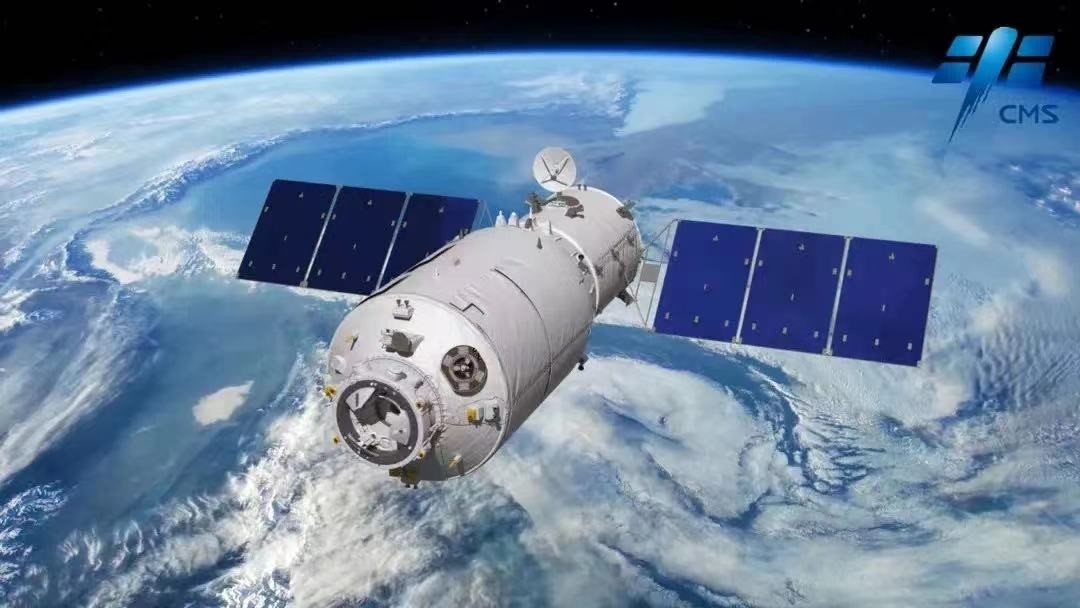
Artistic image of China’s Tianzhou-2 cargo spacecraft.
Credit: CMS/China Academy of Space Technology
Shenzhou-14
According to China Central Television (CCTV), the Tianzhou-4 cargo vessel is set to deliver supplies for the upcoming Shenzhou-14 piloted mission that will send another three Chinese astronauts to the space station following the Shenzhou-13 crew’s return to Earth in mid-April.
China’s Tianzhou-2 cargo spacecraft was deorbited in a controlled manner, re-entering the Earth’s atmosphere on March 31. The Tianzhou-2 was the first cargo spacecraft sent to the station, loaded with nearly 7 tons of supplies.

Shenzhou-13 crew members.
Credit: CNS/Inside Outer Space screengrab
China’s currently orbiting Shenzhou-13 crew — Zhai Zhigang, Wang Yaping and Ye Guangfu — arrived in the core module of the in-construction Tiangong station on October 16, 2021 embarking on their six-month journey – the longest-ever duration in the country’s human spaceflight program.
Upcoming launches
The Tianzhou-4 supply ship is one of six launches that will be made this year to wrap up piecing together the Chinese space station:
- Shenzhou-14 and the Shenzhou-15 piloted missions
- Tianzhou 4 and 5 robotic cargo spaceships for refueling and resupply operations
- Two large space labs to dock with the station: Wentian, or Quest for the Heavens, and Mengtian, or Dreaming of the Heavens
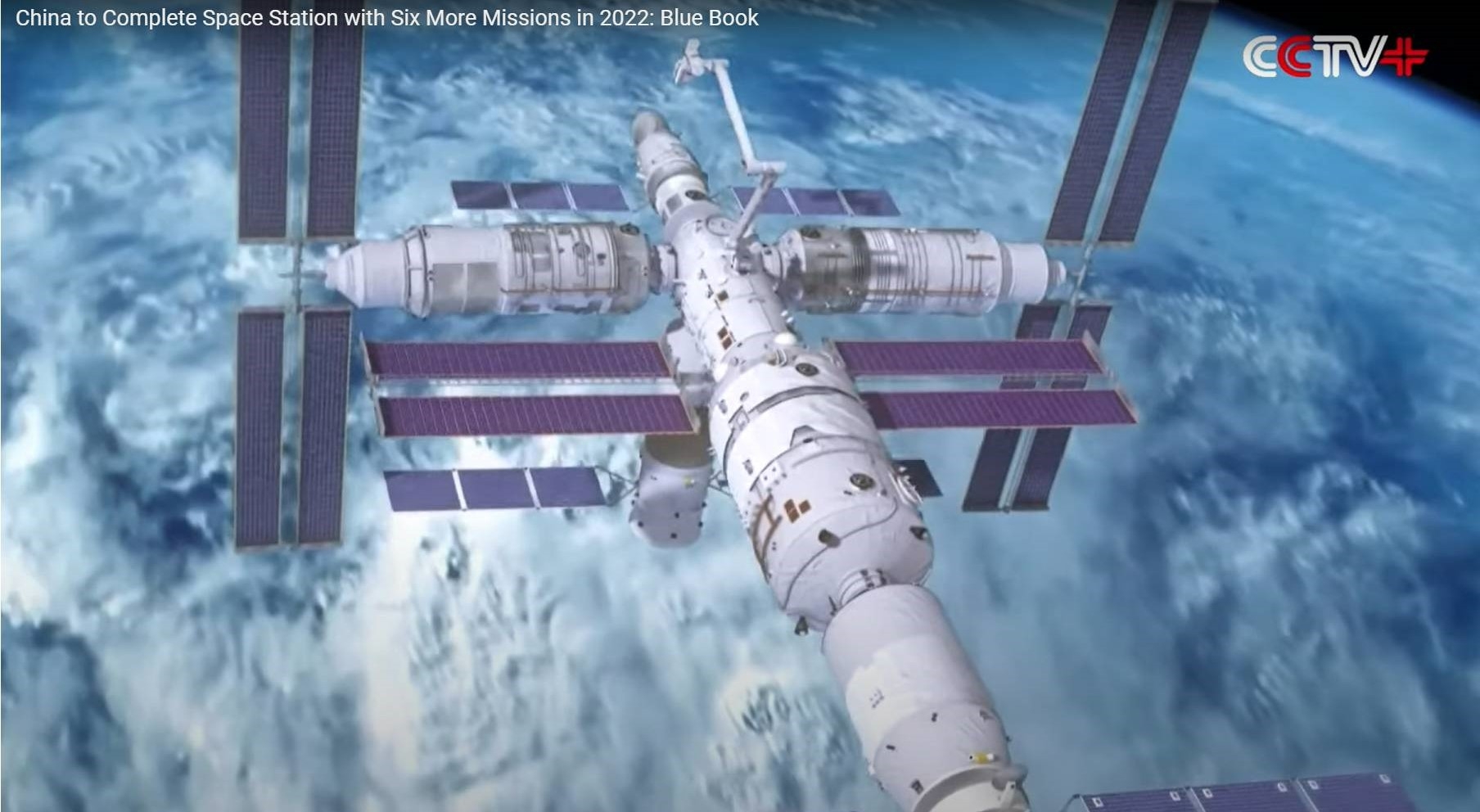
China’s space station to be completed by end of 2022.
Credit: CCTV/Inside Outer Space screengrab
Upon its completion at the end of this year, Tiangong will consist of three main components: a core module attached to two space labs. The facility will have a combined weight of nearly 70 metric tons.
The Tiangong station is scheduled to operate for 15 years in low-Earth orbit.
 Posted in
Russia’s Luna-25 will test lunar sampling skills.
Credit: NPO Lavochkin/IKI/Roscosmos
Russia’s return to the Moon is the country’s Luna-25 mission.
The purpose of the project is to send an automatic probe for research in the region of the south pole of the Moon. It is planned that the landing craft will touch down north of the Boguslavsky crater.
A “reserve area” for the landing craft is southwest of the Manzini crater.
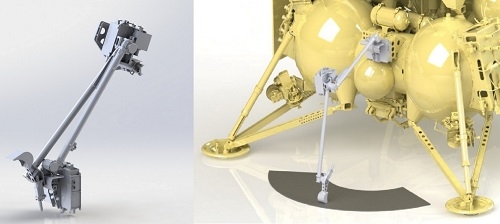
Credit: NPO Lavochkin/IKI/Roscosmos
Repeat delays
At the end of March, Roscosmos reported that tests of the high-precision landing system for the Luna-25 interplanetary automatic station had been successfully completed.
August 22 is now the target date for launch of Luna-25, according to Alexander Mitkin, Deputy General Designer for Electrical Systems at NPO. S. A. Lavochkin – the group that has built and tested the probe.

Russia’s Luna-25 Moon lander.
Credit: RSC Energia/Roscosmos
The Russian robotic Moon lander has repeatedly slipped from last year to May 2022 and now August.
Soil sampling duties
Luna-25 is to study the upper surface layer in the region of the south pole of the Moon, the lunar exosphere and develop landing and soil sampling technologies. The declared active life of the probe on the surface of the Moon is at least one Earth year.

Credit: NPO Lavochkin
This Russian Moon mission continues the series of the former Soviet Union’s lunar exploration activities that ended back in 1976. Luna-24 successfully delivered about 170 grams of lunar soil to Earth.
The Luna-25 mission will be followed by the Luna-26 orbiter and the Luna-27 landing vehicle, after which it is planned to start deploying a full-fledged scientific station on the Moon in collaboration with China.
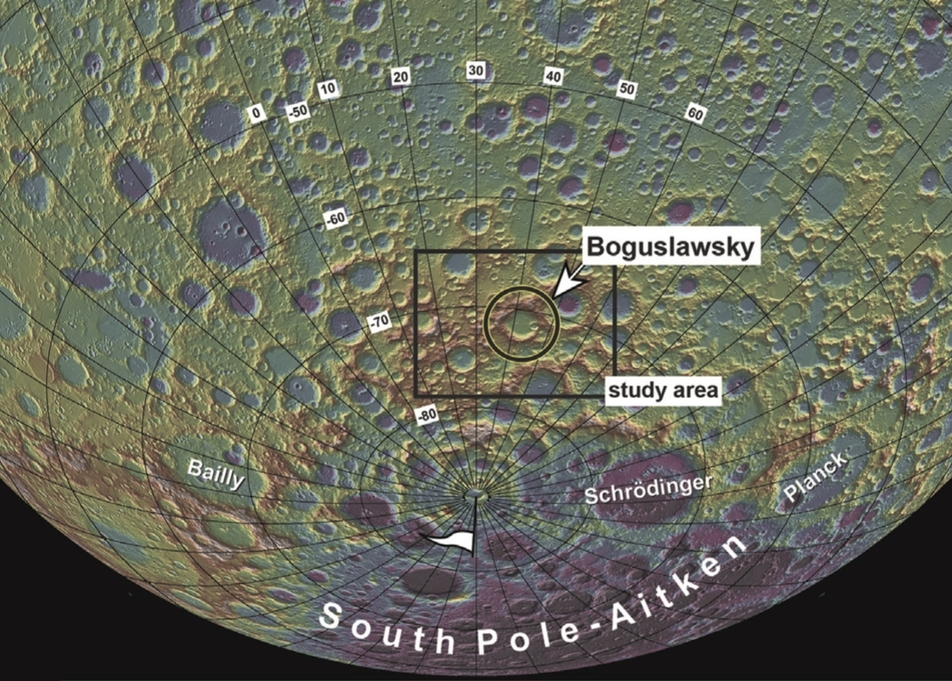
Topographic map of the southern sub-polar region of the Moon showing the location of Boguslawsky crater.
Credit: Ivanov et al., 2015 via Arizona State University/LROC
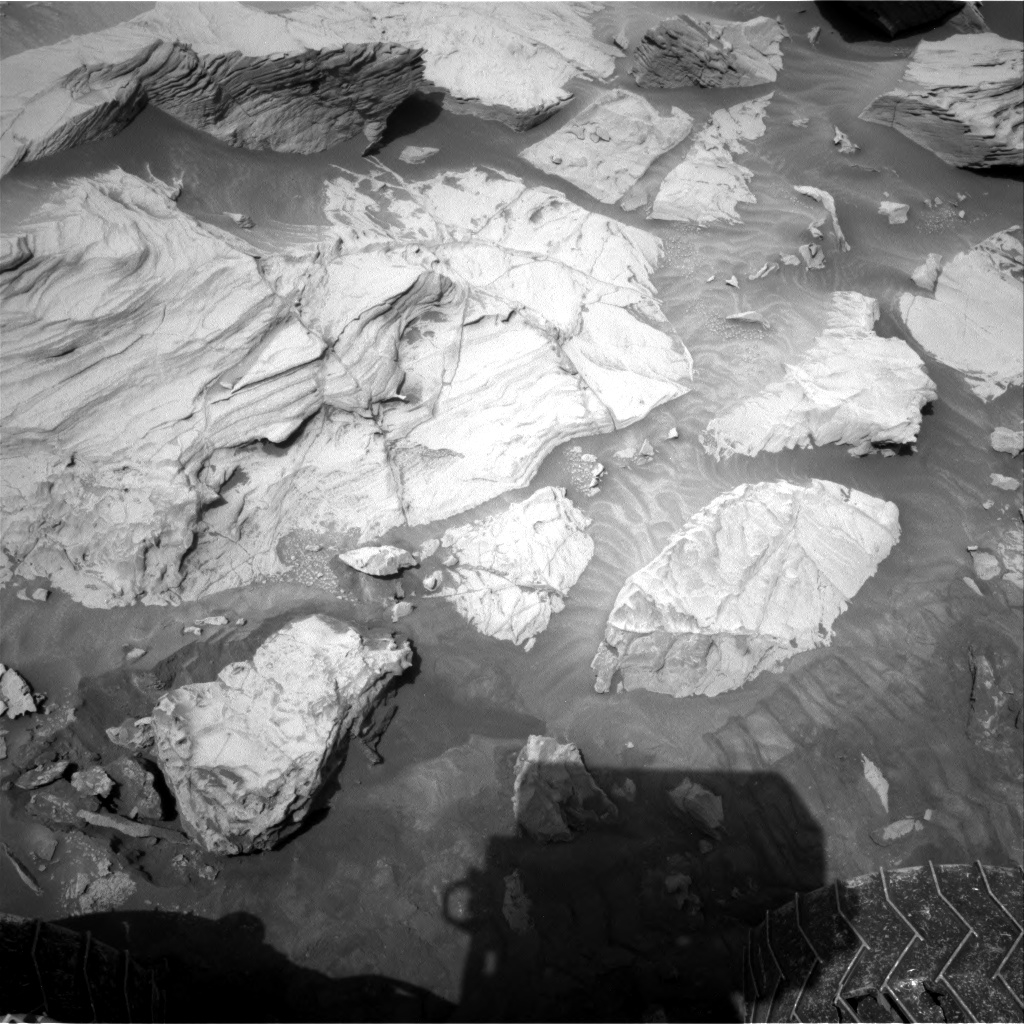
Curiosity Right B Navigation Camera image taken on Sol 3438, April 8, 2022.
Credit: NASA/JPL-Caltech
NASA’s Curiosity Mars rover at Gale Crater is now performing Sol 3439 duties.
“We successfully drove further down off of the “Greenheugh pediment” as we head toward smoother driving pathways downhill,” reports Michelle Minitti, a planetary geologist at Framework in Silver Spring, Maryland. “However, the chaotic jumble of terrain we encountered in the final few rolls of our wheels left a couple of our wheels perched awkwardly.”
That meant the robot could not get out its arm for contact science, lest the large arm swinging around might cause the rover to shift unexpectedly.
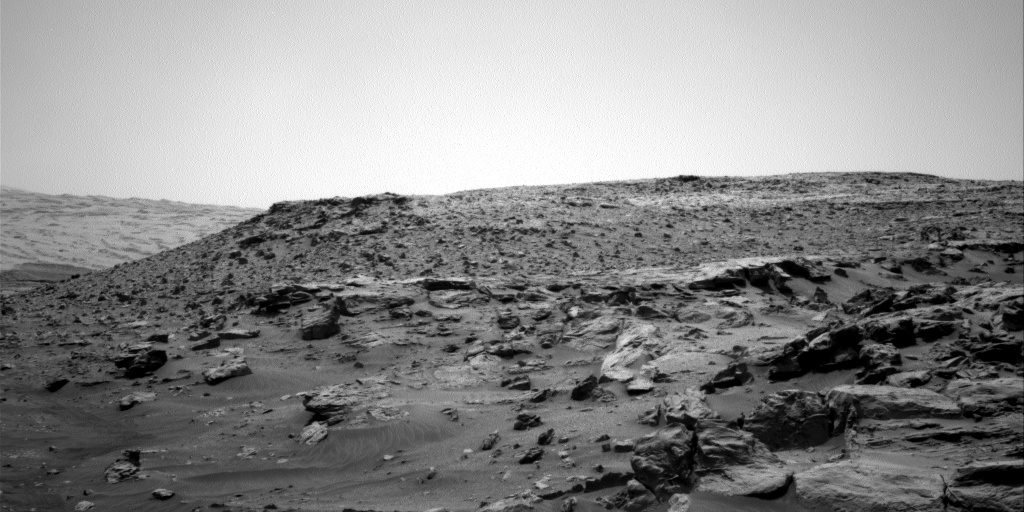
Curiosity Right B Navigation Camera image taken on Sol 3438, April 8, 2022.
Credit: NASA/JPL-Caltech
“It also meant that our rover drivers wanted to scoot the rover off of the offending terrain to put all six wheels on terra firma (or the Martian equivalent) before attempting another drive,” Minitti adds. Thus, a recent drive aims to reposition the rover for observations this weekend.
Layered bedrock
Before the repositioning, the plan called for an extensive set of imaging and analyses with the Chemistry and Camera (ChemCam) and Mastcam.
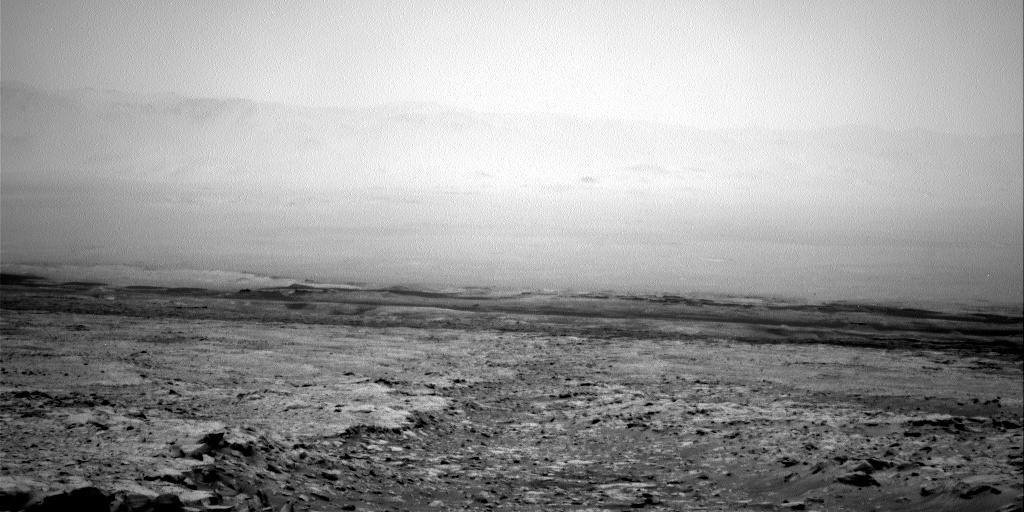
Curiosity Right B Navigation Camera image taken on Sol 3438, April 8, 2022.
Credit: NASA/JPL-Caltech
ChemCam will acquire chemistry from a beautifully layered bedrock outcrop, “Fort Charlotte,” and will acquire a Remote Micro-Imager (RMI) mosaic from the top section of Gediz Vallis Ridge, which researchers can still see despite dropping in elevation in our last drive.
“Mastcam will acquire three mosaics to cover the intricate bedrock structures in this area,” Minitti notes. Two of these mosaics center on the bedrock ridge dubbed “Feorachas” on Curiosity’s first pass through this area.
“The ridge, and the linear features extending away from it, are of great interest for what they might reveal about the history of this part of the pediment,” Minitti explains.
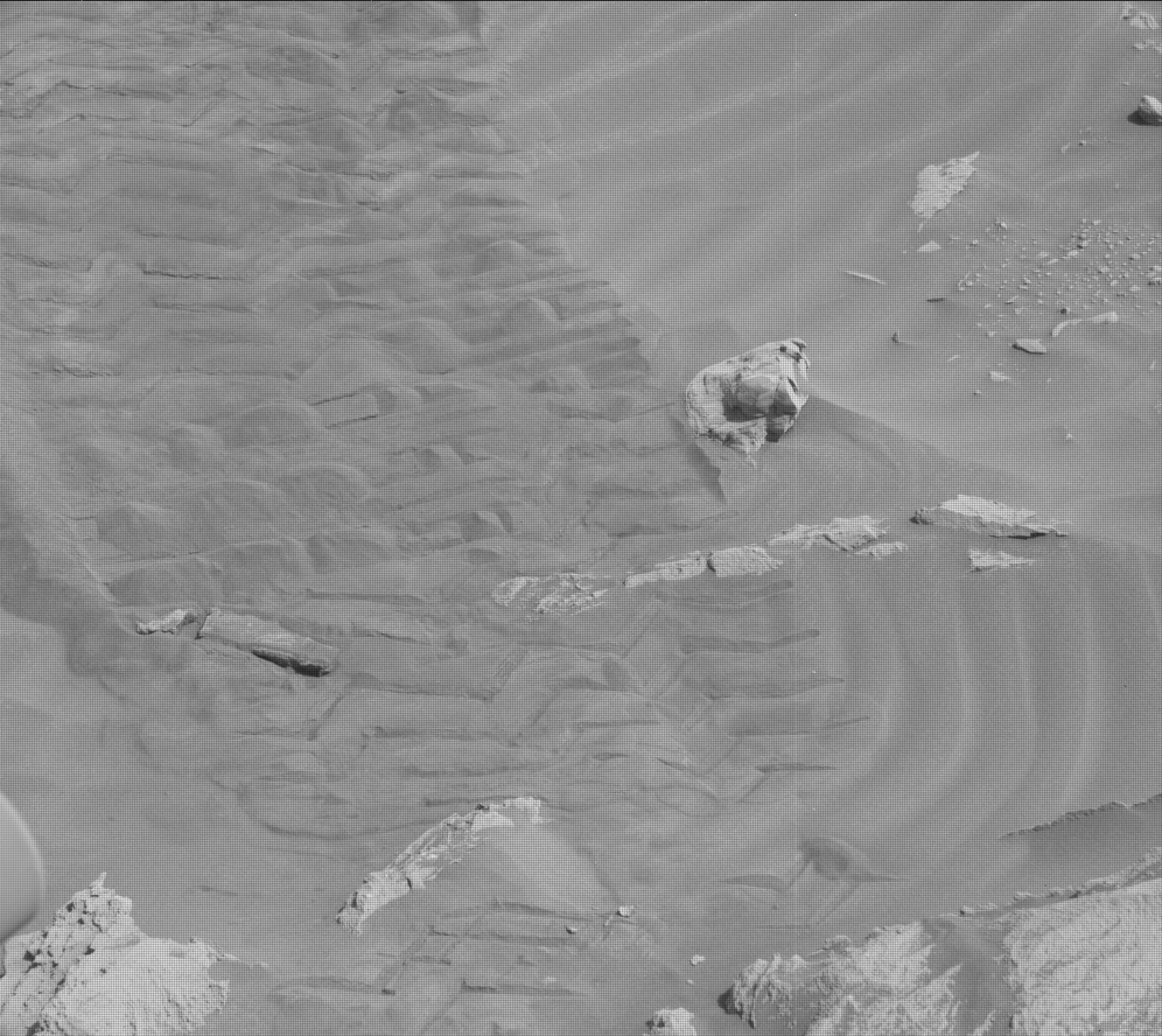
Curiosity Mast Camera (Mastcam) Left photo taken on Sol 3437, April 7, 2022.
Credit: NASA/JPL-Caltech/MSSS
Weekend plans
The third mosaic centers on the bedrock in the workspace in front of the rover, which will come in handy as scientists (hopefully) plan contact science within it over the weekend.
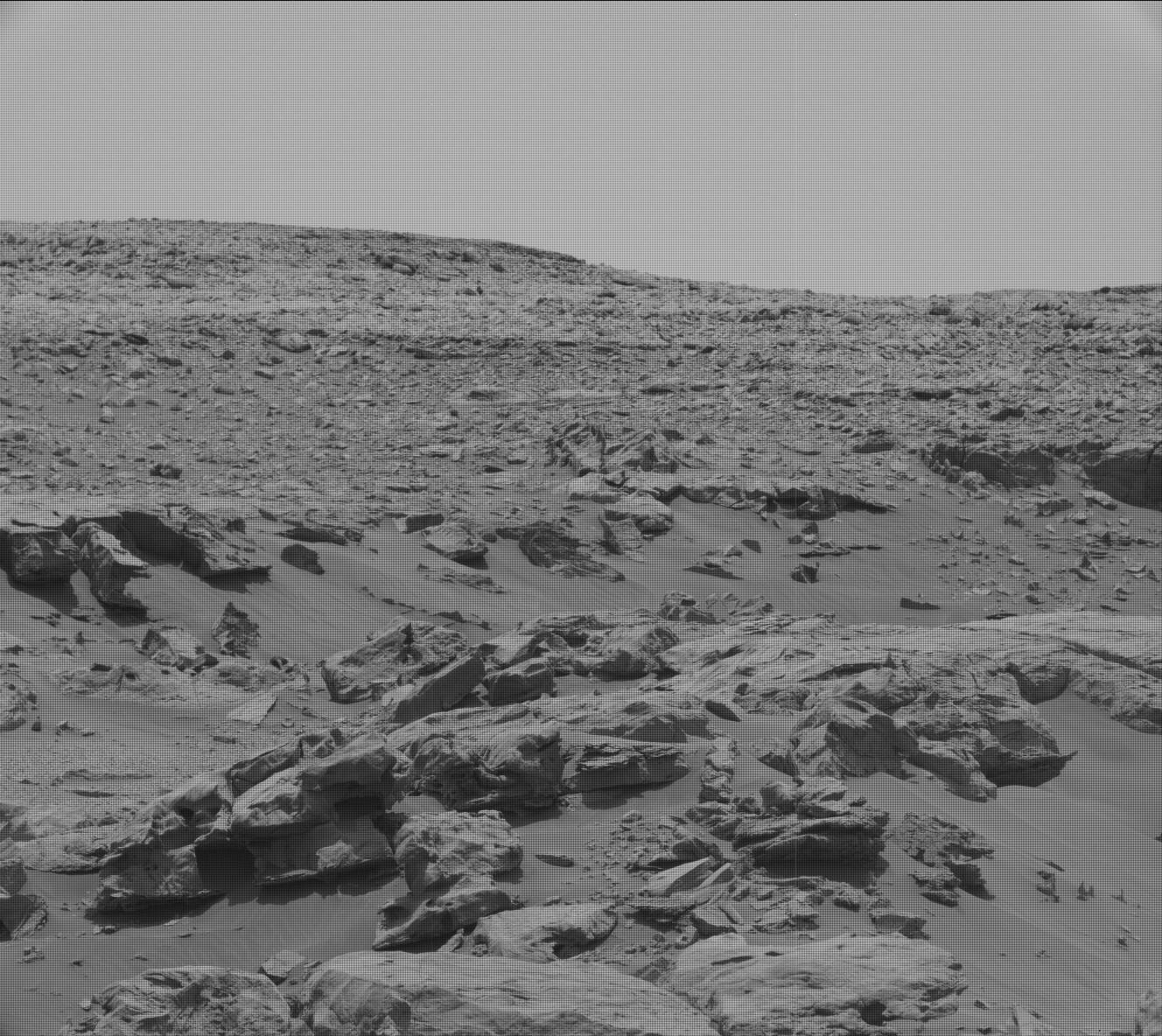
Curiosity Mast Camera (Mastcam) Left photo taken on Sol 3437, April 7, 2022.
Credit: NASA/JPL-Caltech/MSSS
“We will also look skyward, with a Navcam image to monitor the amount of dust in the atmosphere, and a Navcam cloud movie. After we settle our wheels, we plan to acquire an automated ChemCam raster from the surrounding bedrock, a ChemCam passive observation of the atmosphere, a Mastcam tau measurement, and a Navcam dust devil survey,” Minitti reports.
The rover is scheduled to acquire a Dynamic Albedo of Neutrons (DAN) active measurement after its drive to complement the longer DAN passive measurements that span parts of each sol.
Rover Environmental Monitoring Station (REMS) and Radiation Assessment Detector (RAD) are slated to make their systematic measurements throughout both sols (Sols 3437-3438).
Minitti concludes: “Here’s hoping the weekend goes off without a hitch!”
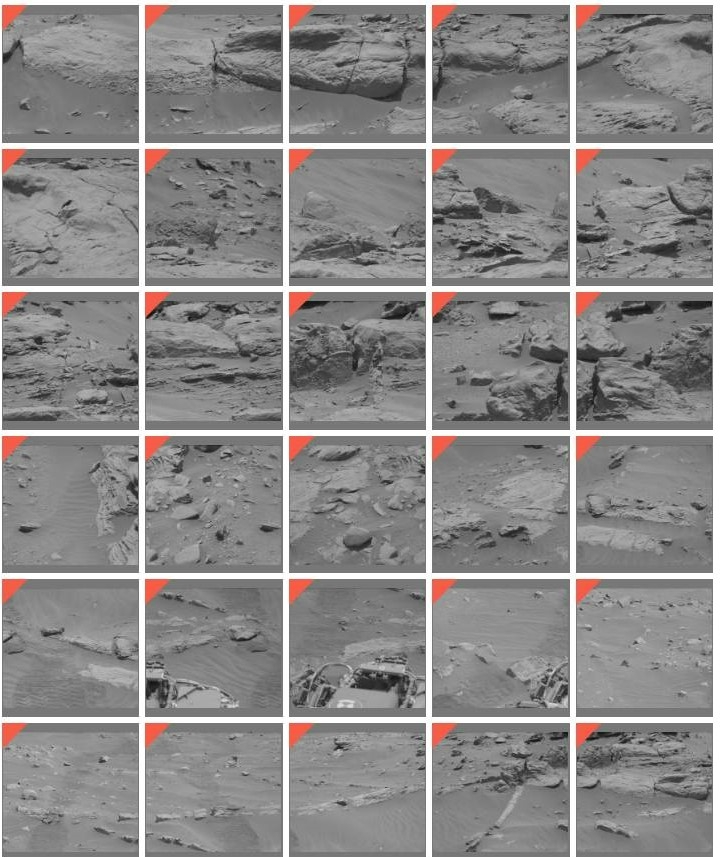
Curiosity Mast Camera (Mastcam) Left and Right photos taken on Sol 3437, April 7, 2022.
Credit: NASA/JPL-Caltech/MSSS

Chelyabinsk sky rendering is a reconstruction of the asteroid that exploded over Chelyabinsk, Russia on Feb. 15, 2013. Scientific study of the airburst has provided information about the origin, trajectory and power of the explosion. This simulation of the Chelyabinsk meteor explosion by Mark Boslough was rendered by Brad Carvey using the CTH code on Sandia National Laboratories’ Red Sky supercomputer. Andrea Carvey composited the wireframe tail. Photo by Olga Kruglova.
Credit: Sandia National Laboratories.
An agreement between NASA and the U.S. Space Force recently authorized the public release of decades of data collected by U.S. government sensors on fireball events – large bright meteors also known as bolides.
This action results from collaboration between NASA’s Planetary Defense Coordination Office (PDCO) and the U.S. Space Force to continue furthering our nation’s efforts in planetary defense, which include finding, tracking, characterizing, and cataloging near-Earth objects (NEOs).

NASA’s Lindley Johnson is head of NASA’s Planetary Defense Coordination Office.
Credit: Leonard David
Events
Recently a small asteroid designated 2022 EB5 approximately 2 meters in size was detected in space as it approached Earth and impacted the atmosphere southwest of Jan Mayen, a Norwegian island nearly 300 miles (470 kilometers) off the east coast of Greenland and northeast of Iceland.
Another notable bolide event in this released data set is of a meteor that was detected on Jan. 8, 2014. This object gained the interest of the scientific community, as it has been posited it could have interstellar origin due to the detected event’s high velocity within the atmosphere.
Further analysis of this event carried out under U.S. Space Command’s purview confirmed the object’s high velocity impact, but the short duration of collected data, less than five seconds, makes it difficult to definitively determine if the object’s origin was indeed interstellar.

Space Force-operated Defense Support Program (DSP) satellites are a key part of North America’s early warning systems.
Credit: U.S. Space Force
Growing archive
The growing archive of bolide reports, as posted on the NASA Center for Near Earth Object Studies (CNEOS) Fireballs website, “has significantly increased scientific knowledge and contributes to the White House approved National Near-Earth Object Preparedness Strategy and Action Plan,” said Lindley Johnson, planetary defense officer at NASA Headquarters.
“The release of these new bolide data demonstrates another key area of collaboration between NASA and the U.S. Space Force,” Johnson added, “and helps further the pursuit of improved capabilities for understanding these objects and our preparedness to respond to the impact hazard NEOs pose to Earth.”
For more information, go the NASA Jet Propulsion Laboratory’s Center for Near Earth Object Studies (CNEOS) fireballs database at:
https://cneos.jpl.nasa.gov/about/cneos.html
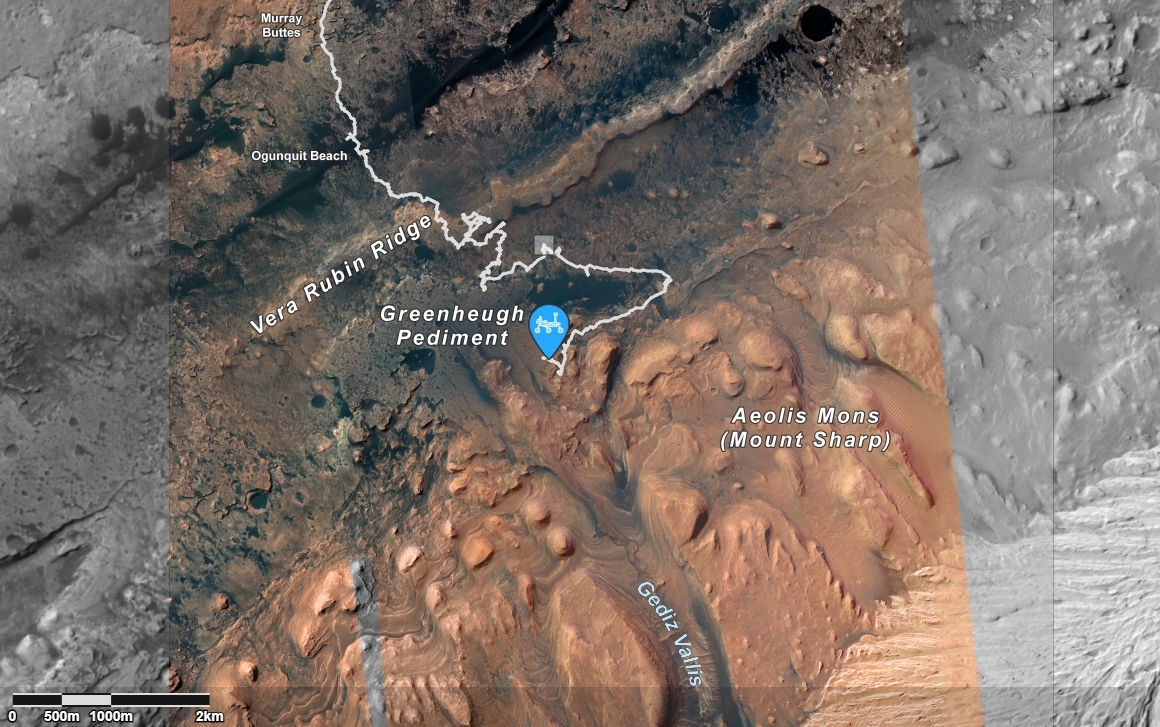
Curiosity’s location on Sol 3436. Distance driven to this period if 17.09 miles/27.5 kilometers
Credit: NASA/JPL-Caltech/Univ. of Arizona
NASA’s Curiosity Mars rover at Gale Crater is now performing Sol 3437 duties.
The robot recently drove to a new workspace, one that was partially explored previously on Sol 3417, reports Ashley Stroupe, a mission operations engineer at NASA’s Jet Propulsion Laboratory.
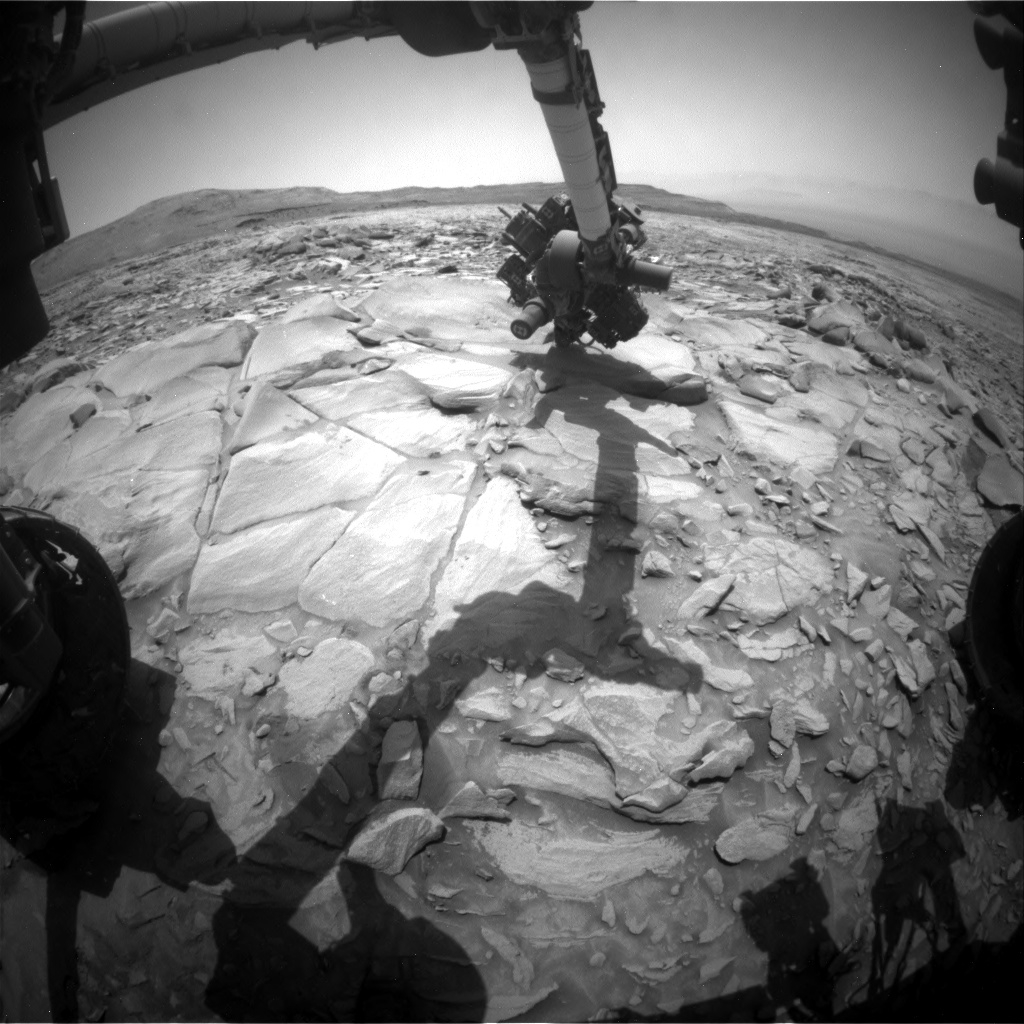
Curiosity Front Hazard Avoidance Camera Left B image taken on Sol 3436, April 6, 2022.
Credit: NASA/JPL-Caltech
Curiosity activities included placing the Alpha Particle X-Ray Spectrometer (APXS) on a smooth bedrock target, “Broo,” to contrast with the rougher target, Knott, that was looked at before. “Fortunately, this was a simpler activity for the rover planners than some of our other workspaces recently,” Stroupe notes.
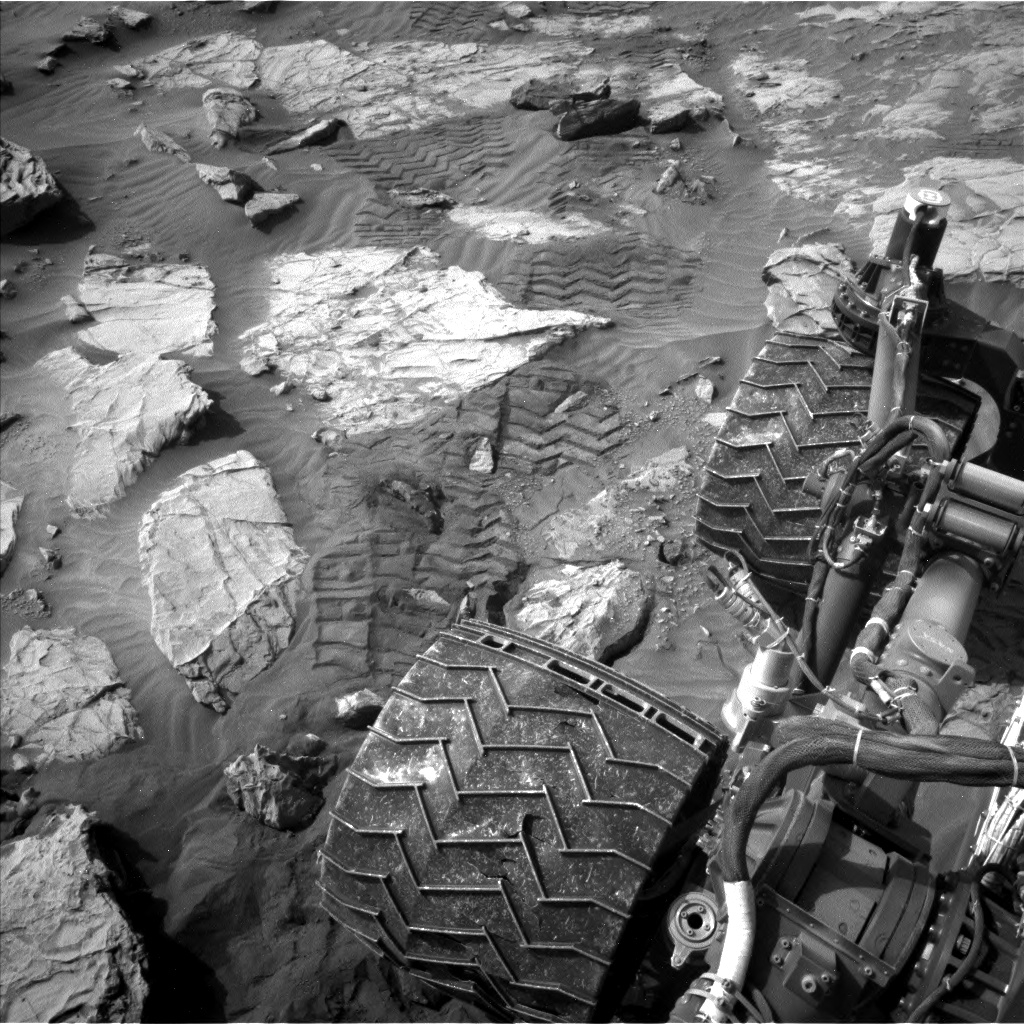
Curiosity Left B Navigation Camera image acquired on Sol 3436, April 6, 2022.
Credit: NASA/JPL-Caltech
Arm on target
“While the APXS integrates on Broo, Curiosity will also be doing some imaging and using the laser. With the arm placed down on the target, we needed to point our cameras at other places,” Stroupe adds.
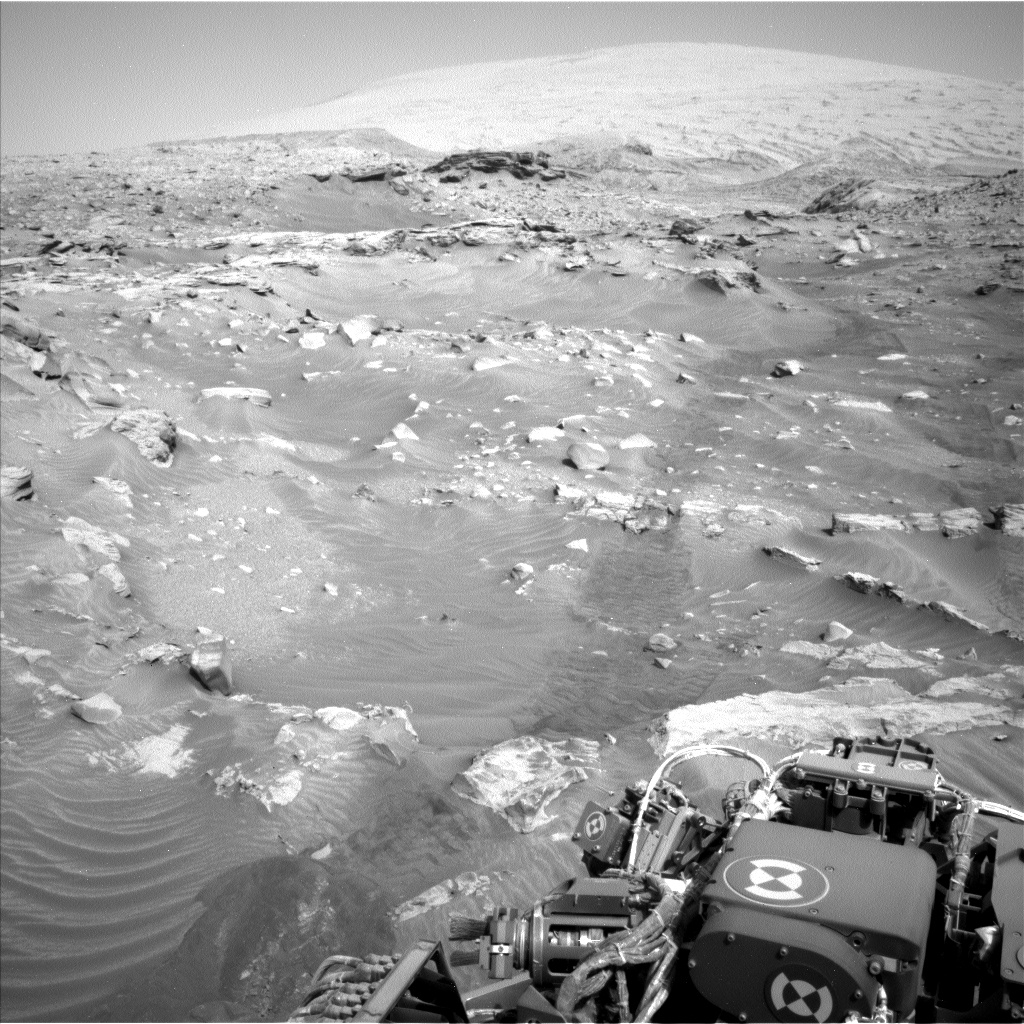
Curiosity Left B Navigation Camera image acquired on Sol 3436, April 6, 2022.
Credit: NASA/JPL-Caltech
“Blue Mull,” which is another target in the workspace similar to Broo, will be examined by Mastcam and the Chemistry and Camera (ChemCam) Laser Induced Breakdown Spectroscopy (LIBS) and the rover’s Remote Micro-Imager (RMI).
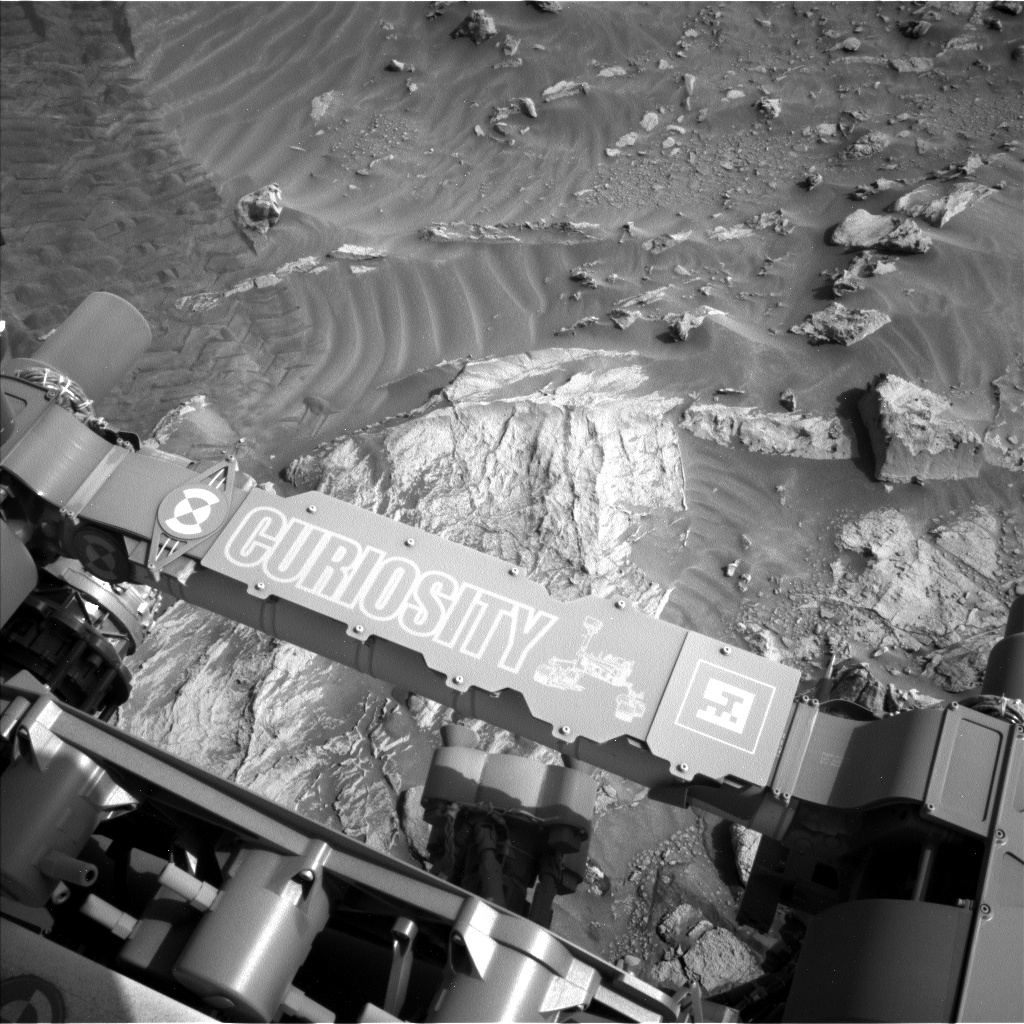
Curiosity Left B Navigation Camera image acquired on Sol 3436, April 6, 2022.
Credit: NASA/JPL-Caltech
“We also will look at some targets outside the workspace, including a previous set of rocks called “Burnfoot,” which we previously imaged from another angle, and a rock named “Da Haaf” that we may have broken under our wheels when driving over it,” Stroupe points out.
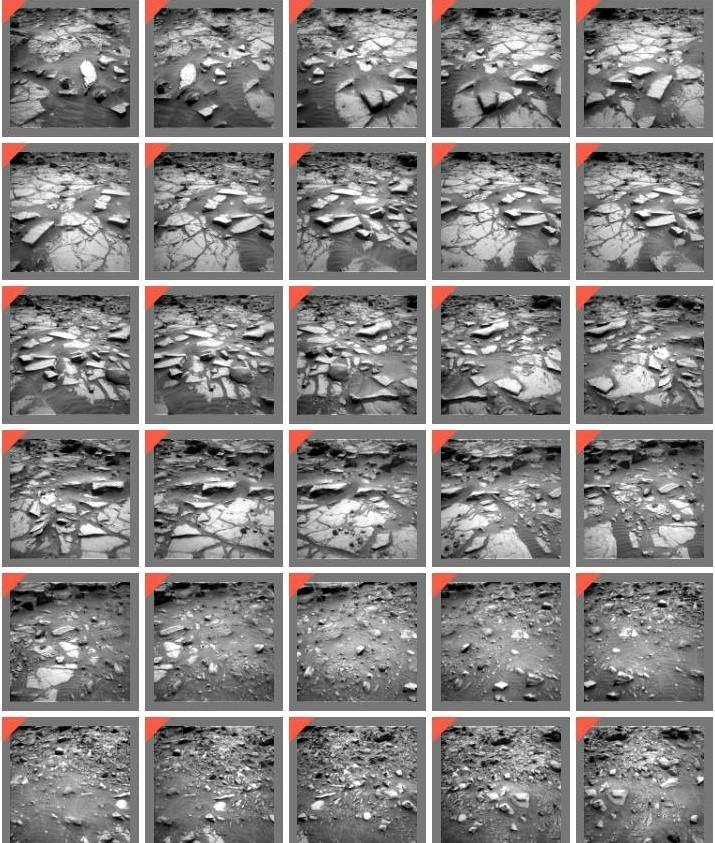
Curiosity Left B Navigation Camera images acquired on Sol 3436, April 6, 2022.
Credit: NASA/JPL-Caltech
Vertical exposure with layers
Also, a new plan calls for extending the past imaging of the Tighnabruaich rock cluster and mosaic of the nearby crater. “Finally, we image Youkil Quarry target,” Stroupe adds, “which shows a nice vertical exposure with layers, from a different angle. Lastly, we are doing some imaging to search for dust devils with Mastcam and Navcam.”
After the imaging and APXS are complete, the plan has taking Mars Hand Lens Imager (MAHLI) images of the Broo target and then stowing the arm.
Rover planners scripted a recent drive that continues to have Curiosity wind around difficult terrain. “We are looking forward to when we have finished returning to these prior locations and can move on to new vistas, Stroupe reports.
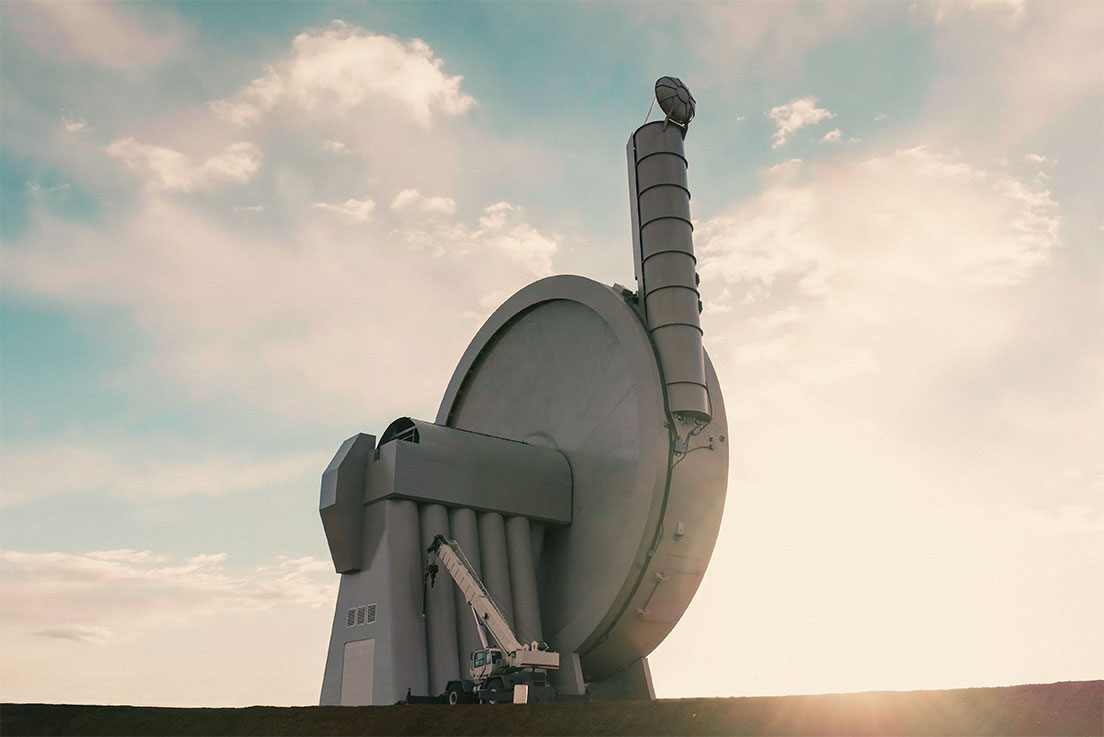
Credit: SpinLaunch
The innovative SpinLaunch company has signed a Space Act Agreement with NASA.
Through this partnership, SpinLaunch will develop, integrate, and fly a NASA payload on the company’s Suborbital Accelerator Launch System to provide information to NASA for potential future commercial launch opportunities.
The Space Act Agreement is part of NASA’s Flight Opportunities Program.
SpinLaunch will manifest and fly the first NASA payload on a developmental test flight later this year and provide means for post-flight recovery of payload back to NASA. The two organizations will work jointly to analyze the data and assess the system for future flight opportunities. After full review, NASA and SpinLaunch will publish all non-proprietary launch environment information from the test flight.
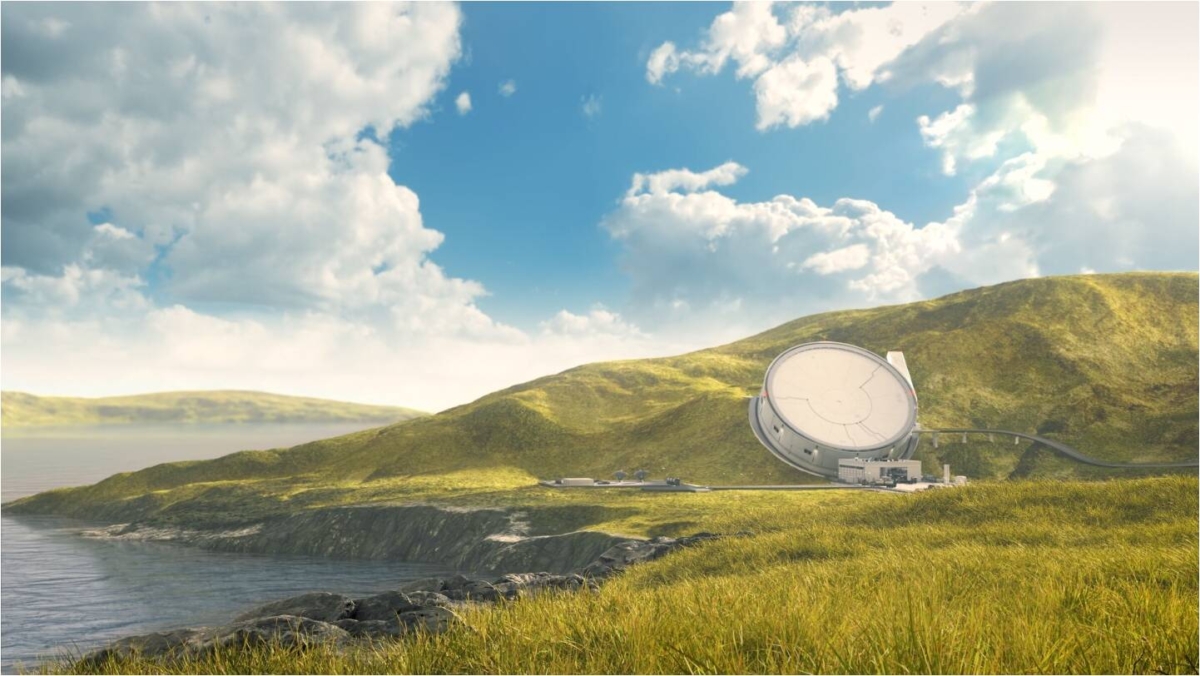
Artist’s view of futuristic launch facility for hurling satellites into Earth orbit.
Credit: SpinLaunch
Orbital flight
SpinLaunch’s Orbital Accelerator will accelerate a launch vehicle containing a satellite up to 5,000 miles per hour using a rotating carbon-fiber-arm within a 300-ft diameter steel vacuum chamber. By doing so, over 70 percent of the fuel and structures that make up a typical rocket can be eliminated.

Credit: SpinLaunch
In October 2021, SpinLaunch’s first test flight successfully propelled a test vehicle at supersonic speeds and ended with the recovery of the reusable flight vehicle. Since then, the suborbital system has conducted regular test flights with a variety of payloads at speeds in excess of 1,000 miles per hour at Spaceport America, located in New Mexico. First orbital test launches are planned for 2025.
For more information on this company and its novel launch concept, go to:
These photos were acquired on April 3, 2022 (Sol 398 of the Perseverance rover mission) – the date of the NASA helicopter’s 24th flight.
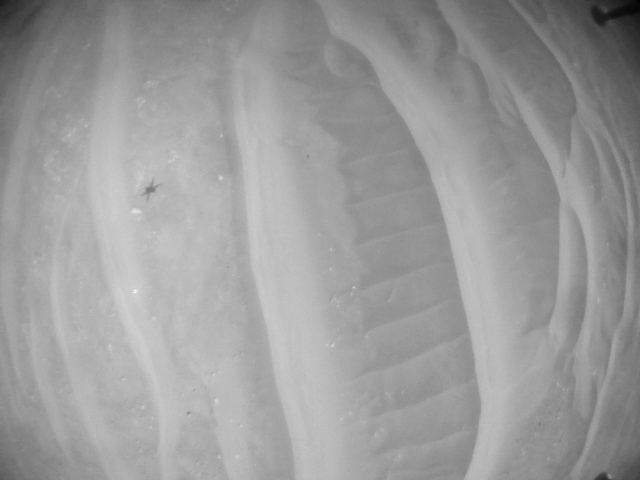


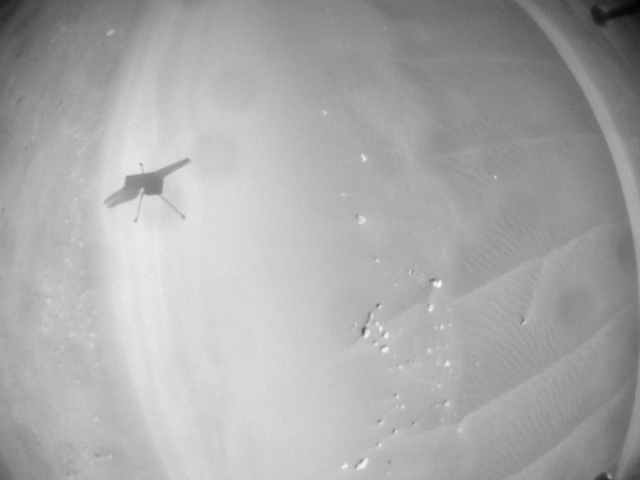
The Ingenuity Mars rotorcraft acquired these images using its navigation camera. This camera is mounted in the helicopter’s fuselage and pointed directly downward to track the ground during flight.
On this latest flight, the device flew for 69.5 seconds, traveling roughly 154 feet and reached a maximum altitude of around 33 feet.

Credits: NASA/JPL-Caltech/University of Arizona/USGS
Extended flight
NASA has extended flight operations of the Ingenuity Mars Helicopter through September. In the months ahead, the rotorcraft will support the Perseverance rover’s upcoming science campaign exploring the ancient river delta of Jezero Crater. Along the way, it will continue testing its own capabilities to support the design of future Mars air vehicles.
Ingenuity’s new area of operations is entirely different from the modest, relatively flat terrain it has been flying over since its first flight in April 2021.
Several miles wide and formed by an ancient river, the fan-shaped delta rises more than 130 feet (40 meters) above the crater floor.

Perseverance Rover location and current whereabouts of the Mars Helicopter.
Image Credit: NASA/JPL-Caltech
Dry river channels
Filled with jagged cliffs, angled surfaces, projecting boulders, and sand-filled pockets that could stop a rover in its tracks (or upend a helicopter upon landing), the delta promises to hold numerous geologic revelations – perhaps even the proof necessary to determine that microscopic life once existed on Mars billions of years ago.

NASA’s robotic Holy Grail mission, a Mars sample return effort to bring back to Earth Martian collectibles.
Credit: NASA/JPL-Caltech
Upon reaching the delta, Ingenuity’s first orders will be to help determine which of two dry river channels Perseverance should take when it’s time to climb to the top of the delta.
See you at the delta
Ben Morrell, Ingenuity Operations Engineer at NASA’s Jet Propulsion Laboratory, reports: “With Flight 24 in our log book, it is now time to look forward to our upcoming effort that charts a course out of Séítah. Flight 25 – which was uplinked yesterday – will send Ingenuity 704 meters to the northwest (almost 80 meters longer than the current record – Flight 9). The helicopter’s ground speed will be about 5.5 meters per second (another record) and we expect to be in the rarefied Martian air for about 161.5 seconds.
Along with routing assistance, data provided by the helicopter will help the Perseverance team assess potential science targets. Ingenuity may even be called upon to image geologic features too far afield (or outside of the rover’s traversable zone), or perhaps scout landing zones and caching sites for the future Mars Sample Return program.
Credit: CCTV/CGTN
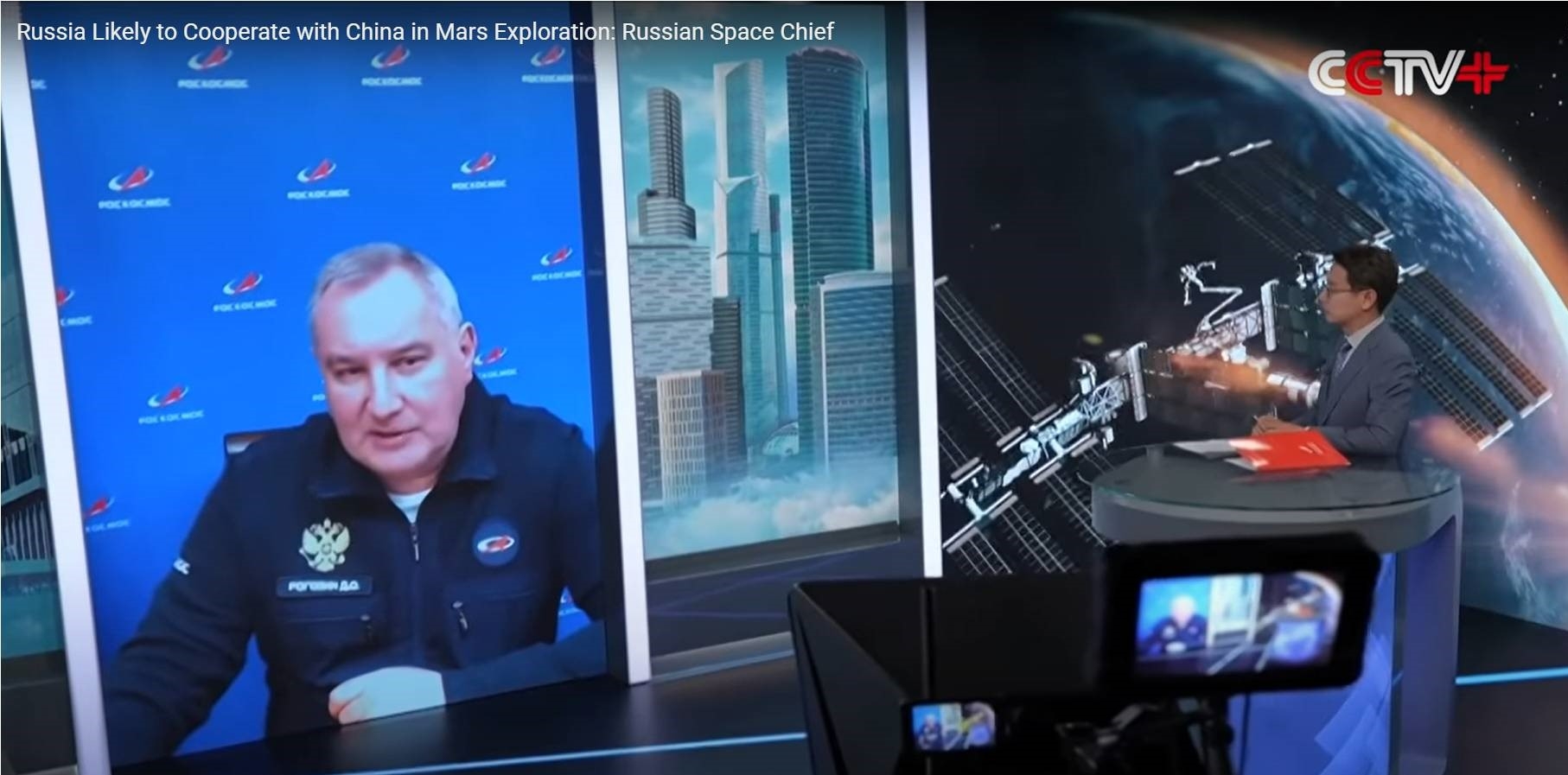
Given the tensions between Russia and the West due to heavy sanctioning sparked by the Ukrainian conflict, Russian space cooperation with China may be stepped up.
Dmitry Rogozin, director general of Roscosmos, underscored that prospect during his appearance on several China television outlets.
Rogozin told China Global Television Network (CGTN) and China Central Television (CCTV) that Russia’s role in space exploration is indispensable.

ExoMars 2022 mission was a joint ESA/Roscosmos project. Shown is rover ready to depart Russia-provided landing module and science landing platform.
Credit: Thales Alenia Space/Master Image Programmes
ExoMars 2022
The European Space Agency (ESA) announced in mid-March that it is suspending its collaboration with Russia on the ExoMars 2022 program.
“The problem is when someone does it on its own, it costs a lot of money. It will be a huge burden on the budget. In the construction of ExoMars, the main element is the landing module. The Mars research rover is not the essential element. I think we can make this mission happen with another partner like China or someone else,” Rogozin said.

The Russian Kazachok platform was destined to land on the Red Planet as part of the ExoMars 2022 mission, shown here being shipped to Europe for final assembly and testing.
Credit: Roscosmos
“It’s a cooperative mission. If Russia doesn’t join, Europe won’t go ahead with the mission, because Russia’s contribution to the mission is huge. It is not only about the heavy rockets that send these instruments into orbit and to Mars, it’s also about the landing vehicles. These vehicles must help achieve a soft landing on Mars or the research rovers. The module itself is a research station. We have been waiting so long to realize this mission. If it is delayed, it will never happen. They may change Russia’s landing module, but that decision could take a lot of time and money,” said Rogozin.
Launch of the ExoMars 2022 mission had been slated for September 20 (the opening of a 12-day launch window); lifting off from Baikonur, Kazakhstan atop a Proton booster.
That mission involved the ESA-led rover and a Roscosmos-led surface landing/science platform named “Kazachok.”
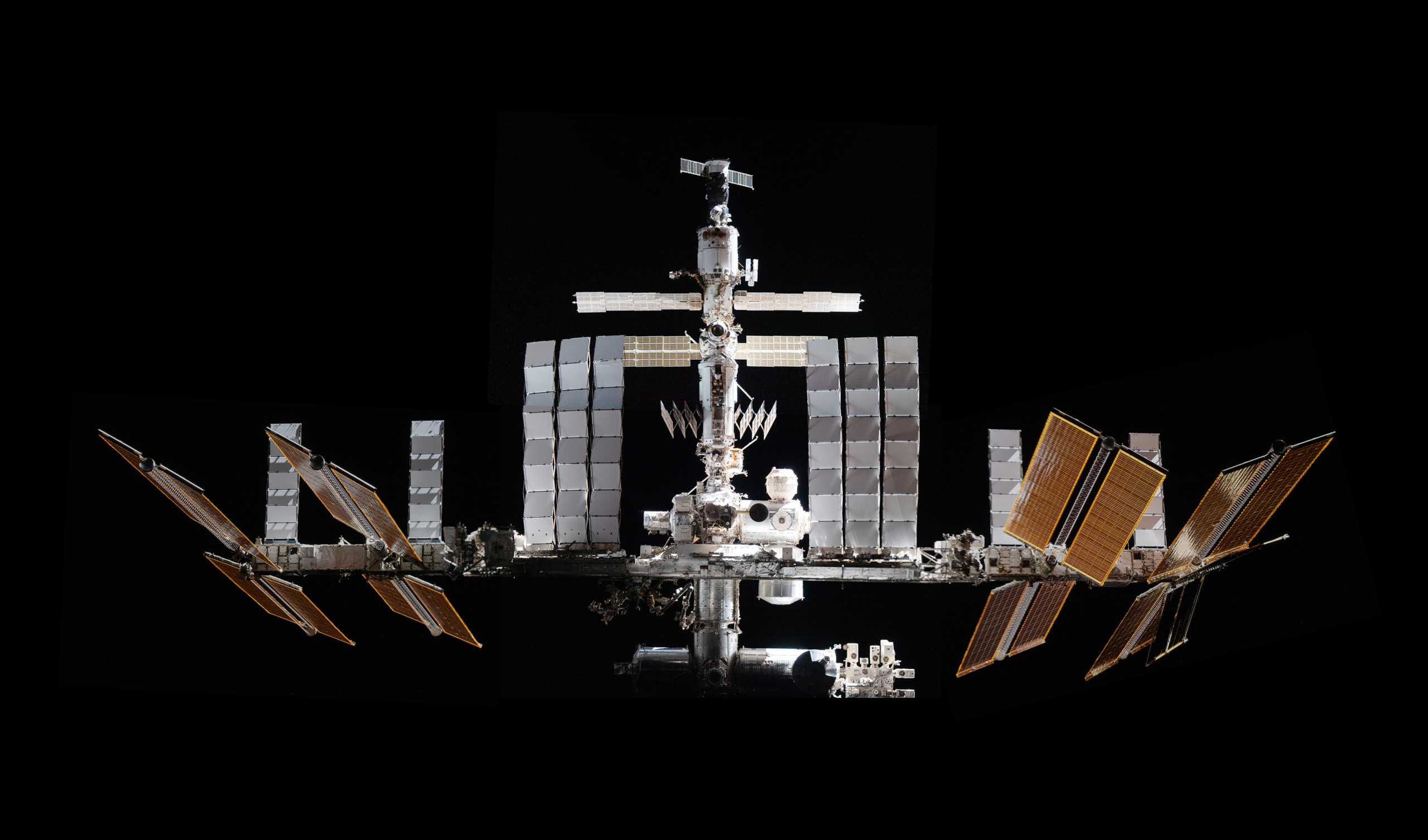
ISS mosaic created with imagery from Expedition 66.
Credit: NASA/Roscosmos
International Space Station
Rogozin also said the Russia-U.S. cooperation on the International Space Station (ISS) will collapse as a result of the sanctions. If the U.S. stops cooperation, the 500-ton ISS will go out of control, he said.
“Russia’s role is vital. Only Russia’s Soyuz spacecraft can transport American, European, Canadian, Japanese astronauts and their guests. Soyuz is irreplaceable, because America doesn’t have any such spacecraft,” Rogozin said.
“Russia helps the ISS avoid space rubbish and maintain orbital correction. The ISS is in a low earth orbit. It helps deliver fuels to the station. These are the main contributions from Russia and Roscomos in particular. So working without Russia is impossible, just like working without America. If they pull us out of this, the ISS wouldn’t exist anymore,” said Rogozin.

Credit: Roscosmos
“We work well with our Chinese friends,” Rogozin emphasized.
The Russian space chief noted the International Lunar Research Station. “We have signed all the necessary documents with our Chinese friends. Regarding China’s space station, we can talk about creating new modules. To be friends in space, we must be friends on Earth. Russia and China are friends on Earth. I think China and Russia can work together in manned cosmonautics,” Rogozin said.
To view Dmitry Rogozin, head of Russia’s space program known as Roscosmos, go to these videos at:
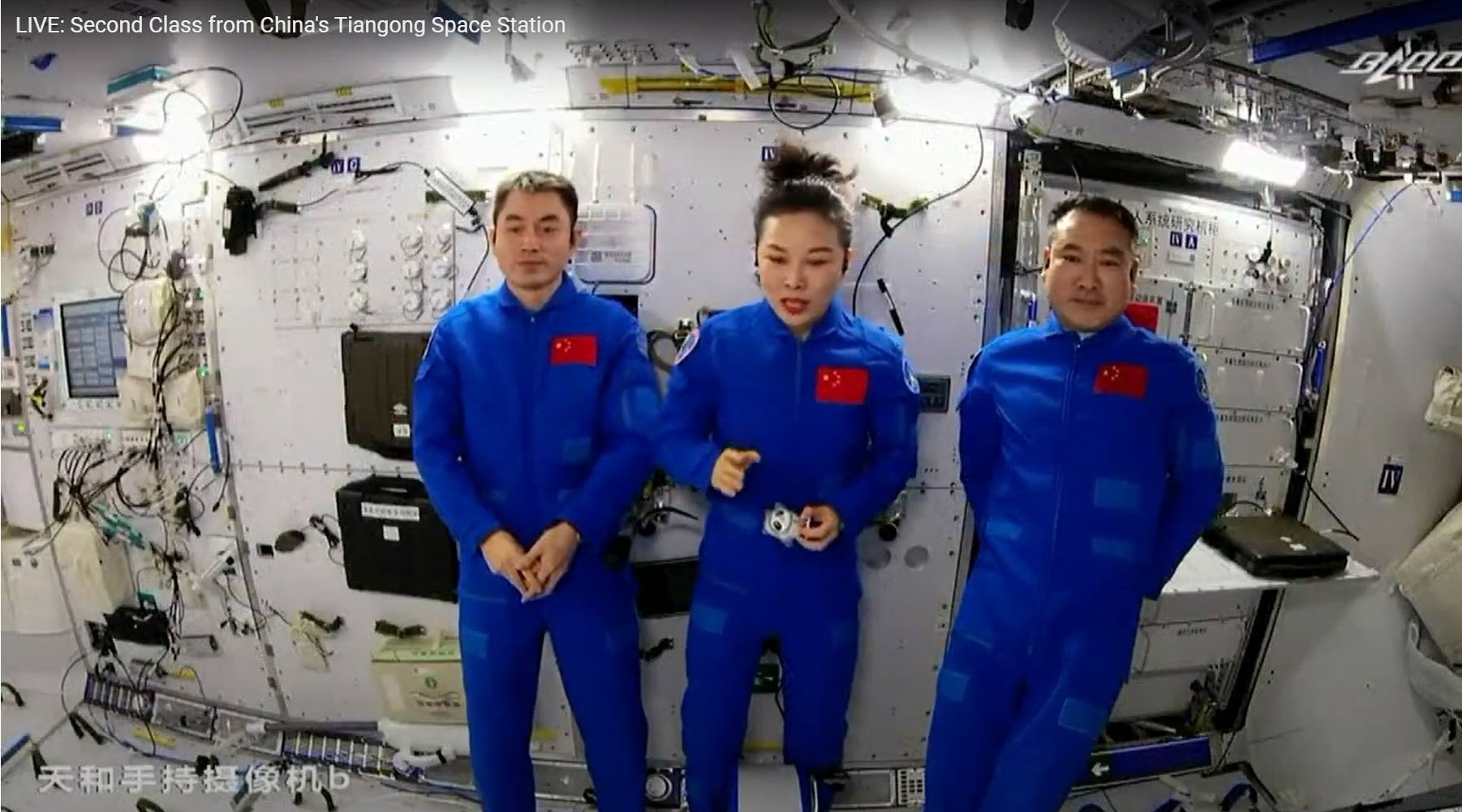
Shenzhou-13 crew.
Credit: CCTV Video News Agency/Inside Outer Space screengrab
China’s Shenzhou-13 astronauts — Zhai Zhigang, Wang Yaping and Ye Guangfu — are preparing for their mid-April return to Earth.
The crew arrived in the core module of the in-construction Tiangong station on October 16, embarking on their six-month journey – the longest-ever duration in the country’s human spaceflight program.
China’s space station to be completed by end of 2022.
Credit: CCTV/Inside Outer Space screengrab
Upcoming launches
Six launches will be made this year to wrap up piecing together the Chinese space station.
- Shenzhou-14 and the Shenzhou-15 piloted missions
- Tianzhou 4 and 5 robotic cargo spaceships for refueling and resupply operations
- Two large space labs to dock with the station: Wentian, or Quest for the Heavens, and Mengtian, or Dreaming of the Heavens
Credit: CCTV/Inside Outer Space screengrab
Tiangong station
Upon its completion at the end of this year, Tiangong will consist of three main components — a core module attached to two space labs — and will have a combined weight of nearly metric 70 tons. The station is scheduled to operate for 15 years in a low-Earth orbit.
Go to these recent videos that focus on preparations for the Shenzhou-13 crew to return to Earth, at:

Curiosity Mars Hand Lens Imager (MAHLI) photo produced on Sol 3427, March 28, 2022.
Credit: NASA/JPL-Caltech/MSSS
NASA’s Curiosity Mars rover at Gale Crater is now performing Sol 3428 duties.
“Unfortunately, our weekend drive stalled, so this morning we found ourselves still at Friday’s workspace,” reports Catherine O’Connell-Cooper, a planetary geologist at University of New Brunswick; Fredericton, New Brunswick, Canada.
“Fortunately, it was an understood issue… and this was a good place to spend some extra time and fill our science glass with amazing data! This workspace (“Hartle Loup”) has examples of different textures, bands of “vuggy” (little holes or pits), material and smoother material.

Mastcam image taken on Sol 3419 showing different textures at “Hartle Loup.”
Credits: NASA/JPL-Caltech/MSSS
Hard choices
Last Friday, the Alpha Particle X-Ray Spectrometer (APXS) and Mars Hand Lens Imager (MAHLI) had to make some hard choices between all the desired targets, and scientists opted to characterize some “vuggy” targets but were unable to also get the “smooth” targets.
“So, in a sense, the drive stall worked in our favor,” O’Connell-Cooper adds, allowing scientists to get three “smooth” targets. APXS and MAHLI was scheduled to investigate “Broadfell” and a brushed target “Venlaw,” whilst the rover’s Chemistry and Camera (ChemCam) will use Laser Induced Breakdown Spectroscopy (LIBS) to target “Cleveland.”

Curiosity Mast Camera Right image taken on Sol 3425, March 26, 2022.
Credit: NASA/JPL-Caltech/MSSS
Mastcam was slated to take multispectral imagery (a further tool to help understand composition, often used for brushed targets) of Venlaw and researchers were able to add a bonus multispectral image of the weekend Dust Removal Tool (DRT) target (“Donkey Trail”) which researchers didn’t have time for on Friday.

Curiosity Front Hazard Avoidance Left B Camera image taken on Sol 3427, March 28, 2022.
Credit: NASA/JPL-Caltech
Overlapping images
MAHLI took the opportunity to slip in a six image mosaic (series of overlapping images) looking at the interaction between the two textures. ChemCam will also examine “Bowder Stone,” a bedrock target that was broken up by the rover’s wheels last week, O’Connell-Cooper reports.

Curiosity Rear Hazard Avoidance Right B Camera image acquired on Sol 3427, March 28, 2022.
Credit: NASA/JPL-Caltech
“Mastcam has, as always, a very busy plan,” O’Connell-Cooper notes. It will document the ChemCam targets from the scripted plan, recover an image from the weekend on “Burn Mouth” which didn’t complete and get some more images of the pediment landscape.

Curiosity Chemistry & Camera (ChemCam) Remote Micro-Imager (RMI) Sol 3426 March 27, 2022
Credit: NASA/JPL-Caltech/LANL
Drive path
“Mastcam will also aid the environmental group in monitoring dust concentrations in the air, obtaining a crater rim extinction observation and a basic ‘tau’ measurement, both of which are used to determine how much dust is the atmosphere,” O’Connell-Cooper points out.
“Once we finish getting all this lovely bonus science at Hartle Loup, we will continue on our way, following the same drive path as we had planned to take over the weekend,” says O’Connell-Cooper.

Curiosity Mast Camera Left photo taken on Sol 3424, March 25, 2022.
Credit: NASA/JPL-Caltech/MSSS
Vuggy rock
In an earlier report, Scott Guzewich, an atmospheric scientist at NASA’s Goddard Space Flight Center, pointed out that vuggy rock in the “Hartle Loup” outcrop seemed particularly unique relative to the other rocks on the Greenheugh Pediment that scientists have seen to-date.
In addition to the contact science, Curiosity continued the effort to image as much of the Greenheugh Pediment and Gediz Vallis Ridge as possible from the rover’s location with Mastcam and the ChemCam Remote Micro-Imager (RMI).
“We will likely never have this perspective on this portion of those features, so we’re being very thorough with our imaging,” Guzewich adds.

