Archive for the ‘Space News’ Category
 Author:
  April 21st, 2022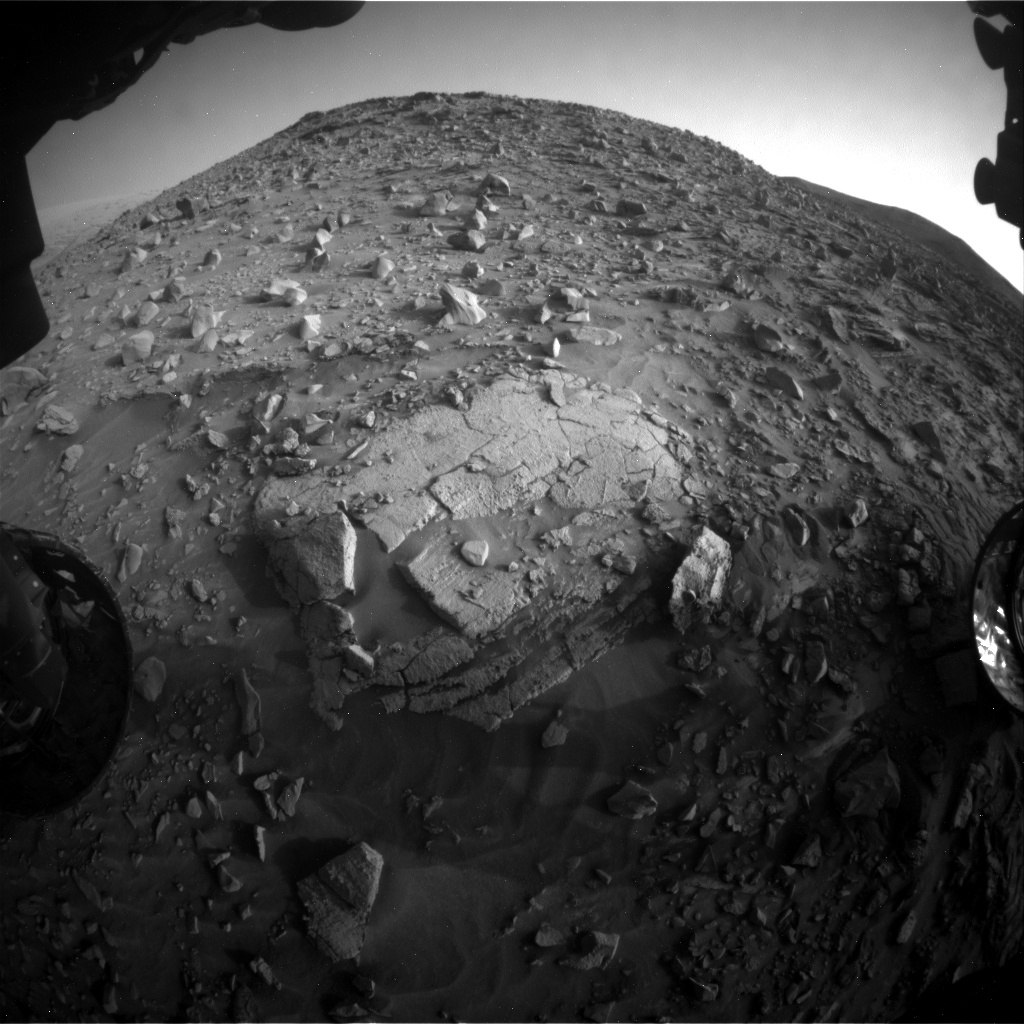
Curiosity’s workspace had a big piece of bedrock in plain view! This image was taken by Front Hazard Avoidance Camera (Front Hazcam) on Sol 3449.
Credits: NASA/JPL-Caltech
NASA’s Curiosity Mars rover at Gale Crater is now performing Sol 3451 duties.
Reports Susanne Schwenzer, a planetary geologist at The Open University, Milton Keynes, U.K., the rover has again found itself dealing with a rock right under the Mars machinery.
“But this time, we were excited about it as the rover was in a stable position parked on a big piece of bedrock, presenting itself flat as a pancake, ready to be brushed and analyzed.”
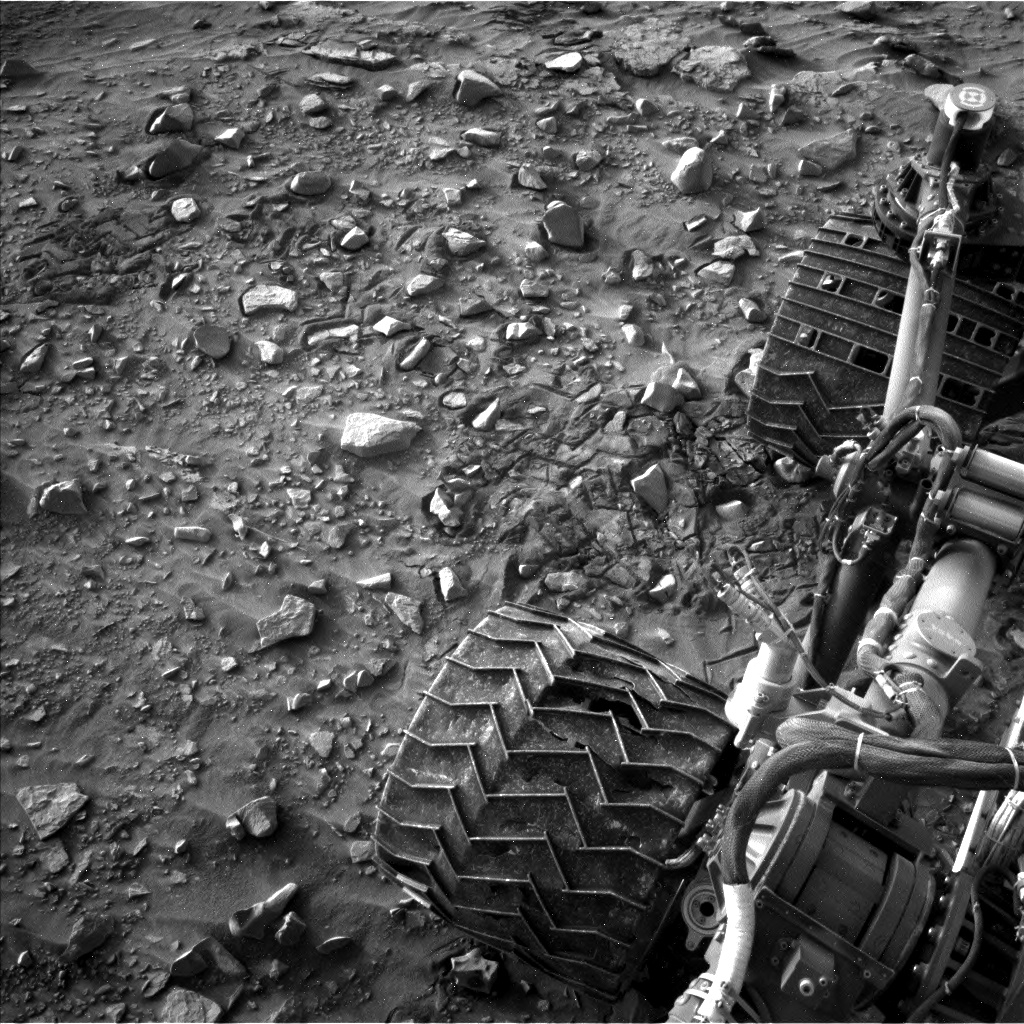
Curiosity Left B Navigation Camera image taken on Sol 3449, April 20, 2022.
Credit: NASA/JPL-Caltech
Warm season
But there was a problem that required discussion, Schwenzer adds.
A recent plan was originally a ‘touch-and-go’ sol, where the robot puts the Alpha Particle X-Ray Spectrometer (APXS) down for a short integration before driving away.
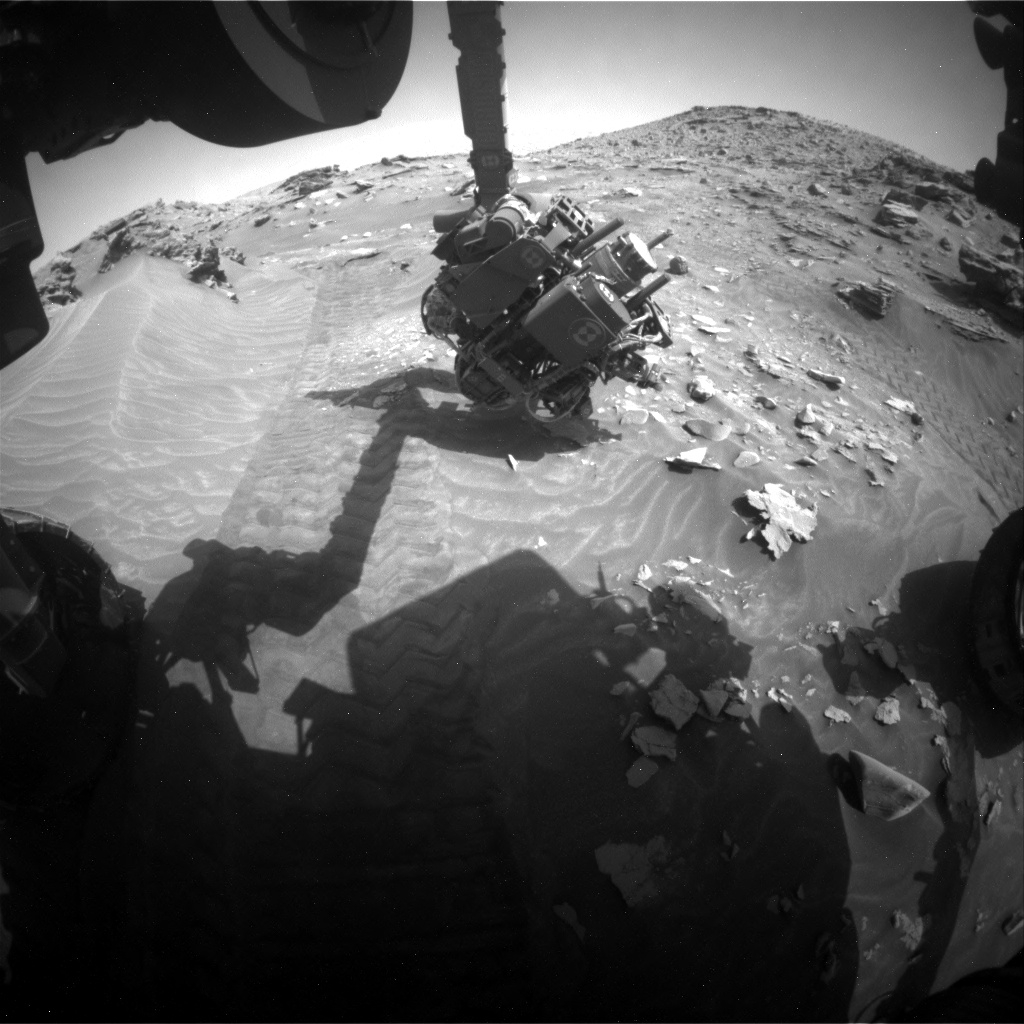
Curiosity Front Hazard Avoidance Camera Left B photo acquired on Sol 3449,April 19, 2022.
Credit: NASA/JPL-Caltech
“Those ‘touch-and-go’ measurements return brilliant analysis throughout most of the Martian seasons,” Schwenzer explains, “but right now we are in a warm season, and that means it’s too warm for really good data at the time those ‘touch-and-go’ measurements are happening.”
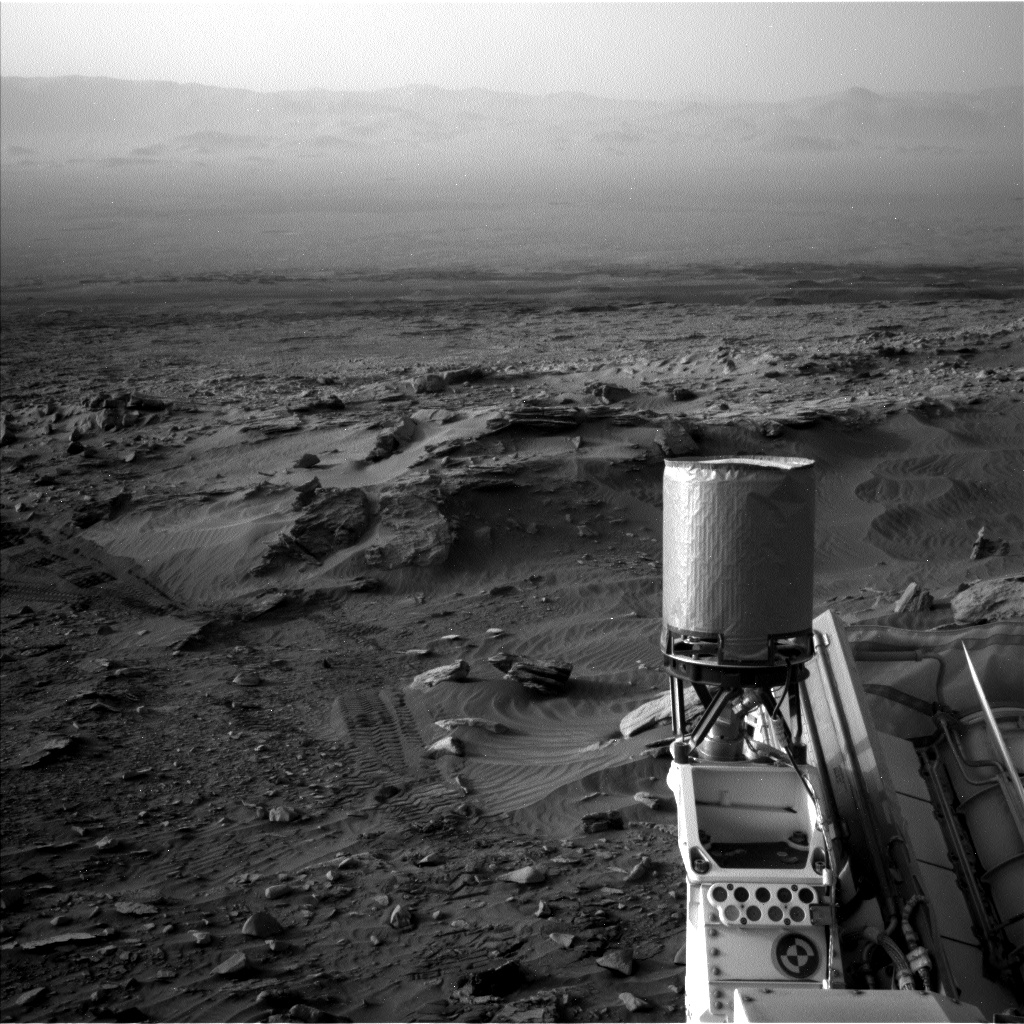
Curiosity Left B Navigation Camera image taken on Sol 3449, April 20, 2022.
Credit: NASA/JPL-Caltech
Different rock types
Therefore the science team discussed carefully how important the target is, and if it warrants the rover to stay in place to get the APXS measurement at a colder time of the day, and therefore get the best possible data quality.
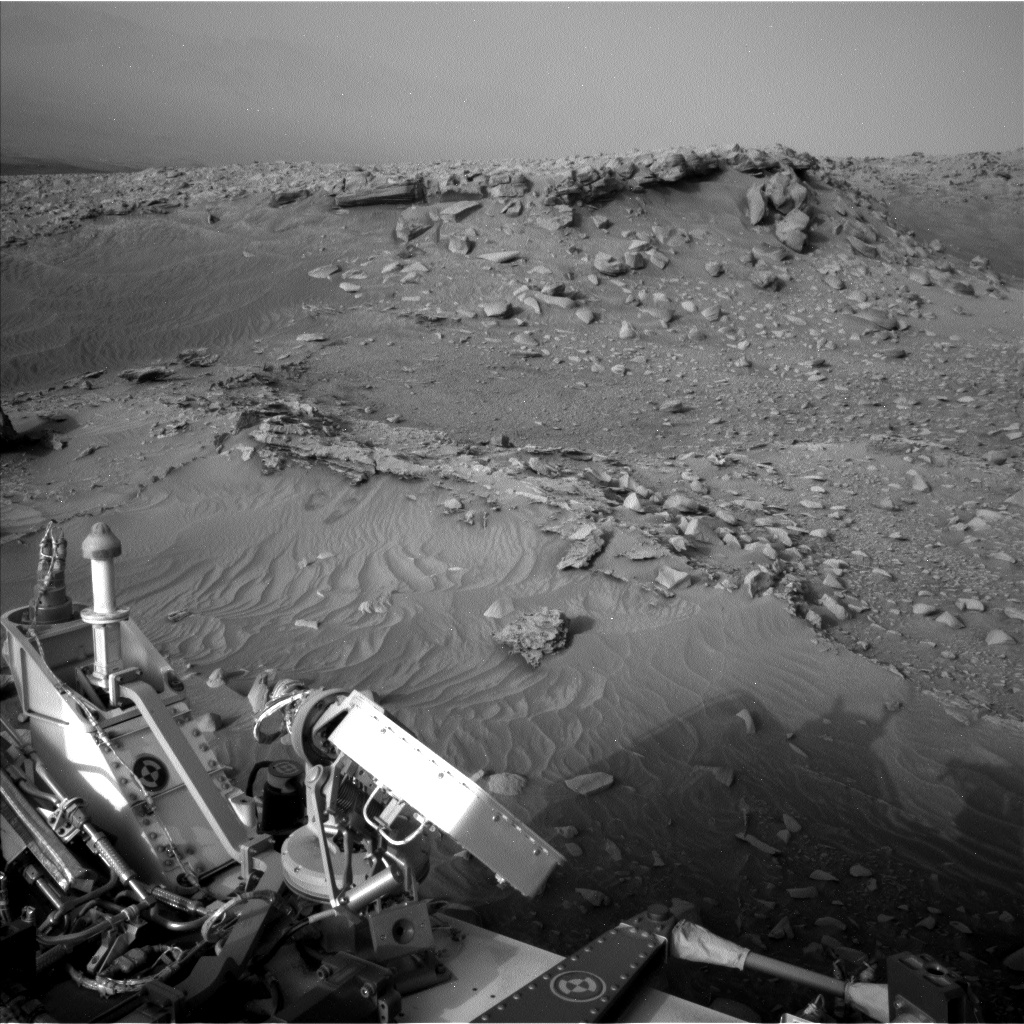
Curiosity Left B Navigation Camera image taken on Sol 3449, April 20, 2022.
Credit: NASA/JPL-Caltech
“Once again, rover progress had to be weighed against the importance of the data. We decided the diversity of the region and the quality of the targets, together with the hypothesis on the different rock types and their formation we can test here warrants us to stay,” Schwenzer notes.
Data feast
As a result there is a plethora of science activities in the plan, and the team is looking forward to have another data feast over the weekend -and of course to seeing the data.
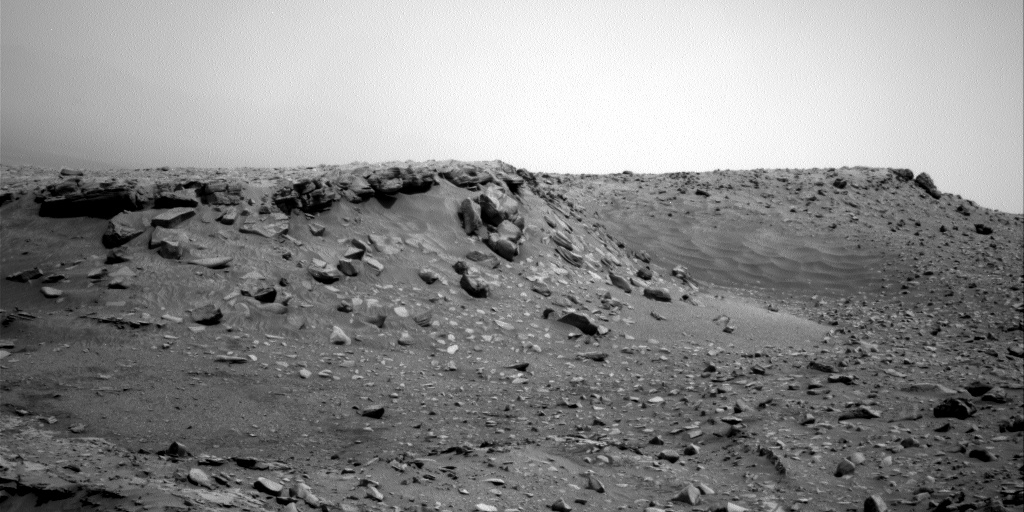
Curiosity Right B Navigation Camera image taken on Sol 3450, April 20, 2022.
Credit: NASA/JPL-Caltech
Here are the details:
APXS and the Mars Hand Lens Imager (MAHLI) have two and three activities, respectively.
“The pancake-shaped rock the rover is parked on will be brushed and investigated with APXS and MAHLI on a target called ‘Shandon.’ APXS and MAHLI are also investigating the edge of the bedrock on a target called ‘Nesting,’ which is at the edge of the big, flat rock and allows side-on view,” Schwenzer reports.
Curiously bright
Finally, MAHLI is looking at ‘Rumblings,’ which is a curiously bright and textured target that the team thinks might be alteration features and would like to know more about. MAHLI will likely also allow for APXS in a future plan, despite the targets being a bit spikey.
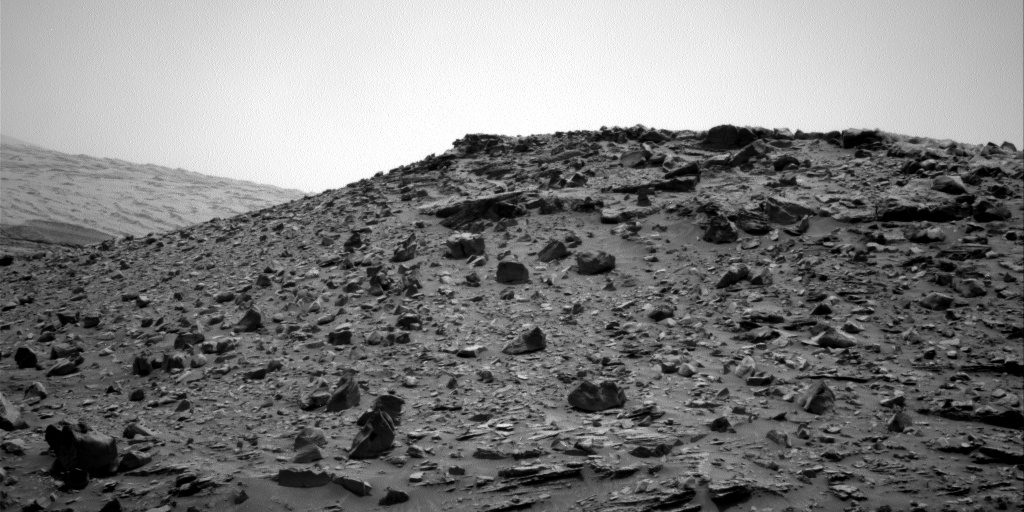
Curiosity Right B Navigation Camera image taken on Sol 3450, April 20, 2022.
Credit: NASA/JPL-Caltech
“The MAHLI images will show if we can get APXS to touch in a safe way, but of course, MAHLI images are always welcome science data, too, especially on textured targets like this one,” Schwenzer points out.
Chemistry and Camera (ChemCam) is investigating two targets, ‘Tonga,’ which is on the bedrock and ‘Kirby Lonsdale,’ a vein target.
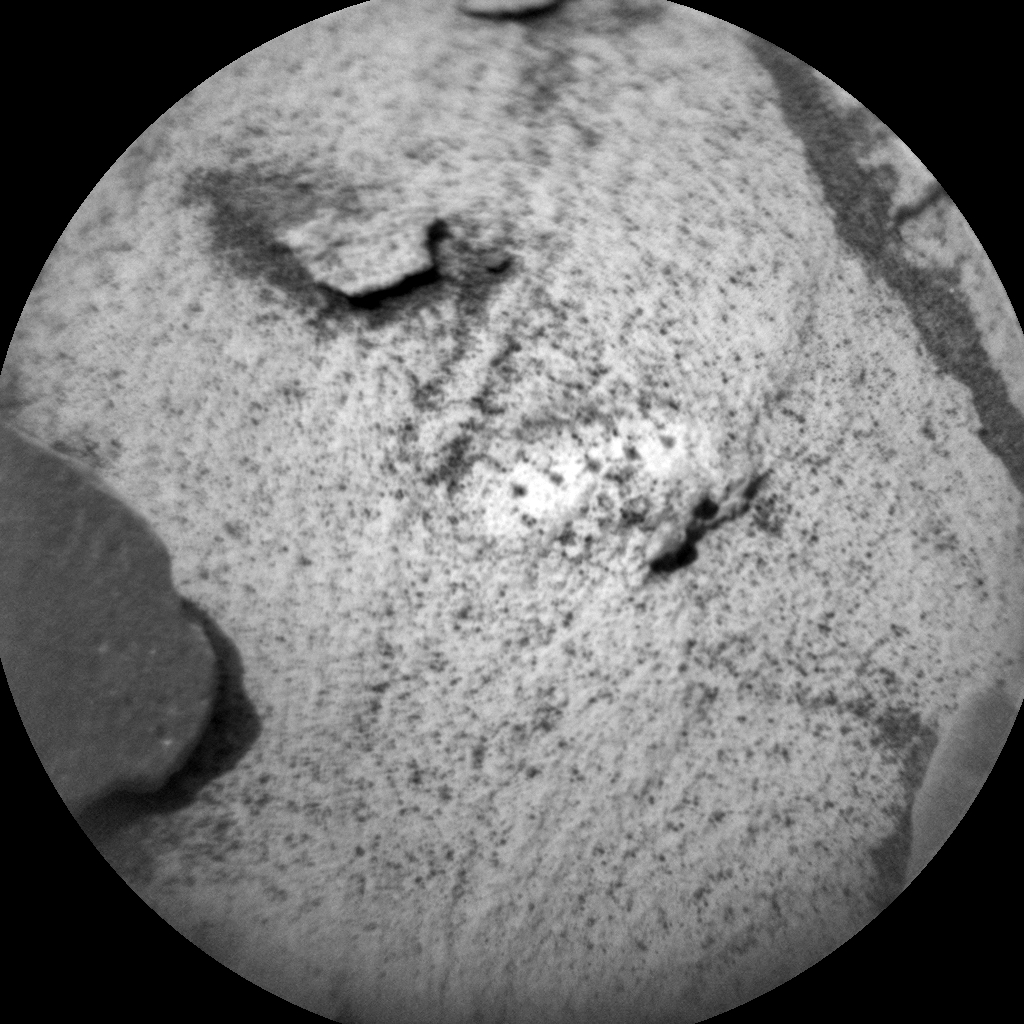
Curiosity Chemistry & Camera (ChemCam) Remote Micro-Imager (RMI) photo acquired on Sol 3450, April 20, 2022.
Credit: NASA/JPL-Caltech/LANL
Multispectral investigation
“Mastcam is taking documentation images of the two ChemCam targets and doing a multispectral investigation on the brushed area,” Schwenzer adds. “More Mastcam images are planned in form of a 16×4 mosaic on the target ‘Onich Dry Gorge,’ which was imaged from a distance and we are now getting much higher resolution images from a closer distance.”
ChemCam is adding to the images through a long distance Remote Micro-Imager (RMI) and an RMI of rocks broken up by the rover wheels.
“Lots of data and images, and more to come over the weekend at this interesting location,” Schwenzer concludes.
 Posted in
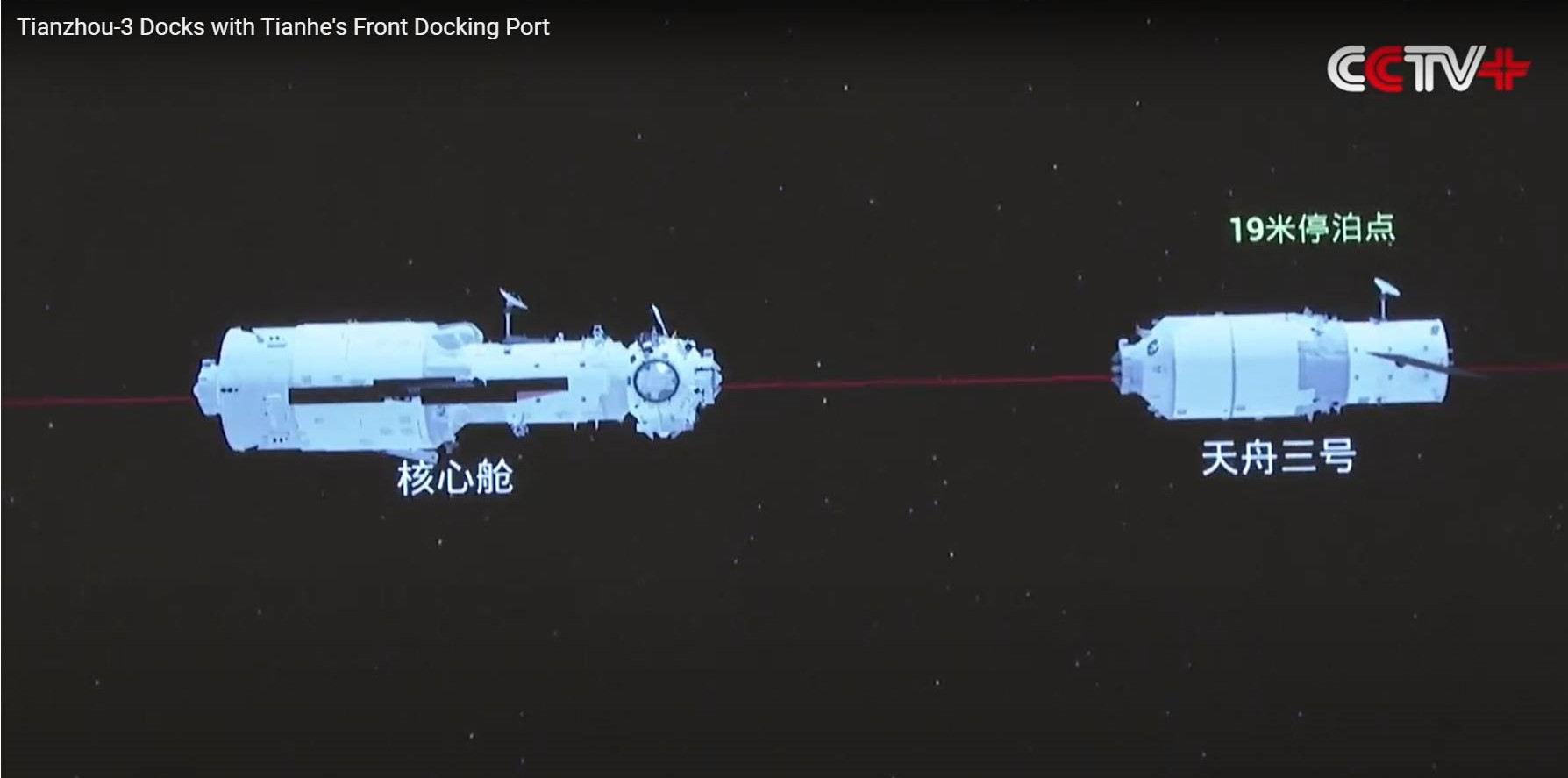
China’s cargo spacecraft Tianzhou-3 docked with Tianhe’s front docking port on Wednesday.
Artwork: CCTV/Inside Outer Space screengrab
China’s Tianzhou-3 cargo ship detached on Wednesday from the rear docking port of the country’s space station core module Tianhe. It moved to the module’s front port and completed a computer-orchestrated rendezvous and docking, according to the China Manned Space Agency (CMSA).
CMSA also reported that the combination of Tianhe and Tianzhou-3 is in good condition.
Now in this configuration, the next step is the upcoming launch of the Tianzhou-4 cargo craft, the Shenzhou-14 manned spaceship and the lab module Wentian.
A total of six missions are planned for this year, including the launch of the Tianzhou-4 cargo spacecraft in May, the Shenzhou-14 manned spacecraft in June, the lab module Wentian in July, and the lab module Mengtian in October.
The three modules will form a T shape to complete the in-orbit construction of China’s space station by the end of 2022.
Short video at: https://youtu.be/2m9alrJZ0ck
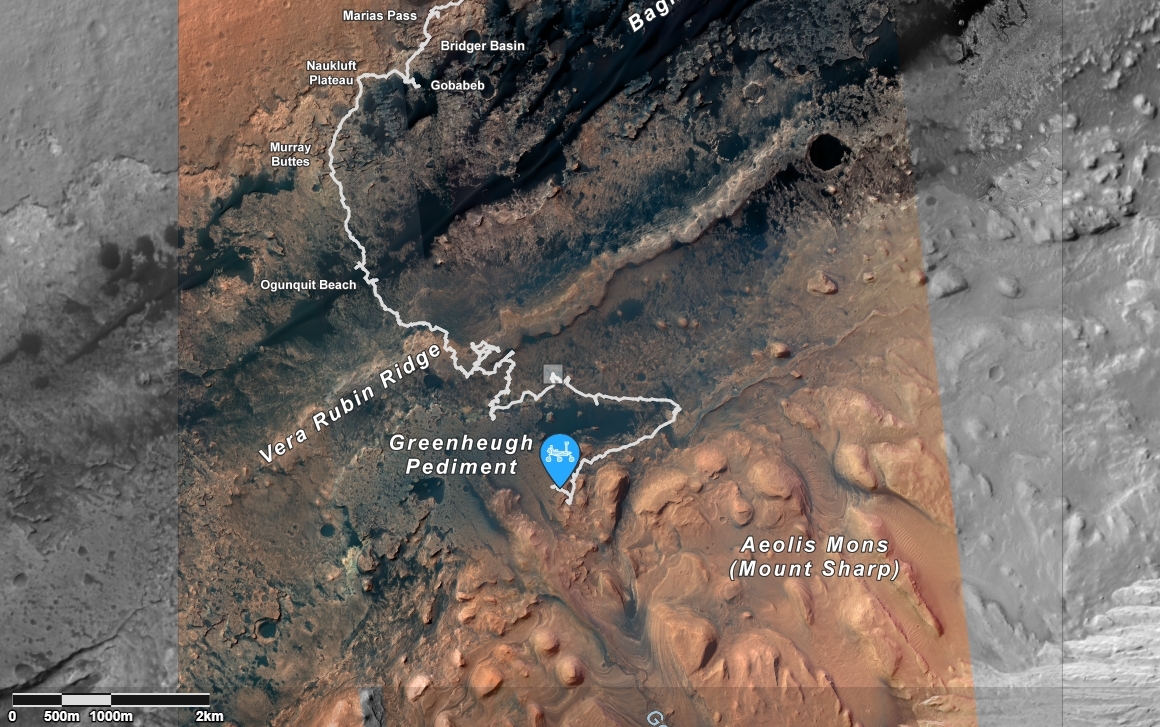
Curiosity’s location as of Sol 3447. Distance driven to that time is 17.11 miles/27.54 kilometers.
Credit: NASA/JPL-Caltech/Univ. of Arizona
NASA’s Curiosity Mars rover at Gale Crater is now performing Sol 3449 duties.
“Due to some complex terrain, the rover’s last drive came up about ten meters short of the target destination,” reports Mariah Baker, a planetary geologist at the Center for Earth & Planetary Studies within the Smithsonian National Air & Space Museum.
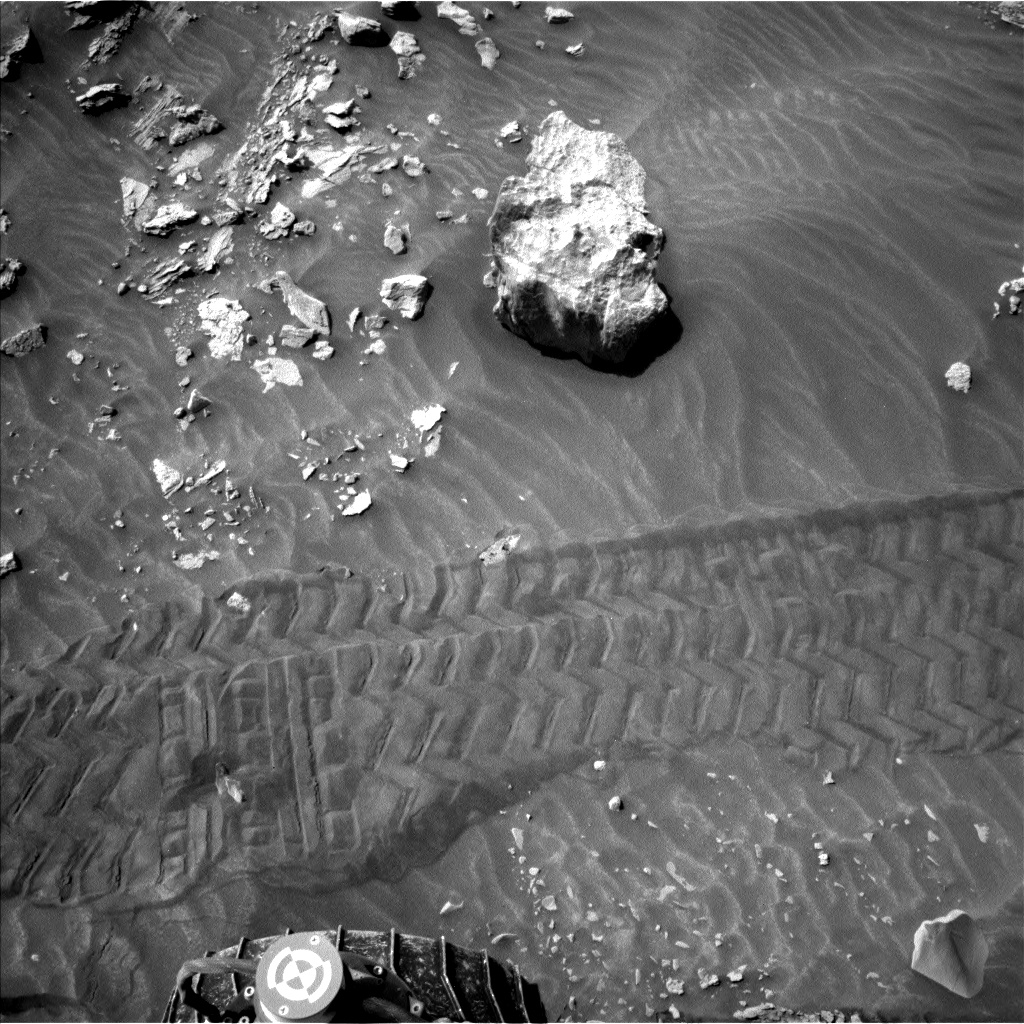
Curiosity Left B Navigation Camera image taken on Sol 3448, April 18, 2022.
Credit: NASA/JPL-Caltech
“The rover’s unexpected parking orientation unfortunately will not allow our usual uplink direct from Earth. We can instead send the weekend’s commands through one of the orbiters at Mars, but a little later than planned,” Baker adds.
Sand and rocks
As a result, a recently scripted plan for Sols 3446-3448 had to be adjusted accordingly. Weekend plans typically include three sols of science, Baker notes, but all the activities for this last weekend had to occur with the second and third sols only.
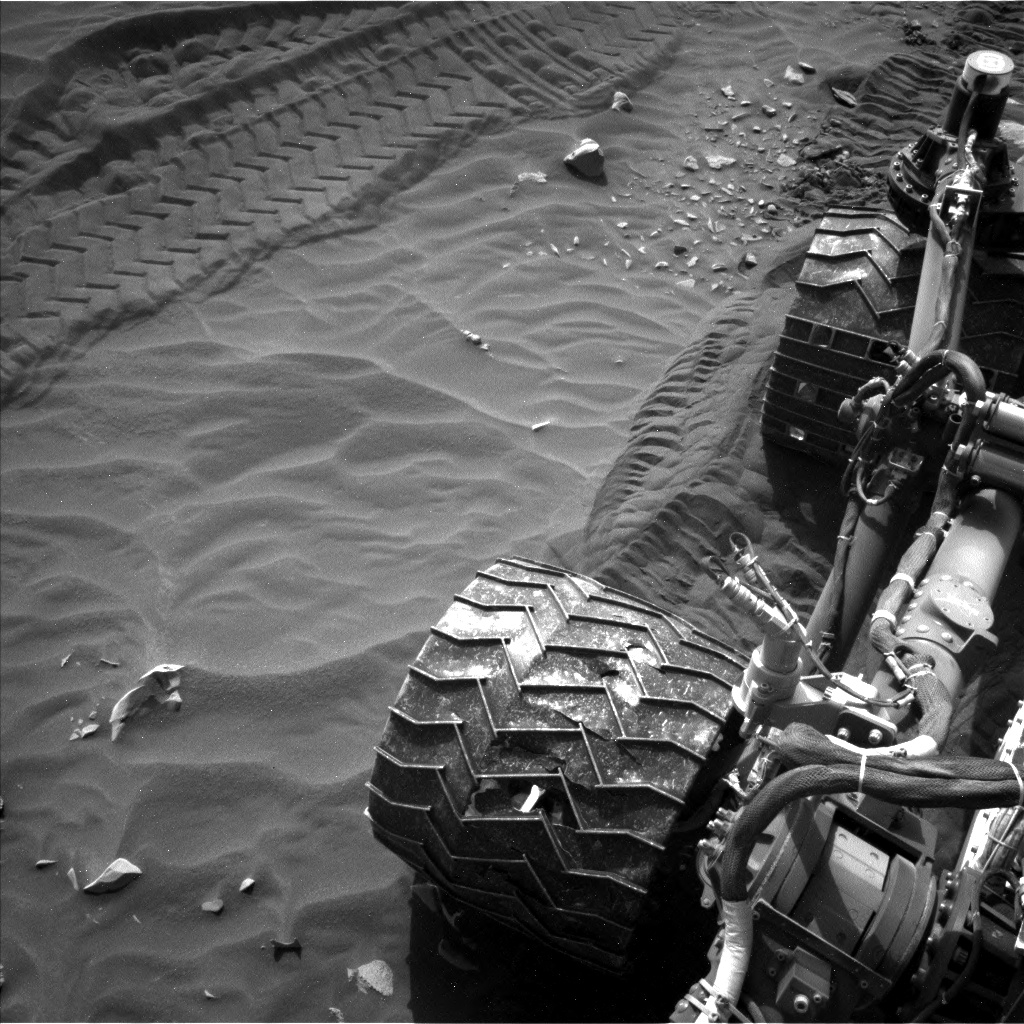
Re-imaging wheel tracks that the rover made during its initial traverse of this area over a month ago. This image was taken by Left Navigation camera on Sol 3444. Credits: NASA/JPL-Caltech
Luckily, the primary targeted science block on the second sol was increased from one hour to two hours, providing ample time to acquire data at this location before driving away, Baker pointed out.
This block was filled with remote science activities to characterize sand and rocks in the rover’s workspace.
Sedimentary textures
A Chemistry and Camera (ChemCam) Laser Induced Breakdown Spectroscopy (LIBS) activity was planned on bedrock target “Easter Skeld,” and two ChemCam Remote Micro-Imager (RMI) mosaics will be used to target the distant Gediz Vallis Ridge.
Three Mastcam stereo mosaics were planned to document the surface around the LIBS target, Baker explains, to characterize some nearby sand ripples, and to extend coverage over interesting sedimentary textures in the target “Lugar Rocking Stone.”
Curiosity’s Mastcam will also be used to re-image wheel tracks that the rover made during its initial traverse of this area over a month ago to search for any wind-driven changes in the tracks.
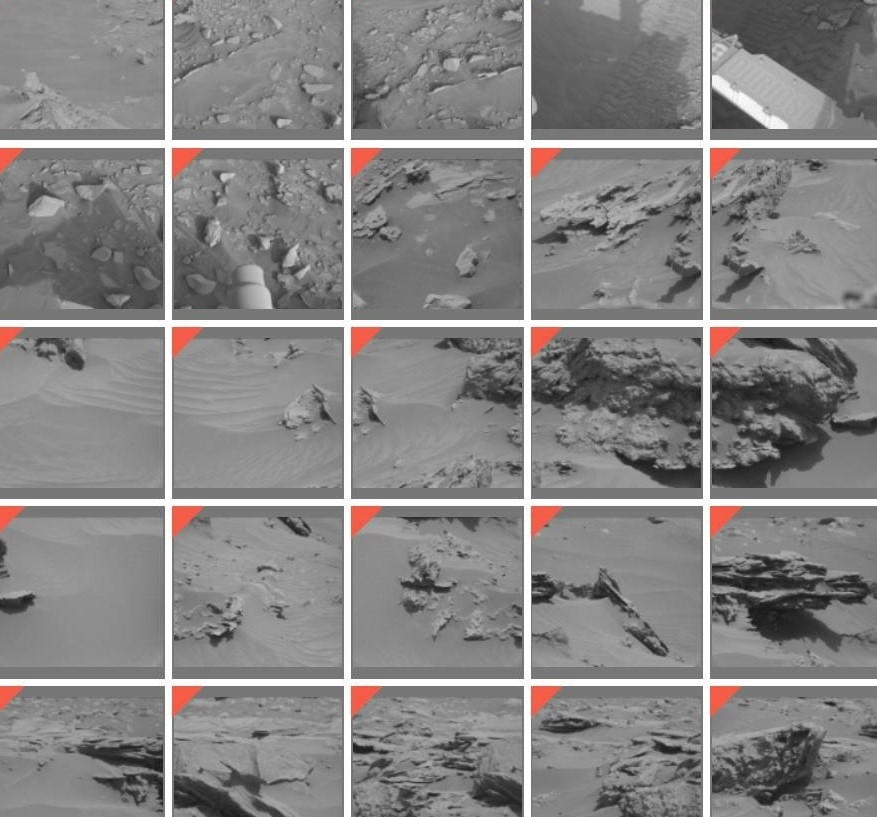
Mast Camera Left and Right images taken on Sol 3447 April 17, 2022.
Credit: NASA/JPL-Caltech/MSSS
Untargeted science block
The untargeted science block on the third sol also contains a single ChemCam AEGIS observation. AEGIS stands for Autonomous Exploration for Gathering Increased Science) – a software suite that permits the rover to autonomously detect and prioritize targets.
The team decided to forego weekend Alpha Particle X-Ray Spectrometer (APXS) activities due to the changes in the plan, but three sets of Mars Hand Lens Imager (MAHLI) photos were still scheduled on soil target “Bains Beach,” a small rock named “Spiggie Beach,” and one of the rover’s wheels.
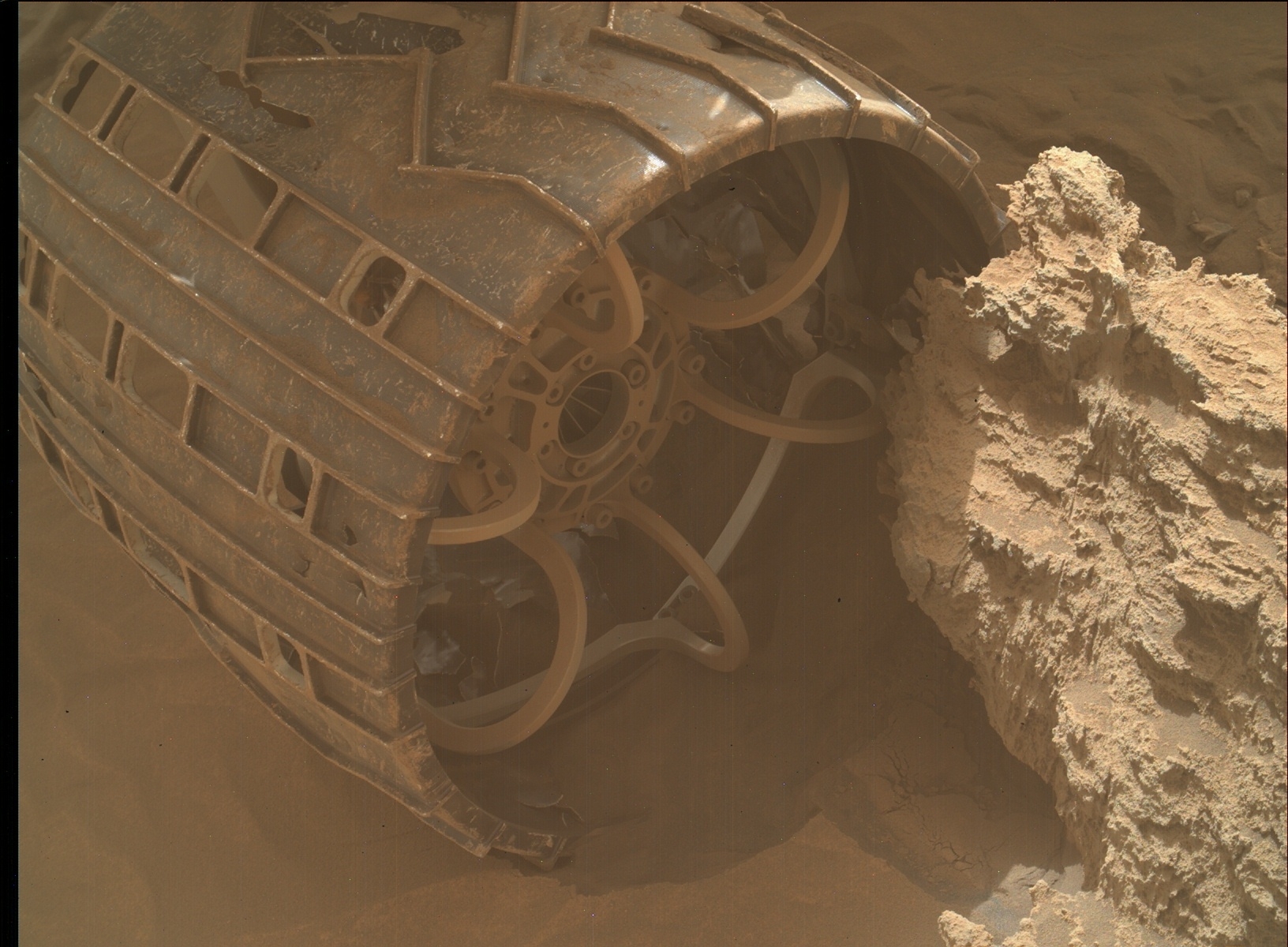
Curiosity Mars Hand Lens Imager (MAHLI) photo produced on Sol 3447, April 17, 2022.
Credit: NASA/JPL-Caltech/MSSS
Environmental conditions
Over the weekend, the rover was scheduled to also collect a large amount of data on current environmental conditions.
The team planned three Mastcam “tau” images, a Mastcam image of the crater rim, and a Navcam “Line of Sight” image, all of which will be used to quantify the amount of dust in the atmosphere, Baker reports.
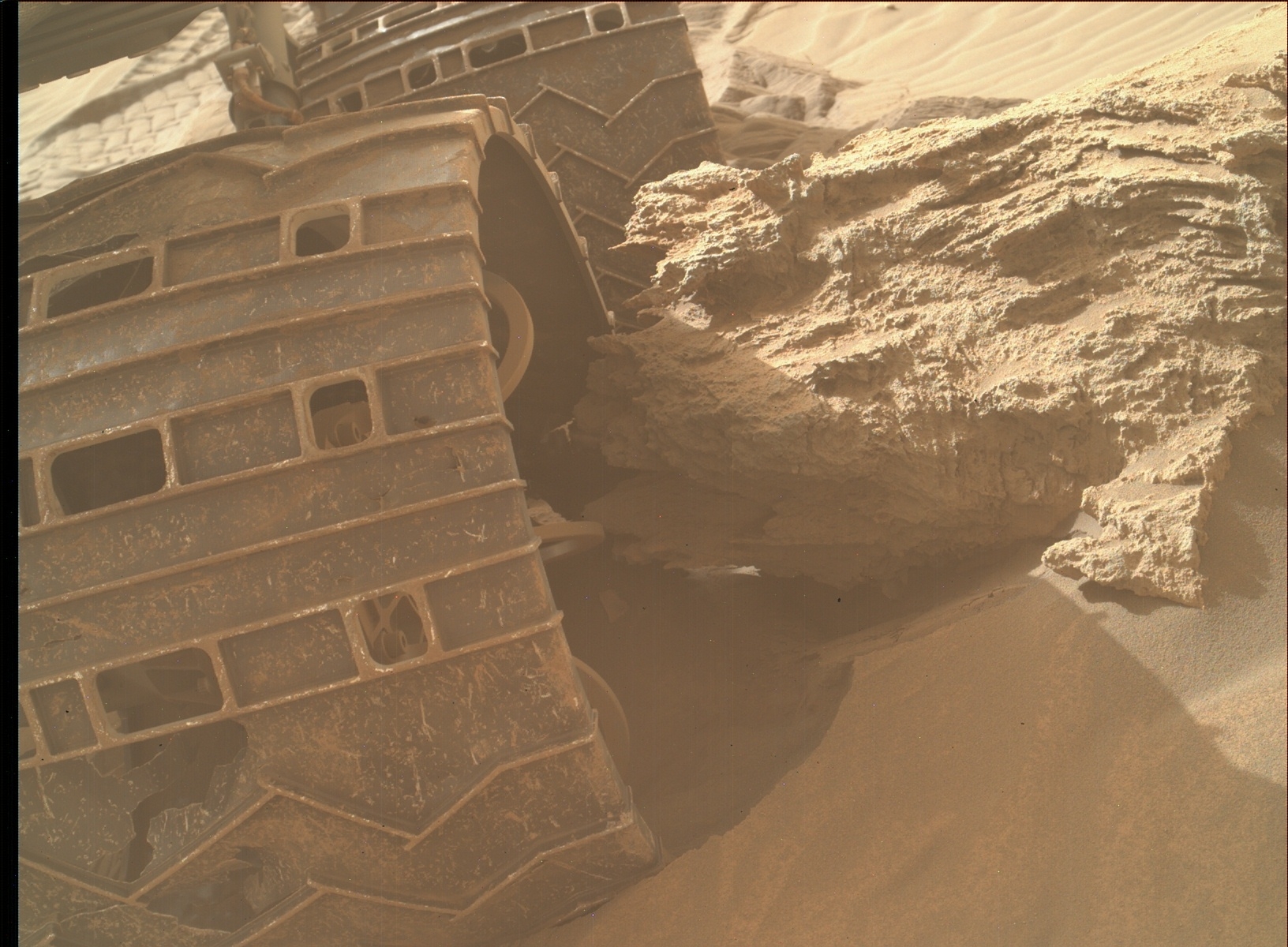
Curiosity Mars Hand Lens Imager (MAHLI) photo produced on Sol 3447, April 17, 2022.
Credit: NASA/JPL-Caltech/MSSS
A Navcam dust devil movie was also slated to be acquired, and four Navcam movies will help characterize cloud motion.
“So, although today’s plan is not necessarily typical for a weekend on Mars,” Baker concludes, the rover still had a full workload.

Credit: CMS/CCTV/Inside Outer Space screengrab
China’s space station development is heading for the next stage of assembly, and upon completion later this year, more space missions are expected to be carried out in the future.
China announced on Sunday it will send its next spaceflight crew to the Tiangong space station in June following the successful return of the three astronauts of the Shenzhou-13 mission on Saturday.
Complete construction
The China National Space Administration plans to complete the construction of the China Space Station in 2022 by adding the Wentian Experiment Capsule-1 and the Mengtian Experiment Capsule-2 to the Tianhe Core Module. Two Tianzhou cargo spacecraft will provide supplies for the astronauts of the Shenzhou-14 and Shenzhou-15 crew spacecraft.
The Wentian lab module will be launched in July and Mengtian in October, Hao Chun, director of the China Manned Space Agency, said at the press conference.
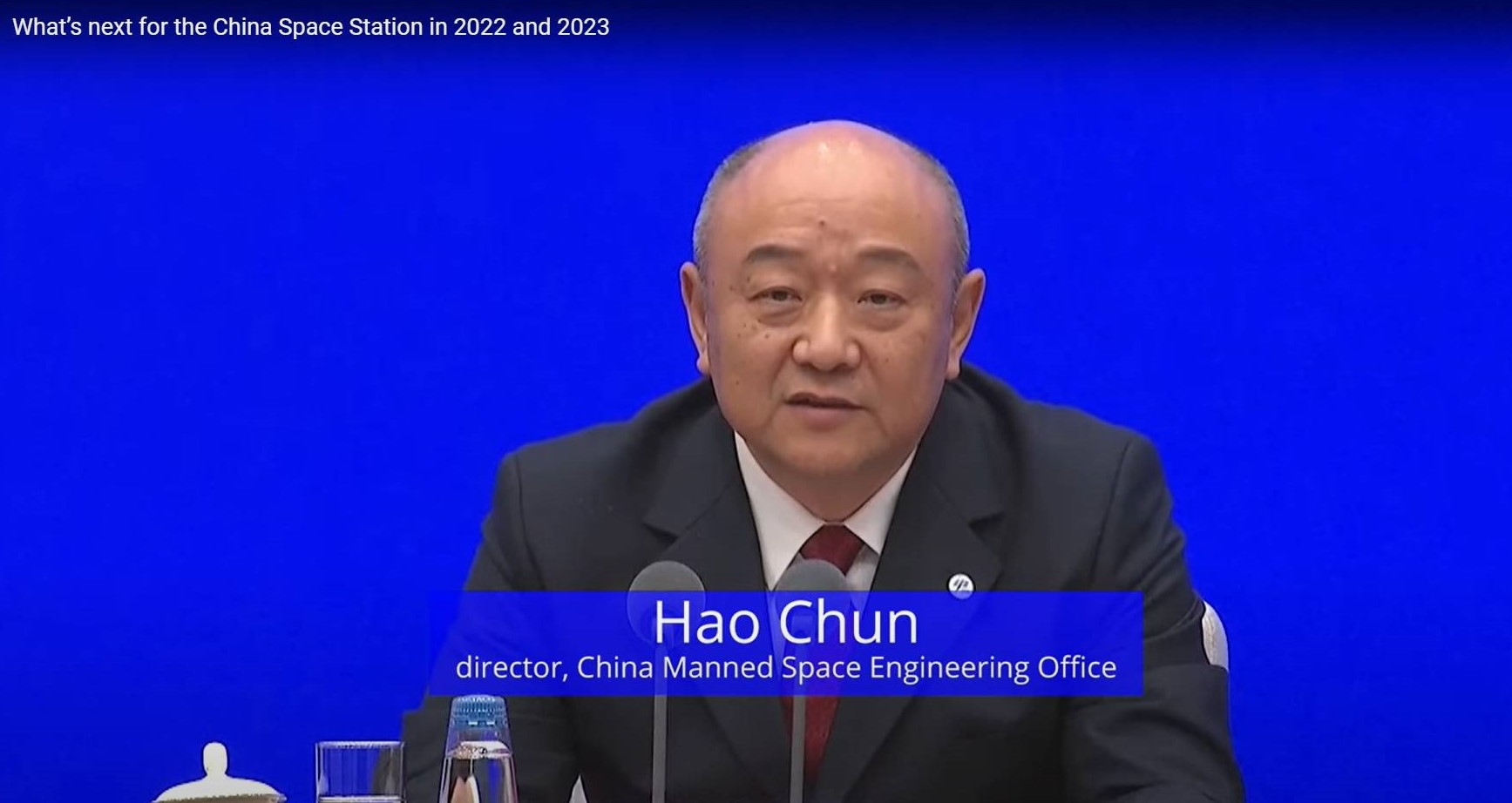
Credit: China National Space Administration (CNSA)/China Media Group(CMG)/China Central Television (CCTV)/Inside Outer Space screengrab
The Shenzhou-14 crew will witness the arrival of two lab modules during their stay in orbit.
The Shenzhou-15 crew will fly to the space station before the end of this year and join the Shenzhou-14 crew in space. At that time, the space station will consist of three modules, two manned spacecraft and one cargo spacecraft, with a total mass of nearly 100 tons.
Training and preparation
The two crews of the Shenzhou-14 and Shenzhou-15 have been selected and they are actively carrying out relevant training and preparation.
“The two crews of the Shenzhou-14 and Shenzhou-15 will stay in orbit for six months respectively, and they will carry out in-orbit rotation for the first time. The six astronauts will stay together in orbit for 5 to 10 days,” said Huang Weifen, chief designer of the astronaut system under China’s manned space program.

Credit: China National Space Administration (CNSA)/China Media Group(CMG)/China Central Television (CCTV)/Inside Outer Space screengrab
Mechanical arm
“Once the space station is completed, astronauts will carry out experiments in space science, space materials, space medicine and space exploration in the two experimental modules. The experimental modules, together with the core module, can also support the life of six astronauts when the two manned spacecrafts dock with the space station,” said Yang Hong, chief designer of the space station under China’s manned space program.
In addition, a small mechanical arm can be used alone or in combination with the large mechanical arm of the core module to jointly complete tasks such as space extravehicular activities, and maintenance and inspection of extravehicular experimental equipment,” said Yang.

Credit: China Central Television (CCTV)/China National Space Administration (CNSA)/United Nations Office for Outer Space Affairs (UNOOSA)/China Manned Space Agency (CMSA)/Inside Outer Space screengrab
China also plans to launch the country’s first space telescope named Xuntian next year to conduct wide-field sky surveys.
Xuntian, or Surveying the Sky, will fly alongside the Tiangong station.
“The telescope will conduct frontier scientific research in the universe’s formation and evolution, dark matter and dark energy, exoplanets and solar system objects, and is expected to secure a batch of major innovative breakthroughs,” said Hao.
Go to video at:
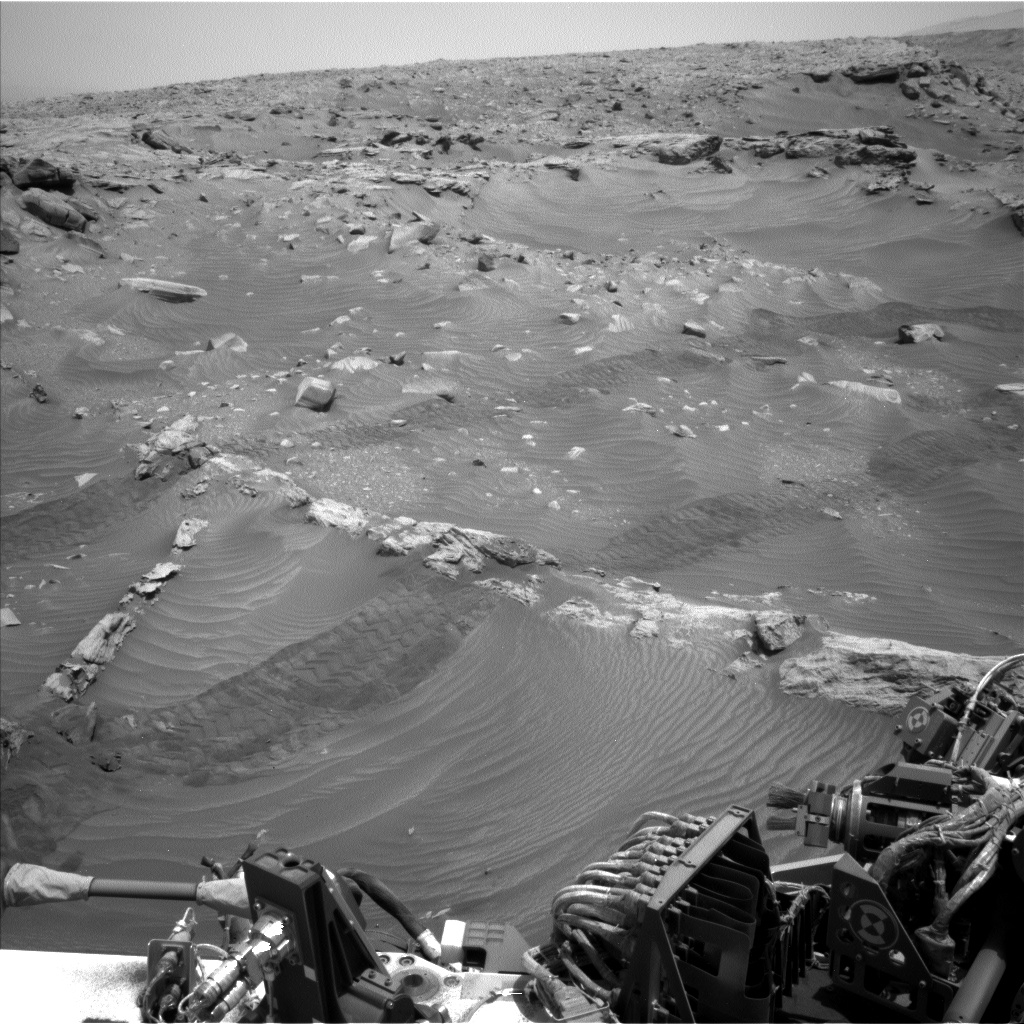
The curious case of cross-cutting ridges. This image was taken by Curiosity’s Left Navigation Camera on Sol 3440 April 10, 2022
Credit: NASA/JPL-Caltech
NASA’s Curiosity Mars rover at Gale Crater is now performing Sol 3446 duties.
“The curious case of cross-cutting ridges,” reports Sean Czarnecki, a planetary geologist at Arizona State University in Tempe, Arizona.
The rover has been focusing on examination of the linear ridges that cross-cut the local terrain.
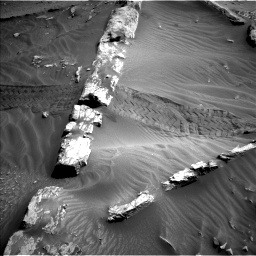
Curiosity Left B Navigation Camera image taken on Sol 3444, April 14, 2022.
Credit: NASA/JPL-Caltech
“These raised ridges look like boxes with their lids cut off and mostly buried in the local bedrock, and all we can see are the vertical box faces sticking up out of the ground,” Czarnecki adds. How these structures actually form is an active area of investigation, and Mars researchers hope the data gathered will help them “think outside the box” and shed some light on their origin.
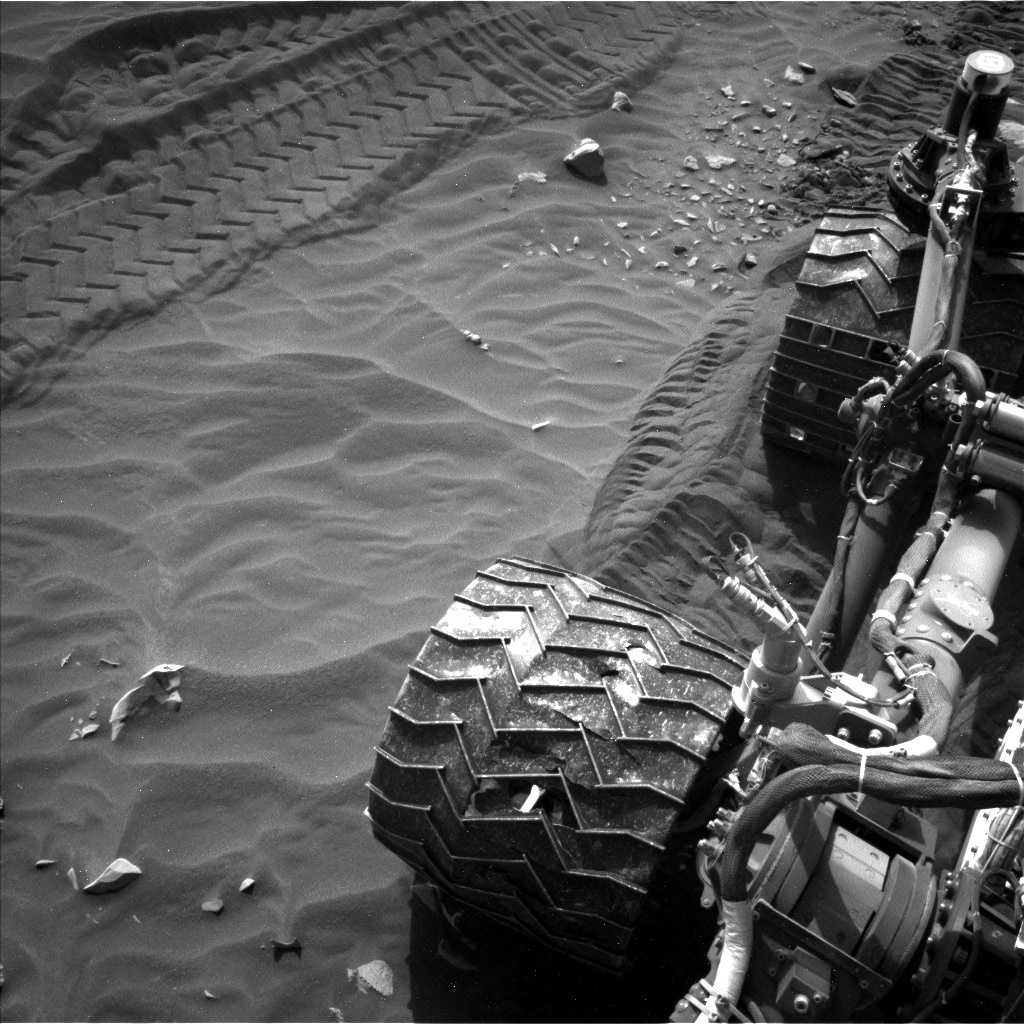
Curiosity Left B Navigation Camera image taken on Sol 3444, April 14, 2022.
Credit: NASA/JPL-Caltech
A recently scripted plan includes use of the Alpha Particle X-Ray Spectrometer (APXS) and the Mars Hand Lens Imager (MAHLI) on the target “Dun,” Chemistry & Camera (ChemCam) Laser Induced Breakdown Spectroscopy (LIBS) of “Ceres” (a target on Mars, not the dwarf planet!), and producing a ChemCam Remote Micro-Imager (RMI) mosaic of the Gediz Vallis ridge.
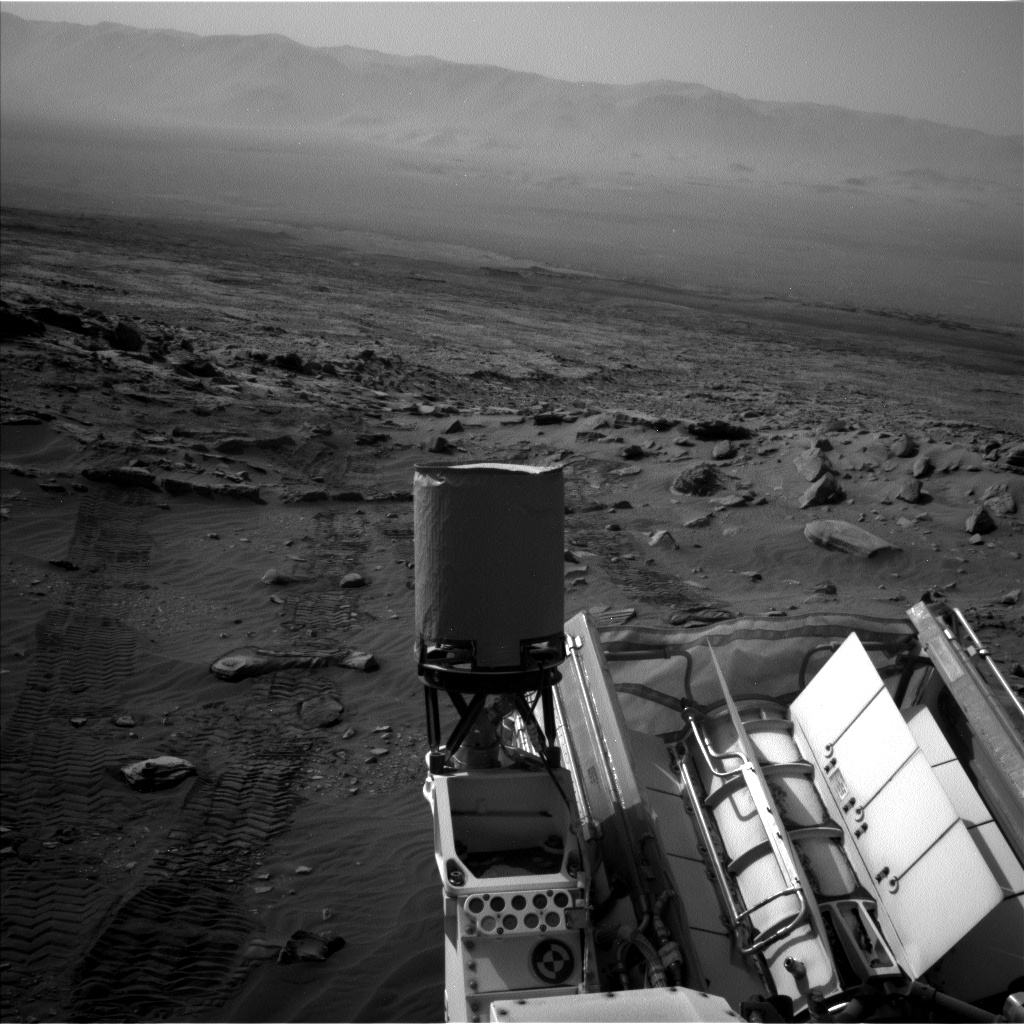
Curiosity Left B Navigation Camera image taken on Sol 3444, April 14, 2022.
Credit: NASA/JPL-Caltech
“Mastcam will be taking stereo images of targets ‘Feorachas’ and ‘Clavel’ as well as a mosaic of some old rover sand tracks to investigate surface granular processes,” Czarnecki reports.
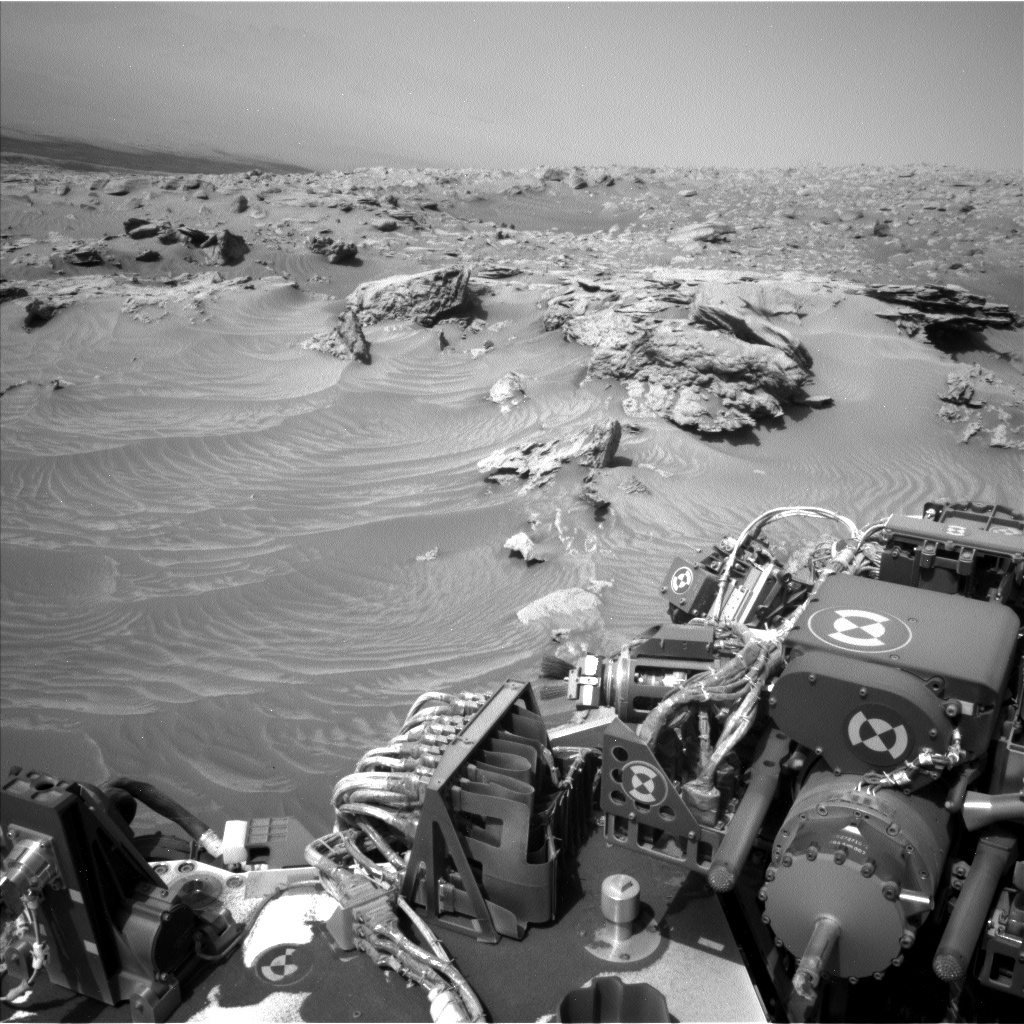
Curiosity Left B Navigation Camera image taken on Sol 3444, April 14, 2022.
Credit: NASA/JPL-Caltech
Mastcam and Navcam are making several dust devil observations among others, and of course Radiation Assessment Detector (RAD) Dynamic Albedo of Neutrons (DAN) and Rover Environmental Monitoring Station (REMS) are making their standard observations, Czarnecki concludes.
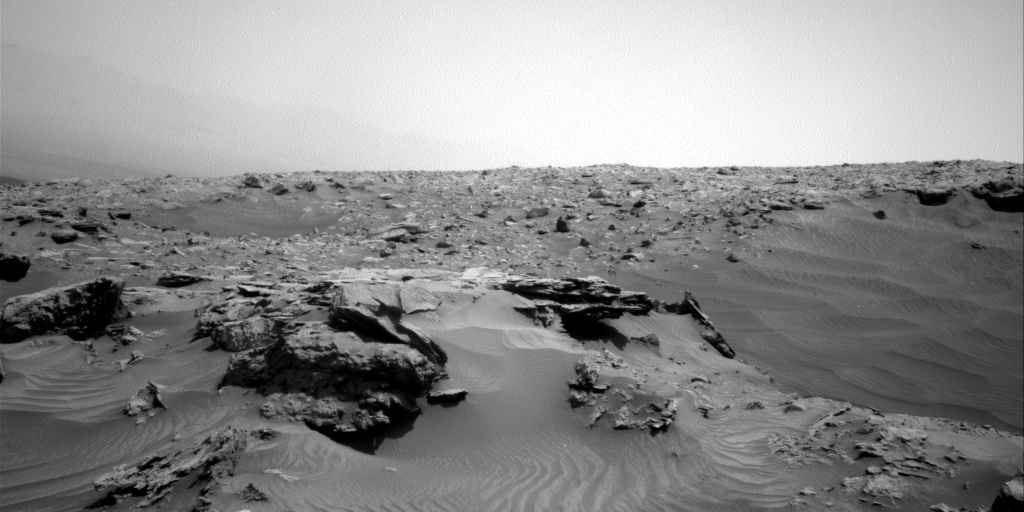
Curiosity Right B Navigation Camera photo taken on Sol 3445, April 15, 2022.
Credit: NASA/JPL-Caltech

Practicing ground recovery crews at the Shenzhou-13 Dongfeng landing site in north China’s Inner Mongolia.
Credit: CCTV/Inside Outer Space screengrab
The crew aboard China’s Shenzhou-13 mission are ready for leaving the space station core module, Tianhe, making a “fast return” to terra firma.
Ground crews at the slated Dongfeng landing site have wrapped up preparations for the return of the three astronauts, said the China Manned Space Agency.
The Shenzhou-13 crewed spacecraft, which has completed all its scheduled tasks, will separate from the space station core module Tianhe at an appropriate time and land at the Dongfeng landing site in north China’s Inner Mongolia, said the agency.
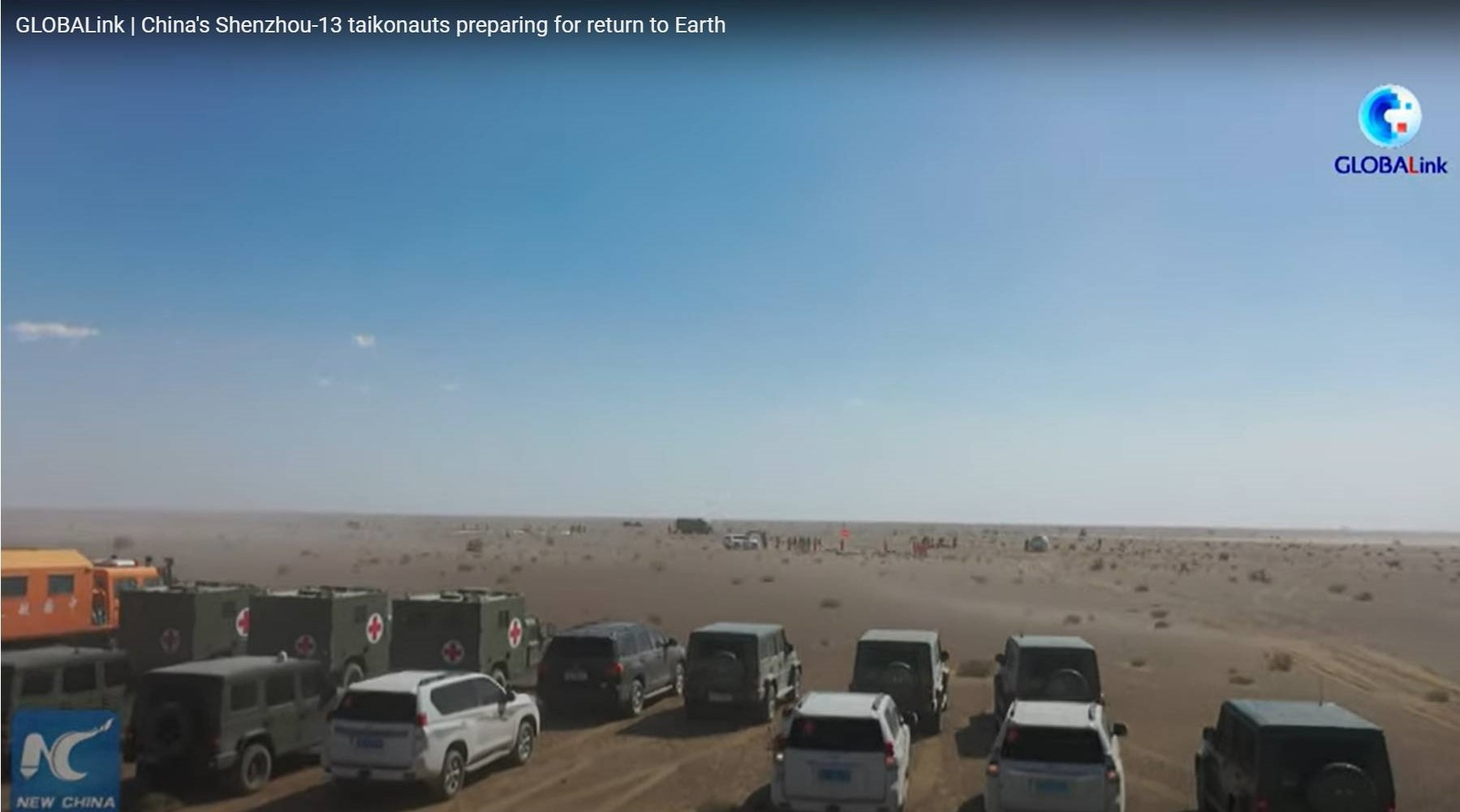
Credit: GLOBALink/Inside Outer Space screengrab
Yang Yanbo, deputy commander of the space mission team under the Beijing Aerospace Control Center, said Friday that the Shenzhou-13 crew — Zhai Zhigang, Wang Yaping and Ye Guangfu — are in good condition and ready for their return to Earth.
“The astronauts have been preparing their return for more than 10 days. The main task is to sort out some materials and transfer them. They need to ensure the samples of experiments can be carried back safely, some key materials used in our space station can be kept there and unnecessary ones can be transferred to the cargo spacecraft in advance. Now, all the astronauts are in good shape,” Yang said.
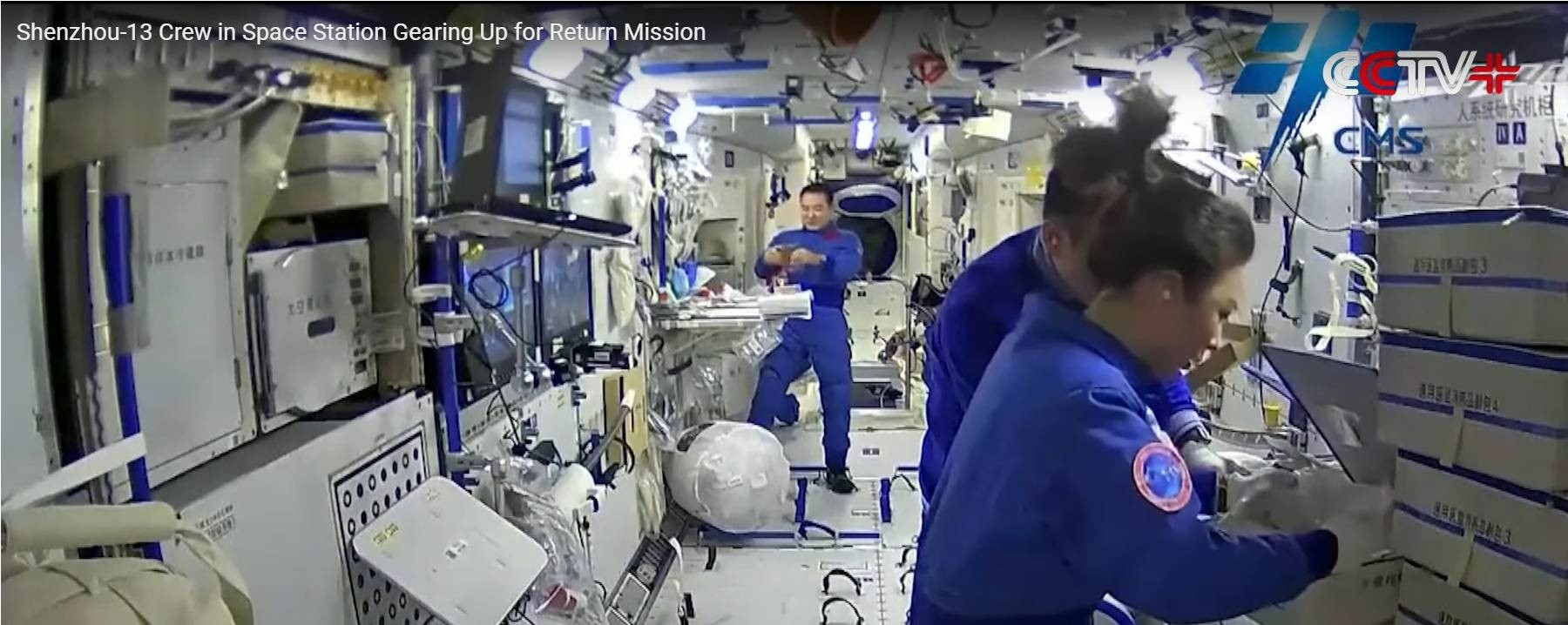
Packing up for return to Earth – Shenzhou-13 crew.
Credit: CCTV/Inside Outer Space screengrab
Landing site
Recovery ground crews are fully prepared, too, as search teams are on standby and multiple search and rescue plans have been elaborately worked out to improve efficiency.
According to China Central Television (CCTV) the Dongfeng Landing Site, located in the Ejin Banner of Inner Mongolia, spans some 13,000 square kilometers with the vast Gobi Desert to the west and its sparsely-populated flatlands to the east, and provides ideal terrain for helicopters to hover and safely land.
As the longest space mission of a Chinese crew – some 6 months – this trio of taikonauts entered China’s space station on Oct. 16, 2021. Meanwhile, this crew have also left some necessary items for the crew of Shenzhou-14 mission to live and work in China’s space station Tiangong.
Upon leaving, the Shenzhou-13 crew will switch the space station into unmanned flight mode and make sure all the equipment and devices are in normal operation, stated CCTV.
Credit: CCTV Video News Agency/Inside Outer Space screengrab
On-station work achievements
As noted by CCTV, during their almost six months’ mission in orbit so far, the Shenzhou-13 crew has completed two extravehicular activities (EVAs).
Zhai and Wang made a 6.5-hour space walk and successfully performed their tasks on November 7, while astronaut Ye stayed inside to support his crewmates in completing the operations.
It marked the first EVAs in Chinese space history involving a female astronaut.
On December 26, Zhai followed Ye who went outside of the space station first and stepped into space, while their teammate Wang Yaping remained inside to assist their operations.
After the two astronauts exited the core model, they coordinated to carry out the mission of lifting a panoramic camera outside the space station, the testing for manned goods transport, and the testing of the functions and performance of the core module airlock cabin, extravehicular suit, and mechanical arm.
Robotic arm work
In January, a transposition test on Tianzhou-2 cargo spacecraft was successfully completed by the robotic arm installed on the Tianhe core module. It was China’s first trial to relocate a large in-orbit spacecraft with a mechanical arm of the space station.
On Jan. 8, the Shenzhou-13 astronauts completed the manual rendezvous and docking experiment with the Tianzhou-2 cargo craft.
It was the first time that astronauts use hand-controlled teleoperation equipment in orbit to control rendezvous and docking between a cargo spacecraft and a space station.
The test preliminarily verified the function and performance of space station and the visiting spacecraft hand-controlled teleoperation system, offering valuable reference for future in-orbit assembly of the space station.
Credit: CCTV/Inside Outer Space screengrab
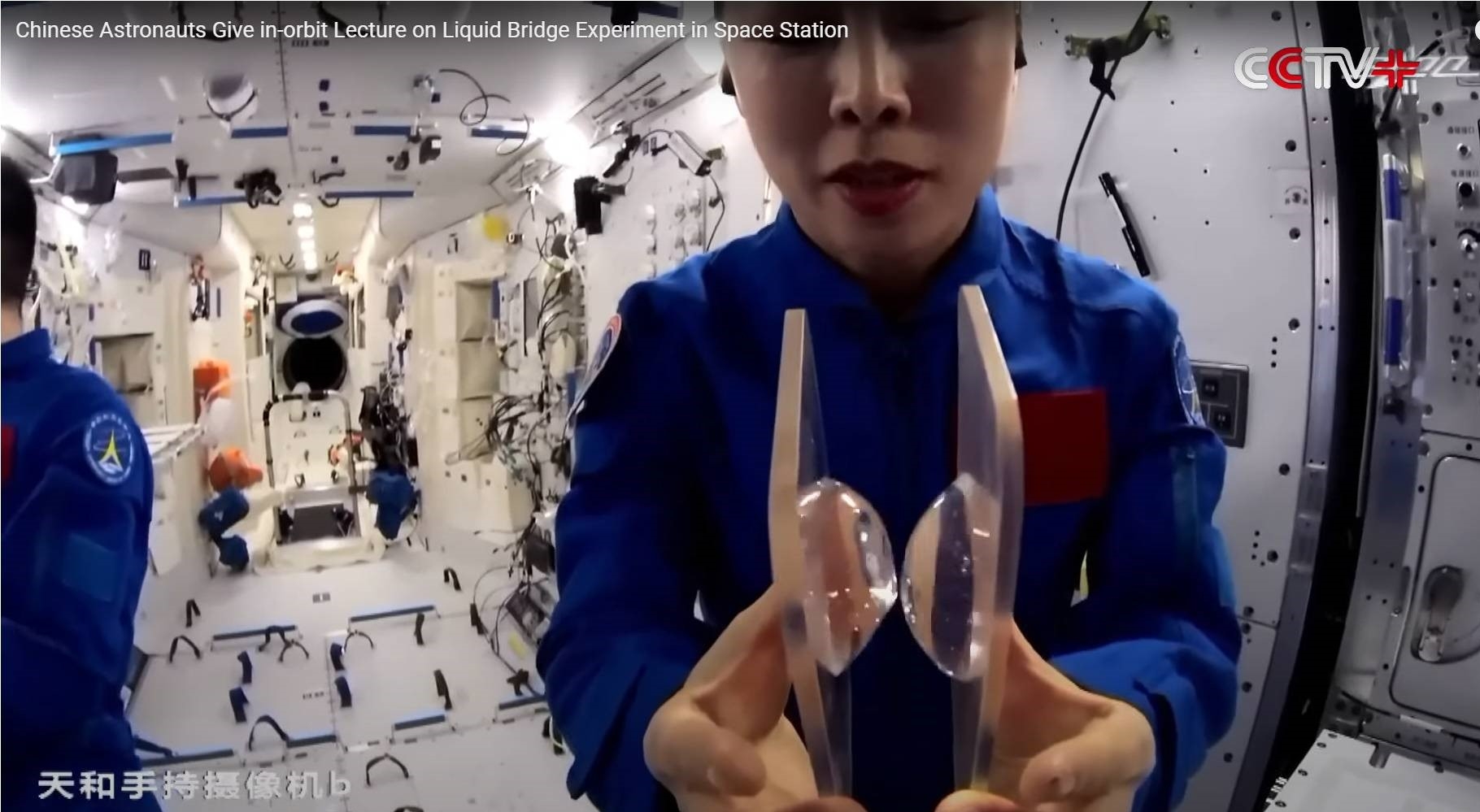
In addition to testing the key technologies for assembly and construction of China’s space station, the crew also livestreamed science lectures during their mission in space, reported CCTV.
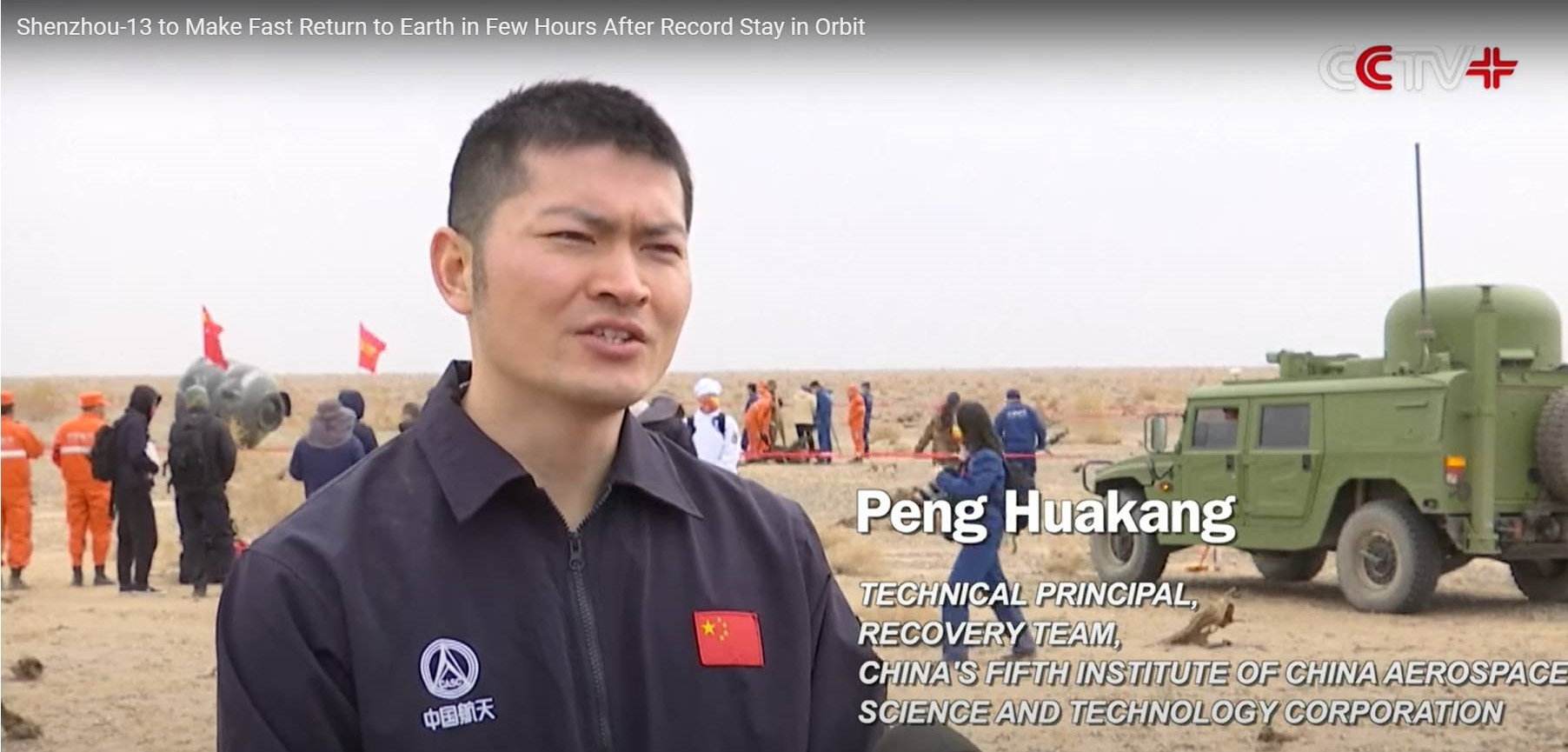
“After the astronauts successfully get out of the capsule, our recovery team will conduct a series of disposals on the capsule, and then take out some samples of the experiments and payloads brought down from the space station in the capsule in time, and hand them over to the relevant party. Then, an on-site measurement and evidence collection will be carried out on the status of a series of movements after the capsule landed. The final step is to dispose of the return capsule before transportation,” said Peng Huakang, technical principal of the recovery team from China’s Fifth Institute of China Aerospace Science and Technology Corporation.
Go to these new videos that show Shenzhou-13 landing preparations at:
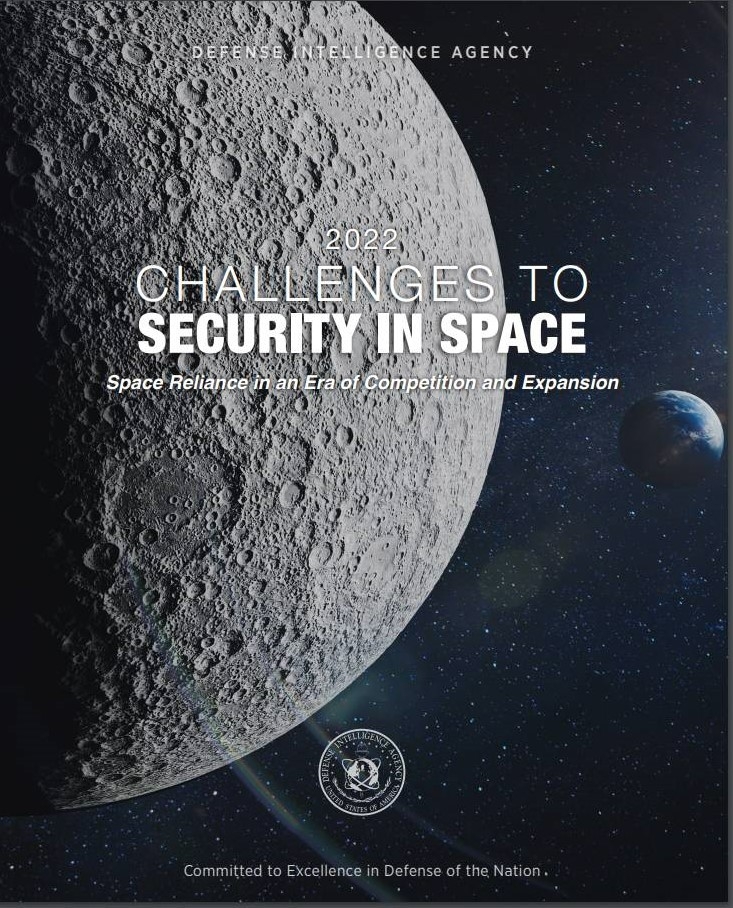
Challenges to Security in Space was first published by the U.S. Defense Intelligence Agency (DIA) in early 2019 to address the main threats to the array of U.S. space capabilities, and examine space and counterspace strategies and systems pursued primarily by China and Russia and, to a lesser extent, by North Korea and Iran.
A just-released second edition builds on that work and provides an updated, unclassified overview of the threats to U.S. space capabilities, particularly from China and Russia, as those threats continue to expand.
Since early 2019, competitor space operations have also increased in pace and scope worldwide, China’s and Russia’s counterspace developments continue to mature, global space services proliferate, and orbital congestion has increased.
Credit: DIA
New edition
As a result, DIA has published this new edition to:
- Expand its examination of competitor space situational awareness (SSA), and command and control (C2) capabilities;
- Detail the profiles of organizations operating space and counterspace systems based on new information;
- Deepen our characterization of new space and counterspace systems deployed and in development;
- Focus on China’s and Russia’s interests in exploring the Moon and Mars;
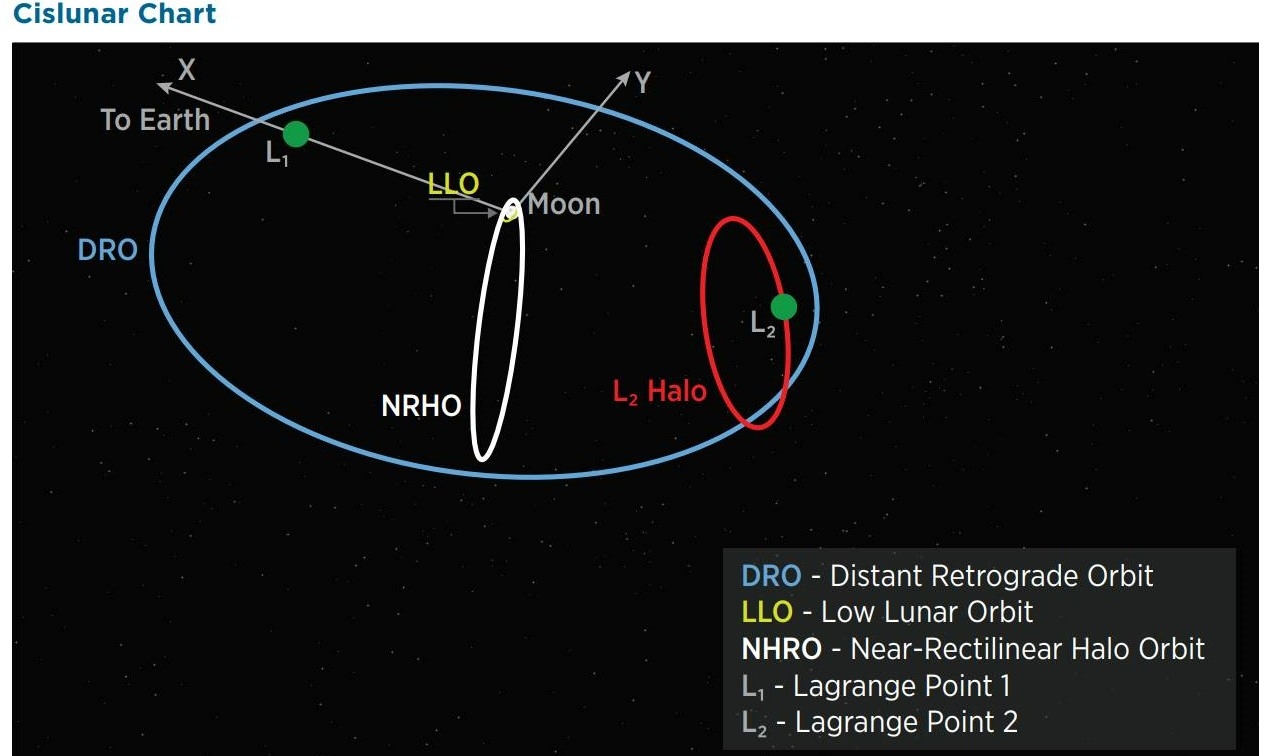
- Provide a new section on the use of space beyond Earth orbit and its implications;
- Widen our treatment on the threats posed to all nations’ space operations from space debris.
Go to the report at:

Image shows the night side of Venus glowing in thermal infrared, captured by Japan’s Akatsuki spacecraft.
Credit: JAXA/ISAS/DARTS/Damia Bouic
Venus is hot right now.
Ok, I don’t want to sidetrack you to think about the planet’s hellish surface that’s blistering enough to melt lead, nor have you cozy up to its cloud-enveloped nature to earn the title of a “love goddess” or a world that’s often tagged as “Earth’s twin.”
Here is what’s happening. Scientists are becoming increasingly eager to sort out a key question: Is Venus a cloud-bound sanctuary for microbial life?
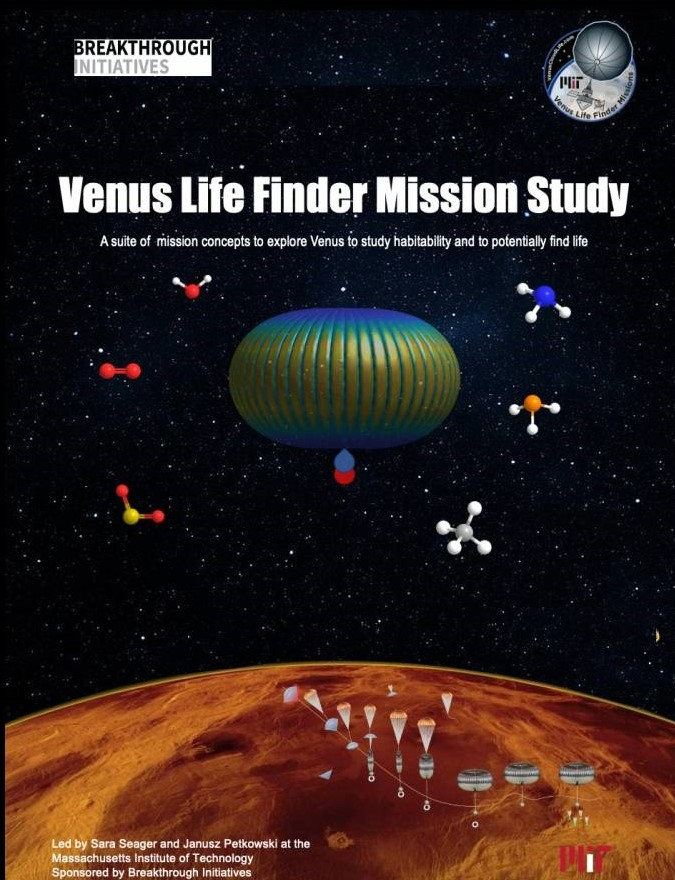
Credit: MIT/Breakthrough Initiatives
Back here on Earth, Venus is somewhere between comedian Rodney Dangerfield’s “no respect” of a world and the Spinal Tap song about living in a “Hell Hole.”
Scientists are now discussing what future missions can cough up new information regarding that world’s potential as an extraterrestrial home address for life – life that’s busily minding its own business in a swirl within Venusian clouds.
For more details, go to my new Space.com story – “New wave of missions to reignite Venus exploration” – at: https://www.space.com/venus-alien-life-search-new-missions

Click to enlarge. Credit: NASA/JPL-Caltech
NASA’s Ingenuity Mars helicopter continues to showcase its “Wright Stuff,” recently completing its 25th flight on April 8th.
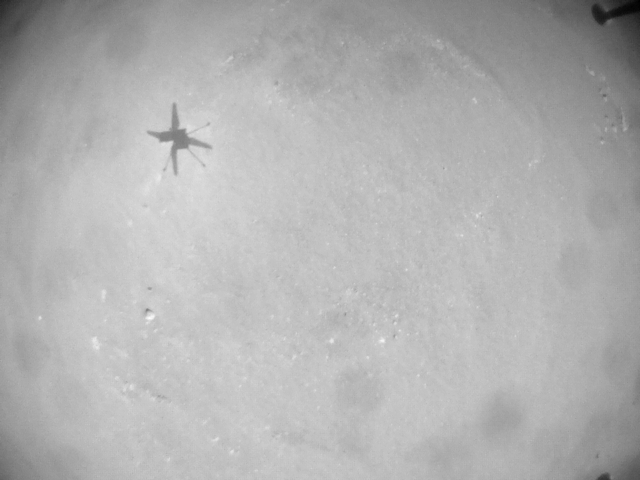
NASA’s Ingenuity Mars Helicopter acquired this image using its navigation camera mounted in the helicopter’s fuselage and pointed directly downward to track the ground during flight. This image was acquired on April 8, 2022 (Sol 403 of the Perseverance rover mission) at the local mean solar time of 10:05:30. This was the date of Ingenuity’s 25th flight.
Credit: NASA/JPL-Caltech
Indeed, the collective flight stats are impressive:
- Distance Flown: 5,824 meters (roughly 19,109 feet)
- Highest Altitude: 12 meters (roughly 39 feet)
- Fastest Ground Speed: 5.50 m/s (12.3 mph)
- Flight Time: roughly 46.5 minutes (2,791 seconds)
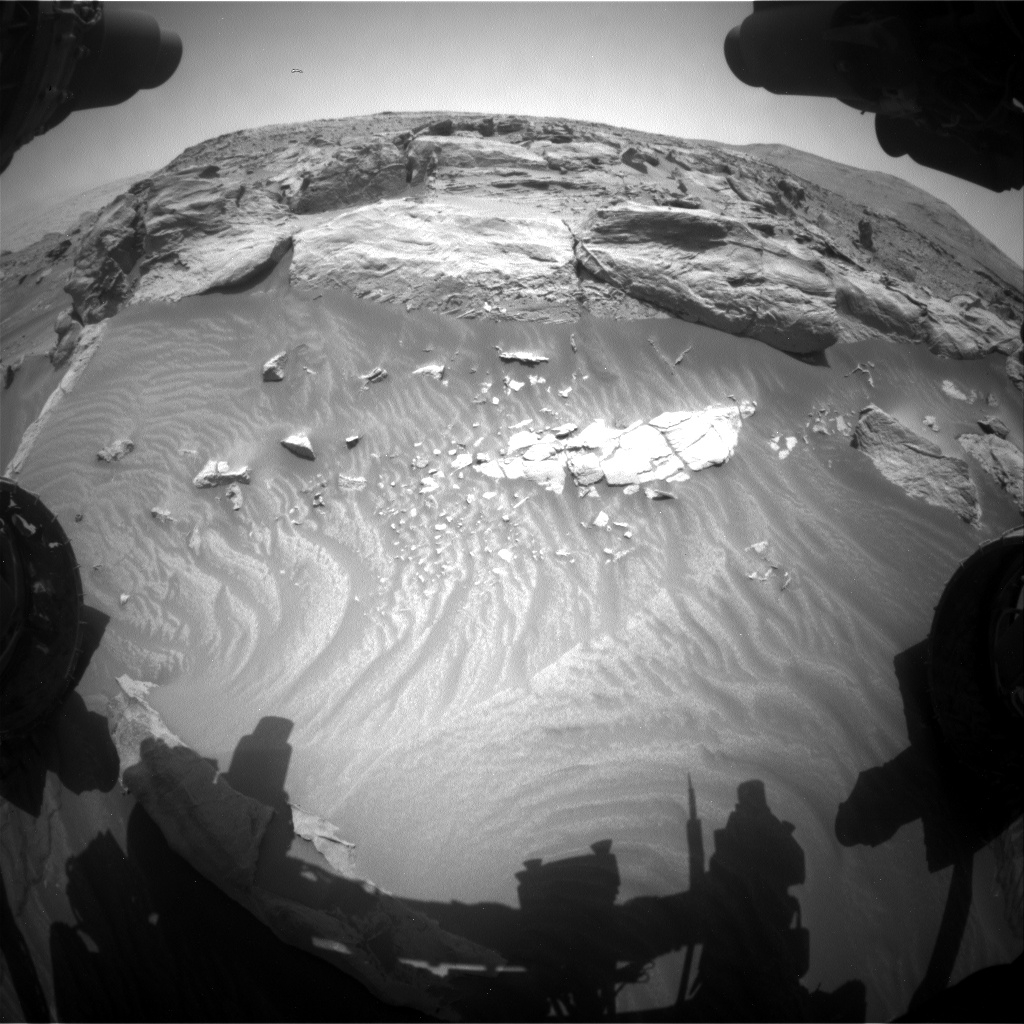
Curiosity Front Hazard Avoidance Camera Right B photo acquired on Sol 3440, April 10, 2022.
Credit: NASA/JPL-Caltech
NASA’s Curiosity Mars rover at Gale Crater is now performing Sol 3441 tasks.
“We are retracing our steps, picking our way slowly back down from the pediment and the dangerous gator rocks which would have eaten our wheels!,” reports Catherine O’Connell-Cooper, a planetary geologist at the University of New Brunswick; Fredericton, New Brunswick, Canada.
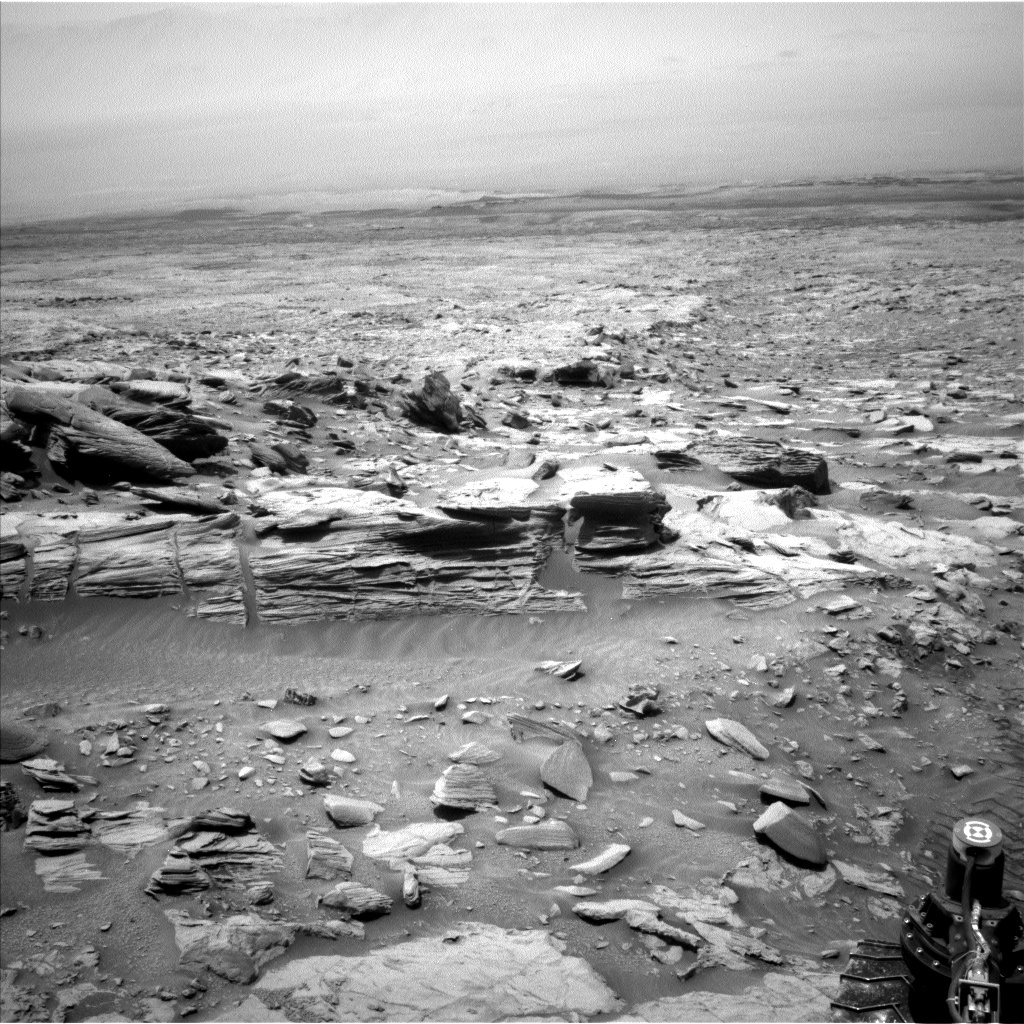
Curiosity Left B Navigation Camera photo taken on Sol 3440, April 10, 2022.
Credit: NASA/JPL-Caltech
There have been so many times across the almost ten years of our mission in Gale [crater] that, in order to keep the forward momentum going, we have needed to move on from sites, leaving our geologists sighing at the wonderful rocks behind us,” O’Connell-Cooper adds. “Our images and compositional analyses usually downlink to Earth after we have left an area, and so we often wish for a ‘go-back’ to zoom in on details that we only noticed in images or to get more compositional data on things that were unexpectedly intriguing.”
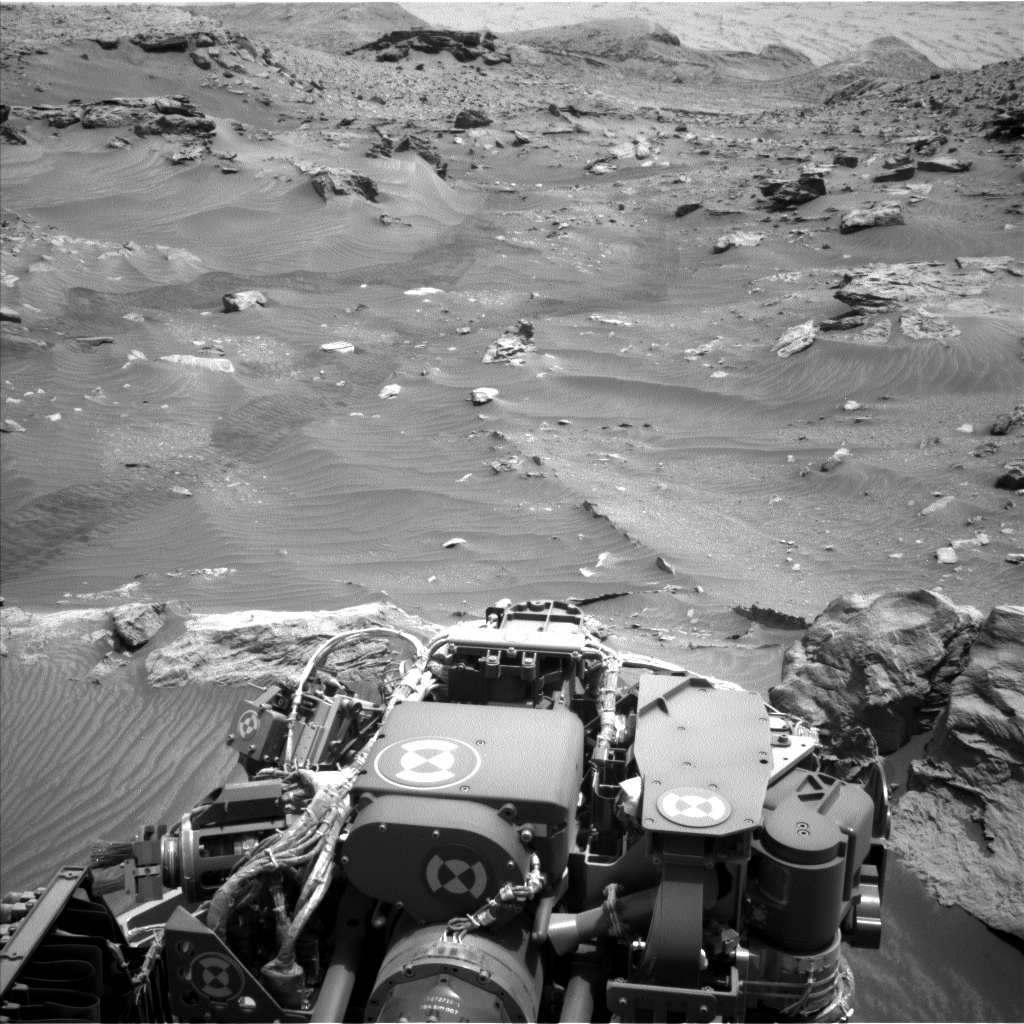
Curiosity Left B Navigation Camera photo taken on Sol 3440, April 10, 2022.
Credit: NASA/JPL-Caltech
Golden opportunity
O’Connell-Cooper explains that, although it is disappointing to be leaving the pediment (for now at least!), this does give researchers a golden opportunity to revisit outcrops that we passed on our drive up to the pediment, back in early March.
“We have a long wish list for this area, but Mastcam acquired some incredible imagery on the drive up, which we are using to pinpoint the best outcrops in this area,” O’Connell-Cooper notes.
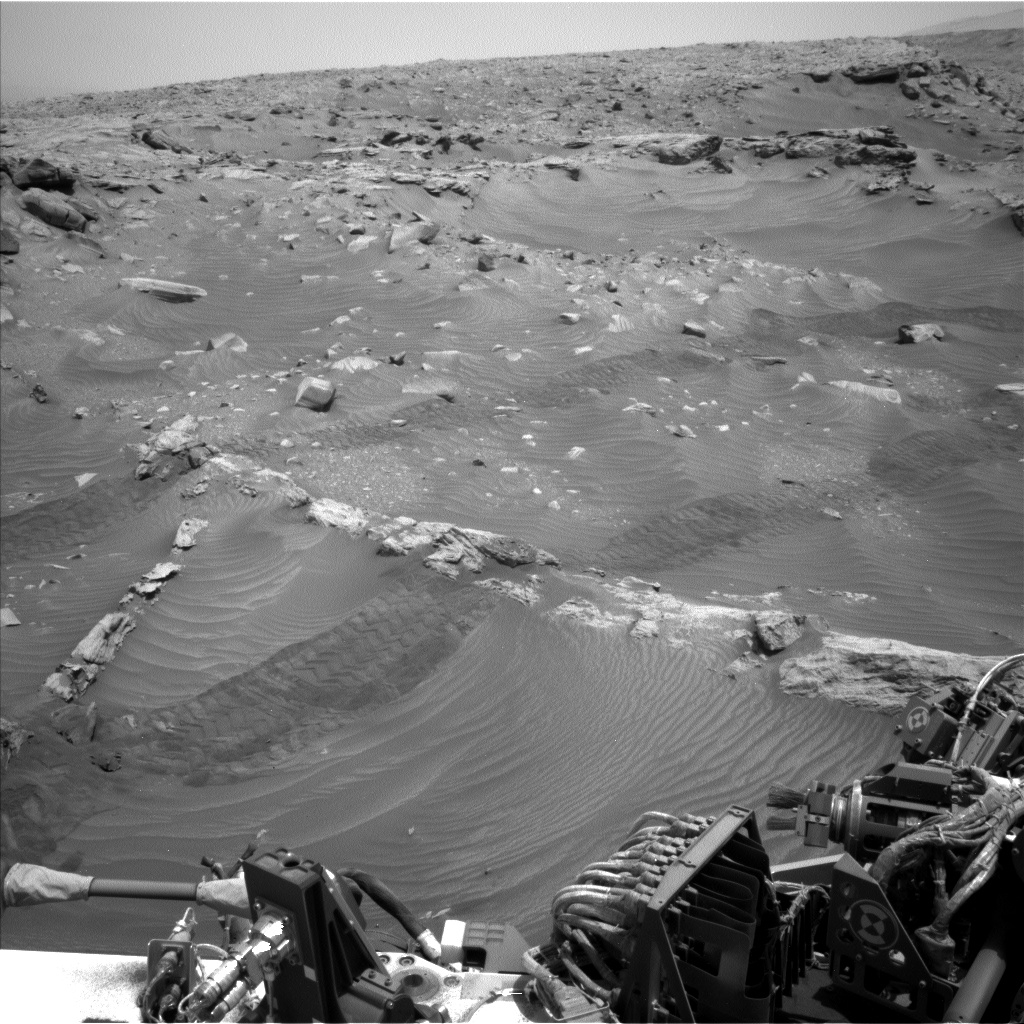
Curiosity Left B Navigation Camera photo taken on Sol 3440, April 10, 2022.
Credit: NASA/JPL-Caltech
Last Wednesday, the rover arrived at one of these outcrops that exhibits a somewhat chaotic appearance and a jumble of veins and raised resistant ridges.
Wheel placements
Awkward wheel placements by the robot meant that scientists could not do any arm science, making use of the Alpha Particle X-Ray Spectrometer (APXS) and the Mars Hand Lens Imager (MAHLI), “so we had to bump back just a little to be safer. This bump actually gave us a gift – it broke up some rocks in the workspace so we can analyze fresh surfaces,” O’Connell-Cooper reports.
“Lodberrie” will be subjected to the full analytical suite of the Chemistry and Camera (ChemCam), Mastcam, APXS and MAHLI in the targets, whilst Mastcam will image two other targets “Denny” and “Saltwick Bay.
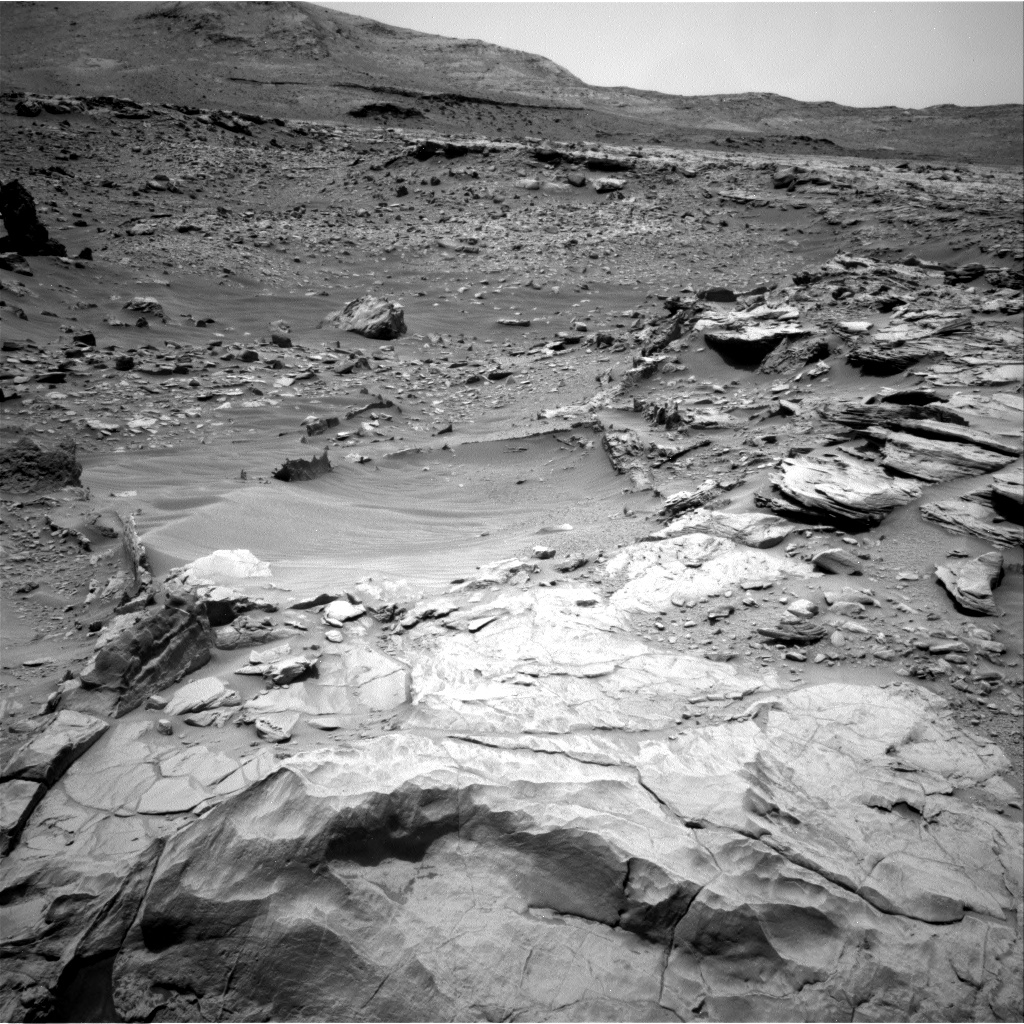
Curiosity Right B Navigation Camera image acquired on Sol 3440, April 10, 2022.
Credit: NASA/JPL-Caltech
Further images
APXS and MAHLI will analyze “Sneuga” on one of these raised ridges, and MAHLI will get images of the nearby target “Inchbonny.”
Mastcam will take further images of one of Wednesday’s targets (“Fort Charlotte”) on an area to the right of our workspace with abundant thin laminations but with few raised ridges.
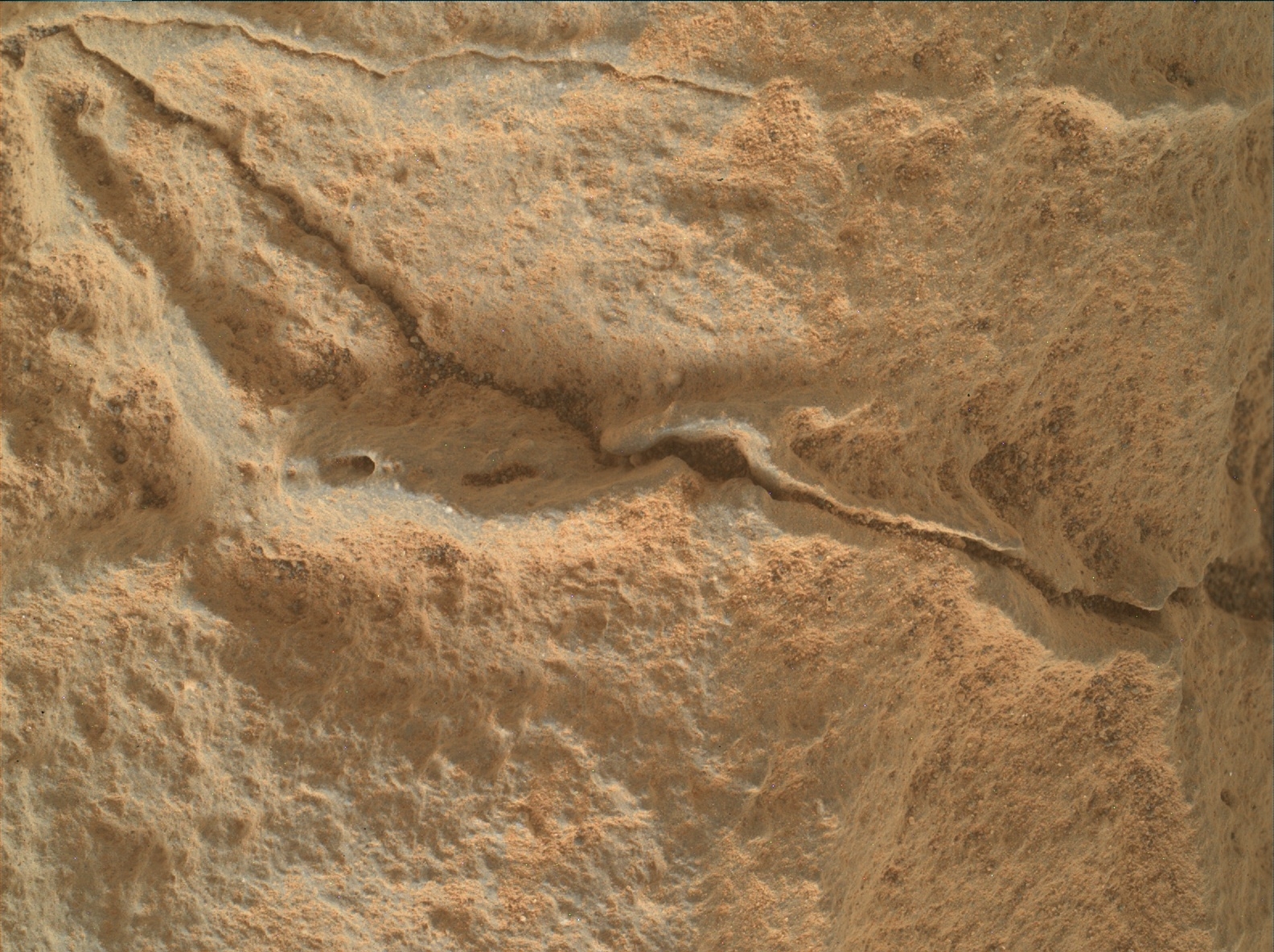
Curiosity Mars Hand Lens Imager photo produced on Sol 3440, April 10, 2022.
Credit: NASA/JPL-Caltech/MSSS
ChemCam will use Laser Induced Breakdown Spectroscopy (LIBS) to investigate the chemistry of the target “Lunna” in that same area.
Mastcam will also acquire even more images of the “Feorachas” outcrop, the intended end of drive destination for a recently scripted plan.
O’Connell-Cooper concludes: “Looking forward to seeing Monday’s workspace!”

