Archive for the ‘Space News’ Category
 Author:
  April 28th, 2022
Artwork depicts CAPSTONE spacecraft in a near rectilinear halo orbit (NRHO) around the moon.
Credit: NASA/Advanced Space
Rocket Lab is slated to launch in May a pathfinding cubesat mission that supports NASA’s Artemis return-to-the moon program.
The Cislunar Autonomous Positioning System Technology Operations and Navigation Experiment — mercifully called CAPSTONE for short — tips the scales at a modest 55-pounds. This microwave-oven sized spacecraft will be lofted from New Zealand aboard a Rocket Lab Electron rocket and the launch provider’s Lunar Photon upper stage.

Jeffrey Parker, chief technology officer of Advanced Space (left) explains the CAPSTONE mission to U.S. Senator John Hickenlooper over a full-size model of the spacecraft.
Credit: Advanced Space/Jason Johnson
The launch window is between May 3-May 15.
For more details on this important mission, go to my new Space.com story — “Little CAPSTONE cubesat ready to launch on big moon mission next month” – at:
https://www.space.com/capstone-cubesat-moon-mission-launch-may
 Posted in

Credit: CCTV/Inside Outer Space screengrab
Technicians have unloaded China’s Shenzhou-13 spacecraft on Tuesday, removing items carried to space, weighing over 73 kilograms, including numbers of experimental equipment and instruments.
Engineers of the China Academy of Space Technology took objects out of the return capsule. Among them are crop seeds brought to the space for biological experiments, which is a tradition of China’s spaceflight missions. Along with the seeds, commemorative stamps and paintings by Hong Kong teenagers were retrieved, reports China Central Television (CCTV).
There are also two 8K ultra-high-definition cameras, which the three taikonauts of Shenzhou-13 used to record their six-month stay in the space station and images of the Earth. The footage is to be used to make a documentary about China’s space program by the China Media Group.

Other objects will be transferred to other institutions of the country.
Notaries at the site registered the information of every object taken out of the capsule and verified them one by one.
China’s longest spaceflight
After the return capsule was transported back to Beijing, engineers tested the equipment in the vehicle, verifying the spacecraft’s technical status to evaluate its operation in space.
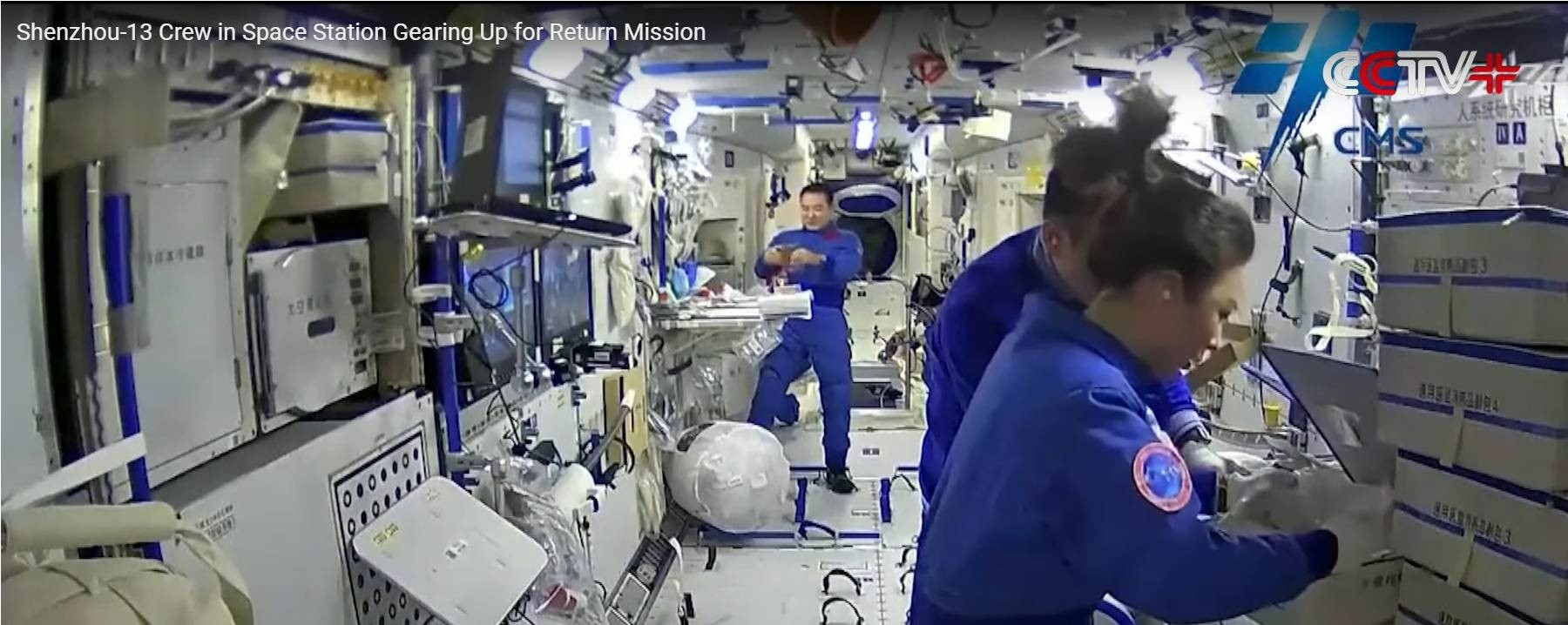
Packing up for return to Earth – Shenzhou-13 crew.
Credit: CCTV/Inside Outer Space screengrab
On Oct 16, 2021, the Shenzhou-13 spacecraft transported the three taikonauts — Zhai Zhigang, Wang Yaping and Ye Guangfu — to the Tiangong space station for a six-month stay (183 days), the longest-ever duration in the country’s human spaceflight program.
The return capsule of the Shenzhou-13 piloted spaceship touched down at the Dongfeng landing site in north China’s Inner Mongolia on April 16.

Shenzhou-13 crew members.
Credit: CNS/Inside Outer Space screengrab
Over the past six months, the three taikonauts completed multiple tasks, including carrying out two extravehicular activities, conducted two live science lectures, also with making a number of sci-tech experiments and fulfilling application projects.
The Chinese taikonauts also used manual tele-operation equipment for the first time to steer a cargo craft to dock with the space station.
“To make use of the performance margin of the flights of Shenzhou-13 manned spacecraft, we conducted more than 10 experiments of scientific value and social benefit. They mainly involve space breeding, space biological experiments and space culture,” said Lin Xiqiang, spokesman of China Manned Space Program and deputy director of China Manned Space Agency.
Go to video of the unpacking at: https://youtu.be/NQhQoc_GkHQ
Credit: CCTV/Inside Outer Space screengrab
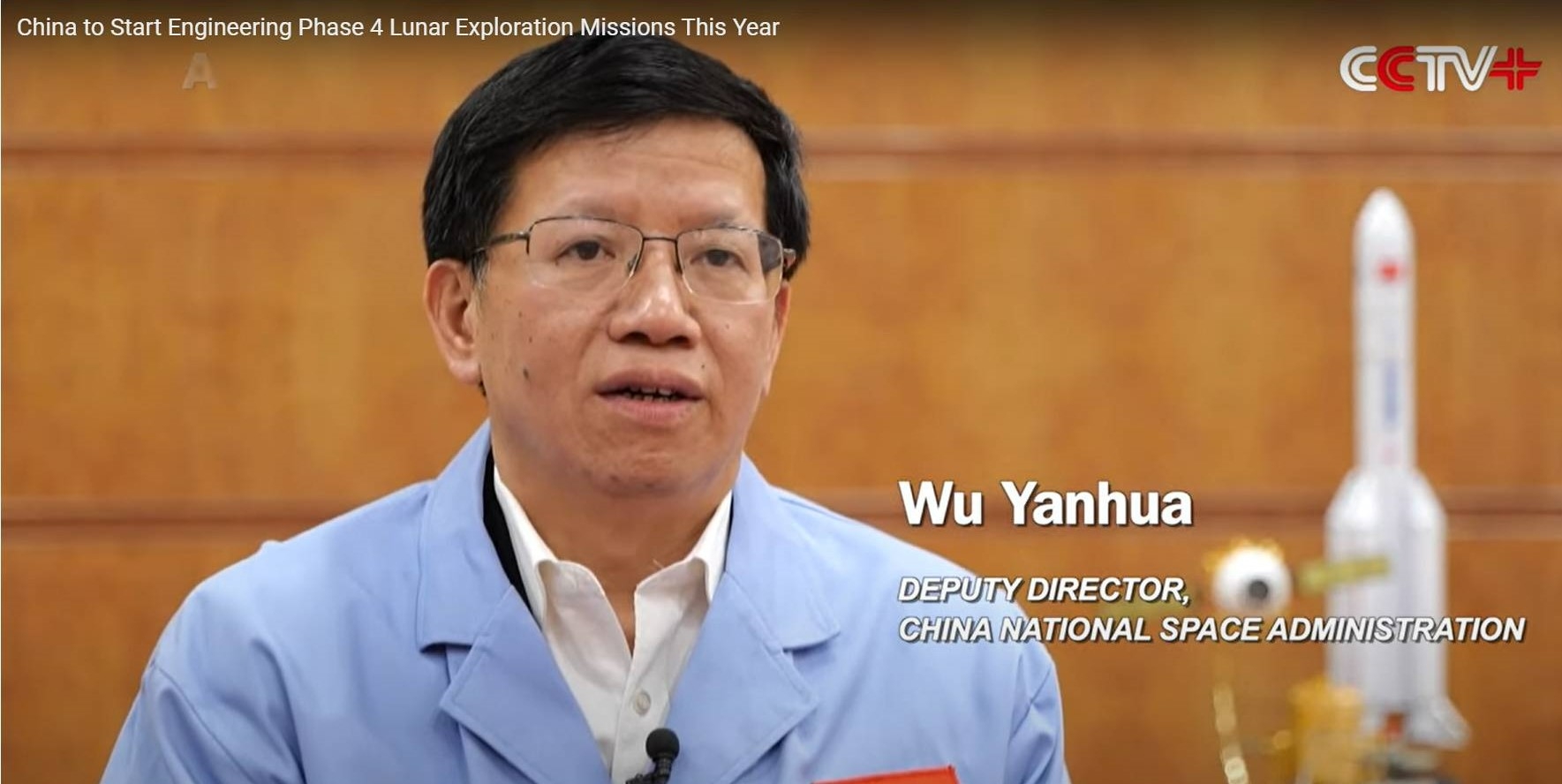
China will start engineering development of the fourth phase of its lunar exploration program this year, according to a senior official of the China National Space Administration (CNSA), as reported by the state-run Xinhua News Agency.
The Chang’e-6, Chang’e-7 and Chang’e-8 lunar probes will be launched successively, and the country will endeavor to make breakthroughs in key technologies and build an international lunar research station, Wu Yanhua, CNSA’s deputy director, told an online launch ceremony for the 2022 Space Day of China on Sunday.
Wu said the Chang’e-6 will take samples from the far side of the Moon.
Furthermore, China is planning to set up a satellite constellation around the moon to provide communication and navigation services.

Artist’s view of China/Russia International Lunar Research Station to be completed by 2035. Credit: CNSA/Roscosmos
Moon research station
The main goal of the fourth phase is to carry out scientific exploration on the Moon’s south pole and set up a fundamental type of lunar scientific research station.
The fourth phase will be carried out in three steps, with the Chang’e-6, Chang’e-7 and Chang’e-8 probes being launched before 2030.
Go to this video that spotlights the next set of Chinese Moon probes at:
Also, go to this video that details China’s Chang’e and Yutu lunar machinery at:

Credit: NPO Lavochkin
Yet another space causality of the ongoing Russian aggression against Ukraine is the European Space Agency’s withdrawal of cooperation on Russia’s reactivation of Moon exploration.
But what are the ripple effects of this move?
Go to my new Scientific American story:
“Europe Cancels Joint Moon Missions with Russia – Russia will move forward with lunar exploration without its European partners,” at:
https://www.scientificamerican.com/article/europe-cancels-joint-moon-missions-with-russia/

Earth orbit is a junkyard of human-made space clutter.
Credit: Space Junk 3D, LLC. Melrae Pictures
The European Space Agency’s Space Debris Office has published an annual Space Environment Report.
A bottom line: humankind’s behavior in space is improving but is still unsustainable in the long term.
On one hand, Earth is encircled by spacecraft carrying out important work to study our changing climate, deliver global communication and navigation services and help us answer important scientific questions.
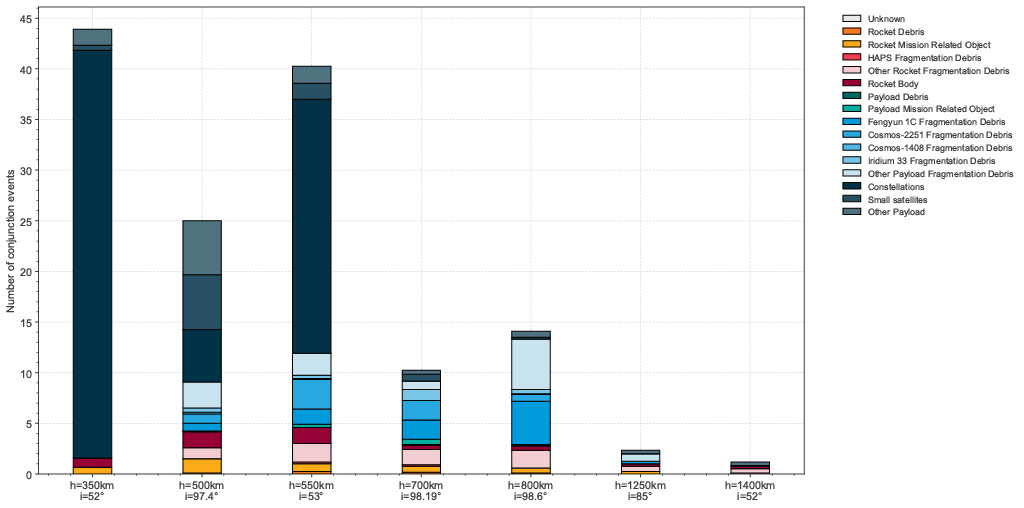
Credit: ESA
However, spacecraft orbits are churning with deadly fragments – fast-moving pieces of defunct satellites and rockets trapped in orbit – that threaten our future in space.
Key findings
Several of the key findings of the 2022 report include:
- More satellites are being launched today than ever before. This is driven by the increasing number and scale of commercial satellite constellations in low-Earth orbit.
- Most, but not all, rocket bodies launched today are safely placed in compliant disposal orbits or removed from low-Earth orbit before they can fragment into clouds of dangerous debris. But active satellites today still have to dodge out of the way of objects that were launched decades ago and have since broken into fragments.
- Not enough satellites are removed from heavily congested low-Earth orbits at the end of their lives.
- Technological advances are improving our ability to spot and track smaller fragments of space debris.
Not enough effort
“While we may be more responsible with what we launch today, our current efforts are not enough,” the report explains.

Earth clutter. This artist’s view shows the broad scope of space debris circling the planet, hundreds of miles above sea level, at the same height where low-Earth orbit satellites operate. The spatial density of debris objects increases at high latitudes. Note that the size of the debris elements in this image is greatly exaggerated compared to the size of Earth.
Credit: European Space Agency.)
“If we don’t significantly change the way we use launch, fly and dispose of space objects, an ‘extrapolation’ of our current behavior into the future shows how the number of catastrophic in-space collisions could rise,” the report adds.
Long term, the report concludes, this could lead to a Kessler Syndrome. That’s a situation in which the density of objects in orbit is high enough that collisions between objects and debris create a cascade effect, each crash generating debris that then increases the likelihood of further collisions. “At this point, certain low-Earth orbits will become entirely inhospitable.”
For more information on ESA’s Space Environment Report 2022, go to:
https://www.sdo.esoc.esa.int/environment_report/Space_Environment_Report_latest.pdf
Also, an informative video detailing space debris can be viewed at:
Credit: University of Central Florida
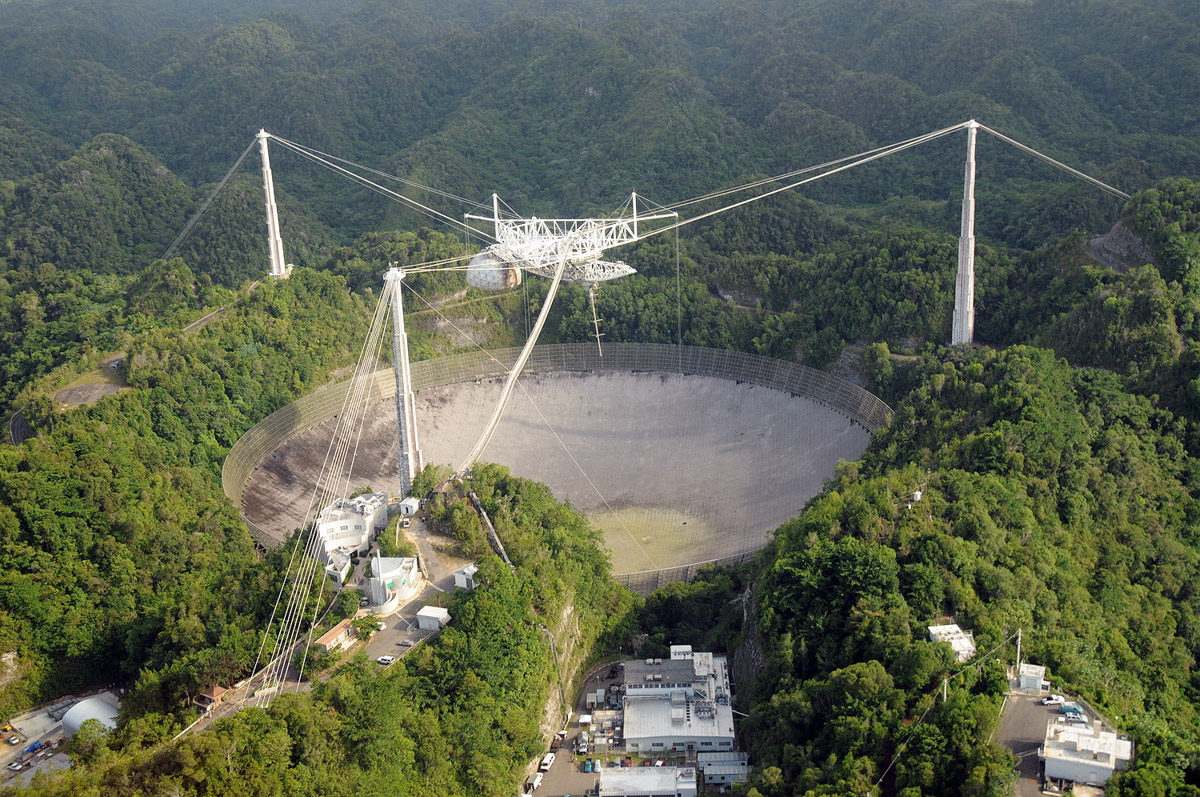
On December 1, 2020, the 57 year old 305-meter Arecibo Telescope in Puerto Rico collapsed after a series of failures of the supporting cables.
While no longer collecting scientific data, components of the telescope may be preserved for historical and educational purposes.
An Arecibo Observatory (AO) Salvage Survey Committee reports the retrieval of items that have potential historical significance, or that might be leveraged for instrument research or informal education.

Credit: Michelle Negron, National Science Foundation
The AO facility of the National Science Foundation operated under cooperative agreement by the University of Central Florida.
Critical salvage pieces
“In order to have a minimal impact on the environment, the clean-up of the site happened very quickly,” says Luisa Fernanda Zambrano-Marin, an AO analyst and co-Chair of the salvage survey committee. “This meant we had to work fast to identify the most critical pieces to salvage.”
Zambrano-Marin adds that, through nineteen weeks of weekly meetings, site visits, and a close study of hundreds of high-resolution survey photographs taken by AO-operated drones, the committee created a database of high-priority items and cataloged the actual pieces collected during the emergency cleanup. “We marked the salvageable items with pink neon construction tape to indicate that they should not be carried away by the clean-up crew.”

Arecibo leftovers.
Credit: Arecibo Observatory (AO) Salvage Survey Committee
“This is history,” notes Zambrano-Marin. “This is part of the bulk of technological wonders that allowed us to make great discoveries in astronomy, planetary science, and space and atmospheric science.”
Historical items
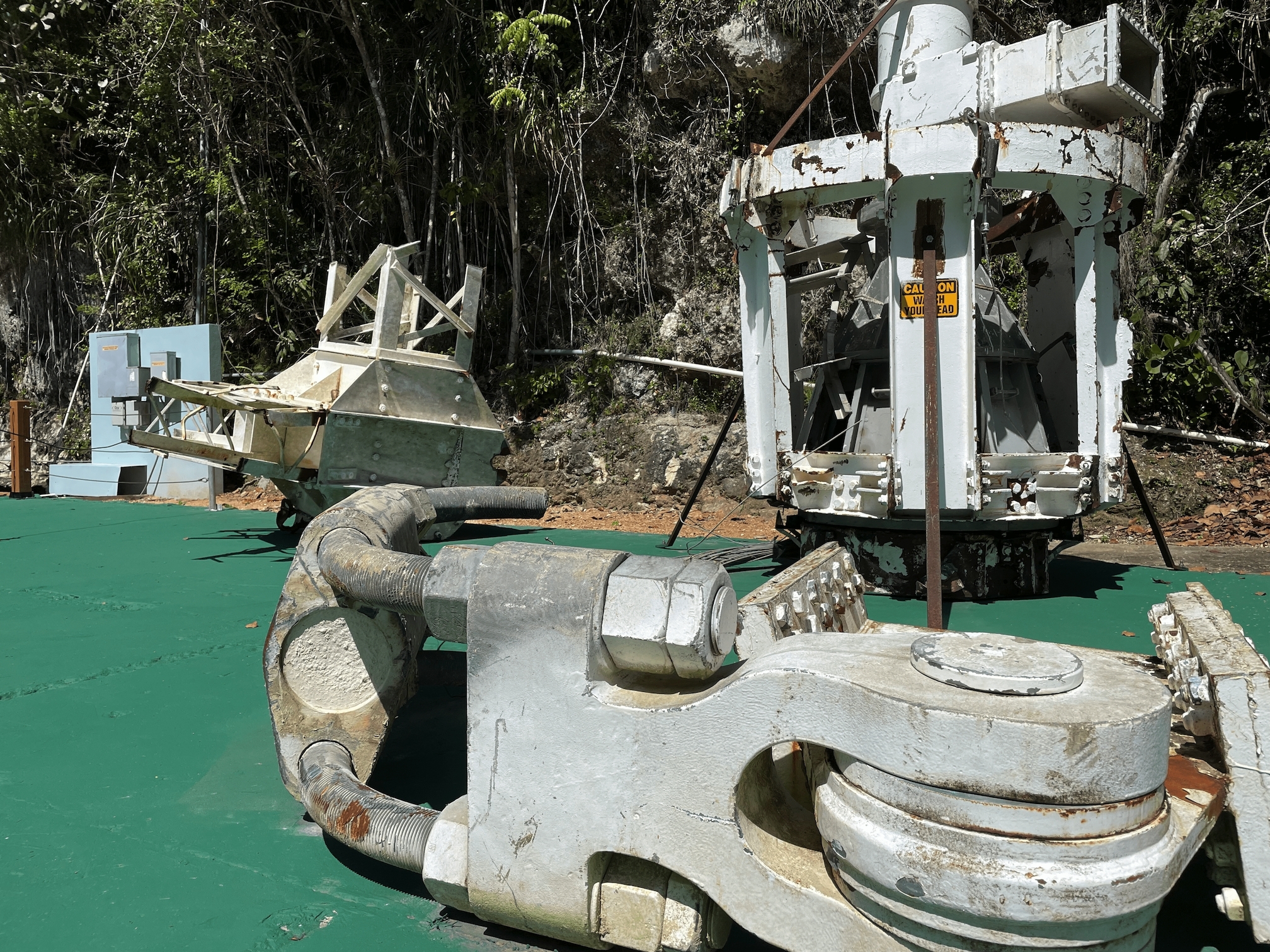
Among the items, radar klystron hardware, a recovered feed array, pieces of the Gregorian dome and the platform, even a landing step from the cable cart that led onto the platform.
Some of the historical items have already been put on display at Arecibo’s Ángel Ramos Science and Visitor’s Center, which reopened to the public on March 10, 2022.
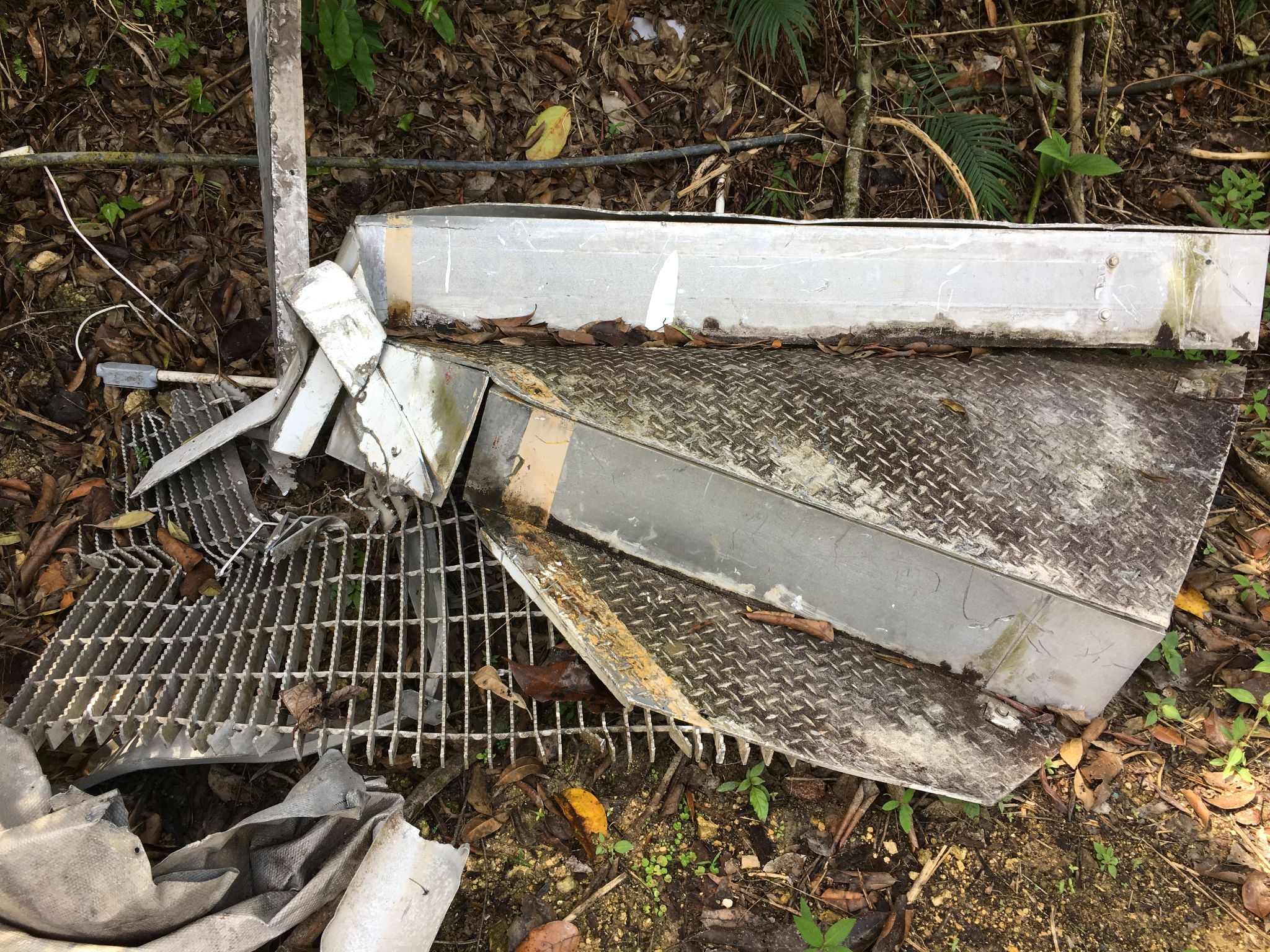
Landing step from the cable cart that led onto the platform. Credit: Arecibo Observatory (AO) Salvage Survey Committee
“It’s so important to be able to show visitors to the observatory or a museum the ‘real thing’ – something that actually captured the radio signals from a pulsar or transmitted a radar signal all the way to Titan,” says Bruce Campbell of the Smithsonian Institution and also served on the salvage survey group. “Those artifacts also provide a link to the human stories of the engineers and scientists that built and used them.”
Campbell adds that he hopes that in the long term “these objects will be preserved and displayed in ways that tell those stories and inspire students to go into fields like engineering, radio astronomy, or planetary science.”
Credit: Arecibo Observatory (AO) Salvage Survey Committee
Ultimate fate
Tracy Becker, an AO collaborator and Southwest Research Institute research scientist, explains that the ultimate fate of the recovered pieces of the legacy telescope is yet to be determined.
The final recommendations from the salvage survey committee, Becker explains, “include the need for action to protect the artifacts from further damage or corrosion, distribution of historic and technical information about the instruments and structural elements to museums and universities, and the formation of a follow-on group to consider the long-term preservation and educational potential of the recovered material.”
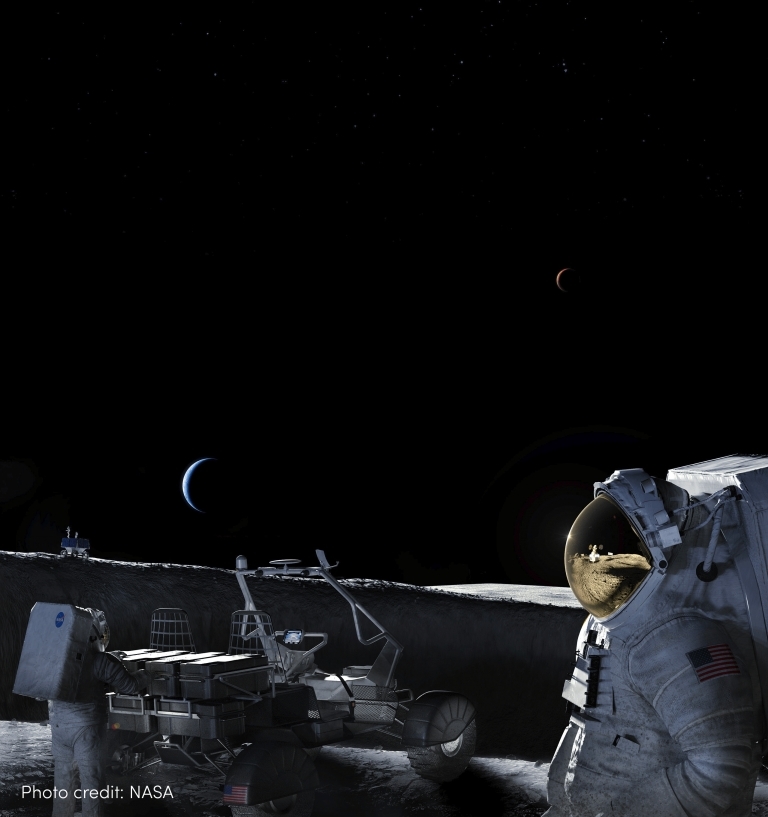
For you future moonwalkers, you may be wearing a knapsack that provides precise navigation capabilities on the Moon.
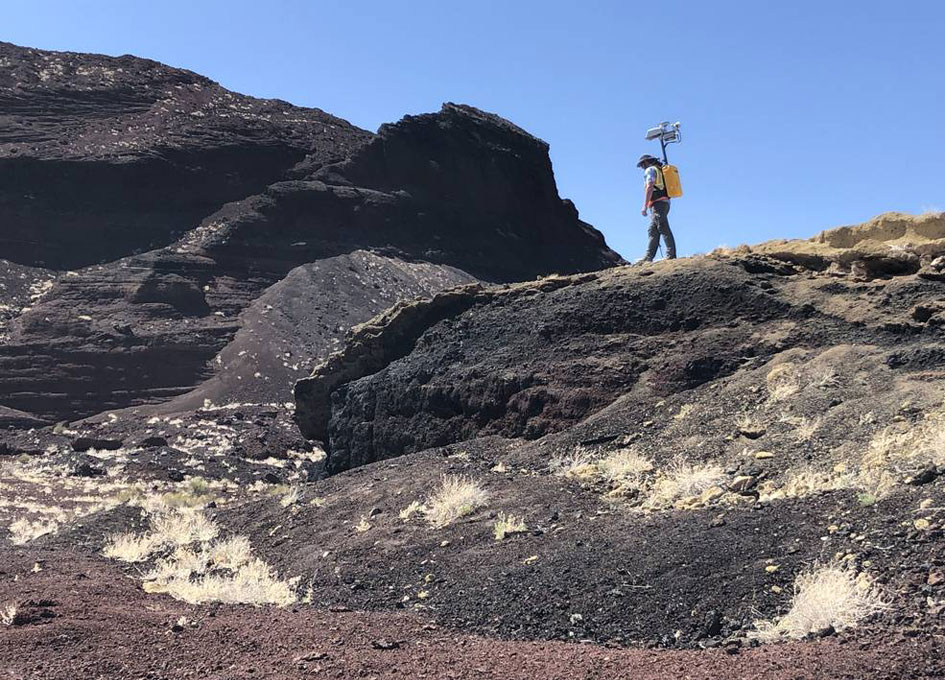
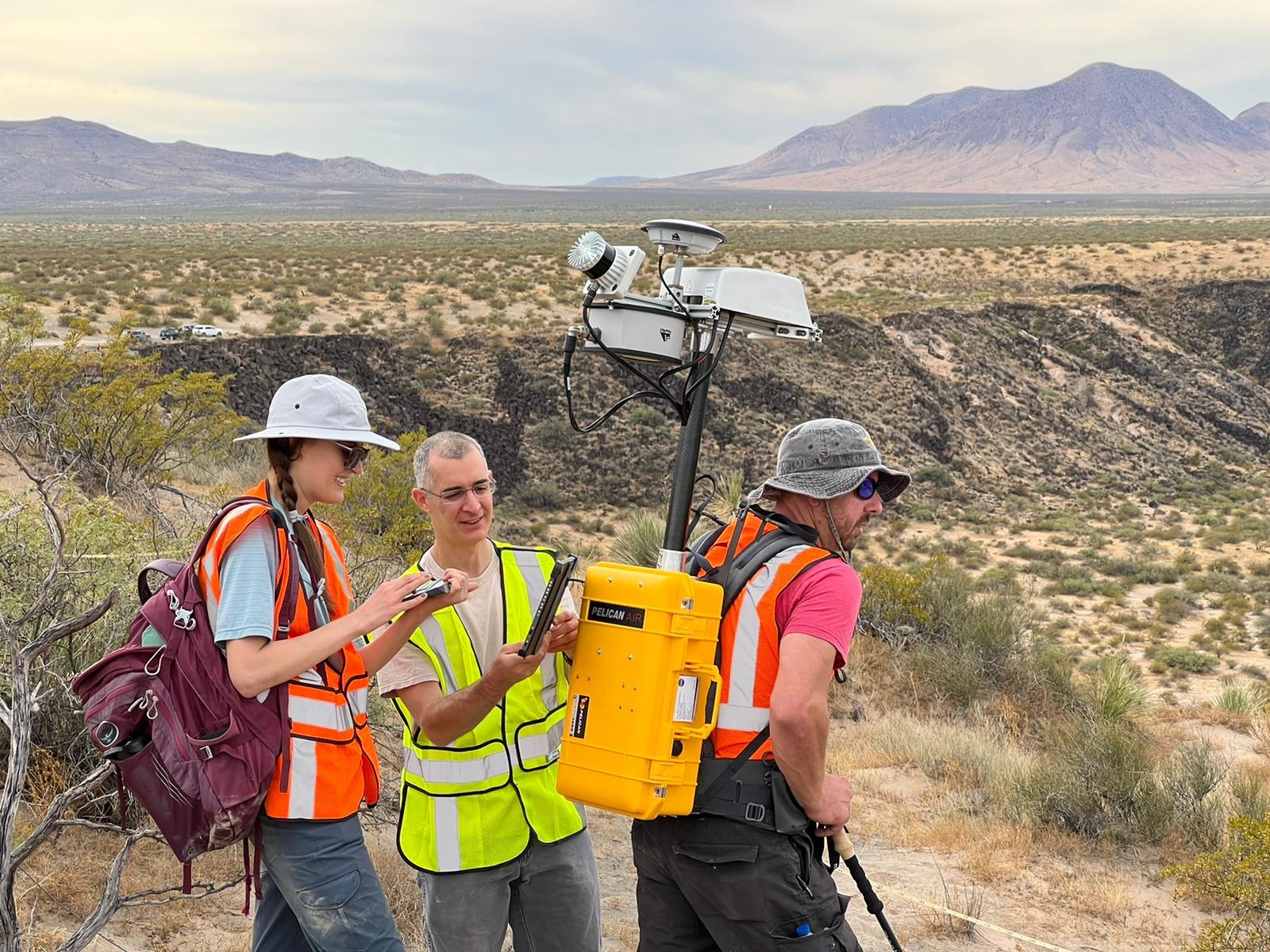
NASA’s Kinematic Navigation and Cartography Knapsack (KNaCK) Instrument project is designed to overcome the lack of global positioning and navigation systems on a person’s lunar outings.
KNaCK is to support missions that are part of NASA’s Artemis program, particularly at the Moon’s South Pole. In that region the low solar incidence means that the sun never appears more than three degrees above the horizon.

In this multi-temporal illumination map of the lunar south pole, Shackleton crater (19 km diameter) is in the center, the south pole is located approximately at 9 o’clock on its rim. The map was created from images from the camera aboard the Lunar Reconnaissance Orbiter.
Credits: NASA/GSFC/Arizona State University
LiDAR-based
As a LiDAR-based (Light Detection and Ranging) mobile terrain-mapping and navigation system, the concept is using Aeva Technologies, Inc.’s 4D LiDAR technology. Based in Mountain View, California, Aeva’s technology, including the new Aeries™ II sensor, is expected to enable the KNaCK Instrument to create highly accurate maps of the lunar surface and provide precise navigation capabilities to conquer the lack of GPS guidance on the Moon.
“The KNaCK sensor is a surveying tool for both navigation and science mapping, able to create ultra-high-resolution 3D maps at centimeter-level precision,” said Michael Zanetti, KNaCK Project Manager and Principal Investigator at NASA’s Marshall Space Flight Center, in a NASA release.
Credit: Michael Zanetti/NASA
GPS-denied environment
A next-generation space-hardened unit will be about the size of a soda can and could enable lunar surface operations like never before. “It also will help ensure the safety of astronauts and rover vehicles in a GPS-denied environment such as the Moon,” Zanetti said, “identifying actual distances to far-off landmarks and showing explorers in real time how far they’ve come and how far is left to go to reach their destination.”
The lunar south pole region also has areas that are permanently shadowed or have long persistent shadows that prohibit photogrammetry-based navigation. Aeva’s Frequency Modulated Continuous Wave technology is immune to optical interference from the sun and can operate in the dark, allowing astronauts and rovers to use the KNaCK Instrument to explore and map the lunar surface anytime, day or night.
Credit: NASA
According to a Aeva statement, beyond the benefits of mapping and navigation, Aeva’s high-resolution sensor data can also be used to create high-definition terrain maps, useful for landing site visualizations. The KNaCK project is also exploring additional applications that leverage Aeva’s instant velocity-sensing capabilities to detect airborne particulates, such as the way rocket plume exhaust interacts with lunar and planetary surfaces and for measuring small scale atmospheric phenomena like dust devils.
Field testing
NASA’s Zanetti said he envisions mounting KNaCK on a rover or on the side of an astronaut’s helmet – which should leave plenty of room in future lunar mountaineers’ all-purpose backpacks.
The KNaCK team will work to miniaturize the hardware – the backpack prototype weighs about 40 pounds – and harden the sensitive electronics against the punishing effects of microgravity and solar radiation.
The hardware is set to be evaluated in another major field test in late April at NASA’s Solar System Exploration Research Virtual Institute (SSERVI) in Kilbourne Hole, New Mexico.
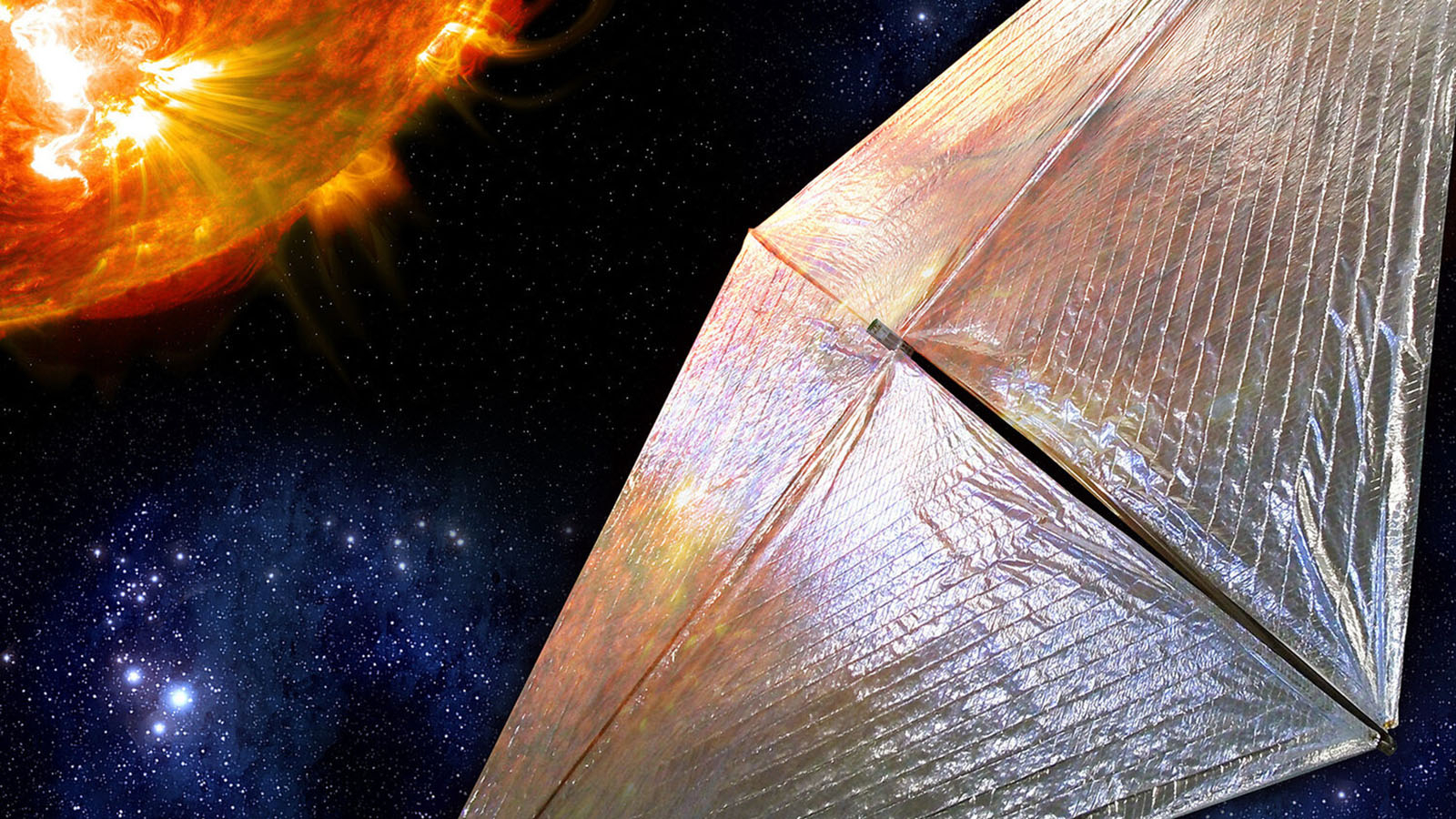
This illustration of NASA’s Solar Cruiser shows the small satellite with its solar sail deployed. The Space Dynamics Laboratory will build two space-based radios for the spacecraft.
Credit: NASA Marshall Space Flight Center
A NASA technology demonstration mission integrates several new technologies aboard a small satellite to validate solar sail propulsion.
Solar Cruiser is sponsored by the NASA Heliophysics Division’s Solar Terrestrial Probes Program. Utah State University’s Space Dynamics Laboratory (SDL) in North Logan Utah announced today that it has been awarded a contract to build two space-based radios for the mission.
The contract was awarded by Solar Cruiser prime contractor Ball Aerospace, which is providing the small satellite.
Space weather watch
NASA’s Marshall Space Flight Center is developing the Solar Cruiser mission, set to fly in 2025, to mature solar sail propulsion technology for future missions.
Solar Cruiser will deploy the ultra-thin reflective sail – the largest sail ever flown — with an area of 1,650 square meters (17,800 square feet). That’s large enough to cover more than six tennis courts.
Solar Cruiser will also demonstrate technologies that will enable subsequent missions to improve space-weather monitoring, prediction, and science.
Credit: NASA/SDO/Goddard Space Flight Center
Information provided by Solar Cruiser will allow scientists, engineers, and mission planners to discern better how solar sail propulsion can be used by spacecraft to collect observations from novel vantage points that are difficult to reach and sustain.
The SDL-built Iris radios onboard Solar Cruiser will fly approximately one million miles sunward of the Earth at Lagrange Point L1, the position in space where Earth’s and the Sun’s gravity are balanced along the Sun-Earth-line, and relay mission data to NASA’s Deep Space Network and other ground networks.
Smallsat growth
In an SDL statement, Asal Naseri, SDL’s satellite technologies branch head for civil and commercial space, said: “As more small satellites operate in deep space, there is a correlating need for radios that can function in the unique conditions of deep space.”
Naseri also added that the space industry has experienced a rapid ascent of spacecraft with masses of less than 500 kilograms—classified as small satellites—and related technologies used for technology demonstration, science, commercial and other applications. “Last year, more than 1,700 small satellites were launched, compared to 1,163 in 2020, and 757 in 2019.”
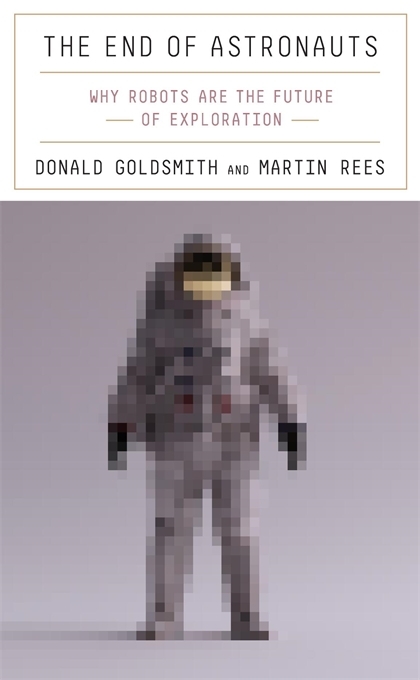
The End of Astronauts – Why Robots Are the Future of Exploration by Donald Goldsmith and Martin Rees; The Belknap Press of Harvard University Press (April 2022); 192 pages; Hardcover: $25.95
My guess is that the reader will either hate or love this book! However, the authors provide a provoking argument for space exploration sans astronauts.
Just a few pages into the book, in an introduction, there’s this forewarning: “Readers who disagree with the conclusions in this book will, we hope, enjoy considering which arguments carry more weight than others.”
That said, this volume is a tour de force of well-written, compelling rationales. The authors believe that beyond low-Earth orbit, space exploration should proceed without humans.
The book is divided into 9 chapters: Why Explore?, Organizing Space, Near-Earth Orbit, The Moon, Mars, Asteroids, Space Colonization, The Global Costs of Space Exploration, and Space Law. So pick your favorite destination/topic and brace yourself.
An epilogue covers perspectives on space exploration in 2040—and far beyond, followed by an appendix of key events in space exploration, as well as notes and a further reading section.
The United Kingdom’s Astronomer Royal, Martin Rees, was previously Professor of Astronomy and Director of the Institute of Astronomy at the University of Cambridge.
Well-regarded science writer, Donald Goldsmith, has written more than a dozen books, including Exoplanets, The Runaway Universe, The Hunt for Life on Mars, Supernova, and, with Neil deGrasse Tyson, Origins.
At its core, the book notes that human journeys into space fill us with wonder. But the thrill of space travel for astronauts comes at enormous expense and is fraught with peril. More to the point, as surrogate automatons become increasingly competent, this question becomes more potent: does our desire to send astronauts to the Moon and Mars justify the cost and danger?
Goldsmith and Rees weigh the benefits and risks of human exploration across the solar system. In space, humans require air, food, and water, along with protection from potentially deadly radiation and high-energy particles.
And all that comes at a cost more than ten times that of robotic exploration.
Automated explorers have shown the ability to investigate planetary surfaces efficiently and effectively, operating autonomously or under direction from Earth. They note that the performance of robots and AI is progressively improving – while our bodies do not.
The reader will find much to ponder in this book, chock-full of up-to-date observations and eye-opener viewpoints. Sure, some of you will have a “bone to pick” about the need for human space travel…others will see the “nuts and bolts” of how space exploration will be done in the future.
For more information on this book, go to:
https://www.hup.harvard.edu/catalog.php?isbn=9780674257726
Additionally, give a listen to an Irish radio program – Futureproof – to hear Goldsmith and Rees explain why twenty-first-century human spaceflight may not be in the cards. Go to:
https://www.newstalk.com/podcasts/futureproof-with-jonathan-mccrea/the-end-of-the-age-of-astonauts

Factory floor integration of science instruments on Russia’s Luna-25 Moon lander.
Credit: Roscosmos
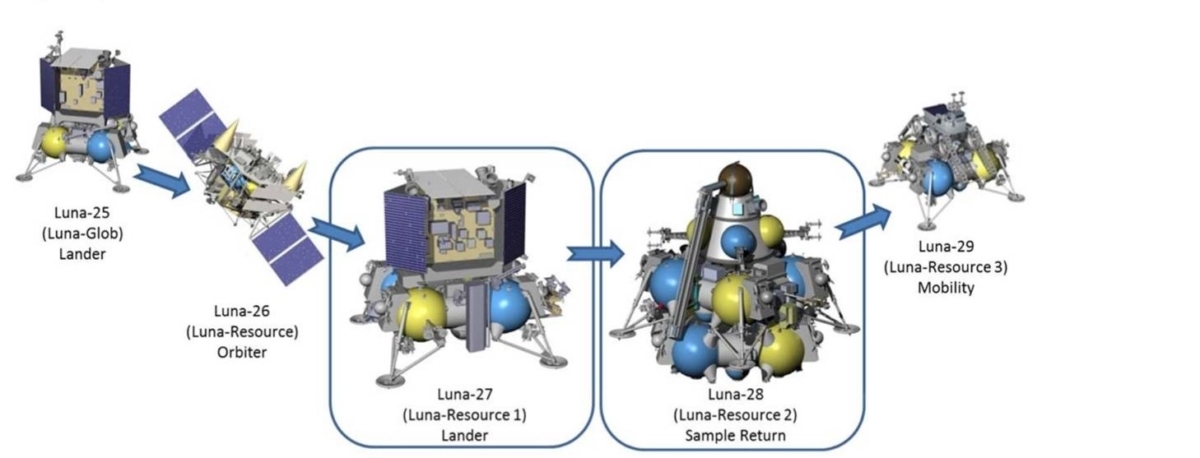
Russia’s Roscosmos continues to implement a national lunar program, planning to implement three lunar missions in the coming years:
- Luna-Glob (Luna-25)
- Luna-Resource-1 (Luna-26) with an orbital spacecraft
- Luna-Resurs-1” (“Luna-27) with a lander
“To date, the Luna-25 spacecraft, which is the first of the renewable domestic lunar program, is fully equipped with standard models of instruments and systems,” according to Roscosmos.

Credit: NPO Lavochkin
Dismantling of ESA’s Pilot-D
Given the recent decision by the European Space Agency (ESA) to no longer participate in Russia’s Luna program, “the dismantling of the Pilot-D device is planned to be carried out at the stage of assembly of the flight model,” Roscosmos has stated.
Credit: ESA
ESA’s Pilot-D camera was to image the lunar terrain, hardware built specifically for Luna-25’s Moon landing.
“The refusal of European partners to participate in cooperation on the Luna-25 project will not affect its implementation in any way,” Roscosmos explains.

Credit: CCTV/Inside Outer Space screengrab
Launch date?
Meanwhile, the launch date of Luna-25 is to be determined after testing.
Dmitry Rogozin, general director of Roscosmos, explains that the launch of the Luna-25 from the Vostochny cosmodrome can take place both earlier and later on August 22 reports RIA Novosti, a Russian state-owned domestic news agency.
“So far, Lavochkin’s NPO has named this date. It could be earlier, maybe in September,” Rogozin told reporters at the Tsiolkovsky Museum of the History of Cosmonautics in Kaluga.

Lunar hardware undergoes testing.
Credit: RSC Energia/Roscosmos
Rogozin clarified that only one very important test remained in the preparation schedule: a repeat test of a Doppler receiver. After all the necessary confirmations of the readiness of the device for launch are received, the specialists will determine the launch date.
No pressure
The general director of the state corporation also urged not to put pressure on the engineers preparing Luna-25 for launch, and to not demand a specific launch date from them.
Credit: NPO Lavochkin
Earlier, Alexander Mitkin, deputy general designer for electrical systems at NPO Lavochkin – the designer and builder of Luna-25 — said that the launch of the first domestic mission to the Moon in 46 years from the Vostochny cosmodrome is scheduled for August 22.
Later, Rogozin said that the launch was simply scheduled for the third quarter of 2022.

