Archive for the ‘Space News’ Category
 Author:
  June 13th, 2022
Credit: CORDS/The Aerospace Corporation
What is the overall impact of the tons of human-made orbital debris, solid and liquid propellant discharges, and other space age substances that reenter the Earth’s atmosphere?
There’s a toss away line in use over the years – indeed, today — that spacecraft refuse “burns up” – but that is far from accurate. The chemistry from high heating of spacecraft materials – including beryllium, aluminum, etc. – is worthy of investigation, specifically the impact of these materials on the atmosphere – top to bottom.
What are the consequences from human-made materials reentering Earth’s fragile atmospheric cocoon?
New research
New research into this area has been done by Laura Ratliff of The Space Policy Institute at the George Washington University Elliott School of International Affairs.
Last month, her paper — “Space Debris Reentry: Inadvertent Geoengineering?” – won the Thacher Prize for Outstanding Publication in Space Policy.

Density of Human-made Objects by Altitude. From Pardini and Anselmo (2021) used in Laura Ratliff paper
“The potential atmospheric effects of satellite hardware reentering from low Earth orbit (LEO) megaconstellations have been largely unstudied to date,” the paper explains. “While researchers have raised concerns about the potential for megaconstellations to pollute LEO, they have largely accepted deorbiting of dead satellites without considering the potential atmospheric pollution from routine burning of various carbon compounds and aerosolization of metal components.”
Host of different materials
As Ratliff points out spacecraft contain a host of different materials that could have varied effects on the atmosphere:
- Aluminum: Commonly used for structural elements and radiation/impact shielding. It accounts for a large percent of the total mass for structures in which it is used.
- Carbon Composites: Either carbon fibers or woven fabric are combined with an epoxy to generate a rigid material which can be used for structural elements in combination with, or replacing, aluminum. Carbon fibers are also used in the construction of propellant tanks.
- Titanium: Useful for propellant tanks and engine components due to its high strength-to-weight ratio. Its thermal resistance and stability also make it useful for optical instruments, where it can thermally isolate cold detectors, and for casings and other supporting structures.
- Steel: A combination of iron and carbon, it is the most common material for fasteners (screws) and reaction wheels.
- Ceramics: Used in solar cells and thermal protection, can be a combination of silicon and other materials.
- Copper: Most commonly used in wiring.
Paucity of data
“The paucity of data available to quantify the effects of debris reentry make it challenging to establish whether there is any current or future danger of significant atmospheric damage,” Ratliff notes in the paper. “Yet, the technical basis upon which estimates of harm rest does suggest there may be cause for concern as reentry rates increase.”

Credit: The Aerospace Corporation/CORDS
Ratliff tells Inside Outer Space: “Starting to characterize the unknowns in the climate system and commercial satellite industry was a daunting task because the gaps in our knowledge are so great and many of the missing pieces interrelate in complex ways.”
With so many unknowns, Ratliff adds, “building an accurate model to predict future climate effects would be quite an undertaking, but doing so might be important to prevent us from committing to satellite disposal practices which we’ll later regret.”
This topic seems ripe for further study by an interdisciplinary group including atmospheric scientists, materials scientists, thermodynamicists, and engineers, Ratliff suggests to Inside Outer Space.
Logical first step
“Cries of “More Research!” can often be heard when policymakers don’t want to act on an issue, but this classic non-solution is actually fairly useful for the issue at hand,” Ratliff says in the paper. “With many fundamental pieces of knowledge unknown and yet knowable, building up a better understanding of the potential inputs into the atmosphere and their interaction within current global climate models would provide a much more solid foundation upon which future policy could be built.”

Credit: NASA
Given the current levels of uncertainty across the board, Ratliff concludes, investing in focused research on the interaction of spacecraft-based aerosols with the atmosphere is the most logical first step.
“This can inform next steps, such as reducing the mass entering the atmosphere, changing the materials used, or mitigating post-aerosolization. While we do not know whether these actions will become necessary in the next decade, next century, or ever, taking steps now to assess the situation in more detail and develop a proactive plan will likely benefit policymakers, citizens, and the environment,” Ratliff suggests in the paper.
To read the winning research paper — “Space Debris Reentry: Inadvertent Geoengineering?” – go to:
https://spi.elliott.gwu.edu/files/2019/08/Ratliff-Debris-Reentry-Final-reformat.pdf
 Posted in

A concept image illustrating various types of technosignatures, including atmospheric, optical, and radio technosignatures.
Credit: Jacob Haqq-Misra, et al.
On the lookout for evidence of extraterrestrial technology? For one, keep an eye out for city lights as a “technosignature.”
Technosignatures refer to observational manifestations of technology that could be detected through astronomical means. Various types of technosignatures include atmospheric, optical, and radio technosignatures.
A new research paper – “Searching for technosignatures in exoplanetary systems with current and future missions” presents a number of conclusions of a TechnoClimes 2020 workshop sponsored by NASA and Blue Marble Space Institute of Science.

Credit: ESA/Hubble & NASA
Takeaway messages in the paper include the fact that current and future astronomical facilities can place constraints on the prevalence of technosignatures. Also, technosignature searches can be included in mission science justification without added cost.
That said, there’s need to engage the broader astronomical community in thinking seriously about the possibility of detecting technosignatures. Furthermore, the tools to find technosignatures may already be available, “but it will require a community-wide effort to start looking,” the paper explains.
Renewed interest
“A logical extension to the search for extraterrestrial life through biosignatures is the search for evidence of extraterrestrial technology,” the paper explains.

Capabilities for detecting technosignatures with recent, ongoing, and future missions and facilities.
Credit: Jacob Haqq-Misra, et al.
“The idea of searching for ‘technosignatures’ has been considered by astronomers for more than half a century, with initial efforts focused on the possibility of detecting extraterrestrial radio transmissions.”
On one hand, funding remains a limiting factor in advancing technosignature science. But recent years have shown a renewed interest in technosignatures by public and private funding agencies.
Atmospherics
According to the paper, atmospheric technosignatures are gases that are produced by artificial means either as an incidental byproduct of industrial civilization or for a specific purpose, perhaps to manage planetary climate.
An example of an atmospheric technosignature is nitrogen dioxide (NO). “The production of NO on Earth today includes biogenic and anthropogenic sources, in addition to lightning. However, human generated NO2 dominates by three times the amount from non-human sources. “Detecting high levels of NO at levels above that of non-technological emissions found on Earth could be a sign that the planet may host active industrial processes,” the paper notes.

Cross-sections for a subset of potential atmospheric technosignature molecules including Ammonia (NF3), Carbon Tetrafluoride (CF4), and Sulfur hexafluoride (SF6).
Credit: Jacob Haqq-Misra, et al.
Nightside city lights
One of the strongest spectroscopic technosignatures present on Earth’s nightside is the emission from nightside city lights, but on Earth this emission is relatively concentrated.
It may be that advanced civilizations on exoplanets have built cities over significantly more of their planets’ surface, the research paper suggests. “These more urbanized planets would have a higher nightside brightness from city lights, and be correspondingly easier to detect.”
To gain free access to the research paper – “Searching for technosignatures in exoplanetary systems with current and future missions” by lead author Jacob Haqq-Misra of Blue Marble Space Institute of Science in Seattle, Washington, go to:
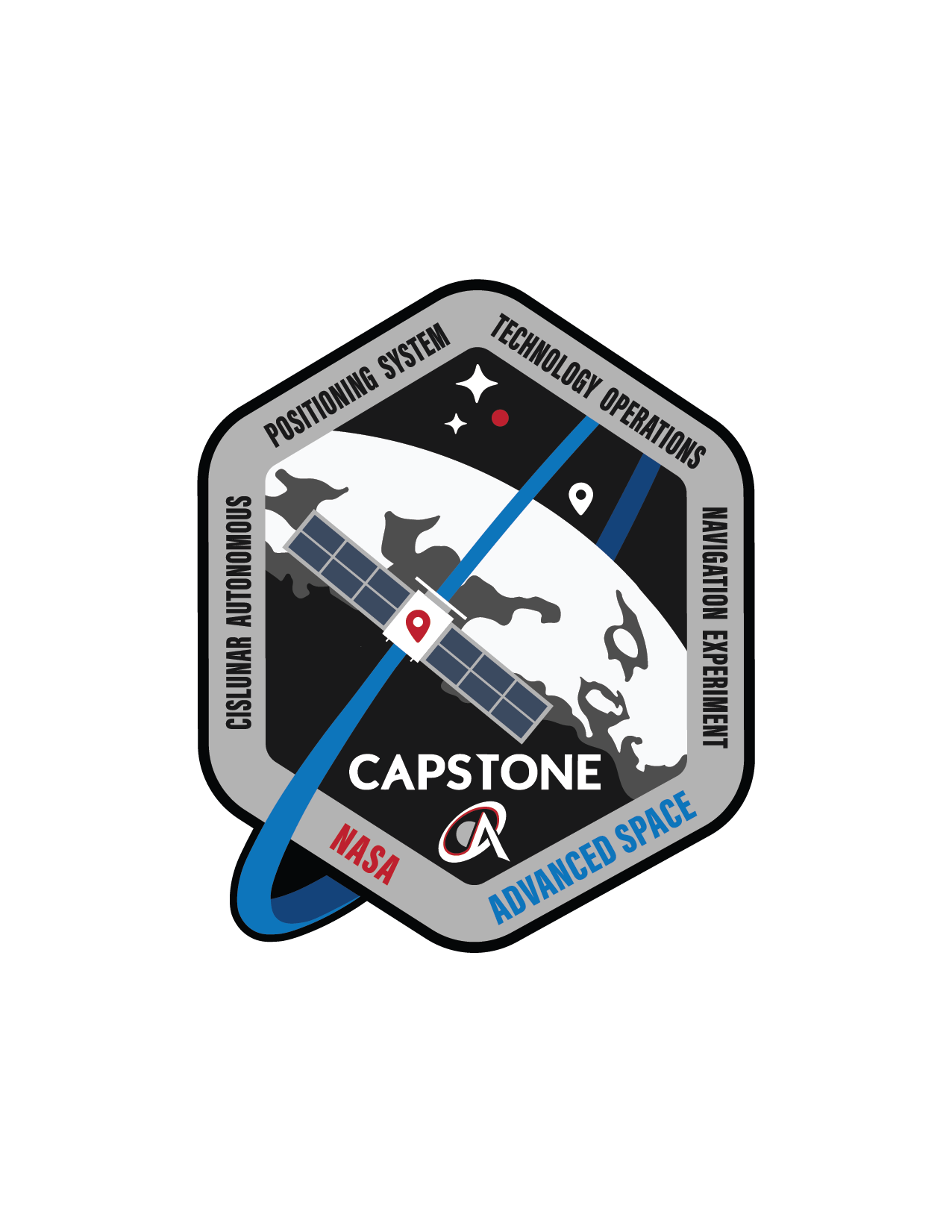
The launch of NASA’s Cislunar Autonomous Positioning System Technology Operations and Navigation Experiment, or CAPSTONE, is no longer targeting a June 13 takeoff, but perhaps by month’s end.
Since arriving at its New Zealand departure point, CAPSTONE has been successfully fueled and integrated with the Lunar Photon upper stage by teams from Rocket Lab, Terran Orbital, and Stellar Exploration. CAPSTONE and Photon have been encapsulated in the payload fairing.
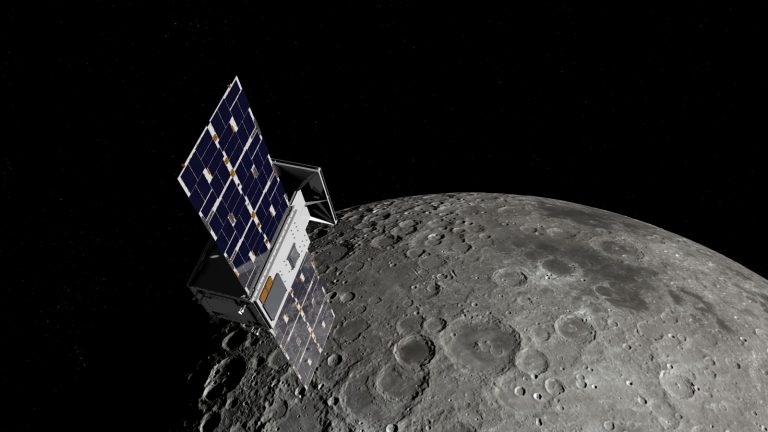
CAPSTONE
Credit: NASA
CAPSTONE is supporting NASA’s Artemis program as a pathfinder for NASA’s Gateway station, a Moon-orbiting outpost.
The mission is to help reduce the risk for future spacecraft by validating innovative navigation technologies and verifying the dynamics of the Near Rectilinear Halo Orbit (NRHO).

Credit: Rocket Lab via Twitter
Staging area
As a 12U CubeSat, CAPSTONE’s orbit also establishes a location that is an ideal staging area for missions to the Moon and beyond. Its location at a precise balance point in the gravities of the Earth and the Moon offers stability for long-term missions like Gateway and requires minimal energy to maintain.
Designed and built by Terran Orbital, the CAPSTONE payload and its software are owned and operated by Advanced Space for NASA.

Credit: Rocket Lab via Twitter
The smallsat is soon to be launched, perhaps by month’s end, atop a Rocket Lab Electron rocket from Rocket Lab Launch Complex 1 (LC-1) on the Mahia Peninsula of New Zealand. That company’s Lunar Photon satellite upper stage will send the spacecraft on its planned lunar transfer trajectory.
CAPSTONE will not go directly to the Moon. Instead, it will follow a “ballistic lunar transfer” that takes the craft out as far as 1.5 million kilometers before returning into lunar orbit. That transfer, which will take about four months to complete, is designed to save propellant, making the mission feasible for such a small spacecraft.
For more information on CAPSTONE, go to:

Credit: NASA/JPL
NASA is evaluating a first human stay on the surface of Mars lasting some 30-days.
Scientists and engineers are debating how to best use that month on Mars – plant a flag, just stay alive, conduct valuable science, or scurry around and set up equipment for the next human Mars landing team?

Credit: NASA
Turns out, site selection will be critical, and hauling select gear on that maiden outing will likely set the framework for future human exploration of the Red Planet.
Go to my new Space.com story “Mars Base 101: How astronauts could make the most of a 30-day Red Planet stay – Mars explorers could get a lot done in a month, experts say,” at: https://www.space.com/nasa-astronauts-30-day-mars-mission-science
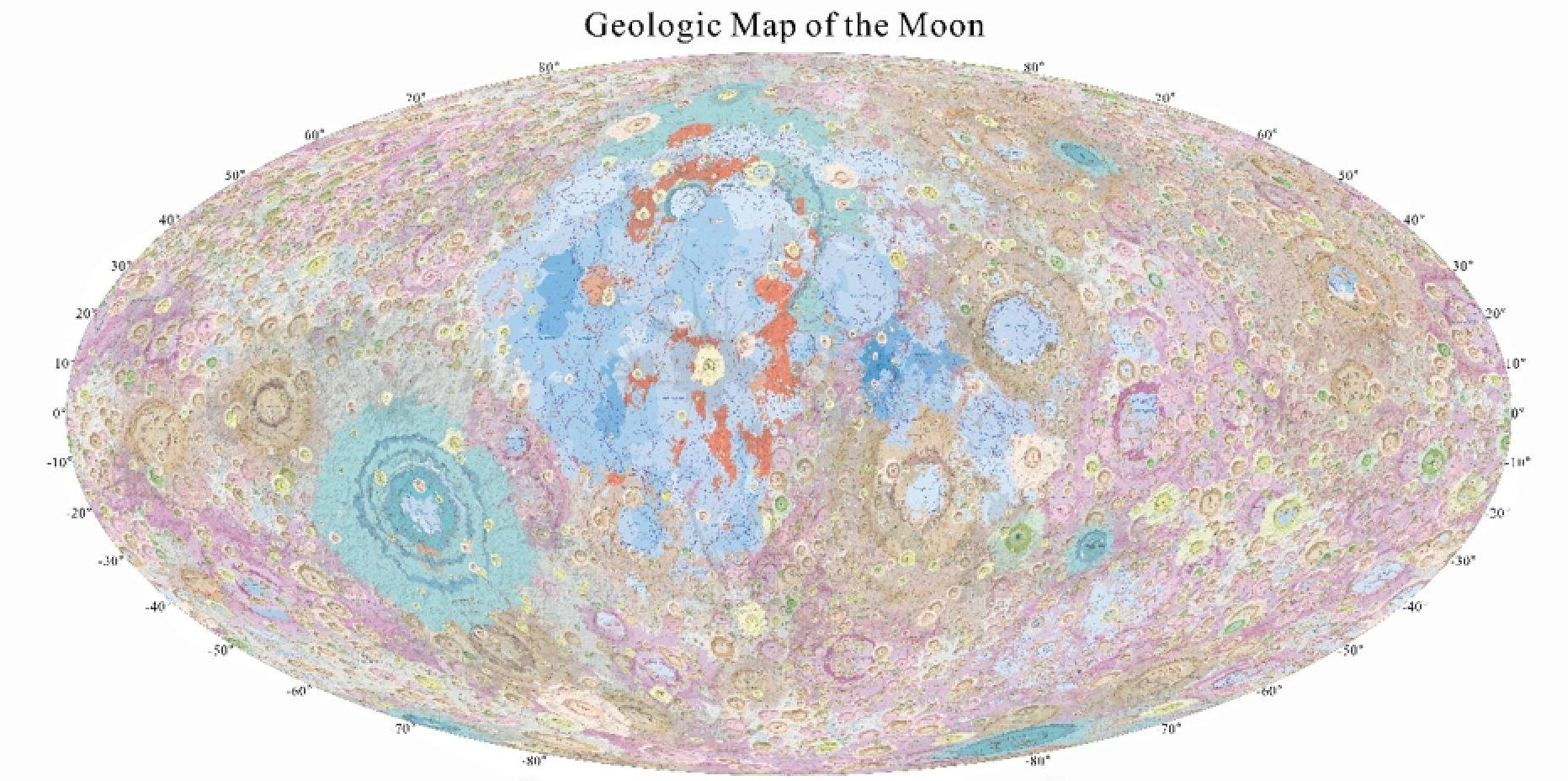
Credit: Jinzhu Ji et al.
Chinese scientists have completed the world’s first 1:2.5 million scale lunar geological map.
The map provides significant basic data for lunar scientific research and an important new reference for the development of other celestial geological maps, according to China Central Television (CCTV).
The new map details information on the Moon’s surface strata, structure, lithology and chronology and charts the evolutionary processes of lunar volcanoes and asteroid impacts. That data will be crucial for future on-site research including exploration planning and landing site selection, CCTV adds.
The creation of the map was led by academician Ouyang Ziyuan and researcher Li Jianzhong, both prominent researchers of China’s lunar exploration program, as well as by the Institute of Geochemistry of the Chinese Academy of Sciences, along with support from five universities and institutes within the field.
Lead author of the paper — “The 1:2,500,000-scale geologic map of the global Moon” — published in the Science Bulletin is Jinzhu Ji, a lecturer at School of Mining, Inner Mongolia University of Technology and visiting scholar at Center for Lunar and Planetary Science, Institute of Geochemistry, Chinese Academy of Sciences.

Credit: Jinzhu Ji et al.
Lunar geological chronology
“Based on the data of China’s Chang’e lunar project and other international lunar exploration research, as well as through the study of strata, morphology, composition, structure and geological age of the Moon’s surface, the team has proposed and established a new lunar geological chronology,” CCTV explains.
The map work has codified the classification of impact crater materials, impact basin construction, rock types and tectonic types and will set standards and procedures for future geological mapping.
“The newly compiled map” CCTV notes, “updates the Moon’s geological chronology based on a better understanding of the history of the lunar surface which has been categorized into three epochs and six periods.”

Credit: ISS/NASA
That trio of epochs have been classified as the early stage, dominated by internal geological activities, the middle stage which features both internal and external geological forces, and the latter stage which has mainly external forces such as asteroid strikes shaping the Moon’s surface.
For more information, go to “The 1:2,500,000-scale geologic map of the global Moon” in the Science Bulletin at:
https://www.sciencedirect.com/science/article/abs/pii/S2095927322002316

Earth orbiting research lab, internal and external – the International Space Station (ISS).
Credit: NASA
The U.S. Government Accountability Office (GAO) has released on June 7: “International Space Station: Opportunities Exist to Improve Communication with National Laboratory Users”
The Center for the Advancement of Science in Space (CASIS) manages the International Space Station National Laboratory for NASA.

Credit: GAO
This report notes that some companies and universities not affiliated with NASA may want access to the lab for research that can’t be done on Earth. CASIS locates resources, such as time astronauts may spend on these research projects.

Credit: GAO rendering of NASA ISS documents
“Recently, the Center formed an advisory committee of these users to improve communication about resource allocation. But the Center hasn’t asked for key input, and some committee members said that more transparency could benefit the user community,” reports the GAO.
Recommendations
In the newly-issued report, GAO makes several recommendations to NASA, including that it ensures CASIS
- Obtains input from its user advisory committee about resource allocation decisions
- Takes steps to agree upon needed information about past allocations, and
- Provides the committee more information about planned resource allocations.
NASA agreed with the first two recommendations, and partially agreed with the third, noting challenges with providing the flight queue.
GAO continues to believe NASA has opportunities to provide additional information, as discussed in the report.
For access to this informative report, go to:

Curiosity’s location as of Sol 3495. Distance driven at that sol: 17.48 miles/28.13 kilometers.
Credit: NASA/JPL-Caltech/Univ. of Arizona
NASA’s Curiosity Mars rover at Gale Crater is now performing Sol 3496 tasks.
“Our drive was successful, and we ended with some lovely flat bedrock with some gorgeous veining running through it,” reports Catherine O’Connell-Cooper, a planetary geologist at University of New Brunswick; Fredericton, New Brunswick, Canada.
As Alpha Particle X-Ray Spectrometer (APXS) payload uplink lead recently, today, O’Connell-Cooper saw several targets that the APXS team would have loved to analyze.

If you zoom in on this image, the veins are just above the arm (with the little rover graphic).This image is a mosaic of 31 images taken by Curiosity in Gale Crater using its mast-mounted Right Navigation Camera (Navcam) on June 6, 2022, Sol 3495 at site number 95 to create a cylindrical projection.
Credit: NASA/JPL-Caltech
Balmy and warm
“Sadly, the timing didn’t work in our favor today. APXS prefers temperatures below -20 C – the colder it is, the better the data quality is. But daytime temperatures in Gale are getting balmy and warm (relatively speaking!) and reaching above -20 C earlier and earlier in the day, often hitting that high by 10 am (Mars local time!),” O’Connell-Cooper explains.

Curiosity Mast Camera (Mastcam) Right image taken on Sol 3494, June 5, 2022.
Credit: NASA/JPL-Caltech/MSSS
Unfortunately, this has an impact on the frequency of APXS data collection.
“During the week, we typically do ‘Touch and Go’ science, meaning we analyze and then drive (on weekends, we stay for the night and drive on the second or third sol). The earliest we can start the Touch and Go right now are often later than 11 am. This means “fuzzy” spectra with noisy data for APXS, O’Connell-Cooper adds.

Curiosity Mars Hand Lens Imager (MAHLI) produced this photo, Sol 3493, June 4, 2022.
Credit: NASA/JPL-Caltech/MSSS
Whilst scientists can still discern basic chemistry from the fuzzy spectra, we obviously prefer to get good quality, and so they found themselves currently passing on early morning science.

Curiosity Chemistry & Camera (ChemCam) Remote Micro-Imager (RMI) photo taken on Sol 3495, June 6, 2022.
Credit: NASA/JPL-Caltech/LANL
Document the target
However, APXS’s loss is the Mars Hand Lens Imager’s (MAHLI) gain!
If APXS analyzes a target, the MAHLI uses its allotted time quota to document the target.
“Without any APXS in the plan,” O’Connell-Cooper reports, “they gain all of the time allotted to APXS (around 18 minutes), in addition to the time they would have used to document the APXS target (around 8 minutes).”
Recently, MAHLI used the bonus time to take a 3 image mosaic of “Wandapa,” centered on an amazing vein junction feature. “There are a number of long linear veins, some thinner cross cutting veins, some nodular features and pebbles, lying on the bedrock,” O’Connell-Cooper notes.

Curiosity Mast Camera Right and Left imagery taken on Sol 3494 June 5, 2022
Credit: NASA/JPL-Caltech/MSSS
Veins and bedrock
The Wandapa mosaic will capture the interactions between the veins and bedrock.

Curiosity Mast Camera Right (Mastcam) acquired this image, Sol 3494, June 5, 2022.
Credit: NASA/JPL-Caltech/MSSS
The rover’s Chemistry and Camera was slated to analyze the composition of the bedrock in this area at “Mahdia” (plus Mastcam) and take some long range imaging of “Gediz Vallis” ridge, up on the pediment.
Mastcam is imaging two targets in the immediate workspace: the ChemCam target (Mahdia) and a sandy target “Karto” looking at structures in a small sand deposit in front of the rover. Two long range images “Eboropu” and “Serra Mara” look at stratigraphy and large scale structural features in the distance.
A newly scripted plan calls for Curiosity to drive around 131 feet (40 meters), aiming to end up on some bedrock for follow-up planning, O’Connell-Cooper concludes.

Credit: CNSA/Inside Outer Space screengrab
The three Shenzhou-14 astronauts — commander Chen Dong and co-astronauts Liu Yang and Cai Xuzhe — entered the space station core module Tianhe on Sunday, just hours after the spaceship was launched into space from a launch center in northwest China.

Credit: CNSA/Inside Outer Space screengrab
Now safely in the core module, their first tasks involved setting up the crew-related environment, including the condition of drinking water, oxygen production, sleep, sanitation and other statuses, said Wang Saijin, deputy chief designer of the China manned space program’s astronaut system at Beijing Aerospace Flight Control Center, in a China Central Television (CCTV) interview.
“These are all very important status settings. They also have to organize and move supplies, including arranging those from the Tianzhou-3 and Tianzhou-4 cargo spaceships,” Wang said.
Six-month stay
This trio has begun their six-month stay in orbit to complete the final stage of constructing the space station Tiangong.

Credit: CCTV/Inside Outer Space screengrab
“We have greatly shortened the time for astronauts to reach the space station since the launch of Shenzhou-12, achieving one-day journey that started at dawn and arrived at dusk. The astronauts had breakfast at Wentian Pavilion in the morning and soon can go to sleep at the space station at night. The space station complex is in great condition for the manned mission,” Gao Xu, deputy chief designer of the China manned space program’s astronaut system under the China Academy of Space Technology told CCTV.
Emergency rescue
Even before the launch of China’s Shenzhou-14 piloted spaceship, the Shenzhou-15 spaceship has been well-prepared for emergency rescue and the rotation mission, according to spacecraft designers.
The trio will complete the assembly and construction of Tiangong, developing it from a single-module structure into a national space laboratory with three modules — the core module Tianhe and two lab modules — Wentian and Mengtian.

Credit: CCTV/Inside Outer Space screengrab
The Shenzhou-14 spaceship was launched from the Jiuquan Satellite Launch Center in northwest China’s Gobi Desert on Sunday and successfully docked with the in-orbit space station core module Tianhe, forming a complex with the core module and the cargo craft Tianzhou-3 and Tianzhou-4.
Continuous technological improvements have made the Long March-2F carrier rocket, China’s only rocket to carry out crewed missions, more reliable and safer, Liu Feng, the launch vehicle’s deputy chief designer said before the launch of the crewed spaceship Shenzhou-14.
International taikonauts
Speaking of the future plan for China’s space station, Huang Weifen, chief designer of taikonaut training system of the China Manned Space Program, said China has been cooperating with other countries and she believes there will be more international taikonauts taking part in joint missions with Chinese taikonauts.

Credit: CCTV/Inside Outer Space screengrab
“Since 2012, in fact, we’ve been cooperating with the European Astronaut Center in selecting and training, medical monitoring and support and space foods. We also sent taikonauts to each other for training. Such exchanges aim for the taikonauts from the European Space Agency to come to the China Space Station. So, we’ve been making relevant technical preparations and discussing how we should select and train,” Huang told CCTV. “We are actively doing this. And many other countries, for example Pakistan, expressed willingness to join flight missions on the China Space Station. I believe there will certainly be a time for international taikonauts to come.”
For newly-issued videos about the Shenzhou-14 mission, go to:

Credit: CCTV/Inside Outer Space screengrab
Following launch from the Jiuquan Satellite Launch Center in northwest China, the Shenzhou-14 crew docked with the core module Tianhe.
Commander Chen Dong and co-astronauts Liu Yang and Cai Xuzhe have entered the core module Tianhe on Sunday, according to the China Manned Space Agency to begin a six-month stay in orbit.

Credit: CCTV/Inside Outer Space screengrab

Credit: CCTV/Inside Outer Space screengrab
The Shenzhou-14 completed a computer-orchestrated rendezvous and docking with the radial port of the in-orbit space station core module Tianhe, forming a complex with the core module and the cargo crafts Tianzhou-3 and Tianzhou-4.

Credit: CCTV/Inside Outer Space screengrab
Three modules
The trio will cooperate with the ground team to complete the assembly and construction of the Tiangong space station – from a single-module structure into a national space laboratory with three modules: the core module Tianhe and modules Wentian and Mengtian.
The Wentian lab module is set to be launched in July and Mengtian in October.
During their stay in orbit, the Shenzhou-14 crew will also witness the docking of the Tianzhou-5 cargo craft and Shenzhou-15 crewed spaceship with the core module. The two individual crews will live and work together for multiple days, with the Shenzhou-14 trio returning to Earth in December.
China’s Tiangong space station is designed to be a versatile space lab, capable of accommodating 25 experiment cabinets for scientific exploration.
Interdisciplinary research
“Each cabinet is a small-sized lab in space, capable of supporting single subject or interdisciplinary research in space science experiments,” said Lin Xiqiang, deputy director of the agency, at a press conference.

Credit: CCTV/Inside Outer Space screengrab
During the construction phase of the space station, nearly 100 experimental research projects have been planned, Lin said.
Multi-level biological experiments on molecules, cells, tissues and organs will be carried out in Wentian by using diverse online detection methods, such as by visible light, fluorescence or microscopic imaging.
Wentian can also provide a variable gravity simulation environment to support the comparative study of the biological growth mechanism in different gravity conditions.

Credit: CCTV/Inside Outer Space screengrab
The Mengtian lab module will mainly support microgravity research, with experiment cabinets for the study of physics of fluids, material science, combustion science and basic physics. It also has cabinets for space technology experiments, Lin said.
Go to these videos that detail the launch and docking of Shenzhou-14 to begin full build-out of the Tiangong space station:

Credit: CCTV/Inside Outer Space screengrab
The upcoming Shenzhou-14 crewed space mission will loft Chen Dong, Liu Yang and Cai Xuzhe.
The Long March-2F carrier rocket for the Shenzhou-14 piloted launch is being fueled Saturday, making the final preparations for the launch at 10:44 on Sunday (local time).
Shenzhou-14 will fly a fast automated rendezvous and docking with the radial port of the space station core module Tianhe, forming a complex with Tianhe as well as the cargo spacecraft Tianzhou-3 and Tianzhou-4.

Credit: CMG/CCTV/CASC/Inside Outer Space screengrab
The Shenzhou-14 mission will complete the construction of the Tiangong space station, with a basic three-module structure consisting of the core module Tianhe and the lab modules Wentian and Mengtian.
National space laboratories
The two lab modules are scheduled to be launched in July and October, respectively, and will host many large-scale and multidisciplinary scientific research experiments for astronauts in orbit following the completion of the space station construction, according to the China Manned Space Agency (CMSA).

Credit: CCTV/Inside Outer Space screengrab
“As national space laboratories, the modules on China’s space station will be equipped with 25 experiment cabinets, with each cabinet serving as a small-scale space lab for single-disciplinary or interdisciplinary scientific experiments. Overall, they have reached international advanced levels,” said Lin Xiqiang, deputy director of the CMSA.
“The Wentian lab module will be mainly used for space life science research as it is be equipped with experiment cabinets for research on life ecology, biotechnology and variable gravity science. It can support research on the growth, development, heredity and senescence of plants, animals and microorganisms under space conditions, as well as experimental research on an enclosed ecosystem. Through visible light, fluorescent light, microscopic imaging and other online monitoring means, it can support multi-level biological experimental research like on the levels of molecule, cell, tissue and organ. It can also provide variable gravity simulation with a range from 0.01 g to 2 g to support comparative research on the growth mechanisms of organisms under different gravity conditions,” said Lin.

Credit: GLOBALink/Inside Outer Space screengrab
“The Mengtian lab module will be mainly used for microgravity science research as it is equipped with multidisciplinary experiment cabinets for research on fluid physics, materials science, combustion science, fundamental physics and aerospace technology experiments. It can support cutting-edge experimental research like research on the essential laws of materials such as multiphase flow, phase change heat exchange, basic combustion process, and material solidification mechanism in microgravity, as well as research on ultra-cold atomic physics,” Lin said.

Credit: GLOBALink/Inside Outer Space screengrab
Cold atomic clock system
Mengtian will also carry the world’s first space-based cold atomic clock system consisting of a hydrogen clock, a rubidium clock and an optical clock, which will become humanity’s most accurate timekeeping device.
“In the meantime, built on the cold atomic clock system in the Tiangong-2 lab, we will establish the world’s first space-based cold atomic clock system [in the Mengtian lab module] which will consist of a hydrogen clock, a rubidium clock and an optical clock, forming the most stable and accurate time and frequency system in space to support frontier scientific research on gravitational redshift, measurement of fine-structure constant and others,” Lin said.

Credit: GLOBALink/Inside Outer Space screengrab
The world’s first-ever cold atomic clock that operates in space was developed by Chinese scientists. It was launched with the Tiangong-2 space lab in 2016 and has a margin of error of less than one second in 30 million years.
Shenzhou-14 crew
China’s Shenzhou-14 spaceflight commander is Chen Dong. This is Chen’s second time to work in space. He served as a crew member of Shenzhou-11 in October 2016.
Liu Yang, the first Chinese woman in space, flew aboard Shenzhou-9 in 2012 – a 13-day mission.
The new Chinese astronaut, Cai Xuzhe, was selected as a member of China’s second batch of astronauts in May 2010.
China has so far completed eight piloted space missions, sending 13 astronauts into Earth orbit and it is now prepping for its 9th crewed launch.
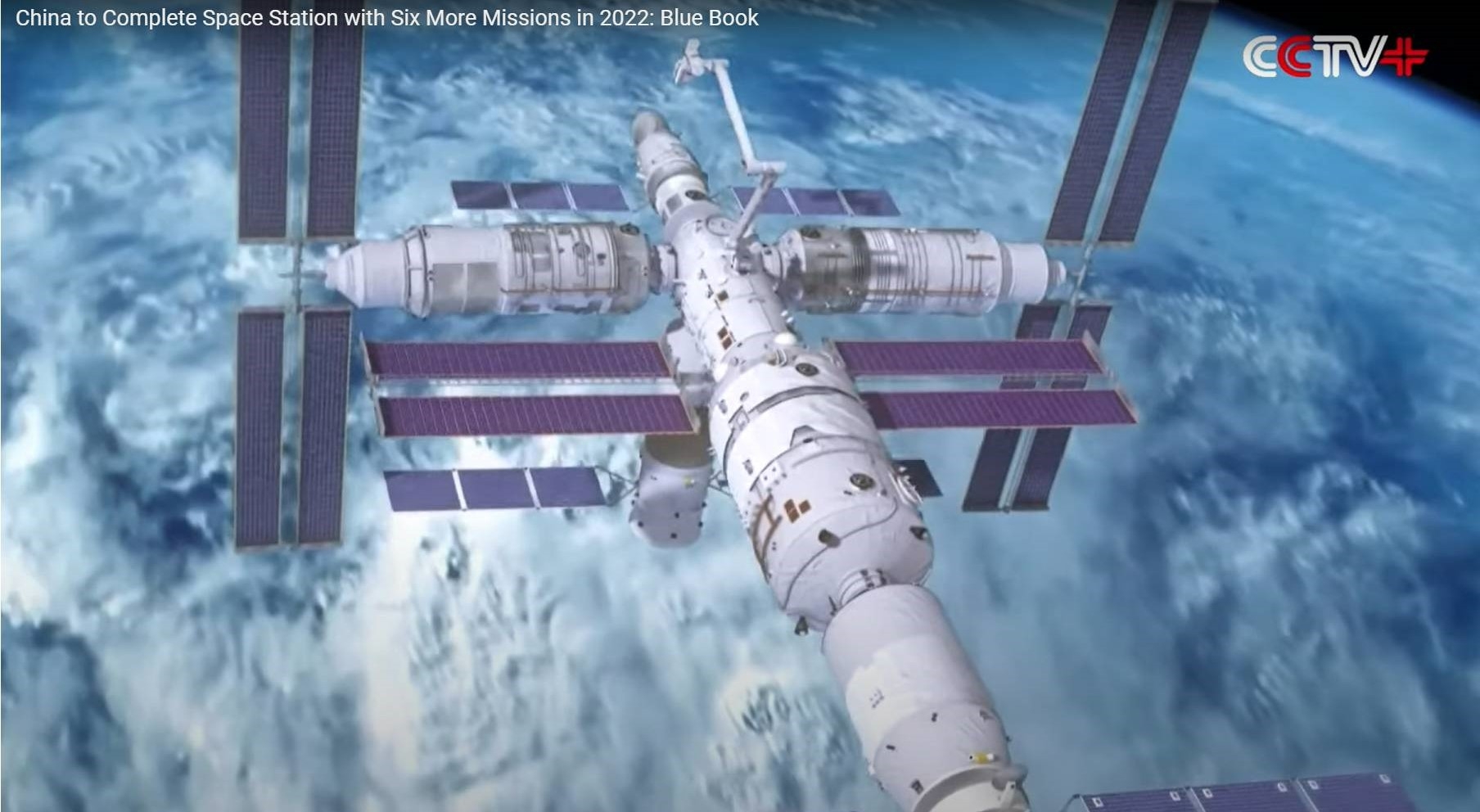
China’s space station to be completed by end of 2022.
Credit: CCTV/Inside Outer Space screengrab
Mission overview
“The Shenzhou-14 crew will work with the ground team to complete the rendezvous, docking and transposition of the two lab modules with the core module, enter the Wentian and Mengtian lab modules for the first time and help make the environment suitable for their stay,” Lin said.
“They will also cooperate with the ground team to carry out tests on the two-module space station complex, the three-module space station complex, large and small mechanical arms, and the exit function of the airlock cabin. The crew will, for the first time, use the airlock cabin in the Wentian lab module to carry out extravehicular activities for two to three times, and unlock and install a dozen of scientific experiment cabinets in the Wentian and Mengtian lab modules,” Lin said.
There is a small mechanical arm installed on the Wentian lab module and the larger robotic arm on the Tianhe core module. They can work independently or together.
According to Lin, the two mechanical arms can be connected to form a combination that can transfer a heavier load for a larger area range.
“The small arm can be grasped by the bigger one to form a combination, so that they can cover a wider range in extravehicular activities (EVAs), transfer for a larger area range and reach different positions for detailed operations,” Lin said.
For more information on the upcoming Shenzhou-14 mission, go to these videos at:

