Archive for the ‘Space News’ Category
 Author:
  August 1st, 2022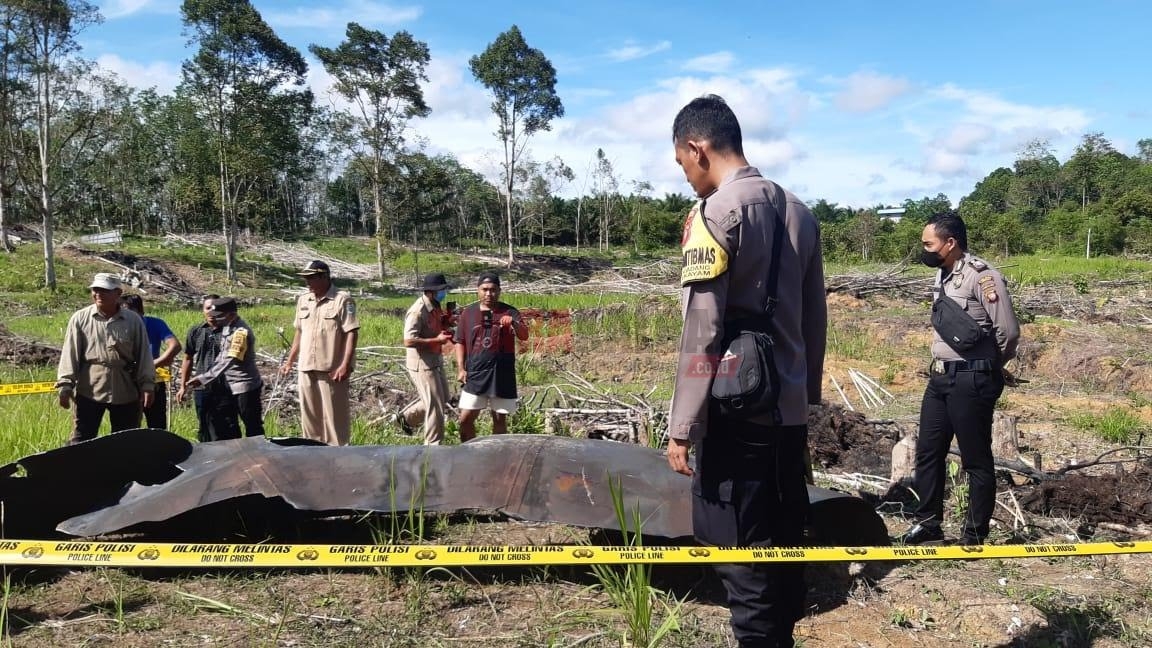
Credit: Photo from Suara Kalbar/Borneo Post Online
Indonesian police and villagers are taking a close look at what could be leftovers of that Chinese rocket body that recently re-entered. The object discovered at Pengadang, a village in Sekayam District of the Sanggau Regency in West Kalimantan measures around 16 feet (5 meters) long and roughly 7 feet (2 meters) wide.

Credit: The Aerospace Corporation
Another Indonesian news portal, Suara Kalbar, reports that there were the numbers ‘84, 31, 75 and 5W’ visible on the object.
As of now, whether the object is part of the Chinese rocket body remains unknown. However, on Saturday night at 23.09pm (12.09am Malaysian time), some residents in Pengadang did hear a “loud roar from the sky.”
For more details, go to this Borneo Post Online story at:
Video of the object has been posted by Tribun Pontianak at:

Credit: Google Maps
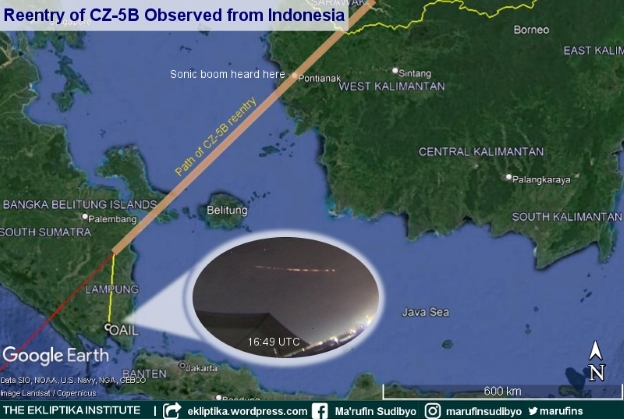
Credit: The Ekiptika Institute
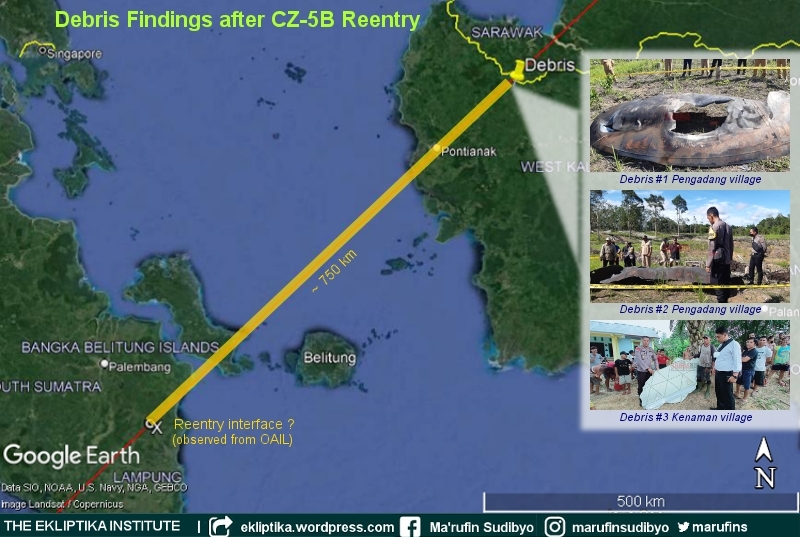
Credit: The Ekiptika Institute
 Posted in

Credit: NASA/GSFC/Arizona State University
Lunar caves would provide a temperate, stable, and safe thermal environment for long term exploration and habitation of the Moon.
Indeed, people could potentially live and work in lunar pits and caves with steady temperatures in the 60s.
That’s the bottom line from researchers at the University of California, Los Angeles (UCLA).
Tyler Horvath, a UCLA doctoral student in planetary science, led the new research recently published in the American Geophysical Union’s Geophysical Research Letters. The research team also included UCLA professor of planetary science David Paige and Paul Hayne of the University of Colorado Boulder.

Credit: NASA
Desirable habitat
“For long term colonization and exploration of the Moon, pits may provide a desirable habitat: they are largely free from the constant threats of harmful radiation, impacts, and extreme temperatures,” states the paper. “Thus, pits and caves may offer greater mission safety than other potential base station locales, providing a valuable stepping stone for sustaining human life beyond Earth.”
Since the discovery of pits on the Moon by the Japan Aerospace Exploration Agency (JAXA) SELENE spacecraft in 2009, there has been interest in whether they provide access to caves that could be explored by rovers and astronauts.

NASA’s Lunar Reconnaissance Orbiter (LRO).
Credit: NASA/GSFC
Prominent pit
Using data from the Diviner instrument aboard the Lunar Reconnaissance Orbiter (LRO), which has been continuously measuring the temperature of the lunar surface for over 11 years, the researchers methodically characterized the environment of one prominent pit located in Mare Tranquillitatis.

The Mare Tranquillitatis pit and (b) the Mare Ingenii pit.
Credit: Tyler Horvath, Paul O. Hayne, David A. Paige
The pit’s thermal environment is more hospitable compared to anywhere else on the Moon, with temperatures varying minimally around a comfortable 17°C (or 63° F) wherever the Sun does not shine directly, explains the research paper.
“Humans evolved living in caves, and to caves we might return when we live on the Moon,” said Paige in a UCLA press statement. Paige leads the Diviner Lunar Radiometer Experiment.
Horvath and Paige are science team members for a new lunar-bound thermal camera led by Paul Hayne named the Lunar Compact Infrared Imaging System (L-CIRiS) which will head to the lunar south pole in late 2023 to get the first ground-based thermal images.
To read the full paper – “Thermal and Illumination Environments of Lunar Pits and Caves: Models and Observations From the Diviner Lunar Radiometer Experiment” – go to:
https://agupubs.onlinelibrary.wiley.com/doi/10.1029/2022GL099710

Tech. Sgt. Ronald Dunn, 729th Airlift Squadron loadmaster, guides a Mongolian driver who is backing the truck toward an Air Force Reserve C-17 Globemaster III in Mongolia, Aug. 26. Dunn was part of a crew from March Air Reserve Base, Calif., who were assigned to a mission to retrieve space debris that fell to earth last summer. The parts were identified as expended rocket parts from an Air Force missile launched into space nearly a decade ago. (U.S. Air Force photo/Master Sgt. Linda Welz)
Increasing attention is being paid to the repercussion of rocket launches and space debris reentries on Earth’s fragile atmosphere, coupled to impacts on global climate and stratospheric ozone.
Exacerbating the situation is the rise of worldwide launch rates and the hurling of mega-constellations of satellites into Earth orbit. Then there’s the associated clutter of deceased spacecraft, discarded booster stages, and countless pieces of human-made refuse, from solid rocket motor effluents to stray nuts and bolts, tiny paint chips and droplets bubbling out of spacecraft coolant systems.

Space debris impact on functioning satellite.
Credit: The Aerospace Corporation
In short, it’s a heavenly mess – with long-term consequences.
The state of affairs has already been characterized by orbital debris experts as a “tragedy of the commons.”
For detailed information, go to my new Scientific American story with Lee Billings – “Don’t Fear China’s Falling Rocket—Fear the Future It Foretells: Long considered trivial, the effects of rocket launches and reentering space debris on global warming and ozone loss could soon become too large to ignore” – at:

Credit: The Aerospace Corporation

Credit: Space Foundation
NASA camera man Bill Ingalls is a sharp shooter for the space agency and has stories to tell.
Ingalls has been a professional photographer for three decades and has served as the Senior Contract Photographer for NASA Headquarters since 1989.
Ingalls has traveled the world photographing missions for NASA. We have all been witness to his assignments and the resulting catalog of his impressive images, be they a launch departing Kennedy Space Center in Florida; the inside of an active volcano in Alaska; clicking away in the White House Oval Office to the brutally cold Kazakh steppes; and even crawling around on the floor in a Capitol Hill hearing room. He says, “because I can’t get up anymore.”
Go to my new Space.com story – “The amazing eye and insight of NASA space photographer Bill Ingalls” a photographer that has captured some of NASA’s most historic moments over the last three decades.
Story at: https://www.space.com/bill-ingalls-nasa-photographer

Credit: CCTV/Inside Outer Space screengrab
China’s “Lijian-1” carrier rocket is a new-type solid-propellant launch vehicle used to send six scientific experiment satellites into orbit July 27th.
The rocket has played a role in enriching China’s solid-propellant carrier rocket family with various technological innovations.

Credit: CCTV/Inside Outer Space screengrab
The Lijian-1 launch vehicle was launched for the first time from the Jiuquan Satellite Launch Center, Gansu Province, northwest China. Also known as ZK-1A, this four-stage solid-propellant launch vehicle was jointly developed by the Institute of Mechanics of the Chinese Academy of Sciences and CAS Space (Beijing Zhongke Aerospace Exploration Technology Co., Ltd.).

Credit: CCTV/Inside Outer Space screengrab
Hydrogen-oxygen engine
Meanwhile, the high-thrust hydrogen-oxygen engine of China’s Long March-5 Y6 carrier rocket passed its calibration test on Tuesday.
This calibration experiment is a kind of short-range ground test under rated conditions of an engine ready for delivery to the final rocket assembly with the purposes to check and adjust performance parameters.

Credit: CCTV/Inside Outer Space screengrab
Only after passing the calibration test can an engine be officially installed on the rocket.
For videos on the Lijian-1 launch vehicle, go to:
For a video on the China’s Long March-5 Y6 engine test, go to:

Docking of Tianzhou-3 cargo spacecraft with core module.
Credit: CNSA/China Media Group/CCTV/Inside Outer Space screengrab
China’s Tianzhou-3 cargo craft re-entered the atmosphere “in a controlled manner” Wednesday, reports the China Manned Space Agency (CMSA).
Meanwhile, all eyes are on the “uncontrolled” re-entry of the hefty Long March-5 rocket body, now predicted to fall to Earth July 31 ± 22 hours, according to re-entry experts at The Aerospace Corporation. This Long March-5 leftover hurled the Wentian, the first lab module of China’s space station.

Credit: The Aerospace Corporation
As for the Tianzhou-3 cargo craft, it was launched on September 20, 2021, delivering roughly 6 tons of supplies to the in-construction station site. While in orbit, the cargo craft conducted two rendezvous and docking operations with the combination of the Tianhe core module, and carried out a test flight circling the space station.
Space technology tests
After its separation from the Tianhe combination on July 17, Tianzhou-3 carried out space technology tests, accumulating important experience for the in-orbit construction as well as the operation and management of the space station, according to a China Central Television (CCTV) report.
Credit: China National Space Administration (CNSA)/China Media Group(CMG)/China Central Television (CCTV)/Inside Outer Space screengrab
The Tianzhou-3 cargo craft flew independently during the rendezvous and docking between the Wentian lab module and the Tianhe core module. If any failure occurred during the docking process, Tianzhou-3 would have re-docked with the space station to provide living space for the astronauts, CCTV noted.
The CMSA explained that, as for the demise of the cargo vehicle, most of the spacecraft’s components burned up during re-entry, and a small amount of its debris fell into the scheduled safe waters.

Credit: The Aerospace Corporation

The Interstellar Probe, a mission to provide a unified view of our heliosphere, out into nearby interstellar space.
Credit: Johns Hopkins/APL
There is promising new work underway to pursue a deep space robotic interstellar mission. An Interstellar Probe venture can capture a unified view of our heliosphere, out into nearby interstellar space.
All of that sounds exceedingly lofty, ambitious, and tough-to-do.
But there’s no need to wait for new technology say advocates – it’s here, and one booster of choice for the mission could be NASA’s Space Launch System (SLS).
“It isn’t about where we are going. It’s about the journey out there. And it is a journey now long overdue,” says one leading advocate.
Go to my new Space.com story – “Interstellar probe: Has its time finally come?” – at:
https://www.space.com/interstellar-probe-johns-hopkins-apl-nasa-sls

The Korea Pathfinder Lunar Orbiter, KPLO, is set for a one-year agenda of research.
Credit: Korean Aerospace Research Institute (KARI)
The first lunar mission of the Korean Aerospace Research Institute is slated for an upcoming SpaceX Falcon 9 boost.
The Korea Pathfinder Lunar Orbiter, KPLO for short, is viewed as the first step of the country’s deep space agenda that includes a future first robotic landing onto the moon by 2030, as well as a sample collecting asteroid mission.
In May of this year, the KPLO was officially named “Danuri” – a blend of two Korean words for moon and “nurida” that means enjoy.
Go to my new Space.com story – “South Korea is ready to launch its 1st moon mission – The Korea Pathfinder Lunar Orbiter will lift off on Aug. 2” – at:
https://www.space.com/south-korea-first-moon-mission-launch-one-week
Credit: China National Space Administration (CNSA)/China Media Group(CMG)/China Central Television (CCTV)/Inside Outer Space screengrab
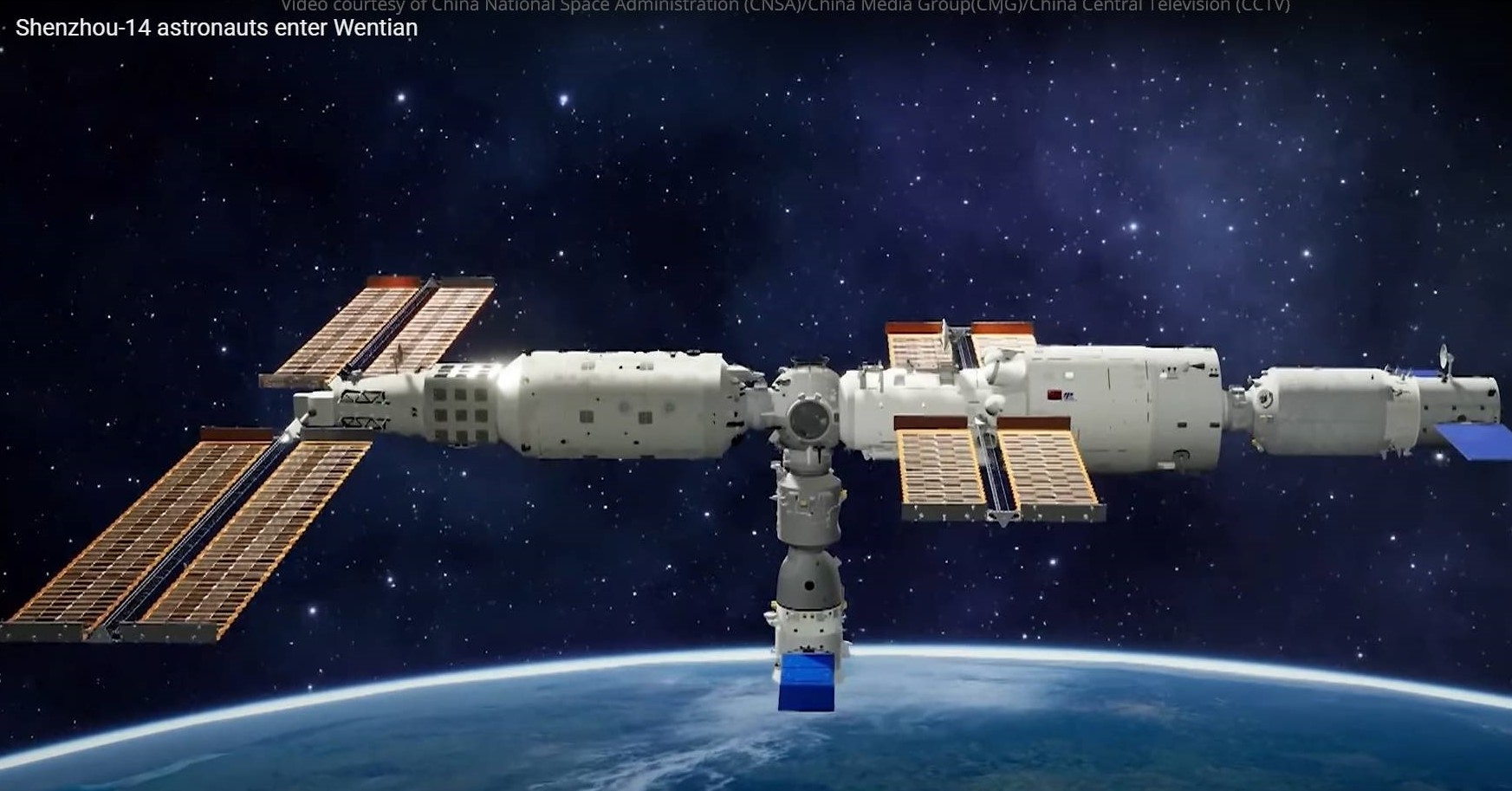
China’s Wentian lab module of China’s space station successfully docked with the combination of the Tianhe core module.
The Shenzhou-14 crew opened the door of Wentian and then entered the lab from the core module Tianhe.

Shenzhou-14 crew watches launch of the new lab module.
Credit: China National Space Administration (CNSA)/China Media Group(CMG)/China Central Television (CCTV)/Inside Outer Space screengrab
Launched on Sunday, the lab module flew to the station construction site, a process that took roughly 13 hours, according to the China Manned Space Agency (CMSA).
It was the first time that China’s two 20-ton-level spacecrafts conducted rendezvous and docking in orbit, and also the first time that a space rendezvous and docking were carried out during the astronauts’ in-orbit stay in the space station, the CMSA said.

Shenzhou-14 crew enters new lab module. Credit: China National Space Administration (CNSA)/China Media Group(CMG)/China Central Television (CCTV)/Inside Outer Space screengrab
Experiment racks
Like the Tianhe, the Wentian lab module is also equipped with living facilities for the astronauts, including three sleeping areas, a toilet and a kitchen. It has an airlock cabin which will become the main exit-entry point for extravehicular activities (EVAs) once active, replacing the role now played by the Tianhe docking hub.
The astronauts are slated to conduct in-orbit work such as the attitude control of the combination of the space station, small mechanical arm crawling and the test of the complex of big and small arms.
They will also use the airlock cabin and the small mechanical arm of Wentian to carry out extravehicular activities.

Station complete is set for year’s end.
Credit: CNAS/CCTV Video News Agency/Inside Outer Space screengrab
Wentian’s main role is hosting experiment racks for science experiments, while also providing backups to the life support and control functions of the core module that was launched in April 2021.
Mengtian, the final component of the space station, is scheduled to arrive in October.
Crew handover
The new crew facilities will allow China to perform a first crew handover. This will take place when the current Shenzhou-14 crew — commander Chen Dong and co-astronauts Liu Yang and Cai Xuzhe — greet three new astronauts aboard Shenzhou-15 in December.
The fully-built Tiangong (Heavenly Palace) station will then host six astronauts for a period of days.
For video views of the docking and the Shenzhou-14 crew boarding the new module, go to:

Credit: CCTV/Inside Outer Space screengrab
China’s Wentian lab module lifted off from the Wenchang Spacecraft Launch Site in south China’s Hainan Province on July 24 – a milestone mission to enlarge the country’s space station.
The lab will function both as a backup of the station’s core module and serve as a scientific experiment platform.

Credit: CCTV/Inside Outer Space screengrab
The construction of China’s Tiangong space station is expected to be completed by year’s end. It will then evolve from a single-module structure into a national space laboratory with three modules — the core module, Tianhe, and two lab modules, Wentian and Mengtian.
The Tianhe core module was launched in April 2021, and the Mengtian module is set to be launched in October this year.

Credit: China Manned Space Engineering Office
The Wentian module is now set to rendezvous and dock to the front docking port of the core module that now houses the Shenzhou-14 crew: Chen Dong and co-astronauts Liu Yang and Cai Xuzhe.
Video of the launch can be viewed at:

