Archive for the ‘Space News’ Category
 Author:
  August 24th, 2022
Curiosity’s location on Sol 3571. Distance driven to that sol: 17.76 miles/28.58 kilometers.
Credit: NASA/JPL-Caltech/Univ. of Arizona
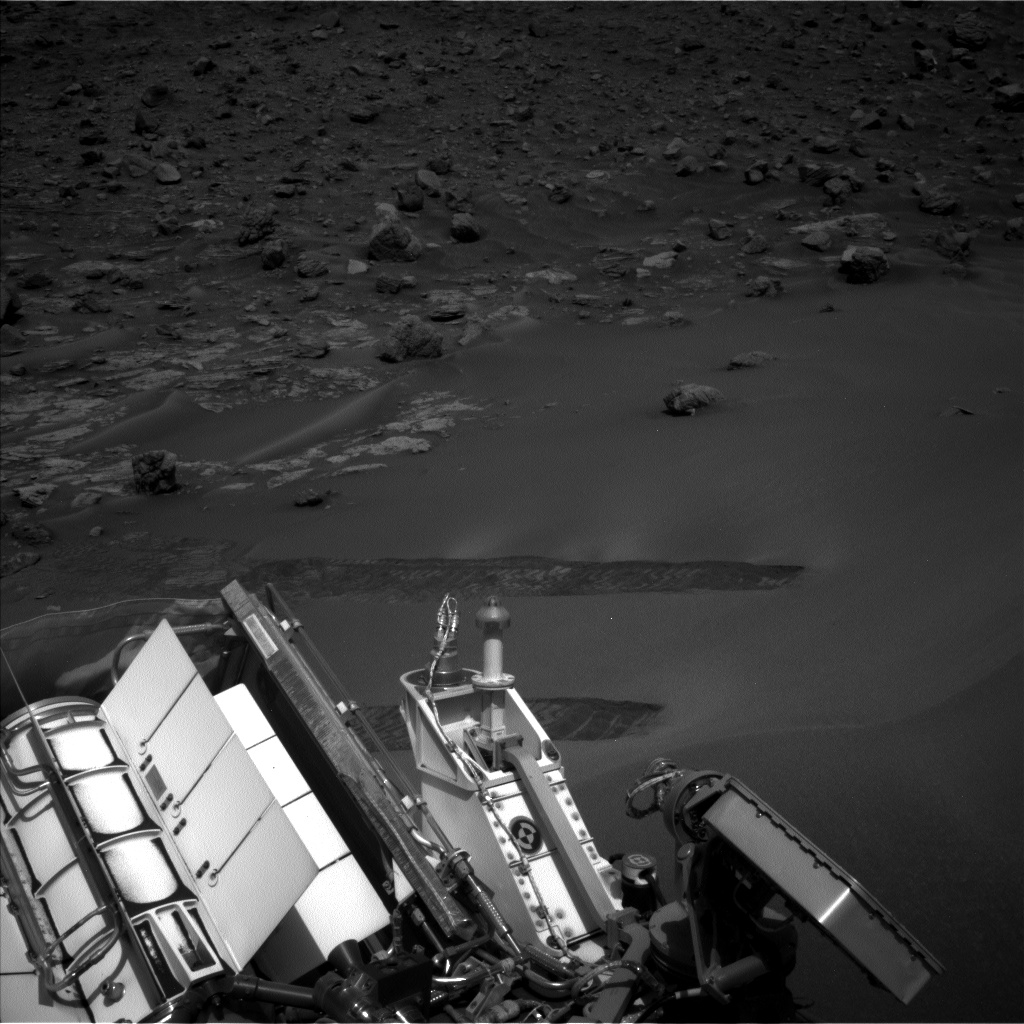
NASA’s Curiosity Mars rover at Gale Crater is now performing Sol 3572 duties.
“We are almost through Paraitepuy pass, an area between two large buttes that has made for tricky driving while dealing with communication challenges, sand and broken-up rocks,” reports Lucy Thompson, a planetary geologist at University of New Brunswick; Fredericton, New Brunswick, Canada.

Curiosity Front Hazard Avoidance Camera Left B image taken on Sol 3572, August 24, 2022.
Credit: NASA/JPL-Caltech
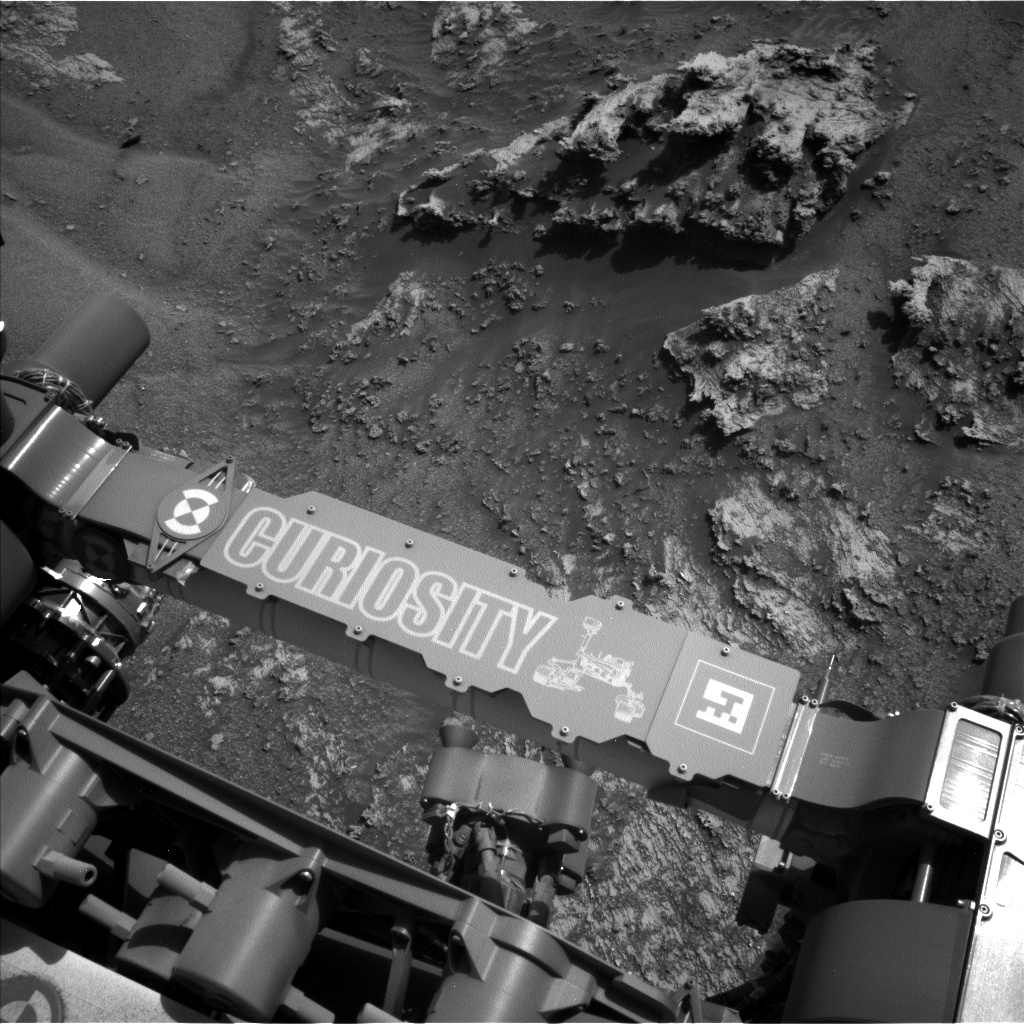
“But the end is in sight as we near an area identified from orbit as probably containing hydrated magnesium sulfates, in contrast with the clay-bearing unit that we have been transitioning out of,” Thompson adds.

Curiosity Front Hazard Avoidance Camera Left B image taken on Sol 3572, August 24, 2022.
Credit: NASA/JPL-Caltech
Broken-up bedrock
“Before we get there though, the team noticed that there is an area that appears quite different from what we have been driving over, and the upcoming, potentially sulfate-rich area. The broken-up bedrock is characterized by numerous, relatively large, resistant features,” Thompson points out.
Although researchers recently had these rocks in front of the rover, because of a low data volume downlink from the previous plan, they did not have the imaging necessary to safely place the arm and the Mars Hand Lens Imager (MAHLI) and Alpha Particle X-Ray Spectrometer (APXS) instruments on the rocks.

Curiosity Left B Navigation Camera image taken on Sol 3572, August 24, 2022.
Credit: NASA/JPL-Caltech
Thompson, as the APXS strategic planner this week, advocated for trying to get APXS compositional data on these rocks before the robot drives away.
“We therefore prioritized driving in this plan to put us in a good position to do contact science on one of these interesting rocks in tomorrow’s plan. Given that these ‘nodule-rich’ rocks occur in the vicinity of the ‘sulfate-bearing’ area mapped from orbit, the team decided that it was important to fully characterize them,” Thompson reports. “They could provide insights into the processes that occurred in the rocks as we change from clay-bearing to sulfate-bearing.”

Curiosity Left B Navigation Camera image taken on Sol 3572, August 24, 2022.
Credit: NASA/JPL-Caltech
Document textures
Although Mars researchers could not do contact science, they took full advantage of Curiosity’s remote sensing instruments to investigate the rocks immediately in front of the rover, as well as attempting to place them in context with outcrops exposed in the surrounding buttes.

Curiosity Right B Navigation Camera photo acquired on Sol 3572, August 24, 2022.
Credit: NASA/JPL-Caltech
Chemistry and Camera (ChemCam) was slated to acquire compositional data on an exposure of the nodular bedrock, “Isla Cangrejo,” which will also be imaged with Mastcam.
Mastcam images were to also be obtained of “Kulishiri,” “Jiboia,” and “Altana Creek” to further document textures.
Nodule rich material
Also in the plan is producing a Mastcam mosaic of a section of the Bolivar butte to look at possible exposures of the nodule rich material, and the relationship with underlying and overlying strata.

Curiosity Mars Hand Lens Imager (MAHLI) photo produced on Sol 3571, August 23, 2022.
Credit: NASA/JPL-Caltech/MSSS
To fully document the terrain around and below us, a Mastcam starboard mosaic and Mars Descent Imager (MARDI) image were also planned.
Also busy, the environmental science team planned several observations to continue monitoring changes in atmospheric conditions. These included: a Navcam large dust devil survey and cosmic ray survey. Standard Rover Environmental Monitoring Station (REMS), Radiation Assessment Detector (RAD) and Dynamic Albedo of Neutrons (DAN) activities round out this plan, Thompson concluded.
 Posted in

Group photo of the Galileo Project members during their first-year conference at the Harvard College Observatory on August 1–3, 2022.
Image credit: Andy Mead, courtesy Avi Loeb
The Galileo Project is the first systematic scientific research program in a search for artifacts or remnants of extraterrestrial technological civilizations.
Team members of the initiative held a conference on August 1–3 at the Harvard College Observatory in Cambridge, Massachusetts to make note of its first-year accomplishments and to chart plans for the year ahead.

Layout diagram of the all-sky Galileo Observatory for UAP on the roof of the Harvard College Observatory in Cambridge, Massachusetts.
Image credit: Avi Loeb
One action item of note was the opening up of a rooftop set of instruments to look into the issue of Unidentified Aerial Phenomenon (UAP), also frequently characterized as Unidentified Flying Objects (UFOs).

Avi Loeb details the Galileo Project effort.
Image credit: Matt Checkowski/Galileo Project archive
Heading the Galileo Project is noted astrophysicist Avi Loeb of Harvard University.
For details, go to my new Space.com story – “On the trail of unidentified aerial phenomenon: the Galileo Project looks ahead” – at:
https://www.space.com/galileo-project-uap-ufos-one-year-update

Venus cloud encounter – a private sector investigation.
Credit: Rocket Lab
Here on Earth, Venus is somewhere between the Spinal Tap song about living in a “Hell Hole” but mixed with comedian Rodney Dangerfield’s quip of getting “no respect.”
Nevertheless, for all that negativity, Venus is more positively alluring than ever.

Electron small launch vehicle enables Venus exploration.
Credit: Rocket Lab
Scientists are now sniffing out what future missions can cough up new information regarding that world’s potential as an extraterrestrial home address for life – life that’s busily minding its own business in a swirl within Venusian clouds.
Boosting the promise of life on Venus detection is to make use of private rocketry capability, such as using the entrepreneurial Rocket Lab booster and their Photon upper stage.

Venus Life Finder Mission report.
Credit: MIT/Breakthrough Initiatives
For many months, work on reaching out to Venus has been in tight-lipped mode.
But for details, go to my new Space.com story – “Rocket Lab planning to launch private Venus mission in May 2023 – A new paper provides details of the ambitious mission” at:
https://www.space.com/rocket-lab-planning-to-launch-private-venus-mission-in-may-2023
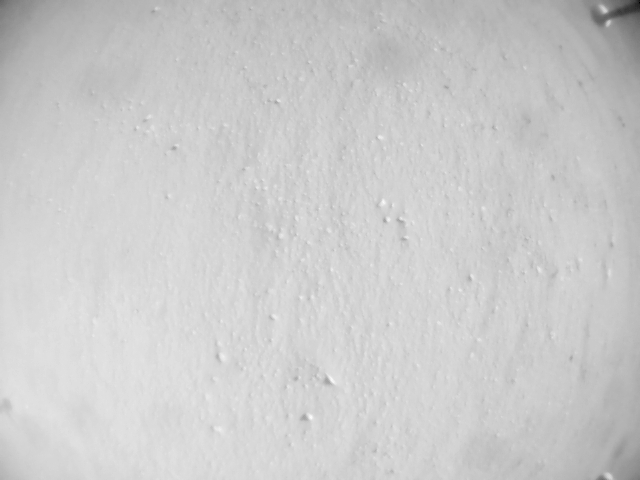
NASA’s Ingenuity Mars Helicopter acquired this image using its navigation camera. This camera is mounted in the helicopter’s fuselage and pointed directly downward to track the ground during flight. This image was acquired on Aug. 20, 2022 (Sol 533 of the Perseverance rover mission).
Credit: NASA/JPL-Caltech
NASA’s Ingenuity Mars helicopter appears to have gone airborne on its 30th sortie. Flying on August 20th, the craft took a set of navigation camera images.
In a pre-flight posting, Teddy Tzanetos, Ingenuity Team Lead at NASA’s Jet Propulsion Laboratory, said the 30th flight would be a short hop. The intent of the flight would be to “check out our system’s health after surviving 101 sols of winter, collect landing delivery data in support of NASA’s Mars Sample Return Campaign, and potentially clear off dust that has settled on our solar panel since Flight 29.” That sortie took place on June 11, 2022.
Translate sideways
Tzanetos said that flight 30 would have Ingenuity translate sideways only 7 feet (2 meters) and then land, “but with the specific goal of providing a data point on Ingenuity’s ability to accurately approach a landing target.”
The rotorcraft’s navigation system’s performance “will be of value to the Sample Recovery Helicopter team (part of the Mars Sample Return Program) in their early design work for a next-generation Mars Helicopter navigation system, Tzanetos said.
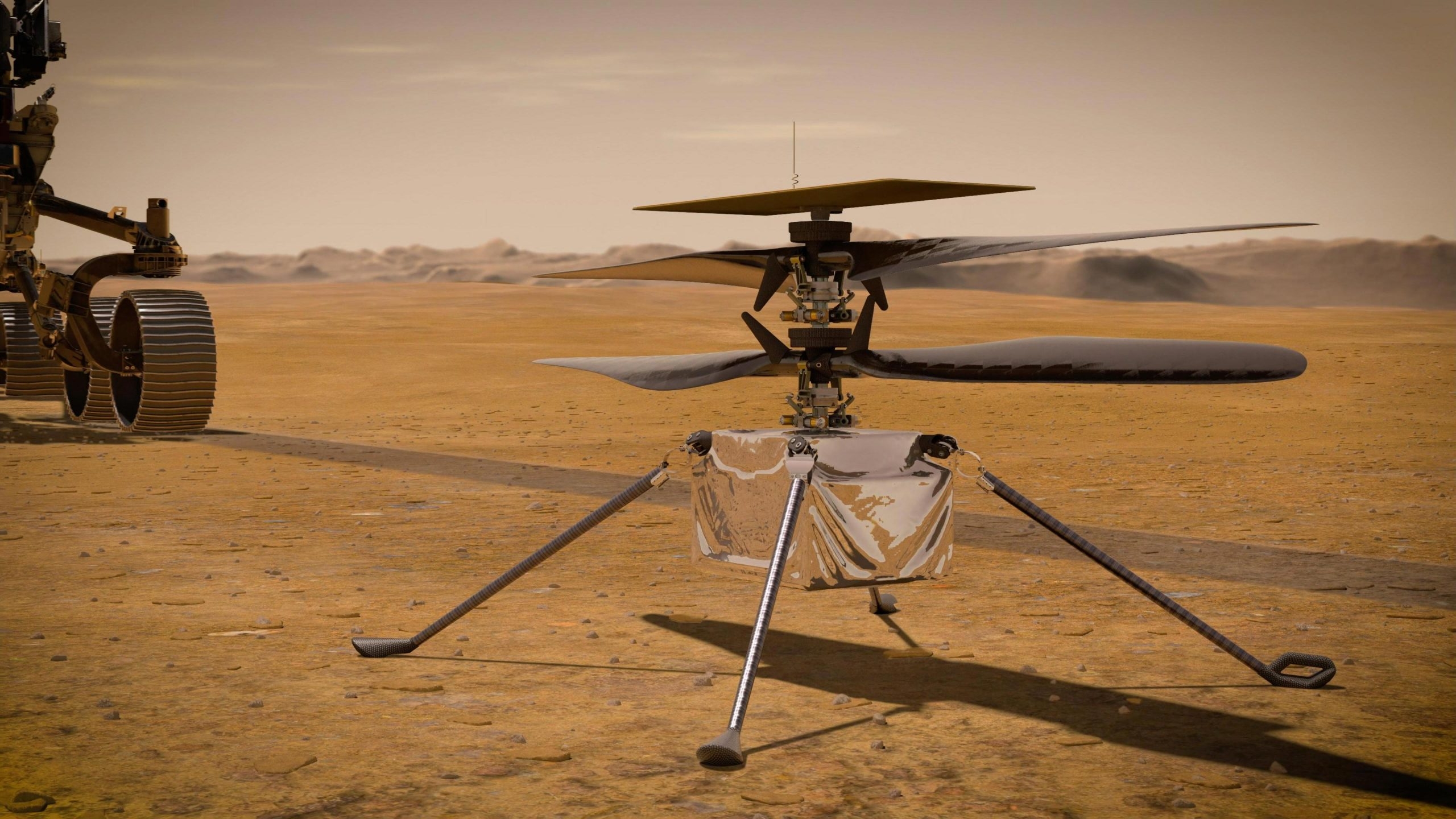
Illustration of Ingenuity helicopter.
Credit: NASA/JPL-Caltech

Credit: CGTN/Inside Outer Space screengrab
Reports from China indicate the country is advancing research on next-generation crewed launch vehicles with new Long March launch vehicles potentially used in China’s human lunar landing program and the construction of an international research station on the Moon.
“The payload capacity of the next-generation rockets and heavy rockets for manned lunar missions has plenty of room for another major upgrading to support the construction and implementation of these projects.” said Chen Xiaofei, an expert with the general design department of China Academy of Launch Vehicle Technology.

Credit: CGTN/Inside Outer Space screengrab
While maintaining a high success launch rate of the active Long March rockets, China Central Television (CCTV) says the country is also carrying out work to reduce the launch cost, as well as make technical breakthroughs like re-use of spacecraft.
“We have been conducting researches and working on solutions revolving around the reuse technology for Long March rockets. Our plan is to finish the relevant flight tests within the 14th Five-Year Plan period (2021-2025),” Chen told CCTV.
Maiden flights
In the past two years, the Long March rockets have put more than 200 spacecraft into the preset orbit precisely, adds CCTV, with several new types making their maiden flights successfully.
China’s large carrier rocket Long March-5B made its maiden flight on May 5, 2022, increasing the carrying capacity of Chinese rockets to low-Earth orbit to 25 tons.
CCTV also added that the successful launch of the medium-lift carrier rocket Long March-8 on Dec. 22, 2020 has filled the gap in China’s launch capability to the sun-synchronous orbit from three to five tons.
The modified version of the Long March-6 carrier rocket with solid strap-on boosters adopted two types of engines, achieving its maiden flight on March 29 of this year and sending two satellites into planned orbit.

Credit: CGTN/Inside Outer Space screengrab
“We must have our own powerful and suitable carrier rockets, because how strong the capability of the carrier rocket decides how deep China’s space capability can reach into space, and how smoothly this pursuit would be,” said Yan Zexian, director of quality and technology department of China Aerospace Science and Technology Corporation (CASC).
Lunar landing: around 2030?
Meanwhile, the Beijing-based Global Times reports that even without the new-generation crew-carrying rocket and super-heavy lift launch vehicle, leading Chinese rocket scientist Long Lehao, an academician of the Chinese Academy of Engineering and chief designer of the Long March rockets, revealed in August 2021 that China could use two rocket launches to send two taikonauts to the Moon by around 2030.
Long referred to the new variant as Long March-5 DY, which stands for “dengyue,” meaning “lunar landing” in Chinese, reports the Global Times.

China’s Long March-5 booster departs Wenchang launch site.
Credit: CASC
Two rockets carrying a lunar lander and a next-generation piloted spaceship would be launched for the mission, and the two parts of the spacecraft will rendezvous and dock in near-lunar orbit, before executing the landing process.
The two taikonauts could work on the Moon’s surface for some six hours, according to Long.
Global Times adds that there is no mention of a specific landing site. The new piloted spaceship would then depart the Moon and carry out another docking with an orbiting module before heading back to Earth – a scenario already used for China’s robotic lunar sample return mission.

Credit: Mars Guy
Two new episodes of Mars Guy flag new developments in NASA’s Perseverance rover exploration at Jezero Crater.
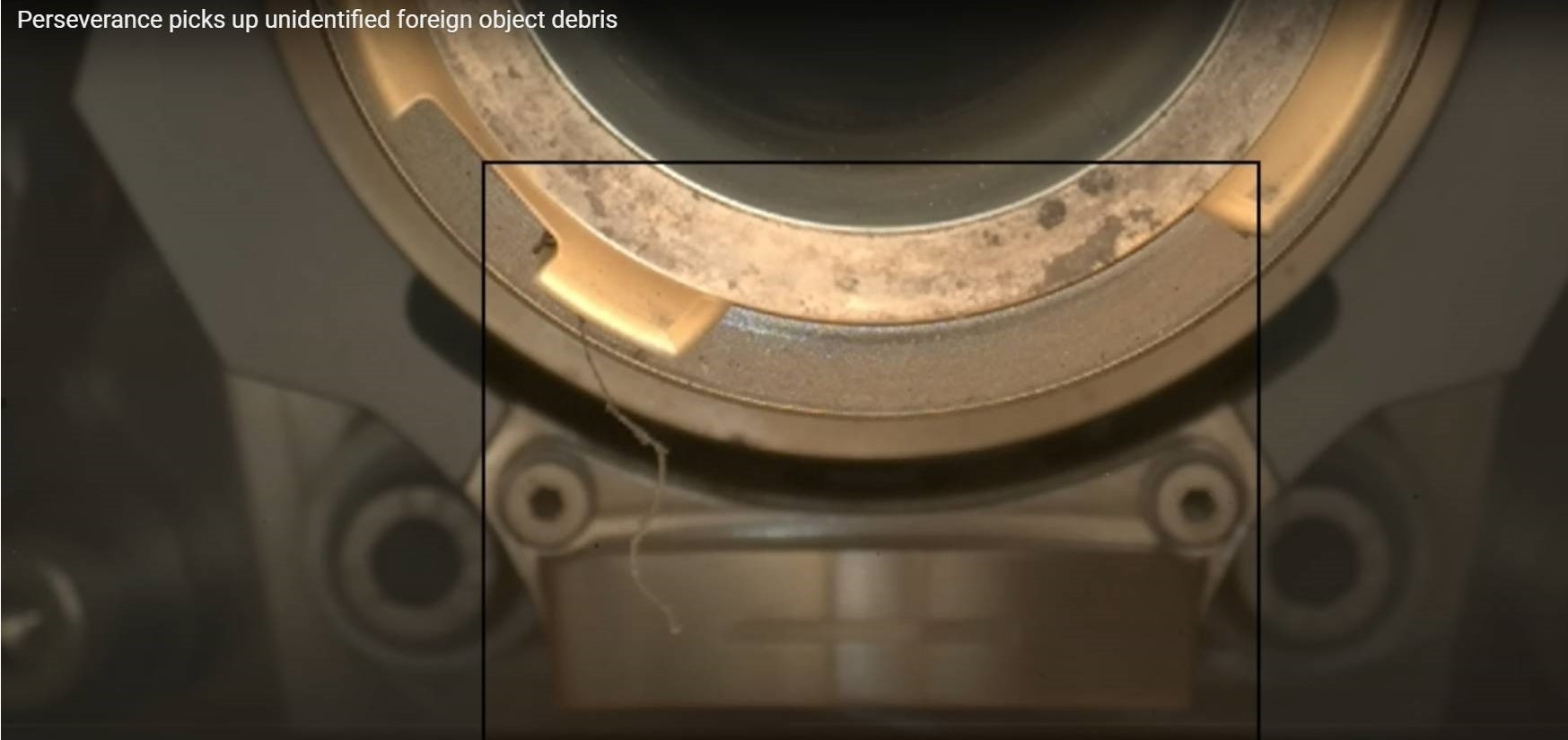
In one episode of Mars Guy, there’s a review of the fact that Perseverance has picked up unidentified foreign object debris.
Credit: Mars Guy
“Following another successful rock coring operation, a routine inspection of the hardware revealed hair-like objects in two places. Now the search is on to figure out what they are and if they jeopardize the mission,” explains Mars Guy, aka Steve Ruff, a planetary geologist with a focus on the mineralogy of Mars at Arizona State University in Tempe.

Credit: Mars Guy
Microbial activity?
In another episode, Ruff discusses the prospect that the Perseverance rover has inspected a rock coating that may be evidence of microbial activity.

Evidence of microbial activity?
Credit: Mars Guy
“Thin dark coatings known as desert varnish are common on rocks in arid regions on Earth and they’re thought to form in part from microbial activity,” Ruff explains. “Now, on Mars, the Perseverance rover has found similar coatings.”
Go to these episodes of Mars Guy at:
Also, go to my related story for Space.com — “Probing the Red Planet: Finding past life at Jezero Crater” — at:

International Space Station
Credit: Roscosmos/NASA
Question: Where does an 800-pound gorilla sleep?” Answer: “Anywhere it wants to.”
But in the case of the International Space Station, with a mass of approximately 450 tons (450,000 kilograms), it needs to be precisely put to sleep in an unpopulated stretch of ocean.
NASA has issued a Request for Information (RFI) to solicit responses from interested parties to gauge industry’s capabilities to provide deorbit capabilities for the ISS.
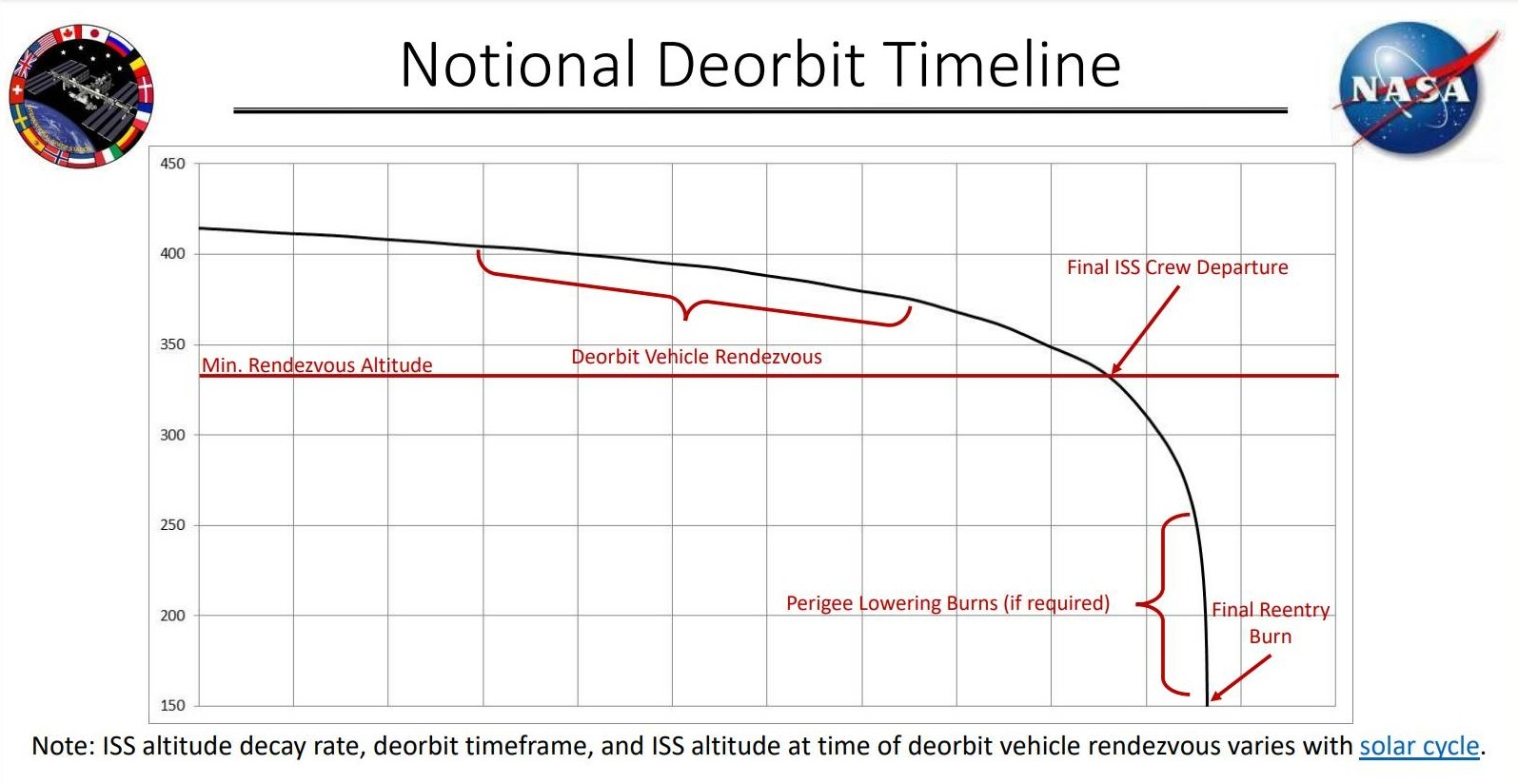
Credit: NASA/JSC
According to the August 19th RFI, at the completion of ISS operations, currently planned through 2030, the ISS must be safely deorbited via a controlled reentry into an unpopulated region. “It is the responsibility of all ISS partners to ensure the safe deorbit and reentry of the ISS at its end-of-life,” the document explains.
Per ISS International Partner agreement and request, NASA is issuing the RFI to assess industry’s capability to design, develop, manufacture, launch, and provide the on-orbit operation to enable a controlled re-entry and the safe deorbit the ISS.
An example deorbit target zone is the South Pacific Ocean(ic) uninhabited area.

Credit: NASA/JSC
Wanted: deorbit vehicle
Labeling it a “deorbit vehicle,” this hardware is to attach (via docking or berthing) to the ISS at least one year prior to the planned ISS reentry date to enable adequate time for on-orbit tests and checkouts.
The deorbit vehicle is to perform the final reentry burn resulting in a controlled reentry of the ISS within a pre-defined, uninhabited entry corridor.
Although nominal ISS end-of-life is late 2030, the Government requires that this deorbit capability be available as soon as possible “to protect for contingencies that could drive early re-entry and beyond 2030 in the event of further ISS mission extensions,” the RFI notes.
The RFI response date is September 9, 2022 at 3:00 pm Central Daylight Time.
To read the entire RFI — International Space Station Deorbit Capability – go to the System for Award Management (SAM.gov), an official website of the U.S. Government, at:
https://sam.gov/opp/74252cfe7d49416abae0977fe4fd503c/view#description
Go to this related story — Incoming – Wet, Watery and Worrisome Graves for Spacecraft — at:
https://www.leonarddavid.com/incoming-wet-watery-and-worrisome-graves-for-spacecraft/

Shown here is a rendering of 13 candidate landing regions for Artemis III. Each region is approximately 9.3 by 9.3 miles (15 by 15 kilometers). A landing site is a location within those regions with an approximate 328-foot (100-meter) radius.
Credit: NASA
NASA has identified 13 candidate landing regions near the lunar South Pole.
Each region contains multiple potential landing sites for Artemis III, which will be the first of the Artemis missions to bring crew to the lunar surface, including the first woman to set foot on the Moon.
Details were presented in this NASA statement:
“Selecting these regions means we are one giant leap closer to returning humans to the Moon for the first time since Apollo,” said Mark Kirasich, deputy associate administrator for the Artemis Campaign Development Division at NASA Headquarters in Washington. “When we do, it will be unlike any mission that’s come before as astronauts venture into dark areas previously unexplored by humans and lay the groundwork for future long-term stays.”

Credit: Aerospace Corporation
Candidate regions
NASA identified the following candidate regions for an Artemis III lunar landing:
Faustini Rim A
Peak Near Shackleton
Connecting Ridge
Connecting Ridge Extension
de Gerlache Rim 1
de Gerlache Rim 2
de Gerlache-Kocher Massif
Haworth
Malapert Massif
Leibnitz Beta Plateau
Nobile Rim 1
Nobile Rim 2
Amundsen Rim
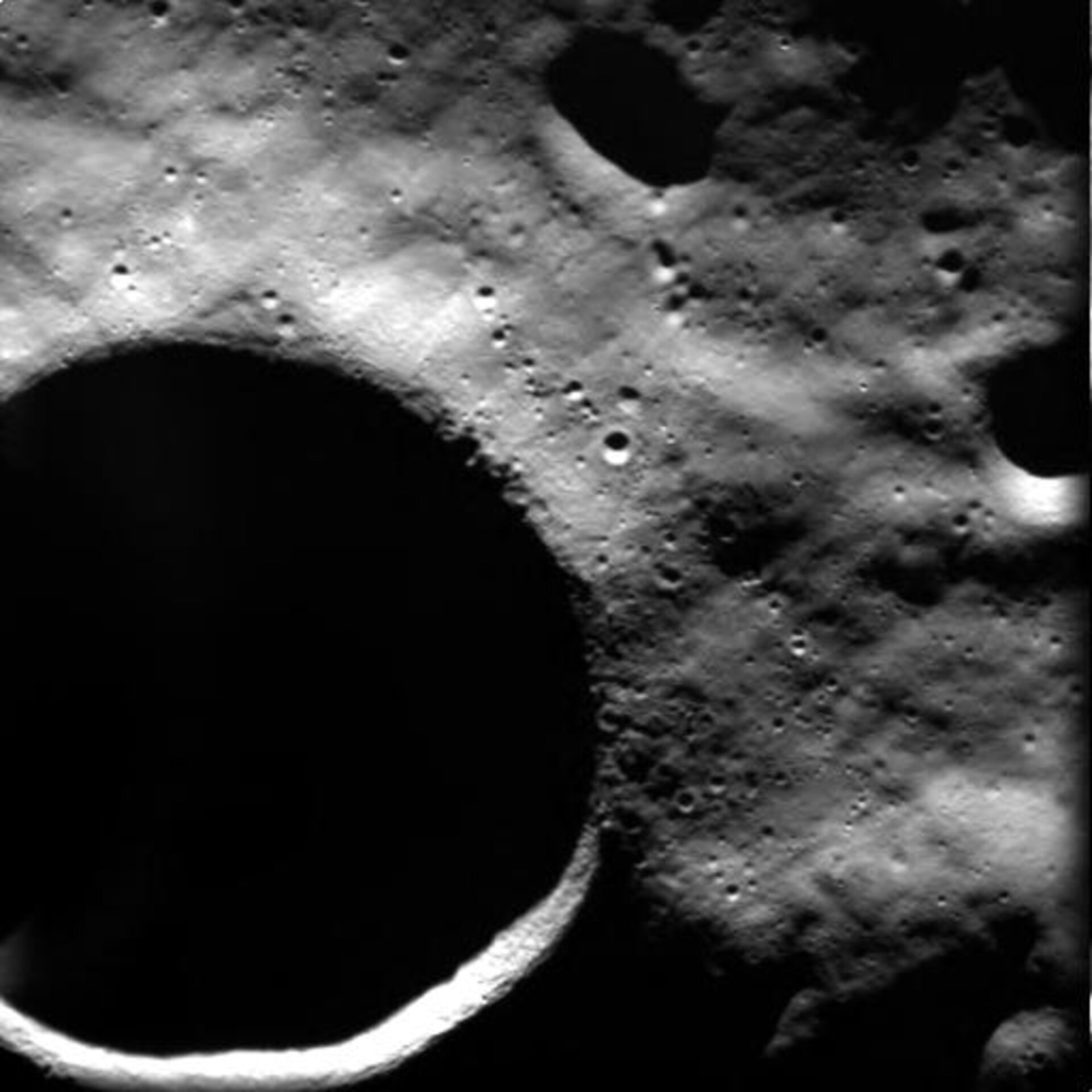
This image, taken by the advanced Moon Imaging Experiment (AMIE) on board ESA’s SMART-1 spacecraft, shows crater Shackleton on the Moon.
Credit: ESA
Diverse geologic features
“Each of these regions is located within six degrees of latitude of the lunar South Pole and, collectively, contain diverse geologic features. Together, the regions provide landing options for all potential Artemis III launch opportunities. Specific landing sites are tightly coupled to the timing of the launch window, so multiple regions ensure flexibility to launch throughout the year,” the NASA statement explains.
Other details include:
- To select the regions, an agencywide team of scientists and engineers assessed the area near the lunar South Pole using data from NASA’s Lunar Reconnaissance Orbiter and decades of publications and lunar science findings.
- In addition to considering launch window availability, the team evaluated regions based on their ability to accommodate a safe landing, using criteria including terrain slope, ease of communications with Earth, and lighting conditions.
- To determine accessibility, the team also considered combined capabilities of the Space Launch System rocket, the Orion spacecraft, and the SpaceX-provided Starship human landing system.
Permanently shadowed regions
“All regions considered are scientifically significant because of their proximity to the lunar South Pole, which is an area that contains permanently shadowed regions rich in resources and in terrain unexplored by humans,” according to the NASA press statement.

In this multi-temporal illumination map of the lunar south pole, Shackleton crater (19 km diameter) is in the center, the south pole is located approximately at 9 o’clock on its rim. The map was created from images from the camera aboard the Lunar Reconnaissance Orbiter.
Credits: NASA/GSFC/Arizona State University
“Several of the proposed sites within the regions are located among some of the oldest parts of the Moon, and together with the permanently shadowed regions, provide the opportunity to learn about the history of the Moon through previously unstudied lunar materials,” said Sarah Noble, Artemis lunar science lead for NASA’s Planetary Science Division.
According to the NASA release, the analysis team weighed other landing criteria with specific Artemis III science objectives, including the goal to land close enough to a permanently shadowed region to allow crew to conduct a moonwalk, while limiting disturbance when landing. This will allow crew to collect samples and conduct scientific analysis in an uncompromised area, yielding important information about the depth, distribution, and composition of water ice that was confirmed at the Moon’s South Pole.

NASA’s Lunar Reconnaissance Orbiter flies over Shackleton crater near the lunar south pole in this computer rendering.
Credit: NASA’s Scientific Visualization Studio
Access to sunlight
“The team identified regions that can fulfill the moonwalk objective by ensuring proximity to permanently shadowed regions, and also factored in other lighting conditions,” reports NASA. “All 13 regions contain sites that provide continuous access to sunlight throughout a 6.5-day period – the planned duration of the Artemis III surface mission. Access to sunlight is critical for a long-term stay at the Moon because it provides a power source and minimizes temperature variations.
“Developing a blueprint for exploring the solar system means learning how to use resources that are available to us while also preserving their scientific integrity”, said Jacob Bleacher, chief exploration scientist for NASA. “Lunar water ice is valuable from a scientific perspective and also as a resource, because from it we can extract oxygen and hydrogen for life support systems and fuel.”
NASA adds that it will select sites within regions for Artemis III after it identifies the mission’s target launch dates, which dictate transfer trajectories and surface environment conditions.
For more information on lunar south pole sites, go to:
Setting Up a Moon Base – But Where?
https://www.leonarddavid.com/setting-up-a-moon-base-but-where/
Moon’s South Pole: Crowd Control Needed?
https://www.leonarddavid.com/moons-south-pole-crowd-control-needed/
New Study on Moon’s South Pole Water Ice
https://www.leonarddavid.com/new-study-on-moons-south-pole-water-ice/
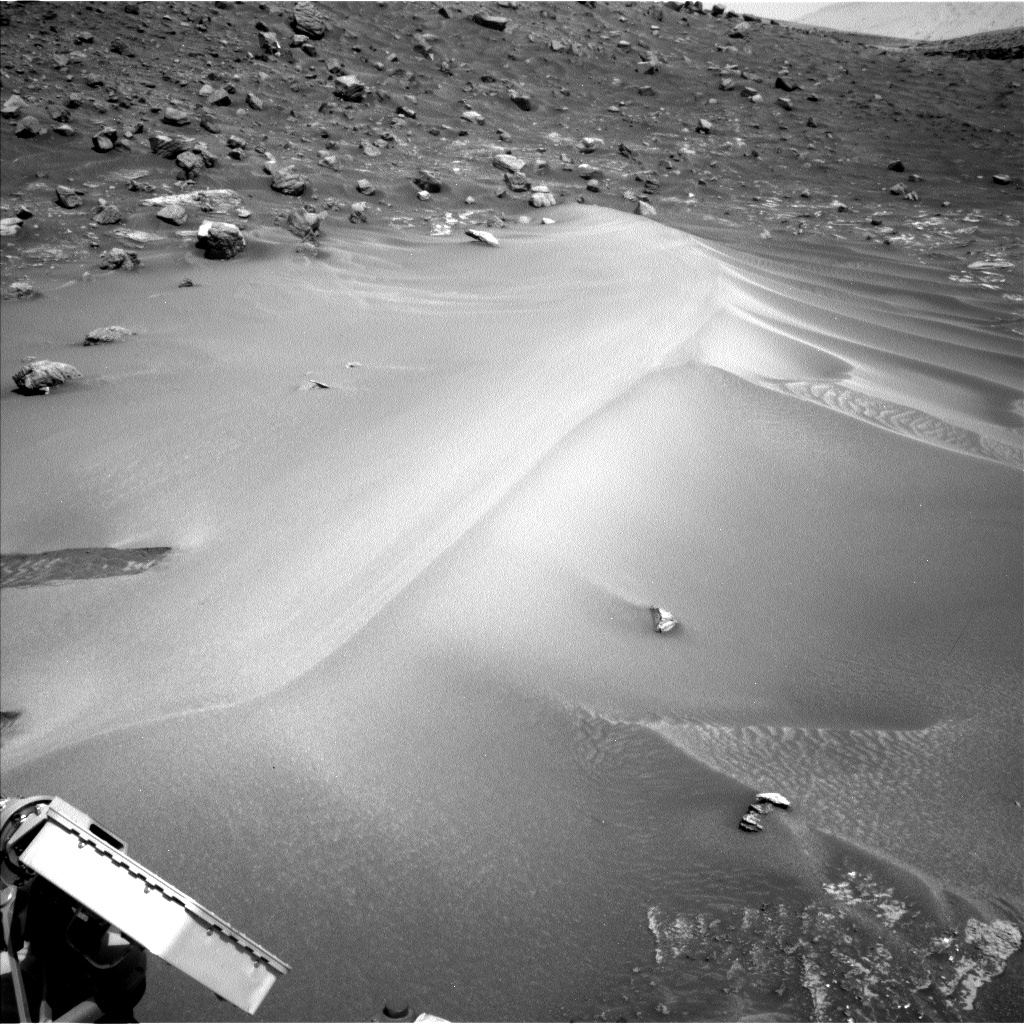
Curiosity Left B Navigation Camera image taken on Sol 3567, August 19, 2022.
Credit: NASA/JPL-Caltech
The “road” through Paraitepuy pass continues to challenge the intrepid Curiosity rover, reports Abigail Fraeman, a planetary geologist at NASA’s Jet Propulsion Laboratory
“We attempted to cross another large sand ripple (formally called a transverse aeolian ridge, or TAR),” in a recent plan.
However, Curiosity had automatically stopped the drive when the rover’s wheels slipped more than expected right before they reached the crest of the TAR, Fraeman adds.
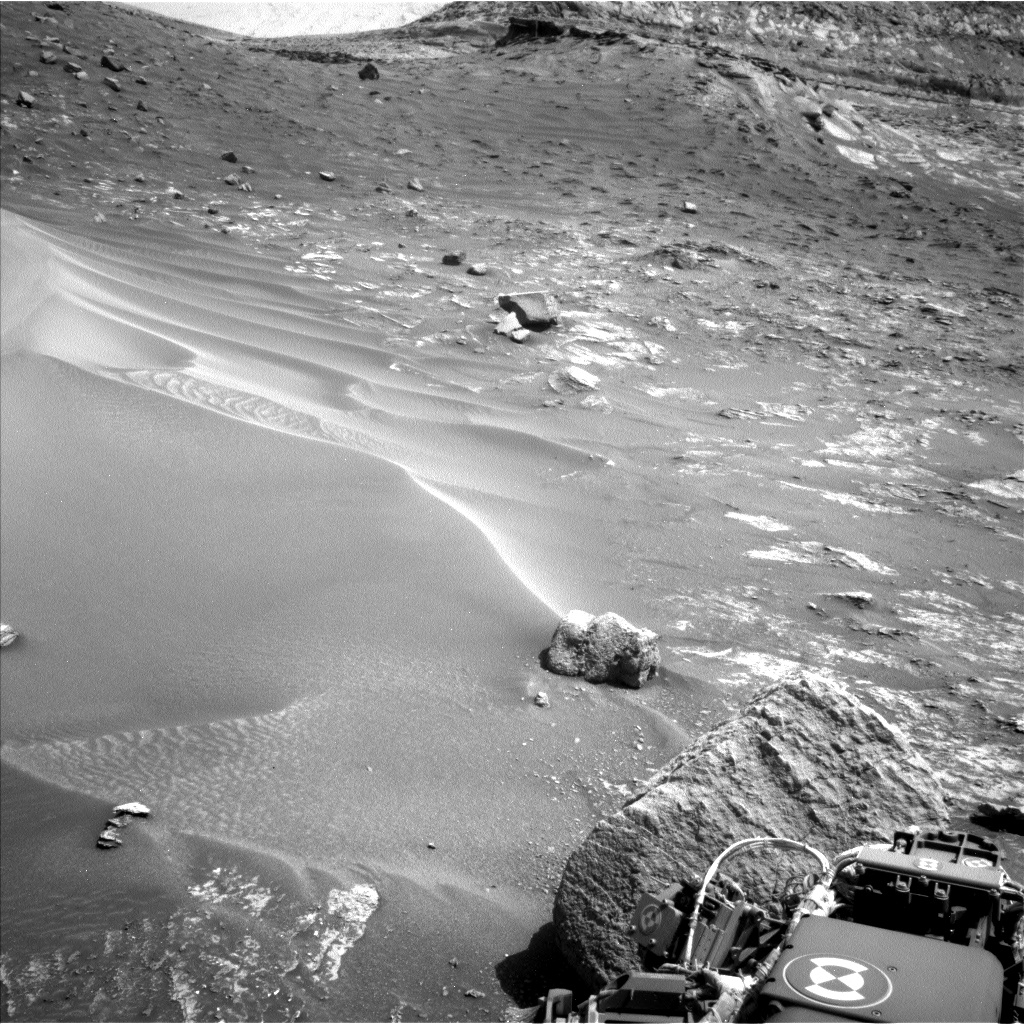
Curiosity Left B Navigation Camera image taken on Sol 3567, August 19, 2022.
Credit: NASA/JPL-Caltech
Unintended stops
“While unintended stops like this are frustrating, it’s comforting to know the rover is so capable of keeping itself safe,” Fraeman explains. Stopping the drive early is definitely better than trying to plow through and potentially embed the wheels deep into the sand!
A new plan called for the robot to back out and try again.
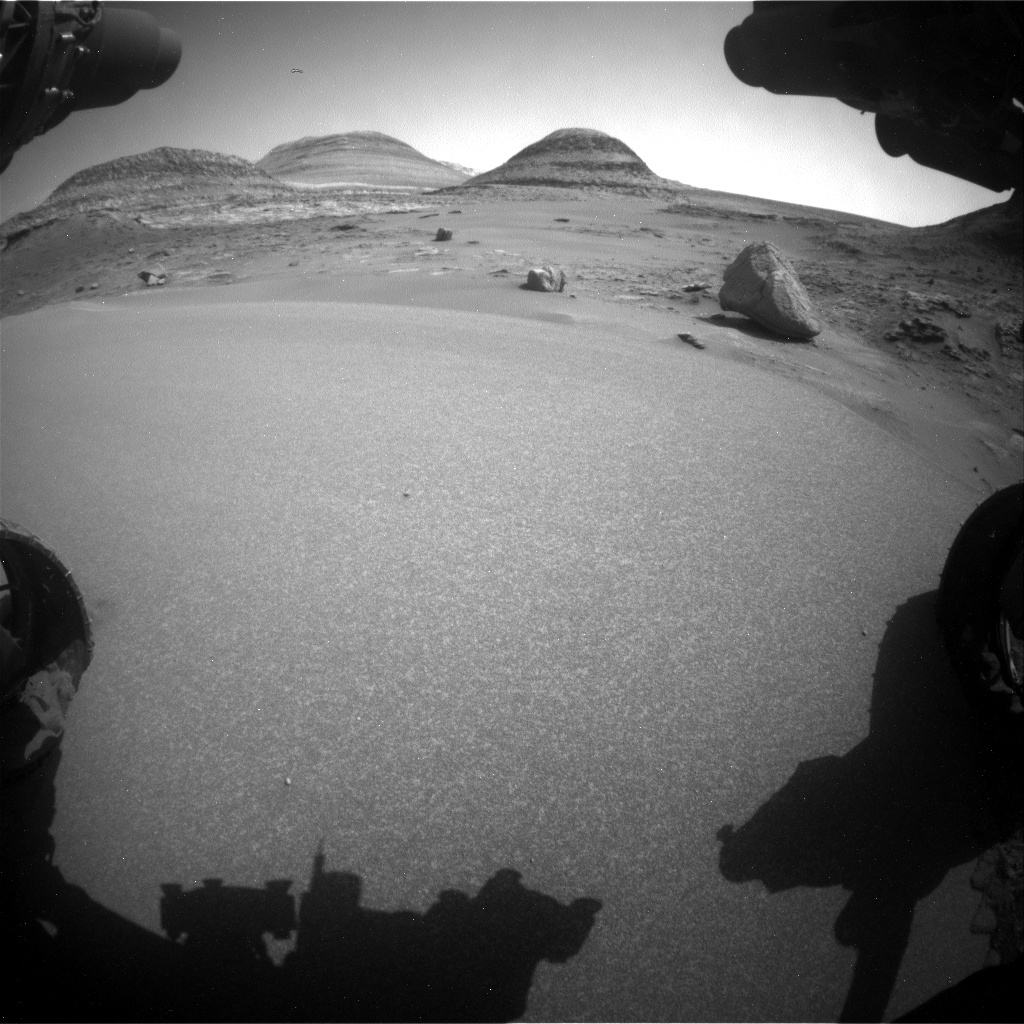
A large rock is another obstacle Curiosity will encounter right after crossing sand. Image taken by Front Hazard Avoidance Camera on Sol 3565 (August 17, 2022
Credit: NASA/JPL-Caltech
“Rather than crossing the TAR in the same place, we’re going to try crossing a few feet to the side, where the sand is shallower and therefore should be easier to cross,” Fraeman reports. “Unfortunately, there’s another obstacle we’ll encounter right after we cross at this new location, a large rock.”
Safe path
In order to navigate this tricky terrain, we’re planning to stop the drive after we cross the TAR but right before we reach the rock, just to make sure the rover is positioned exactly where we want and so that we’ll be in the best position to plan a safe path around,” Fraeman adds. “Paraitepuy pass is certainly testing our rover drivers, but I have complete confidence we’ll make it through soon!”
Curiosity Left B Navigation Camera image taken on Sol 3567, August 19, 2022.
Credit: NASA/JPL-Caltech
Since Curiosity stopped while trying to cross the TAR, researchers were greeted with another sand-filled workspace.
A newly scripted plan called for contact science with the Mars Hand Lens Imager (MAHLI) and the Alpha Particle X-Ray Spectrometer (APXS) on a single target, “Yupukari,” that’s along the crest of the bedform.
Curiosity Left B Navigation Camera image taken on Sol 3567, August 19, 2022.
Credit: NASA/JPL-Caltech
Float rock
That plan also slated the taking of remote sensing data, with a Chemistry and Camera (ChemCam) Laser Induced Breakdown Spectroscopy (LIBS) observation of targets “Makarapan,” a rock near the rover’s back wheel, and “Uaipan,” a different area along the crest of the TAR.
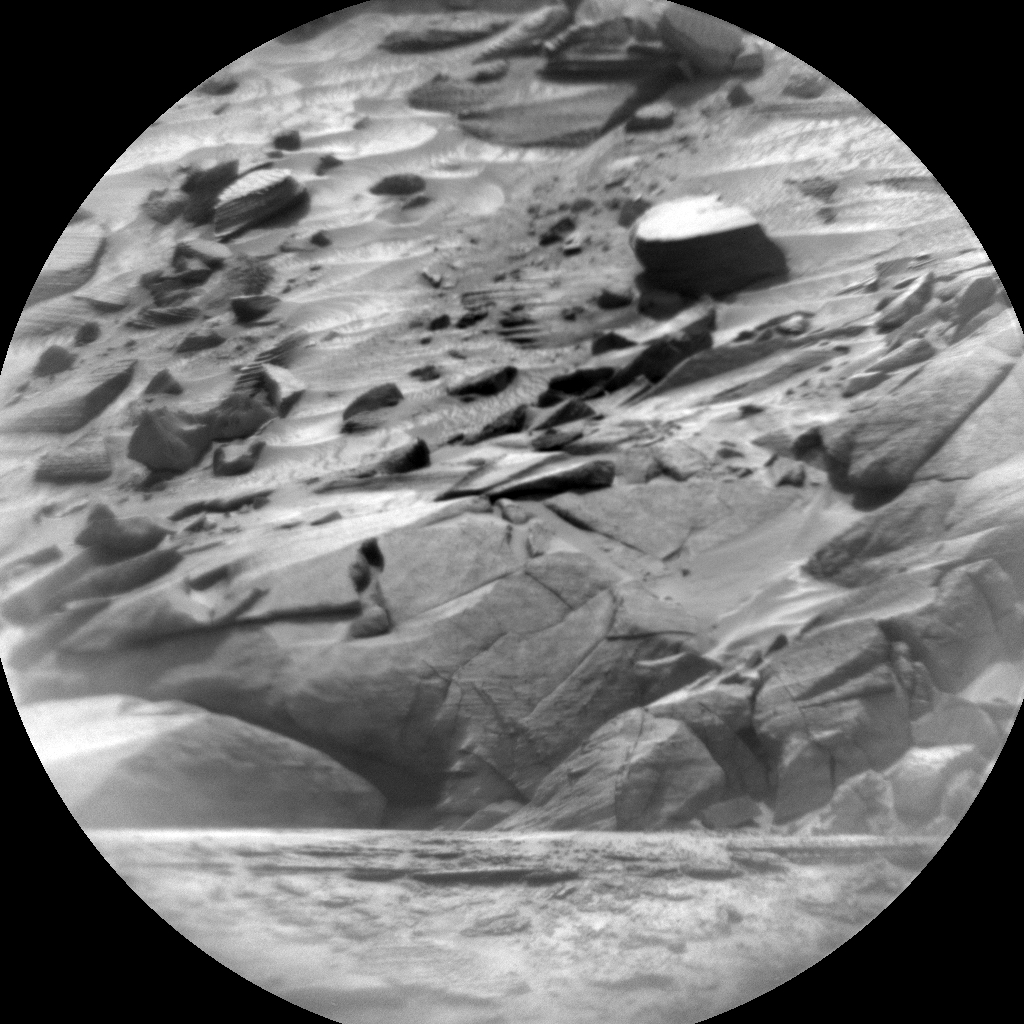
Curiosity Chemistry & Camera (ChemCam) Remote Micro-Imager (RMI) photo acquired on Sol 3567, August 19, 2022.
Credit: NASA/JPL-Caltech/LANL
Another long distance Remote Micro-Imager (RMI) mosaic will be taken of the mysterious marker band unit, and Mastcam observations of some bedrock behind the rover named “Maturuca,” a float rock in the sand named “Los Viejitos,” another distant rock named “Salgado,” and the rock the rover needs to drive around on Friday, named “Rera.”
“We’ll also capture additional imaging of the ‘Bolivar’ butte that we have been driving around for the last few sols. Environmental science observations will round out the plan,” Fraeman concludes.

Image traces a small segment of Curiosity’s path traversing obstacles that guard the pass – over one of the large ripples, around several large boulders – leading the robot to a point where it is nearly through the pass.
This image was taken by Left Navigation Camera on Sol 3564 August 16, 2022
Credit: NASA-JPL/Caltech
NASA’s Curiosity Mars rover at Gale Crater is now performing Sol 3566 duties.
Michelle Minitti, a planetary geologist at Framework in Silver Spring, Maryland, reports that the robot is imaging “the wonders around and ahead of us as we pick our way through ‘Paraitepuy Pass.’”
The towering buttes, geologic relationships, and layers at that location have drawn research attention for a literal decade.
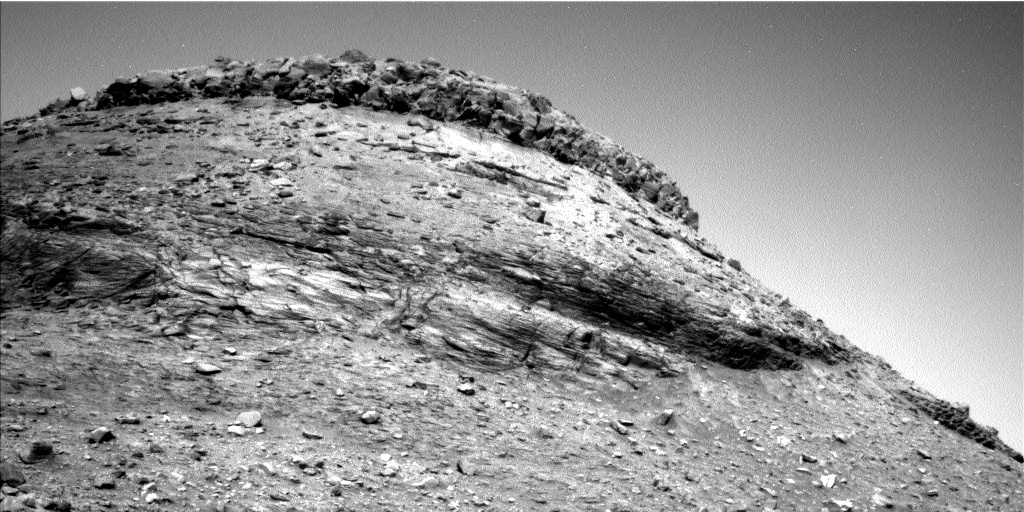
Curiosity Left B Navigation Camera photo taken on Sol 3565, August 17, 2022.
Credit: NASA/JPL-Caltech
“But it is also fun to look back on how we got to where we are,” Minitti adds, as Curiosity traverses the obstacles that guard the pass – over one of the large ripples, around several large boulders, “leading us to a point where we are nearly through the pass.”
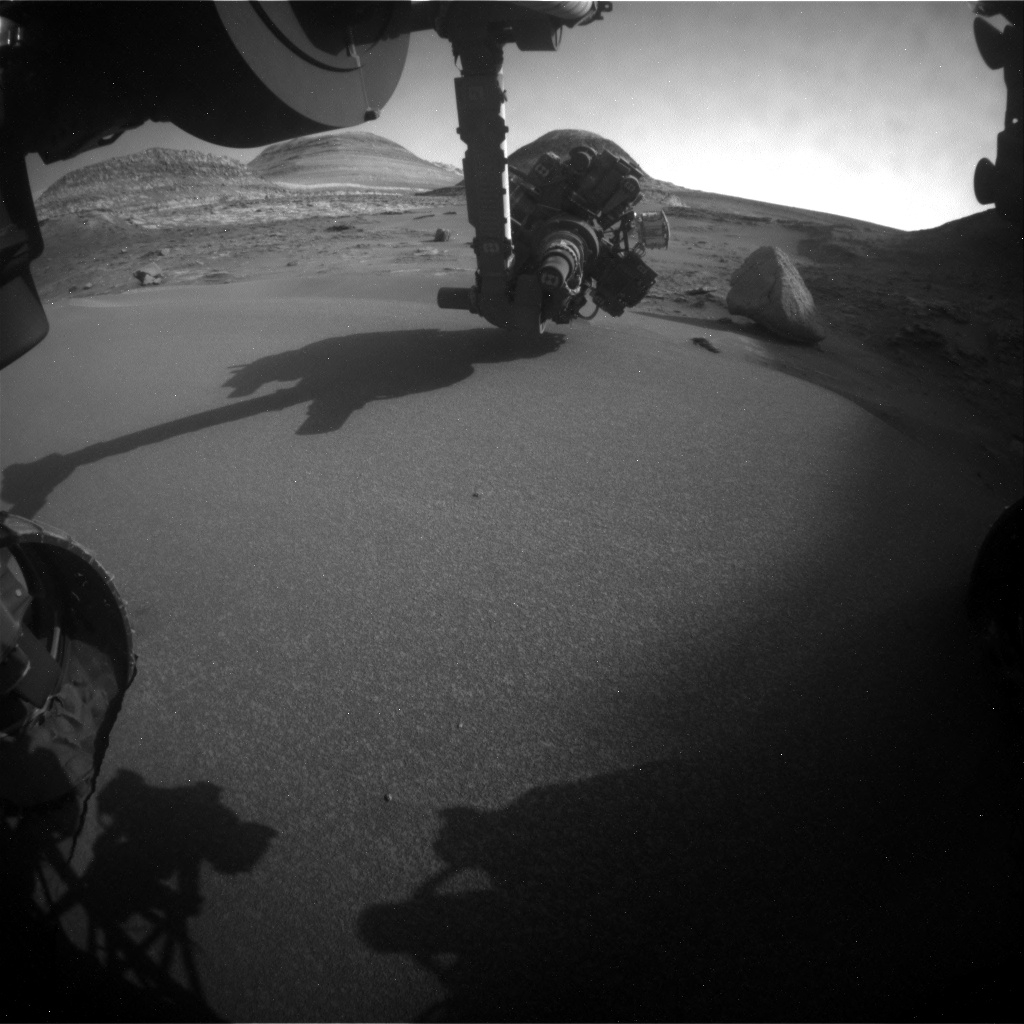
Curiosity Front Hazard Avoidance Camera Left B image acquired on Sol 3566, August 18, 2022.
Credit: NASA/JPL-Caltech
Ripple crossing
“I particularly enjoy seeing the choice of diverting the drive oh-so-close to the towering ‘Bolivar’ butte to our starboard side so our wheels could cross the (presumably!) shallowest part of the large ripple. It is great to see yet another successful ripple crossing, hearkening back to the first big one way back on Sol 535 at ‘Dingo Gap.’”
Before the rover crosses yet one more ripple, researchers planned imaging from the scale of vistas to small bedrock blocks.
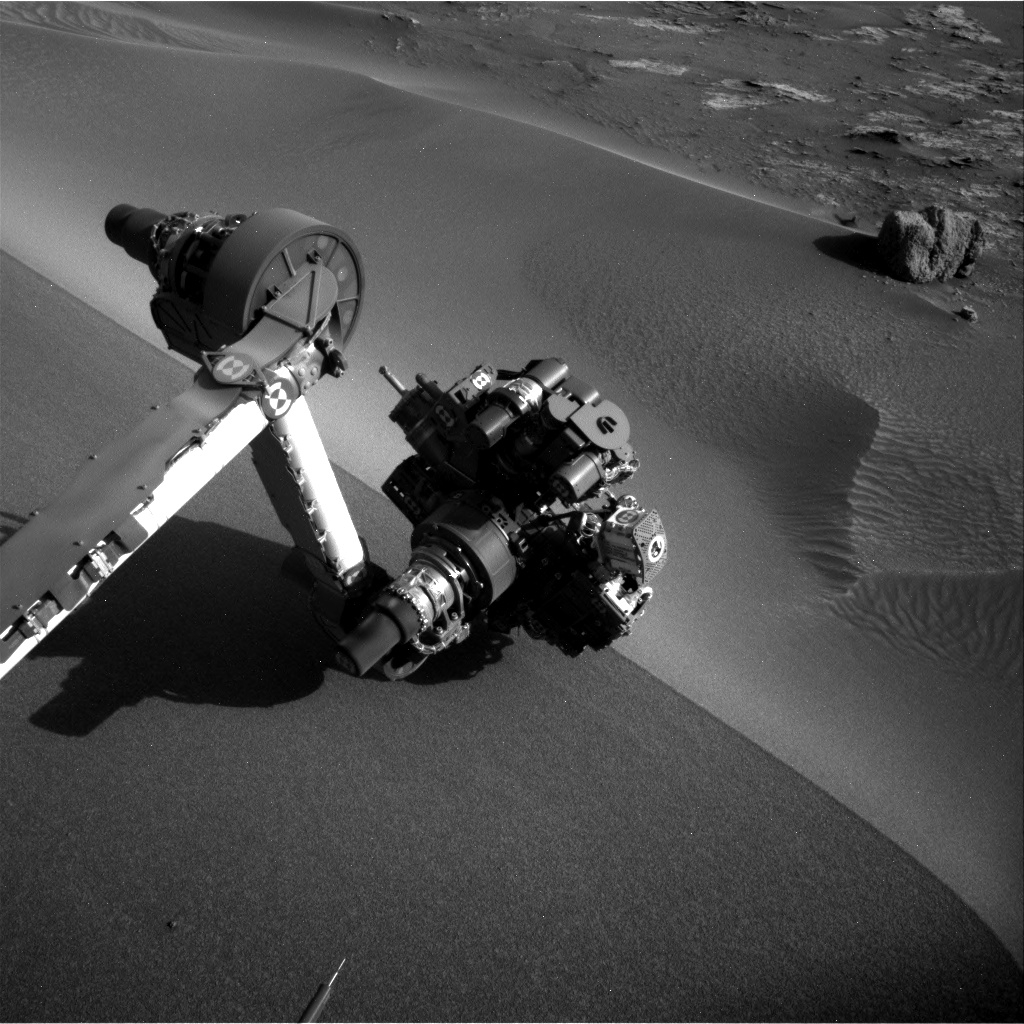
Curiosity Right B Navigation Camera photo taken on Sol 3566, August 18, 2022.
Credit: NASA/JPL-Caltech
Rubbly ridge
On tap, the robot’s Chemistry and Camera (ChemCam) is to image the spectacular “Kukenan” butte, and team up with Mastcam to image an intriguing rubbly ridge extending from the north side of Bolivar.
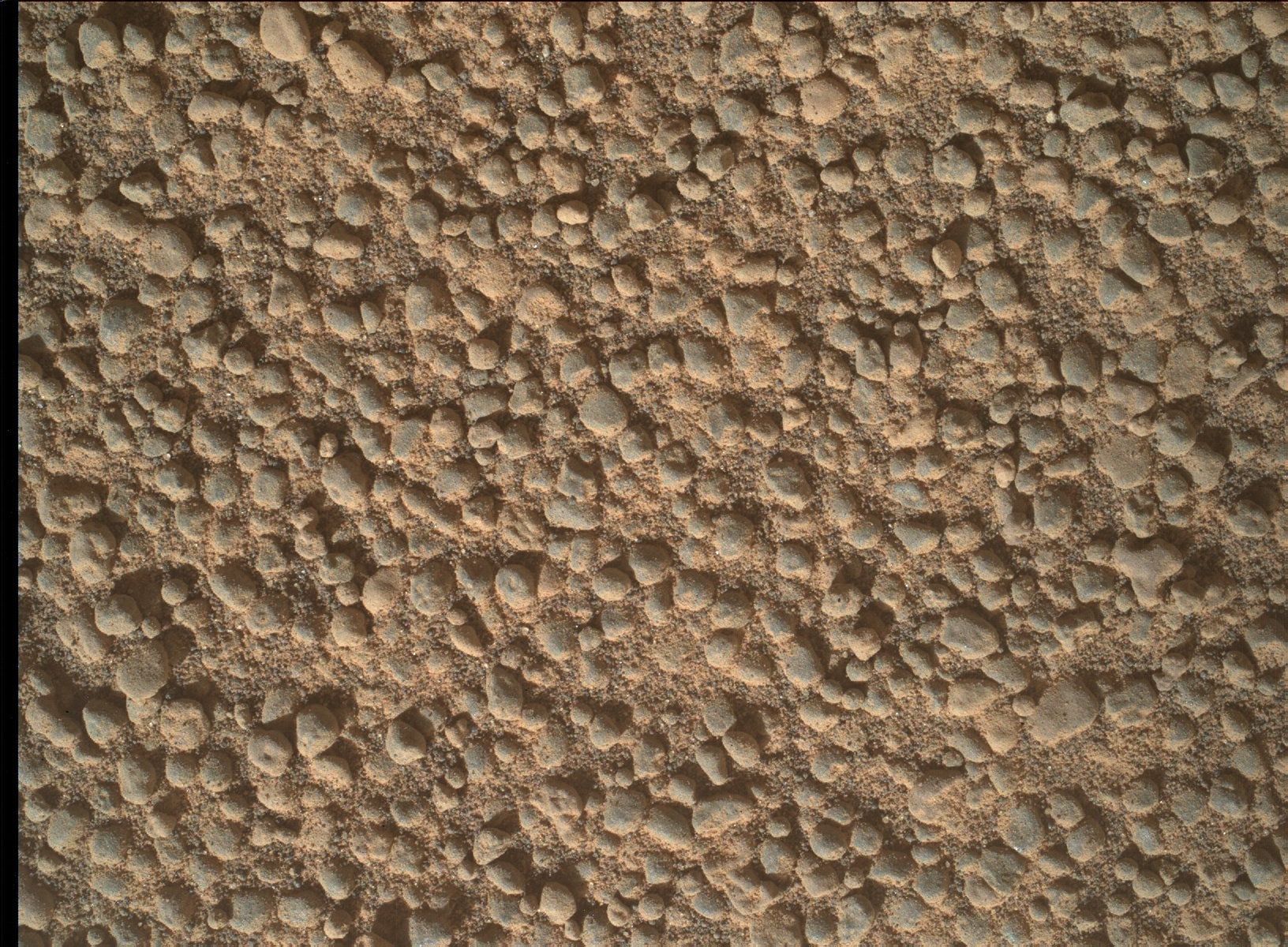
Curiosity Mars Hand Lens Imager (MAHLI) photo produced on Sol 3566, August 18, 2022.
Credit: NASA/JPL-Caltech/MSSS
Curiosity’s Mastcam will add to the coverage of the “Orinoco” butte, and Bolivar butte with mosaics along its base including the “Karia Island” and “Ayanganna” targets.
“The interesting texture and color of the former target also made it a target for Mastcam multispectral analysis,” Minitti reports. “We will acquire one Mastcam image of ‘Antonio,’ the lone rock poking out of the ripple in front of the rover which has a lumpy texture.”
On the plan is use of the Dynamic Albedo of Neutrons (DAN) to make passive runs in parallel with all these geologic observations and punctuated by a DAN active post-drive.
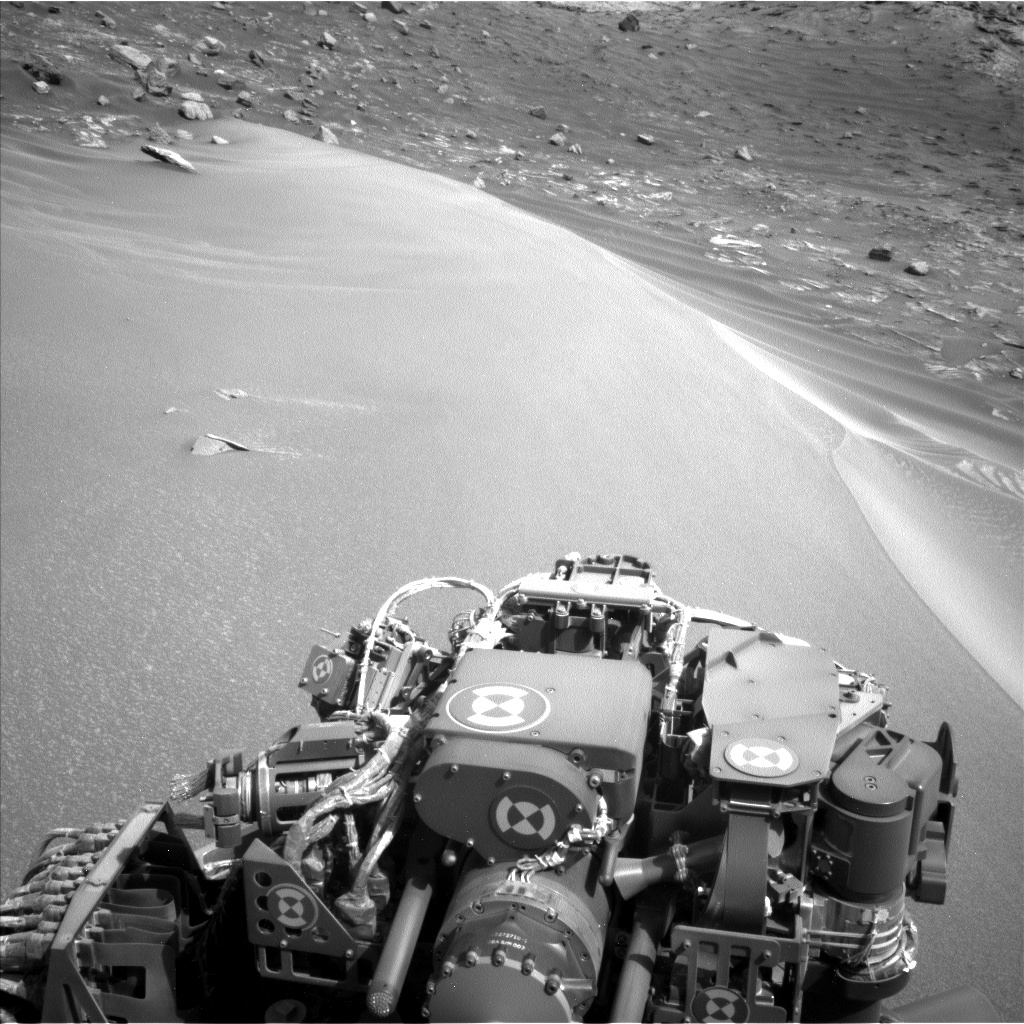
Curiosity Left B Navigation Camera photo taken on Sol 3565, August 17, 2022.
Credit: NASA/JPL-Caltech
The Radiation Assessment Detector (RAD) and the Rover Environmental are slated to keep their regular tabs on our environment throughout the sol (Sol 3565), Minitti concludes.

