Archive for the ‘Space News’ Category
 Author:
  September 10th, 2022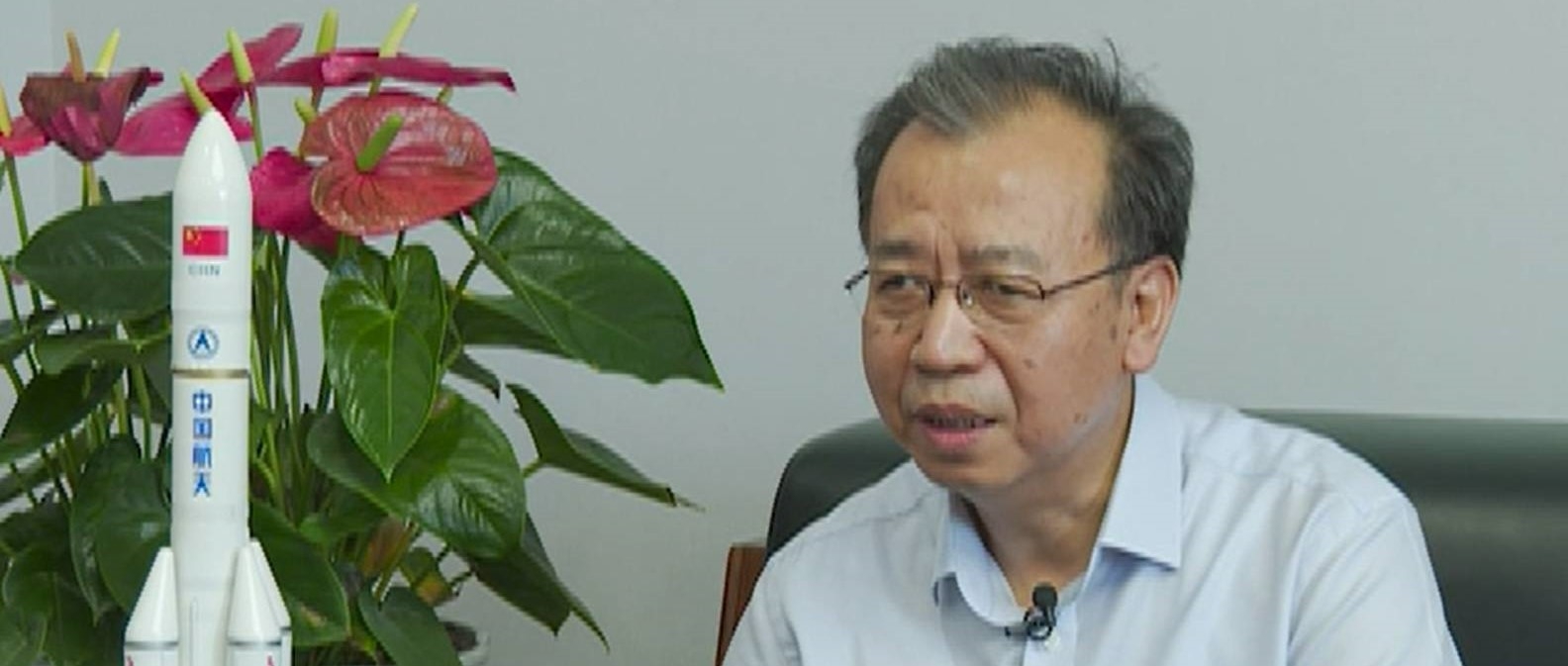
Liu Jizhong, director of Lunar Exploration and Space Program Center under China National Space Administration (CNSA).
Credit: CCTV/Inside Outer Space screengrab
China’s Moon exploration plans are moving ahead smoothly. This fourth phase consists of three missions: the Chang’e-6, Chang’e-7, and Chang’e-8 lunar spacecraft, to be implemented in the following 10 years.
Liu Jizhong, director of Lunar Exploration and Space Program Center under China National Space Administration (CNSA), observes that as backup of the Chang’e-5 probe, the Chang’e-6 will endeavor to retrieve samples from the far side of the Moon and return them to the Earth.

The lunar far side as imaged by NASA’s Lunar Reconnaissance Orbiter using its LROC Wide Angle Camera.
Credit: NASA/Goddard/Arizona State University
“The production of the Chang’e-6 probe has almost been completed,” Liu told China Central Television (CCTV). “To better understand the Moon and given that the Chang’e-4 went to the far side of the Moon, we, after discussion among engineers and scientists, decided to have the Chang’e-6 probe to retrieve samples from the far side of the Moon and return them to Earth. The samples will be much more valuable.”

Artist’s view of Lunar Research Station to be completed by 2035. Credit: CNSA/Roscosmos
Lunar research station
The Chang’e-7 probe, which is under research, will probe the south pole of the Moon and help with the building of a basic structure of a lunar research station.
“The goal of these missions is to lay a foundation for the lunar research station. So there are a lot technological issues to be tackled and it is a tough challenge to explore the energy on the Moon. However, with the foundation we’ve built up and an excellent team, I believe we will succeed,” said Liu.

Credit: Society of Science and Technology, CAS
Moon sample management
Liu said that regulations have been made to stipulate lunar soil distribution and international cooperation to ensure the samples were taken in appropriate conditions that meet scientific research standards, Liu told China Global Television Network (CGTN).
“The China National Space Administration has issued lunar sample management regulations covering the whole administration process, with guidelines specifying assignment of responsibility, process of distribution and international cooperation,” said Liu.

Chinese President Xi Jinping inspects Chang’e-5 lunar sample return capsule.
Credit: CCTV/Inside Outer Space screengrab
“Since the return of the Chang’e-5 lunar samples, we’ve distributed four batches of samples thus far, with the application of the fifth batch being reviewed and soon to be distributed. As for the four batches of samples already distributed, we’ve organized a team of scientists to strictly evaluate the applications and assess the purpose and value of the research. So far, more than 50 grams of samples have been distributed,” Liu said.

Box indicates Chang’e-5 lander on the basaltic plains of Oceanus Procellarum (“Ocean of Storms”) in December 2020. Credit: NASA/LROC/ASU
Strategic steps
“The mission plans for future Chang’e-7 and Chang’e-8 will pivot on the goal of building a lunar research station, which requires technical breakthroughs. Meanwhile, we will carry out a survey of the resources on the Moon to lay a better foundation for future space exploration,” Liu added in the CGTN interview.
China’s lunar exploration program was launched in 2004, with three strategic steps of orbiting the Moon, landing on the lunar surface and returning samples from the Moon.
In 2007, Chang’e-1 completed China’s first lunar orbiting and at the end of 2020, Chang’e-5 returned with around 1.7 kilograms of lunar samples.
 Posted in

Credit: CCTV/Inside Outer Space screengrab
A sixth new lunar mineral discovered has been named “Chang’esite-(Y)” – identified from the Moon samples brought back to Earth by China’s Chang’e-5 mission in 2020.
Scientists at the Beijing Research Institute of Uranium Geology announced that they found the new mineral within the 1,731 grams of lunar samples returned to Earth.
“This family is divided into two groups – one is Whitlockite, which is found on Earth. The Chang’esite is called the Brianite subgroup, and it is a typical extraterrestrial mineral, which only appears in the Moon and meteorites,” said Li Ting, a research expert for lunar samples of the Beijing Research Institute of Uranium Geology.

Credit: CCTV/Inside Outer Space screengrab
“Its elemental composition and content are different from those of known minerals in this group. It is the first new lunar mineral discovered by the Chinese, and it is a new phosphate mineral in mineralogy,” Li told China Central Television (CCTV), formed as column-shaped crystal, found in lunar basalt grains.
Changesite is ultra-tiny with a size no more than 10 microns.

Credit: CCTV/Inside Outer Space screengrab
Other study findings
How was Changesite catalogued as a new mineral?
According to Li: “Matter has two basic properties: one is chemical composition and the other is crystal structure. The chemical composition refers to what elements it is composed of, and the crystal structure refers to how these elements are arranged. Each mineral corresponds to a set of rules. If a position is occupied by a different element, or the elements are arranged in a different way, it is a new mineral.”
In addition to the new mineral Changesite, CCTV reports that other significant scientific research reveals in studying the samples include the content and extraction conditions of Helium-3, as well as nanophase iron particles in lunar soil.
“This provides fundamental scientific data for lunar resource evaluation and exploration,” reports CCTV.

Photo taking during Chang’e-5 surface sampling.
Credit: CCTV/Inside Outer Space screengrab
Officially approved
The China National Space Administration (CNSA) and the China Atomic Energy Authority (CAEA) jointly announced the new lunar mineral finding in Beijing.
“This ‘Chang’esite-(Y)’ is the first new mineral discovered on the moon by China, and the sixth by mankind. The new finding makes China the third country in the world to have discovered a new mineral on the Moon,” said Dong Baotong, Vice Chairman of CAEA.

Chang’e-5 return capsule holding lunar specimens.
Credit: National Astronomical Observatories, CAS
The Chang’esite-(Y) has been officially approved as a new mineral by the Commission on New Minerals, Nomenclature and Classification of the International Mineralogical Association, reports CCTV.
CNSA has distributed four batches of 152 lunar samples totaling 53,625.7 milligrams. The fifth batch of samples from the Moon is under review.
China’s Chang’e-5 lunar mission consisted of an orbiter, a lander, an ascender, and a returner. Launched on Nov. 24, 2020, the return capsule parachuted into north China’s Inner Mongolia Autonomous Region on Dec. 17, 2020 with its load of lunar samples, primarily rocks and soil from the Moon’s surface.
To view a video on the finding, go to:
“We had liftoff!”
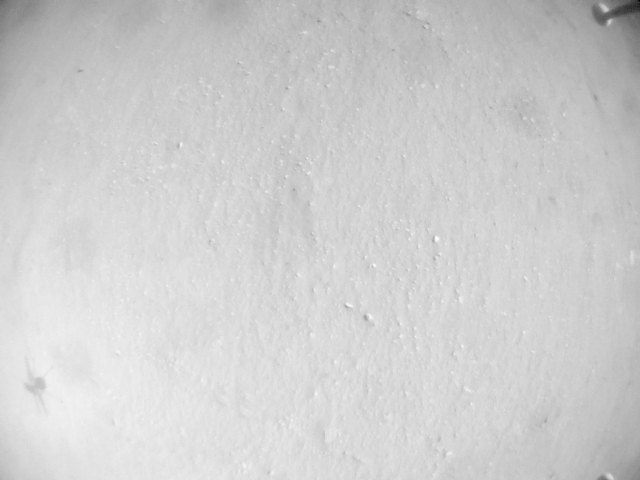
That’s the word from JPL detailing the successful flight 31 on September 6th of NASA’s Ingenuity Mars helicopter. The mini-craft flew 318 ft (97 meters) west towards the Jezero river delta, in 55.6 seconds.
Maximum altitude reached: 33 feet (10 meters)
Go to the helicopter’s flight log at: https://go.nasa.gov/3BmhGib
A photo posted is from the helicopter’s navigation camera mounted in the craft’s fuselage and pointed directly downward to track the ground during flight.
This image above was acquired on Sept. 6, 2022 (Sol 550 of the Perseverance rover mission), the date of Ingenuity’s 31st flight.
Image Credit: NASA/JPL-Caltech

Space debris plunges to Earth, burning its way through the atmosphere.
Image credit: The Aerospace Corporation
New research points to increasing pollution in the upper stratosphere due to reentering satellites, rocket bodies, and other incoming high-tech riff raff.
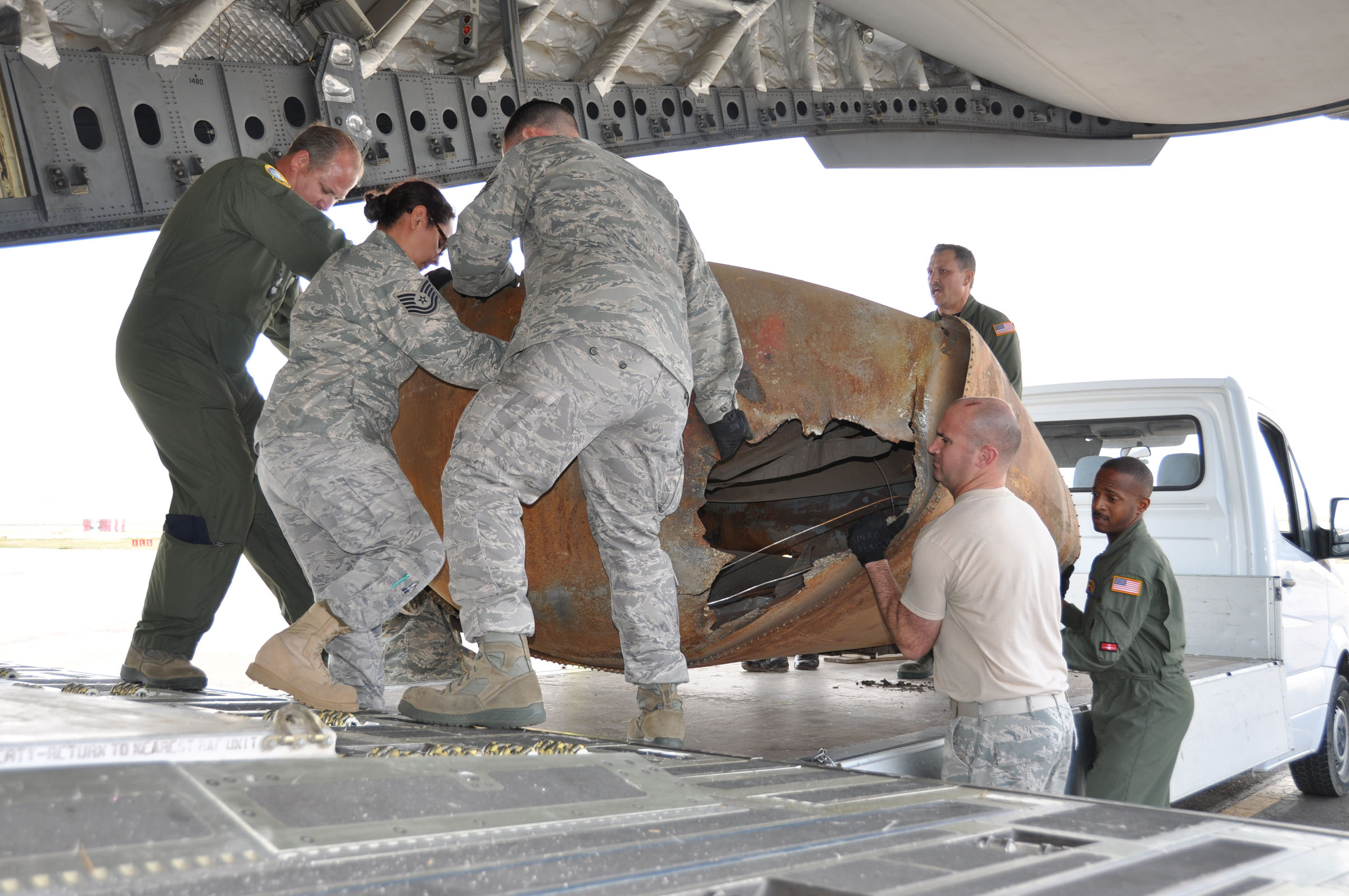
Air Force reservists load recovered rocket parts in a 2011 trip to Mongolia. The debris was identified as expended hardware from an Air Force booster that circled Earth for nearly a decade.
Image credit: Master Sgt. Linda Welz/U.S. Air Force
That troublesome trend is leading researchers to come up with proposals – one of those that use fabrication ideas to lessen space debris that make it to Earth.
The Aerospace Corporation has established a Space Safety Institute (SSI). As one of five focus areas, SSI is working on launch and reentry safety and “Design for Demise” is an item they’ve paid attention to.

Launch and reentry particle emissions in the Earth’s stratosphere.
Image credit: The Aerospace Corporation
For more information, go to my new Space.com story – “Space junk threat: Researchers working to reduce impact of falling debris – Building smarter could help a lot” – at:
https://www.space.com/space-junk-threat-research-reduce-impact

Credit: NPO Lavochkin
Russia’s reactivation of lunar exploration via its robotic Luna-25 lander has slipped to 2023.
The postponement was announced to Russia’s TASS news agency by the General Director of Roscosmos Yuri Borisov on the sidelines of the Eastern Economic Forum. “Unfortunately, yes,” he said, when asked if the mission had been pushed back to next year, TASS reports.

Lunar hardware undergoes testing.
Credit: RSC Energia/Roscosmos
Reportedly, a Luna-25 speed and distance sensor required for a safe and soft landing underperformed during testing, leading to the slip from this September into 2023. It was made by the Vega Concern, a member of Rostec’s Ruselectronics holding company, owned by the Rostech State Corporation.

Topographic map of the southern sub-polar region of the Moon showing the location of Boguslawsky crater.
Credit: Ivanov et al., 2015 via Arizona State University/LROC
South pole landing
Luna-25 is intended to become the first domestic apparatus in modern Russia to head for the Moon. The probe is targeted for a region of the south pole of the Moon, touching down near the Boguslavsky crater.
A “reserve area” for the landing craft is southwest of the Manzini crater.

Factory floor integration of science instruments on Russia’s Luna-25 Moon lander.
Credit: Roscosmos
The Russian robotic Moon lander was built and has been undergoing testing by NPO. S. A. Lavochkin. This spacecraft has repeatedly slipped, from last year to May to August, then September 2022…and now 2023.
Soil sampling duties
Luna-25 is to study the upper surface layer in the region of the south pole of the Moon, the lunar exosphere and develop landing and soil sampling technologies. The declared active life of the probe on the surface of the Moon is at least one Earth year.

Russia’s Luna-25 will test lunar sampling skills.
Credit: NPO Lavochkin/IKI/Roscosmos
This Russian Moon mission continues the series of the former Soviet Union’s lunar exploration activities that ended back in 1976. Luna-24 successfully delivered about 170 grams of lunar soil to Earth.
The Luna-25 mission is to be followed by the Luna-26 orbiter and a Luna-27 landing vehicle, after which it is planned to start deploying a full-fledged scientific station on the Moon in collaboration with China.
Artist’s view of China/Russia International Lunar Research Station to be completed by 2035. Credit: CNSA/Roscosmos
Earlier, prior to Russia’s intrusion into the Ukraine, the European Space Agency (ESA) was to provide the European Pilot-D camera built specifically for precisely landing Luna-25 on the Moon. Due to the conflict, ESA cancelled the camera cooperation, among a number of other collaborative space projects.

Credit: Aerospace Corporation
As nations set their eyes on the Moon, specialists are starting to plot out international lunar search and rescue plans. The aim is to design, make operational, and deal with legal and organizational matters in case of emergencies on future human Moon missions.
Surely, the idea of surviving and thriving on the Moon is a first-rate realization…but not dying there.

Illustration of NASA astronauts on the lunar south pole carrying out early work to establish an Artemis Base Camp. Multiple nations are setting their eyes on the same lunar locale. Credit: NASA
Next month, the First International Conference on Lunar Search and Rescue is being held in Hainan, China. The unique meeting of experts is co-organized by the International Association for the Advancement of Space Safety (IAASS) and the Beijing Institute of Technology.
For more information on the first-of-its-kind meeting, go to my new Space.com story – “In Trouble on the Moon? A 911 Call for a Search and Rescue Organization” at:
https://www.space.com/lunar-safety-search-and-rescue-on-moon

Credit: NASA
“Impact Earth: A review of the terrestrial impact record” is an impressive look at impact craters and hypervelocity impact craters on Earth. Still to be revealed is the total number of these craters, and there are reasons to suspect that the terrestrial small crater record is incomplete.
Lead author of the new research carried in Earth-Science Reviews is Gordon Osinski in the Department of Earth Sciences at the University of Western Ontario, Canada.
“Over the past few decades, it has become increasingly clear that the impact of interplanetary bodies on other planetary bodies is one of the most ubiquitous and important geological processes in the Solar System,” Osinski and colleagues explain.

Images of lunar craters showing the change in morphology with increasing diameter. All images are portions of Lunar Reconnaissance Orbiter Camera Wide Angle Camera mosaics.
From paper: Credit: Gordon R. Osinski, et al.
“This impact process has played a fundamental role throughout the history of the Earth and other planetary bodies, resulting in both destructive and beneficial effects. The impact cratering record of Earth is critical to our understanding of the processes, products, and effects of impact events,” the research team adds.
Searchable database
Introduced in the new paper is the Impact Earth initiative and an Impact Earth Database. The goal of the initiative Impact Earth initiative is to provide a holistic view of impacts, from fireballs, to meteorite falls, to the largest crater-forming events.
At its core is a new searchable database of all confirmed impact sites on Earth and many of their most salient attributes, such as age, size, etc., Osinski and colleagues add.
“Given the fact that two-thirds of the Earth’s surface is covered by water, it would be expected that a large number of impact features on Earth formed in such an environment. However, the record is notably sparse,” the scientists note in the paper.
Impact record
“It can be reasoned that the impact of extraterrestrial objects with planetary bodies is one of the most fundamental and ubiquitous geological processes in the Solar System, with implications for the origin and evolution of planets and of life itself,” the researchers observe.

Credit: Impact Earth Database
The study team flags the fact that the database is a new tool that can tell us about impact cratering processes and products. While newly established, the database has already yielded important new information, for example, on the simple-to-complex crater transition diameter and the nature of complex craters on Earth.
“With the ongoing robotic exploration of two impact craters on Mars (Gale and Jezero) and the imminent prospect of humans conducting fieldwork once again on the heavily cratered lunar surface, it is our hope that as happened during Apollo, that the exploration of the Moon, Mars and other Solar System bodies will occur hand in hand with the exploration of the impact record here on Earth,” they conclude.

Schematic diagrams showing the formation of simple and complex hypervelocity impact craters.
Credit: Gordon R. Osinski, et al.
To acquire the full paper – “Impact Earth: A review of the terrestrial impact record” – go to:
https://www.sciencedirect.com/science/article/pii/S0012825222001969?dgcid=raven_sd_via_email
To access the database, go to: http://www.impactearth.com

Credit: Pneumocell
A novel inflatable lunar habitat design study has been funded by the European Space Agency (ESA).
The concept has been advanced by Vienna, Austria-based Pneumocell. Thomas Herzig is the architect that is specialized in inflatable structures.
This lunar habitat is located in the close vicinity of one of the lunar poles in places where sunlight is almost permanently available.
The habitat will operate self-sufficiently in the long term by producing and recycling its own oxygen and food inside large greenhouses and exclusively by using solar irradiation power.
Key elements
The concept features the combination of:
Prefabricated ultra-light inflatable structures
Covering the inflated structure with a thick layer of local loose regolith is seen as efficient protection from extreme temperature, meteorites and cosmic radiation.

Architect Thomas Herzig.
Credit: Pneumocell
The design uses mirrors that rotate towards the sun and bring visible sunlight into greenhouses.
On top, a hyperbolic truss frame tower holds a mirror membrane that reflects the horizontally arriving sunlight down into an artificial crater, where another cone-shaped mirror directs the sunlight into the toroidal greenhouse. The tower is based on a circular magnetic rail and rotates to follow the direction of the sunlight. In order to simulate night, the mirror is simply turned away from the sun for 5-6 hours within every 24 hour cycle.
The structure is modular. Several modules can form a large Moonbase or even Moon village
Go to this informative video at: https://youtu.be/1rOLgS_StSc
NASA’s Curiosity Mars Rover is now performing Sol 3581 tasks.
New imagery taken within Marker Band valley:
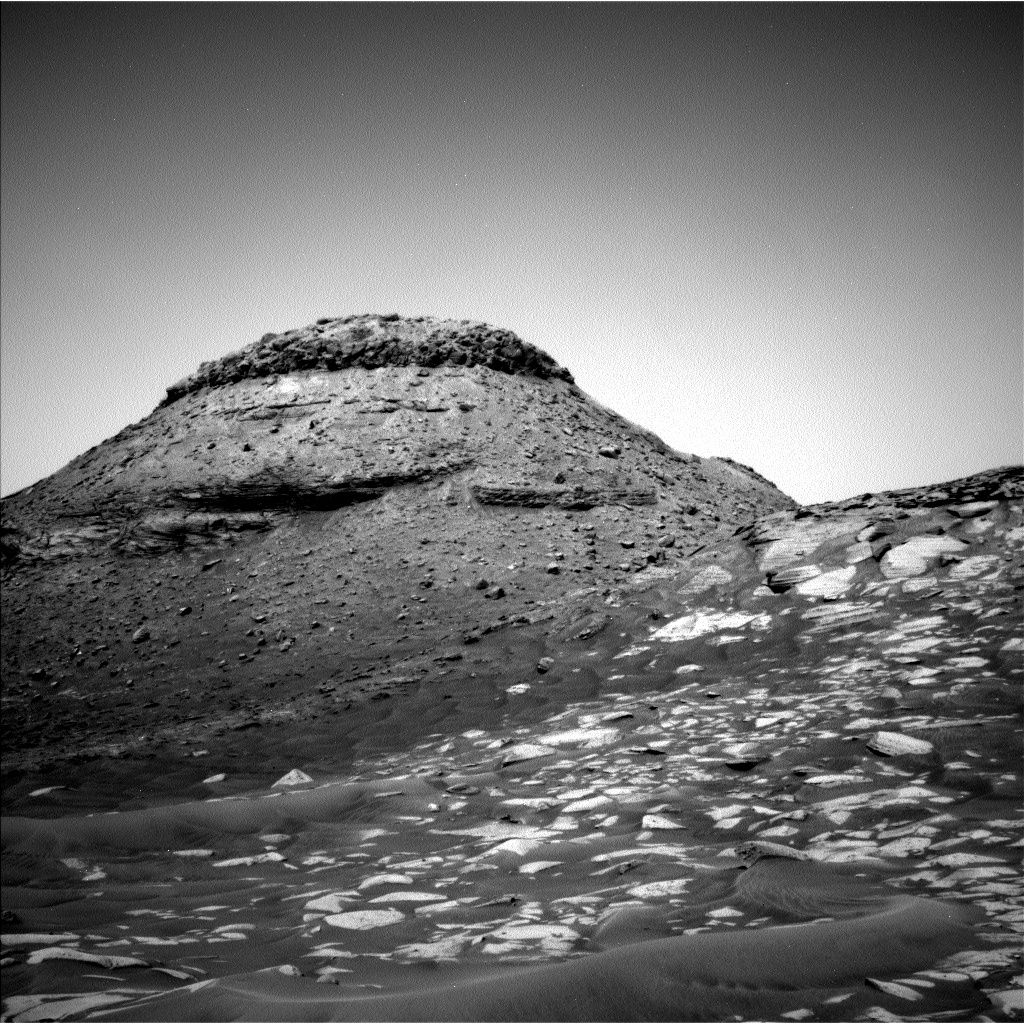
Curiosity Left B Navigation Camera image taken on Sol 3580, September 1, 2022.
Credit: NASA/JPL-Caltech
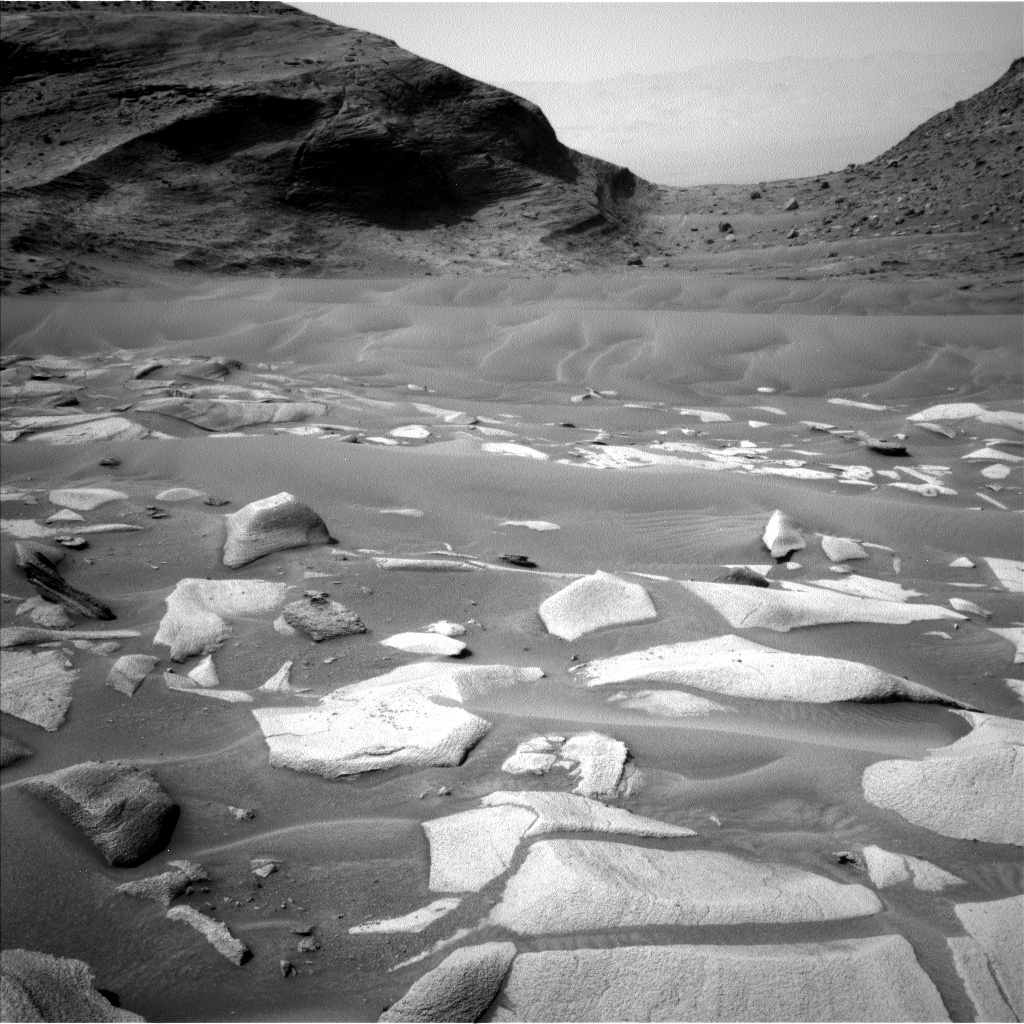
Curiosity Left B Navigation Camera image taken on Sol 3580, September 1, 2022.
Credit: NASA/JPL-Caltech
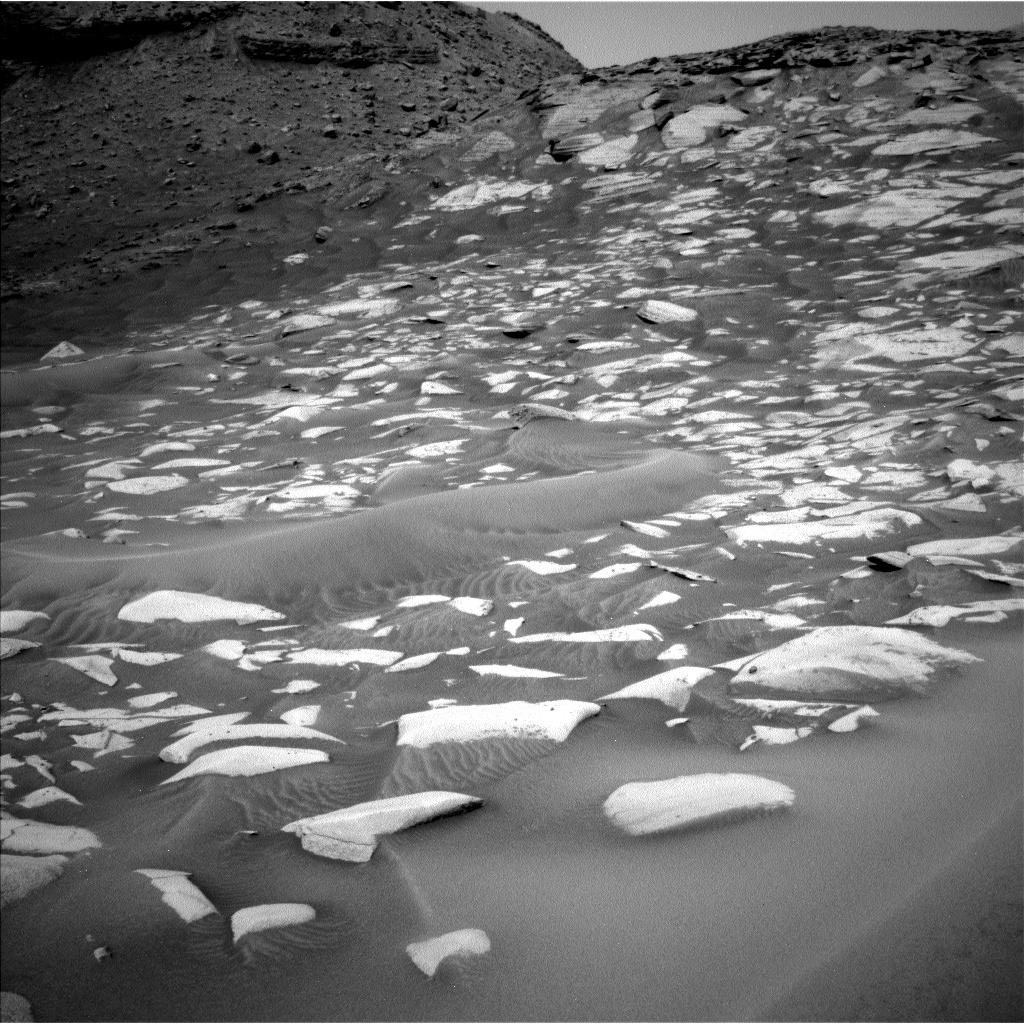
Curiosity Left B Navigation Camera image taken on Sol 3580, September 1, 2022.
Credit: NASA/JPL-Caltech
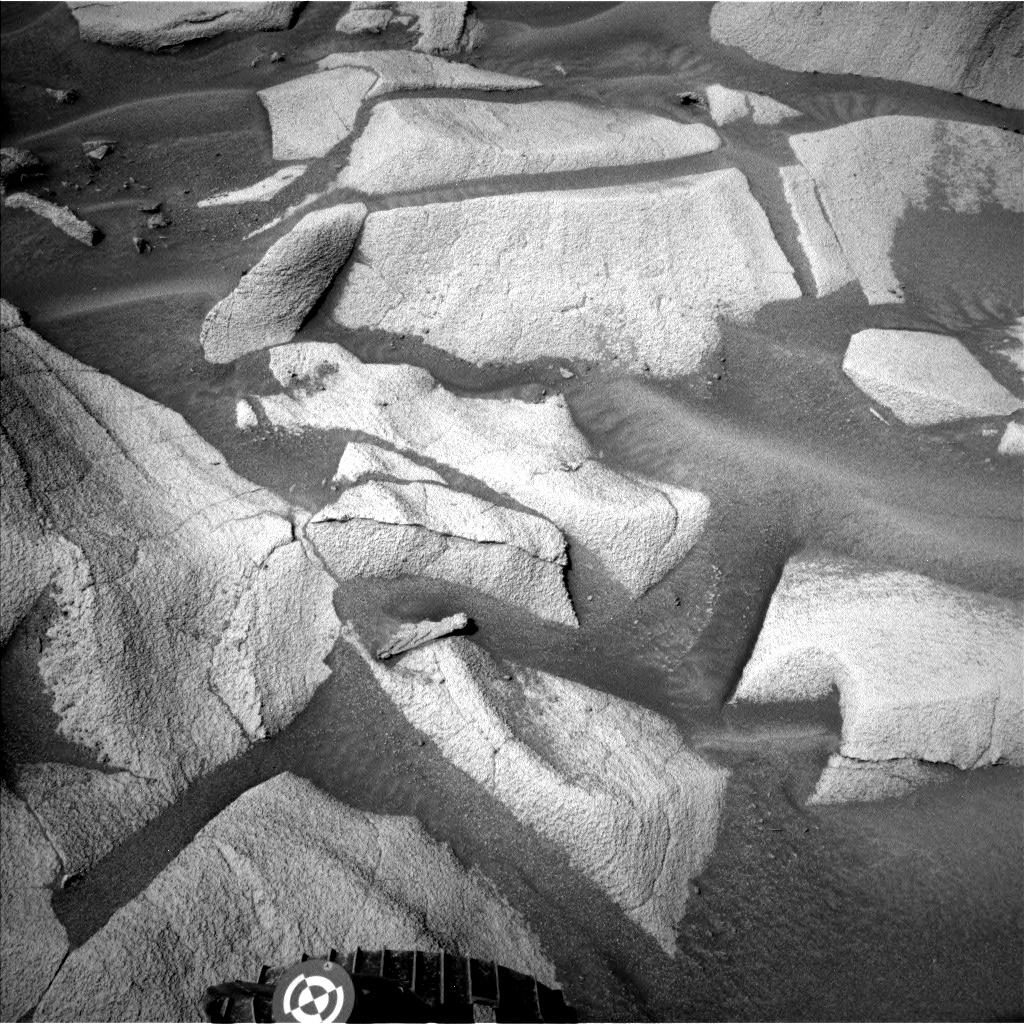
Curiosity Left B Navigation Camera image taken on Sol 3580, September 1, 2022.
Credit: NASA/JPL-Caltech
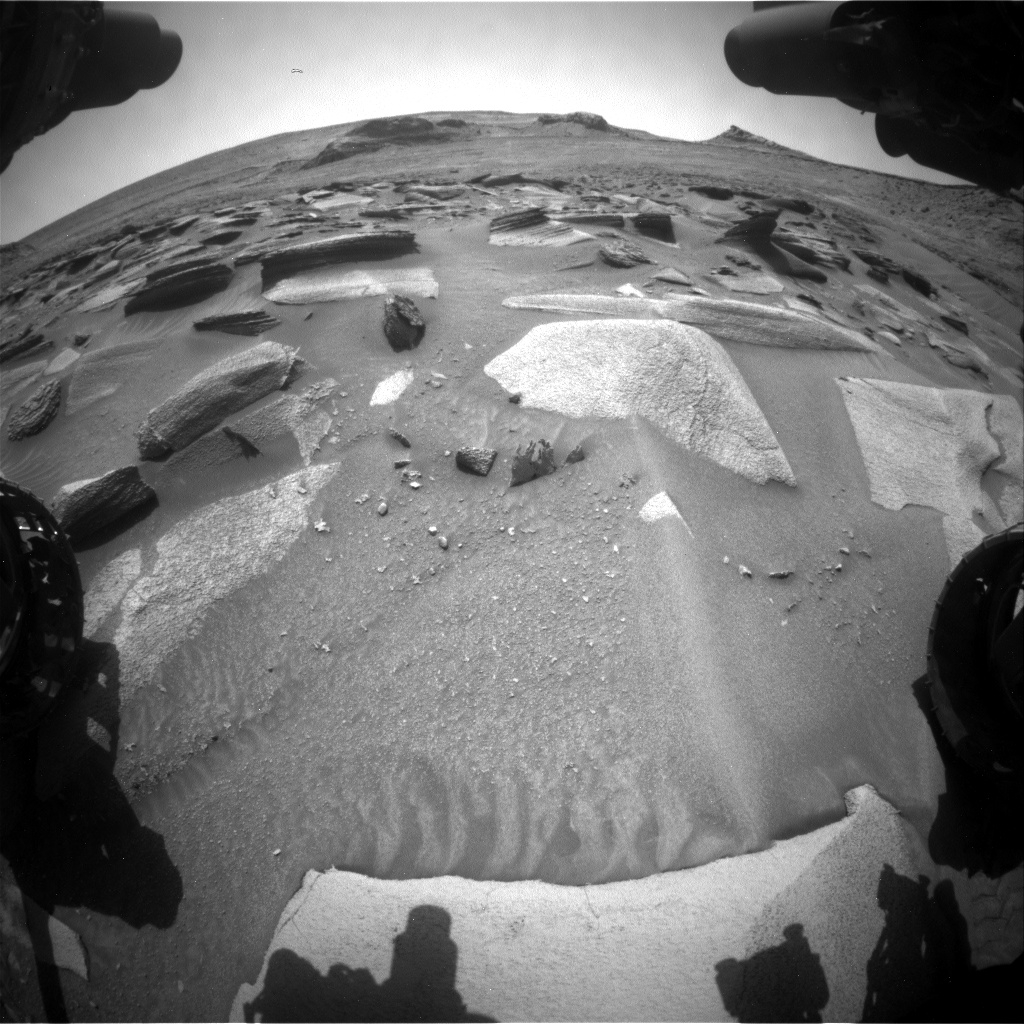
Curiosity Front Hazard Avoidance Camera Right B image acquired on Sol 3580, September 1, 2022.
Credit: NASA/JPL-Caltech
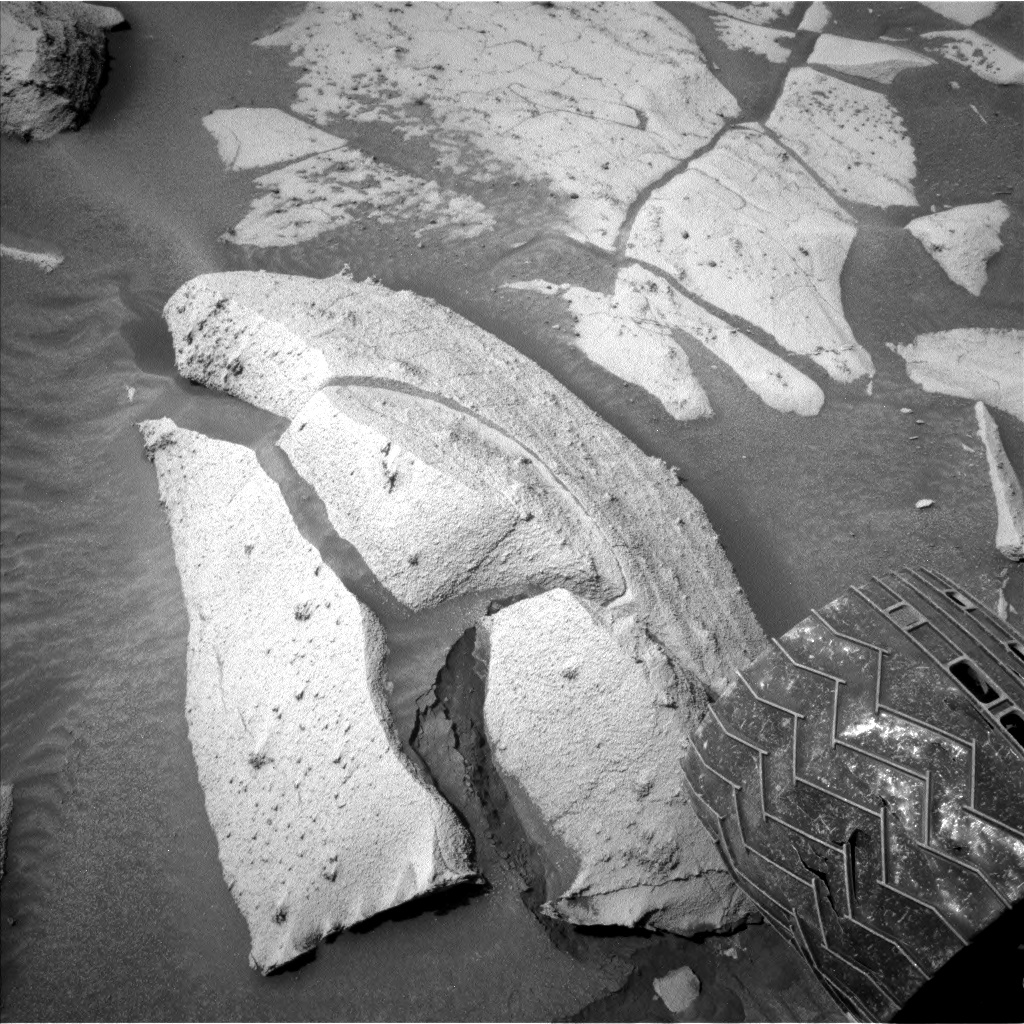
Curiosity Left Navigation Camera image taken on Sol 3579, August 31, 2022.
Credit: NASA/JPL-Caltech
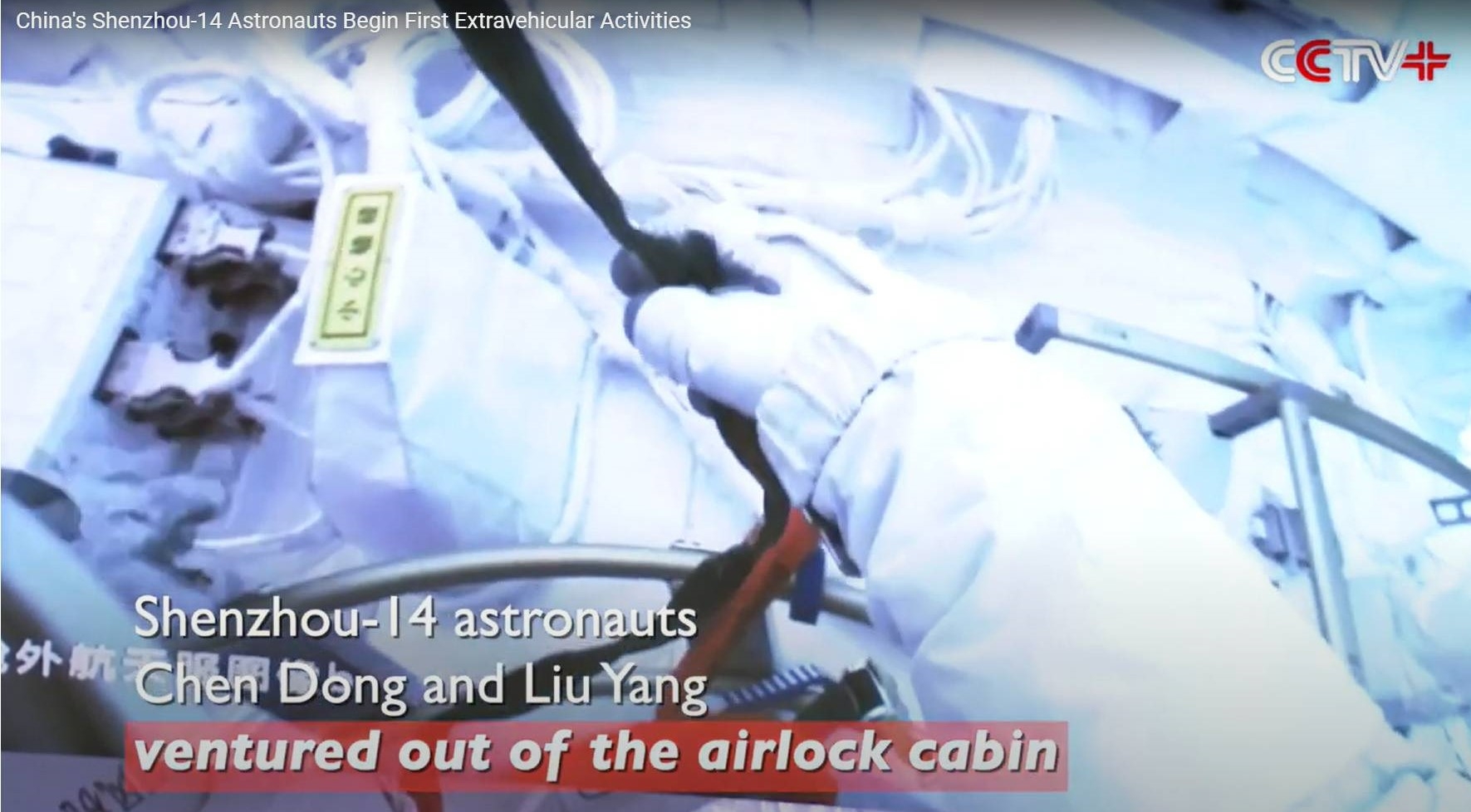
Credit: CCTV/Inside Outer Space screengrab
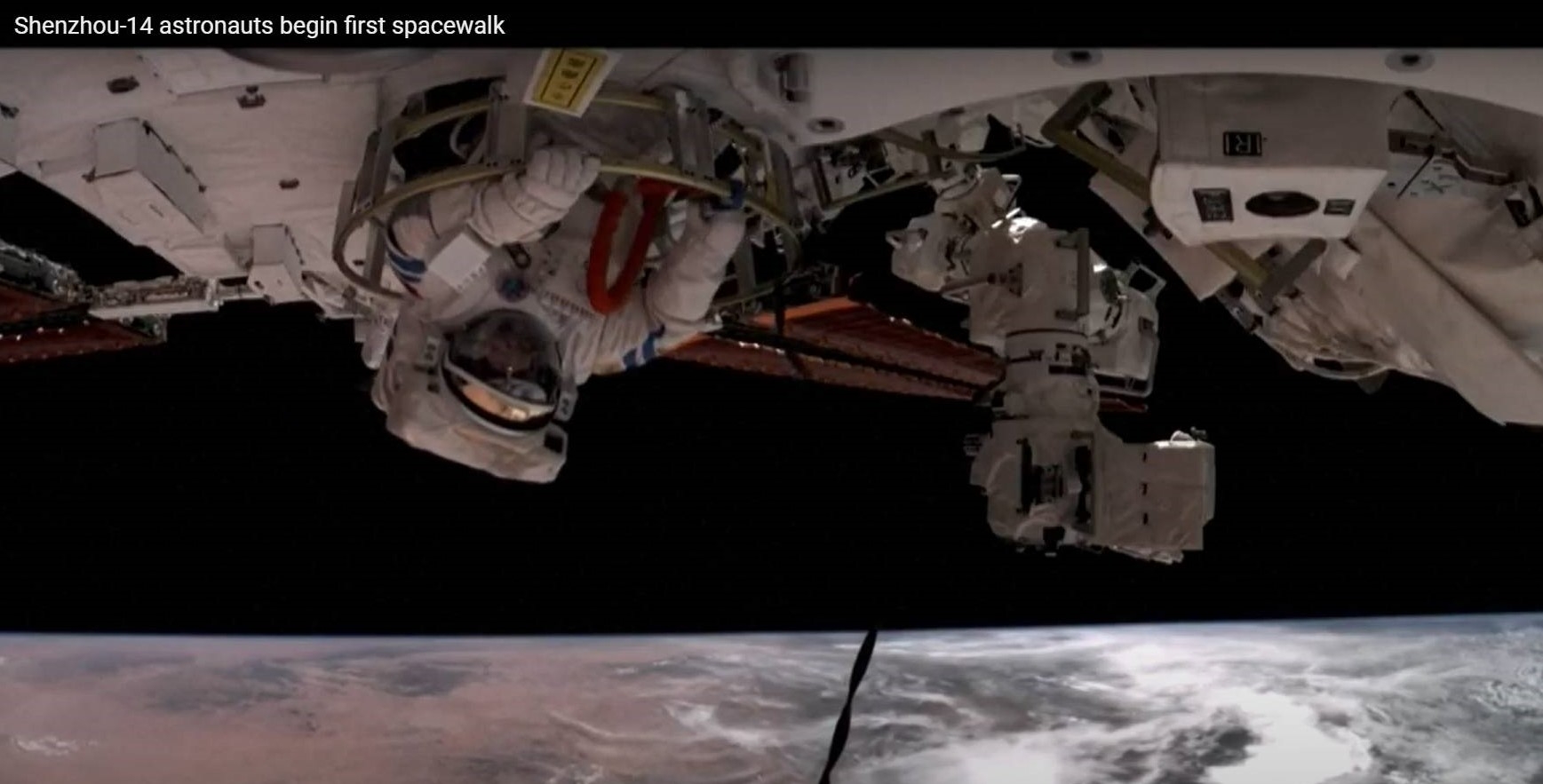
China’s Shenzhou-14 crew conducted their first EVA tasks, venturing out of the airlock cabin of the Wentian lab module.
Shenzhou-14 astronauts Chen Dong and Liu Yang carried out spacewalk tasks with Cai Xuzhe assisting the pair from inside the Tianhe core module.
During their first EVAs, expected to last about seven hours, Chen and Liu conducted tasks outside the lab module, including installing protective cables, setting up the expansion pumps, raising the panoramic cameras, and assembling the extravehicular toolbox, according to China Central Television (CCTV).

Shenzhou-14 crew enters new lab module. Credit: China National Space Administration (CNSA)/China Media Group(CMG)/China Central Television (CCTV)/Inside Outer Space screengrab
Three-module structure
The three Chinese astronauts have been working and living in orbit for 88 days since they were sent into space onboard the Shenzhou-14 spaceship and entered the combination of the country’s space station on June 5.
The combination of the space station is currently formed by the Tianhe core module, the Wentian lab module, the Shenzhou-14 spaceship and the Tianzhou-4 cargo craft.
During their six-month stay in orbit, the Shenzhou-14 crew will cooperate with ground control to complete the assembly and construction of the space station, expanding it from the foundational core module Tianhe into a basic T-shaped three-module structure, with Tianhe in the center and the two lab modules Wentian and Mengtian on each side of it.
The Mengtian lab module is set to be launched in October by way of a Long March 5B booster.
Credit: CCTV/Inside Outer Space screengrab
Onboard duties
Since arriving at the in-construction Tiangong space station in June, CCTV reports that the Shenzhou-14 have transferred material and supplies, completed in-orbit test work of the Wentian lab module experiment platform, unlocked and tested operation of experiment cabinets, conducted in-orbit tests of the functions of the small mechanical arm outside Wentian with the support of the ground team and completed space station complex management.
In addition, the crew completed routine work, such as medical examination, weightlessness protection training and performed scientific experiments. Training sessions included emergency evacuation, small mechanical arm operation, and medical rescue, CCTV notes.

Station complete is set for year’s end.
Credit: CNAS/CCTV Video News Agency/Inside Outer Space screengrab
China launched Wentian, the first lab module of its space station, on July 24. The Tianhe core module was launched in April 2021. The construction of the Tiangong space station is expected to be completed by the end of this year.
Foot restraint
Fan Ziqi, chief engineer for aerospace product design of the department of assembly and environmental engineering at the China Academy of Space Technology told CCTV: “In the extravehicular activity this time, the foot restraint will be installed on the smaller robotic arm, which has a seating on the end of the arm. After getting out of the module, the astronaut will grab the foot restraint and install on the smaller arm.”
Fan added that after installing the foot restraint, the astronaut will proceed to hold the extravehicular workbench and insert it into one side of the foot restraint. “Equipment for transfer, including tools, can be placed on the extravehicular workbench which has quite a number of connectors on it.”
When standing on the seating, the astronauts can make a 360-degree turn while performing their extravehicular activities.
“The airlock cabin on the Wentian module is relatively large. Previously with the core module, the extravehicular workbench would be assembled outside of the module. This time, with the Wentian, the three sections of extravehicular workbench will be assembled inside the cabin and then moved outside the cabin to be installed on the foot restraint,” Fan said.
For CCTV videos of this spacewalk, go to:

