Archive for the ‘Space News’ Category
 Author:
  September 15th, 2022
Artwork depicts CAPSTONE spacecraft in a near rectilinear halo orbit (NRHO) around the moon.
Credit: NASA/Advanced Space
That troublesome tumbling of the NASA CAPSTONE Moon mission received some relatively good news on a recovery pathway for the spacecraft.
“The communications situation has dramatically improved, the power state of the spacecraft appears to be sufficient for continuous (duty cycled) heating of the propulsion system which dropped below its operational temperature,” said Advanced Space that’s operating the probe for NASA.
The microwave-sized spacecraft — Cislunar Autonomous Positioning System Technology Operations and Navigation Experiment (CAPSTONE) — continues on its planned path to the Near Rectilinear Halo Orbit around the Moon.

CAPSTONE team members install solar panels onto the Cislunar Autonomous Positioning System Technology Operations and Navigation Experiment – at Tyvak Nano-Satellite Systems Inc. in Irvine, California.
Credits: NASA/Dominic Hart
Ongoing effort
Teams at the Deep Space Network, NASA, Terran Orbital, and Advanced Space been engaged in a continuous, ongoing effort to straighten out and fly right CAPSTONE over the past 5 days.
Over the last few days, CAPSTONE’s power – though limited by the orientation of the spacecraft in its spin relative to the Sun – appears to be sufficient for heating of the propulsion system. The propellant and propulsion system are in a recoverable state.
“Information on the cause of the anomaly has been obtained and is being evaluated, and recovery plans that mitigate risk of further anomalous behavior are being developed,” said Advanced Space of Westminster, Colorado, the group that developed and operates CAPSTONE.

Jeffrey Parker, chief technology officer of Advanced Space (left) explains the CAPSTONE mission to U.S. Senator John Hickenlooper over a full-size model of the spacecraft.
Credit: Advanced Space/Jason Johnson
“We do not have a timeline for a recovery attempt, but the team is working hard to make progress guided by what we are learning from the data with an explicit goal to minimize further risk to the mission,” an Advanced Space statement explained.
 Posted in

Credit: Space Foundation
The Space Foundation is launching a “Moon Colony Kit” project for classrooms. Students and educators grades 4-8 can participate, with the kit highlighting 50 different Science, Technology, Engineering, the Arts and Mathematics (STEAM) careers. A Website offers Spanish translation.
The kit was developed in collaboration with NASA and The White House National Space Council, with principal sponsorship from AstroSapiens Foundation.

Artemis I Rollout: August 16, 2022
Credit: NASA/Joel Kowsky
Drawing upon the upcoming Artemis I mission, Space Foundation is hosting a free, national educator professional development event for thousands of educators with NASA and Space Foundation education specialists. This event is being held on Monday, Sept.19 to discuss the Artemis program and related educational opportunities.
At a live mission briefing during World Space Week 2022 on Friday, Oct. 7, the Moon Colony Kit project will kick off a nationwide student challenge in which top-performing students will have the opportunity to participate in NASA-themed programs at Space Center Houston.

Credit: Space Foundation
Are you eligible?
You are eligible to participate in the Moon Colony Kit initiative IF you are a resident of the continental United States (excluding Puerto Rico, Alaska, or Hawaii), you teach 4th – 8th grade and agree to the following:
Participate in a live (or view a recorded) 90-minute Teacher Professional Development Workshop on September 19, 2022
Participate in a live (or view a recorded) 30-minute Student Mission Briefing on October 7, 2022
Implement the Moon Colony Kit collaborative game content with your students
To learn more about the Moon Colony Kit and to register, visit:
https://www.discoverspace.org/education/resources-for-educators/moon-colony-kit/

The Philippine Space Agency (PhilSA) has been closely monitoring the Long March 7A (CZ-7A) rocket launched on September 13, 2022 from the Wenchang Space Launch Center, Hainan Island.
PhilSA was able to verify the estimated drop zones of rocket debris from the Notice to Airmen (NOTAM) issued by the Civil Aviation Administration of China.
In a PhilSA posting, two drop zones within Philippine territory have been identified based on the NOTAM: Drop zone 1 is approximately 71 kilometers from Burgos, Ilocos Norte, while drop zone 2 is approximately 52 kilometers away from Sta. Ana, Cagayan.
PhilSA submitted this information as well as other actionable details in a report issued to all relevant government agencies before the launch.

Credit: China Central Television (CCTV)/China Aerospace Science and Technology Corporation (CASC)/Inside Outer Space screengrab
Falling debris threat
“While debris from CZ-7A is unlikely to fall on land features or inhabited areas in the Philippine territory,” PhilSA said, “falling debris still poses a considerable threat to ships, aircraft, fishing boats, and other vessels that will pass through the drop zones.”
Last July, the core stage debris of the Long March 5B rocket landed on Philippine waters in an uncontrolled reentry.
“In the case of Long March 7A, the possibility of a similar uncontrolled reentry of the rocket’s upper stages cannot be ruled out at this time,” the PhilSA statement added.
“PhilSA wishes to reiterate its earlier advice to the public to immediately inform local authorities if suspected floating debris is sighted at sea. PhilSA also cautions everyone against retrieving or coming in close contact with these materials,” the statement concludes.
The Long March-7A booster launched the ZhongXing-1E satellite from the Wenchang Spacecraft Launch Site, a telecommunications satellite designed to “provide users with high-quality voice, data, radio, and television transmission services.”
Quite disruptive
While the Long March 7A uses kerosene and liquid oxygen in its first two stages. “that said, dropping rocket stages into another country’s 200 nautical-mile Exclusive Economic Zone (EEZ), while likely not illegal, could be quite disruptive…as the Philippines have pointed out,” said Michael Byers, co-director, of the Outer Space Institute at the University of British Columbia in Canada told Inside Outer Space.
Byers was lead author of a recent study published in Nature Astronomy that looked at three decades of data to approximate the chance of human casualties from uncontrolled rocket reentries.
To view a video of the launch, go to:
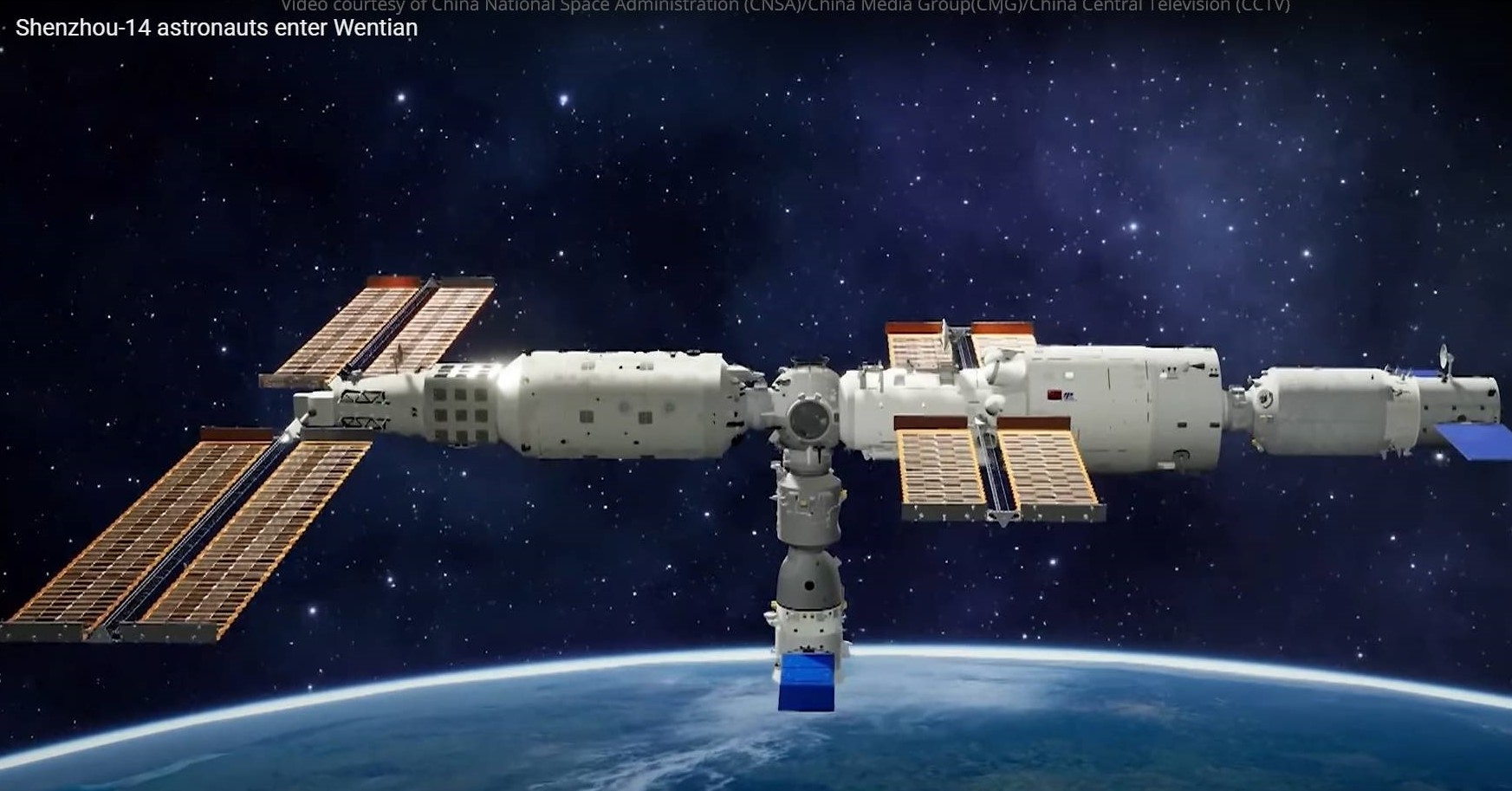
Current configuration of China’s in-construction space station.
Credit: China National Space Administration (CNSA)/China Media Group(CMG)/China Central Television (CCTV)/Inside Outer Space screengrab
China’s Shenzhou-14 crew is preparing for their second spacewalk adventure outside the country’s in-construction space station, the state-run Xinhua news agency reports.
Back on September 2, two taikonauts — Chen Dong and Liu Yang – exited the space station. The third taikonaut, Cai Xuzhe, provided support inside the cabin.

Shenzhou-14 crew.
Credit: CNSA/CCTV/Inside Outer Space
Once outside, using the Wentian lab’s airlock for the first time, Chen and Liu completed tasks such as installing additional pumps and lifting a panoramic camera onto the Wentian lab module.
The Shenzhou-14 crew has been in space since June 5.

Station complete is set for year’s end.
Credit: CNAS/CCTV Video News Agency/Inside Outer Space screengrab
Busy schedule ahead
During the second half of their six-month stay in orbit, they will oversee the arrival of the second lab module, Mengtian.
Also ahead for the Shenzhou-14 taikonauts is the first Chinese space station crew handover when the Shenzhou-15 crew arrives later this year.

Panoramic camera view.
Credit: CMSA/CCTV/Inside Outer Space screengrab
If all continues to plan, the Chinese space station is to be fully assembled by year’s end.
Meanwhile, the China Manned Space Agency (CMSA) has released imagery from the recently installed panoramic camera.
Go to:

Curiosity Right B Navigation Camera image acquired on Sol 3590, September 11, 2022.
Credit: NASA/JPL-Caltech
NASA’s Curiosity Mars rover at Gale Crater is now performing Sol 3592 tasks.
“Curiosity is back on the road,” reports Kristen Bennett, a planetary geologist at the USGS Astrogeology Science Center in Flagstaff, Arizona.
The robot’s arm is good to go, so the team planned a full day of activities.

Curiosity Right B Navigation Camera image acquired on Sol 3590, September 11, 2022.
Credit: NASA/JPL-Caltech
Extra observations
“Curiosity has been sitting in the same place for a few sols, so the team has been taking advantage of that to get extra observations in this area,” Bennett adds.

Curiosity Right B Navigation Camera image acquired on Sol 3590, September 11, 2022.
Credit: NASA/JPL-Caltech
One Mastcam observation is an extension of a mosaic (“Parai Pond”) that was started last week. Additionally, there is a Mastcam multispectral observation in the plan to capture bedrock that shows color variations.
“We will get a closer look at a feature in the distance that is thought to be an inverted channel with a ChemCam [Chemistry and Camera] long distance RMI [Remote Micro-Imager],” Bennett notes.
ChemCam will also target the “Kurupung” block in the workspace.

Chemistry & Camera (ChemCam) Remote Micro-Imager (RMI) photo taken on Sol 3590, September 11, 2022.
Credit: NASA/JPL-Caltech/LANL
Interesting pink pebble
“The ChemCam team is taking advantage of spending several sols in one location to build up their statistics of the geochemistry in this area. By targeting multiple rocks in the scene, we will get a better understanding as to whether everything has the same chemistry or if there are small variations,” Bennett explains.

Chemistry & Camera (ChemCam) Remote Micro-Imager (RMI) photo taken on Sol 3590, September 11, 2022.
Credit: NASA/JPL-Caltech/LANL
Contact science is back in the mix, with a Mars Hand Lens Imager (MAHLI) observation of an interesting pink pebble in the workspace called “Piabas.”

Curiosity Chemistry & Camera (ChemCam) Remote Micro-Imager (RMI) photo taken on Sol 3591, September 12, 2022.
Credit: NASA/JPL-Caltech/LAN

Curiosity Mars Hand Lens Imager (MAHLI) photo produced on Sol 3590, September 11, 2022.
Credit: NASA/JPL-Caltech/MSSS
“We also get back on the road in this plan, [Sols 3592-3593] with a short seven meter drive that will take the rover to the edge of the next area of interest,” Bennett concludes. “Onwards!”

Credit: Moon World Resorts Inc.
Says the add: “12 people have been there…7 billion want to visit.”
Designed by Canadian architectural company Moon World Resorts Inc., each of the four MOON Destination Resorts to be developed in North America, MENA, Europe and Asia Pacific will feature 4,000 luxury Resort suites.
The Resort will be developed to a Five Star standard with service delivery operating at a Five Diamond level.

Credit: Moon World Resorts Inc.
Wellness and wellbeing
According to a company posting, “in today’s hectic world, wellness and mental wellbeing are more important than ever, especially for global travelers. MOON’s exclusive luxury Resort suites are designed to inspire and educate guests to the benefits of healthy living,” the group explains. “Guests will enjoy the most exclusive sensory experiences derived from aromatherapy plus the integration of light, sight and sound therapy.”

Credit: Moon World Resorts Inc.
State of the art technology
Suites within a 735-foot-high complex will include the most innovative clean, fresh and antibacterial air technology, vitamin infused filtered water systems and all amenities will be certified nontoxic, recyclable, biodegradable, eco-friendly and not tested on animals.

Credit: Moon World Resorts Inc.
“Suites will feature the latest state of the art technology including MOON’s unique “Windows to the Universe” which will essentially provide guests with the ability to visualize anything and anywhere their thoughts may wish to take them,” the Moon World Resorts posting adds.
While full details are apparently still to come, visit this Facebook page at:

Credit: NASA
Worried about safe and stable spaceflight, free of satellite collisions in orbit?
Slingshot Aerospace, Inc. announced today a free version of the group’s Slingshot Beacon that provides urgent collision alerts; coordinates satellite maneuvers; and seamlessly communicates, especially during high-risk moments.
“Ensuring the safety of current and future satellites in orbit is paramount to maintaining space as a safe operating environment,” said Melanie Stricklan, do-founder and CEO of Slingshot Aerospace. “This is why we are offering Slingshot Beacon for free so that all space operators around the world can coordinate, communicate and deconflict spaceflight risk.”

Clutter in the cosmos.
Credit: Used with permission: Melrae Pictures/Space Junk 3D
Analyze risk
According to the group, Slingshot Beacon capabilities are designed in collaboration with commercial space operators that represent more than 70% of satellites in low Earth orbit to help:
- Visualize the current and future state of satellites in a customizable dashboard
- Analyze risk using more accurate models to and cut through the noise of irrelevant data
- Enable coordination based on the same data with seamless chat and file sharing, and
- Guide decision stages for maneuvers to eliminate uncertainty
Potential collisions
There are more than 9,800 satellites in orbit today according to Slingshot’s space object database, Seradata SpaceTrak, with more than 115,000 planned to be in space by 2030.

Orbital debris hit.
Credit: NASA
Slingshot’s data indicates that 30% of alerts for potential collisions are with other active satellites. “This means space operators need to avoid more than just debris when maneuvering in space, and underscores the need for active coordination amongst the global space community,” said the firm in a press statement.
Debris clouds
“Accidental collisions can produce fast moving debris clouds that can spread and damage additional satellites with a cascading effect rendering havoc on spaceflight operations and limiting the use of space in the future,” the statement adds.

“Previously, owner-operators would resolve collision alerts by communicating via email and phone, wasting valuable time cross-referencing positional data to ensure they were looking at the same information,” notes the press statement.
The intent of the Slingshot Beacon is to transform how operators work together, save time, reduce uncertainty, while promoting space safety.
For more information go to: https://slingshotaerospace.com/
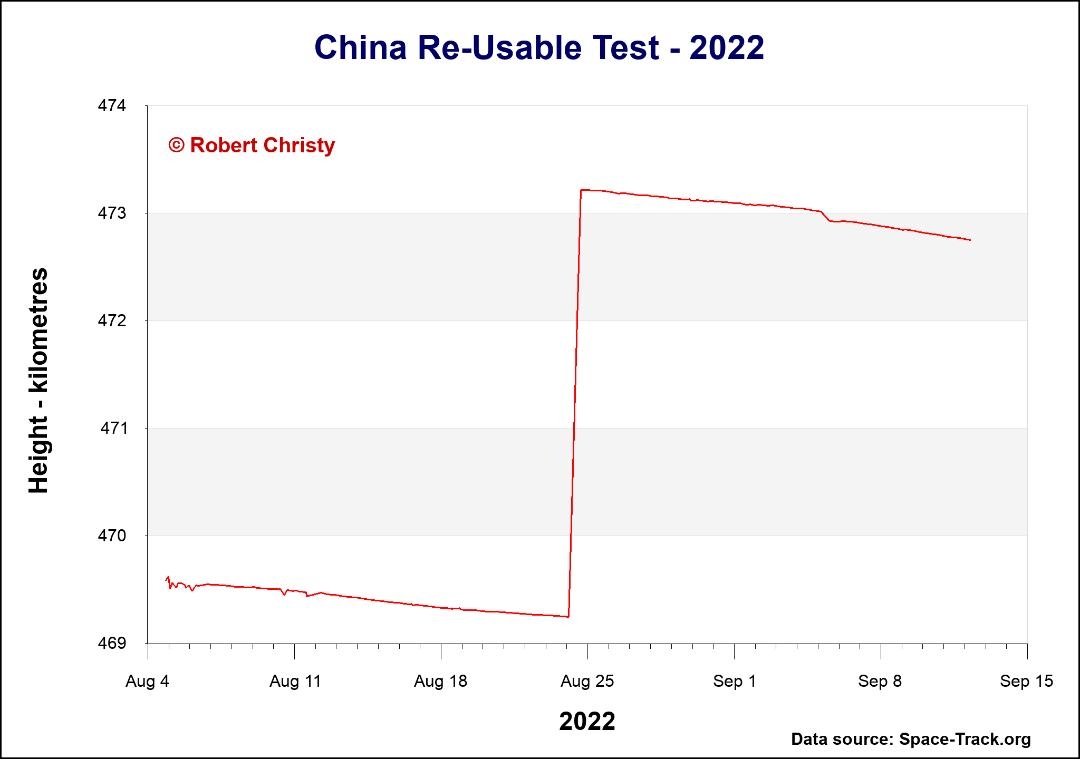
China’s mysterious reusable space plane remains in orbit, a mission that got underway on August 4th. This “reusable experiment spacecraft” was hurled into orbit from Jiuquan in the Gobi Desert atop of a Long March 2F rocket.
This type craft flew back in September 2020, but performed a much shorter shake-out mission of two days.
As for the currently flying space plane, Inside Outer Space reached out to Bob Christy and his informative website: http://orbitalfocus.uk/ and hisTwitter: @OrbitalFocus for an update.

Possible design of China’s space plane.
Source: Homem do Espaco/Twitter
Long-duration flight
“I suspect this is a long-duration test or operational flight after the 2020 ‘shakedown,’” Christy said.
“The vehicle itself hasn’t performed any startling maneuvers so far,” Christy said. There was a small adjustment, he added, when a 1.9 mile (3 kilometers) orbit raise on August 24 took it from 215 miles x 368 miles (346 km x 593 km) to 218 miles x 370 (351 km x 595 km) altitude.
“An almost-imperceptible change September 5 lowered it by a few hundred meters. There is no obvious reason for the changes but possibilities are thruster tests and/or debris avoidance maneuvers,” Christy explained. “The orbit is decaying very slowly, probably indicating that it is flying nose or tail first, presenting a high mass/cross-section ratio to the air,” he said.
Unidentified object
“Early days, radio trackers detected transmissions similar to those from a small satellite left in orbit after the 2020 flight. It then fell silent,” Christy said.
He went on to explain: “A possibility is a detachable camera package on an arm and used to inspect the re-entry insulation. We may get a further clue if it too is left behind after the space plane lands back on Earth. As yet, it is still attached to the main craft.”
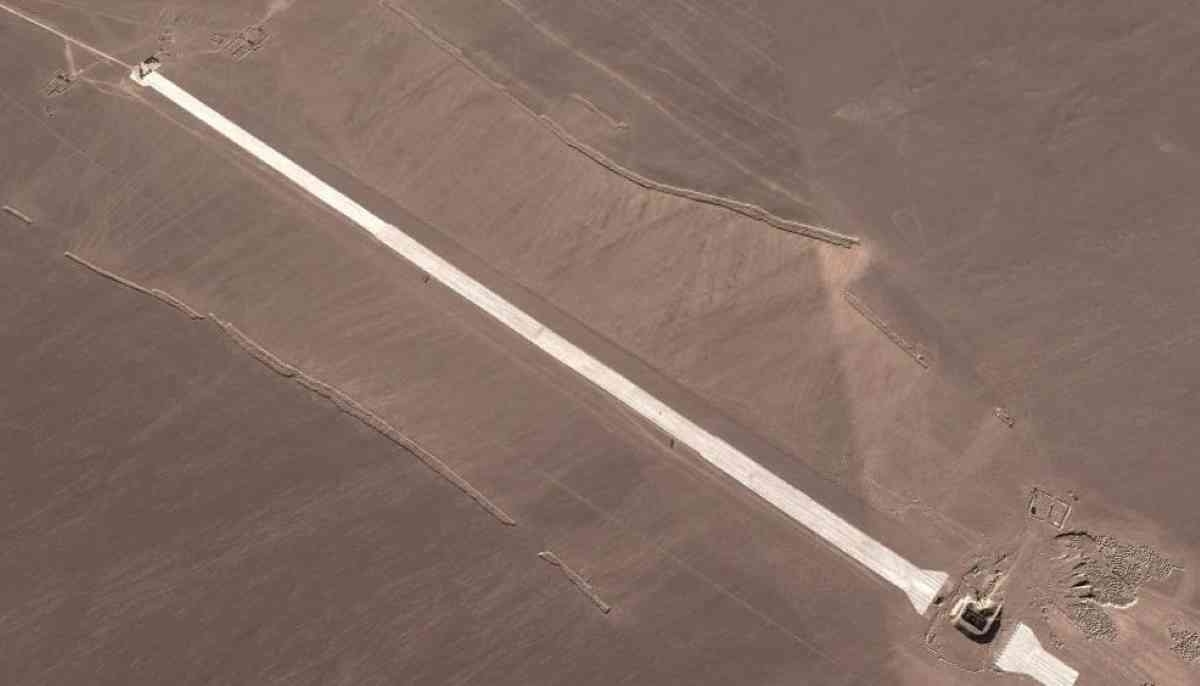
Landing opportunities
There was an early landing opportunity at a Lop Nor landing strip on August 27, Christy noted, under similar on-orbit and ground lighting conditions — and from a similar ground track — to the 2020 flight.
“Ideal” ground tracks for the space plane’s landing now occur every 12 days and similar lighting conditions recur every 60 days, Christy added.
“They probably shouldn’t be taken as strict rules because there’ll be leeway in the lighting constraints and it will have a degree of cross-track maneuverability,” said Christy.

Encapsulated X-37B Orbital Test Vehicle for United States Space Force-7 mission.
Credit: Boeing
U.S. space plane
Often characterized as akin to the U.S. Space Force X-37B space plane, China’s now orbiting long-duration winged vehicle has a lot of catching up to do.
The X-37B Orbital Test Vehicle (OTV-6) was launched on May 17, 2020. OTV-6 is also called USSF-7 for the U.S. Space Force.
OTV-6 is nearing 850 days of flight.
The still orbiting X-37B space drone broke the program’s on-orbit record for long duration flight on July 6 at 5:49:08 ZULU, according to a Pentagon statement provided to Inside Outer Space.

X-37B Air Force space plane.
Credit: Boeing/Inside Outer Space Screengrab
Flight roster
Here’s a listing of previous flights of the X-37B Space Force space plane:
OTV-1: launched on April 22, 2010 and landed on December 3, 2010, spending over 224 days on orbit.
OTV-2: launched on March 5, 2011 and landed on June 16, 2012, spending over 468 days on orbit.
OTV-3: launched on December 11, 2012 and landed on October 17, 2014, spending over 674 days on orbit.
OTV-4: launched on May 20, 2015 and landed on May 7, 2015, spending nearly 718 days on-orbit.
OTV-5: launched on September 7, 2017 and landed on October 27, 2019, spending nearly 780 days on-orbit.

X-37B (OTV-5) on the runway after landing at the Kennedy Space Center.
Credit: U.S. Air Force
Progressive records: time on orbit
As to when and where OTV-6 will return to a wheels-stopped landing is anybody’s guess.
OTV-1, OTV-2, and OTV-3 missions landed at Vandenberg Air Force Base, California, while the OTV-4 and OTV-5 missions landed at Kennedy Space Center, Florida.
According to the builder of the space plane, Boeing, a fact sheet explains that “the X-37B is one of the world’s newest and most advanced re-entry spacecraft, designed to operate in low-earth orbit, 150 to 500 miles above the Earth. The vehicle is the first since the Space Shuttle with the ability to return experiments to Earth for further inspection and analysis. This United States Air Force unmanned space vehicle explores reusable vehicle technologies that support long-term space objectives.”
At first designed to fly 270 days per mission, Boeing adds that “the X-37B has set progressive records for time on orbit during each of its five previous missions.”
NASA’s Curiosity Mars rover at Gale Crater is now performing Sol 3590 duties.
A select number of images showcase the work of the robot at its present location:
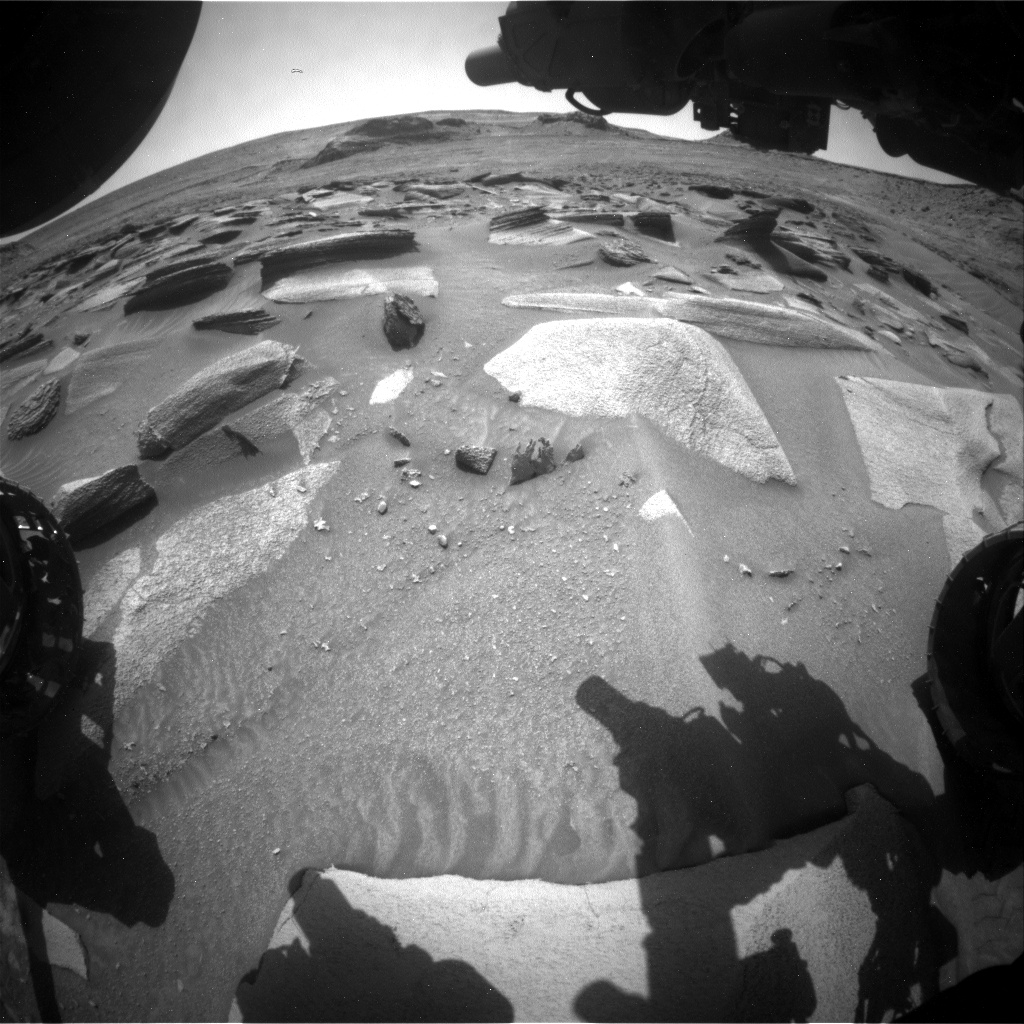
Curiosity Front Hazard Avoidance Camera Right B image taken on Sol 3589, September 10, 2022.
Credit: NASA/JPL-Caltech

Curiosity Left B Navigation Camera photo acquired on Sol 3589, September 10, 2022.
Credit: NASA/JPL-Caltech

Curiosity Left B Navigation Camera photo acquired on Sol 3589, September 10, 2022.
Credit: NASA/JPL-Caltech

Curiosity Right B Navigation Camera image taken on Sol 3589, September 10, 2022.
Credit: NASA/JPL-Caltech

Curiosity Rear Hazard Avoidance Camera Left B image taken on Sol 3589, September 10, 2022.
Credit: NASA/JPL-Caltech

Curiosity Chemistry & Camera (ChemCam) Remote Micro-Imager (RMI) photo acquired on Sol 3583, September 4, 2022.
Credit: NASA/JPL-Caltech/LANL

Credit: NASA
NASA hosted the second National Space Council meeting, chaired by Vice President Kamala Harris.
The Vice President highlighted the importance of climate, human spaceflight, and STEM education during the Biden-Harris Administration’s second National Space Council meeting Friday, September 10th, held at NASA’s Johnson Space Center in Houston.
A recording of the full National Space Council meeting is available online at:
FACT SHEET: Vice President Harris Announces Commitments to Inspire, Prepare, and Employ the Space Workforce:
To read the remarks by Vice President Harris at the National Space Council Meeting go to:

