Archive for the ‘Space News’ Category
 Author:
  October 3rd, 2022
Putting a spin on rocket launch. Flight 10 photo.
Credit: SpinLaunch
SpinLaunch has announced the results of a tenth successful Flight Test of its Suborbital Accelerator from Spaceport America, New Mexico.
The flight test took place on September 27, 2022. Four partner payloads, as well as two instrumentation payloads, were flown on the Suborbital Accelerator Flight Test Vehicle. Payloads came from NASA, Airbus U.S., Cornell University and Outpost.
All payloads were flown and recovered successfully.

Attendees tour the Mass Accelerator.
Credit: SpinLaunch
The test vehicle captured launch and flight test data to help validate and commercialize SpinLaunch’s Suborbital and Orbital Launch Systems.
Flight Test 10 was the company’s tenth flight test in just under eleven months since the Suborbital Mass Accelerator came online in late 2021.
Pre-spin qualification process
As part of the pre-flight qualification process, SpinLaunch accelerated payloads up to 10,000 Gs in SpinLaunch’s 12-meter Lab Accelerator at its Long Beach headquarters. Payloads were inspected post-spin and subsequently integrated into the Flight Test Vehicle in preparation for Flight Test 10.

SPIN Lab Accelerator Team.
Credit: SpinLaunch
In a company statement, Jonathan Yaney, Founder & CEO of SpinLaunch said: “The data and insights collected from flight tests will be invaluable for both SpinLaunch, as we further the development of the Orbital Launch system, and for our customers who are looking to us to provide them with low-cost, high-cadence, sustainable access to space.”
Payload participants
NASA provided a Data Acquisition Unit (DAQ) to capture critical launch characteristics of SpinLaunch’s kinetic launch system. The sensor suite was equipped with two accelerometers in addition to a gyroscope, magnetometer, and sensors for pressure, temperature, and humidity.

Readying the Suborbital Accelerator Flight Test Vehicle.
Credit: SpinLaunch
The DAQ was used given SpinLaunch’s signed Space Act Agreement with NASA to develop, integrate and fly a NASA payload, providing the agency with the information necessary to determine the potential of future commercial launch opportunities with SpinLaunch.
For Flight Test 10, Airbus U.S. provided a satellite sun sensor, which is typically used for spacecraft attitude control and positioning purposes.
Cornell Engineering’s Space Systems Design Studio (SSDS) has developed and launched small, inexpensive satellites called ChipSats to provide distributed in-situ measurements of the upper atmosphere of multiple planets, including Earth. Flight Test 10 exercised the operation of a SpinLaunch designed payload deployment system, which released multiple ChipSats from the Flight Test Vehicle.
Outpost, a company developing reusable satellites for high-precision Earth return, provided SpinLaunch with an onboard computer for testing and qualification in the SpinLaunch launch environment.

Payload rendering.
Credit: SpinLaunch
On target
SpinLaunch was founded by Jonathan Yaney, in 2014. The company is building a ground-based, kinetic launch system that delivers a substantially less expensive and environmentally sustainable system to place constellations of small satellites into Low Earth Orbit (LEO), according to the company.
SpinLaunch is based in Long Beach, California, and has built its Suborbital Mass Accelerator at Spaceport America in New Mexico.
The company adds that it is on target to place satellites into orbit and deliver payloads for spacefaring endeavors by 2026.
SpinLaunch announced last month that the company had closed a $71 million Series B funding round.
“The funds will be used to continue the development and commercialization of the world’s first kinetic launch system and satellite product line, designed to provide low-cost, high-cadence, environmentally responsible space access,” the company said in a statement.
For more information on SpinLaunch, go to:
 Posted in

Credit: The Big Ear Observatory
The renowned “WOW! Signal” was a surprising anomaly detected in the radio spectrum on August 15, 1977 by the Ohio State University’s Big Ear radio telescope.
Later work identified the star 2MASS 19281982-2640123 as a potential Sun-like star from which the signal could have originated.
Jump to present day. A search has been carried out for technosignatures from this source using multi-telescope observations with both the Robert C. Byrd Green Bank Telescope and the newly refurbished Allen Telescope Array on May 21, 2022.

Credit: Palmer Square Press
Targeted search
Technosignatures is defined as potentially detectable signatures and signals of the presence of distant advanced civilizations.
“While blind searches using radio telescopes have been conducted in the general field of view in which the WOW! signal was first detected, this is the first time a targeted search has been done,” notes a report in Research Notes of the AAS (American Astronomical Society).
Lead author of the report — “Breakthrough Listen Search for the WOW! Signal” – is Karen I. Perez of the Department of Astronomy at Columbia University in New York.

2MASS 19281982-2640123, the star with the temperature, radius, and luminosity most similar to the Sun found in the WOW! Signal region, based on data from the Gaia Archive. Source: PanSTARRS/DR1
Number of sources
These simultaneous observations, the paper explains, “represent an attempt to prepare for verification in the case that future candidate technosignatures are identified by either telescope individually.”
Perez and colleagues report: “we find no trace of the WOW! signal.” “No technosignature candidates were detected.”

Big Ear Observatory courtesy of North American Astrophysical Observatory. In late 1997, after almost 40 years of operation, the Big Ear radio ceased operation. The telescope was destroyed in early 1998.
“There remain a significant number of sources that are either Sun-like and/or pass the criteria for having a habitable zone, and future observations could target these in followup of the WOW! Signal,” the researchers conclude.
To view “Breakthrough Listen Search for the WOW! Signal” go to:

Credit: CCTV/Inside Outer Space screengrab
China started the selection of a new batch of astronauts – a fourth batch of reserve astronauts, according to the China Manned Space Agency (CMSA).
Lasting roughly a year and a half, the process will lead to the selection of some 12 to 14 reserve taikonauts, China Central Television (CCTV) reports. That new cadre of individuals is to include seven to eight pilots. Engineers will also be selected as well as two payload experts, reports the China Global Television Network (CGTN).
Space pilots will be selected among active flyers of China’s armed forces. The engineers will be picked from researchers and technicians in aerospace or related industries. And the payload experts will be drafted among those also researching space science, CGTN adds.
Credit: CMSA/CCTV/Inside Outer Space screengrab
For the first time candidates for payload specialists will also be selected from Hong Kong and Macao.
Promotional video
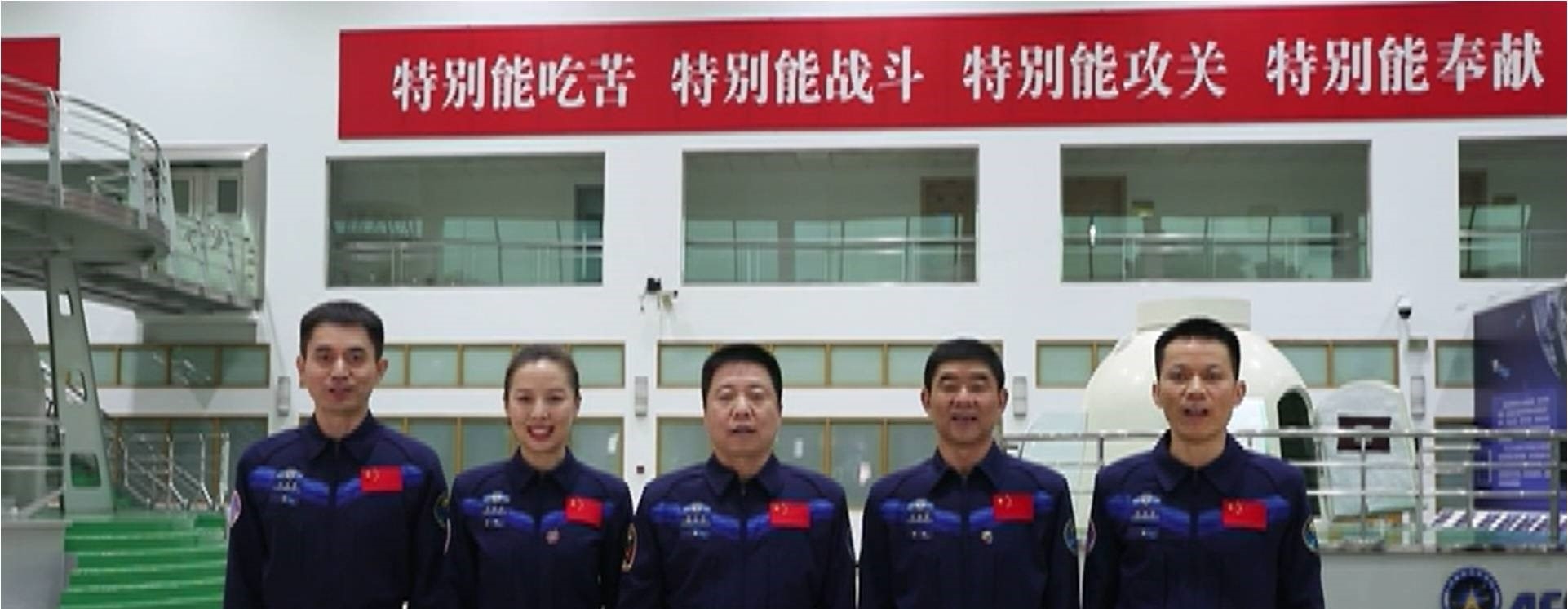
In a bit of a promotional come-on, video of Chinese astronauts are part of the call for more taikonauts:
“Come and join us in pursuing the space dream and building China into a space power. The selection of candidates for the fourth batch of Chinese astronauts is underway. We look forward to the joining of qualified astronauts,” the video explains.
“The Chinese space station is waiting for you to work here,” said Shenzhou-14 taikonauts now living aboard the in-construction Tiangong space station.

Credit: CMSA/CCTV/Inside Outer Space
Transposition maneuver
CMSA released on a video showing the space station lab module Wentian conducting in-orbit transposition. That transposition maneuver of the module took place last Friday, lasting about one hour.
It was the first time China has completed the in-orbit transposition of a large-scale spacecraft cabin by applying transfer facilities, the CMSA said.
During the transposition, the Wentian lab module first completed its state configuration and separated from the space station’s core module Tianhe. Then Wentian conducted transposition and docked with the side port of the space station’s node cabin.

Current configuration of China’s space station. Credit: CMSA/CCTV/Inside Outer Space screengrab
L-shape, T-shape
Through the transposition, the station’s combination of elements has changed from a straight line to L-shape.
When the Mengtian lab module arrives, to be launched later this month, the three-module combination will be maneuvered to take a T-shape.
Go to this newly-issued video showing China’s Space Station Wentian lab module during its in-orbit transposition at:

Credit: Omega
For those aspiring Mars explorers, you now have a watch that displays the time back on Earth, as well as on the Red Planet.
Swiss watch brand Omega has teamed up with the European Space Agency (ESA) to launch the “Marstimer.”
According to an ESA statement, “this new watch is space-tough and Mars-mission ready.”
Space-ready
The Omega Speedmaster family of watches has had a long association with space exploration. NASA’s Gemini and Apollo astronauts used them and they continue to be worn by astronauts today, including on the International Space Station.
ESA notes that the initial concept for the Marstimer came from ESA’s engineers and scientists, who wanted a watch with Mars-specific mission functions to help operate that space agency’s yet-to-fly Rosalind Franklin Mars rover.
Credit: Omega
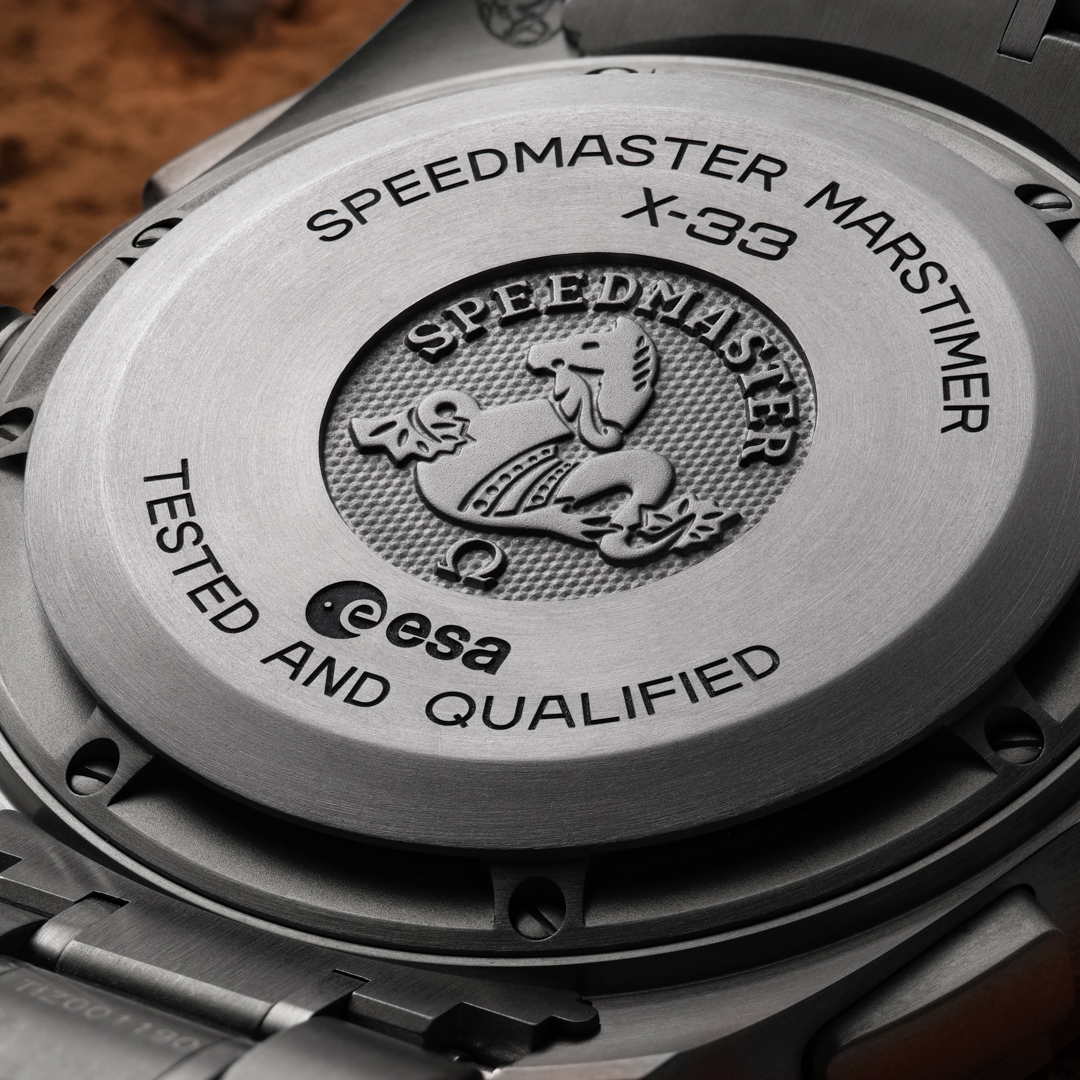
The Speedmaster Marstimer X-33 was developed under ESA patents.
To ensure the Marstimer was space-ready to take up timeless duties, a suite of tests was developed with Omega and several prototype watches were successfully evaluated at ESA ESTEC.
As a result, the watch bears the words “ESA tested and qualified” on its caseback.
Cased in grade 2 titanium, Omega’s unique 45 mm chronograph tracks time on Earth and Mars – “and allows you to find true north down here and up there,” adds Omega.
BTW: Apollo 11 Moonwalker Buzz Aldrin took part in this Omega watch design. Go to this story at:

Credit: Omega

Curiosity Front Hazard Avoidance Camera Right B image taken on Sol 3608, September 30, 2022.
Credit: NASA/JPL-Caltech
NASA’s Curiosity Mars rover at Gale Crater is now performing Sol 3608 duties.
“Whenever working on Mars throws up a complication, Curiosity’s team has to make a pivot,” reports Alex Innanen, an atmospheric scientist at York University in Toronto, Ontario, Canada.
Curiosity has found itself in a bit of a precarious spot, and can’t do any direct contact science or drill. “The small drive in the last plan didn’t quite get us where we wanted to go, so we’re still not able to drill,” Innanen adds

Curiosity Left B Navigation Camera image acquired on Sol 3608, September 30, 2022.
Credit: NASA/JPL-Caltech
The team quickly pivoted into other science looking at some nearby and more distant targets.
Distant marker band
On the first sol of the plan (Sol 3607-3608) the robot’s Chemistry and Camera (ChemCam) was slated to do Laser Induced Breakdown Spectroscopy (LIBS) work on a nearby block, ‘Sophia Point,’ along with Mastcam.
Mastcam and ChemCam are also continuing to document the distant marker band.

Curiosity Left B Navigation Camera image acquired on Sol 3608, September 30, 2022.
Credit: NASA/JPL-Caltech
Later in the sol, Innanen notes, the Mars Hand Lens Imager (MAHLI) was to get up close with two bedrock targets – “Esperito Santo” and the dusty “El Pao de la Fortuna.”
Dusty season
“The next sol has a ChemCam LIBS on ‘Juventina’, which we possible scuffed while driving, followed up by Mastcam. ChemCam and Mastcam are also imaging the slightly more distant ‘Kabrito Island,’ a dark, nodular block. After all this we’re going to do a small bump to try to get into a location where we can hopefully drill and do contact science, Innanen explains, finishing up the sol with a Mars Descent Imager (MARDI) twilight image.
“Even through changes to the plan, the environment is always there around us to check up on. We’re still well in the dusty season in Gale,” Innanen reports, with environmental team members keeping an eye on the changing atmosphere.

Curiosity Left Navigation Camera image taken on Sol 3606, September 28, 2022.
Credits: NASA/JPL-Caltech
Stuff in the atmosphere
“One of these observations is called a tau, which is a measurement of optical depth, or how ‘thick’ the atmosphere is with aerosols such as dust. Another way we look at the amount of ‘stuff’ in the atmosphere is with the line of sight, which shows us how far we see towards the crater rim,” adds Innanen. “Unfortunately, our view of it can get obscured by the big hills we’ve been driving through. Luckily for us, there’s a small gap between two hills where we can see a sliver of crater rim!”

Curiosity Right B Navigation Camera photo acquired on Sol 3607, September 29, 2022.
Credit: NASA/JPL-Caltech
Argon changes
Also planned were two dust devil observations: a survey and a movie.
“The survey looks all the way around the rover to see where we might spot dust devils, which can help us decide where to point for the movie,” Innanen points out.

Curiosity Right B Navigation Camera photo acquired on Sol 3607, September 29, 2022.
Credit: NASA/JPL-Caltech
Rounding out the environmental observations is a suprahorizon cloud movie.
“Even though it’s not the cloudy season,” concludes Innanen, Mars researchers still like to “keep an eye on the sky for occasional clouds drifting past.” An Alpha Particle X-Ray Spectrometer (APXS) atmospheric is also planned, to look at seasonal argon changes.

Credit: China National Space Administration (CNSA)/China Central Television (CCTV)/Inside Outer Space screengrab
China completed an in-orbit key step on Friday, Beijing Time – the transposition of the in-construction space station’s Wentian lab module.
The hour-long operation was carried out between astronauts inside the Tiangong orbital facility — Chen Dong, Liu Yang, and Cai Xuzhe — and ground controllers.
“After the Wentian lab module completed the transposition, the same techniques can be directly applied to Mengtian,” said Luo Chao, deputy chief designer of the Wentian lab module. “We describe the transposition as the most important part in the entire space station assembly and construction process, a hurdle that must be overcome,” he told China Central Television (CCTV).

Credit: China National Space Administration (CNSA)/China Central Television (CCTV)/Inside Outer Space screengrab
“In-orbit assembly and construction are like block building. Through docking and transposition technology, the block grows bigger and bigger, and whatever shape you want is possible,” added Yuan Huiling, chief designer of the sub-system of docking and transposition.
Ready for Mengtian module
The Wentian segment was launched in late July from the Wenchang Space Launch Center in south China’s Hainan Province and then connected with the Tianhe core module.
Wentian is 23-tons in weight and 59-feet (17.9-meters) in length. This module is presently the largest and heaviest spacecraft China has ever built and also the world’s heaviest self-propelled spaceship in service, according to CCTV.

Credit: China National Space Administration (CNSA)/China Central Television (CCTV)/Inside Outer Space screengrab
Next up is launch next month of the Mengtian module, Tiangong’s second lab component. Once Mengtian is connected to Tiangong, the station will be T-shaped and astronauts will have as much as 110 cubic meters of usable space.
Docking mechanism
Yuan also noted that completing the rendezvous and docking in space is like the collision of two large vehicles of dozens of tons. The greater the mass, the greater the kinetic energy generated. The kinetic energy can only be eliminated by the docking mechanism. The new generation of docking mechanism can quickly absorb and consume the released energy, he told CCTV.
“Capture requires high speed. If I want to catch you, I must increase the speed. But I can’t bump against you…I just wish the speed was as low as possible. The lower the speed, the lower the energy, which means it is easier to absorb. This is contradictory,” Yuan added. “Therefore, we put a lot of emphasis on the design of our docking mechanism. The docking mechanism is considered to be the most complex mechanism product in space. The sparrow may be small, fully-equipped.”

Credit: China National Space Administration (CNSA)/China Central Television (CCTV)/Inside Outer Space screengrab
The transposition mission was divided into three steps: the separation of Wentian from the core module, the translation of Wentian, as well as its docking with the core module’s flank and permanent berthing here.
L-shaped
To ensure that the hour-long operation went smoothly, astronauts inside the Tiangong space station and ground controllers in China made sure the space station assembly was lined up perpendicular to the Earth’s surface, with the craft’s solar panels being used throughout to ensure the module remained steady.

Station complete is set for year’s end.
Credit: CNSA/CCTV Video News Agency/Inside Outer Space screengrab
After the operation, the Tiangong station is now L-shaped and will remain in that shape until docking with the Mengtian lab module in October.
If all goes according to plan, the entire space station is to be completed by year’s end.
Go to these CCTV videos of the transposition maneuver of the module at:

The U.S. Government Accountability Office (GAO) has assessed technologies and approaches to evaluate and mitigate the following potential effects:
Increase in orbital debris. Debris in space can damage or destroy satellites, affecting commercial services, scientific observation, and national security.
Better characterizing debris, increasing adherence to operational guidelines, and removing debris are among possible mitigation steps. But achieving these steps is a challenge.

NASA’s Space Launch System (SLS) makes use of powerful solid rocket motors.
Credit: NASA
Emissions into the upper atmosphere. Rocket launches and satellite reentries produce particles and gases that can affect atmospheric temperatures and deplete the ozone layer. Limiting use of rocket engines that produce certain harmful emissions could mitigate the effects. However, the size and significance of these effects are poorly understood due to a lack of observational data, and it is not yet clear if mitigation is warranted.

Starlink constellation pass overhead near Carson National Forest, New Mexico, photographed soon after launch.
SpaceX Starlink Satellites over Carson National Forest, New Mexico, photographed soon after launch.
Credit: Mike Lewinsky/Creative Commons Attribution 2.0
Disruption of astronomy. Satellites can reflect sunlight and transmit radio signals that obstruct observations of natural phenomena. Satellite operators and astronomers are beginning to explore ways of mitigating these effects with technologies to darken satellites, and with tools to help astronomers avoid or filter out light reflections or radio transmissions.
However, the efficacy of these techniques remains in question, and astronomers need more data about the satellites to improve mitigations.
To access the full GAO report — Large Constellations of Satellites – Mitigating Environmental and Other Effects, go to:

NASA’s Dragonfly rotorcraft-lander approaching a site on Saturn’s exotic moon, Titan, captured in this artistic rendering.
Credits: NASA/JHU-APL
A target touchdown spot on Titan – a moon of Saturn. New research is helping to converge on a smooth landing location for NASA’s 990-pound Dragonfly rotorcraft in 2034.
“Dragonfly will land in an equatorial, dry region of Titan – a frigid, thick-atmosphere, hydrocarbon world,” said Cornell’s Léa Bonnefoy.
“It rains liquid methane sometimes, but it is more like a desert on Earth – where you have dunes, some little mountains and an impact crater. We’re looking closely at the landing site, its structure and surface. To do that, we’re examining radar images from the Cassini-Huygens mission, looking at how radar signal changes from different viewing angles,” Bonnefoy said in a Cornell University press statement.

Natural color view of Titan and Saturn from NASA’s Cassini spacecraft.
Image Credit: NASA/JPL-Caltech/Space Science Institute
The Selk crater region is the mission’s target for touchdown of the craft.
Radar reflectivity
Bonnefoy and her colleagues have characterized the equatorial, hummocky, knoll-like landscape on Titan by combining and analyzing all of the radar images of the area acquired by the Cassini spacecraft during its historic 13 year exploration of the Saturn system. They used radar reflectivity and angled shadows to determine the properties of the surface.
In point of fact, it’s a terrain composed of sand dunes and broken-up icy ground.
The radar work of the Selk crater region, where the Dragonfly mission is expected to land, has been mapped into six units, and the dunes and interdune regions were separated within dune fields.

Radar reflection assists in surveying landing site on Titan;
Credit: Léa Bonnefoy, et al.
Solid foundation
The new research, “Composition, Roughness, and Topography from Radar Backscatter at Selk Crater, the Dragonfly Landing Site,” was published in a recent edition of the Planetary Science Journal.
“Over the next several years, we are going to see a lot of attention paid to the Selk crater region,” said Cornell’s Alex Hayes, associate professor of astronomy in the College of Arts and Sciences. “Lea’s work provides a solid foundation upon which to start building models and making predictions for Dragonfly to test when it explores the area in the mid-2030s.”
NASA’s Dragonfly mission is scheduled to launch in 2027 and arrive at Titan in 2034 for a three-year mission.
To read the full research paper — “Composition, Roughness, and Topography from Radar Backscatter at Selk Crater, the Dragonfly Landing Site” – go to:

Missions to Mars – A New Era of Rover and Spacecraft Discovery on the Red Planet by Larry Crumpler; HarperCollins; (2021) 336 pages; Hardcover: $35.00.
There is nothing like reading a first-rate book on Mars expertly written by a person that’s moved across the Martian landscape – that is, through the eyes of a robotic surrogate.
This book is an enthralling read. It is beautifully packed with photos and engaging text, telling the story of how to think of Mars as “Coyote Mars,” as the author coins it, an eternal “trickster” that’s both a wise figure but mischievous in coughing up its truths.
Larry Crumpler was one of the long-term planning leads for NASA’s Mars Exploration Rover Project, the effort that landed Spirit and Opportunity on the Red Planet. He helped control the daily communications between the space agency and the dual mini-rovers that roamed the planet to draw together key scientific data.
“There are probably just a few of moments in human history when a small group of humans stood on the margins of a vast new world, and it is no stretch of the romantic imagination that the arrival of two rovers on the surface of another planet was surely one of them,” Crumpler explains.
Divided into three parts – Knowing the Unknown; Roving a New World; and Becoming Martians – Crumpler has written 12 chapters that sweep across a plethora of subjects, concluding with “Future Mars: Mars Exploration Next.”
Crumpler notes that the question of life on Mars, past and possibly there now, has the planet “stringing humans along and doing the bait-and-switch.”

Credit: NASA
The reader will find a rich, wonderful and vibrant narrative about Mars pre-machinery to “wheels on the ground,” what has been discovered so far, as well as the ups, downs and demands of life as a scientist taking part in opening up the frontier of Mars for exploration and discovery.
As the author notes, taking the cue from the author, playwright and poet, Oscar Wilde: “An optimist will tell you the glass is half-full; the pessimist, half empty; and the engineer will tell you the glass is twice the size it needs to be.”
One cleaver aspect of this volume is how best to do geology on that faraway world. Crumpler contrasts the geologist in the field…and a rover on Mars. He details the “time-honored way that geologists go about understanding the history of a place.”
Mars is currently a world of telepresence, a planet inhabited solely by robots. The book spotlights both the NASA Curiosity and Perseverance activities, as well as the Ingenuity helicopter’s first powered flight on another planet.
Taking on the when and why humans will set boot on Mars, Crumpler points to the difficult tasks ahead in planting a human presence on the Red Planet.
“Mars is a difficult place to get to and to explore,” Crumpler adds. “One thing that we can probably be assured of, given the complete and utter fascination that Mars has held for humanity over the course of civilization, is that we will get there. When finally we do arrive, the humans will begin the long and no doubt exciting journey of leaving tracks on the red planet on foot.”
For more information about Missions to Mars – A New Era of Rover and Spacecraft Discovery on the Red Planet, go to:
https://www.harpercollins.com/products/missions-to-mars-larry-crumpler?variant=33105337188386

Allen Telescope Array dedicated to astronomical observations and a simultaneous search for extraterrestrial intelligence (SETI).
Image credit: Seth Shostak/SETI Institute
What are the ripple effects from declaring we have found extraterrestrial life beyond Earth…or perhaps here on Earth?
There’s a steady drumbeat of Unidentified Flying Object (UFO) organizations and specialists calling for “Full Disclosure” that alien contact has occurred in the past, and indeed is underway now given reports of Unidentified Aerial Phenomenon – UAP for short.
Meanwhile, new astronomical eyes like the James Webb Space Telescope crank out stirring deep space data – all of which may help clarify that we are not only alone, but providing evidence of just how crowded is it with other star folk?

Arrival movie poster.
Image credit: Paramount Pictures
Still to be weighed is the impact upon and willingness of the general public to accept extraterrestrial intelligence contact scenarios.
For more information, go to my new Space.com story — “Contact with ET: How would humanity react? – It’s unclear what the effects would be” – at:
https://www.space.com/contact-intelligent-alien-life-humanity-reaction

