Archive for the ‘Space News’ Category
 Author:
  November 28th, 2022
Shenzhou-15 prepared for launch.
Image credit: CMS/CGTN/Inside Outer Space screengrab
The crew of China’s next human spaceflight has been announced: Veteran space flyer Fei Junlong along with Deng Qingming and Zhang Lu, both first flight crew members.
The Shenzhou-15 manned spaceship will be launched Tuesday, November 29 at 23:08 Tuesday (Beijing Time) from the Jiuquan Satellite Launch Center.

Taikonaut trio, left to right: Zhang Lu, Fei Junlong, Deng Qingming. Credit: CCTV/Inside Outer Space screengrab
This upcoming mission marks the sixth piloted flight of China’s crewed spaceflight program this year and the last one in the construction phase of the country’s space station.
Former space traveler Fei flew 17 years ago a five-day Shenzhou-6 spaceflight mission with colleague Nie Haisheng – the second piloted spacecraft of the Chinese space program.
Six areas of work
The Shenzhou-15 trio will stay in orbit for six months.
After entering China’s space station, the Shenzhou-15 crew will carry out missions in multiple areas after entering China’s space station, including spacewalks and a number of space science experiments, Ji Qiming, assistant to the director of China Manned Space Agency (CMSA), said at a press conference on Monday.

Credit: CCTV/Inside Outer Space screengrab
“During the mission, the Shenzhou-15 crew members will focus on six areas of work,” Ji said. “First, they will carry out long-term residency verification of the status of the three modules of the space station. Second, they are to get 15 science experiment cabinets unlocked, installed and tested, and carry out more than 40 space science experiments and technology tests in the fields of space science research and application, space medicine and space technology.”
Ji added that the soon-to-launch crew will carry out three to four extravehicular activities, in order to install an expansion pump set and a load platform exposed to the space. Also, they will verify the working mode of cargo airlock cabin and conduct six extravehicular tasks of cargo in coordination with our colleagues on the ground.
A fifth area, Ji added, involves the crew carrying out regular platform test, maintenance and management of the space station. Lastly, the astronauts will roll out exercises for health protection on orbit, as well as training sessions and drills.

Shenzhou-15 crew meets reporters.
Credit: GLOBALink/Inside Outer Space screengrab
Crew handover
Also on tap, the Shenzhou-15 crew members will join the now orbiting Shenzhou-14 colleagues to complete the space station’s first-ever crew handover, as they strive to complete the final phase of construction by the end of the year.
“The Shenzhou-15 mission is the last leg in the construction phase of China’s space station, and the first leg in the application and development phase of the space station. It plays an important role in linking the past and the future,” Ji said.
In a related China Central Television (CCTV) story, Ren Changwei, chief designer of the manned spacecraft system general assembly of the China Academy of Space Technology, said: “Actually, we will launch the Shenzhou-15 spacecraft for this mission, but at the same time, the Shenzhou-16 manned spacecraft has also been transported into the launch site and is also in a standby state. When the Shenzhou-15 is launched, the Shenzhou-16 will be on standby for emergency rescue.”
For new videos detailing the upcoming Shenzhou-15 crew and launch, go to:
 Posted in
Shenzhou-15 prepared for launch.
Image credit: CMS/CGTN/Inside Outer Space screengrab
China is readying its next milestone in completing the country’s space station.
The piloted Shenzhou-15 spaceship program underwent a joint pre-launch rehearsal on Sunday at the Jiuquan Satellite Launch Center.
Meanwhile, the crew of the Shenzhou-14 mission now in Earth orbit have made preparations for the arrival of their successors, and they will make China’s first crew rotation in orbit.
The Yuanwang-6 spacecraft tracking ship, which will carry out the tracking and control mission, is also in its designated mission area.

Image credit: CCTV/Inside Outer Space screengrab
Severe winter conditions
One challenge flagged by China Central Television (CCTV) is severe winter and bitter cold conditions at the launch site. The Shenzhou-15 launch time has intensified meteorological support for the takeoff, reportedly set for November 29th.
“To deal with the low temperature during the launch, the teams in charge of all systems at the launch site continue to carry out facilities and equipment review. Judging from the outcome of the inspection of all equipment and the joint rehearsal of the entire system today, all the systems of the rocket, the spaceship and the launch site are in good condition, and all the preparatory work before the rocket refueling has been completed,” Wang Xuewu, deputy director of the Jiuquan Satellite Launch Center, told CCTV.

Image credit: CCTV/Inside Outer Space screengrab
Launch pad upgrades
The Long March 2F Y-15 rocket, topped by Shenzhou-15, was transferred to the launch tower on November 21.
“Through inspection, we have determined that the rocket itself is in very good condition. We hope that our rocket can carry the Shenzhou-15 crew smoothly into space,” said Chang Wuquan, chief designer of Long March 2F.
CCTV notes that the weather at the site is chilly, at about minus 20 Celsius degrees. “This temperature would be the lowest in the launching history of manned spaceship,” they report.

Credit: CCTV/Inside Outer Space screengrab
“During the construction of the space station, we comprehensively upgraded the air conditioning equipment in the launch tower, equipping it with heat pumps, unit electric heating and air duct electric heating systems. After debugging twice, the heating effect has apparently improved,” said Li Pengchong, a test and launch control system engineer at the Jiuquan Satellite Launch Center.

Shenzhou-15/Long March 2F Y-15
Credit: CCTV/Inside Outer Space screengrab
Intelligent launch
Technicians also used a special canvas to seal all chinks of the launch tower, and all stages of the rocket are equipped with thermal insulation material so that the temperature, humidity and cleanliness can be precisely adjusted.
“Focusing on the vision of intelligent space launch, the center has developed a brand-new rocket ground test and launch control system, which greatly improves the automation and intelligence level of rocket test and launch. Now all the systems at the launch site are in good shape and up to the requirements for launching,” said Shen Tingzheng, expert of overall ground test and launch control technology at the Jiuquan Satellite Launch Center.

Credit: CCTV/Inside Outer Space screengrab
During their mission, the trio now in orbit — Chen Dong, Cai Xuzhe and Liu Yang — oversaw the arrivals of the station’s two lab modules, Wentian and Mengtian, and saw off two cargo crafts, Tianzhou-4 and Tianzhou-5. The Chinese space station is on track to be fully completed by the end of this year.
Completing their 6-month space trek, the Shenzhou-14 crew is scheduled to return to the Dongfeng landing site in north China’s Inner Mongolia Autonomous Region in December.
For new videos showing Shenzhou-15 launch preparations, go to:
Also go to:

Space Race 2.0 – SpaceX, Blue Origin, Virgin Galactic, NASA, and the Privatization of the Final Frontier by Brad Bergan; The Quarto Group/Motorbooks (2022); 176 pages; Hardcover: $40.00.
This is a splendid read, chocked full of impressive images that showcase the entrepreneurial get-up-and-go that is opening up space to private exploration.
Science journalist Brad Bergan has authored a perspective on the private space sector, a business that is providing cargo and supply services, as well as lofting astronauts to low Earth orbit…and eventually beyond.
This is a well-written and nicely packaged product – a ground floor look at what the future holds. As Bergan notes, the pace of Space Race 2.0 “is and will be relentless, as countless scientists, engineers, and politicians join hands with a few billionaire space barons to signify humanity’s first solid steps into a wider universe.”

The book’s contents are divided into 8 sections, from healthy servings of Elon Musk at SpaceX to Richard Branson as the space knight, along with Jeff Bezos and his empire of dreams to detailed looks at the long road to reusability and sustainability, the race itself, and the future of conflicting realities.
There’s a festival of little-seen photos included in this volume, documenting both successes and missteps. The reader will also find a section on China’s emerging role in shaping the second space race.
“Until very recently, it seemed a foregone conclusion that the second Space Race would be a friendly, if at times rude, rivalry between major aerospace firms vying for contracts with NASA and other major space agencies,” the author notes. “But in the last several years, a new power has rapidly accelerated its own growth into space exploration…that new power is the Middle Kingdom: China.”
Bergan offers illuminating and distinctive thoughts in the book, asking what will sustainable practices mean in space? Also, the author pointedly observes that much like the first Space Race, the international dynamic of Space Race 2.0 is likewise serving as “an extended domain for mounting tensions between rival nations.”
Once again, this informative and nicely packaged book is well-worth reading, both a retroflection on private space growth and where it stands today, as well as what’s in the offing and challenges ahead.
For more information on this book, go to:
https://www.quartoknows.com/books/9780760375549/space-race-2-0

Credit: ESA
It looks like a sunny forecast for Europe’s Solaris project to investigate space-based solar power.
The European Space Agency’s recently concluded Ministerial Level meeting agreed to fund the Solaris project, one that scopes out the viability of developing, from 2025, a space-based solar power system.
Within ESA’s General Support Technology Program (GSTP) Element-1 is where funding for SOLARIS work resides. However, how much of the GSTP Element-1 budget each Member State foresees specifically for space-based solar power will be, reportedly, forthcoming in early December.

Credit: ESA
High-tech testing
Around the globe, numbers of high-tech tests of SPS-related hardware are underway.
Take for example the China Academy of Space Technology and Xidian University. On campus, a large ground recipient verification system has been built to enable next-generation microwave power wireless transmission technology and space-based solar power plant technology. The project uses a steel tower that’s over 245-feet (75 meters) high. The work is codenamed Zhuri (“chasing the Sun”).

Yang Hong, chief designer of China’s space station system with the China Academy of Space Technology.
Credit: CCTV/Inside Outer Space screengrab
Toss in for good measure is use of China’s nearly complete space station. It will provide in-orbit verification for key technologies related to space-based solar power stations. That’s the word from Yang Hong, chief designer of China’s space station.
Yang told China Central Television (CCTV) that space solar power stations are one of the directions of new green energy.
Hardware in space
In the United States, space-based solar energy technology has already been appraised in Earth orbit.
The recently landed U.S. Space Force X-37B robotic space plane – chalking up 908 days in orbit — carried among its payloads the U.S. Naval Laboratory’s (NRL) Photovoltaic Radio-frequency Antenna Module Flight Experiment. It is comprised of “sandwich” modules that are more efficient for space solar power.

Artwork depicts X-37B in Earth orbit.
Credit: Boeing
There’s another U.S. endeavor in the offing to show-off hardware to beam energy to Earth.
Enter the U.S. Air Force Research Laboratory’s (AFRL) Space Solar Power Incremental Demonstrations and Research (SSPIDR) project, a team effort involving Northrop Grumman and the NRL.
They recently conducted the first end-to-end demonstration of hardware for an in-space flight experiment dubbed Arachne.

Project Managers James Winter (Air Force Research Laboratory) and Tara Theret (Northrop Grumman) hold models of the photovoltaic and the radio frequency sides of the sandwich tile, while at the Linthicum, Maryland facility, to witness the conversion and beaming experiment. Courtesy photo/Northrop Grumman)
Anticipated to be launched in 2025, Arachne is to showcase more efficient energy generation, radio frequency forming and beaming.
Technological innovations
Tara Theret, program director at Northrop Grumman, said that the SSPIDR project was established to rapidly infuse space technological innovations in collecting solar energy to provide uninterrupted, assured, and logistically agile power to expeditionary forces.
“By removing costly and dangerous energy supply lines from the front lines, this technology has the potential to save money and save lives,” Theret told Inside Outer Space. “From a technology standpoint, space solar power beaming has the potential to provide energy anywhere on Earth at any time. This technology could make power available to remote locations that need medical and communications equipment.”

Depiction of the Air Force Research Laboratory’s Arachne flight experiment on orbit.
Image credit: AFRL
Rearview mirror
SSPIDR is working “to make science fantasy into science reality,” Theret said.
The Northrop Grumman/AFRL team has made significant strides forward that have matured a concept “and taken it off paper and into the manufacturing and test environment,” Theret noted.
That work has led to successfully testing a pioneering “sandwich tile,” technology able to collect solar energy, convert it to radio frequency (RF) energy, and transmit it to a ground-based rectenna in a lab environment.
Theret added that tangible progress is being made in panel assembly to prepare for on-orbit flight demonstration. “And we are continuing to work towards AFRL’s planned 2025 on-orbit demonstration mission.”
Bolstered by the work on SSPIDR, “the toughest technical milestones are now in the rearview mirror as we have successfully demonstrated solar energy to wireless power beaming and wireless controlled beam steering through our two most recent demonstrations,” Theret concluded.
Go to this informative video from Northrop Grumman – “From Science Fiction to Reality with Space Solar Power Beaming” — at:
“True Grit” – Atacama Desert Biocrust Offers Extra-terrestrial Tie to Microbial Colonization of Mars

Image taken from the International Space Station of the Atacama Desert and the numerous salt flats in the Andes Mountains along the border of Chile and Bolivia.
Credit: NASA
The Atacama Desert in Chile continues to offer Earth-based clues on searching for astrobiology off-planet.
Recently, a novel type of “biocrust” was discovered in the Atacama Desert, one of the world’s oldest and driest deserts, covering most of its floor. This biocrust is made of prokaryotic cyanobacteria, eukaryotic green algae, fungi, lichens and other microbes.
The harsh conditions under which they thrive in this biocrust – or at least individual strains contained therein – might be suitable candidates for testing their vitality in outer space or under conditions found on Mars.

Credit: Patrick Jung, et al.
A new research paper — “The grit crust: A poly-extremotolerant microbial community from the Atacama Desert as a model for astrobiology” – appears in Frontiers in Astronomy and Space Sciences.
Extra-terrestrial landscapes
According to the research, led by Patrick Jung, a post doctoral researcher at the
University of Kaiserslautern in Germany, the grit crust mediates various bio-weathering activities in its natural habitat.
“These activities prime soil for higher organisms in a way that can be envisioned as a proxy for general processes shaping even extra-terrestrial landscapes,” Jung and colleagues explains. The grit crust as a model for astrobiology “in terms of extra-terrestrial microbial colonization and biotechnological applications that support human colonization of planets.”

Potential fossilization traces of the grit crust depicted by various techniques.
Credit: Patrick Jung, et al.
Jung and associates explain that one of the biggest challenges during human colonization of other planets has been the formation of soil as a weathering product of mainly unweathered rocks found on other planets. “Access to nutrient rich soil would subsequently allow the growth of microorganisms and/or plants in order to support human life,” they suggest.
Wind-blown dust
The atmosphere of the Red Planet is full of dust, with loads that greatly fluctuate with the year’s season. Indeed, that aeolian (wind-blown dust) transport, including microbes, is a likely scenario that could support the microbial colonization of other planets that support human life.
In the Atacama Desert, for example, it has been shown that certain soil-borne microorganisms were transported more than 60 miles (100 kilometers) off the coast towards the hyper-arid core of the Atacama, the researchers point out.
“The ecology of the grit crust, including its extremophile microbial constituents, are unique amongst biocrusts on Earth that can be beneficial for human colonization of other planets or rock bodies such as the Earth’s Moon or Mars,” the research team observes.

Humans on Mars – the reach for the Red Planet.
Credit: Boeing
Consortium of microorganisms
The grit crust’s extremophiles can be used to test their suitability during mass cultivation in photobioreactors (food-, oxygen source for crewed missions), screenings for Chlorophyll F, a photosynthetic pigment which is able to capture light energy in the infrared spectrum.
“For these reasons, the grit crust as a consortium of various microorganisms on a mineral substrate opens up a new opportunity to test hypotheses and ideas in the context of astrobiology that surpasses other biocrusts known on Earth,” Jung and colleagues report.
Currently, the research project “Grit Life” funded by the German Research Foundation, aims to untangle the microbiota of the grit crust based on metabarcoding data applied to a recovery experiment over several years.
To read the full paper – “The grit crust: A poly-extremotolerant microbial community from the Atacama Desert as a model for astrobiology” – go to:
https://www.frontiersin.org/articles/10.3389/fspas.2022.1052278/full

Image credit: CCTV/Inside Outer Space screengrab
China is preparing to engage in its own planetary defense initiative – a “knock ’em sock ’em” tactic to showcase how an asteroid that’s threatening to Earth can be diverted.
The planetary defense mission would take place in the next 10 years, said chief designer of China’s lunar exploration program, Wu Weiren.
Two-pronged effort
“For example, this small celestial body has a size of about 30 meters. We will launch two probes from the ground. The first one is for survey. And having studied it thoroughly after a period of survey, we will launch the other one, an impactor, which will follow our order to collide with the asteroid and hopefully divert it three or five centimeters away from its course,” Wu told China Central Television (CCTV).

Credit: NASA/Don Davis
“A deviation of three or five centimeters would change the trajectory by over 1,000 kilometers after around three months,” Wu added. “The longer the time, the bigger the change of the trajectory. So, this is a very important mission. It’s mainly to eliminate asteroids’ impacts on human or potential threats of collision with Earth.”
Go to video at:

Wu Weiren, general designer of China’s lunar exploration program.
Image credit: CCTV/Inside Outer Space screengrab
China’s chief designer of the country’s expansive Moon plans has detailed the next 10 to 15 years of lunar projects.
Wu Weiren said China has planned the fourth stage of its lunar exploration program, including Chang’e-6, Chang’e-7, and Chang’e-8.
Among them, Chang’e-6 is set to collect samples from the far side of the Moon and bring them back to Earth. If successful, it will be the first time for mankind to achieve such a mission, said Wu in a Central China Television (CCTV) interview.

Chinese President Xi Jinping inspects Chang’e-5 lunar sample return capsule.
Credit: CCTV/Inside Outer Space screengrab
Far side samples
“Chang’e-5 retrieved 1,731 grams of lunar soil from the near side of the Moon. We hope Chang’e-6 will collect more samples from the far side, aiming to achieve a goal of 2,000 grams,” Wu said.
The Chang’e-6 will be tasked to pick up samples from the far side the Moon and ship them to the Earth.
“If it succeeds, it will be the first time that humans have accomplished a collection of soil samples from the far side of the Moon. We all know that the Chang’e-5 retrieved and came back with 1.7 kilograms of lunar soils. We hope that the Chang’e-6 will pick up even more than that amount from the far side of the Moon,” Wu said.

Artist’s view of International Lunar Research Station to be completed by 2035. Credit: CNSA/Roscosmos
Launch of the Chang’e-6 is currently expected around 2025, according to the China National Space Administration (CNSA).
South pole surveying
Slated for launch around 2008, Chang’e-8 will form the basis of a scientific research station at the Moon’s south pole with Chang’e-7, said Wu said, also noting that the station will include a lunar orbiter, lander, rover, a flying vehicle, and multiple scientific instruments
Chang’e-7 is going to land on the lunar south pole and have a flyover to search for water within that area, places that never sees sunlight, Wu said.

Ice distribution and thickness after a complete 2 Gyr model run. (a, b) Maps from ±60° latitude to the poles in (a) the south and (b) the north. (c, d) Maps from ±80° latitude to the poles in (c) the south and (d) the north. (e, f) Ice deposits remaining after 4 Gyr of sublimation to space.
Credit: Andrew X. Wilcoski et al 2022 Planet. Sci. J. 3 99
Mega science project
“We hope to cooperate with other countries to build an international lunar scientific research station by 2035 and realize joint design, joint survey, scientific data sharing, and joint management of the station,” said Wu. He noted that Chinese researchers are developing a nuclear power system that will be the long-term energy supply for the research outpost.
China will possibly complete the establishment of a lunar research outpost based on two robotic exploration missions by 2028 and send Chinese astronauts to the moon around 2030, Wu said as reported by CCTV.
The outpost consists of landers, rovers, ascenders and in-orbit craft, and the ascenders could be reusable, Wu said.

Credit: CGTN/Inside Outer Space screengrab
“We prepare to work with other countries to build the international lunar research station and appeal to them to join hands with us in conducting the designing and surveying and the subsequent scientific data sharing,” Wu noted. “In the meantime, we hope to jointly manage the station. We hope to finish building the international lunar research station by 2035 and we also hope it will grow to be a mega science project of our country,” he said.
China is studying the feasibility of building internet communications on the Moon, designed to integrate data relay, navigation, and remote sensing, Wu added.
Deep space plans
In the arena of small celestial bodies, Wu said China plans to have asteroid sampling in the next 10 to 15 years and is preparing to carry out a planetary defense mission that will have an overall plan for the detection, early warning, and deflecting of small celestial bodies posing potential threats to Earth.
China also plans to retrieve samples from Mars and carry out interplanetary exploration of Jupiter and Uranus, said Wu. Exploration of the sun and sending a probe to the edge of the solar system are also in contemplation.

Credit: CCTV/Inside Outer Space screengrab
“We will also develop a heavy-lift launch vehicle with a takeoff thrust of about 4,000 tons, to send astronauts to the Moon and Mars,” added Wu.
Earlier this week, Long Lehao, a chief designer of China’s Long March rockets, also noted that China could land three astronauts on the Moon – before 2030.
Go to this video at: https://youtu.be/2JFUbSk70Ko
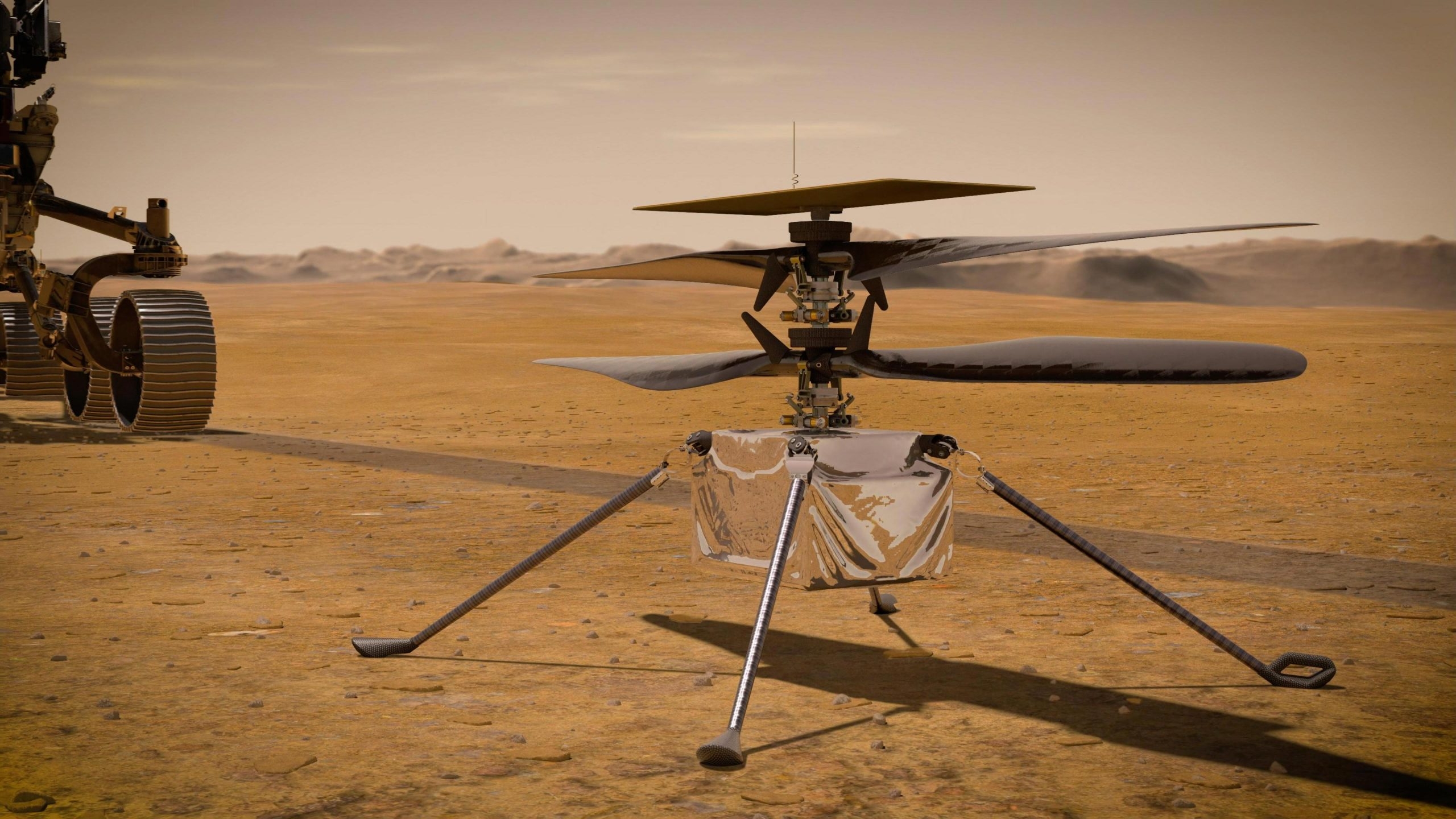
Illustration of Artwork of Ingenuity helicopter.
Credit: NASA/JPL-Caltech
NASA’s Martian helicopter has made its 34th flight – a short, low altitude hop – but a test of its get-up-and-go.
The 18 second flight and climb to 16 feet (5 meters) took place on November 23rd, during Sol 625 of the Perseverance rover’s wheeling across the Red Planet.
Flight 34 is a continuation of the handling quality testing of the aircraft.
New capabilities
According to NASA’s Jet Propulsion Laboratory, prior to this flight, lab specialists carried out a large-scale update of the Ingenuity software. “This update provides the aircraft with two major new features: crash prevention during landing and the use of digital elevation maps for easier navigation.”

This image acquired by Ingenuity Mars helicopter on Nov. 23, 2022 (Sol 625 of the Perseverance rover mission) and the date of Ingenuity’s 34th flight. Image taken using the vehicle’s navigation camera mounted in the helicopter’s fuselage and pointed directly downward to track the ground during flight.
Image credit: NASA/JPL-Caltech
The successful flight simply “popped up” to an assigned height, hovered, then landed.
“Over the past few weeks, the operations team has been at work installing a major software update aboard the helicopter,” explains Joshua Anderson, Ingenuity Mars Helicopter Operations Lead. “This update provides Ingenuity two major new capabilities: hazard avoidance when landing and the use of digital elevation maps to help navigate.”
Software update
Anderson explained in a website posting that Flight 34 may not seem like much, but it was Ingenuity’s first with this software update.
“The team will use results from this simple flight to start testing these new capabilities, ensuring that everything works as expected on the surface of Mars,” Anderson added. “The update brings out new functionality in Ingenuity, making it a far more capable vehicle and effective scout for Perseverance. We’re all excited to see where this update will allow us to take Ingenuity’s journey next!”

Jared Isaacman, mission commander for Polaris Dawn.
Image credit: Barbara David
The crewmembers of the Polaris Dawn mission are busily training for their orbital flight early next year, one that will see the first commercial spacewalk, as well as carry out studies on the long-term implications of microgravity and radiation on human health.
Polaris Dawn’s four-person team recently visited the University of Colorado, Boulder, detailing their flight with aerospace professors and students. The university’s BioServe Space Technologies center is orchestrating a set of investigations to perform on Polaris Dawn.

The Polaris Dawn crew (center) detail their upcoming flight with University of Colorado, Boulder students and faculty.
Image credit: Barbara David
In an exclusive SPACE.com interview, the Polaris Dawn crew outlined the meaningfulness of their private space voyage onboard their SpaceX Crew Dragon craft, targeted for liftoff no earlier than March 2023 from NASA’s Kennedy Space Center.
To read my new Space.com story — “Polaris Dawn crew prepares for world’s 1st private spacewalk with SpaceX” — go to:
https://www.space.com/polaris-dawn-crew-private-space-mission
Also go to this video: CU Boulder panel and Q&A with the Polaris Dawn crew members at:

Image credit: ESA – S. Corvaja
Among the European Space Agency’s “Acknowledges”, “Recognizes,” “Reaffirms,” “Stresses,” “Notes” “Decides,” “Having Regard to”, “Considers that,” “Welcomes” and “Underlines” from documents written for a just-concluded Ministerial meeting:
“Looking towards Mars exploration, and with strong backing from the science community, the decision was made to build a European lander to take the Rosalind Franklin rover to the surface of Mars to explore whether life existed in the ancient lakes of the red planet,” explains the European Space Agency (ESA).
ESA’s ExoMars rover had earlier been confirmed technically ready for launch, and a fast-track study was established to determine options for bringing the mission to Mars.

Image credit: ESA/Inside Outer Space screengrab
In a post-Ministerial Level press gaggle, ESA Director General Josef Aschbacher, said he was “very glad to say that we have found a very positive way forward.” ExoMars would be launched in 2028, he said.
Aschbacher also noted that NASA has indicated that they may contribute to the ExoMars mission, perhaps offering a launcher and assistance on getting the robot down on Mars.
Ukraine war
The ESA-led Rosalind Franklin rover’s 2022 launch window was no longer possible following the suspension of ESA cooperation with Russia’s Roscosmos due to Russia’s war with Ukraine.

ESA Exomars robot.
Credit: ESA
ExoMars 2022 mission was a joint ESA/Roscosmos project. In an ESA statement, due to the suspension of the 2022 launch, the Exomars elements were prepared for storage at a Thales Alenia Space site in Italy awaiting further instruction.
A fast-track industrial study was initiated to better define the available options for a way forward to implement the ExoMars rover mission in a future launch.

The Russian Kazachok platform was destined to land on the Red Planet as part of the ExoMars 2022 mission, shown here being shipped to Europe for final assembly and testing.
Credit: Roscosmos
Rebirth of the mission
At the time of that decision, David Parker, Director of Human and Robotic Exploration at ESA said: “I hope that our Member States will decide that this is not the end of ExoMars, but rather a rebirth of the mission, perhaps serving as a trigger to develop more European autonomy.”
Launch of the ExoMars 2022 mission had been slated for liftoff from Baikonur, Kazakhstan atop a Proton booster. A Roscosmos-led surface landing/science platform named “Kazachok” was to be utilized to safely plop the Rosalind Franklin rover down on the Red Planet.

