Archive for the ‘Space News’ Category

Credit: Mars Guy

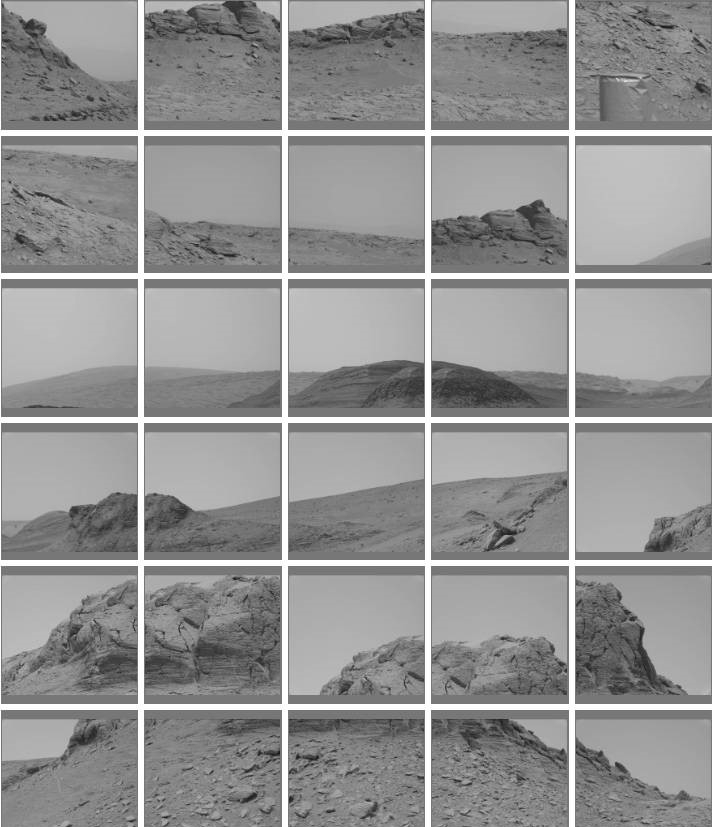
Two new episodes of Mars Guy flag new developments in NASA’s Perseverance rover exploration at Jezero Crater.

In one episode of Mars Guy, there’s a review of the fact that Perseverance has picked up unidentified foreign object debris.

Credit: Mars Guy

“Following another successful rock coring operation, a routine inspection of the hardware revealed hair-like objects in two places. Now the search is on to figure out what they are and if they jeopardize the mission,” explains Mars Guy, aka Steve Ruff, a planetary geologist with a focus on the mineralogy of Mars at Arizona State University in Tempe.

Credit: Mars Guy


Microbial activity?

In another episode, Ruff discusses the prospect that the Perseverance rover has inspected a rock coating that may be evidence of microbial activity.

Evidence of microbial activity?
Credit: Mars Guy


“Thin dark coatings known as desert varnish are common on rocks in arid regions on Earth and they’re thought to form in part from microbial activity,” Ruff explains. “Now, on Mars, the Perseverance rover has found similar coatings.”

Go to these episodes of Mars Guy at:

https://youtu.be/JpKEcJdywkw

https://youtu.be/tZawXhZys5s

Also, go to my related story for Space.com — “Probing the Red Planet: Finding past life at Jezero Crater” — at:

International Space Station
Credit: Roscosmos/NASA


Question: Where does an 800-pound gorilla sleep?” Answer: “Anywhere it wants to.”

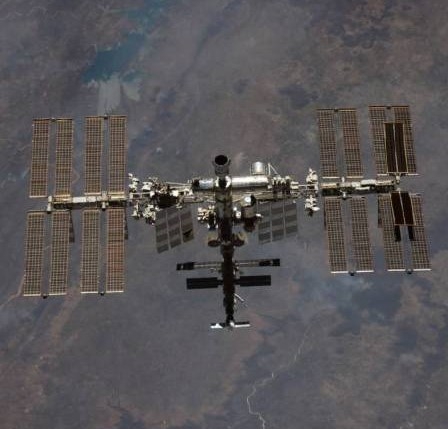
But in the case of the International Space Station, with a mass of approximately 450 tons (450,000 kilograms), it needs to be precisely put to sleep in an unpopulated stretch of ocean.

NASA has issued a Request for Information (RFI) to solicit responses from interested parties to gauge industry’s capabilities to provide deorbit capabilities for the ISS.

Credit: NASA/JSC


According to the August 19th RFI, at the completion of ISS operations, currently planned through 2030, the ISS must be safely deorbited via a controlled reentry into an unpopulated region.  “It is the responsibility of all ISS partners to ensure the safe deorbit and reentry of the ISS at its end-of-life,” the document explains.

Per ISS International Partner agreement and request, NASA is issuing the RFI to assess industry’s capability to design, develop, manufacture, launch, and provide the on-orbit operation to enable a controlled re-entry and the safe deorbit the ISS.

An example deorbit target zone is the South Pacific Ocean(ic) uninhabited area.

Credit: NASA/JSC

Wanted: deorbit vehicle

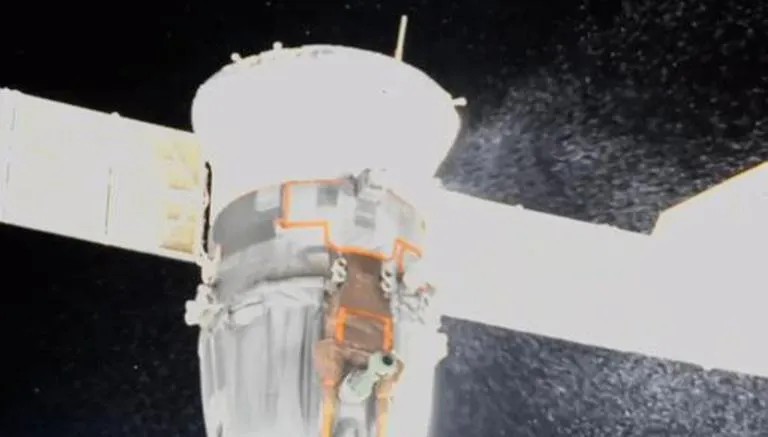
Labeling it a “deorbit vehicle,” this hardware is to attach (via docking or berthing) to the ISS at least one year prior to the planned ISS reentry date to enable adequate time for on-orbit tests and checkouts. 

The deorbit vehicle is to perform the final reentry burn resulting in a controlled reentry of the ISS within a pre-defined, uninhabited entry corridor. 

Although nominal ISS end-of-life is late 2030, the Government requires that this deorbit capability be available as soon as possible “to protect for contingencies that could drive early re-entry and beyond 2030 in the event of further ISS mission extensions,” the RFI notes.

The RFI response date is September 9, 2022 at 3:00 pm Central Daylight Time.

To read the entire RFI — International Space Station Deorbit Capability – go to the System for Award Management (SAM.gov), an official website of the U.S. Government, at:

https://sam.gov/opp/74252cfe7d49416abae0977fe4fd503c/view#description

Go to this related story — Incoming – Wet, Watery and Worrisome Graves for Spacecraft — at:

https://www.leonarddavid.com/incoming-wet-watery-and-worrisome-graves-for-spacecraft/


Shown here is a rendering of 13 candidate landing regions for Artemis III. Each region is approximately 9.3 by 9.3 miles (15 by 15 kilometers). A landing site is a location within those regions with an approximate 328-foot (100-meter) radius.
Credit: NASA

NASA has identified 13 candidate landing regions near the lunar South Pole.

Each region contains multiple potential landing sites for Artemis III, which will be the first of the Artemis missions to bring crew to the lunar surface, including the first woman to set foot on the Moon.

Details were presented in this NASA statement:

“Selecting these regions means we are one giant leap closer to returning humans to the Moon for the first time since Apollo,” said Mark Kirasich, deputy associate administrator for the Artemis Campaign Development Division at NASA Headquarters in Washington. “When we do, it will be unlike any mission that’s come before as astronauts venture into dark areas previously unexplored by humans and lay the groundwork for future long-term stays.”

Credit: Aerospace Corporation

Candidate regions

NASA identified the following candidate regions for an Artemis III lunar landing:

Faustini Rim A

Peak Near Shackleton

Connecting Ridge

Connecting Ridge Extension

de Gerlache Rim 1

de Gerlache Rim 2

de Gerlache-Kocher Massif

Haworth

Malapert Massif

Leibnitz Beta Plateau

Nobile Rim 1

Nobile Rim 2

Amundsen Rim

This image, taken by the advanced Moon Imaging Experiment (AMIE) on board ESA’s SMART-1 spacecraft, shows crater Shackleton on the Moon.
Credit: ESA

Diverse geologic features

“Each of these regions is located within six degrees of latitude of the lunar South Pole and, collectively, contain diverse geologic features. Together, the regions provide landing options for all potential Artemis III launch opportunities. Specific landing sites are tightly coupled to the timing of the launch window, so multiple regions ensure flexibility to launch throughout the year,” the NASA statement explains.

Other details include:

  • To select the regions, an agencywide team of scientists and engineers assessed the area near the lunar South Pole using data from NASA’s Lunar Reconnaissance Orbiter and decades of publications and lunar science findings.
  • In addition to considering launch window availability, the team evaluated regions based on their ability to accommodate a safe landing, using criteria including terrain slope, ease of communications with Earth, and lighting conditions.
  • To determine accessibility, the team also considered combined capabilities of the Space Launch System rocket, the Orion spacecraft, and the SpaceX-provided Starship human landing system.

Permanently shadowed regions

“All regions considered are scientifically significant because of their proximity to the lunar South Pole, which is an area that contains permanently shadowed regions rich in resources and in terrain unexplored by humans,” according to the NASA press statement.

In this multi-temporal illumination map of the lunar south pole, Shackleton crater (19 km diameter) is in the center, the south pole is located approximately at 9 o’clock on its rim. The map was created from images from the camera aboard the Lunar Reconnaissance Orbiter.
Credits: NASA/GSFC/Arizona State University

“Several of the proposed sites within the regions are located among some of the oldest parts of the Moon, and together with the permanently shadowed regions, provide the opportunity to learn about the history of the Moon through previously unstudied lunar materials,” said Sarah Noble, Artemis lunar science lead for NASA’s Planetary Science Division.

According to the NASA release, the analysis team weighed other landing criteria with specific Artemis III science objectives, including the goal to land close enough to a permanently shadowed region to allow crew to conduct a moonwalk, while limiting disturbance when landing. This will allow crew to collect samples and conduct scientific analysis in an uncompromised area, yielding important information about the depth, distribution, and composition of water ice that was confirmed at the Moon’s South Pole.

NASA’s Lunar Reconnaissance Orbiter flies over Shackleton crater near the lunar south pole in this computer rendering.
Credit: NASA’s Scientific Visualization Studio

Access to sunlight

“The team identified regions that can fulfill the moonwalk objective by ensuring proximity to permanently shadowed regions, and also factored in other lighting conditions,” reports NASA. “All 13 regions contain sites that provide continuous access to sunlight throughout a 6.5-day period – the planned duration of the Artemis III surface mission. Access to sunlight is critical for a long-term stay at the Moon because it provides a power source and minimizes temperature variations.

“Developing a blueprint for exploring the solar system means learning how to use resources that are available to us while also preserving their scientific integrity”, said Jacob Bleacher, chief exploration scientist for NASA. “Lunar water ice is valuable from a scientific perspective and also as a resource, because from it we can extract oxygen and hydrogen for life support systems and fuel.”

NASA adds that it will select sites within regions for Artemis III after it identifies the mission’s target launch dates, which dictate transfer trajectories and surface environment conditions.

For more information on lunar south pole sites, go to:

Setting Up a Moon Base – But Where?
https://www.leonarddavid.com/setting-up-a-moon-base-but-where/

Moon’s South Pole: Crowd Control Needed?
https://www.leonarddavid.com/moons-south-pole-crowd-control-needed/

New Study on Moon’s South Pole Water Ice
https://www.leonarddavid.com/new-study-on-moons-south-pole-water-ice/

Curiosity Left B Navigation Camera image taken on Sol 3567, August 19, 2022.
Credit: NASA/JPL-Caltech

The “road” through Paraitepuy pass continues to challenge the intrepid Curiosity rover, reports Abigail Fraeman, a planetary geologist at NASA’s Jet Propulsion Laboratory

“We attempted to cross another large sand ripple (formally called a transverse aeolian ridge, or TAR),” in a recent plan.

However, Curiosity had automatically stopped the drive when the rover’s wheels slipped more than expected right before they reached the crest of the TAR, Fraeman adds.

Curiosity Left B Navigation Camera image taken on Sol 3567, August 19, 2022.
Credit: NASA/JPL-Caltech

Unintended stops

“While unintended stops like this are frustrating, it’s comforting to know the rover is so capable of keeping itself safe,” Fraeman explains. Stopping the drive early is definitely better than trying to plow through and potentially embed the wheels deep into the sand!

A new plan called for the robot to back out and try again.

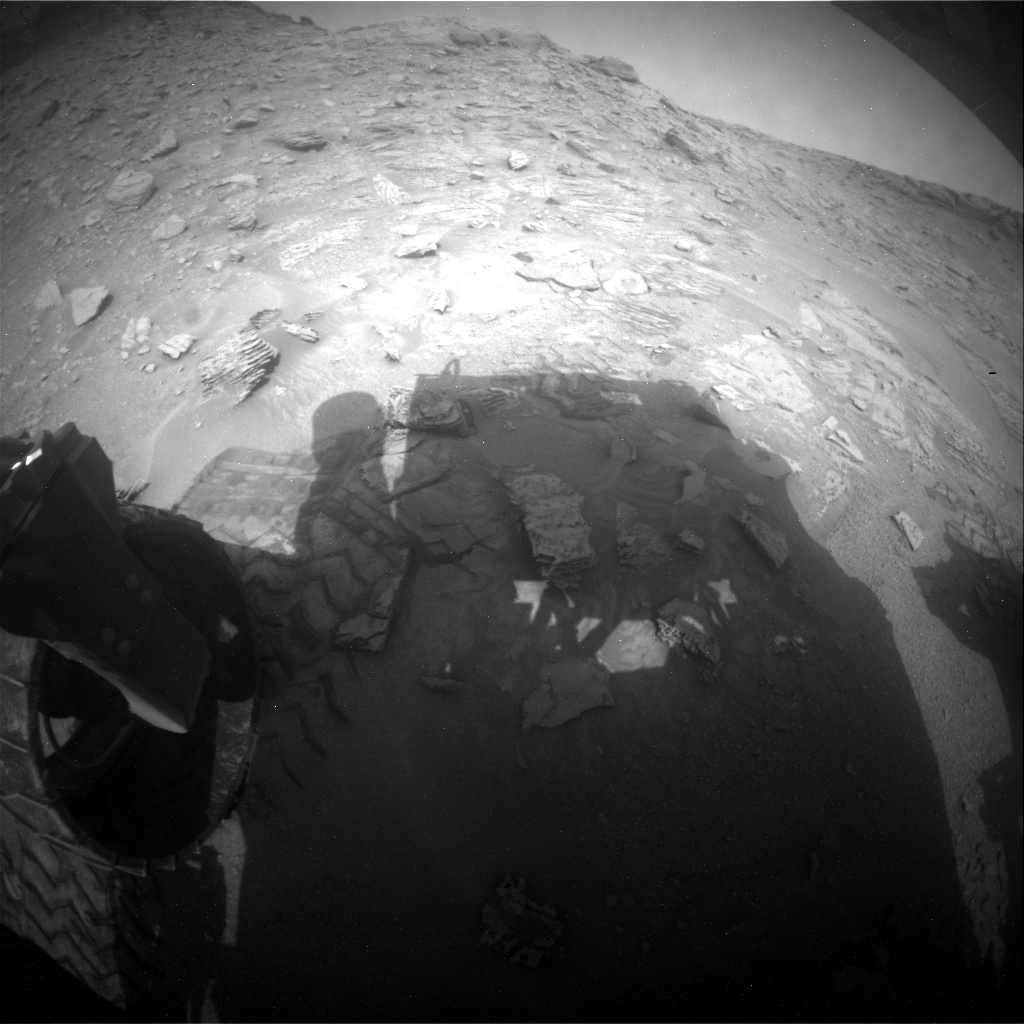
A large rock is another obstacle Curiosity will encounter right after crossing sand. Image taken by Front Hazard Avoidance Camera on Sol 3565 (August 17, 2022
Credit: NASA/JPL-Caltech

“Rather than crossing the TAR in the same place, we’re going to try crossing a few feet to the side, where the sand is shallower and therefore should be easier to cross,” Fraeman reports. “Unfortunately, there’s another obstacle we’ll encounter right after we cross at this new location, a large rock.”

Safe path

In order to navigate this tricky terrain, we’re planning to stop the drive after we cross the TAR but right before we reach the rock, just to make sure the rover is positioned exactly where we want and so that we’ll be in the best position to plan a safe path around,” Fraeman adds. “Paraitepuy pass is certainly testing our rover drivers, but I have complete confidence we’ll make it through soon!”

Curiosity Left B Navigation Camera image taken on Sol 3567, August 19, 2022.
Credit: NASA/JPL-Caltech

Since Curiosity stopped while trying to cross the TAR, researchers were greeted with another sand-filled workspace.

A newly scripted plan called for contact science with the Mars Hand Lens Imager (MAHLI) and the Alpha Particle X-Ray Spectrometer (APXS) on a single target, “Yupukari,” that’s along the crest of the bedform.

Curiosity Left B Navigation Camera image taken on Sol 3567, August 19, 2022.
Credit: NASA/JPL-Caltech

Float rock

That plan also slated the taking of remote sensing data, with a Chemistry and Camera (ChemCam) Laser Induced Breakdown Spectroscopy (LIBS) observation of targets “Makarapan,” a rock near the rover’s back wheel, and “Uaipan,” a different area along the crest of the TAR.

Curiosity Chemistry & Camera (ChemCam) Remote Micro-Imager (RMI) photo acquired on Sol 3567, August 19, 2022.
Credit: NASA/JPL-Caltech/LANL

Another long distance Remote Micro-Imager (RMI) mosaic will be taken of the mysterious marker band unit, and Mastcam observations of some bedrock behind the rover named “Maturuca,” a float rock in the sand named “Los Viejitos,” another distant rock named “Salgado,” and the rock the rover needs to drive around on Friday, named “Rera.”


“We’ll also capture additional imaging of the ‘Bolivar’ butte that we have been driving around for the last few sols. Environmental science observations will round out the plan,” Fraeman concludes.

Image traces a small segment of Curiosity’s path traversing obstacles that guard the pass – over one of the large ripples, around several large boulders – leading the robot to a point where it is nearly through the pass.
This image was taken by Left Navigation Camera on Sol 3564 August 16, 2022
Credit: NASA-JPL/Caltech

NASA’s Curiosity Mars rover at Gale Crater is now performing Sol 3566 duties.

Michelle Minitti, a planetary geologist at Framework in Silver Spring, Maryland, reports that the robot is imaging “the wonders around and ahead of us as we pick our way through ‘Paraitepuy Pass.’”

The towering buttes, geologic relationships, and layers at that location have drawn research attention for a literal decade.

Curiosity Left B Navigation Camera photo taken on Sol 3565, August 17, 2022.
Credit: NASA/JPL-Caltech

“But it is also fun to look back on how we got to where we are,” Minitti adds, as Curiosity traverses the obstacles that guard the pass – over one of the large ripples, around several large boulders, “leading us to a point where we are nearly through the pass.”

Curiosity Front Hazard Avoidance Camera Left B image acquired on Sol 3566, August 18, 2022.
Credit: NASA/JPL-Caltech

Ripple crossing

“I particularly enjoy seeing the choice of diverting the drive oh-so-close to the towering ‘Bolivar’ butte to our starboard side so our wheels could cross the (presumably!) shallowest part of the large ripple. It is great to see yet another successful ripple crossing, hearkening back to the first big one way back on Sol 535 at ‘Dingo Gap.’”

Before the rover crosses yet one more ripple, researchers planned imaging from the scale of vistas to small bedrock blocks.

Curiosity Right B Navigation Camera photo taken on Sol 3566, August 18, 2022.
Credit: NASA/JPL-Caltech

Rubbly ridge

On tap, the robot’s Chemistry and Camera (ChemCam) is to image the spectacular “Kukenan” butte, and team up with Mastcam to image an intriguing rubbly ridge extending from the north side of Bolivar.

Curiosity Mars Hand Lens Imager (MAHLI) photo produced on Sol 3566, August 18, 2022.
Credit: NASA/JPL-Caltech/MSSS

Curiosity’s Mastcam will add to the coverage of the “Orinoco” butte, and Bolivar butte with mosaics along its base including the “Karia Island” and “Ayanganna” targets.

“The interesting texture and color of the former target also made it a target for Mastcam multispectral analysis,” Minitti reports. “We will acquire one Mastcam image of ‘Antonio,’ the lone rock poking out of the ripple in front of the rover which has a lumpy texture.”

On the plan is use of the Dynamic Albedo of Neutrons (DAN) to make passive runs in parallel with all these geologic observations and punctuated by a DAN active post-drive.

Curiosity Left B Navigation Camera photo taken on Sol 3565, August 17, 2022.
Credit: NASA/JPL-Caltech

The Radiation Assessment Detector (RAD) and the Rover Environmental are slated to keep their regular tabs on our environment throughout the sol (Sol 3565), Minitti concludes.

Curiosity Right Navigation Camera Sol 3560
Credit: NASA/JPL-Caltech


NASA’s Curiosity Mars rover at Gale Crater is now performing Sol 3564 duties.

For the robot, it’s slow and steady does it, reports Catherine O’Connell-Cooper, a planetary geologist at University of New Brunswick Fredericton, New Brunswick, Canada.

“We are making slow but steady progress through the ‘Paraitepuy pass,’ having passed the approximate halfway point over the weekend,” O’Connell-Cooper adds.

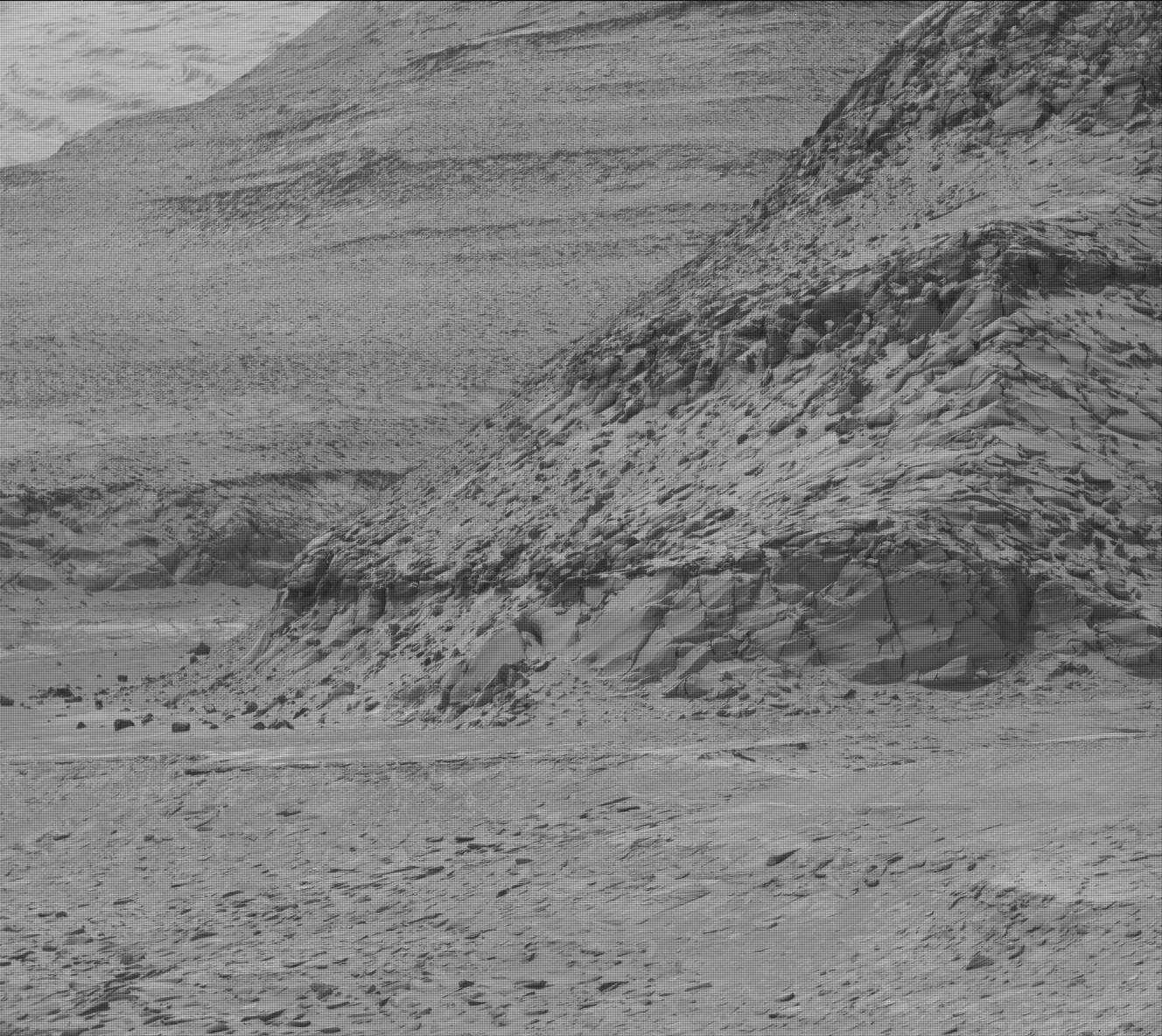
Curiosity Left Navigation Camera image showing Orninoco and Kukenán buttes. Image taken on Sol 3563, August 15, 2022. “Chenapua” is just visible on the right hand side of the image.
Credit: NASA/JPL-Caltech

Path forward

A recent one sol plan (Sol 3564) found researchers staring around the corner at the neck of the pass and considering a rover drive path forward.

“Sometimes, our drive forward is smooth and flat,” O’Connell-Cooper, notes, “neither word can be used here! Our drive forward has abundant sand and sharp rocks, so finding a safe path is providing our intrepid rover planners with some interesting times!”

Curiosity Front Hazard Avoidance Camera Right B image acquired on Sol 3564, August 16, 2022.
Credit: NASA/JPL-Caltech

A newly scripted planned drive is roughly 95 feet (29 meters).

Extraordinary view

O’Connell-Cooper points out: “The view from here is quite extraordinary — we are looking at several large buttes, which lie along the side of the pass and in front of us — and it is hard to resist the urge to photograph everything in sight, just like any tourist or traveler!”

Curiosity Right B Navigation Camera image taken on Sol 3564, August 16, 2022.
Credit: NASA/JPL-Caltech

Mastcam is hard at work again as a result, imaging the butte Orinoco and “Kukenán,” along with two mosaics on the Bolivar butte. Curiosity’s Chemistry and Camera (ChemCam) is using its long distance imager, the Remote Micro-Imager (RMI) to look at the butte “Chenapua.”

Curiosity Chemistry & Camera (ChemCam) Remote Micro-Imager (RMI) photo taken on Sol 3564, August 16, 2022.
Credit: NASA/JPL-Caltech/LANL

“We parked next to some sand in this plan, so we are spending time to look at grain sizes within the sand patch,” O’Connell-Cooper reports.

Curiosity Front Hazard Avoidance Camera Right B image acquired on Sol 3564, August 16, 2022.
Credit: NASA/JPL-Caltech

The robot’s Mastcam will image the nicely developed ripple crest (“Blackwater Creek”). The Mars Hand Lens Imager (MAHLI) target “Sand Creek” and the Mastcam target “Karowrieng” look at the flanks, away from the ripple crest.

Curiosity Left B Navigation Camera image acquired on Sol 3564, August 16, 2022.
Credit: NASA/JPL-Caltech

Intriguing sand flow patterns

This sandy patch has a few float (i.e., loose on the surface) rocks in it, O’Connell-Cooper reports.

MAHLI will analyze “Nascente,” which is a small rock in the middle of the sand patch, right in front of the rover.

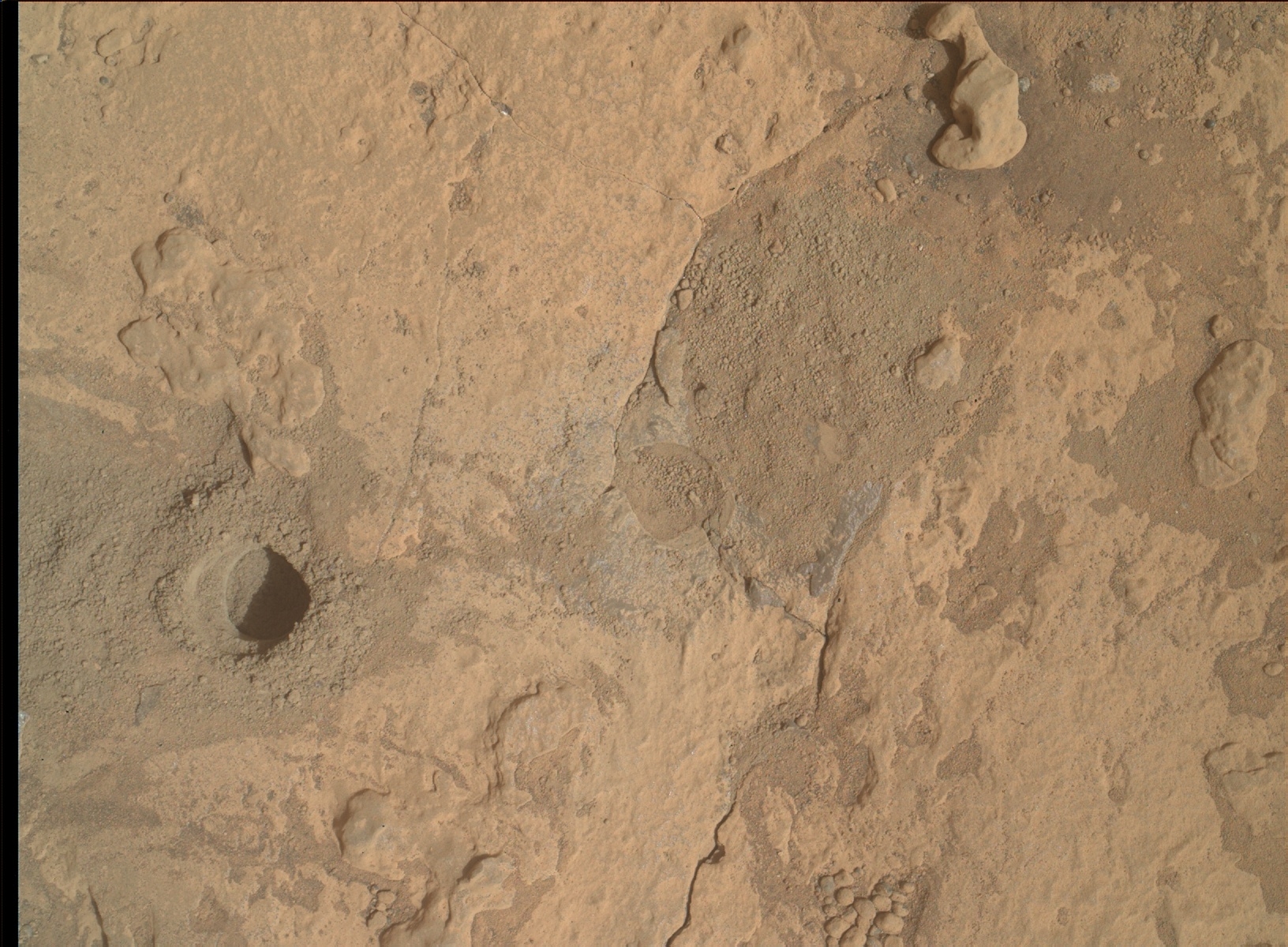
Curiosity Mars Hand Lens Imager (MAHLI) photo produced on Sol 3564, August 16, 2022.
Credit: NASA/JPL-Caltech/MSSS

Curiosity Mars Hand Lens Imager (MAHLI) photo produced on Sol 3564, August 16, 2022.
Credit: NASA/JPL-Caltech/MSSS

Curiosity Mars Hand Lens Imager (MAHLI) photo produced on Sol 3564, August 16, 2022.
Credit: NASA/JPL-Caltech/MSSS

Mastcam is imaging a large float rock “Plantain Island,” off to the left of the rover, and the float “Pairuwa Islands” within the sand patch, which has some intriguing sand flow patterns.

Mars researchers can compare these float targets to the bedrock ChemCam . Laser Induced Breakdown Spectroscopy (LIBS) target “Corocito” – this may help them determine the origin of the float rocks.

“Once our imaging and contact science is complete here today, we will move forward, picking our way along the pass, O’Connell-Cooper concludes.

Curiosity’s location as of Sol 3563. Distance driven to this sol: 17.7 miles/28.49 kilometers.
Credit: NASA/JPL-Caltech/Univ. of Arizona

Artemis I Rollout: August 16, 2022
Credit: NASA/Joel Kowsky

The rollout of NASA’s powerful Space Launch System, topped by the Orion capsule, is crawling testament to the space agency’s ambitious plan to “reboot” the Moon, and then push humans onward to Mars.

On this moonward and momentous occasion, I’m reminded of that quip during coverage by Chet Huntley/David Brinkley of a roaring Saturn V liftoff that it was hard to tell if the rocket was going up…or Florida was going down.

A projected 100,000 people are reportedly showing up to get an eye-full of the Space Launch System’s (SLS) ascension into Florida skies.

Long and winding road

For sure, it has been a long and winding road, and not without a lot of high-tech, dollar-fueled political hullabaloo.

Meanwhile, in the space community of chit-chat, there are those that rail against the SLS and even wish that this giant of a booster falls flat on its tail section at liftoff.

Personally, I can’t think of a Space Age time when there were those wishing NASA to fail.

Artist concept of NASA’s Space Launch System (SLS) 70-metric-ton configuration launching to space. SLS will be the most powerful rocket ever built for deep space missions, including to Mars.
Credit: NASA

For those hopeful for an SLS/Artemis 1 malfunction, a default position is reliance on Elon Musk and his Starship enterprise.

I asked several leading space policy experts to help scrutinize what’s afoot here.

Waste of money

“I don’t think it’s about ‘wanting NASA to fail.’ It’s about anger at NASA being forced to fail by Congress…because being forced to use SLS is another dead-end approach,” says Rand Simberg, an analyst and consultant in space policy, technology, and business.

From Simberg’s point of view, it’s infuriation at the waste of money. “It makes me angry as a taxpayer, but it makes me even angrier as a space enthusiast, that NASA is being forced by Congress to waste money on something that is not needed to get back to the Moon. It will be just as unsustainable as Apollo was, for the same reasons, while lying to us about how we can’t get back to the Moon without it, and all the while not spending money on things we actually do need to get back to the Moon in a sustainable way,” he adds.

Au natural: Earth’s Moon as seen from the International Space Station.
Credit: NASA/ESA

What SLS opponents want, such as Simberg, is for NASA to be allowed to get back to the Moon in a sustainable and scalable way, without Congress being involved in the design of the architecture, and this implies that neither SLS or Orion are necessary, he suggests.

“It should simply be allowed to purchase transportation services from the private sector, just as it is doing to get to and from low Earth orbit. Selecting Starship for the lander program was a good start, but the logical conclusion is that SpaceX should be used for all phases of the trip, and not just the landing,” believes Simberg.

“Using 1970s technology to send a handful of astronauts to the Moon a few times, at best, in this decade, at billions of dollars per flight,” Simberg concludes, “is a pathetic lack of vision compared to what the billionaires want to do, and will do.”

Illustration of NASA astronauts on the lunar south pole carrying out early work to establish an Artemis Base Camp. Will placing Artemis astronauts on the moon become a stepping stone to a sustained presence on Earth’s celestial next door neighbor? Credit: NASA

Trust in government

Space history expert, Roger Launius of Launius Historical Services, portrays SLS as no small part a reflection of a larger situation. And that is the U.S. Public trust in government in decline since the Nixon administration.

Launius spotlights public trust in government polling from 1958-2022 by the Pew Research Center that shows trust in government has been below 40 percent when asked the question if Washington would do what is right “just about always” or “most of the time” since the 1970s, and in the 21st century it has declined precipitously to the low 20th percentiles, he says.

“Conversely, there is a belief, buttressed by talking points from one of the major parties that has embraced neoliberalism, that the private sector may be relied on to accomplish all that is necessary,” Launius told Inside Outer Space. “Of course, it doesn’t help that NASA’s SLS program has been expensive and has yet to show much in the way of results,” he points out.

SpaceX Starship human lander design to carry NASA astronauts to the surface of the Moon under the Artemis program.
Credit: SpaceX

Shiny new thing

“I don’t think people want NASA to fail in the sense that SLS blows up. They just want SLS to go away because they think it’s a dinosaur and Starship is the shiny new thing,” responds Marcia Smith, Founder and Editor of Space Policy Online.

Critics skip over the fact that Starship didn’t exist when SLS began, Smith points out. “There was no SLS versus Starship contest. It was SLS or no “Moon rocket” at all because President Obama had just killed Ares V. Falcon 9 barely existed then, never mind Starship. It had one test flight in 2010, the year Congress directed NASA to build SLS. Demonstrating reusability was 7 years in the future.”

Smith adds that SLS critics talk as though Starship is an alternative to SLS right now. “Starship hasn’t flown either. And they ignore the fact that Starship can’t get to the Moon directly like SLS. It has to stop for fuel in Earth orbit at a fuel depot that doesn’t exist yet,” she explains.

“I think the antagonism to SLS is mostly from people who think Musk has all the answers,” says Smith. “They overlook Starship’s own schedule delays, cheerfully excusing Musk’s over-optimism…not to mention the lack of transparency about how much Starship costs. There are no budget requests to Congress to keep track. No NASA Inspector General or Government Accountability Office reports.”

Credit: NASA

Up in flames?

How can SLS costs be compared to Starship when Starship data is proprietary, questions Smith.

“One hopes it’s not as eye-poppingly expensive as SLS, but only Musk and his inner circle know,” Smith says. “How much did each of those Starship prototype failures cost? Musk supporters cheered when they blew up because he’s taking risks, but would they feel the same if it was their tax dollars going up in flames?”

It will be interesting to see if any attitudes change now that Musk is using $3 billion of our tax dollars for Starship development, Smith adds. “Small compared to the billions for SLS, but still a lot of money.”

Smith gives Musk a lot of credit for thanking NASA at every opportunity he gets for having faith in him and funding SpaceX especially in those difficult early years.

“It seems a lot of people don’t realize how much taxpayer money he’s gotten through NASA for development of Falcon, Dragon, and now the Human Landing System and in-space propellant transfer. Why his supporters often seem contemptuous of NASA is a mystery to me,” Smith says.

Having said all that, NASA doesn’t do itself any favors with unending cost overruns and schedule delays. And they certainly are behind the times when it comes to reusability, Smith adds.

NASA leaders have often said it is ‘and, not or’ SLS and Starship, and other new rockets, too, like Vulcan and Blue Origin’s New Glenn launcher, Smith concludes. “It is not one or the other. All of them will be needed to support sustainable lunar and Mars exploration. I think that’s right.”

Credit: NASA

Giant boondoggles

“I am rooting for NASA to succeed,” says Howard Bloom, founder and chair of the Space Development Steering Committee. “But its focus on the SLS and Orion has been killing NASA’s manned and womanned space program.”

In Bloom’s view, the SLS and Orion are giant boondoggles for the space military industrial complex. “A single launch of the SLS and Orion will cost $4.1 billion. For that price, you could buy as many as 2,000 launches of Elon Musk’s Starship.  You could take 200,000 people to space,” he says.

The SLS is being advertised as the rocket that will return Americans to the Moon, Bloom notes.

“But the SLS and Orion can’t land on the Moon…they can simply orbit it and watch the Chinese and Russians build their research station where it counts, down below on the Moon’s surface. And even this Moon-gazing privilege will be for roughly three passengers. SpaceX’s starship can carry 100 passengers in luxury, can land on the Moon’s surface, then can take off and come back to Earth again…all things the SLS and Orion can’t do,” says Bloom.

NASA has to stop wasting $3 billion a year on a “frankenrocket,” buy launch services from private industry, Bloom suggests, and create the cargos the Starship and its competitors can take to destinations in space, 100 ton payloads in the case of the Starship, he says.

Credit: Aerospace Corporation


Bloom says that there’s desperate need to develop space infrastructure: Moon and Mars bases, construction equipment, robotic mining equipment for water, and on-the-spot hardware to turn lunar or Martian water into breathable oxygen and drinkable water. We need to make human homes on the Moon and Mars permanent.

“NASA could do that with the $3 billion it is wasting each year on the SLS and Orion…wasting on a rocket that can’t even land on the Moon, Mars, or back down here on Earth,” Bloom concludes.

Juicy target

Space historian John Logsdon is Professor Emeritus at George Washington University’s Elliott School of International Affairs, where he was the founder and long-time director of GW’s Space Policy Institute. As for people hating the SLS, he can’t recall any space project that has generated that kind of emotion.

As for why, Logsdon suggests because “it is the epitome of the old style of doing things.”

“SLS was forced on NASA leadership by the Congress, reflecting the views of the heritage, traditional aerospace contractors and NASA workforce.  All of that makes it a very juicy target for those that think the old way of doing business is wrong. It’s a way of bringing together a lot of critics of NASA focused on one thing,” Logsdon says.

Artemis 1 flight profile.
Credit: NASA

“We have never before had an alternative like the SpaceX Starship Heavy launcher to rally around. But it hasn’t worked yet. In the Artemis architecture, NASA is using the Starship upper stage for the lunar lander. It requires 5-6 launches to get enough fuel in the thing to operate. Kind of crazy,” Logsdon adds. “SLS may be far from ideal, but it’s about to be rolled out to the launch pad and hopefully is basically ready to go. To say ‘don’t do that’ and wait for Starship Heavy instead, too me, that doesn’t make sense. I think it’s prudent to take what you’ve got, not what you wish you had.”

The Artemis architecture, based on SLS, Orion, and Starship as the Moon lander, Logsdon feels that in an ideal world it’s not the way to reignite a humans-on-the Moon-and-beyond effort.

“But it is there and we’re pretty well down that route,” Logsdon adds. “The consequences of backing off now, if America cancels SLS, the thought of immediately transferring funds to Starship, I don’t think NASA would be allowed to do that. For the initial return to the Moon, it’s the Artemis architecture or nothing,” he feels.

Credit: China National Space Administration (CNSA)/China Media Group(CMG)/China Central Television (CCTV)/Inside Outer Space screengrab

China’s Shenzhou-14 astronauts are readying hardware for a spacewalk, venturing out of the in-construction space station through the airlock cabin of the Wentian lab module for the first time.

The Wentian module was launched and docked with the Tianhe core module of China’s space station in July.

This lab module functions both as a backup of the core module and as a scientific experiment platform. The Wentian module, the largest and heaviest spacecraft China ever launched, is nearly 60 feet long (17.9 meters) and has a maximum diameter of 13.8 (4.2 meters).

Shenzhou-14 crew enters new lab module. Credit: China National Space Administration (CNSA)/China Media Group(CMG)/China Central Television (CCTV)/Inside Outer Space screengrab

Outfitted module

Wentian consists of a work cabin, an airlock cabin and a resource cabin. In the work cabin, there are three sleeping areas and one sanitary area. The Wentian module is also outfitted with a small, flexible mechanical arm can perform precision operations, and flexible solar wings, which can provide sufficient energy for the operation of the space station.

The Shenzhou-14 crew consists of Chen Dong, Liu Yang, and Cai Xuzhe. The taikonaut trio has stayed in orbit for 70 days as of Saturday since they were sent into space in June.

The current composition of China’s space station is formed by the Tianhe core module, the Wentian lab module, the Shenzhou-14 spaceship and the Tianzhou-4 cargo craft.

A video is available at: https://youtu.be/pEv7fJdwW0Q

Credit: CCTV/Inside Outer Space screengrab

China Manned Space Agency on Friday published a video that gives a glimpse at the space life of Chinese astronauts aboard the country’s space station, showing how the crew are performing scientific tasks and working out to keep fit in the Wentian lab module.

First spacewalk for this crew coming up! Go to video at: https://youtu.be/310j0Rcw3Xo

Credit: White House/Inside Outer Space screengrab

Commercial space
 
Remarks by Vice President Harris on Supporting the Commercial Space Sector at the Chabot Space and Science Center, Oakland, California – August 12th.
 
The Vice President discusses a partnership between regulatory agencies and the private sector.
 
Go to written text at:
 

Curiosity Left B Navigation Camera image acquired on Sol 3560, August 12, 2022.
Credit: NASA/JPL-Caltech


NASA’s Curiosity Mars rover at Gale Crater is now performing Sol 3561 duties.

Curiosity is continuing to press on through Paraitepuy Pass reports Alex Innanen, an atmospheric scientist at York University; Toronto, Ontario, Canada.

“The terrain continues to be tricky, with lots of sand and rocks…and the rover planners are working hard to determine the best and safest way forward,” Innanen adds. “In between carefully creeping along, we’re pausing to take in the views – by which I mean do a lot of science!”

Curiosity Front Hazard Avoidance Camera Right B image taken on Sol 3560, August 12, 2022.
Credit: NASA/JPL-Caltech

Best path

Before the robot departs its current location, researchers have packed in a whole host of observations. These start with Chemistry and Camera (ChemCam) on the nearby Dust Removal Tool (DRT) target “Annai,” and two Remote Micro-Imager (RMI) mosaics looking further afield at the lower part of “Kukenan” and the marker band near the top of “Deepdale.”

Curiosity Chemistry & Camera Remote Micro-Imager (RMI) photo taken on Sol 3560, August 11, 2022.
Credit: NASA/JPL-Caltech/LANL

Curiosity Chemistry & Camera Remote Micro-Imager (RMI) photo taken on Sol 3560, August 11, 2022.
Credit: NASA/JPL-Caltech/LANL

Curiosity’s Mastcam is also documenting Annai, as well as looking at the side of Deepdale in order to study the processes of its formation, Innanen explains. To round out a recent morning of imaging, Mars Hand Lens Imager (MAHLI) is getting up close with two targets, Annai and “Mirizal.”

The plan called for finishing a recent sol with a drive and post-drive imaging to help find the best path onwards, Innanen notes.

Curiosity Front Hazard Avoidance Camera Right B image taken on Sol 3560, August 12, 2022.
Credit: NASA/JPL-Caltech

Extra-long targeted movie

The plan for the current sol (3561) was relatively calm in comparison, with a ChemCam Autonomous Exploration for Gathering Increased Science (AEGIS) – using a software suite that permits the rover to autonomously detect and prioritize targets.

Curiosity Left B Navigation Camera image acquired on Sol 3560, August 12, 2022.
Credit: NASA/JPL-Caltech

As always, on the plan is keeping tabs on the environment of Gale Crater not only with the Rover Environmental Monitoring Station (REMS) and Dynamic Albedo of Neutrons (DAN) instruments, which maintain their standard monitoring, but also with some observations of dust and clouds.

Curiosity Mars Hand Lens Imager photo produced on Sol 3560, August 12, 2022.
Credit: NASA/JPL-Caltech/MSSS

“We have a suprahorizon movie, looking just above the horizon for clouds, followed by a line of sight and basic tau to measure atmospheric dust. We are also casting a wide net in hopes of spotting dust devils, with a 360 degree survey and extra-long targeted movie,” Innanen concludes.

Curiosity Left B Navigation Camera image acquired on Sol 3560, August 12, 2022.
Credit: NASA/JPL-Caltech

Dates of planned rover activities described in these reports are subject to change due to a variety of factors related to the Martian environment, communication relays and rover status.

Curiosity Left B Navigation Camera image acquired on Sol 3560, August 12, 2022.
Credit: NASA/JPL-Caltech

Curiosity Right B Navigation Camera image taken on Sol 3560, August 12, 2022.
Credit: NASA/JPL-Caltech

Curiosity Right B Navigation Camera image taken on Sol 3560, August 12, 2022.
Credit: NASA/JPL-Caltech