Archive for the ‘Space News’ Category
 Author:
  January 8th, 2023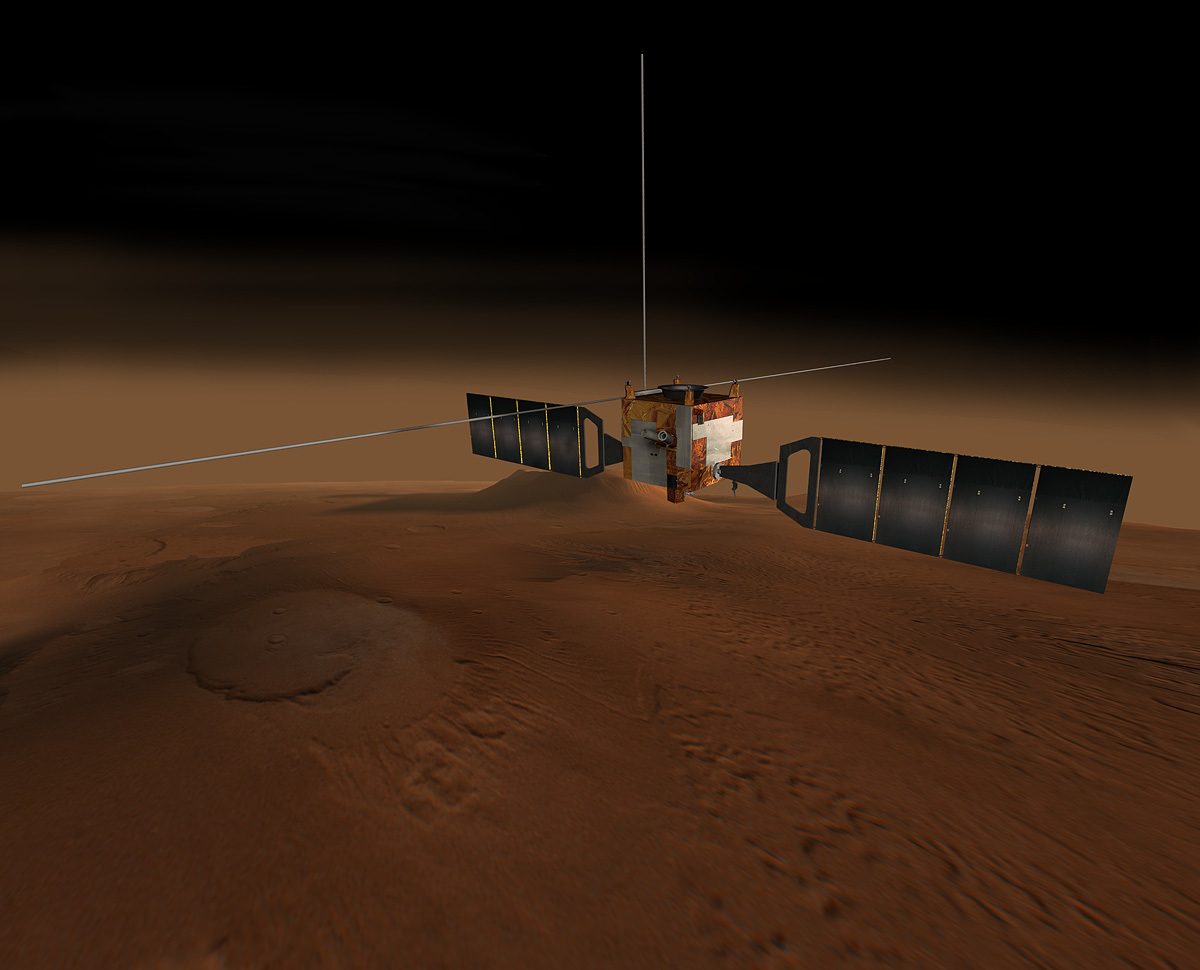
Image credit: ESA
Red Planet researchers that have benefited by the European Space Agency’s Mars Express orbiter are advocating extending the spacecraft’s mission, a probe launched back in June 2003.
The Mars Express team is soliciting the support of the global scientific community for a mission extension. That orbiter’s work in progress is to end in March of this year.
The final decision on any new extension will be made at the European Space Agency’s (ESA) Science Program Committee meeting on March 7-8th.

The Red Planet as seen by Europe’s Mars Express.
Credit: ESA/D. O’Donnell – CC BY-SA IGO
Accomplishments
“We invite all planetary scientists, astrobiologists, astrophysicists, and engineers interested in Mars science to show their support,” notes a Mars Express team statement.
There’s a long list of Mars Express accomplishments to date, such as:
- First detection of hydrated minerals at the surface, which has firmly established that Mars harbored once conditions conducive to the emergence of life;
- The characterization and mapping of water ice on the surface and deep below it, data that has helped decipher the recent evolution of Mars’ climate and the internal layering of the planet’s polar ice caps;
- A new vision of the Martian atmosphere, with the first annual survey of ozone;
- The first detection of methane whose presence defies our understanding of chemistry on Mars;
- A first comprehensive survey of the plasma surrounding the planet.
Uniquely equipped
Mars Express (MEx) “remains uniquely equipped to cover a broad spectrum of disciplines and feed Mars’community at large. Over time, MEx has come to serve as a backbone for planetary science in Europe; by fostering, and then retaining the expertise and knowledge for the new generation of scientists and engineers who carry ESA’s future in planetary exploration,” the communiqué adds.

Europe’s ExoMars 2020 rover.
Credit: ESA
Furthermore, keeping MEx on the fly would help support the European community that is now engaged in getting ESA’s ExoMars spacecraft off and onto the surface of Mars, as well as ESA’s key role in Mars Sample Return activities.
An ESA review has established that the Mars Express orbiter can operate for at least six more years.
More work to do
A new extension period would, for example, allow identifying and characterizing Oxia Planum, the landing site of the ExoMars rover.
“Stopping MEx in 2023 would not only weaken ESA’s role in exploring Mars, it would also weaken the long-term effort of the scientific community to solve the outstanding questions the Red planet still poses to us,” the support solicitation letter concludes.
To date, over 500 researchers have signed up to support the Mars Express extension. That document can be found at:
https://docs.google.com/document/d/1KrNKkFV6uNv3tvfln-tirmgkkPq6DfNICitBROeVGBQ/edit
 Posted in

Image credit: Virgin Orbit
Start Me Up is the first launch of Virgin Orbit’s LauncherOne rocket from the United Kingdom – the firm’s first mission outside the United States – departing Spaceport Cornwall at Cornwall Airport Newquay.
The mission will be livestreamed on Virgin Orbit’s YouTube channel on Monday, January 9th
The Start Me Up launch window officially opens Monday, Jan. 9 at 2:16pm PT/22:16 UTC.
Virgin Orbit is backed by entrepreneur Richard Branson. The aircraft, Cosmic Girl, carries LauncherOne skyward under the plane’s left wing – and then released. This will be the first ever orbital launch from the UK, and the fifth operational mission for Virgin Orbit, and the sixth overall flight of LauncherOne.

Image credit: Virgin Orbit
Manifestly yours
The Start Me Up manifest includes:
IOD-3 AMBER – Developed by Satellite Applications Catapult (“SA Catapult”) and Horizon Technologies and built by AAC Clyde Space, all based in the U.K. IOD-3 Amber is expected to be the first of more than 20 Amber satellites to provide space-based Maritime Domain Awareness (MDA) data to users.
Prometheus-2 – Two cubesats owned by the U.K. Ministry of Defense’s (MOD) Defense Science & Technology Laboratory Dstl. These satellites, co-funded with Airbus Defence and Space who are designing them jointly with In-Space Missions, will support MOD science and technology (S&T) activities both in orbit and on the ground through the development of ground systems focused at Dstl’s site near Portsmouth.
CIRCE (Coordinated Ionospheric Reconstruction CubeSat Experiment) – CIRCE is part of a joint mission between the U.K.’s Defense Science and Technology Laboratory and the U.S. Naval Research Laboratory (NRL).
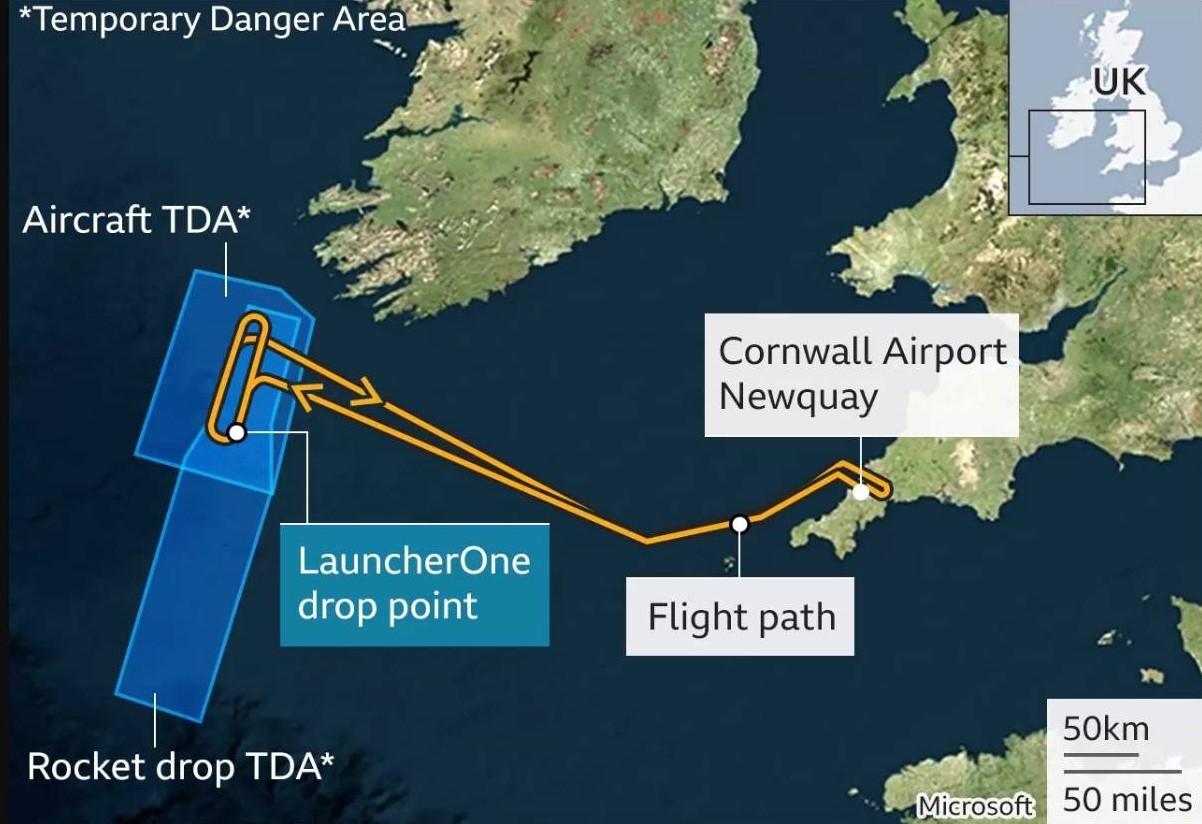
Image credit: Virgin Orbit
DOVER – Developed by RHEA Group in the UK, it is the company’s first satellite in its 30-year history. The satellite is being co-funded through the European Space Agency’s (ESA) Navigation Program (NAVISP) and built by Open Cosmos of the United Kingdom. DOVER is a SmallSat that was created as a pathfinder for resilient global navigation satellite systems.
ForgeStar-0 – Developed by Space Forge of Wales, the satellite is a fully returnable and reusable platform to enable in-space manufacturing. This launch will be the first for the company’s ForgeStar platform and will test future returns from space technology.
AMAN – Oman’s first orbital mission, it is a single earth observation satellite meant to demonstrate the future feasibility of a larger constellation and was developed after a memorandum of understanding among the Sultanate of Oman, Polish Small Satellite manufacturer and operator SatRev, Poland-originated AI data analytics specialists TUATARA, and Omani-based merging technology innovator ETCO. The agreement includes additional planned small satellites, including this, the first in Oman’s history.
STORK-6 – Stork-6 is the next installment of Polish Small Satellite manufacturer and operator SatRev’s STORK constellation. Virgin Orbit previously launched two spacecraft in this constellation on a previous launch and looks forward to continuing to launch SatRev’s STORK spacecraft in the future.

Image courtesy: Virgin Orbit
According to Virgin Orbit, “Start Me Up” is so named as a newspace nod to the Rolling Stones, the iconic British rock and roll band. Their hit song debuted on the 1981 album Tattoo You and was later released on the Forty Licks compilation by Virgin Records in 2002.
Flight details
For more details on this flight, go to:
https://drive.google.com/file/d/1lEUcwgIKUHeorVZuADvtrBr2szAqWxDF/view
An overview video is available at:
https://www.youtube.com/watch?v=O_NV_cgDiFE
For live coverage of launch, go to:

Artist’s concept of NASA’s Ingenuity Mars Helicopter flying through the Red Planet’s skies. Credit: NASA/JPL-Caltech
NASA’s Ingenuity Mars helicopter chalked up some new stats at Jezero Crater, flying above the Red Planet on its 38th flight.
On this trek the micro-device flew on January 4, 2023, reaching a horizontal distance of roughly 364 feet and approximately 33 feet in altitude. Overall, the flight lasted 74.3 seconds.
Here’s what happens when Ingenuity picks where to land. Go to Mars Guy at: https://youtu.be/NAPK8UM8-eM

Image credit: Mars Guy
New imagery from the flight has been posted by NASA/Jet Propulsion Laboratory:

Helicopter acquired this image using its high-resolution color camera mounted in the helicopter’s fuselage and pointed approximately 22 degrees below the horizon. This image was acquired on Jan. 5, 2023, the date of Ingenuity’s 38th flight.
Image credit: NASA/JPL-Caltech

Mars helicopter acquired these images using its navigation camera mounted in the helicopter’s fuselage and pointed directly downward to track the ground during flight. This image was acquired on Jan. 5, 2023, the date of Ingenuity’s 38th flight.
Image credit: NASA/JPL-Caltech
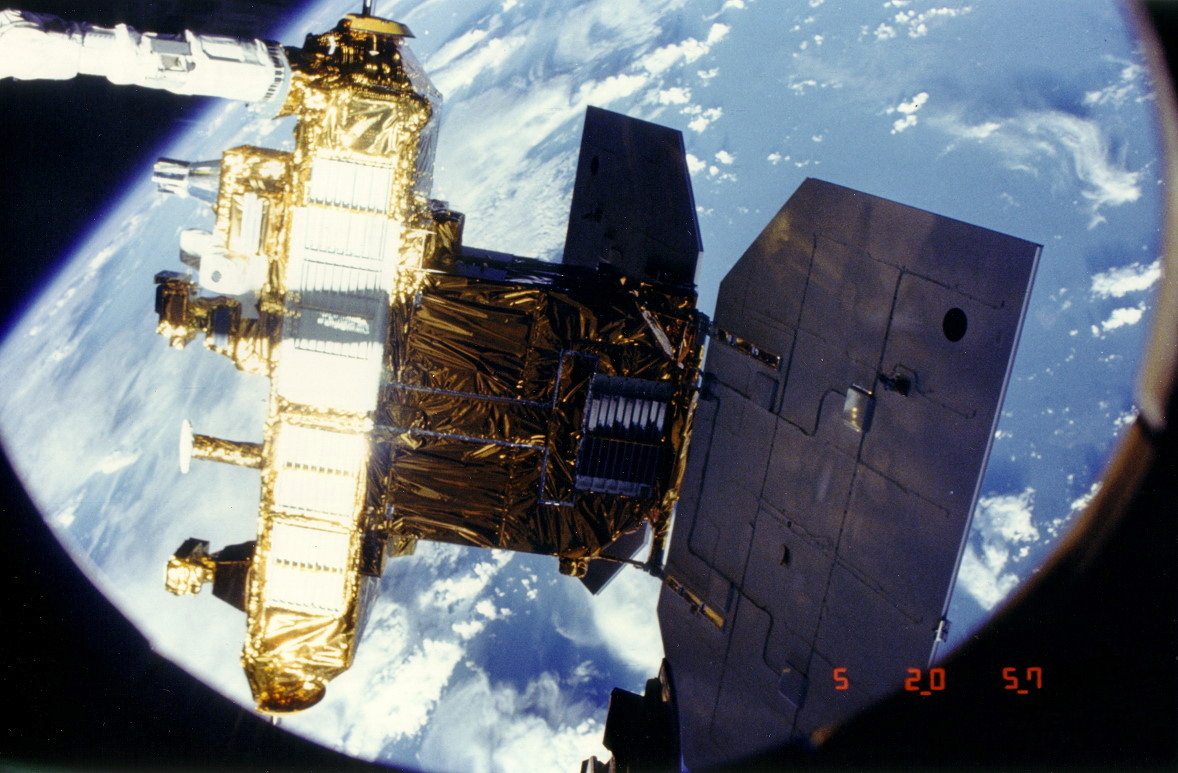
Deployed during 1984 space shuttle mission, NASA’s Earth Radiation Budget Experiment (ERBS) spacecraft is making an uncontrolled death dive into the atmosphere.
Image credit: NASA
NASA’s Earth Radiation Budget Experiment (ERBS) spacecraft is nearing its uncontrolled death plunge into the atmosphere.
Weighing in at nearly 2.5 tons (2,449 kilograms), NASA expects most of the satellite to “burn up” as it dives through the atmosphere.
However, some components are expected to survive the reentry. The space agency’s risk of harm stats for anyone on Earth is approximately 1 in 9,400.
Mitigation guidelines
The hefty ERBS satellite was the first spacecraft to be launched and deployed by a NASA space shuttle mission, back in early October 1984. For 21 years the ERBS studies how the Earth absorbed and radiated energy from the Sun, and made measurements of stratospheric ozone, water vapor, nitrogen dioxide, and aerosols.

Image credit: NASA
In 2002, the spacecraft’s perigee (low point to Earth) was lowered to ensure that the vehicle would naturally decay within 25 years after its end of mission, in compliance with NASA and then national orbital debris mitigation guidelines.
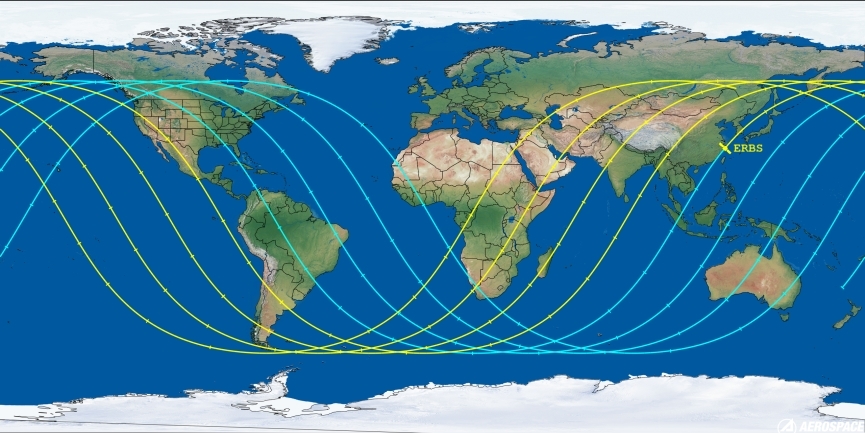
Yellow Icon – location of object at midpoint of reentry window
Blue Line – ground track uncertainty prior to middle of the reentry window (ticks at 5-minute intervals)
Yellow Line – ground track uncertainty after middle of the reentry window (ticks at 5-minute intervals)
Pink Icon (if applicable) – vicinity of eyewitness sighting or recovered debris
Note: Possible reentry locations lie anywhere along the blue and yellow ground track. Areas not under the line are not exposed to the debris.
Image credit: CORDS
Orbit lowering
In 2005, as part of that ERBS decommissioning process, all residual propellants were expended during a two-month interval. The spacecraft’s orbit lowering was deemed “fortuitous” as ERBS’s propulsion system had further degraded and was no longer capable of such a maneuver.
According to the Aerospace Corporation’s Center for Orbital and Reentry Debris Studies (CORDS), the ERBS nosedive to Earth is predicted to be January 9, plus or minus a handful of hours.
To keep an eye on the incoming spacecraft, go to:
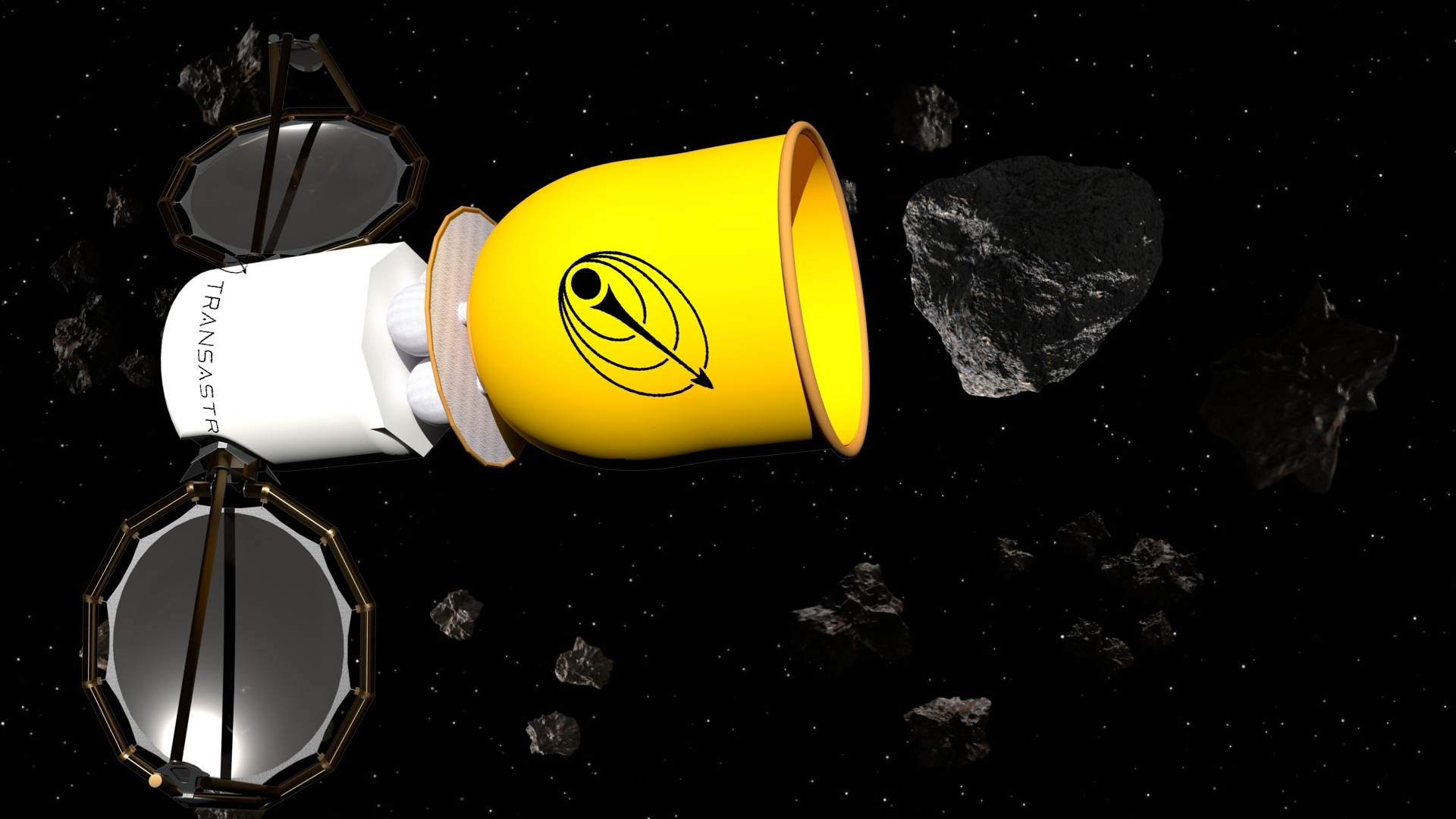
Worker Bee hardware on first asteroid mining flight mission.
Image credit: TransAstra
A cash flow cascading from the heavens is a provisionary but promising harvest from asteroid mining. It’s already a “claim jumping” enterprise with assertions that billions, trillions, even quadrillions of dollars are looming in deep space, ripe for the picking and up for grabs.
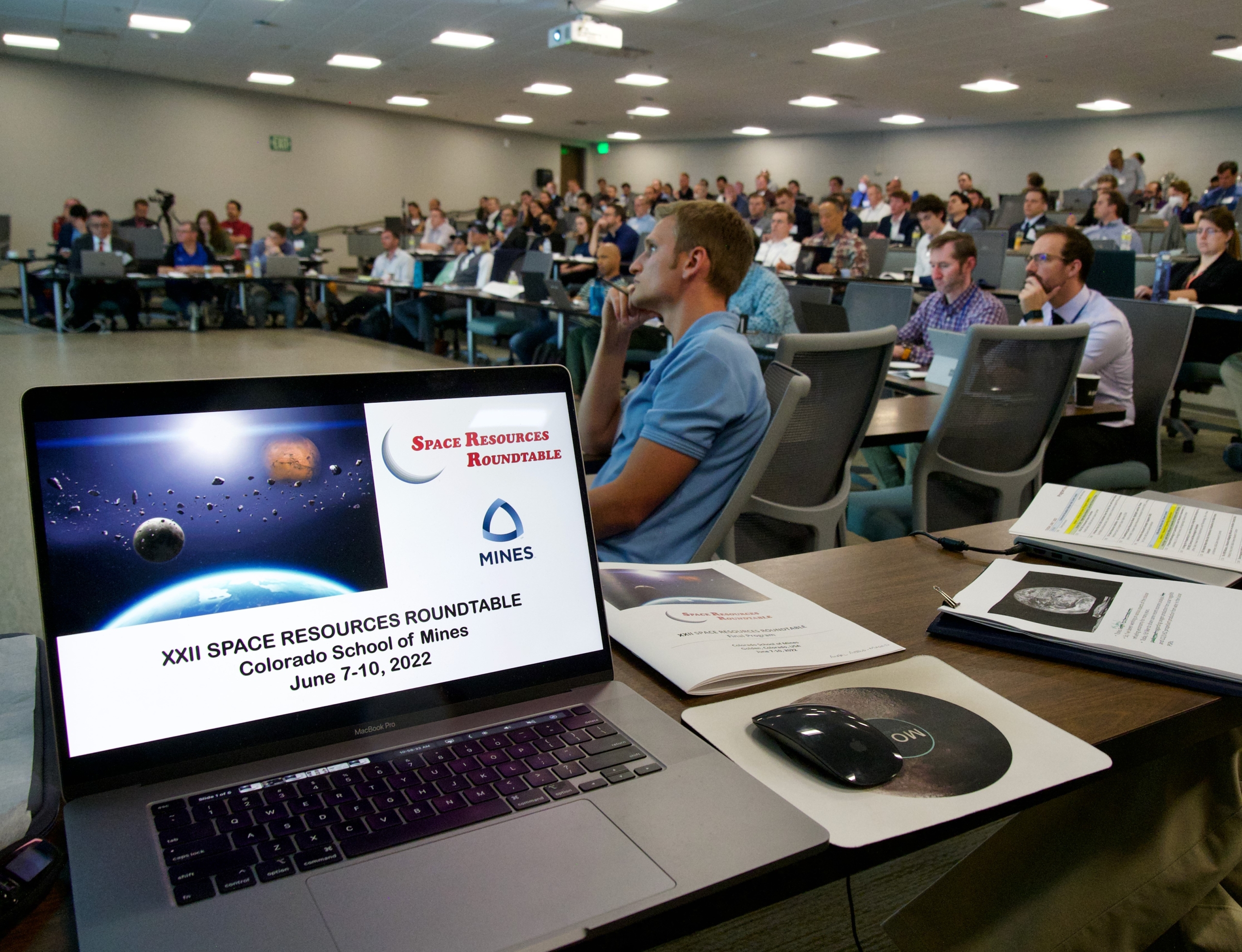
Experts gather at the Colorado School of Mines to attend a space resources roundtable, drawing together scientists, engineers, entrepreneurs, mining and minerals industry specialists, legal experts, and policy makers.
Image credit: Colorado School of Mines
Several space mining groups, eager to dig into extraterrestrial excavation of asteroids, have already come and gone. Left behind are torn, tattered and beleaguered business plans.
Gobs of moolah?
The past, however, is prologue. But this time, step-by-step strategies are being fielded. By and large, the prospect of reaping gobs of moolah from off-Earth mining has become a tempered affair.
For more details, go to my new Space.com story – “Space mining startups see a rich future on asteroids and the moon – Nobody wants to think about a future in which humans don’t thrive. So it’s time for us to go into space” at:

Work is progressing on scoping out a Moon-based radio telescope.
A Lunar Crater Radio Telescope (LCRT) on the lunar farside, currently funded by the NASA Innovative Advanced Concepts (NIAC) program, is a proposed nearly 1,150 feet (350 meter) in diameter reflecting telescope on the farside of the Moon.
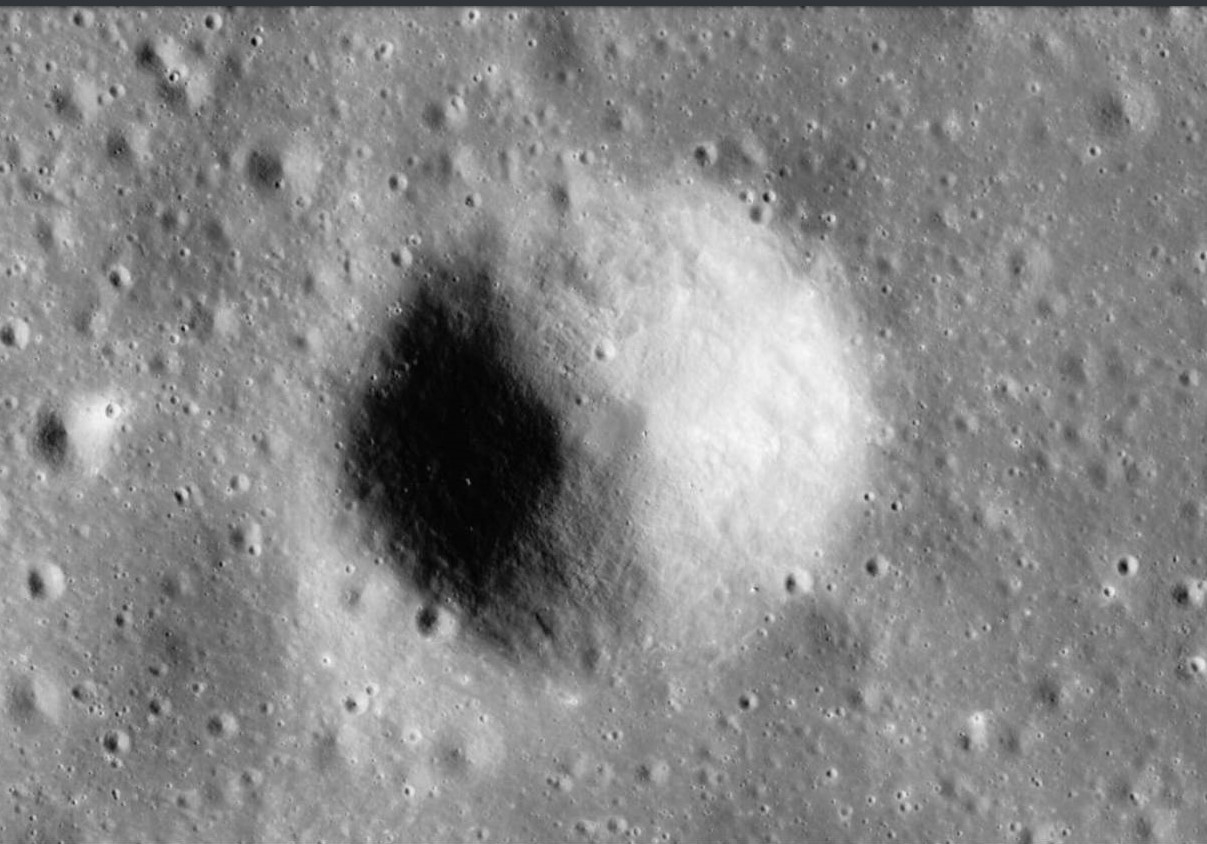
Candidate farside observatory site.
Image credit: NASA/Saptarshi Bandyopadhyay
Cosmology duties
As foreseen by Saptarshi Bandyopadhyay of NASA/Jet Propulsion Laboratory and colleagues, this off-world facility — perhaps installed by Artemis crew members — would enable scientific discoveries in the field of Dark Ages cosmology by observing the early Universe in a wavelength band that has not been explored by humans to date.
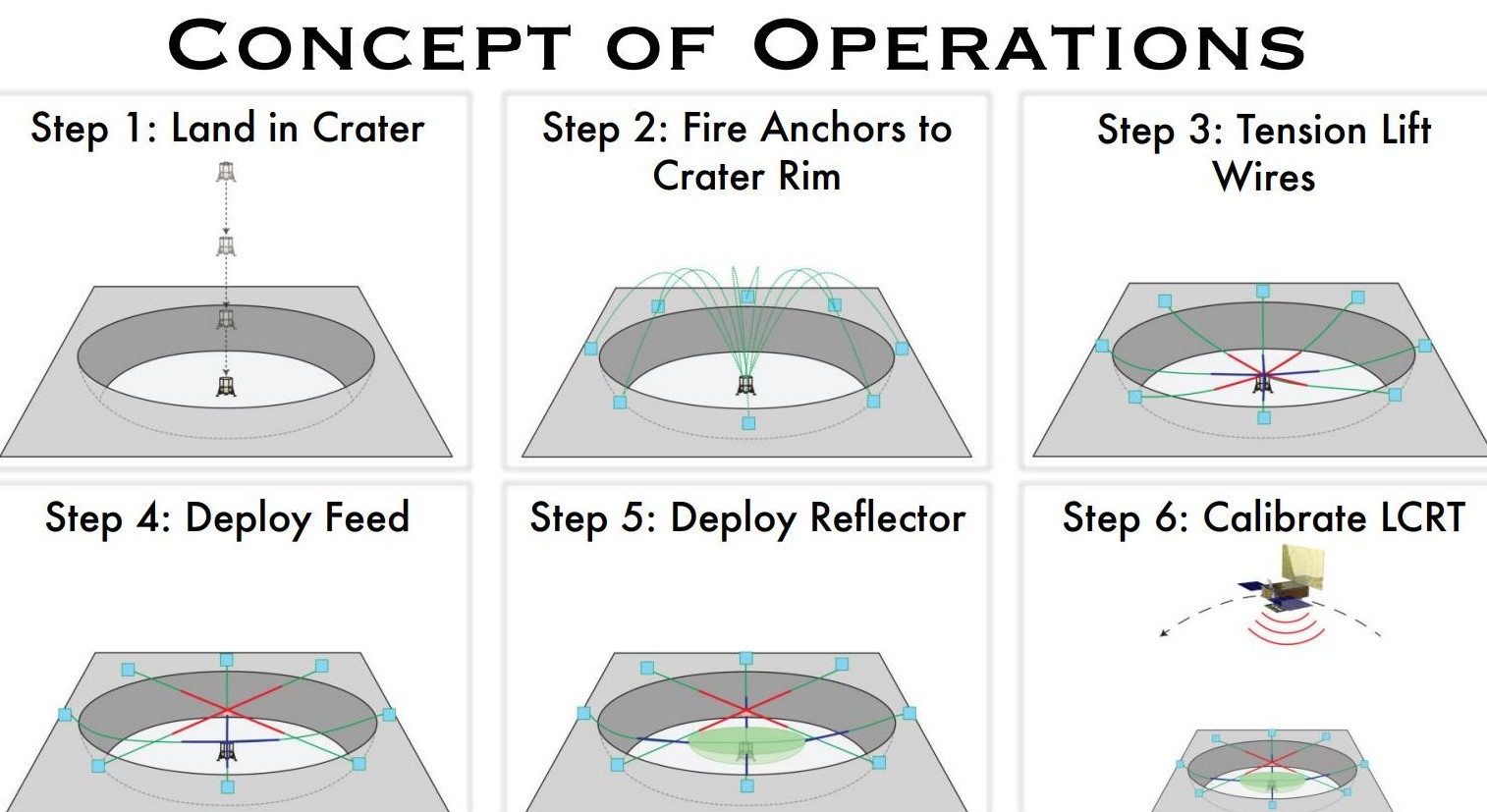
Image credit: Saptarshi Bandyopadhyay
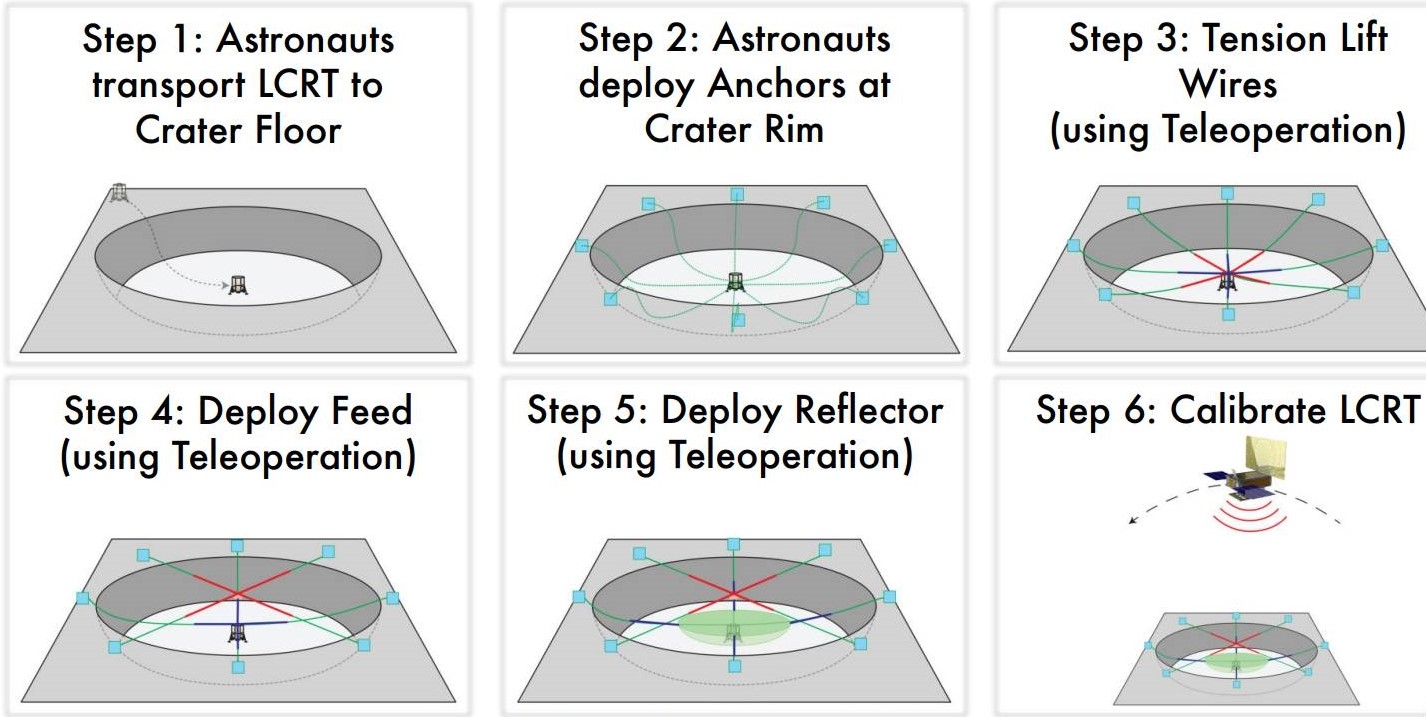
Image credit: Saptarshi Bandyopadhyay
Special thanks to the Future In-Space Operations (FISO) group for spotlighting this work-in-progress.

Solar Cruiser’s sail is a whopping 17,800 square feet in size. Shown here is a recent unfurling of one quadrant (a test article) of Solar Cruiser’s huge sail.
Image credit: NASA/Marshall Space Flight Center
Solar sailing has been a slow-motion affair, but the concept is meant to be just that!
The idea is not to use classic and conventional “gas guzzling” propulsion. Rather, the notion is to employ ever-present and energetic solar photons to nudge you through space. Over time, this steady thrust from sunlight can move the spacecraft to very high speeds.

Last picture show. The Planetary Society’s publicly-funded LightSail 2 spacecraft returned this final image on October 24, 2022 before atmospheric reentry.
Image credit: The Planetary Society
Promising attributes
Harnessing this technology, now being pursued by multiple nations, is anticipated to permit a low-cost pathway to matchless exploration of the outer solar system and interstellar space.
Advocacy aside, the promising attributes of the scheme has been a work-in-progress for many years – and sometimes it hasn’t been smooth sailing.
For more information, got to my new Space.com story – “Solar-sailing probes may soon get their moment in the sun” – at:
https://www.space.com/solar-sail-spacecraft-development-progress

Curiosity’s location as of Sol 3700. Distance driven at that time: 18.16 miles/29.23 kilometers
Image credit: NASA/JPL-Caltech/Univ. of Arizona
NASA’s Curiosity Mars rover at Gale Crater is now performing Sol 3702 duties.
Reports Lucy Thompson, a planetary geologist at the University of New Brunswick; Fredericton, New Brunswick, Canada: “The team came into our first day of planning for 2023 to learn that all our holiday activities had executed as expected!”

Curiosity Sol 3700 Front Hazcam image showing rover’s current workspace, the thin, resistant Marker band outcrop in top right of the image and the buttes ahead to the south. Image credit: NASA/JPL-Caltech
Thompson notes that, as Curiosity ages, Mars researchers are thankful that the robot continues to do amazing science on Mars, and the holiday plans were no exception.
Dark fragments
“We finished up our investigations at the Marker band (for now anyway), analyzed bright material revealed in a scuff just below the Marker band and drove to the south to continue our climb of Mount Sharp,” Thompson adds.

Curiosity Right B Navigation Camera image acquired on Sol 3701, January 3, 2023.
Image credit: NASA/JPL-Caltech
Curiosity’s recent view of its surroundings reveal dusty, in place bedrock with dark fragments scattered over the surface, which do not appear to be in place.

Curiosity Mast Camera Left image taken on Sol 3700, January 2, 2023.
Image credit: NASA/JPL-Caltech/MSSS
“These dark fragments may be pieces of the Marker band or they may be associated with the in place bedrock just to the right of the rover,” Thompson points out. “Our activities are focused on documenting the chemistry, texture and context of the rocks in front of the rover, as well as looking further afield at the Marker band as it extends south, and the surrounding and distant buttes.”

Curiosity Left B Navigation Camera image taken on Sol 3701, January 3, 2023.
Credit: NASA/JPL-Caltech
Bedrock chemistry
The rover’s Chemistry and Camera (ChemCam) is analyzing two targets (“Uafaranda” and “Aliquelau”) with the Laser Induced Breakdown Spectroscopy (LIBS) to document the chemistry of the bedrock at different distances from the nearby, overlying Marker band.

Curiosity Mars Hand Lens Imager photo produced on Sol 3700, January 2, 2023.
Image credit: NASA/JPL-Caltech/MSSS
“Do we see a change in the composition of the underlying bedrock as we get closer to the Marker band that might indicate alteration associated with the contact? To complement these observations, we are also investigating the “Uafaranda” bedrock target, after brushing to remove the ubiquitous dust cover, with APXS (chemistry) and MAHLI (close-up imaging).”

Curiosity Left B Navigation Camera photo acquired on Sol 3700, January 2, 2023.
Image credit: NASA/JPL-Caltech
Look for lateral changes
The Alpha Particle X-Ray Spectrometer (APXS) and the Mars Hand Lens Imager (MAHLI) will also be used to examine the composition and texture of one of the dark-toned rocks (“Anarem”) that are strewn across the surface.
“This might help us determine the origin of these rocks. We are also documenting all three of these targets with Mastcam, as well as some nearby regolith-filled troughs (“Aoiau” and “Arraia”),” Thompson adds.

Curiosity Left B Navigation Camera photo acquired on Sol 3700, January 2, 2023.
Image credit: NASA/JPL-Caltech
“We will image the Marker band at this location with Mastcam to look for lateral changes in its texture and structure relative to our previous locations, and some nearby buttes (“Alto Alegre”) for context with the surrounding terrain,” Thompson explains.
ChemCam long distance Remote Micro-Imager (RMI) mosaics will also be acquired of sections of two other buttes off in the distance.

Curiosity Left B Navigation Camera photo acquired on Sol 3700, January 2, 2023.
Image credit: NASA/JPL-Caltech
Southward
On the second sol of a 3-sol [Sols 3702-3704] New Year plan, Thompson reports that researchers hope to continue the robot’s path south by roughly 165-feet (50 meters) to fully document the terrain below Curiosity, and any transitions that may occur as the rover drives. A Mars Descent Imager (MARDI) photo is planned for after the drive.

Curiosity Front Hazard Avoidance Left B Camera image taken on Sol 3700, January 2, 2023.
Image credit: NASA/JPL-Caltech
The environmental science team was also busy and planned several observations to continue monitoring changes in atmospheric conditions, Thompson notes. These include: a Navcam large dust devil survey, a dust devil movie and suprahorizon movie, and a Mastcam basic tau observation.
Standard Rover Environmental Monitoring Station (REMS), Dynamic Albedo of Neutrons (DAN) and Radiation Assessment Detector (RAD) activities round out this plan.
As always, dates of planned rover activities described in these reports are subject to change due to a variety of factors related to the Martian environment, communication relays and rover status.

Image credit: Caltech/Space Solar Power Project
Updated: Momentus established contact with its Vigoride vehicle on its first orbital pass and confirmed that both solar arrays are deployed, and the vehicle is generating power and charging its batteries. Priorities for this flight include hosting Caltech’s Space-based Solar Power Project payload, deploying a satellite with the Qosmosys Zeus-1 payload, and testing Vigoride’s performance in space, including its Microwave Electrothermal Thruster (MET) system.

Image credit: Momentus
Today’s SpaceX Falcon 9 launch of over a 100 payloads includes prototype gear of the Caltech Space Solar Power Project (SSPP).
The payload was successfully deployed. Given an operational status, this Space Solar Power Demonstrator will evaluate key components of how best to harvest solar power in space and beam that energy back to Earth.
According to Caltech, a Momentus Vigoride Orbital Service Vehicle onboard the SpaceX rocket on the Transporter-6 mission carried the 110-pound (50-kilogram) prototype solar power tech demo to space.

DOLCE portion of the Space Solar Power Demonstrator is lowered onto the Vigoride spacecraft built by Momentus.
Image credit: Caltech/Space Solar Power Project
Main experiments
It consists of three main experiments, a Caltech statement explains, each tasked with testing a different key technology of the initiative:
- DOLCE (Deployable on-Orbit ultraLight Composite Experiment): A structure measuring 6 feet by 6 feet that demonstrates the architecture, packaging scheme and deployment mechanisms of the modular spacecraft that would eventually make up a kilometer-scale constellation forming a power station;
- ALBA: A collection of 22 different types of photovoltaic cells, to enable an assessment of the types of cells that are the most effective in the punishing environment of space;
- MAPLE (Microwave Array for Power-transfer Low-orbit Experiment): An array of flexible lightweight microwave power transmitters with precise timing control focusing the power selectively on two different receivers to demonstrate wireless power transmission at distance in space.

A flexible prototype antenna sheet for Caltech’s power transmitter array. Each orange square on the yellow tile is an antenna driven by a single transmitter.
Credit: Lance Hayashida/Caltech
An additional fourth component of the solar power demo is a box of electronics that interfaces with the Momentus Vigoride spacecraft computer and controls the three experiments.
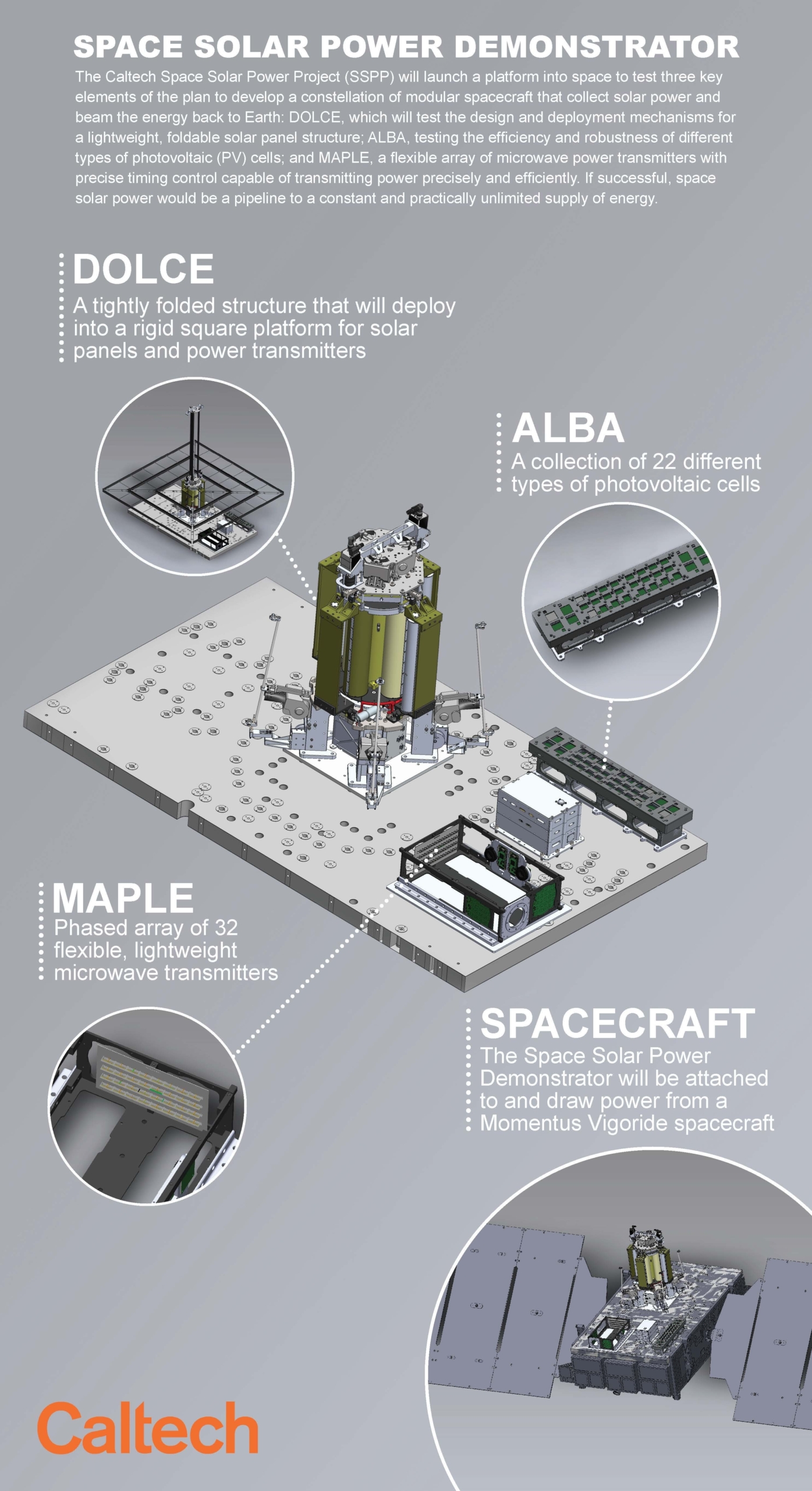
Image credit: Caltech/Space Solar Power Project
Go to this animated look at Caltech’s Space Solar Power Demonstrator at:

Wait a Minute!
A recent item caught my eye.
Late last month, the ocean-going cruise ship – Viking Orion – was not permitted to pull into dock in Australia.
Over 800 ocean goers have been stranded offshore for nearly a week due to “biofoul” – a condition in which marine growth, a fungus, was carried on the Viking Orion’s hull.
An Australian fisheries department labeled it a “potentially harmful” fungus. The worry was that by introducing this invasive species into a new habitat, that organism could hamper the local biological species thriving in the area.

Image credit: Viking Cruises
Ship-shape steps have been taken by Viking Cruises, although it’s not clear when passengers will set foot back on land.
But more to the point – a space exploration point of view about hauling back samples from Mars.
Extraterrestrial goodies
Now in the works is the multi-nation, multi-billion dollar Mars Sample Return (MSR) campaign – a “cache and carry” project for the 2030’s to haul to Earth select specimens of Red Planet soil, rock and atmosphere.

Newly revised Mars Sample Return campaign makes use of a set of machines, including use of helicopters, to collect Martian soil, rock and atmospheric specimens for return to Earth.
Image Credit: NASA/JPL-Caltech
The plan is for the Mars samples – roughly a pound of extraterrestrial goodies — to be plopped into the Utah Test and Training Range (UTTR) in west-central Utah.
The MSR campaign team is developing specific transportation, storage, and curation protocols for the Mars samples, including transportation from the UTTR point of recovery to the yet-to-be-determined site of an MSR sample receiving facility.
Public comment
For its part, NASA recently posted for public comment a draft MSR “Programmatic Environmental Impact Statement” or PEIS for short. A 45-day public comment period began on November 4, 2022 and ended on December 19, 2022.

Proposed Utah landing zone (red ellipse) for the Mars sample return mission.
Image credit: NASA
As a result, the PEIS spurred nearly 75 comments.
There’s a mixed bag of support for rocketing back Mars collectibles to our planetary home, and a goodly number of those comments urged not bringing samples back to our home base before testing or studying them on Mars itself.
Others responded by being supportive of using an off-Earth lab, perhaps on the International Space Station, to use “protocols similar to ones described in the Andromeda Strain, minus the nuclear device.”
Another comment remarks: “The arrogance of scientists thinking their containment system is unbreakable reminds me of how the Titanic was supposedly unsinkable. The difference is that at least the Titanic had some lifeboats when it sank; the Earth has none.”

The Andromeda Strain – the 1971 movie, but how real for a 21st century return to Earth of Mars samples?
Credit: Universal Pictures
Miniscule risk
On the other hand, there were those supportive of the MSR endeavor.
“Risk is so small it is not worth it to go about this in a different way that wouldn’t be incredibly expensive. The entire point of this mission is to get the samples back to our state of the art labs, not some makeshift lab in LEO or cis-lunar space,” wrote one commenter.
“I am good with the miniscule risk in the name of science,” continued the person’s remark, “for anything to go wrong there would A) need to be dangerous live pathogens B) could interact with us and C) need to get through all containment protocols. The chances of all that happening is one tick above zero, we have found no life on Mars so the idea these samples would contain dangerous life that can infect species from another planet (Earth) is a bit absurd. Let’s go get them!”

Image credit: NASA/PEIS
Ongoing work
Chiming in on the draft environmental impact statement is the United States Environmental Protection Agency (EPA).
“Based on the review of the draft PEIS, EPA did not identify significant environmental concerns to be addressed in the Final EIS,” the December 7, 2022 EPA comment explains.
However, the EPA does note that the draft PEIS references in multiple places that studies regarding burnup/breakup, atmospheric release, contingency planning, and the possibility that Mars material will be distributed outside of the landing site radius are ongoing, and actions to recover MSR Earth Entry System (EES) fragments, if it is damaged upon reentry and landing, are still being worked.

Perseverance rover deposits select rock and soil samples in sealed tubes on Mars’s surface for future missions to retrieve and bring back to Earth for detailed study.
NASA/JPL-Caltech
Ship-to-shore signal?
In summary, observes the EPA, more work is to be done.
“We welcome the opportunity to discuss appropriate response authorities with NASA and are available to assist with additional information if required,” the EPA communiqué to NASA concludes.
In the meantime, NASA’s Perseverance rover is busy at work on Mars, scouting about for primo samples that are being cached for eventual pick-up and delivery to Earth-situated labs for intensive scientific inquiry.
Harkening back to the good ship Viking Orion, one wonders whether there’s a strong ship-to-shore signal.
What’s your view?
For more information on the Mars Sample Return and environmental impact comments/studies, go to:
https://www.nasa.gov/feature/nepa-mars-sample-return-campaign/

