Archive for the ‘Space News’ Category
 Author:
  January 31st, 2023
Image credit: NASA
Taking a whiz on Mars, it’s a must-do for future Red Planet crews.
But doing so turns out to be good for on-the-spot cultivation of food to help sustain the extraterrestrial experience.
A new study suggests the possibility of using a blend of astronaut urine and Mars regolith to grow cyanobacterium called Synechococcus nidulans.
“We chose to investigate Synechococcus nidulans because it is an extremophile cyanobacterium capable of adapting to extreme environments such [as] the ones taking place on Mars,” explains Alessandro Concas of the Department of Mechanical, Chemical and Materials Engineering at the University of Cagliari in Italy.
Concas is lead author of a paper – “Modeling and experimental assessment of Synechococcus nidulans cultivation using simulated Martian medium and astronauts’ urine” – set to appear in the journal, Acta Astronautica.

Planting life on Mars – future “Martians” set up habitats on the Red Planet.
Credit: NASA
Potential food source
Concas and colleagues report that, while efforts are being made to develop novel techniques to cultivate microalgae on Mars, “further research activity is needed to verify the possibility to use microalgae and cyanobacteria as potential food source” in the framework of human expeditions to Mars that rely on in-situ (living off the land) resource utilization (ISRU) technologies.
The research paper explains that, while urine could supply macronutrients such as phosphates and ammonium, “regolith leachate” could provide relevant micronutrients and in particular iron which is known to strongly affect the growth microalgae and cyanobacteria.
Nutritional characteristics
The investigators also make note of the nutritional characteristics of the biomass produced using the selected growth media were investigated for the first time.
“The experimental results have been interpreted by a mathematical model that allows the identification of the set of operating conditions to maximize the biomass, and thus food productivity,” the research team explains.

Starships on Mars.
Credit: SpaceX
The team investigated the capability of the autotrophic strain Chrococcidiopsis sp. CCMEE 029 to tolerate perchlorate salts that are typically found top-side on the Red Planet.
Edible biomass
The results of the research show that the growth of this strain was not affected by Mars-relevant concentrations of Magnesium (Mg) or Calcium (Ca) perchlorate, thus demonstrating that Chrococidiopsis is a good candidate for bio-ISRU contexts on Mars.
According to Concas and collaborators, the results of this activity provide a first assessment on the possibility of growing this strain within a pressurized and heated dome on Mars to produce edible biomass and photosynthetic oxygen.
The growth of microalgae as food for astronauts is one of the main challenges ahead to support humans on Mars.
“The possibility of cultivating the cyanobacterium Synechococcus nidulans in a medium consisting of a mixture of simulated regolith leachate and astronauts’ urine, called Martian Medium, is investigated with the aim of reducing the payload deriving from nutrients to bring from Earth,” the paper notes.
 Posted in

UAP have been reported by Navy pilots unlike anything they have ever witnessed.
Image credit: Enigma Labs/Lt. Cmdr. Alex Dietrich
The coming year will surely see a persistence of debate, discussion and disbelief regarding anonymous airborne occurrences.
Today they are branded as Unidentified Aerial Phenomenon (UAP). But perhaps UAP is an off-shoot of “flying saucers” from afar, and once identified will satisfy those hungry for a governmental confession that over the decades Unidentified Flying Objects (UFOs) have assaulted our atmospheric, as well as mental airspace.

Image credit: Scientific Coalition for UAP Studies

Enigma Labs is offering a new public platform for sighting reports of unidentified aerial objects.
Image credit: Enigma Labs
Whatever is at play here, organizations are taking close encounters with weirdness seriously.
2023: Year of the “big reveal“?
What confidently looms ahead is an entire year of UAP and UFO banter. Could 2023 become the year of the great reveal, the “truth” that Earth is on the receiving end of full-body contact with other star folk?
Conversely, will it be one more calendar of time that adds up to a nothing burger and confusing brouhaha?
Go to my new Space.com story – “Unidentified aerial annoyance: Full disclosure or dubious nonsense? – Whatever is at play here, organizations are taking close encounters with weirdness seriously” – at:
https://www.space.com/unidentified-aerial-annoyance-disclosure-or-nonsense

Artwork of Ingenuity Mars helicopter.
Image credit: NASA/JPL-Caltech
NASA’s Ingenuity Mars helicopter that’s overflying Jezero Crater on behalf of the space agency’s Perseverance rover produced several color images during its 41st flight on January 27th.

Image credit: NASA/JPL-Caltech

Image credit: NASA/JPL-Caltech

Image credit: NASA/JPL-Caltech
The mini-chopper acquired these images using its high-resolution color camera, mounted in the helicopter’s fuselage and pointed approximately 22 degrees below the horizon.
The final stats of Flight 41, as posted by JPL:
Horizontal distance: roughly 600 feet (183 meters);
Maximum altitude: roughly 33 feet (10 meters);
Maximum ground speed: roughly 6.7 miles per hour (3 meters per second);
Duration of flight: 109.1 seconds.

Space Vault #1
Image credit: Leonard & Barbara David
For more than six decades of reporting on and assessing global space activities I have amassed loads of paper, reports/documents, books, photos, and countless tape recordings of space experts (some now long-gone) – never mind years of swag that I have accumulated.

Wernher von Braun signed recording.
Image credit: Leonard & Barbara David

Signed von Braun recording.
Image credit: Leonard & Barbara David
This combined “collected works” now resides within a home office, but for the most part is parked within two large storage facilities that are packed and stacked!
Recently, I have begun the dreaded (but fun!) task of sorting through hundreds of boxes. It’s an onerous chore, a dusty, deep-dive into space history…right up to today.
All that said, and as a 1946 graduate of life, I am now engaged in organizing this compilation.
But wait a minute!
How many out there have taken on a similar task of treasure trove hunting and gathering?
Any ideas welcomed!

Image credit: Leonard & Barbara David

Image credit: Leonard & Barbara David

Image credit: Leonard & Barbara David

Image credit: NASA/JPL-Caltech
New Imagery: Flight 41 from Ingenuity Mars Helicopter: NASA’s Ingenuity Mars Helicopter acquired these images using its navigation camera mounted in the helicopter’s fuselage and pointed directly downward to track the ground during flight.
This select set of Images were acquired on Jan. 27, 2023:

Image credits: NASA/JPL-Caltech
Pre-flight: 41 Stats via NASA/JPL-Caltech
Flight date: No earlier than 01/25/2023
Horizontal flight distance (nominal, w/ max divert): 587 feet (179 meters)
Flight time: 103.57 seconds
Flight altitude: 33 feet (10 meters)
Heading: Out to North West and return
Flight speed: 6.7 mph (3 meters per second)
Goal of flight: Scouting

Perseverance rover images show a gust of wind sweeping dust across the Martian plain beyond the rover’s tracks on June 18, 2021.
Image credit: NASA/JPL-Caltech/SSI
Serving as the exploration zone for NASA’s Perseverance rover is Jezero Crater. It turns out to be a site for swirls of dust…so much so that one device has been damaged on the rover by two passing dust devils.
The rover’s Mars Environmental Dynamics Analyzer is known as MEDA. It produces weather measurements such as wind speed and direction, temperature and humidity, and also gauges the amount and size of dust particles in the Martian atmosphere. The instrument suite was developed and provided by the Spanish Astrobiology Center at the Spanish National Research Council in Madrid, Spain.

Image credit: NASA/JPL-Caltech
Dust devils on Mars are whirlwinds of warm air with winds strong enough to lift dust, and they are abundant on Mars, where they are one of the elements that bring dust to the atmosphere.
Since its landing in February 2020, Perseverance has observed a plethora of dust devils via its MEDA instrument. Word is that a couple of dust devils damaged part of the hardware of the wind sensors of MEDA.

Wind Sensors (a) Image of WS2 on sol 339. (b) Detail of one of the boards of
WS1 on sol 339 showing the thin filament possibly damaged in the boards of WS2. (c) MEDA
data for the DD on sol 313. Wind data from WS2 was unavailable after the vortex produced its
peak pressure drop. Note the shift between pressure and RDS Top 7 data and the failure of WS2
at the time the dust content increases (d) MEDA data for the DD on sol 413. Yellow lines on (c)
and (d) indicate the moment when the failure in one of the WS boards occurred.
Image credit: Ricardo Hueso, et al.
A new paper – “Convective vortices and dust devils detected and characterized by Mars 2020” – details the wicked winds of Mars, published in the Journal of Geophysical Research: Planets.
High abundance of events
“Results for more than 400 Martian days from spring to autumn indicate a high abundance of events with small seasonal variability,” reports the paper, led by Ricardo Hueso of Física Aplicada, Escuela de Ingeniería de Bilbao, Universidad del País Vasco in Bilbao, Spain.
“Terrains with lower thermal inertia warming more efficiently at noon favor the appearance of dust devils. We also found an increased dust devil activity during a short dust storm that covered the region,” Hueso and colleagues note.
Large vortices with diameters of over 300 feet (100 meters) form frequently enough to dominate dust lifting at Jezero. Thanks to MEDA data, three dust devils that size were detected passing within less of 100 feet (30 meters) of the rover.
Intense vortices can put at risk surface hardware on Mars, as evidenced by the MEDA experience. The instrument has two booms. Two dust devils were responsible for damaging part of the hardware of the MEDA wind sensors. These sensors contain fragile elements such as sub-millimeter-wide conducting filaments exposed to the Martian atmosphere.

MEDA location. Image credit: NASA/JPL-Caltech
Different seasons, different terrains
Since dust devils – DDs for short — are common features over most of the surface of Mars, new missions may have to take into account the risks of impacts by speedy sand particles or granules.
“Convective vortices in Jezero seem to be able to raise dust much more efficiently than in locations such as Elysium and Gale crater,” the research paper explains. That’s where NASA’s InSight Mars lander and the Curiosity rover have found no dust lifting activity (InSight), or very low dust lifting activity (Curiosity).
Image credit: NASA
The swirling dust lifting activity at Jezero is probably smaller than the dust lifting at Gusev crater observed by Spirit, but in most of these missions observations over different Martian Years have found strong differences.
“Thus, new observations by Perseverance over different seasons and terrains, exploring properties such as surface roughness and particle size and cohesion from surface images, will help to understand the characteristics that make Jezero so active in developing DDs within its rich population of convective vortices,” the paper concludes.
For access to “Convective vortices and dust devils detected and characterized by Mars 2020,” go to:
https://agupubs.onlinelibrary.wiley.com/doi/epdf/10.1029/2022JE007516

Curiosity Right B Navigation Camera image taken on Sol 3723, January 26, 2023.
Image credit: NASA/JPL-Caltech
NASA’s Curiosity Mars rover at Gale Crater is now performing Sol 3724 duties.
Susanne Schwenzer, a planetary geologist at The Open University; Milton Keynes, U.K., reports that recent planning started with a discussion where the robot should drive next.
Triple junction
“We had spotted features in the distance, including a triple junction of rock layers, and are now aiming for those, and for a large, dark rock just before that,” Schwenzer explains. “Carefully surveying each image for features that look different allows us to spot the unknown, the new, and the change, and then put all our instruments to work to understand what we see.”

Curiosity Right B Navigation Camera image taken on Sol 3723, January 26, 2023.
Image credit: NASA/JPL-Caltech

Curiosity Mars Hand Lens Imager photo produced on Sol 3723, January 26, 2023.
Image credit: NASA/JPL-Caltech/MSSS
Schwenzer adds that, piece by piece, the picture of the geology of Gale crater grows and with it our understanding of Mars as a planet. “The triple junction is especially important, as it is expected to allow us to see how the different rock layers are related to each other.”

Curiosity Front Hazard Avoidance Camera Left B image taken on Sol 3723, January 26, 2023.
Image credit: NASA/JPL-Caltech
Dogs-eye view
Before the drive of Curiosity, Mars researchers will be busy at its current parking location with two Alpha Particle X-Ray Spectrometer (APXS) targets that will also be documented by the Mars Hand Lens Imager (MAHLI): “El Descanso” and “Peters Mine.”
“MAHLI in addition performs a dogs-eye view to document sedimentary features on a target named ‘Semang Peak.’ All of those will add to the understanding of the chemistry and formation conditions of the differently textured rocks.”
Mastcam is to also document the various features around the rover and at a distance.
“There will be a mosaic to further look at the marker band feature,” Schwenzer notes. “Yes, that’s the rock that so far was too hard to drill, most recently as target Encanto.”

Laser strikes: Curiosity Chemistry & Camera Remote Micro-Imager (RMI) photo acquired on Sol 3723, January 26, 2023.
Image credit: NASA/JPL-Caltech/LANL
New parking lot location
Mastcam is also slated to document an area around target “Cacao” and “Telhiero,” as well as take single frame images of the Chemistry and Camera (ChemCam) Laser Induced Breakdown Spectroscopy (LIBS) targets “Mapiripana” and “Potaro.”
ChemCam is to also perform a long distance Remote Micro-Imager (RMI) inspection of target “Amapa.
”Atmospheric observations include a dust devil survey and horizon movie. The Curiosity Dynamic Albedo of Neutrons (DAN) experiment is to take a passive measurement, allowing investigators to get a full set of data once more, including atmospheric measurements and water in the subsurface under the rover.

Meteorite? Curiosity Mast Camera Right photo taken on Sol 3721, January 24, 2023.
Image credit: NASA/JPL-Caltech/MSSS
“Then the rover will drive off to Cacao, the large rock spotted at a distance, and upon arrival take a [Mars Descent Imager] (MARDI) image and a set of Navcam and Mastcam images that will allow understanding the new parking location for the planning in two days’ time,” Schwenzer concludes.

Curiosity Front Hazard Avoidance Camera Left B image taken on Sol 3721, January 24, 2023.
Image credit: NASA/JPL-Caltech
NASA’s Curiosity Mars rover at Gale Crater is now performing Sol 3722 duties.
Despite giving it the “old college try,” Curiosity’s attempt to drill into the Marker Band at the “Encanto” site did not reach sampling depth, reports Sharon Wilson, a planetary geologist at the Smithsonian National Air and Space Museum.
“Because other rocks around the rover look similar to ‘Encanto’ and are likely also too hard to drill,” Wilson adds, “the Science Team decided to convert the plan to a ‘Touch and Go.’”

Curiosity Left B Navigation Camera photo taken on Sol 3721, January 24, 2023.
Image credit: NASA/JPL-Caltech
Up Mt. Sharp!
While the Science Team is disappointed to leave the Marker Band location without a sample, Curiosity will use the Mars Hand Lens Imager (MAHLI), the Alpha Particle X-Ray Spectrometer (APXS), and the Chemistry and Camera (ChemCam) Laser Induced Breakdown Spectroscopy (LIBS) device to analyze the chemistry and texture of the shallow “Encanto” drill hole and tailings, targeting the intriguing light-toned material exposed in the wall of the drill hole, Wilson explains.

Curiosity Mars Hand Lens Imager (MAHLI) photo produced on Sol 3721, January 24, 2023.
Image credit: NASA/JPL-Caltech/MSSS
“We may see another location in the Marker Band worth sampling in the near future, but even if we don’t,” Wilson notes, “there will certainly be many more exciting drilling opportunities to look forward to as Curiosity continues her climb up Mt. Sharp!”

Curiosity Left B Navigation Camera photo taken on Sol 3721, January 24, 2023.
Image credit: NASA/JPL-Caltech

Curiosity Left B Navigation Camera photo taken on Sol 3721, January 24, 2023.
Image credit: NASA/JPL-Caltech
Document the terrain
Wilson reports that, in addition to a drive of roughly 82 feet (25 meters) to the south on Sol 3721, Mastcam will take an image of the “Cacao” target to document the terrain in the direction that the rover is driving as well as a multispectral image of “Cana Dulce,” a dark-toned rock that is perched on the surface of the Marker Band.
Curiosity will round out the sol by observing the sky and looking for dust devils, Wilson concludes.

Coolant spraying instrument-assembly compartment of the Soyuz spacecraft.
Image credit: NASA
That human-rated Soyuz MS-23 that will fly uncrewed as a replacement craft for a compromised Soyuz now docked at the International Space Station has completed vacuum chamber testing.
The Soyuz MS-23 has also been tested for leaks and is now in a workplace for further pre-flight preparation, according to Russia’s Roscosmos in a Telegram posting.

Soyuz MS-23 in testing. Image credit: RSC Energia

Image credit: RSC Energia“In the coming days, specialists will check the functioning of the automatics of the combined propulsion system and the system of the descent executive bodies, will conduct control testing of the onboard digital computer complex and equipment of radio engineering systems, as well as refueling the lines of the ship’s thermal regime system with coolant,” the Roscosmos posting adds.
Coolant leak
It was a coolant leak in the Soyuz MS-22 last December that has created all the rush to checkout and fast track the launch of the Soyuz MS-23.
Due to a possible meteoroid strike, the vehicle’s radiator pipeline discharged into free space its coolant, putting to question the overall integrity and safety of the craft to return crew members back to Earth.
The hurried launch of a Soyuz-2.1a launch vehicle, topped by the unpiloted Soyuz MS-23, is slated for February 20, 2023.
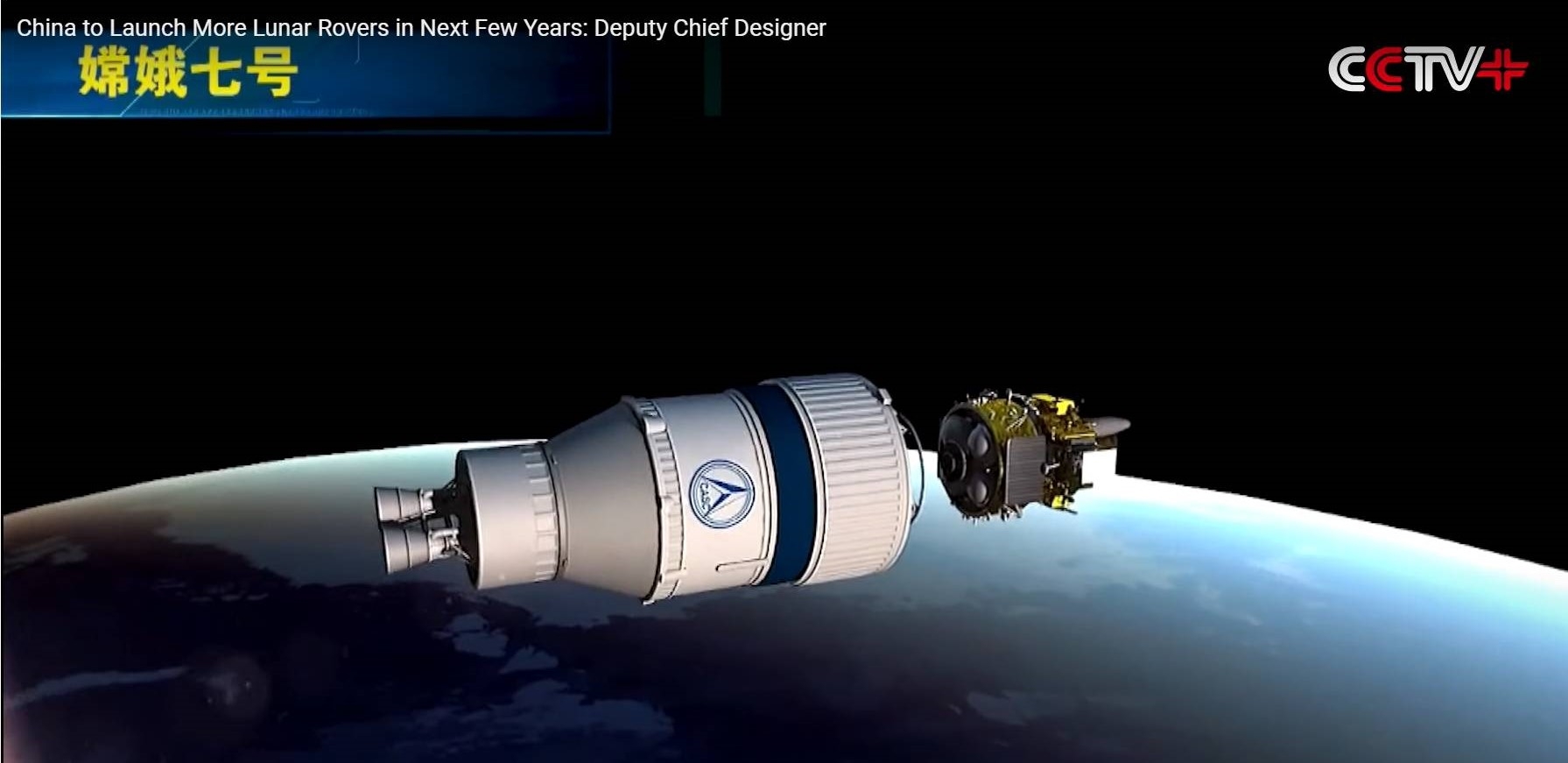
Image credit: CCTV/Inside Outer Space screengrab
In China’s Collaborative Design and Simulation Hall of the Deep Space Exploration Laboratory, lunar spacecraft specialists are conducting collaborative demonstration and design of plans for the Chang’e-6, Chang’e-7 and Chang’e-8 Moon missions.
These lunar missions are to be carried out successively in the next 10 years.

Image credit: CCTV/Inside Outer Space screengrab
This fourth phase of lunar exploration has been detailed by Tang Yuhua, deputy chief designer of Chang’e-7 with the Deep Space Exploration Laboratory of the Lunar Exploration and Space Engineering Center of China.
Far side sampling
In a China Central Television (CCTV) interview, Tang said that the Chang’e-4 mission has been completed and the Chang’e-6 and the Chang’e-7 are currently under development.
“The Chang’e-6, which will be launched around 2024, will sample the far side of the Moon and return. The Chang’e-7 will be launched around 2026 and land on the Moon’s South Pole to carry out resource exploration,” Tang told CCTV.

China’s Chang’e-7 is to launch a mini-scout that will overfly a shadowed crater at the Moon’s south pole to look for possible traces of water or ice.
Image credit: CCTV/Inside Outer Space screengrab
Tang added that the Chang’e-7 includes a lunar orbiter, a lander, a rover, a flying vehicle and a relay satellite. That flying vehicle will conduct the first “lunar flyby,” traveling to a shadowed crater at the Moon’s south pole to look for possible traces of water or ice.
Science research station
“The rover of the Chang’e-7 is slightly larger than that of the Chang’e-4 in scale. It is designed to carry different loads, and is of roughly the same structure. It’s more intelligent. The original rover had more ground intervention, and now the path planning will be more autonomous,” Tang said.

Artist’s view of International Lunar Research Station to be completed by 2035. Image credit: CNSA/Roscosmos
The rover, together with the orbiter, lander and other scientific instruments, will form the basic structure of the China’s south pole scientific research station with the Chang’e-8.
Moon relay services
China plans to launch the Queqiao-2 satellite in 2024 to provide relay communications services for its lunar missions.
Queqiao-2’s predecessor was launched on May 20, 2018 for the Chang’e-4 lunar mission, designed to function as a communications relay for the Chang’e-4 lander and Yutu-2 rover now on the far side of the Moon.
“Yutu-2 rover is carrying out its patrol surveys on a rugged terrain at the far side of the Moon, and the entire mission is done through a relay satellite. This kind of mission mode can be a working mode applied in deep space exploration in the future,” said Tang.

Image of Moon’s far side surface.
Image credit: CCTV/Inside Outer Space screengrab
According to CCTV, as the designed life of China’s current relay satellite is set to expire, the country plans to launch the Queqiao-2 communications satellite which will serve as a public relay satellite platform for the phase-4 lunar probe missions.
Compared with Queqiao, the Queqiao-2 will be upgraded to a new level with improvements in its overall capabilities.
New imagery
China’s lunar rover Yutu-2, or the Jade Rabbit-2, has sent back new images captured from the far side of the Moon ahead of the Chinese Lunar Year of the Rabbit.
Consisting of a lander and the Yutu-2 rover, the Chang’e-4 lunar probe touched down on the Moon on January 3, 2019, marking the first-ever soft landing on the far side.

Image credit: CCTV/Inside Outer Space screengrab
Four years on, the lunar rover Yutu-2 — named after the pet rabbit of the Chinese moon goddess Chang’e — has collected data on solar wind and cloddy soil research, gel-like rocks and craters on the Moon.
Extended life
“In order to map out the route for Yutu-2, we need to use its navigation camera to learn about the position of the rover before recovering and analyzing the terrain. The rover can climb 20-to-30-degree slopes. Since the soil on the Moon is relatively loose, we don’t want to risk it to walk through steep slopes for safety consideration so as to minimize the damage to Yutu-2,” said Li Chunlai, deputy chief designer of the third phase of China’s lunar exploration project in a CCTV interview.
The service life of the rover was to be only three months, but it has now worked for a record four years on the Moon. Currently, the wheeled robot is located around 2,625 feet (800 meters) away in the west-north direction of the Chang’e-4 landing site and reportedly in good condition together with the scientific payloads.
Go to this newly-released CCTV video at:

