Archive for the ‘Space News’ Category
 Author:
  March 7th, 2023
At the National Museum of China in Beijing, the “30 years of achievements exhibition” of China’s Human Space Program presented concepts of a human lunar lander, a new-generation spacecraft, and the Long March-10 concept launch vehicle.
Image credits: China Central Television (CCTV)/China Aerospace Science and Technology Corporation (CASC)/Inside Outer Space screengrab.


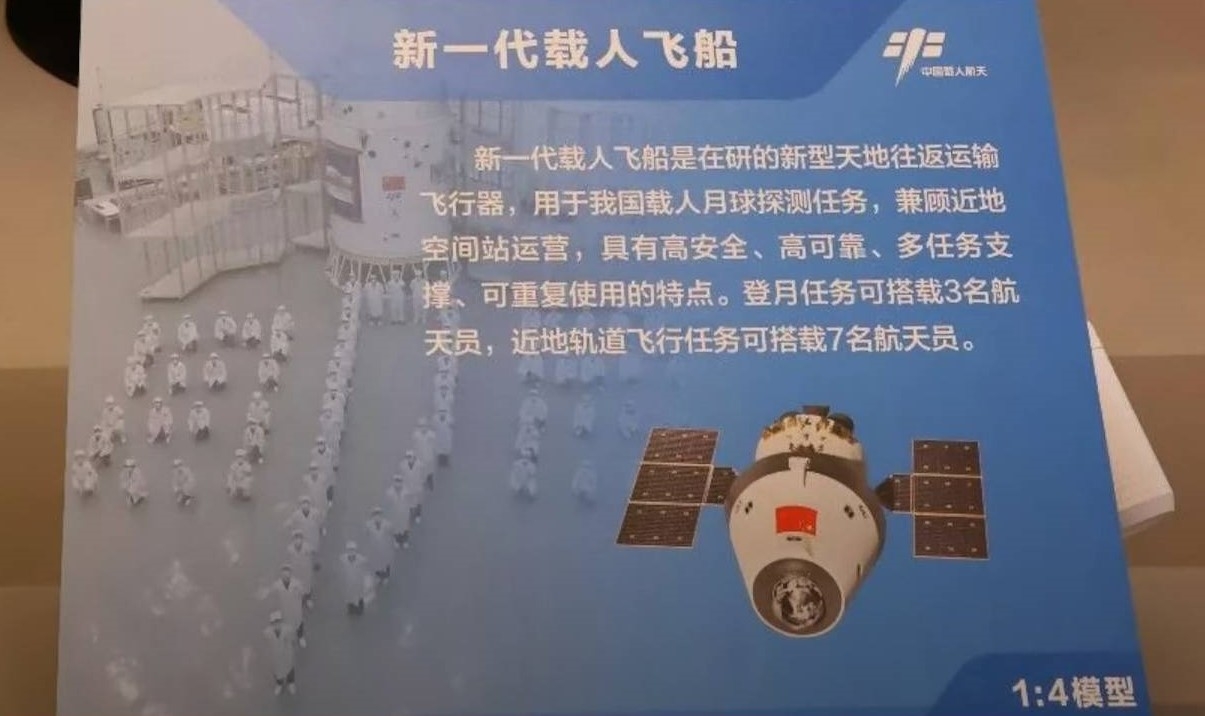
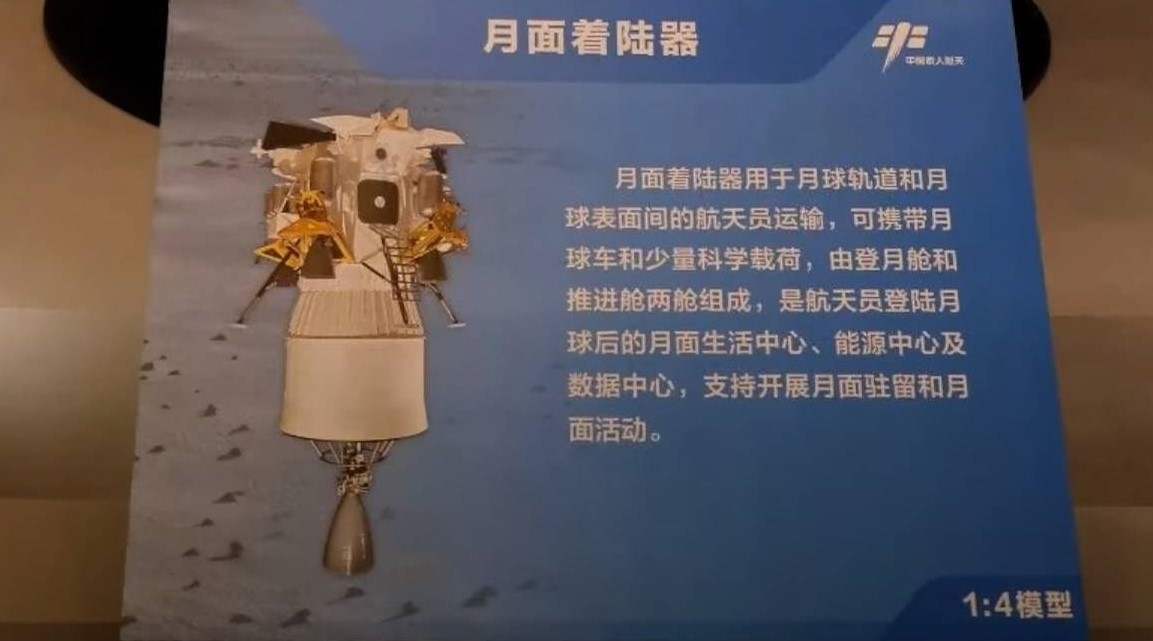
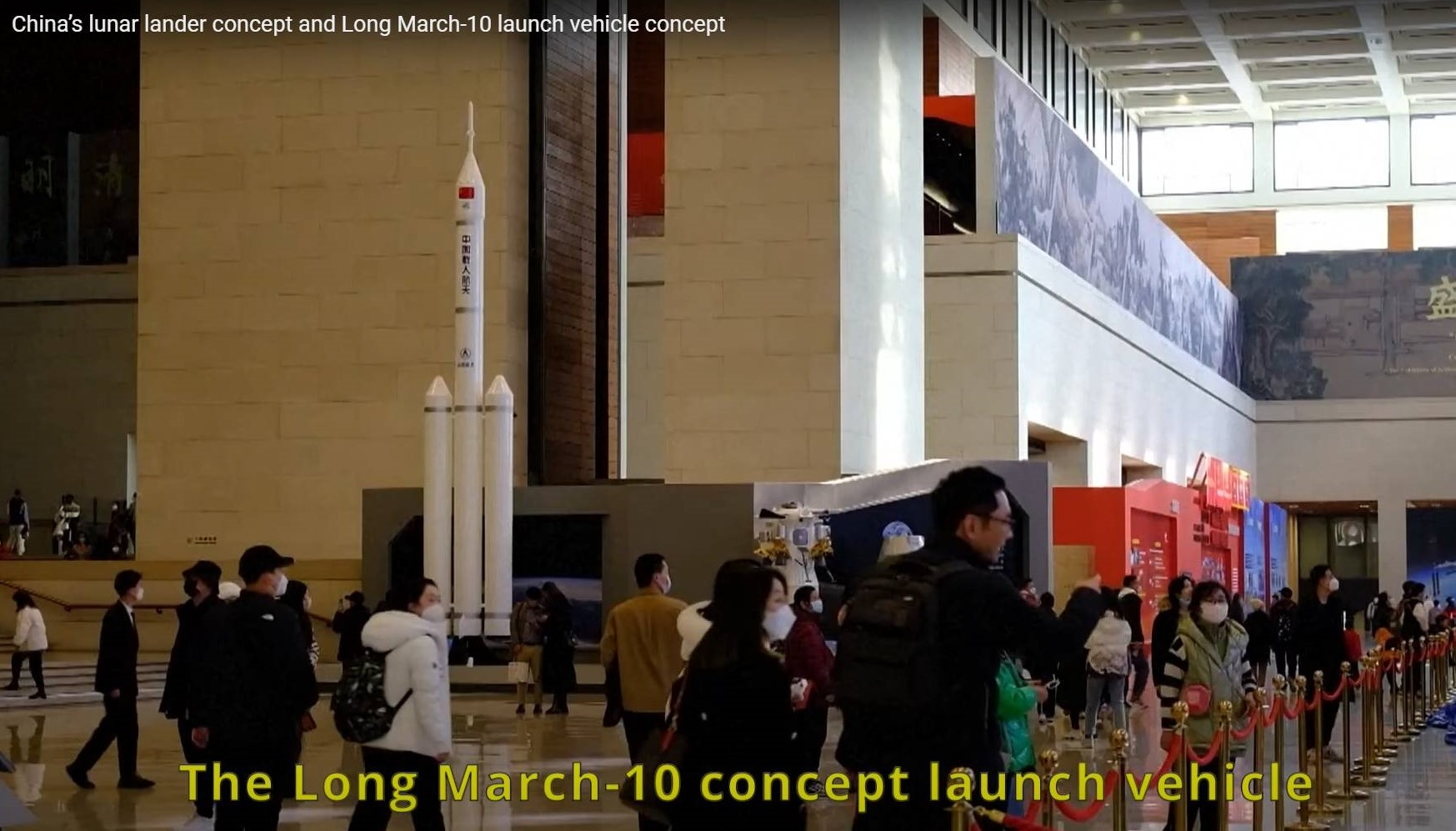
For a video spotlighting China’s humans-to-the-Moon effort, go to:
 Posted in

Image credit: ESO/P. Horálek
The European Southern Observatory (ESO) and other astronomy groups are petitioning the United Nations to address the impact of satellites on dark and quiet skies.
An international collaboration involving ESO has submitted a paper to the United Nations Committee on Peaceful Uses of Outer Space (COPUOS) proposing a new “Expert Group” to protect dark and quiet skies.
The call for a new Expert Group is to push forward on monitoring the impact of satellites on astronomy and seeks inputs from global stakeholders to make recommendations to help mitigate their sky pollution concerns.
Dark sky reserves and radio quiet zones
“The proliferation of satellites launched into orbit around the Earth has improved our ability to communicate globally instantaneously; however, there are concerns about the impact these technologies have on astronomical observations and the preservation of dark and quiet skies,” explains an ESO statement.

Starlink constellation pass overhead near Carson National Forest, New Mexico, photographed soon after launch.
SpaceX Starlink Satellites over Carson National Forest, New Mexico, photographed soon after launch.
Credit: Mike Lewinsky/Creative Commons Attribution 2.0
The statement flags the fact that there are over 8,000 active and defunct satellites orbiting the Earth and this number will continue to grow. As many as 100,000 satellites could be launched in the coming decade. These new satellites are encroaching on the few remaining dark sky reserves and radio quiet zones.

Credit: SpaceX/StarLink
“Astronomers have already begun to notice the effects of the dramatic increases in space traffic. Even from remote locations — specifically chosen to isolate telescopes from unwanted light pollution — satellites interfere with optical and infrared observations,” the ESO statement adds. “These satellites also transmit and receive radio signals which is especially concerning for radio telescopes, such as the highly sensitive Atacama Large Millimeter/submillimeter Array of which ESO is a partner.”
Mitigation steps
The ESO statement notes that some companies have made efforts to mitigate these effects, such as use of less-reflective material in satellite construction or changing the orientation of satellites in space.

An image of the NGC 5353/4 galaxy group made with a telescope at Lowell Observatory in Arizona, USA on the night of Saturday 25 May 2019. The diagonal lines running across the image are trails of reflected light left by more than 25 of 60 Starlink satellites as they passed through the telescope’s field of view. Although this image serves as an illustration of the impact of reflections from satellite constellations, please note that the density of these satellites is significantly higher in the days after launch (as seen here) and also that the satellites will diminish in brightness as they reach their final orbital altitude.
Credit: Victoria Girgis/Lowell Observatory
A proactive step would have companies provide astronomers with higher accuracy information about the location of satellites so that observatories can take this into account to decide when and where to point their telescopes.
“While these potential solutions show promise, they will require a coordinated effort between satellite industry, governments, and astronomers,” the ESO statement continues. “A cooperative approach involving all stakeholders is an effective way to reach a satisfactory balance between the need for the evolution of the low-Earth orbit space economy and the need protect the science of astronomy and the pristine visibility of the night sky.”
Cascade effect
Andrew Williams, co-lead of the policy hub of the International Astronomical Union’s (IAU) Center for the Protection of the Dark and Quiet Sky from Satellite Constellation Interference, stated that there is a cascade effect from the discussions at COPUOS that can influence governments and companies to act.

Nineteen Atacama Large Millimeter/submillimeter Array (ALMA) antennas on the Chajnantor Plateau in Chile.
Image credit: ALMA (ESO/NAOJ/NRAO)/W. Garnier (ALMA)
“From the substantial number of countries from all regions of the globe that voiced support for our proposal, we are hopeful we can find a way forward at the main session of the committee,” Williams says.
The mission of the IAU Center is to coordinate efforts and unify voices across the global astronomical community with regard to the protection of the dark and quiet sky from satellite constellation interference.
A “Conference Room Paper on the Protection of Dark and Quiet Skies for science and society” has been endorsed by Chile, Spain, Slovakia, Bulgaria, Dominican Republic, Peru, South Africa, in addition to ESO, the International Astronomical Union (IAU) and the Square Kilometer Array Observatory (SKAO).
That paper is available at:

Image credit: CGTN/Inside Outer Space screengrab
China’s Shenzhou-15 crew has carried out a second spacewalk outside the country’s Tiangong space station.
According to the China Manned Space Agency (CMSA), Fei Junlong, commander of the mission, along with colleague Zhang Lu, have completed the spacewalk and have returned to the station’s Wentian lab module.
The third crew member, Deng Qingming, stayed inside the orbiting outpost to provide support for the spacewalking twosome.

Image credit: CGTN/Inside Outer Space screengrab
Science experiments
The three astronauts were sent to the country’s space station in late November last year. Over the past three months, they have fulfilled multiple tasks, ranging from spacewalks to scientific experiment cabinet tests and cargo exit tasks in the Wentian and Mengtian lab modules.
In addition, experiments and testing in the fields of space science research and application are progressing steadily as planned, according to China Central Television (CCTV).
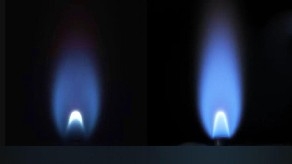
Image credit: CMSA/CCTV
Combustion, skin epidermis tests
“In coordination with the ground team, the astronauts successfully performed the first in-orbit ignition test with Mengtian’s combustion cabinet, which carries a device to measure the velocity field in the combustion region,” CCTV reports. “The test has verified the functions of the experiment system and the accuracy of the experiment process, laying a foundation for follow-up projects.”
In addition, the astronaut trio has obtained the three-dimensional structural images of their skin epidermis and superficial dermis with the country’s self-developed two-photon microscope.
“The event marked the success of the in-orbit verification experiments of the two-photon microscope, providing a promising tool for future health monitoring of astronauts in orbit,” CCTV reports.

Image credit: CCTV Video News Agency/CMSA/Inside Outer Space screengrab
Gravity loses its grip
The very first ball of flame was ignited on Feb. 16 aboard Mengtian, one of the two lab modules that make up the basic T-shaped structure of the space station along with the core module, with camera footage capturing the stunning and rarely-seen image in an environment where gravity loses its grip on materials of all forms.
Using methane as fuel, the test was carried out in the lab module’s combustion cabinet, which is designed for conducting experiments that involve fire.
Underlying physics
According to experts, CCTV reports, the flame, dome-shaped or spherical, looked different from that on Earth because of a lack of buoyancy and meager oxygen flow.

Fast paced series of missions completed China’s space station by end of 2022.
Credit: CMSA/CCTV/Inside Outer Space screengrab
The test allows scientists to learn about the underlying physics behind flame structure and behavior. Moreover, finding out about how fire spreads and behaves in space is crucial for the safety of future astronauts on the space station and for understanding and controlling fire on Earth.
The combustion science experiment system on board the space station was designed by the Institute of Engineering Thermophysics under the Chinese Academy of Sciences.
Mengtian modules
China plans to carry out more than 40 combustion experiments on board the space station by the end of this year.
Launched in October 2022, the Mengtian lab module is used for studying microgravity and carrying out experiments in fluid physics, materials science, combustion science and fundamental physics. It has completed more than 50 tasks as planned over the months.
In the next three months, the Shenzhou-15 mission will continue to carry out experiments and tests, and conduct extravehicular activities (EVAs) as well as cargo exit tasks.

Wait a Minute!
Wait a minute!
A number of Moon exploration missions by numbers of nations are planned for the next decade. The target areas of the Moon being eyed are likely to be a handful of small sites of interest, to carry out science investigations as well as process lunar materials to churn out construction materials, rocket fuel, oxygen and water, etc.

Image credit: NASA
Is there potential for creating risks of crowding and interference at these special lunar locales?
A research paper explores that prospect.
“Concentrated lunar resources: imminent implications for governance and justice,” has been made available by The Royal Society in the United Kingdom. The paper appeared in a special issue of the journal Philosophical Transaction A, published in 2020.

Image credit: JAXA/NHK/Paul Spudis
Small regions
“Many of the useful and valuable resources on the Moon are concentrated into a modest number (tens) of quite small regions (in the order of a few kilometers),” the research paper notes.
Locations of interest include the Peaks of Eternal Light, the coldest of the cold traps on the Moon and smooth areas on the lunar far side.
“Over the next decade, forms of interference and related disputes and conflicts over these concentrated resources may arise, as many actors, sovereign, philanthropic and commercial, descend onto just a handful of small, high-value sites on the lunar surface,” the research paper suggests.

Image credit: NASA
Lead author is astrophysicist Martin Elvis of Harvard-Smithsonian Center for Astrophysics in Cambridge, Massachusetts.
Need for action
“The need for action is perhaps most acutely felt by the astronomy community,” the paper explains. “If astronomers do not take the initiative to identify and raise awareness of the scientific and public interest in protecting unique lunar features now, they may find themselves unable to do so once these features are under threat from interference and crowding.”

Concept art credit: Volodymyr Vustyansky
Astronomers will find common cause with other scientists, such as astrobiologists, and other researchers for whom planetary protection measures are crucial. “The scientific community today faces both an opportunity and a responsibility to help guard precious lunar sites from the irreversible damage threatened by crowding and interference,” the paper observes.
Extraterrestrial commons
When is the appropriate time to begin developing a governance framework? Now says Elvis and colleagues, suggesting that a study of commons on Earth can provide lessons applicable to efforts at governing lunar sites of interest.
Lessons from the management and mismanagement of terrestrial commons, the paper adds, suggest that “action should be taken now rather than later, or at least now as well as later, to develop the governance structures needed to prevent (and later on contain) avoidable and undesirable problems of crowding and interference.”

Image credit: For All Moonkind
Diverse actors
How to responsibly coordinate diverse actors’ activities on the Moon requires recognizing and accommodating their distinct interests and purposes.
“Any proposed governance arrangement may have to contend with irreducible practical and conceptual tensions between different actors’ designs: scientific, commercial and human-exploration activities may often be incompatible with each other,” the paper explains. “Moreover, it is likely that these varied actors’ plans are best served by different governance arrangements.”
To read the full paper – “Concentrated lunar resources: imminent implications for governance and justice” – go to:
https://royalsocietypublishing.org/doi/10.1098/rsta.2019.0563

Image credit: ispace
The ispace Hakuto-R Mission 1 lunar lander is now on a trajectory to the Moon with a scheduled landing for the end of April – the first privately-led Japanese mission to attempt to land on the lunar landscape.
This Moon-bound probe was launched in December of last year via a SpaceX Falcon 9 booster and has now become “the farthest commercial operating spacecraft to travel into deep space, according to the organization.
In a statement released today, the ispace flight team is expecting to complete all deep space orbital maneuvers before lunar orbit insertion around mid-March.

Transformable lunar robot (left: before transformation, right: after transformation)
Image credit: JAXA/TOMY Company/Sony/Doshisha University
Toted by the M1 lander is a Japan Aerospace Exploration Agency (JAXA) transforming robot ball, as well as a Rashid lunar rover from the United Arab Emirates.

UAE’s Rashid rover.
Image credit: Mohammed Bin Rashid Space Centre (MBRSC)
Follow-on missions
The company has offices in Japan, Luxembourg, and the United States and is also working on Mission 2 and Mission 3 of their lunar exploration program.
Mission 2, a lander/rover, is planned for 2024 and Mission 3 is targeted for 2025.
ispace has also launched a lunar data business concept to support new customers as a gateway to conduct commerce on the Moon. Part of the ispace business model is to provide reliable lunar transportation and data services, based on lessons learned from Mission 1.
For an up-close look at the ispace series 1 lunar lander, go to:
https://www.youtube.com/watch?v=q49UdKvoj8I
Also, go to this ispace 2040 “vision movie” at:

Image credit: ESA
The European Space Agency has invited private space companies in Europe and Canada “to create a shared commercial telecommunication and navigation service for lunar missions by putting a constellation of satellites around the Moon.
According to a European Space Agency (ESA) statement, ESA “will either lead or be an international partner in many of these lunar missions – robotic and crewed – including those that envisage a permanent lunar presence. Creating a shared telecommunications and navigation service for these missions would reduce design complexity and make them lighter and more cost efficient.”


Image credit: ESA
Moonlight program
ESA is inviting space companies to create lunar services under its Moonlight program.
“By acting as an anchor customer, ESA is enabling space companies involved in Moonlight to create a telecommunication and navigation service for the agency, while being free to sell lunar services and solutions to other agencies and commercial ventures,” the ESA statement adds.

Artist’s impression of the European Large Logistics Lander, known as EL3, on the Moon.
Image credit: ESA
For more information, ESA has issued an invitation to tender for the work that closes May 26, 2023 and can accessed at:
https://esastar-publication-ext.sso.esa.int/ESATenderActions/details/54040
Also, go to this informative ESA video on their Moonlight work at:

This exceptional work is divided into three parts to embrace seven solid chapters that range from the dawn of the global space age, applied witchcraft and technical wizardry to spacepower at war and war on the cosmic coastline
Bleddyn E. Bowen is an associate professor of international relations at the University of Leicester, specializing in space policy and military uses of outer space.
The reader will benefit from Bowen’s meticulous research skills, well-documenting the book’s premise that “space technology’s original sin goes much further than missile and nuclear technology.”
As the book concludes, whatever form political changes may take, “they cannot come about without studying astropolitics as it is today and accepting the original sin of space technology.”
I’m not prying out of the book any specifics on what connotes the “original sin,” but a reader will find that nomenclature justified in detail.
“The twists and turns of the maturation of space technologies as they met the needs of warfare was not a clear-cut path of technological ‘progress’ nor merely a story of rational policy making,” says Bowen.
I particularly appreciated the writer’s analogy of Earth orbit as a “coastal or littoral zone” and analyzing the common drumbeat metaphor that Earth orbit is the “ultimate high ground.”
The book concludes by detailing the anarchy that’s resident in the Global Space Age.
There’s an excellent notes section and a very helpful bibliography to propel the reader forward to ponder other writings on this rich – at times terrifying – look into the ever-evolving militarization of outer space.
For more information on this book, go to:
https://global.oup.com/academic/product/original-sin-9780197677315?cc=us&lang=en&

Image credit: CGTN
Zhou Jianping, the chief designer of the China Manned Space Program (CMS), has outlined plans for growth of the country’s space station.
China’s space station, so far, is outfitted with 14 experimental cabinets that have been installed, with the country eyeing the encouragement of international cooperation.
“We have been doing things in this sector. For example, together with the United Nations Office for Outer Space Affairs, we collected a group of experiment projects from around the world and we will begin to set them in orbit soon,” Zhou told China Global Television Network (CGTN) reporter, Zheng Yibing.

China’s Xuntian space telescope.
Image credit: CGTN/Inside Outer Space screengrab
“In science experiments, we have close cooperation with other countries, for example, the Xuntian space telescope which involves the international participation and an international evaluation panel,” Zhou added.
“We are preparing the science applications of the telescope and organized four science centers,” Zhou explained.
Image credit: CGTN/Inside Outer Space screengrab
Station expansion
The China Space Station was completed by the end of 2022 with a configuration of three modules: the Tianhe core module and the Wentian and the Mengtian lab modules.
Zhou spotlighted robot arm technology and bioregenerative life support system hardware as key station developments.
Image credit: CGTN/Inside Outer Space screengrab
According to Zhou, CMS has outlined the future mode of station expansion.
“We could develop it to a six-module configuration with a total weight of about 180 tons,” he said. Furthermore, the chief designer said that the designed life of the station is ten years, but could be expanded to 15, 20 or even 30 years. “This is a big challenge, not just expansion, but technology upgrades as well,” Zhou said.

Image credit: CGTN/Inside Outer Space screengrab
In the foreseeable future, Zhou said, “we will send the Chinese to step on the Moon. We will explore how human beings can use the resources on the Moon and how to live on the moon for a long period and get ready for manned deep space exploration,” he said.
To view the CGTN exclusive interview with Zhou Jianping and an embedded video (wait for full upload), go to:
https://news.cgtn.com/news/2023-02-24/VHJhbnNjcmlwdDcwNzQ3/index.html

Credit: CCTV
China has finished recruiting a total of six astronauts for spaceflight missions in 2023.
Chinese astronauts will be on regular duty at the country’s space station in the future. Each batch of astronauts will support a mission duration of six months. There will be two batches of six astronauts in total to conduct spaceflight missions this year.
The update on the new astronauts comes from China’s first space traveler, Yang Liwei, also deputy chief designer of China’s manned space program.

“Before the start of the spaceflight mission, we will select the astronauts one or one and a half years in advance, including the astronauts who will perform the mission and the backup crew,” Yang said in a recent interview with the China Media Group.
Diverse backgrounds
“Now we’ve basically conducted astronaut selection for two missions together, and will select a backup crew. This is conducive to the connection between the regular training and that of the backup astronauts. Therefore, you can also imagine that we must have selected the next space station crew and the backup crew for this year’s missions, which is conducive to the execution of our entire mission,” Yang said.

Credit: GLOBALink/Inside Outer Space screengrab
China’s first batch of astronauts were initially pilots from the air force, “and now our astronauts come from colleges, universities, research institutions, engineering departments, and the Chinese Academy of Sciences,” Yang said.
Training rules and regulations
The selection of China’s fourth batch of astronauts will also be open to the Hong Kong Special Administrative Region (HKSAR) and the Macao Special Administrative Region (SAR).
“From this point of view, there are many different changes in the source of astronauts. In terms of occupations, drivers, engineers, and payload specialists all have the chance to be astronauts. So far, our standards and training rules and regulations have become mature and entered the application stage, as of course, we are now moving into the operational phase of the space station,” Yang said.

Curiosity Right B Navigation Camera image acquired on Sol 3751, January 24, 2023.
Image credit: NASA/JPL-Caltech
NASA’s Curiosity Mars rover at Gale Crater is now performing Sol 3752 duties.
Is Tap Caparo drillable?
That’s the question facing Mars researchers, reports Natalie Moore, a mission operations specialist at Malin Space Science Systems in San Diego, California.

Curiosity MAHLI photo produced on Sol 3750 of Tapo Caparo post-preload test.
Image credit: NASA/JPL-Caltech/MSSS
Perhaps this drilling target is too hard like the robot’s last Marker Band drill attempts at Amapari, Encanto, and Dinira, Moore adds.
Scratches and a divot
Mars Hand Lens Imager (MAHLI) imagery of the post-preload test of Tap Caparo has revealed something rover scientists hadn’t seen for a while: Dust Removal Tool (DRT) scratches and a divot from the pre-load test!

Curiosity Mast Camera Right B image taken on Sol 3750. February 23, 2023.
Image credit: NASA/JPL-Caltech/MSSS
“This was a good sign; this block wasn’t as hard as our last few drill targets (which did not get deep enough to collect sample),” Moore notes. By midday the geochemistry data from the Alpha Particle X-Ray Spectrometer (APXS) and Chemistry and Camera (ChemCam) came down “and both teams went to work analyzing Tapo Caparo’s chemistry to determine if the mineralogy was distinct enough to warrant gathering sample.”

Curiosity Right B Navigation Camera image acquired on Sol 3750, February 23, 2023.
Image credit: NASA/JPL-Caltech

Curiosity Right B Navigation Camera image acquired on Sol 3750, February 23, 2023.
Image credit: NASA/JPL-Caltech

Curiosity Right B Navigation Camera image acquired on Sol 3750, February 23, 2023.
Image credit: NASA/JPL-Caltech

Curiosity Right B Navigation Camera image acquired on Sol 3750, February 23, 2023.
Image credit: NASA/JPL-Caltech

Curiosity Right B Navigation Camera image acquired on Sol 3750, February 23, 2023.
Image credit: NASA/JPL-Caltech
The rover team decided wholeheartedly to proceed with Drill Sol 2 and finally (hopefully) will be able to sample depth before leaving the Marker Band area for good, Moore explains.
Drill plans
“Our modeling tools work extra hard on Drill Sol 2 plans so there’s an incentive to keep things moving early in the day. But since we’ve planned Drill Sol 2 four other times in the past ~three months, our team knew exactly what to do to make planning go as smooth as possible,” Moore reports.
Drilling takes a lot of rover energy and pre-drill planning is kept to a minimum. So, the plan calls for using sol 3752 for a full drill including lots of documentation imaging during and after.
Moore notes that the only non-drill activities on that sol will be some Dynamic Albedo of Neutrons (DAN) atmospheric measurements and a Navcam twilight cloud survey since Curiosity is still in Mars cloud season.

Curiosity Mast Camera Right image taken on Sol 3750, February 23, 2023.
Image credit: NASA/JPL-Caltech/MSSS
Remote science
Sol 3753 will be filled with remote science: Mastcam taking the lead for data volume with >60 full images taken midsol, ChemCam following close behind with 21 Remote Micro-Imager (RMI) frames, some afternoon Mastcam images showing the atmospheric opacity near the sun, and lastly a Mars Descent Imager (MARDI) photo to hopefully get better exposure on what’s under the rover than what was taken on sol 3749.
In the middle of all this remote science, an early-afternoon arm block contains sample drop-off activities to the Sample Analysis at Mars (SAM) Instrument Suite, “assuming the drill succeeds and sample is collected,” Moore adds.
Earth and Mars: in-sync
On the last sol (3754) planned, more time is dedicated to remote science with lots more Mastcam images, ChemCam Laser Induced Breakdown Spectroscopy (LIBS) and RMI, and Navcam’s usual long-distance movies to maybe catch dust devils and other atmospheric occurrences.
“We had a sholiday (soliday + holiday) last weekend,” Moore says, “so Earth and Mars are pretty in-sync right now with timing. That means our drill data should come down roughly 11am Saturday morning, whatever the outcome!”

