Archive for the ‘Space News’ Category
 Author:
  March 22nd, 2023
Curiosity Left B Navigation Camera Sol 3776 March 22, 2023.
Image credit: NASA/JPL-Caltech
NASA’s Curiosity Mars rover at Gale Crater is now performing Sol 3777 duties.
Monday’s planned drive positioned Curiosity with a new workspace to investigate, reports Scott VanBommel, a planetary scientist at Washington University.
“We have left the Marker Band,” VanBommel adds. “As a physicist and spectroscopist by training, I find myself looking more at the analytical data, in particular X-ray fluorescence data, acquired on rocks, than the rocks themselves. But there was something about the primary rock target in today’s workspace that kept my eyes glued.”

Curiosity Left B Navigation Camera Sol 3776 March 22, 2023.
Image credit: NASA/JPL-Caltech
Waves and a rock
VanBommel says his attention was drawn not so much about the rock’s shape, but its texture.
“We’ve seen this before, sure, but there was a certain textural je ne sais quoi of this rock for me…not only the layers, but the ruffled edges. I couldn’t put my finger on what in everyday life it reminded me of, so, I did the only logical thing one can do in such a situation: ask my 5- and (nearly) 3-year-old nieces in Canada what the rock in tosol’s blog image reminded them of. They said waves and a rock, respectively,” VanBommel adds.

Curiosity Mars Hand Lens Imager photo produced on Sol 3776, March 21, 2023.
Image credit: NASA/JPL-Caltech/MSSS

Curiosity Mars Hand Lens Imager Sol 3776, March 22, 2023.
Image credit: NASA/JPL-Caltech/MSSS
Brush off
A recent two-sol plan (Sols 3778-3779) is focused on brushing and acquiring Alpha Particle X-Ray Spectrometer (APXS) compositional analyses of this rock, specifically one spot named “Marabitana.”
Curiosity then acquired images of the brush with Mastcam before acquiring further images of Marabitana as well as “Owenteik,” “Itapaiuna,” “Uaila,” “Mocidade,” “Xeriuini,” and “Anaua,” with Chemistry and Camera (ChemCam) acquiring laser analyses of Anaua as well.
In the early afternoon when the lighting was just right, Curiosity acquired several Mars Hand Lens Imager (MAHLI) images of Marabitana, including one planned only one centimeter above the surface.

Curiosity Front Hazard Avoidance Camera Right B image acquired on Sol 3776, March 22, 2023.
Image credit: NASA/JPL-Caltech
Active bombardment
The arm was then stowed, and Curiosity commenced a planned drive of roughly 49 feet (15 meters) in parallel with the Dynamic Albedo of Neutrons (DAN) performing active bombardment of Mars with its neutrons. At the end of the drive, the Mars Descent Imager (MARDI) snapped an image beneath the rover as Curiosity concluded its sol 3778 activities, VanBommel reports.

Curiosity Front Hazard Avoidance Camera Left B image taken on Sol 3776, March 21, 2023.
Image credit: NASA/JPL-Caltech

Curiosity Left B Navigation Camera image taken on Sol 3776, March 22, 2023.
Image credit: NASA/JPL-Caltech
The second sol of the plan contained passive analyses by DAN, automated laser targeting analyses by ChemCam, and environmental science using ChemCam, Navcam, Mastcam, and the Rover Environmental Monitoring Station (REMS).
“We shall see what Friday’s workspace has in store. I’d wager more “waves and rocks,” but I’ll defer classification to the same experts,” VanBommel concludes.
 Posted in

Russia’s Luna-25 Moon lander.
Image credit: Roscosmos
Russia’s reactivation of Moon exploration is on the move – the country’s Luna-25 robotic lander is to be transported to the Vostochny Cosmodrome in early June.
According to NPO Lavochkin, the production leader of the spacecraft, delivery of the Luna-25 is scheduled for the first ten days of June 2023.
Previously, Russia’s Roscomos announced that liftoff of the Moon-bound probe is targeted for July 13th atop a Soyuz-2.1b booster.

Russia’s return-to-the-Moon Lunar-25 hardware undergoes testing.
Image credit: Roscosmos
Hardware issues resolved
The repeated delay of launching the spacecraft was pinned on hardware built to help soft land the craft – Doppler velocity and distance gear. Late last year, that equipment passed testing and was incorporated into Luna-25.
Luna-25 is tagged as the first robotic Moon probe in Russia’s modern history. Under the former Soviet Union, a series of successful Moon missions took place, including the return of lunar specimens via sample return vehicles.

Topographic map of the southern sub-polar region of the Moon showing the location of Boguslawsky crater.
Credit: Ivanov et al., 2015 via Arizona State University/LROC
Given a successful sendoff, Luna-25 is targeted for the lunar south pole and slated to touch down near the Boguslawsky crater.
Russia/China lunar station
Meanwhile, in other Russian back-to-the-Moon news, Roscosmos Director General Yuri Borisov told the TASS news agency that Russia and China as cooperating on the International Scientific Lunar Station initiative.
“We have a wide range of interaction. First of all, this is a joint project on the International Scientific Lunar Station. I think that we have something to work on in this direction and enrich our joint programs,” Borisov told the Zvezda TV channel.

Credit: NPO Lavochkin
Borisov reports that the first stage of creating the International Scientific Lunar station (MNLS) is now underway via autonomous work on domestic lunar programs.
Russia plans to launch three robotic missions to the Moon, then move on to a second phase of putting in place the MNLS.
Joint Mars work
Borisov also reportedly said that Russia and China are already cooperating on issues of human space travel, a collaboration that will be continued. He also stated that following the Moon program, the two countries would evolve interest in the exploration of Mars.
“Russia is perhaps the only country that has the greatest experience in the field of long-term stay of cosmonauts in space,” Borisov adds. “I think that all these competencies will be useful not only for the lunar, but also for the future Martian program,” he added, as reported by the Russian Novosti Kosmonavtiki news group.

Curiosity’s location as of Sol 3774. Distance driven to that sol: 18.49 miles/29.76 kilometers.
Credit: NASA/JPL-Caltech/Univ. of Arizona
NASA’s Curiosity Mars rover at Gale Crater is now performing Sol 3775 duties.
It was a jam packed weekend for the robot on Mars reports Sharon Wilson, a planetary geologist at the Smithsonian’s National Air and Space Museum in Washington, D.C.

Curiosity Left B Navigation Camera image acquired on Sol 3774, March 19, 2023.
Image credit: NASA/JPL-Caltech
“The rover is heading south across the Marker Band and is currently sitting in front of a lovely view that includes a contact between two types of bedrock,” Wilson notes. “The lower section of bedrock consists of very thin, horizontal layers, as though you were looking at the edge of a thick stack of construction paper. Above, the bedrock appears rougher and bumpier and is not finely layered.”

Curiosity Left Navigation Camera image acquired on Sol 3771, March 16, 2023.
Image credit: NASA/JPL-Caltech
Abrupt change in appearance
Over last weekend, the plan called for Curiosity to analyze both of these bedrock sections, below and above the contact, because this abrupt change in appearance may help Mars researchers understand how the environment evolved over time.

Curiosity Left B Navigation Camera image acquired on Sol 3774, March 19, 2023.
Image credit: NASA/JPL-Caltech
The weekend plan also scripted use of several instruments to characterize the bedrock, including the Dust Removal Tool (DRT), the Alpha Particle X-Ray Spectrometer (APXS), the Mars Hand Lens Imager (MAHLI), and multispectral activities of the “San Rafael” target in the lower section, and the “San Francisco de Yuruani” target in the upper section.

Curiosity Mars Hand Lens Imager (MAHLI) photo produced on Sol 3774, March 19, 2023.
Image credit: NASA/JPL-Caltech/MSSS
“A MAHLI mosaic of target ‘Santa Elena de Uairen’ will stretch vertically across the two types of bedrock,” Wilson adds.
Short drive
The robot’s Chemistry and Camera (ChemCam) Laser Induced Breakdown Spectroscopy (LIBS) device was slated to analyze the “Pico del Toro” target in the lower section and the “San Francisco de Yuruani” target in the upper section.

Curiosity Front Hazard Right B Avoidance Camera image taken on Sol 3774, March 19, 2023.
Image credit: NASA/JPL-Caltech
“Mastcam will document the contact in the workspace as well, in addition to taking a stereo image of target “Iurua” to get a closer view of an interesting rock sitting on the surface nearby,” Wilson points out.

Curiosity Left B Navigation Camera image acquired on Sol 3774, March 19, 2023.
Image credit: NASA/JPL-Caltech
“Once Curiosity wraps up this long list of science activities, the rover will complete a short drive toward a nearby bedrock outcrop, stopping to take a look at a “foreign” stone (a rock that looks different than the surrounding bedrock),” Wilson reports.
Monitoring of environmental conditions was to continue over last weekend, with a survey for dust devils and observing the dust in the atmosphere.
“We have so much to celebrate after ten years of exploration with the Mars Science Laboratory Rover Curiosity,” Wilson concludes, “and so much to look forward to on the road ahead!”

RKF Space Printer. Image credit: RKF Engineering Solutions
Rovers capable of imprinting the Moon and Mars landscape with customized words and pictures is a new line of business being offered by RKF Engineering of Bethesda, Maryland.
The idea has garnered a U.S. patent earlier this year, according to the group, cited as RKF Engineering patent US 18/100,141.
For example, once the made to order imprint is emblazoned on lunar terrain, the wheeled printers can then photograph the images against an Earthrise glowing over a lunar horizon.
“The RKF patent protects against any competition that draws imagery on a celestial body and is not reliant on a specific printer or rover design,” adds a company statement.

Apollo 11 footprint on the Moon.
Image credit: NASA
Tangible, lasting product
“RKF is thrilled to announce our space printer patent, and I can’t wait to see the first imagery drawn on the Moon and Mars,” says Jeffrey Freedman, RKF’s Chief Technical Officer.
RKF explains that Moon-emplaced imagery can survive millions of years, “immortalizing consumers’ words and likenesses.”

In April 1972, Apollo 16’s Charlie Duke left a family picture on the lunar surface.
Image credit: Charlie Duke/NASA
“Images can be anything from portraits to eternal love letters, words of wisdom, epitaphs of loved ones who passed, or even advertisements. The options are limitless,” RKF reports. “Once in place, a lunar rover printer can stamp and photograph millions of unique images and text messages over its operating life.”
According to the RKF statement, unlike plopping down big dollars for space tourism, “which is too expensive and impractical for most people, space printing will be affordable and provide a tangible, lasting product.”

Wait a minute!
Image credit: Barbara David
The highly productive NASA New Horizons mission is on “extended leave” after departing Earth in January 2006 – and the agency is now considering a new assignment for the nuclear-powered craft after over 6,267 days in space.

New Horizons was built by the Johns Hopkins Applied Physics Laboratotry.
Credit: NASA/Johns Hopkins University Applied Physics Laboratory/Southwest Research Institute/Steve Gribben/Alex Parker
New Horizons zoomed past Pluto and its moons in July 2015, before conducting the first reconnaissance of a Kuiper Belt object (KBO), Arrokoth, on New Year’s 2019.
With the completion of the New Horizons prime mission to Pluto, and its extended mission to Arrokoth, mission operations of the spacecraft would be terminated at the end of its second extended mission at the end of fiscal year 2024 (FY24).

Pluto flyby of New Horizons continues to offer a scientific bounty of new findings.
Image credit: NASA/Johns Hopkins APL/SwRI/James Tuttle Keane
“However, it is in the best interest of NASA, the New Horizons mission, the scientific community, and the American taxpayer for the New Horizons mission to continue operations and utilize its unique position in the solar system to answer important questions about our heliosphere and its interaction with the interstellar medium, while allowing for scientific opportunities that present themselves beyond Heliophysics.”
That’s the word from a just-issued NASA Request for Information regarding a New Horizons Interstellar Mission (NIHM).

Kuiper Belt Object (KBO) Arrokoth as viewed by New Horizons.
Image credit: NASA/Johns Hopkins APL/SwRI
Level of interest
NASA’s Science Mission Directorate (SMD) is exploring whether interested science teams have a set of science objectives to propose to the space agency for use of the mission beyond FY24.
The Request for Information (RFI) issued on March 15 is designed to gauge the level of interest of the wider science community in pursuing the next phase of science leadership for the mission, and to estimate appropriate annual costs.
That RFI seeks to define three years of science goals for a new mission concept utilizing the New Horizons observatory, including the definition of operations modes of the spacecraft and its instruments to address these science goals. The New Horizons mission carries seven scientific instruments.
The RFI emphasizes that NASA is obtaining information for planning purposes only, and the Government does not intend to award a contract at this time.
All responses to the RFI must be received by 11:59 p.m. Eastern time on April 17, 2023.
By continuing the New Horizons mission operations and utilizing its unique position in the Solar System, important questions can be answered about the heliosphere and its interaction with the interstellar medium “while allowing for scientific opportunities that present themselves beyond Heliophysics,” the RFI adds.
Scientific leadership
While on the face of it, the RFI is welcomed news for deep diving space exploration. But there seems to be a bit of disconcerting news too.
“The solicitation may allow teams and/or organizations to propose for scientific leadership of a New Horizons Interstellar Mission.” In non-NASA speak, what appears to be afoot is the disbanding of the current New Horizons science team that scored over the years milestone-making observations by the spacecraft – a group shaped by some 20 years of work to assure the scientific output from the probe.
As noted in the RFI: “It is expected that spacecraft operations will continue to be conducted by the existing operations team.”
So as New Horizons continues to fly outward, those bureaucratic wheels of space science at NASA are likely to hit a speed bump within certain scientific community circles.
Stay tuned!
For a look at the RFI, go to: https://go.nasa.gov/NewH23IMRFI

Image credit: Roscosmos
That compromised Russian Soyuz MS-22 spacecraft is returning to Earth – in un-crewed manner — at the end of the month. The craft experienced a coolant leak attached to the International Space Station last year, putting to question safe transport of crew members back to terra firma.
Meanwhile, cosmonauts onboard the ISS have been readying the Soyuz MS-22 to re-enter the Earth’s atmosphere without crew. Payload containers have been installed in the Soyuz descent vehicle in preparation of “thermal testing” of the vehicle.

Image credit: Roscosmos
Russia’s Roscosmos reports that Dmitry Petelin, together with cosmonaut colleague Sergei Prokopiev, recently put on Sokol KV-2 spacesuits to enter and test the Soyuz MS-22 prior to its end-of-March fiery return and parachute landing to awaiting recovery crews.
Radiator pipeline
Back on December 15, 2022, the external contour of the radiator of the thermal control system of the Soyuz MS-22 spacecraft was depressurized. Specialists later determined that the damage was purportedly caused by a micrometeoroid impact.
The vehicle’s radiator pipeline spewed its coolant out into space, compromising the overall integrity of the craft to return crew members safe and sound to Earth by keeping the interior of the Soyuz in a comfy temperature range.

Coolant spraying instrument-assembly compartment of the Soyuz spacecraft.
Image credit: NASA
As for the cause of the coolant loss, studies aided by robotic arm-mounted cameras were carried out. Up-close looks found a tiny hole in the Soyuz MS-22 radiator less than 1 millimeter in size, created by an impactor zooming through space at a speed of 7,000 meters per second, according to Russian space specialists.
Discarded compartment
In bringing back the Soyuz MS-22 descent vehicle, that process entails discarding the troubled instrument-assembly compartment of the ship – so it cannot be evaluated by hands-on experts here on Earth.
The three major components of the Soyuz are the spherical-shaped orbital module, the bell-shaped descent vehicle and the cylindrical-shaped instrument assembly module from which solar panels protrude.
Like the orbital module, the intermediate section of the instrumentation/propulsion module separates from the Soyuz descent module after the final deorbit maneuver and “burns up” in Earth’s atmosphere upon reentry.

Image credit: NASA

An artist’s impression of Uranus and its five largest moons (innermost to outermost) Miranda, Ariel, Umbriel, Titania and Oberon.
Image credit: NASA/Johns Hopkins APL/Mike Yakovlev
Researchers have reanalyzed nearly 40-year-old data accumulated by NASA’s Voyager 2 and now speculate that two moons of Uranus may have oceans beneath their icy surfaces.
The moons – Ariel and Miranda — may be releasing energetic particles into space, according to a new study led by specialists at the Johns Hopkins Applied Physics Laboratory (APL) in Laurel, Maryland.
Even better is that Uranus is a newly recommended target for a NASA flagship mission over the coming decade.
Unknown, mysterious mechanism
Accepted for publication in the journal Geophysical Research Letters, and detailed last week at the annual Lunar and Planetary Science Conference, the research suggests that one or two of Uranus’ 27 moons — Ariel and/or Miranda — are adding plasma into the space environment through an unknown and mysterious mechanism.

Miranda, a moon of Uranus.
Image credit: Voyager 2/NASA/JPL
Scientists took another look into particle data collected by the APL-built Low-Energy Charged Particle (LECP) instrument carried by Voyager 2, uncovering something peculiar: a trapped population of energetic particles the spacecraft had observed while departing Uranus.
During its approximately three-day flyby of Uranus in 1986, Voyager 2 captured the only on-the-spot observations of the planet and its system.
Tantalizing explanation
One tantalizing explanation for the particles is that one or both moons have oceans beneath their icy surfaces and are actively spewing material, possibly through plumes.
The team suspects the particles arise from Ariel and/or Miranda through either a vapor plume or through sputtering — a process where high-energy particles hit a surface, ejecting other particles into space.
As for what’s taking place on Ariel and/or Miranda, “right now, it’s about 50-50 whether it’s just one or the other,” reports Ian Cohen, a space scientist at APL and the lead author of the new study.
“What was interesting was that these particles were so extremely confined near Uranus’ magnetic equator,” Cohen said in an APL statement. Magnetic waves within the system would normally cause them to spread out in latitude, he explained, but these particles were all cramped near the equator between the moons Ariel and Miranda.

The complex terrain of Ariel is viewed in this image, the best Voyager 2 color picture of the Uranian moon.
Image credit: Voyager 2/NASA/JPL
Eruptions of water?
Originally, scientists attributed these features to Voyager 2 flying through a chance stream of plasma being “injected” from the distant tail of the planet’s magnetosphere. But that explanation doesn’t hold, Cohen said. “An injection would normally have a much broader spread of particles than what was observed.”
Scientists had previously suspected Uranus’ five largest moons — Ariel and Miranda included — may have subsurface oceans. Voyager 2 images of both moons show physical signs of geologic resurfacing, including possible eruptions of water that froze on the surface.
The rehashed Voyager 2 data and determining the source of the particles has given rise to the potential of there being an active ocean moon there, Cohen said. “We can always do more comprehensive modeling, but until we have new data, the conclusion will always be limited.”
This new research potentially hints that the Uranian magnetosphere may harbor an ocean world like those known or believed to exist at the other Giant Planets.
For more information, go to – “A localized and surprising source of energetic ions in the Uranian magnetosphere 1 between Miranda and Ariel” – at:

Curiosity Mars Hand Lens Imager photo produced on Sol 3771 March 16, 2023.
Image credit: NASA/JPL-Caltech/MSSS
NASA’s Curiosity Mars rover at Gale Crater is now performing Sol 3772 duties.
The Red Planet robot is leaving Tapo Caparo and is beginning something new, reports Catherine O’Connell-Cooper, a planetary geologist at the University of New Brunswick; Fredericton, New Brunswick, Canada.
“But… actually, we are not going very far,” O’Connell-Cooper adds. “Whilst sitting at Tapo Caparo, we spent some time looking around at the neighborhood using Mastcam and [Chemistry and Camera] ChemCam imaging. Not too far away, we spotted a workspace that includes two types of bedrock – finely laminated bedrock (which is what we just drilled) and some bedrock with abundant nodules but apparently no laminations.”

Curiosity Front Hazard Avoidance Camera Right B image captured on Sol 3771, March 16, 2023. Image credit: NASA/JPL-Caltech
This may mark a transition from one unit to another, O’Connell-Cooper notes, so a new plan called for a rover drive over to that area in order to get this workspace into the upcoming weekend plan.
Float rock
The plan scripts a Touch and Go, doing the very last contact science on the research wish list and then moving on.

Curiosity Front Hazard Avoidance Camera Left B image captured on Sol 3771, March 16, 2023. Image credit: NASA/JPL-Caltech
The Alpha Particle X-Ray Spectrometer (APXS) is to analyze a float rock (“Tucupita”) which was previously analyzed by ChemCam, who will use Laser Induced Breakdown Spectroscopy (LIBS) to look at another float rock (“Uaimiti”) for comparison.
As the Mars Hand Lens Imager (MAHLI) team acquired images of Tucupita in last Monday’s plan to facilitate APXS placement, they were able to fit it in a MAHLI-only target, looking at another float stone (“Tamanaco”) which is slightly closer to the rover.

Curiosity Left B Navigation Camera image taken on Sol 3771, March 16, 2023.
Image credit: NASA/JPL-Caltech
Imaging the buttes
“As we have been here for several sols, we have already imaged the buttes around us with Mastcam and the ChemCam’s long distance imager [Remote Micro-Imager] (RMI), but once we leave, obviously the view will change,” O’Connell-Cooper notes. “So, before we leave, we will get one final set of images from this viewpoint of the “Chenapau” butte (Mastcam) and a large channel feature further afield (RMI).”

Curiosity Left B Navigation Camera image taken on Sol 3771, March 16, 2023.
Image credit: NASA/JPL-Caltech
As always, the environmental theme group continues their monitoring of environmental conditions in Gale. Navcam will complete a dust devil (wind vortice) survey, and Mastcam will look at dust in the atmosphere (tau measurement).

Curiosity Left B Navigation Camera image taken on Sol 3771, March 16, 2023.
Image credit: NASA/JPL-Caltech
Back on the road
“It will be good to be back on the road, even if we are just heading further along the Marker Band,” O’Connell-Cooper reports.
The Marker Band (including this drill site) has been the site of lots of exciting science, some of which was presented this week at a special session at the Lunar and Planetary Science Conference in Texas, marking Curiosity’s ten years of active roving in Gale. O’Connell-Cooper
“However, there is so much amazing data and images to work on from the Marker Band,” O’Connell-Cooper concludes, “we will be talking about for many years to come!”

Image credit: Rolls-Royce/Inside Outer Space screengrab
The UK Space Agency has provided funding to Rolls-Royce into how nuclear power could be used to support a future Moon base for astronauts.
Specialists at Rolls-Royce are engaged in developing a “Micro-Reactor” program, a key technology to help sustain future Moon missions and enhance their scientific value.
The UK Space Agency has announced $3.5 million (£2.9 million) of new funding for the project which will deliver an initial demonstration of a UK lunar modular nuclear reactor. This follows an over $300,000 (£249,000) study funded by the UK Space Agency in 2022.
According to a company statement, Rolls-Royce plan to have a reactor ready for transport to the Moon by 2029.

Image credit: Rolls-Royce
Small, lightweight
Relatively small and lightweight compared to other power systems, a nuclear micro-reactor for the Moon could enable continuous power regardless of location, available sunlight, and other environmental conditions.
Rolls-Royce will be working alongside a variety of collaborators including the University of Oxford, University of Bangor, University of Brighton, University of Sheffield’s Advanced Manufacturing Research Centre (AMRC) and Nuclear AMRC.
The funding enables Rolls-Royce to focus on three key features of the Micro-Reactor: the fuel used to generate heat, the method of heat transfer and technology to convert that heat into electricity, according to a company statement.

Image credit: Rolls-Royce
The aim of the research work – beyond Moon needs — is to create a power and propulsion capability for multiple markets and operator needs.
Increasing lunar stay-time
Scientists and engineers at Rolls-Royce are working on the Micro-Reactor program to further technology that will provide power needed for humans to live and work on the Moon. All space missions depend on a power source, to support systems for communications, life-support and science experiments. Nuclear power has the potential to dramatically increase the duration of future lunar missions and their scientific value.
The UK Space Agency announced the $3.5 million (£2.9 million) of new funding for the project which will deliver an initial demonstration of a UK lunar modular nuclear reactor. This follows an over $300,000 (£249,000) study funded by the UK Space Agency in 2022.
The aim is to create a world-leading power and propulsion capability for multiple markets and operator needs, alongside a clean, green and long-term power source.

Image credit: NASA
Further down the road
Abi Clayton, Director of Future Programs for Rolls-Royce said: “This funding will bring us further down the road in making the Micro-Reactor a reality, with the technology bringing immense benefits for both space and Earth. The technology will deliver the capability to support commercial and defense use cases alongside providing a solution to decarbonise industry and provide clean, safe and reliable energy.”
The partnership with Rolls-Royce comes after the UK Space Agency recently announced over $60 million (£51 million) of funding available for UK companies to develop communication and navigation services for missions to the Moon, as part of the European Space Agency’s Moonlight program, which aims to launch a constellation of satellites into orbit around the Moon.

Image credit: ESA
Those Moon-circling satellites would allow future astronauts, rovers, science experiments and other equipment to communicate, share large amounts of data including high-definition video, and navigate safely across the lunar surface.
In a related development, earlier this week, as part of the AUKUS trilateral agreement between Australia, the UK and the US, it was announced that Rolls-Royce Submarines Ltd will provide reactors for Australia’s nuclear powered submarines.
For video on this lunar power source, go to:
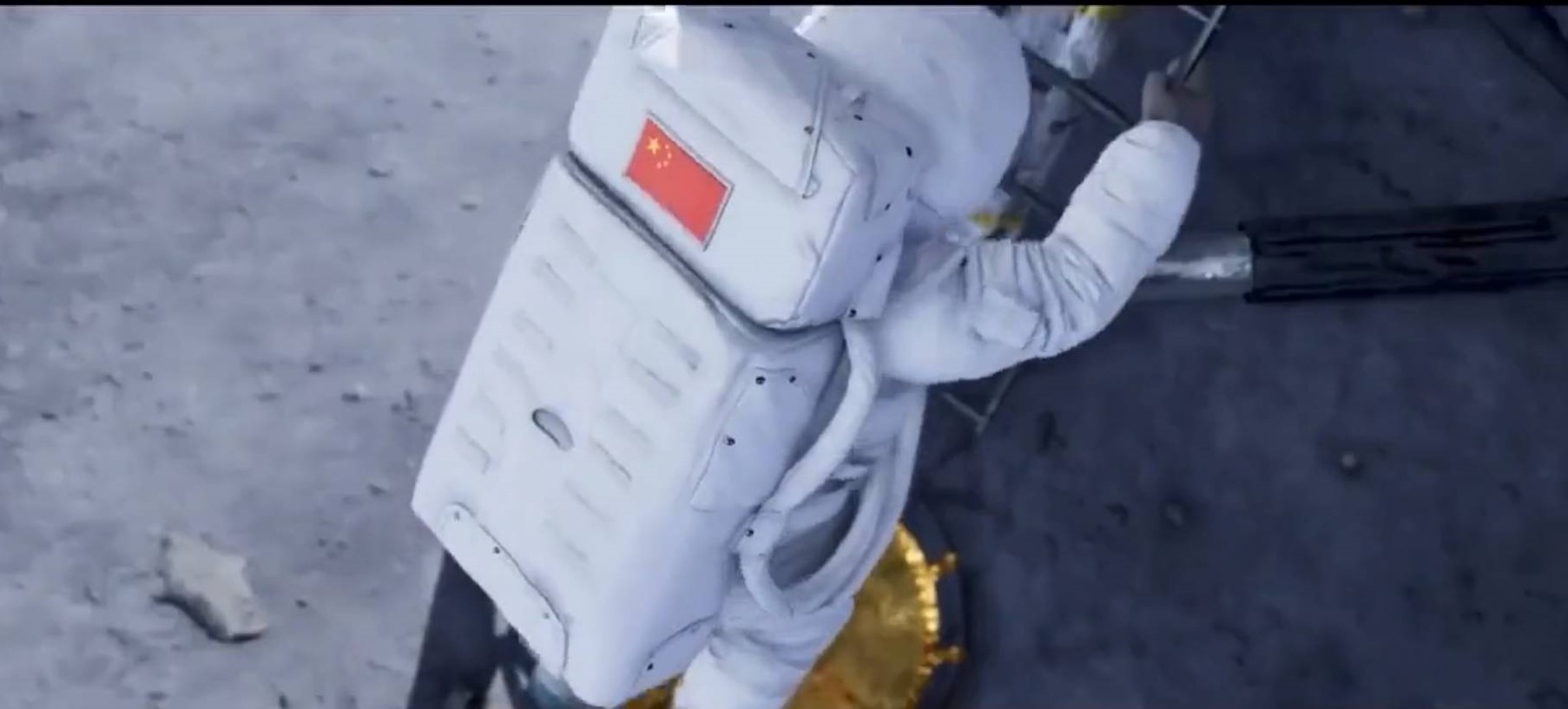
Image credit: CCTV/Inside Outer Space screengrab
China continues to scope out a future international lunar research station, one that will carry out lunar-based Earth observations and perform lunar resource utilization.
Zou Yongliao, head of the lunar and deep space exploration division of the Chinese Academy of Sciences, revealed the goals at a recent national space conference, as reported by China Science Daily.

Image credit: CCTV/Inside Outer Space screengrab
China plans to establish a basic model for a lunar research station based on two planned robotic exploration missions by 2028. Subsequently that research will expand into an international one, with objectives mainly involve studying the Moon’s evolution, exploring star formation and activities, and observing the sun and Earth from the Moon.
Historical necessity
Zou also mentioned the performance of scientific experiments, like growing plants on the lunar surface, and the utilization of lunar resources, such as Moon minerals and solar energy, the China Science Daily report adds. “The scientist noted that the Moon is still the “main field” of deep space exploration and the construction of an international lunar research station was a historical necessity.”
China is pushing forward on its crewed Moon exploration planning, reportedly making breakthroughs in key technologies that are required and intends to promote this year a research and development agenda toward a crewed Moon landing mission.

Image credit: GLOBALink/Inside Outer Space screengrab
Station operations: new chapter
Meanwhile, closer to home and in Earth orbit, China is pushing forward on the country’s space station as it enters a new chapter of application and development.
China’s Global Times reports that the China Manned Space Agency (CMSA) China has scheduled the next set of launches this year to the orbiting complex: the Tianzhou-6 cargo spacecraft and the Shenzhou-16 and -17 crewed space missions.

Image credit: CGTN/Inside Outer Space screengrab
Upcoming missions
China will launch the Tianzhou-6 cargo spacecraft in May, and the spacecraft has already been transported to Wenchang Space Launch Site in South China’s Hainan Province.
The current Shenzhou-15 crew of three is expected to return to Earth in June.
The crew members for Shenzhou-16, Shenzhou-17 have been selected and they are now training for the missions, the CMSA stated.
The CMSA highlighted that the first batch of international experiment projects that were jointly selected by the agency and the United Nation Office for Outer Space Affairs, will be uploaded to the China orbiting outpost this year.

