Archive for the ‘Space News’ Category
 Author:
  May 1st, 2023
Curiosity Left B Navigation Camera image taken on Sol 3815, May 1, 2023.
Image credit: NASA/JPL-Caltech
NASA’s Curiosity Mars rover at Gale Crater is now performing Sol 3816 duties.
Curiosity has arrived at a new location with some bright toned, and more rounded rocks in its vicinity, reports Elena Amador-French, Science Operations Coordinator at NASA’s Jet Propulsion Laboratory.
“Unfortunately, we could look but not touch as our wheels were positioned such that we could not safely unstow the arm for contact science. We typically have a large suite of arm activities in weekend plans but with those now removed, the science team had ample power and time to do remote sensing,” Amador-French adds.
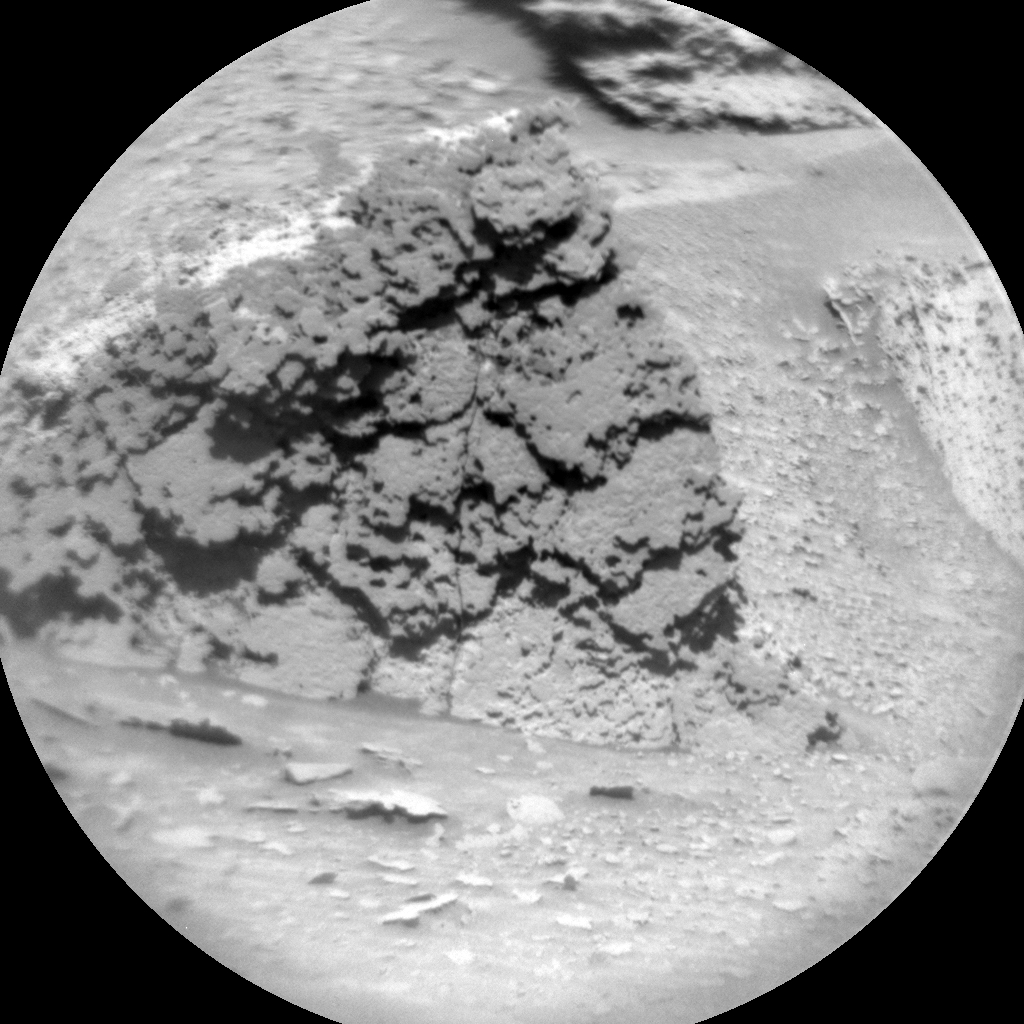
Curiosity Chemistry & Camera (ChemCam) Remote Micro-Imager (RMI) photo taken on Sol 3815, April 30, 2023.
Image credit: NASA/JPL-Caltech/LANL
Rhythmic textures
In a recent plan for Sols 3814-3816, the first sol had the robot use Mastcam to image the target “Ekeni,” a target just in front of the rover’s right front wheel “with interesting rhythmic textures, Amador-French notes. “Could they be due to how the sediment was originally emplaced or how it has since eroded?”
Similarly, the target “Fazendinha” appears to represent a transition between rock textures.

Curiosity Left B Navigation Camera image taken on Sol 3815, May 1, 2023.
Image credit: NASA/JPL-Caltech
High resolution Mastcam images will allow scientists to consider the history of these blocks.
“We’ll also use our ChemCam [Chemistry and Camera] instrument to provide compositional information for the target ‘Sao Miguel,’ giving us our first ‘taste’ of the bedrock in front of us,” Amador-French reports.
More Mastcam
On the second sol, the rover was to continue investigating the area around it with more Mastcam and another ChemCam LIBS [Laser Induced Breakdown Spectroscopy] observation on “Sao Tome” before taking a short drive – a scoot of just a few meters – to a potential sampling location.

Curiosity Left B Navigation Camera image taken on Sol 3815, May 1, 2023.
Image credit: NASA/JPL-Caltech
Mastcam will document this new location with a 360-degree mosaic, capturing all the terrain that surrounds Curiosity.
New location
On the third sol of the plan, ChemCam was slated to use its autonomous target selection capability, AEGIS, to collect compositional data from the robot’s new location.

Curiosity Left B Navigation Camera image taken on Sol 3815, May 1, 2023.
Image credit: NASA/JPL-Caltech
As is typical for weekend plans, it called for the rover to take a suite of environmental monitoring measurements – searching for dust devils with its navigation camera, studying the dust opacity in the atmospheric with Mastcam and engineering cameras, as well as a regular cadence of Rover Environmental Monitoring Station (REMS) observations.

Curiosity Front Hazard Avoidance Camera Left B image acquired on Sol 3815, May 1, 2023.
Image credit: NASA/JPL-Caltech
Sample dump
In addition to these remote sensing activities, also planned were two Chemistry & Mineralogy X-Ray Diffraction/X-Ray Fluorescence Instrument (CheMin) activities to set Curiosity up for potential sampling next week.
“Both activities are intended to ensure our instrument is as clean and prepared as possible to accurately measure mineralogy,” Amador-French concludes. “We’ll vibe CheMin’s inlet funnel, as well dump any potential remaining sample from the cell we intend to deliver our next sample to.”
As always, dates of planned rover activities are subject to change due to a variety of factors related to the Martian environment, communication relays and rover status.
 Posted in

Very Large Array (VLA) in New Mexico.
Credit: Bettymaya Foott, NRAO/AUI/NSF
A new processing system for the Search for extraterrestrial intelligence (SETI) is dubbed “COSMIC” – the Commensal Open-Source Multimode Interferometer Cluster.
COSMIC is spearheaded by the SETI Institute, in collaboration with the National Radio Astronomy Observatory and the Breakthrough Listen Initiative.
Now a massive radio array is joining the SETI quest and use of COSMIC to scout for signals from other galactic civilizations.

Credit: Breakthrough Listen
Desert real estate
Enter the National Science Foundation’s Karl G. Jansky Very Large Array (VLA), situated about 50 miles west of Socorro, New Mexico.
VLA is collecting data that scientists will analyze for the type of emissions that only artificial transmitters make, signals that would reveal the existence of a technically accomplished society.
The VLA consists of 27 antennas spread over 23 miles of desert real estate. Since 2017 the facility has been engaged in a radio reconnaissance of 80 percent of the sky.

Credit: SETI Post-detection Hub
Alien transmitter
While that VLA endeavor continues, observational data is being fed into a special receiver sporting very narrow (approximately one hertz wide) channels.
“Researchers expect that any signals from a deliberately constructed transmitter will contain such narrow-band components, and their discovery would indicate that the signal is not produced by nature, but by an alien transmitter,” explains a SETI Institute statement.
“COSMIC operates commensally, which means it works in the background using a copy of the data astronomers are taking for other scientific purposes,” said Paul Demorest, Scientist and Group Lead for VLA/VLBA Science Support at the National Radio Astronomy Observatory. “This is an ideal and very efficient way to get large amounts of telescope time to search for rare signals.
More comprehensive
By combining VLA sensitivity with COSMIC, the result is roughly a thousand times more comprehensive than any previous SETI search.
“History shows that major improvements in the sensitivity and range of exploratory experiments are often rewarded with the detection of a signal,” the SETI Institute statement adds. “If so, this effort might see the uncovering of a radio whisper that would tell us that we’re not the only intelligent inhabitants of the Milky Way Galaxy.”

If it’s just us, it seems like an awful waste of space. In the movie Contact, a radio astronomer receives the first extraterrestrial radio signal ever picked up on Earth…via the Very Large Array.
Credit: Warner Brothers
Also go to this interesting research paper — “Inferring the Rate of Technosignatures from 60 yr of Nondetection” — available at:

Image credit: ABS
The American Bureau of Shipping (ABS) has published the first international requirements for the design and construction of offshore spaceports, announcing those publicized requisites during an Offshore Technology Conference in Houston, Texas.
ABS provides classification and technical advisory services to the marine and offshore industries.
“The offshore space industry is growing rapidly, and ABS is already a pioneer in the field of offshore space support with our industry-leading work on autonomous rocket recovery droneships,” said Miguel Hernandez, ABS Senior Vice President, Global Offshore.
This new publication allows ABS, Hernandez adds, “to provide clear support for organizations that are engaging with regulatory agencies to reactivate assets such as offshore support vessels, barges and liftboats to support space flight.”
Offshore assets
ABS produced a new set of requirements based on service experience with industry leading aerospace rocket launch and recovery companies, according to an ABS statement, “to guide the burgeoning maritime aspects of the space flight industry in the safe design and construction of offshore assets.”
Up to now, there were no industry requirements “to address an offshore spaceport’s unique concept of operation,” said the ABS.
The ABS Requirements for Building and Classing Offshore Spaceports addresses several vessel types including barge type units, column-stabilized, offshore installations and self-elevating units.
ABS’ joint development project with SpaceX reviewed the remotely controlled functions of autonomous rocket recovery droneships used for booster rocket recovery at sea.
To view a copy of ABS Requirements for Building and Classing Offshore Spaceports, go to:

Image credit: Space Perspective/ABS
Spaceship Neptune
Last month, ABS and Space Perspective announced the first marine spaceport for human spaceflight.
Space Perspective is offering six-hour passenger-carrying balloon jaunts skyward in a pressurized capsule. The capsule accommodates eight passengers and a captain.
Called Spaceship Neptune, Space Perspective will launch from land at Kennedy Space Center in Florida, and now also from sea using the MS Voyager, which will reside on the coast of Florida, where the company is based.
According to the group, the first in a planned fleet of ships globally for Space Perspective, MS Voyager will also eventually enable flights around the Gulf and Caribbean.
Flexible launch locations
The ocean-going MS Voyager would transport passengers to an approved offshore location where a huge “space balloon” is filled with hydrogen and lift Spaceship Neptune and its passengers 20 miles above the Earth. At the end of the six-hour flight, the pressurized capsule will gently splash down in the ocean where MS Voyager will retrieve Spaceship Neptune’s captain and the aerial commuters.

Image credit: Space Perspective/ABS
ABS is providing class, engineering review and regulatory services for MS Voyager, with completion expected later this year.
Modifications to the near 300-foot-long offshore supply vessel are already underway and will include the addition of the balloon launch system and a space capsule A-frame, which will house Spaceship Neptune using a specially designed cradle on the aft deck.
“The future of space travel is on the water,” said Taber MacCallum, founder and co-CEO of Space Perspective.
“MS Voyager unlocks flexible launch locations, ideal launch conditions, and more frequent launch opportunities. Our collaboration with the experts at ABS is helping us make space travel more accessible to the world than ever before,” MacCallum said in a statement.
For more information on Space Perspective, go to:

The Atlas of Space Rocket Launch Sites by Brian Harvey with Gurbir Singh, Edited by Paul Meuser, Cartography by Katrin Soschinski; DOM Publishers; (2022); 272 pages; Hardcover: € 98.00 incl. MwSt., excl. shipping costs.
This is a seminal work, a unique and fascinating overview of all major launch sites on the globe. All 25 major global launch sites – from Eurasia, Asia-Pacific and the Americas – even several rocket departure points you may not have heard about previously.
Loaded with some 500 images, this volume features 100 exclusive maps to pinpoint the world of launch sites that operate in weather conditions from cold arctic conditions to hot desert and equatorial jungle.
As editor Meuser explains: “With most places hidden away in jungles, deserts, or amid the Central Asian steppes, these places exist for the most part out of the eye of the general public.”
Some information on the book’s marvelous-detailed launch sites was easy to access, while some sites have been forgotten or are still shrouded in secrecy, Meuser adds.
This comprehensive Atlas comes with descriptions of each site that include an outline of the history of the site in question, why and how it came to be situated in its location, its current use and future prospects, and its distinctive features.
Author Brian Harvey and co-author Gurbir Singh spotlight the steps of space travel in an unprecedented way; a richly documented text offers insights that have never been previously presented.
“The purpose of this book is to tell the architecture of launch sites in an accessible way,” writes Harvey. The book situates launch sites in their context, history, evolution, development, changing use, and future prospects, he adds.
To that end, this volume fits the task and provides far more, particularly given its selection of specially captioned and distinctive photos.
The reader will treasure this book that portrays the rich legacy of well-known and not-so-familiar launch sites, and appreciate more than ever how humankind has echoed rocket countdowns around the planet to open up outer space for an array of purposes.
For more information on this book, go to:
https://dom-publishers.com/collections/monographs/products/the-atlas-of-space-rocket-launch-sites

Image credit: CCTV/Inside Outer Space screengrab
China’s space station will receive the uncrewed Tianzhou-6 cargo craft in the first half of May.
Prior to the supply ship’s arrival, the currently docked Tianzhou-5 will depart from the station, opening up the docking hatch to receive the new cargo ship.
Tianzhou-5 is scheduled to be deorbited, taking a destructive plunge into Earth’s atmosphere.

Image credit: CCTV Video News Agency/CMSA/Inside Outer Space screengrab
Steady progress
The Shenzhou-15 crew members have made steady progress in various scientific experiments and space station maintenance work since they entered orbit on Nov. 30, 2022.
The trio’s six-month journey is scheduled to conclude around the end of May. At that time the Shenzhou-16 crew will take over station operations, supported by ground teams.
Monday marks completion of the fifth month of stay in orbit by the Shenzhou-15 crew: Fei Junlong, Deng Qingming and Zhang Lu.

Image credit: Shujianyang Wikimedia Commons, CC BY-SA
The crew members are currently busy with the maintenance work of environmental control and life support systems onboard the space station and continuing with different space experiments, according to the given plan.
Greatly enlarged
The Shenzhou-15 crew is sorting out the remaining supplies brought by the Tianzhou-5 cargo spacecraft last year. “Some consumables will be placed inside the spacecraft and will be burnt up together with the spacecraft during its descent toward the Earth,” reports China Central Television (CCTV).
The Tianzhou-6 is now being readied for launch at the Wenchang Satellite Launch Center in south China’s Hainan Province.

Image credit: CCTV/Inside Outer Space screengrab
CCTV reports that the cargo craft is nearly 35 feet (10.6 meters) long and has a liftoff weight of 13.5 tons, consisting of a propulsion section in the lower part and a cargo cabin in the upper half. It can transport up to 7.4 tons of supplies.
“There was an unsealed section for equipment in the cargo cabin but now the equipment was transferred to the propulsion cabin. Therefore, the transport space inside the cargo cabin has been greatly enlarged, with the effective loading capacity rising from 18.1 cubic meters to 22.5 cubic meters, equivalent to an increase of 20 percent,” Wang Ran, chief designer of the cargo spacecraft system under the China Academy of Space Technology told CCTV.
More fruit!
The vehicle will carry 1.75 tons of propellants, including 1,543 pounds (700 kilograms) for the space station, clothing, food, drinking water and fresh fruits for the crewed Shenzhou-15 and 16 missions. The fresh fruits weigh approximately 70 kg, twice as much as that of the Tianzhou-5.

Image credit: CGTN/Inside Outer Space screengrab
“In the past, due to lack of experience, we were not sure how long the fruits can be kept in space. But now, we have the condition and ability to deliver more fruits to the space station after summarizing our experience of using fresh fruits in space for the past six months and a year,” said Wang.
In addition, the cargo list adds a set of xenon cylinders as fuel propellant backup for the space station, according to the China Global Television Network (CGTN). They can help maintain the station in orbit or adjust its position, slowing down the consumption of the propellant.
China’s Tiangong orbital outpost currently consists of three major components – a core module and two science lab modules – and is connected with two visiting craft – the Shenzhou-15 crew ship and the Tianzhou-5 cargo ship.
For informative videos on the upcoming cargo spacecraft launch, go to:

Taking the fall. Space hardware dives into Earth’s atmosphere with some fragments making their way to the ground.
Image credit: ESA/D.Ducros
Russia, China, and the United States should step up cooperation in the space sector for the sake of common progress, and one of those steps is de-cluttering the global space commons.
Earlier this week, according to a report in Russia’s TASS news agency, Wang Guoyu, the founder of Beijing Shiyu Outer Space Consulting, broached the multi-country action idea at an event dedicated to the International Day of Intellectual Property held in Beijing.

Credit: The Aerospace Corporation’s Space Safety Institute
“We propose a novel approach to remediate the most dangerous debris in low Earth orbit – massive derelicts owned by Russia, the U.S. and China. These objects are in imminent danger of colliding, after which the cost and risk of operating in space will increase for everyone,” said Chuck Dickey, co-leader of Three Country-Trusted Broker (TCTB) in Houston, Texas.
TCTB was created and is led by Dickey (United States), Valentin Uvarov (Russia) and Guoyu Wang (China).

Image credit: TCTB
Principles of cooperation
Dickey told Inside Outer Space that TCTB sees cooperation among these governments, perhaps achieved by using a neutral, transparent, international non-governmental organization to shape a plan for space junk remediation.
TCTB would act like a mediator to facilitate cooperative planning, and also act as the prime contractor to manage the work.
“Planning would help reach consensus on necessary principles of cooperation,” Dickey added, “including cost, risk and information sharing, legal consent, object selection methodology, a procurement plan, dispute resolution mechanisms, and protection of sovereign prerogatives.
UN recognition
“We are currently seeking recognition from the UN (Consultative Status) in order to facilitate cooperation,” Dickey said, through the UN Committee on the Peaceful Uses of Outer Space and the UN’s Office of Outer Space Affairs. A vote on this recognition is currently scheduled in New York during May 15-23, he said.
In an opinion piece, “Orbital Debris Threatens Your Future – Here’s the Remedy” provided to Inside Outer Space, Dickey and colleagues from Russia and China, underscore that there is risk today from high mass debris in high and low Earth orbit.

In-orbit explosions can be related to the mixing of residual fuel that remain in tanks or fuel lines once a rocket stage or satellite is discarded in Earth orbit. The resulting explosion can destroy the object and spread its mass across numerous fragments with a wide spectrum of masses and imparted speeds.
Credit: ESA
“Like cross-border environmental pollution or genocide,” that risk is “another ‘problem from hell’” – requiring cooperation among sovereign governments to avoid a tragedy, “but also because the risk it portends is based on statistical probabilities.”
Derelict space hardware
According to the TCTB’s website, there are roughly two thousand mostly intact derelict rocket bodies and spacecraft left in space by Russia, the U.S., China, France, the European Space Agency (ESA), Japan and India, before the commercial space era began.
“These government-owned objects, each weighing between one and ten tons, share similarities which make them amenable to consideration for remediation purposes as a single class or ‘market,’ distinguishing them from other types of orbital debris or cross-border terrestrial pollution on Earth.”
For more information on Three Country-Trusted Broker, go to:

CCTV/Inside Outer Space screengrab
China space officials have outlined step-by-step plans for planting Chinese footprints onto the surface of the Moon before 2030.
The country’s lunar exploration initiatives are being detailed during Space Day presentations this week, held in Hefei, the capital of east China’s Anhui Province.
Lunar relay constellation
China plans to launch Queqiao-2, or Magpie Bridge-2, a relay satellite for communications between the far side of the Moon and Earth in 2024, according to the China National Space Administration (CNSA).

Image credit: CCTV/Inside Outer Space screengrab
That relay satellite would support the fourth phase of China’s lunar exploration program, providing communications services for the now in place Chang’e-4 far side rover/lander, then Chang’e-6, Chang’e-7, and Chang’e-8 missions.
The Queqiao-2 relay mission also involves release of two experimental satellites — Tiandu-1 and Tiandu-2 — for communication and navigation, developed by China’s Deep Space Exploration Lab. This twosome would conduct technological experiments and provide a reference for the design of the future Queqiao constellation.

International Lunar Research Station. Image credit: CNSA
Lunar research station
According to China Central Television (CCTV), Chang’e-6 is poised to collect samples from the far side of the Moon around 2024.
Chang’e-7 involves landing on the lunar south pole and searching for water. It is expected to be launched in 2026 and to land in the South Pole-Aitken Basin area of the Moon. According to the CNSA, the Chang’e-7 mission to the Moon will include an orbiter, a lander and a “flyer” – a hopper to move between sites to search for water in permanently darkened craters.

China’s Chang’e-7 lander launches hopper craft to search for lunar ice.
Image credit: CCTV/CNSA/Inside Outer Space screengrab
Chang’e-8, launched around 2028, is to conduct a survey of lunar materials at the Moon’s south pole, which scientists hope will be used to build houses by using 3D printing technology, CCTV reports.
Through these three missions, China aims to complete the building of the basic model of the international lunar research station on the south pole of the moon by 2030.

Image credit: CCTV/Inside Outer Space screengrab
Moon-centered internet
Wu Weiren, chief designer of China’s lunar exploration program, said in a CCTV interview: “We are building a satellite constellation around the Moon, a system that can provide communication, navigation, and remote sensing services. After that, we can carry out future deep space exploration.”
The Moon-centered deep space internet can be extended to a broader scope in the solar system. With the internet, the Moon will have access to TV programs, games and a WiFi network. “And astronauts will never get bored on the Moon,” Wu added.

Large-scale exploration
Wu emphasized that by 2030, “the Chinese people will definitely be able to set foot on the Moon. That’s not a problem.” As for whether China can build a house, make bricks and have access to communication services on the Moon, “they are expected to be verified by sufficient Chang’e-8 experiments, which will provide a guarantee for large-scale lunar scientific exploration in future,” he said.
China formally established its lunar exploration “Project Chang’e” in 2004.
In December 2020, the Chang’e-5 lunar probe brought back 1,731 grams of samples from the Moon, marking the completion of the three-step lunar exploration program of orbiting, landing and return.
To watch informative videos on China’s Moon exploration plans, go to:

Newly created Crescent subsidiary of Lockheed Martin initially calls for a two satellite system of data relay spacecraft circuiting the Moon in 2025.
Image Credit: Lockheed Martin
The future of Moon exploration for lunar science and long-term development is advancing private plans for communicating from and navigating across the crater-pocked lunar terrain.

NASA’s Artemis program to establish a sustainable presence on the Moon will require extensive communications and relaying of data back to Earth.
Image credit: NASA
A newly formed deep space infrastructure company is putting in place a common infrastructure around the Moon, offering it as an inventive commercial network service for future outposts and other assets that will soon dot that distant landscape.
For more information, go to my Multiverse Media SpaceRef story:
Crescent: Giving the Moon the Business
https://spaceref.com/newspace-and-tech/crescent-giving-the-moon-the-business/

Curiosity Left B Navigation Camera photo taken on Sol 3808, April 23, 2023.
Image credit: NASA/JPL-Caltech
NASA’s Curiosity Mars rover at Gale Crater is now performing Sol 3810 duties.
“We have cleared the canyon,” reports Catherine O’Connell-Cooper, a planetary geologist at the University of New Brunswick; Fredericton, New Brunswick, Canada.
There were a lot of tricky rocks the robot had to climb over.

Curiosity Left B Navigation Camera photo taken on Sol 3808, April 23, 2023.
Image credit: NASA/JPL-Caltech
Free-wheeling territory
“We don’t exactly have free-wheeling territory up ahead in our drive direction, but it is a little flatter. This hopefully will give us better views of the path ahead and reduce slippage as we drive, so that we can drive for longer than we have been recently,” O’Connell-Cooper adds.
Rover planners outlined a recent plan that had Curiosity taking an over 80 feet (25 meter) drive, much more ambitious than recent wheeled adventures.

Curiosity Left B Navigation Camera photo taken on Sol 3808, April 23, 2023.
Image credit: NASA/JPL-Caltech
“We also will hopefully have a higher rate of passing our “SRAP” test (this stands for Stability Risk Assessment Process and is the way we evaluate rover stability) up here than we did last week as we climbed the canyon,” O’Connell-Cooper points out.
Failing SRAP, Mars scientists cannot use robotic arm-mounted instruments, the Mars Hand Lens Imager (MAHLI) and the Alpha Particle X-Ray Spectrometer (APXS).

Curiosity Mast Camera Right photo taken of Dust Removal Tool action on Sol 3808, April 23, 2023.
Image credit: NASA/JPL-Caltech/MSSS
Solid workspace
“Fortunately, our weekend drive was successful – it took us where we had planned to go, ending with some solid workspace and safely parked to allow us to take the arm out for contact science,” O’Connell-Cooper adds.
Rover viewed bedrock has strong laminations apparent along its side and a flat top. The flat top is smooth enough for brushing, so use of the Dust Removal Tool “Anortosito Repartimento” is on tap before taking MAHLI images, analyzing with APXS and getting a Mastcam multispectral image, all centered on the same spot for maximum science return.

Curiosity Left B Navigation Camera photo taken on Sol 3808, April 23, 2023.
Image credit: NASA/JPL-Caltech
The robot’s Chemistry and Camera (ChemCam) will use its Laser Induced Breakdown Spectroscopy (LIBS) instrument to look at an interesting fracture face, which looks like an upturned smile in a recently taken workspace image. “Galeras” is centered on the far right corner of the fracture, where the fracture is thickest.
Detail from great distance
Curiosity’s ChemCam will also take a long distance image via the rover’s Remote Micro-Imager (RMI) much further afield to “Gediz Vallis ridge.”
These long distance RMI photos can acquire a lot of detail from a great distance, “helping to inform discussions about future science campaigns and potential drive directions,” O’Connell-Cooper observes.
Mastcam will take two mosaics close to the rover, a smaller mosaic looking at a laminated target (“Vichada”) to the right of the workspace, and a larger mosaic covering the main block in Curiosity’s workspace (including the ChemCam and APXS/MAHLI targets) and the way that sand has gathered in a trough feature around the block.

Curiosity Front Hazard Avoidance Camera Right B image acquired on Sol 3808, April 23, 2023.
Image credit: NASA/JPL-Caltech
Wind scour patterns
“Further afield, Mastcam will get an observation of the stratigraphy of the Chenapau butte and some interesting wind scour patterns,” just beyond the rover’s recent workspace.
O’Connell-Cooper concludes the report by noting that the robot is continuing to monitor environmental conditions in Gale.
In addition to routine Dynamic Albedo of Neutrons (DAN) and Rover Environmental Monitoring Station (REMS) measurements, Mastcam will acquire three tau measurements, which help to constrain the amount of dust in the atmosphere. Navcam will take a “dust devil” movie, in the hopes of catching a wind vortex in action.

Curiosity Left B Navigation Camera photo taken on Sol 3808, April 23, 2023.
Image credit: NASA/JPL-Caltech

Image credit: Barbara David
Europe is establishing an ambitious space agenda, one designed to accelerate a broad portfolio of objectives while catching up in launchers, as well as robotic and human exploration beyond Earth orbit.
The European Space Agency (ESA) is outward looking, across a number of space fronts, some of them evolutionary…some revolutionary.
Go to my exclusive Multiverse Media’s SpaceRef interview with Josef Aschbacher, Director General of the European Space Agency at:

