Archive for the ‘Space News’ Category
 Author:
  May 16th, 2023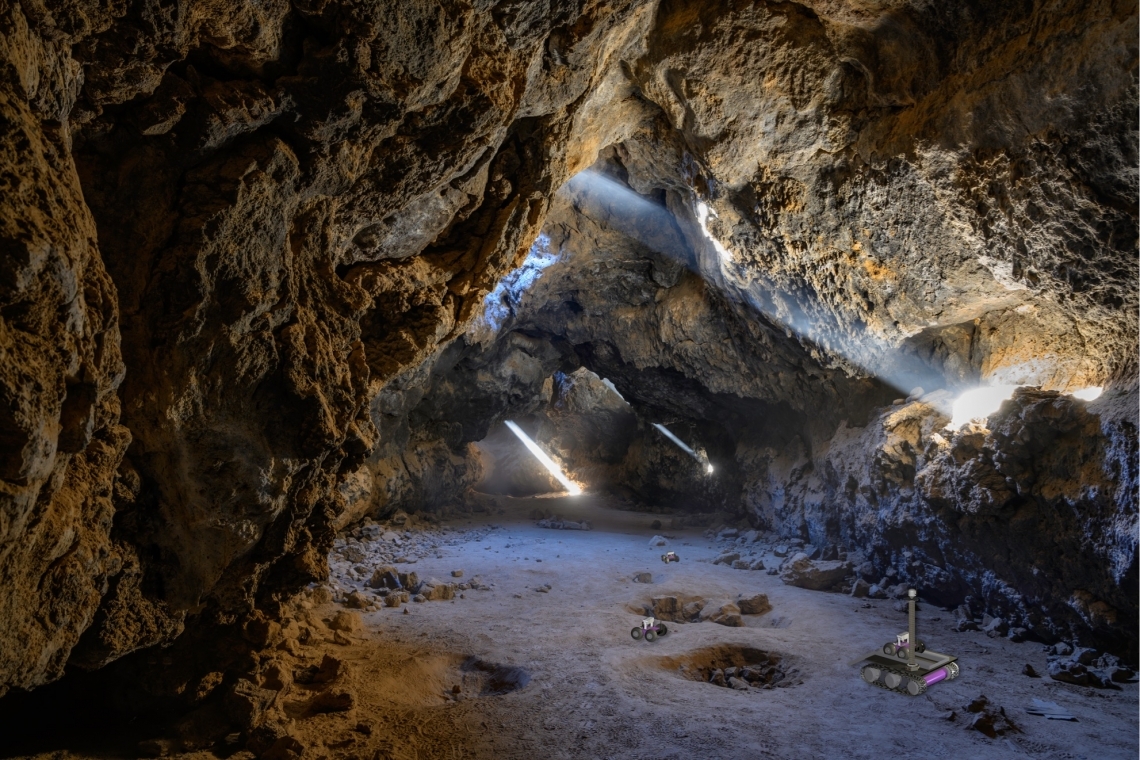
Artist’s impression of the breadcrumb scenario, autonomous rovers can be seen exploring a lava tube after being deployed by a mother rover that remains at the entrance to maintain contact with an orbiter or a blimp. Image credit: John Fowler/Wikimedia Commons, Mark Tarbell and Wolfgang Fink/University of Arizona
Engineers have developed a system that allows autonomous vehicles to scout out underground habitats for astronauts.
Researchers at the University of Arizona’s College of Engineering have developed technology that would allow a flock of robots to explore subsurface environments on other worlds.
Their patent-pending concept the “Breadcrumb-Style Dynamically Deployed Communication Network” paradigm is admittedly a nod to the fairy tale “Hansel and Gretel.”
Maintaining awareness
According to a university statement, continuously monitoring their environment and maintaining awareness of where they are in space, the rovers proceed on their own, connected to each other via a wireless data connection, deploying communication nodes along the way. Once a rover senses the signal is fading but still within range, it drops a communication node, regardless of how much distance has actually passed since it placed the last node.

Cave opening on Mars as imaged by the Mars Reconnaissance Orbiter’s powerful HiRISE camera. Protected from the harsh surface of Mars, such pits are believed to be good candidates to contain Martian life, making them prime targets for possible future spacecraft, robots and even human interplanetary explorers.
Image credit: NASA/JPL/University of Arizona
Wolfgang Fink, associate professor of electrical and computer engineering at the University of Arizona, explains that the breadcrumb approach provides a robust platform allowing robotic explorers to operate underground or even submerged in liquid environments.
One idea detailed by Fink and colleagues is sending an orbiter carrying a balloon and a lake lander to study one of the hydrocarbon seas on Saturn’s moon Titan.
Such swarms of individual, autonomous robots could also aid in search and rescue efforts in the wake of natural disasters on Earth, Fink adds.
Search for off-Earth life
The communication network approach has the potential to herald a new age of planetary and astrobiological discoveries, said Dirk Schulze-Makuch, president of the German Astrobiological Society, as noted in the university statement.
“It finally allows us to explore Martian lava tube caves and the subsurface oceans of the icy moons – places where extraterrestrial life might be present,” Schulze-Makuch adds.
For more information on this intriguing concept, go to:
To read the research paper – “A Hansel & Gretel breadcrumb-style dynamically deployed communication network paradigm using mesh topology for planetary subsurface exploration” – at:
https://www.sciencedirect.com/science/article/abs/pii/S0273117723001187?via%3Dihub
 Posted in

Artwork depicts Russia’s Venera-D design.
Image credit: Roscosmos/NPO Lavochkin
Russia is pressing forward on creation of a new Venus exploration spacecraft – Venera-D.
A “draft design” for Venera-D is scheduled to begin in January 2024.
Champion spacecraft design leaders, Russia’s NPO Lavochkin Scientific and Production Association, have blueprinted the Venera-D space complex.
Based on Lavochkin results, work schedules, technical specifications and the contracting of co-executing organizations for Venera-D have been formed, as has a Council of Chief Designers.

Image credit: Bulletin/NPO Lavochkin

Image credit: Bulletin/NPO Lavochkin
Refusal of the United States
Due to the 2022 Russian invasion of Ukraine, and implementation of US sanctions, then Roscosmos head, Dmitry Rogozin, announced that any continued participation between Russia and the United States on Venera-D was inappropriate.
Both Roscosmos and Lavochkin made clear in Internet postings that “the refusal of the United States to cooperate in no way affected the tasks of the Venera-D mission for remote and contact studies of the atmosphere, surface, internal structure and surrounding plasma of Venus at the modern scientific and technical level.”
Russia’s Roscosmos and the Russian Academy of Sciences are also working on the possibility of returning to Earth samples of the soil, atmosphere and aerosols of Venus – tagged as the Venera-V mission. “Its concept involves the consistent launch of completely new search-and-return and landing spacecraft,” reports Roscosmos.
The former Soviet Union, now Russia, has a rich history of Venus exploration, one that between 1961 and into the early 1980s scored a number of milestones in reconnoitering the cloud-veiled world – even from its hellish surface via short-lived landers.

Image credit: NASA
The world is abuzz, perhaps befuddled, about the growing use of artificial intelligence then strapping it to ChatGPT, the AI-powered language model.
“It” can respond to queries, discuss a lot of topics, and crank out writing pieces.
So let’s blue-sky a bit…but mix in the mystique of the Red Planet Mars.

Could robots on Mars be super-charged with AI/ChatGPT to perform on-the-spot research, relaying their discoveries in real-time?
Image credit: NASA/JPL-Caltech
Well-paginated
Say that data is digested, assessed, appraised and assembled in some scientific form. Then the product, in well-paginated condition, with footnotes to boot, is transmitted to a scientific journal, like Science or Nature, for publication.

ChatGPT is an AI-powered language model, “trained” and fed vast amounts of Internet information.
Image credit: OpenAI
I reached out to several leading researchers, presenting this off-Earth, on-Mars scenario, with a variety of reactions in return.
For more information, go to my new Space.com story – “ChatGPT on Mars: How AI can help scientists study the Red Planet” – at

New drill site. Curiosity Front Hazard Avoidance Camera photo acquired on Sol 3823, May 9, 2023.
Image credit: NASA/JPL-Caltech
NASA’s Curiosity Mars rover at Gale crater is now performing Sol 3827 tasks.
The rover team reports successful drilling of a new hole on the Ubajara target.
Catherine O’Connell-Cooper, a planetary geologist at the University of New Brunswick; Fredericton, New Brunswick, Canada reports: “Drilling campaigns force us to sit and stop, whilst the ‘Ubajara’ drill sample is analyzed.” This takes a week or two, depending on the types of analysis that Chemistry & Mineralogy X-Ray Diffraction/X-Ray Fluorescence Instrument (CheMin) and the Sample Analysis at Mars (SAM) Instrument Suite chose to do.
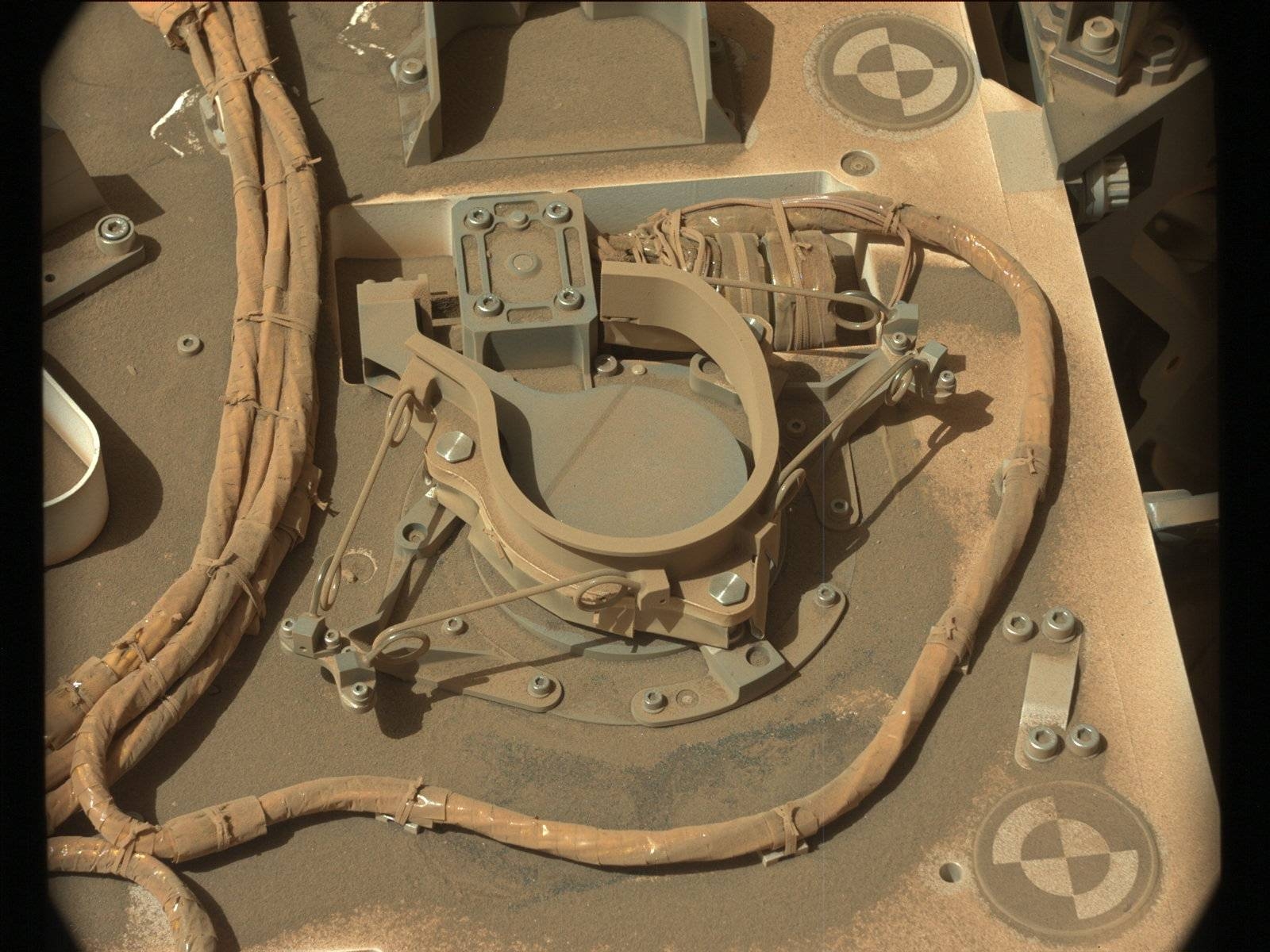
Curiosity Mast Camera Left image acquired on Sol 3825, May 11, 2023.
Image credit: NASA/JPL-Caltech/MSSS
Busy and power hungry
“This might sound like we are sitting quietly, just waiting but drill campaigns are furiously busy and ‘power hungry,’” O’Connell-Cooper notes.
CheMin planned the first part of their analysis last Wednesday, later adding a second set of analysis, integrating over the drilled “Ubajara” sample.
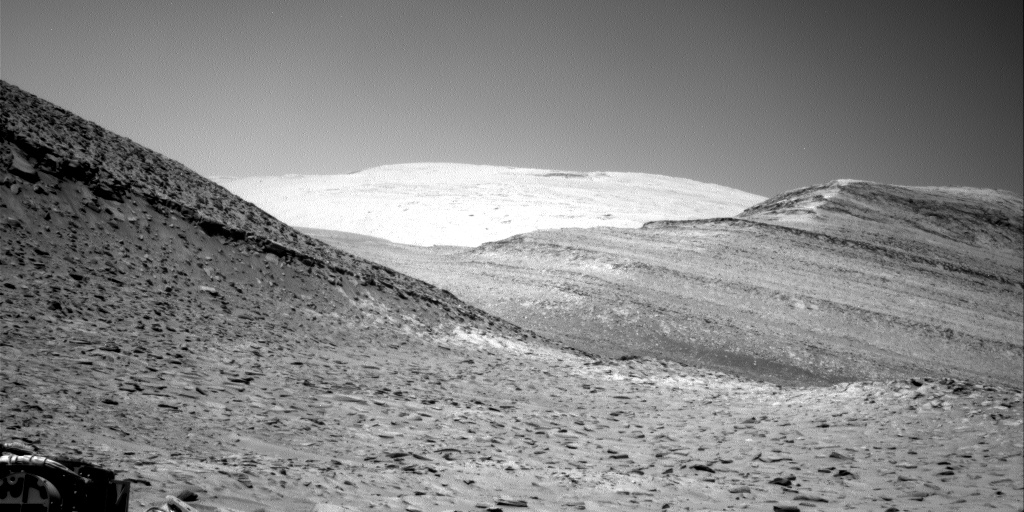
Curiosity Right B Navigation Camera photo acquired on Sol 3825, May 11, 2023.
Image credit: NASA/JPL-Caltech
SAM will do a “preconditioning” activity, which sets SAM up for analysis next week. These activities are power intensive, which constrains what geology and environmental scientists can fit into the plan, O’Connell-Cooper adds.
In an earlier report, Ashley Stroupe, a mission operations engineer at NASA’s Jet Propulsion Laboratory, explains: “Normally we take images of the CheMin inlet immediately before and after sample drop-off. This time we are doing the sample drop-off at night in order to minimize the time between dropping off and analysis. As a result, we have to take the images of the inlet outside of the arm activities. After a nap, Curiosity wakes up to drop off the sample to CheMin for an overnight analysis.”
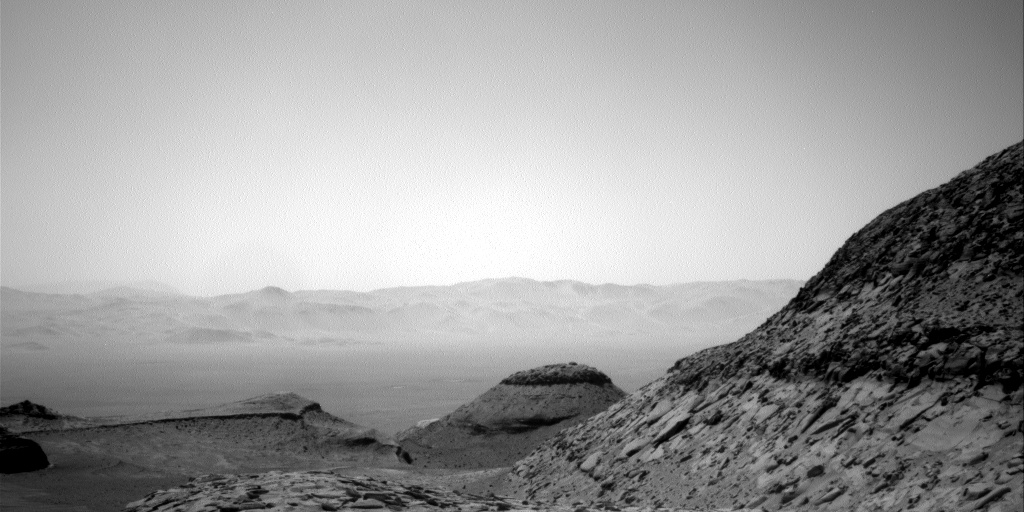
Curiosity Right B Navigation Camera photo acquired on Sol 3825, May 11, 2023.
Image credit: NASA/JPL-Caltech
“Science is very anxious to see how this sample differs from Tapo Caparo,” Stroupe points out, which was about 80 feet (25 meters) lower in elevation than the Ubajara location.
Small, raised resistant features
“Often, we leave a workspace with regret,” O’Connell-Cooper notes, as “there are only so many hours in a given day, and even though a given sol (day) on Mars is longer than one on Earth, we almost always identify more targets than we can possibly fit in!”

Curiosity MAHLI image of “Ilha Grande.”
Image credit: NASA/JPL-Caltech/MSSS.
So geologists are taking the opportunity to analyze everything that the robot’s Chemistry and Camera (ChemCam) can reach.
A newly scripted plan focused on small raised resistant features.
Hard to target
Earlier last week, the Alpha Particle X-Ray Spectrometer (APXS) analyzed a really small nodule feature at “Ilha Grande,” and there was interest in analyzing this target with ChemCam’s Laser Induced Breakdown Spectroscopy (LIBS) instrument, which is well suited to hitting these types of targets.
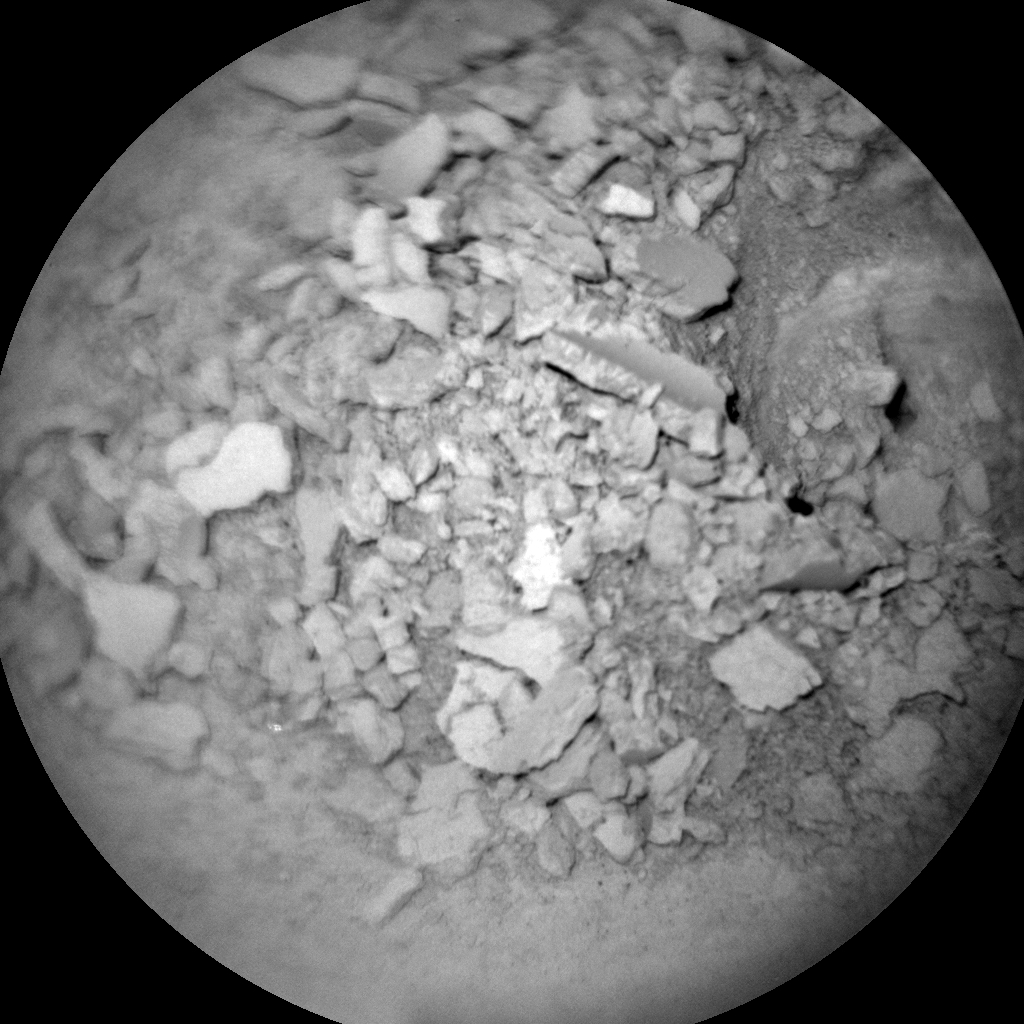
Curiosity Chemistry & Camera (ChemCam) Remote Micro-Imager (RMI) photo acquired on Sol 3825, May 11, 2023.
Image credit: NASA/JPL-Caltech/LANL
“ChemCam will use LIBS on Ilha Grande and a nearby larger mass of similar material (“Tucuma”) (which was too rough to analyze with APXS as it posed a danger to the instrument) in this plan,” O’Connell-Cooper explains. “The raised features are so small (Ilha Grande is 1 centimeter at its widest point) that they are hard to target with any great confidence, so targeting this early in our Ubajara stop will allow them to be refined and repeated if necessary. Mastcam will also image both ChemCam targets.”
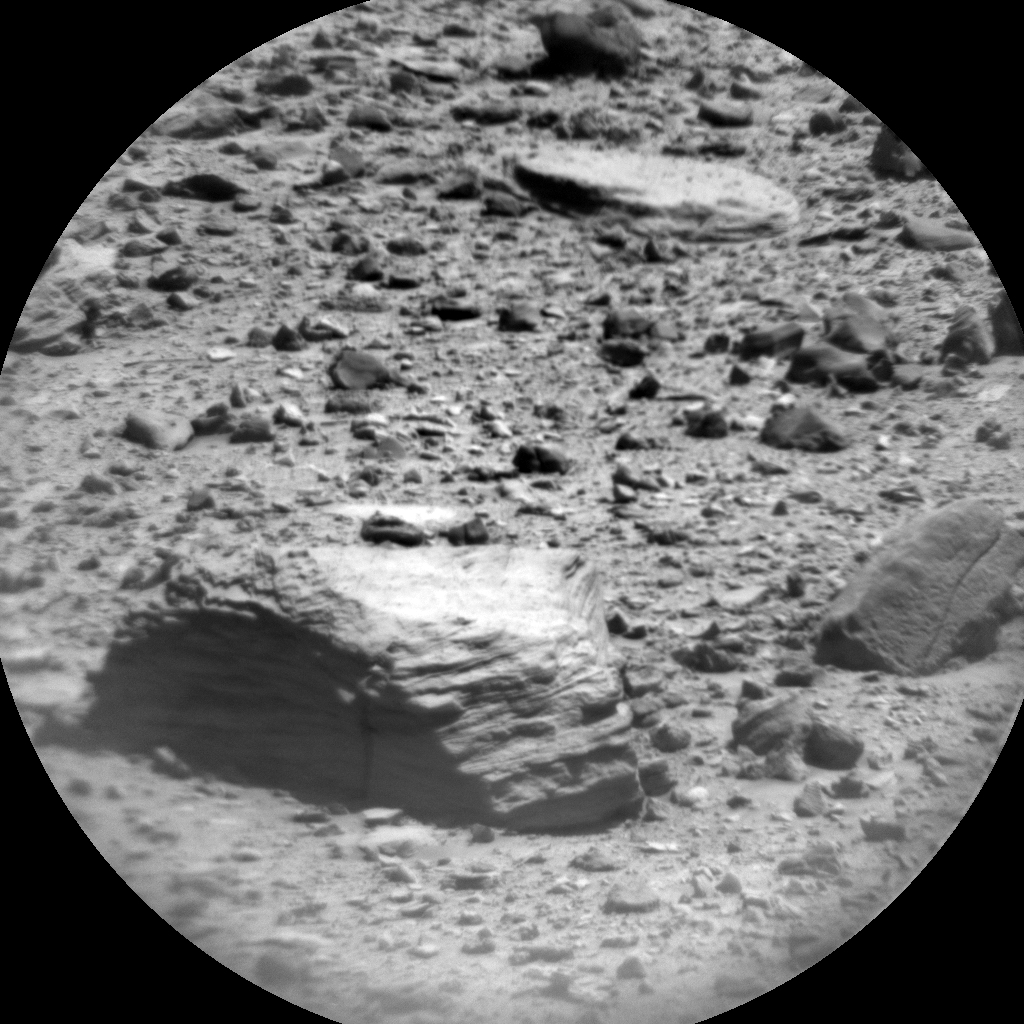
Curiosity Chemistry & Camera (ChemCam) Remote Micro-Imager (RMI)
photo taken on Sol 3826, May 12, 2023.
Image credit: NASA/JPL-Caltech/LANL
Change detection
In parallel to the geological themed part of the plan, the environmental group also uplinked several environmental activities.
“Mastcam will take two change detection images. These are typically done when we are stopped in a place for a few days. Taking images at the same time of day on a number of consecutive days allows us to see how much sediment is moving in our workspace, giving us an idea of wind directions and strengths,” O’Connell-Cooper reports.
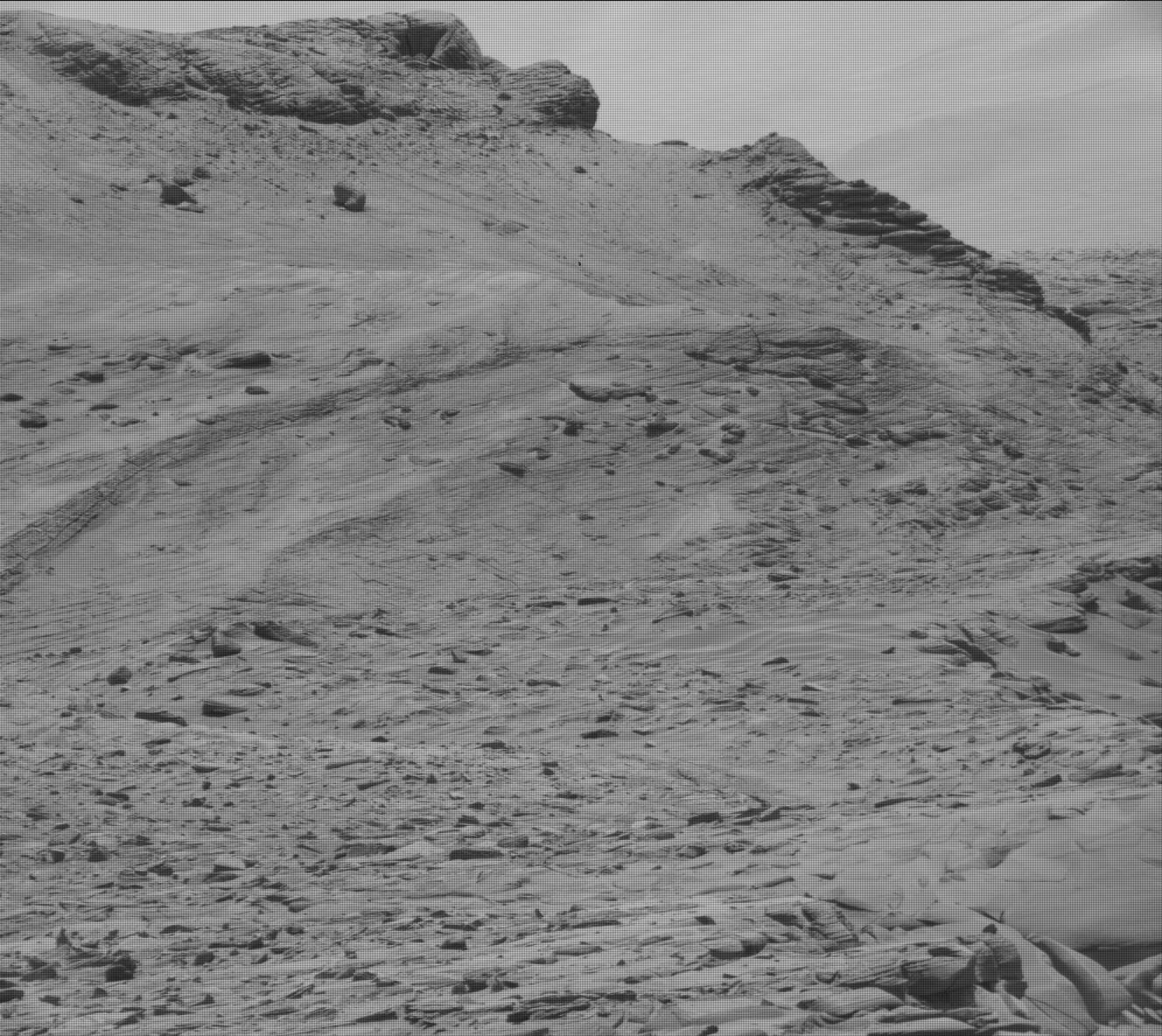
Curioisty Mast Camera Right photo taken on Sol 3824, May 10, 2023.
Image credit: NASA/JPL-Caltech/MSSS
Navcam will also look for indirect evidence of winds, through “dust devil” movies that can also tell researchers about wind direction and strength.
Mastcam will take a “crater rim extinction” image and a full tau measurement, to measure dust both within the crater and overhead in the atmosphere, whilst Navcam will survey clouds above the rover.
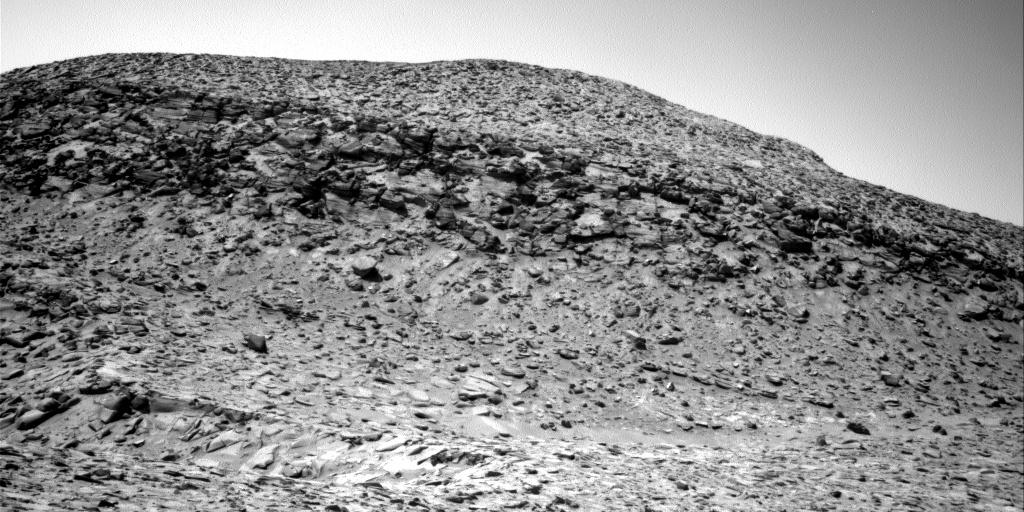
Curiosity Right B Navigation Camera photo acquired on Sol 3825, May 11, 2023.
Image credit: NASA/JPL-Caltech
The environmental portion of the plan is rounded out by Rover Environmental Monitoring Station (REMS) and Dynamic Albedo of Neutrons (DAN) activities, looking at temperatures (REMS) and potential traces of hydrogen (DAN), O’Connell-Cooper concludes.
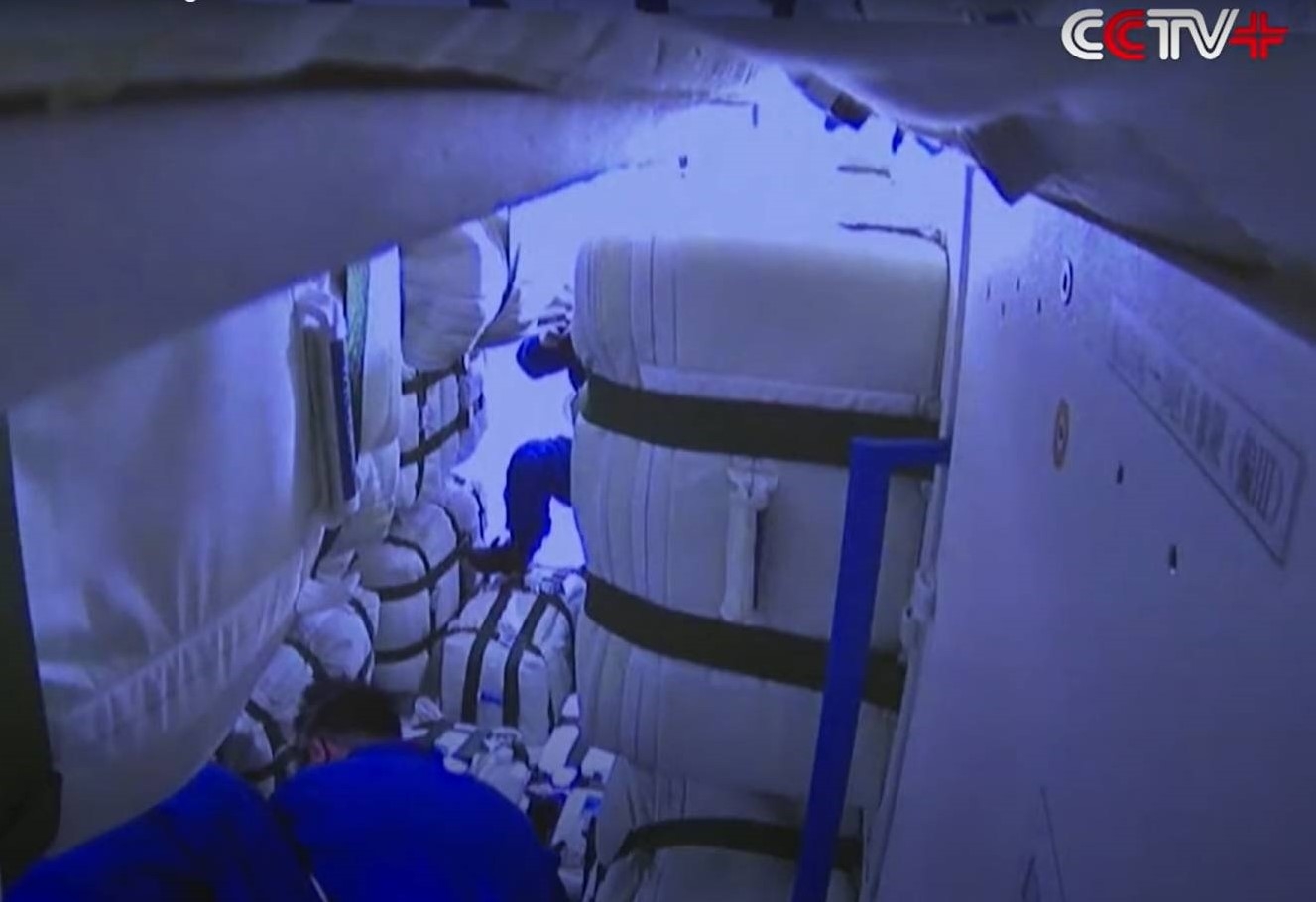
Image credit: CCTV/CMSA/Inside Outer Space screengrab
China’s Shenzhou-15 astronauts have entered the recently docked Tianzhou-6 cargo spacecraft to begin unloading goods and equipment that will enhance the country’s Tiangong space station program.
Fei Junlong, Deng Qingming and Zhang Lu began unpacking the supply craft on Friday.
The coupling of the Tianzhou-6 cargo spacecraft with the station signals an “integrated flight phase.”
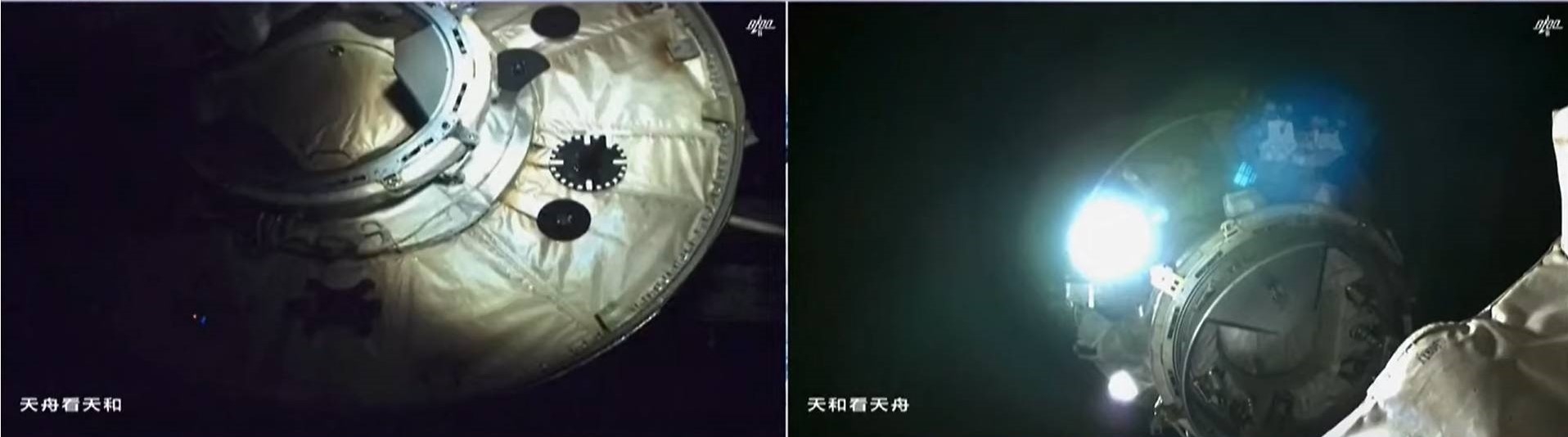
Image credit: CCTV/CNSA/Inside Outer Space screengrab
China Central Television (CCTV) reports that the Tianzhou-6 hauled over 7 tons of goods, including around 5.8 tons of daily supplies for the six crew members of the upcoming Shenzhou-16 and Shenzhou-17 missions, and 1.75 tons of propellant, of which 700 kg is to refuel the space station.
Loading volume
“The configuration layout of Tianzhou-6 has been optimized, which expanded the loading volume by about 20 percent compared to Tianzhou-5,” said Feng Yong, chief commander of Tianzhou cargo spacecraft.
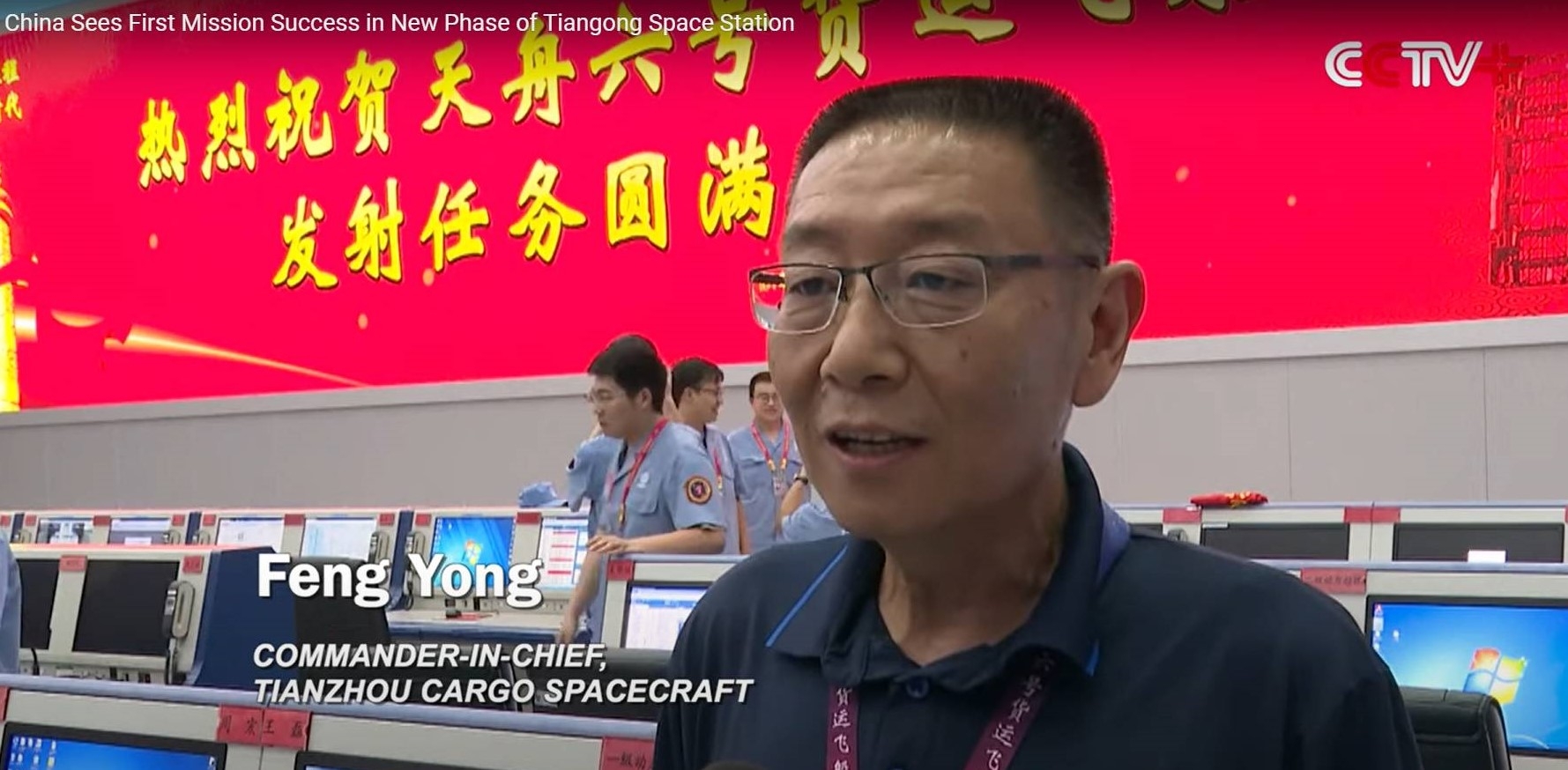
Image credit: CCTV/Inside Outer Space screengrab
“After Tianzhou-6 forms a combination with the space station, for its long-term operations, it will continue to provide orbit control and attitude control support for the space station, as well as provide technical verification of new measurement technologies for the rendezvous and docking of the following manned missions,” Feng told CCTV.
International astronauts
Chen Jie, director of the Integrated Planning Department under the China Manned Space Agency (CMSA) added: “We need to further reduce costs and improve capabilities, for which we will develop a new generation of reusable manned round-trip transportation systems.”
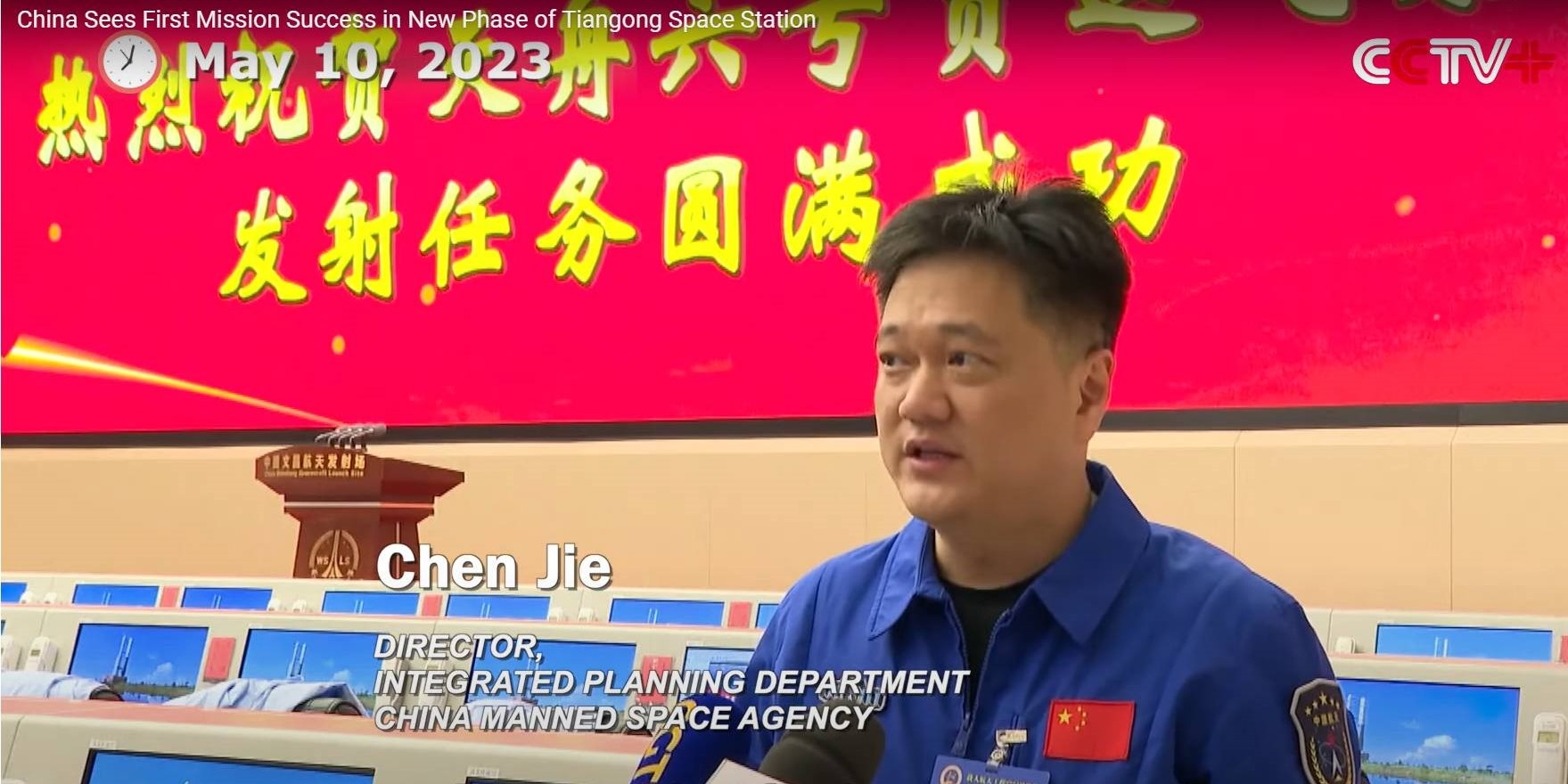
Image credit: CCTV/Inside Outer Space screengrab
Chen said that, according to the new mission plan, “the space station will operate for more than ten years. We will implement one or two cargo resupply missions each year, two manned missions and an astronaut in-orbit rotation, and we will also train international astronauts to participate in our joint flights.”
Stem cell research
Supplies on-board Tianzhou-6 include stem cell experimental units, which were loaded on the cargo craft five hours before the launch due to its specific requirements for time and temperature. They will be quickly moved to a biotechnology experiment cabinet inside the station’s Wentian lab module.
Tianzhou-6 also carried clothes, drinking water and food — including over 150 pounds (70 kilograms) of fresh fruits for the crew.

Image credit: CCTV/Inside Outer Space screengrab
Move that refrigerator
“Next, we plan to send a large refrigerator to the space station, to ensure the supply of not only fruits but also some frozen food for the astronauts. For example, if they wish to have fried steak in the space station in the future, we will freeze the beef on the ground and deliver it to the space station,” said Wang Ran, chief designer of the cargo spacecraft system under the China Academy of Space Technology. “We will bolster our ability gradually in the future to ensure a better life for the astronauts.”
Go to these new videos focused on the newly arrived supply ship at:
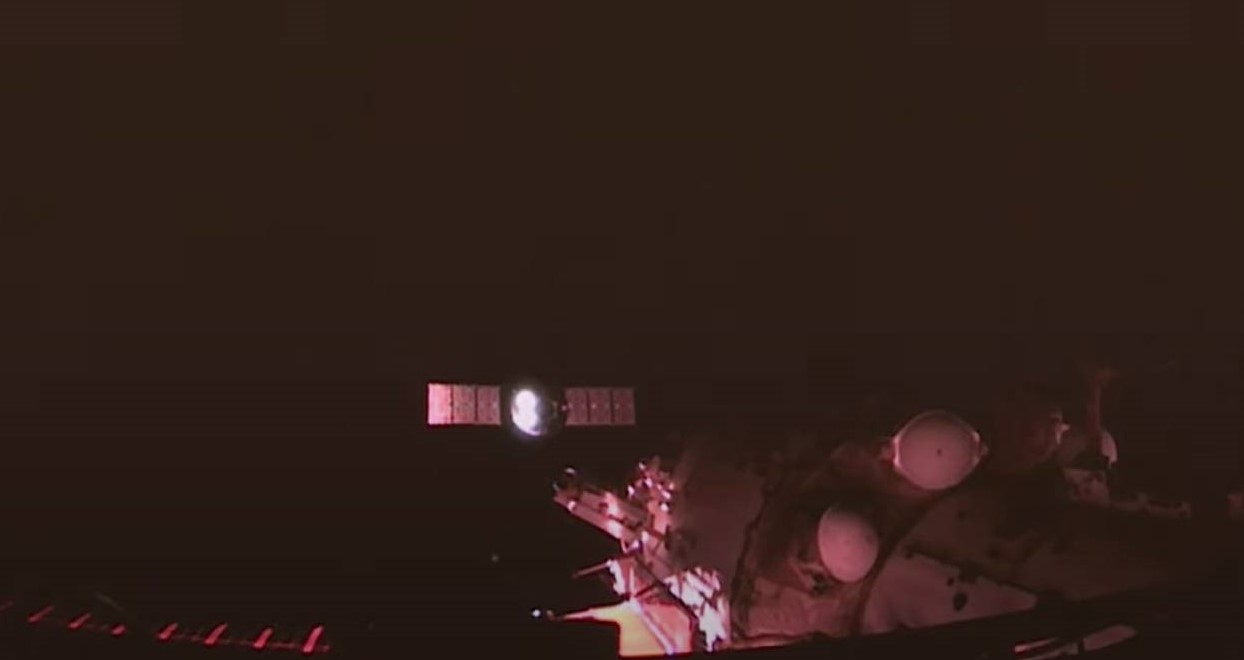
Image credit: GLOBALink/CNSA/Inside Outer Space screengrab
A China-launched cargo craft has docked with the country’s space station, the first link-up since the orbital facility entered the application and development stage.
The Tianzhou-6 supply ship was lofted by a Long March-7 Y7 carrier rocket on Wednesday from the Wenchang Spacecraft Launch Site in south China’s Hainan Province.
With the cargo craft now attached to the station, the current three-person Shenzhou-15 crew will enter the supply ship and transfer just-arrived payloads.
Image credit: CCTV/CNSA/Inside Outer Space screengrab
Packed with payloads
According to China news sources, there are roughly 260 packages with a combined weight of nearly 5.8 metric tons, including living necessities enough for a three-member crew for 280 days.
There are 98 packages of science payloads, with a combined weight of 1,574 pounds (714 kilograms), including new equipment, spare parts and experiment-related materials. These payloads are slated to be utilized in 29 scientific experiments and technological tests, from life sciences, biology and fluid physics in microgravity, to combustion and material sciences.

Shenzhou 15 crew.
Image credit: CCTV/CNSA/Inside Outer Space screengrab
Tianzhou-6 also carries 1.7 tons of propellant, of which 1,543 pounds (700 kilograms) will be fed into the Tiangong space station enabling engine firings to maintain the outpost’s orbit.
Mini-satellite to be released
According to reports, the cargo craft will also release a mini-satellite, developed by Dalian University of Technology.
The satellite is reportedly a high-resolution Earth remote sensing CubeSat that weighs 37 pounds (17 kilograms). This CubeSat is to verify high-resolution remote sensing technologies, a domestic “OpenHarmony” operating system, advanced satellite components and “ultralight multiple satellite deployers.”
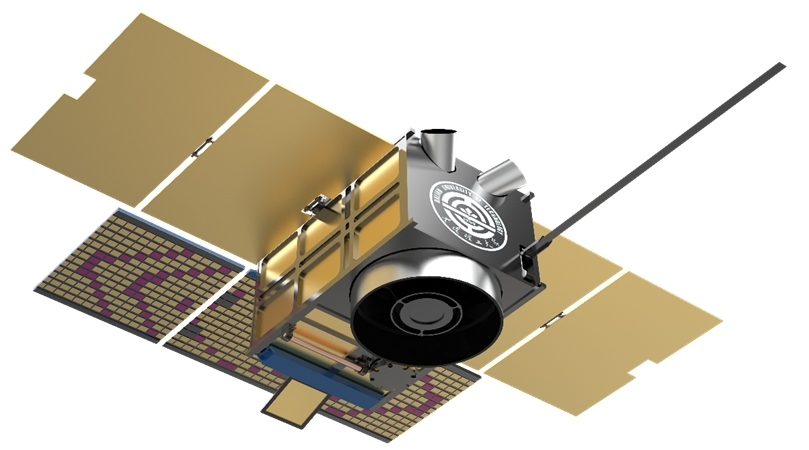
The experimental Dalian-1 CubeSat launched onboard the Tianzhou-6 cargo craft.
Image credit: Dalian University of Technology
“The main payload of the satellite is a high-resolution multispectral camera, capable of achieving low-cost sub-meter high-resolution observation on ocean and Earth in orbit,” one story notes, quoting professor Xia Guangqing, chief designer of the satellite told China Global Television Network (CGTN).
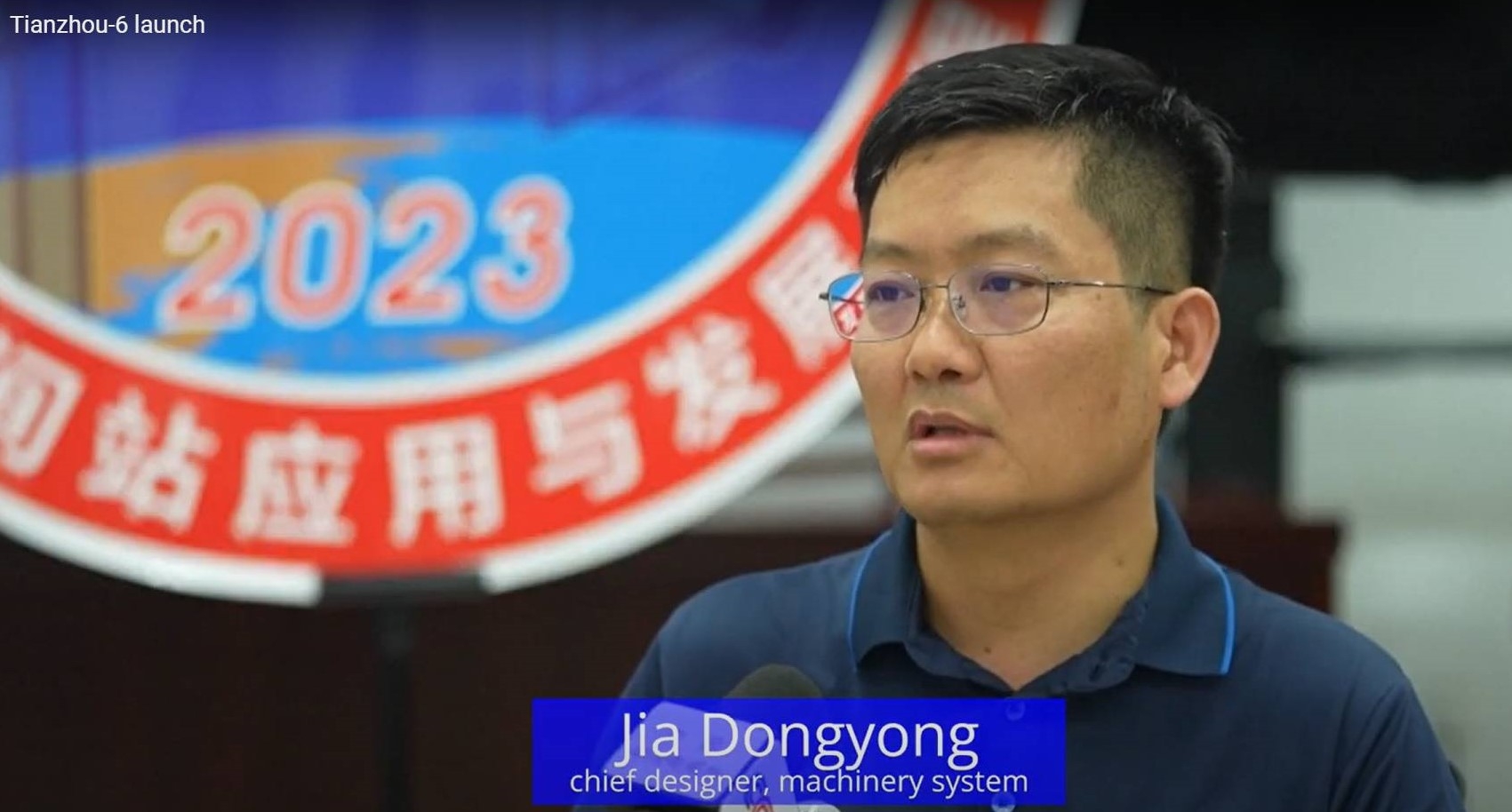
Image credit: CCTV/CNSA/Inside Outer Space screengrab
Re-docking older supply ship
Meanwhile, the in-space and loitering older cargo craft — Tianzhou-5 – is set to re-dock with the Earth-orbiting facility in the coming weeks for further use. It is to be filled with wastes from the current crewed mission, said Jia Dongyong, chief designer for the Tianzhou cargo spacecraft system under the China Academy of Space Technology (CAST).

Image credit: Shujianyang Wikimedia Commons, CC BY-SA
Use of the older cargo vessel, re-docked after its separation, is not always done, Jia pointed out.
Tianzhou-5 will rendezvous and re-dock with the space station’s forward port after the departure of the Shenzhou-15 crew who will return to the Earth after their six-month space journey end later this month, Jia told China Central Television (CCTV).
Image credit: CMS
Launched on Nov. 12, 2022, Tianzhou-5’s lifespan is yet to end, Jia added. “Besides, the space inside the orbiting space station is limited and precious, and the Tianzhou-5 has not been filled. So it is going to dock with the forward port of the space station, and will be parked there in use for a period of time. The cargo craft will end up with being packed with wastes.”
Go to these new videos showcasing the supply ship arrival at:
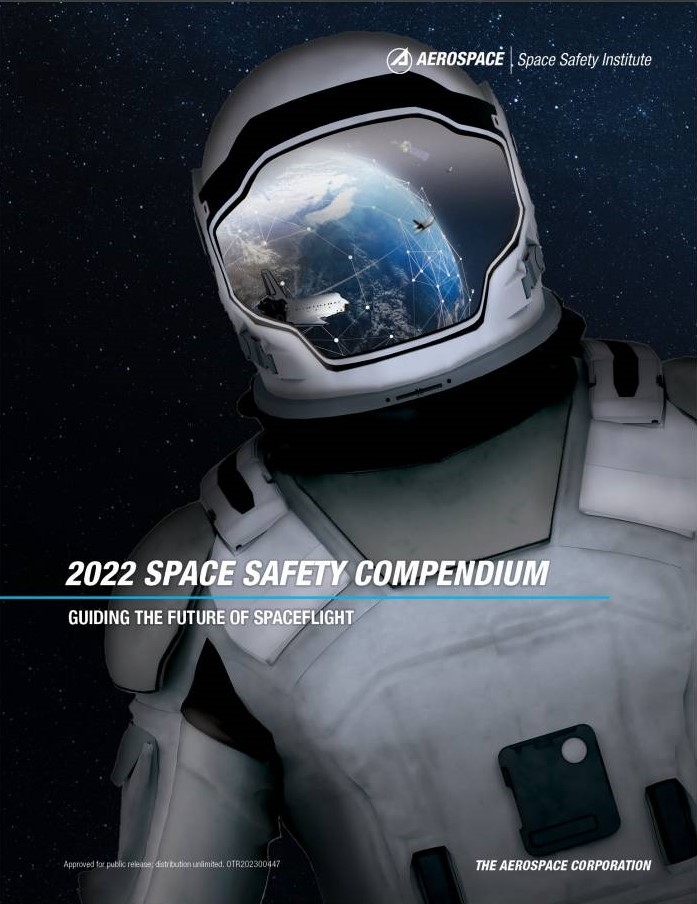
There are many challenges the space sector faces in this era of enhanced commercial space activity.
The Aerospace Corporation has issued a 2022 Space Safety Compendium – Guiding the Future of Spaceflight, edited by Samira Patel and Josef S. Koller
The publication covers policy implications of issues within five core mission areas, as well as two crosscutting areas:
— space operations assurance
— space situational awareness
— satellite launch and reentry
— cyber and spectrum security
— human space flight safety
Dominate: commercial space
“The space sector is undergoing an unprecedented period of growth that expands the scope of what is possible in space and who is involved,” the report notes. We have shifted away from the 1960s and 70s model of centralized, government-led space activities to a new model that increasingly leverages the dominating commercial space market.”
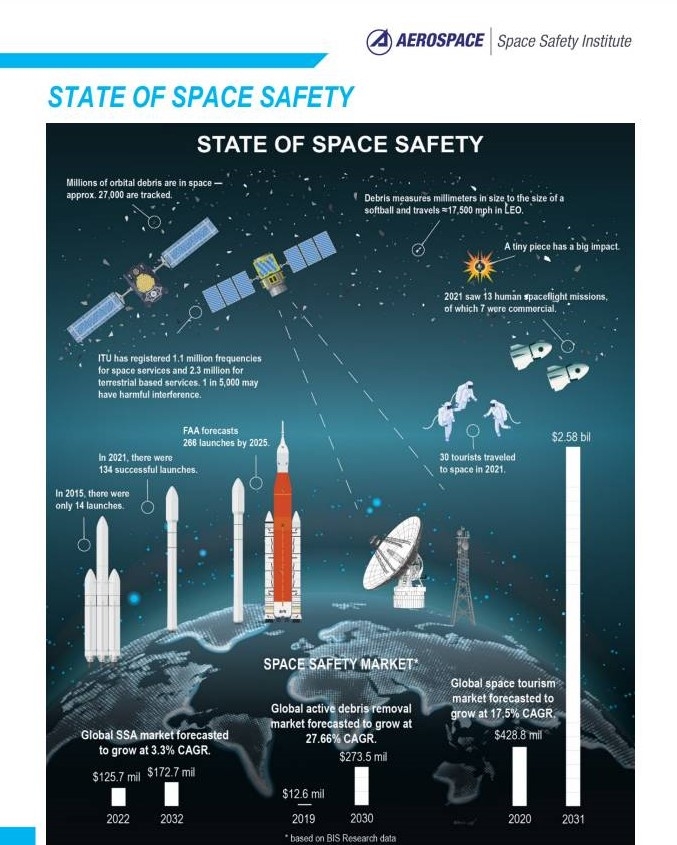
Furthermore, the report points out that new actors in space represent a wide array of international actors, partnership and business models, and commercial entrants. “They have expanded the scope of missions and capabilities in space that include everything from commercial human spaceflight to growing industrial activity such as mining and pharmaceutical development.
Keeping space safe
The new report asks: How do we keep space safe so that Earth and its inhabitants continue to benefit?
“We are seeing increasing uncertainty in regulation and, in some cases, not even a clear picture of which U.S. government agencies bear the responsibility of handling which issues. There is also friction between regulators and new actors as regulations could become more burdensome for new
entrants, giving a competitive advantage to those who have long been in space,” the report states.
To access a copy of 2022 Space Safety Compendium – Guiding the Future of Spaceflight go to:
https://aerospace.org/sites/default/files/2023-03/SSI_Compendium_2022_v1-1_1.pdf

Image credit: CCTV/Inside Outer Space screengrab
China this week is expected to reach a new high point in outfitting its multi-modular space station as it moves from assembly in Earth orbit to on-going utilization.
For more information, go to my new Multiverse Media’s SpaceRef story – “China’s Space Station: Moving Towards Utilizing the Orbiting Outpost” – at:
https://spaceref.com/space-stations/chinas-space-station-utilizing-orbiting-outpos/
Also, go to this newly issued China Central Television (CCTV) video on China completing a site-wide final rehearsal before launching the Tianzhou-6 cargo spacecraft at:
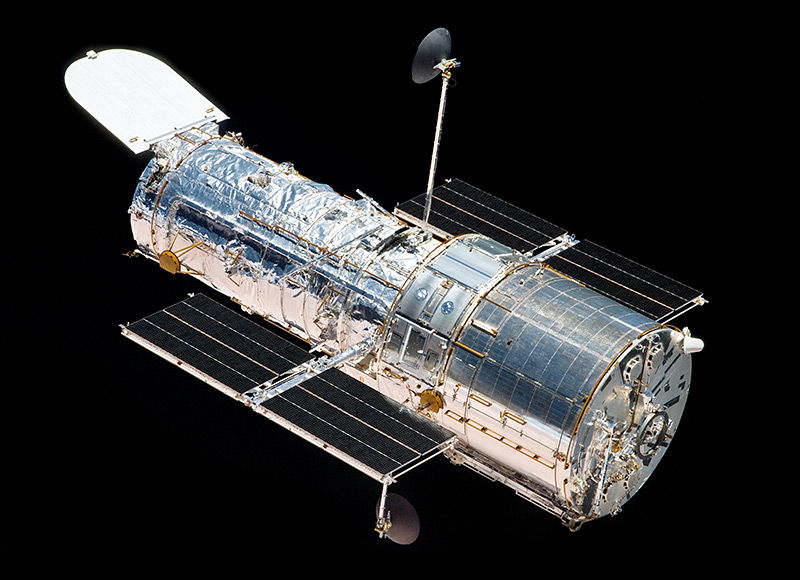
NASA’s venerable Hubble Space Telescope – still carrying out sightseeing observations thanks to several servicing missions.
Image credit: NASA
NASA has been on the lookout for a lift service – one that would place the Hubble Space Telescope into a higher, longer-lived orbit.
The revered space observatory is predicted to reach 310 miles (500 kilometers) in approximately 2025. At that point, the space agency notes, there is a risk that rendezvous with Hubble would be more difficult.
Bottom line: Unless the space scope is reboosted to a higher orbit before that time, the large, Earth-circling eye on the Universe is predicted to reenter the Earth’s atmosphere in the mid 2030’s.
Reboost request
Enter a new collaboration between the commercial space groups, Momentus and Astroscale, responding to a NASA Hubble reboost request for information.
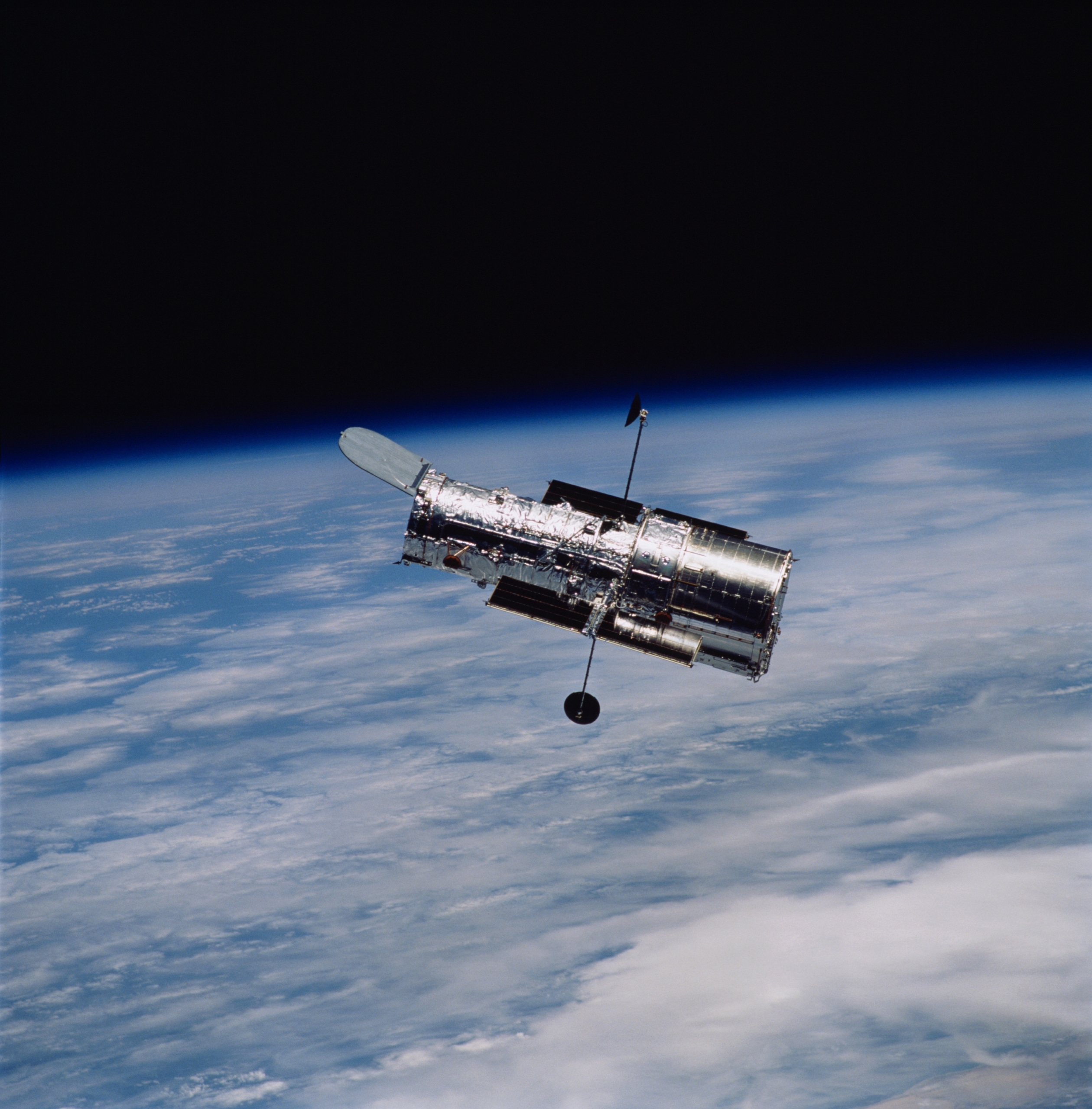
Image credit: NASA
The proposed solution by the private space groups includes safe relocation of Hubble and removal of nearby threatening debris from the telescope’s new orbit. Reboost would extend the life of the iconic 33-year-old, billion-dollar space telescope, according to a Momentus statement.
Orbital stability
“Leveraging Momentus’ flight heritage with three orbital service vehicles on-orbit today and Astroscale’s expertise in RPOD (rendezvous, proximity operations and docking), we found our product suites to be synergistic in support of a major NASA mission,” said John Rood, Momentus Chief Executive Officer.
“Even at 33, Hubble is fully capable of continuing its mission; where it is aging is in its orbital stability,” Rood added, pointing to the collaboration as a cost-effective way to continue operating Hubble.

Momentus Vigoride Orbital Service Vehicle (OSV) undergoes vibration testing.
Image credit: Momentus
Saving Hubble scenario
The proposed mission concept makes use of a Momentus Vigoride Orbital Service Vehicle (OSV), rocketed into low-Earth orbit on a small launch vehicle.
Once on orbit, Astroscale’s RPOD technology built into the OSV would be used to safely rendezvous, approach and then complete a robotic capture of the telescope.
Once mated, the OSV would perform a series of maneuvers to raise the Hubble altitude by over 30 miles (50 kilometers).
Lastly, according to the Momentus statement, removal of surrounding and threatening space debris in Hubble’s new orbit would also use the Vigoride and Astroscale’s RPOD capabilities, a prioritized task after the completion of the primary reboost mission.
Wake-up call
“The Hubble’s need for a reboost should be an important wake-up call as to why the space industry needs dynamic and responsive in-space infrastructure, and in this case, to extend opportunities to explore our universe,” said Ron Lopez, President and Managing Director of Astroscale U.S. in a statement.
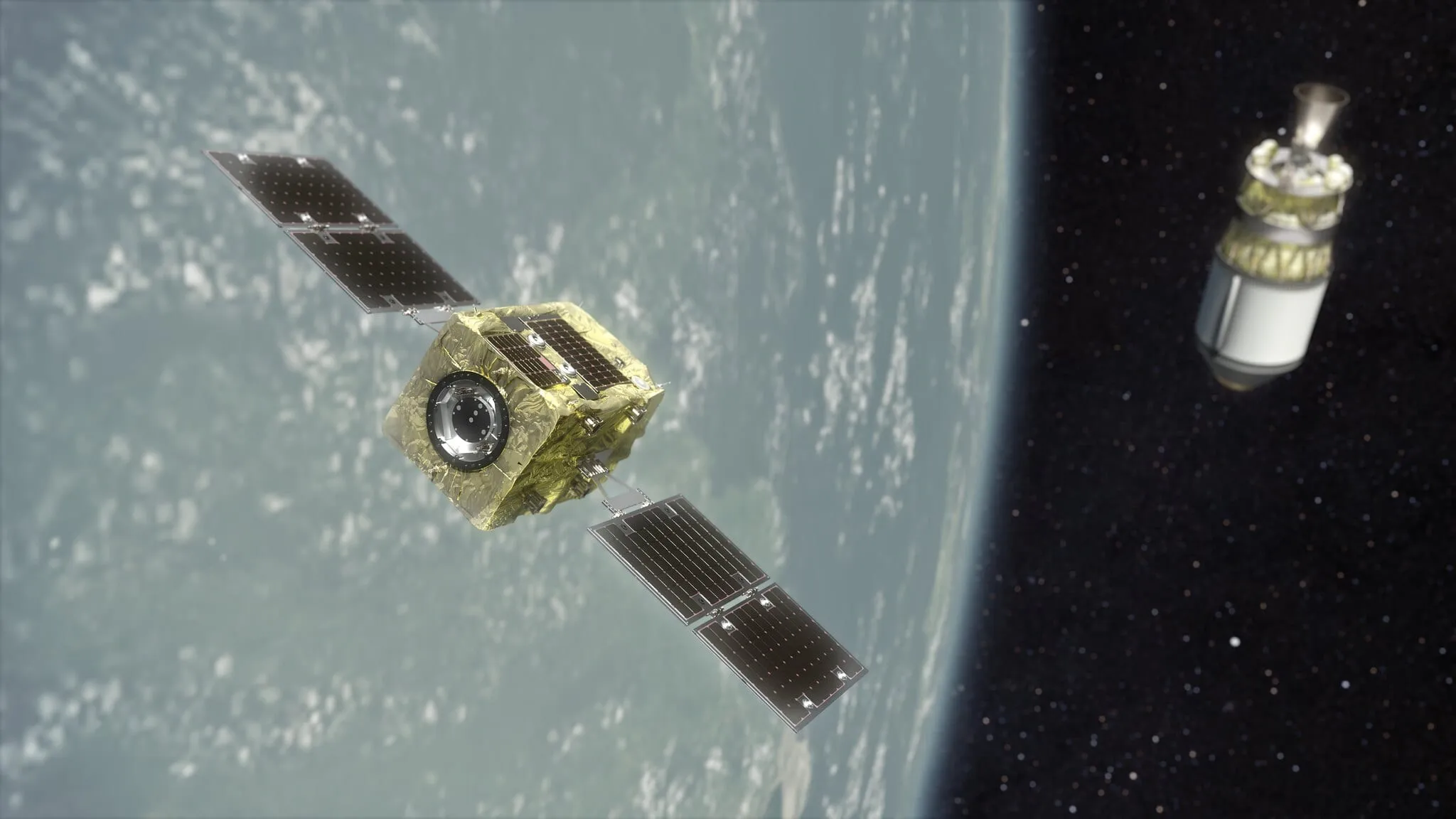
Image credit: Astroscale
“The proliferation of in-space servicing and assembly allows us to reimagine how our investments are managed in space; it is the foundation on which the new space age is being built,” Lopez added. “What we’ve proposed to NASA are options—options that were not available during the five previous crewed servicing missions and that leverage the best of in-space servicing to achieve mission objectives and advance U.S. leadership in space.”
Polaris program
Late last year, NASA and SpaceX signed an unfunded Space Act Agreement to study the feasibility of a SpaceX and Polaris Program idea to boost the agency’s Hubble Space Telescope into a higher orbit with a Dragon spacecraft – at no cost to the government.
The Polaris Program is a human spaceflight program organized by Jared Isaacman, an entrepreneur, who commanded the first all-civilian Inspiration4 spaceflight in September 2021. Subsequently, he purchased flights from SpaceX in order to create the Polaris Program.
At the time of that NASA/SpaceX signing, NASA underscored that there is no formal go-ahead on such an uplifting idea for Hubble, but is exploring the prospect of commercial possibilities.

New Horizons was built by the Johns Hopkins Applied Physics Laboratotry.
Credit: NASA/Johns Hopkins University Applied Physics Laboratory/Southwest Research Institute/Steve Gribben/Alex Parker
OPEN LETTER ON HELIOPHYSICS INVESTIGATIONS FROM NEW HORIZONS
We are heliophysicists on or benefiting from data from the NASA New Horizons mission.
New Horizons has enabled uninterrupted heliophysics measurements throughout the heliosphere for over a decade, alongside its groundbreaking Kuiper Belt and other planetary observations. Three of its instruments have provided unique, essentially continuous, in-situ measurements of solar wind and interstellar pick-up ions, energetic particles, Galactic Cosmic Rays and dust. Additionally, New Horizons’ UV spectrograph is obtaining regular, unparalleled remote measurements of interplanetary hydrogen and all-sky mapping of the heliospheric boundary and nearby interstellar clouds.
The conduct of the mission’s heliophysics observations is both synoptic and in no way in competition with its planetary science observations of the Kuiper Belt and Kuiper Belt Objects.

Kuiper Belt Object (KBO) Arrokoth as viewed by New Horizons.
Image credit: NASA/Johns Hopkins APL/SwRI
In the coming years New Horizons can perform unparalleled planetary science and important astrophysical observations from its unique, distant position in the Kuiper Belt. And, over the next two decades of its expected operational lifetime, it can also carry out unprecedented, nearly-continuous heliophysics measurements during the traversal of the outer heliosphere out into the Very Local Interstellar Medium that Voyager could not make, offering insight into how the entire heliosphere is upheld.

The Interstellar Probe, a mission to provide a unified view of our heliosphere, out into nearby interstellar space.
Credit: Johns Hopkins/APL
Therefore, New Horizons continues to be a powerful cross-divisional tool that should continue to explore the heliosphere alongside its important studies of the Kuiper Belt, and to be a pathfinder scientifically, technically and even programmatically for future candidate missions such as an Interstellar Probe.
[Signed]
Pontus C. Brandt (JHU APL, Deputy Project Scientist)
Fran Bagenal (U Col, Heliophysics Science Theme Team Lead)
Andrew Poppe (UC Berkeley, Deputy Heliophysics Science Theme Team Lead)
Ralph McNutt (JHU APL, PEPSSI Instrument Lead)
Matthew E. Hill (JHU APL, NH Co-I and PEPSSI Instrument Scientist)
Heather Elliott (SWRI, SWAP Deputy Instrument Lead)
Mihaly Horanyi (U Col, Student Dust Counter, Instrument Lead)
Zoltan Sternosky (U Col, Student Dust Counter, Instrument Lead)
Randy Gladstone (SWRI, Alice Team Member)
Tracy Becker (SWRI, Deputy Alice Instrument Lead)
Merav Opher (Boston U., Co-I and SHIELD Director)
John Richardson (MIT, SHIELD Co-I)
Resources
For more information on the future of New Horizons, go to:
“Dream Machine: New Horizons, New Opportunities – Bad Politics?”
https://www.leonarddavid.com/dream-machine-new-horizons-new-opportunities/
Also, go to:
“Hard feelings over mission change for NASA’s Pluto spacecraft – US space agency plans to shift the New Horizons planetary probe to studying heliophysics, and some scientists don’t agree,” by Alexandra Witze/Nature
Go to: https://www.nature.com/articles/d41586-023-01530-y
Also, read these signature stories:
https://www.universetoday.com/160935/nasa-plans-threaten-new-horizons/

