Archive for the ‘Space News’ Category
 Author:
  June 6th, 2023
NASA Administrator Bill Nelson discusses lunar landing sites as he testifies during an April House Science, Space and Technology Committee hearing. One photo – multiple nations headed for lunar territory.
Image credit: NASA/Bill Ingalls
A number of nations are heading for the Moon – first with robotic craft, but then to establish “permanent facilities.” Count in China, Russia, as well as the U.S. among those countries hungry to not only set up a research base, but also “live off the land” by tapping into a suspected bounty of resources on the Moon.
Already identified are areas at the Moon’s south pole, termed Permanently Shadowed Regions (PSRs) that might be repositories of water ice. Once processed, these PSR-laden plots of ice could be utilized to sustain future human crews on the Moon’s crater-scared landscape. That icy supply of oxygen and hydrogen can be converted into rocket fuel and oxygen to breathe.

Rendering of Artemis astronauts exploring a lunar south pole crater. A water ice-rich resource ready for processing?
Image credit: NASA
There are those that assert a “space race” is underway. How serious is the situation and is there room for everyone – or perhaps the making of conflict regarding available resources, particularly at the lunar south pole?
For more information, go to my new Multiverse Media SpaceRef story — “Next Stop in Space Race 2.0 – South Pole of the Moon” – go to:
https://spaceref.com/science-and-exploration/space-race-2-south-pole-moon/
 Posted in

New Shenzhou-16 crew onboard with Shenzhou-15 astronauts during handover ceremonies.
Image credit: CCTV/CNSA/Inside Outer Space screengrab
China’s Shenzhou-15 crew is homeward bound, headed for a return to Earth later today.
Trained teams are at the Dongfeng Landing Site in north China, ready to handle the fiery reentry, atmospheric plunge and parachute recovery of the taikonaut trio: Fei Junlong, Deng Qingming and Zhang Lu.
This threesome entered China’s Tiangong space station on Nov. 30 last year for a six-month stay, as the fourth crew to operate the space station.

Shenzhou-15 undocks from space station. Image via China ‘N Asia Spaceflight
Complex topography
Located in the Gobi Desert in north China’s Inner Mongolia Autonomous Region near the Jiuquan Satellite Launch Center, the Dongfeng Landing Site covers 13,000 square meters of depopulated zone with complex topography notes China Central Television (CCTV).
Late last week, more than 10 search and rescue groups, five helicopters, and nearly 100 vehicles with different functions headed for their positions in the early hours of Thursday for the final all-element drills.
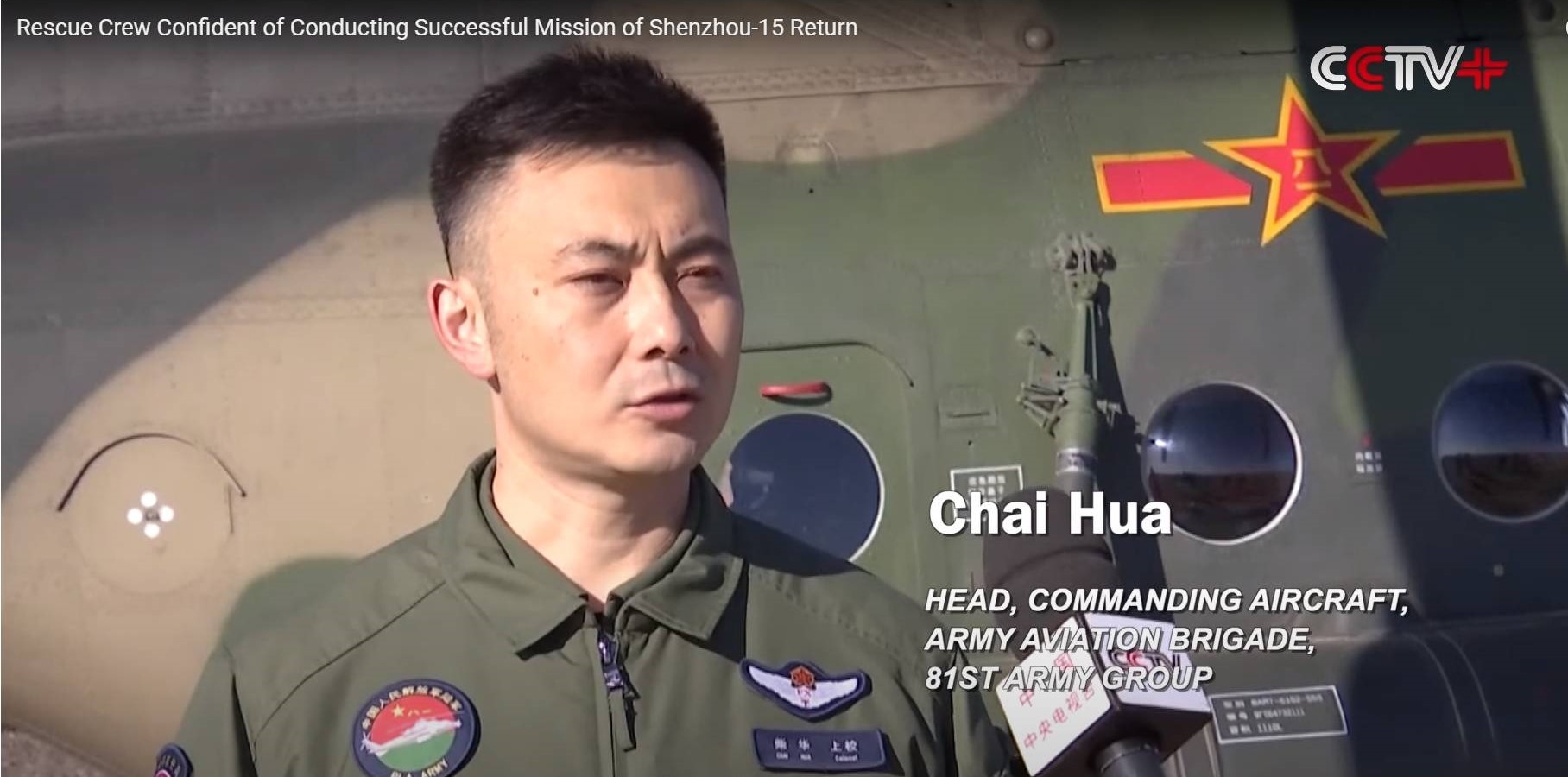
Image credit: CCTV/Inside Outer Space screengrab
Training and drills
“The results of this time’s joint drills were good. All the detachments followed orders from the command center in the entire process including takeoff, target searching and landing. Generally speaking, we have laid a solid foundation for the official retrieving mission with the previous training and drills,” said Chai Hua, aircraft commander of the commander plane of air forces in the mission of searching and receiving Shenzhou-15 crew.
“After all five comprehensive drills and more than 10 single-subject drills, we have made complete contingency plans for 29 kinds of injuries and emergencies. We are ready to welcome the astronauts back and ensure their safety,” said Gu Jianwen, team leader of Shenzhou medical rescue team.

Depiction of Shenzhou-16 spacecraft approaching docking port.
Image credit: CCTV/Inside Outer Space screengrab
New crew, supply craft re-docking
Meanwhile, onboard China’s Tiangong station, the newly arrived Shenzhou-16 crew — Jing Haipeng, Zhu Yangzhu and Gui Haichao – settled into their off-world setting. They are to perform scientific, maintenance and spacewalk duties during their 5-month space stint.
The Tianzhou-5 cargo spacecraft, launched and once docked with the orbital outpost, was undocked in early May to leave its port for its successor, the now docked Tianzhou-6 supply craft.

Image credit: Shujianyang Wikimedia Commons, CC BY-SA
Currently, the older Tianzhou-5 vehicle is flying alongside the station and will re-dock with the facility after the landing of the Shenzhou-15 crew.
Tianzhou-5 can provide propellants, solar power and waste storage for the station in the coming months.
At present, the three-module and three-ship configuration will remain in place for nearly half a year until the liftoff of the Shenzhou-17 piloted mission. Looking ahead, the plan is to expand Tiangong with additional modules, according to CCTV.
For video of Shenzhou-15 landing preparations, go to:
Live coverage via China Global Television Network (CGTN) at:

Moonlighter is a 3U CubeSat developed to enable real-time cyber security testing in orbit.
Image credit: The Aerospace Corporation
A tiny CubeSat is being sent into Earth orbit described as the world’s first and only “hacking sandbox in space.”
Called Moonlighter, the mid-size 3U nanosatellite has been designed and built by The Aerospace Corporation. It is slated to offer hackers the ability to perform tests that could identify methods for preventing the hacking of satellite systems in space.
The project is sponsored by the International Space Station (ISS) National Laboratory and supported by Nanoracks and will be used to introduce the nation’s top cyber professionals to help fill gaps in cyber security testing in space.
The Center for the Advancement of Science in Space, Inc. (CASIS) manages the ISS National Lab.
Repeatable, realistic, and secure
The world’s best hackers are able to do space-based cyber experiments that are repeatable, realistic, and secure.

Image credit: Hack-A-Sat 4
“When we say it’s a sandbox, Moonlighter is like a playground where we provide the space and the tools for professional hackers to perform cyber exercises and test out new technology,” said Aaron Myrick, project leader for The Aerospace Corporation. “We hope this will lead to more cyber-resilient architectures for future space missions.”
Moonlighter is among a set of payloads to be soon launched (targeted for Saturday, June 3) on a SpaceX Falcon 9 booster mission – the SpaceX commercial resupply mission, CRS-28.

Image credit: Hack-A-Sat 4/The Aerospace Corporation
Moonlighter will be part of Hack-A-Sat 4, an annual challenge supported by The Aerospace Corporation, the U.S. Air Force, and the U.S. Space Force. That challenge offers finalists the chance to hack the CubeSat in orbit during DEF CON, a convention for hackers held in August.
For more information on Hack-A-Sat 4, go to:

Curiosity’s location as of Sol 3846. Distance driven since landing is 18.65 miles/30.01 kilometers.
Image credit: NASA/JPL-Caltech/Univ. of Arizona
NASA’s Curiosity Mars rover at Gale Crater is now performing Sol 3847 duties.
“What do you do when you are driving through challenging terrain? Well, hit a new record!” That’s the word from Susanne Schwenzer, a planetary geologist at The Open University; Milton Keynes, U.K.
The robot has passed the 19 mile (30 kilometers) mark! “Way to go Curiosity!”
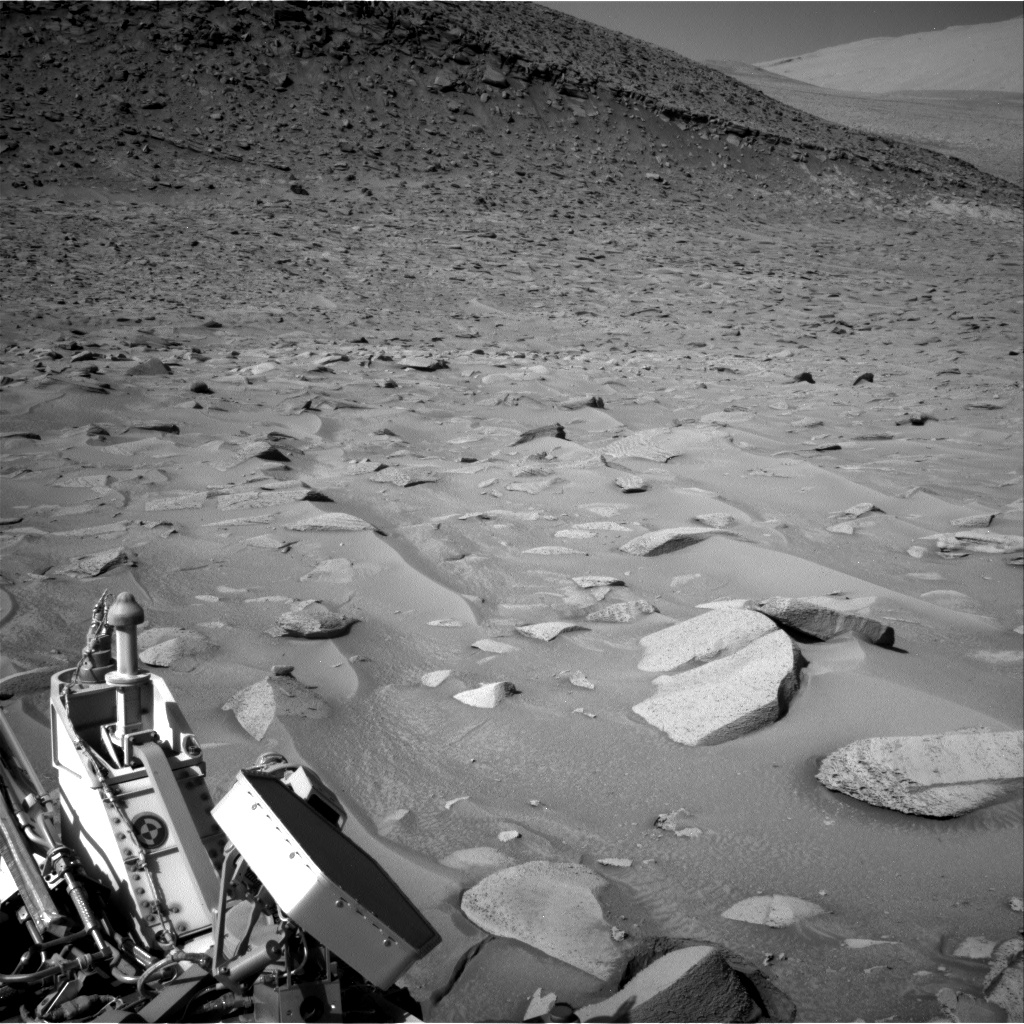
Curiosity Right B Navigation Camera image taken on Sol 3846, June 1, 2023.
Image credit: NASA/JPL-Caltech
Rover milestone
“That’s a Mars rover milestone only the NASA Opportunity rover has reached so far,” Schwenzer points out. “That was around June 2011 and just over 2610 sols into the mission with Opportunity on its way between Victoria and Endeavour Crater. At Endeavour crater Opportunity had driven a marathon on Mars – remember Marathon Valley?”
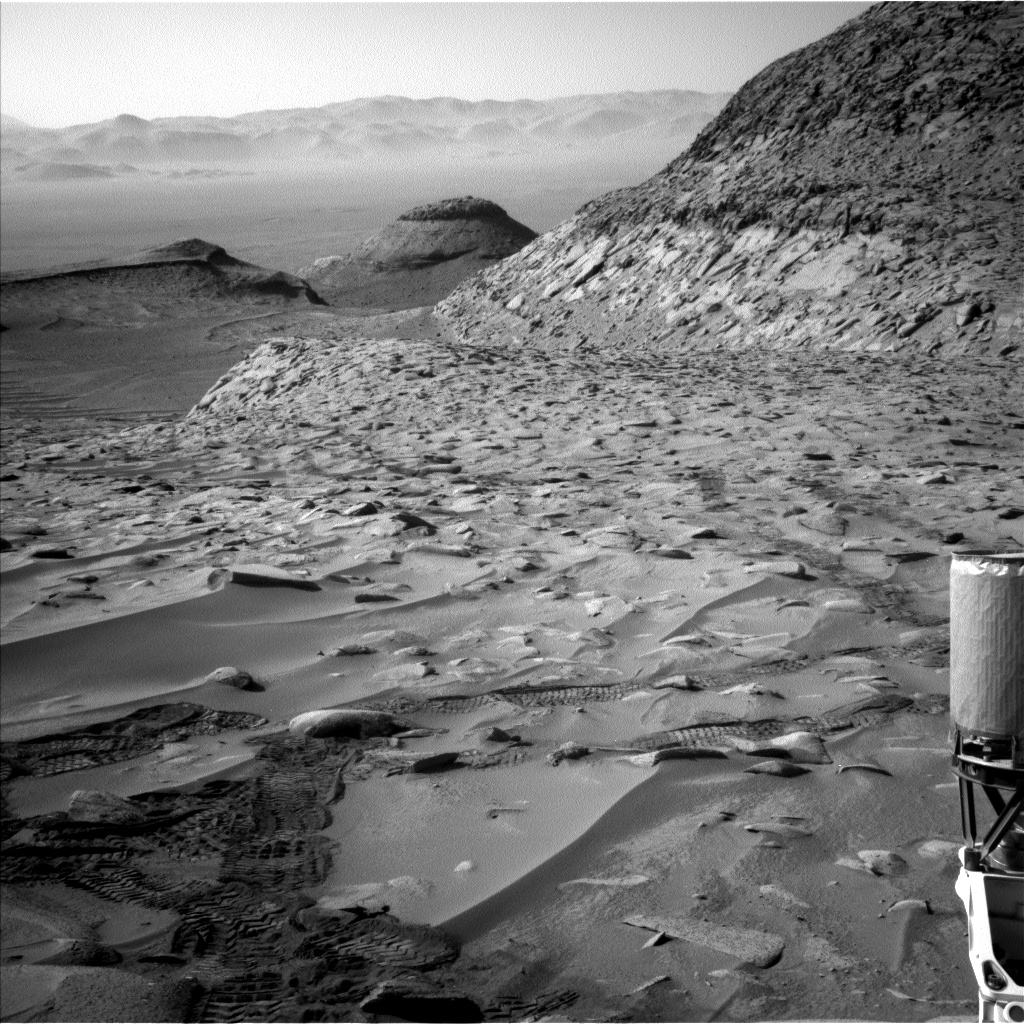
Curiosity Left B Navigation Camera image taken on Sol 3846, June 1, 2023.
Image credit: NASA/JPL-Caltech
Schwenzer adds that Curiosity driving is especially difficult for rover drivers right now. “One of us remarked they wouldn’t want to walk through there, let alone drive.”
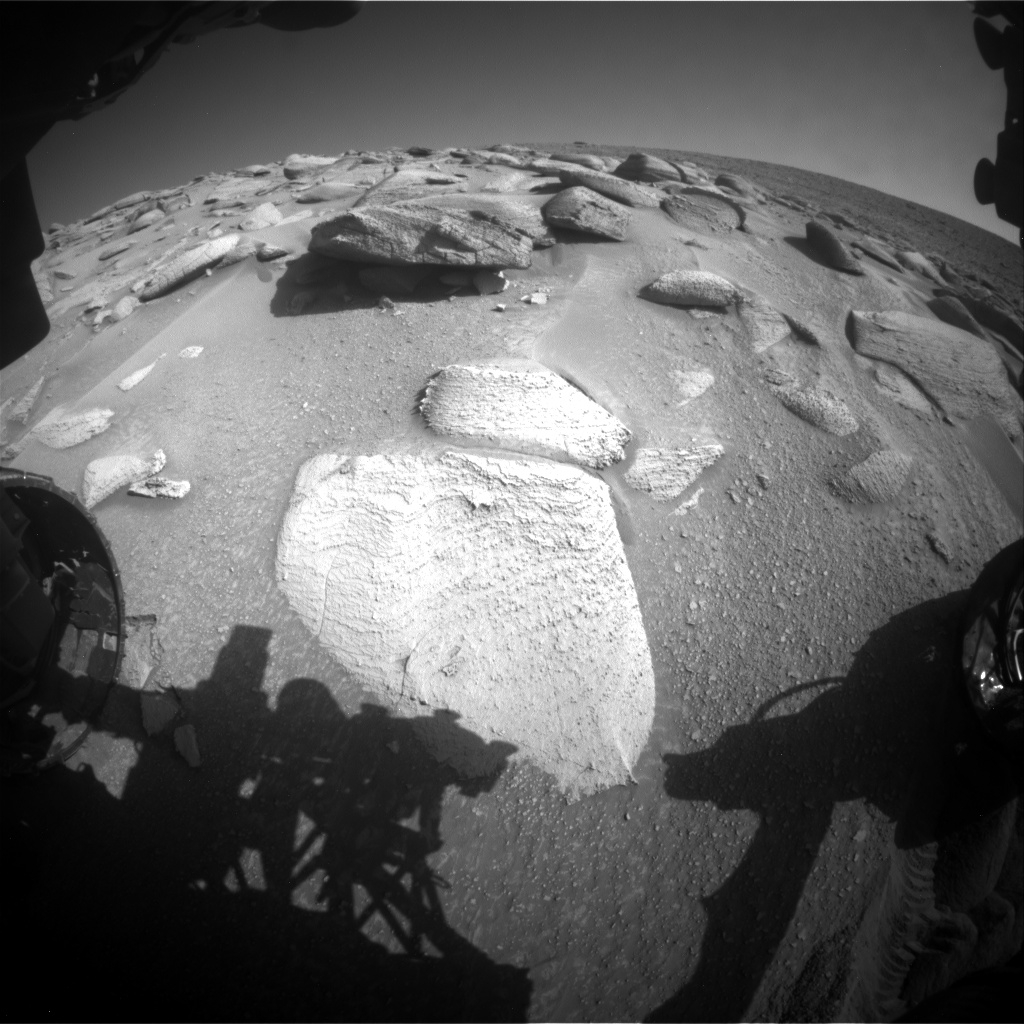
Curiosity Front Hazard Avoidance Camera Left B image taken on Sol 3846, June 1, 2023.
Image credit: NASA/JPL-Caltech
Wheels on the ground
But rover drivers are experts, not only getting the robot to the next stop, Schwenzer reports, but also parking the Mars machinery with all wheels safely on the ground so that the robotic arm can be used.
“And we are making best use of the opportunity investigating target ‘Cujubim’ after using the DRT [Dust Removal Tool].”
There is a three spot Alpha Particle X-Ray Spectrometer (APXS) raster on the target and of course Mars Hand Lens Imager (MAHLI) documentation. In addition, MAHLI looks at the target “Cumbal” to further document the sedimentary structures around Curiosity.

Curiosity Left B Navigation Camera image taken on Sol 3846, June 1, 2023.
Image credit: NASA/JPL-Caltech
Sedimentary structures
A recently acquired Remote Micro-Imager (RMI) photo illustrates some of those interesting things. “It shows the sedimentary structures, all the laminae, but also the nodules within, which will tell us a full story of how those rocks formed, one lamina at a time, and then there must have been another watery event forming the nodules,” Schwenzer observes.
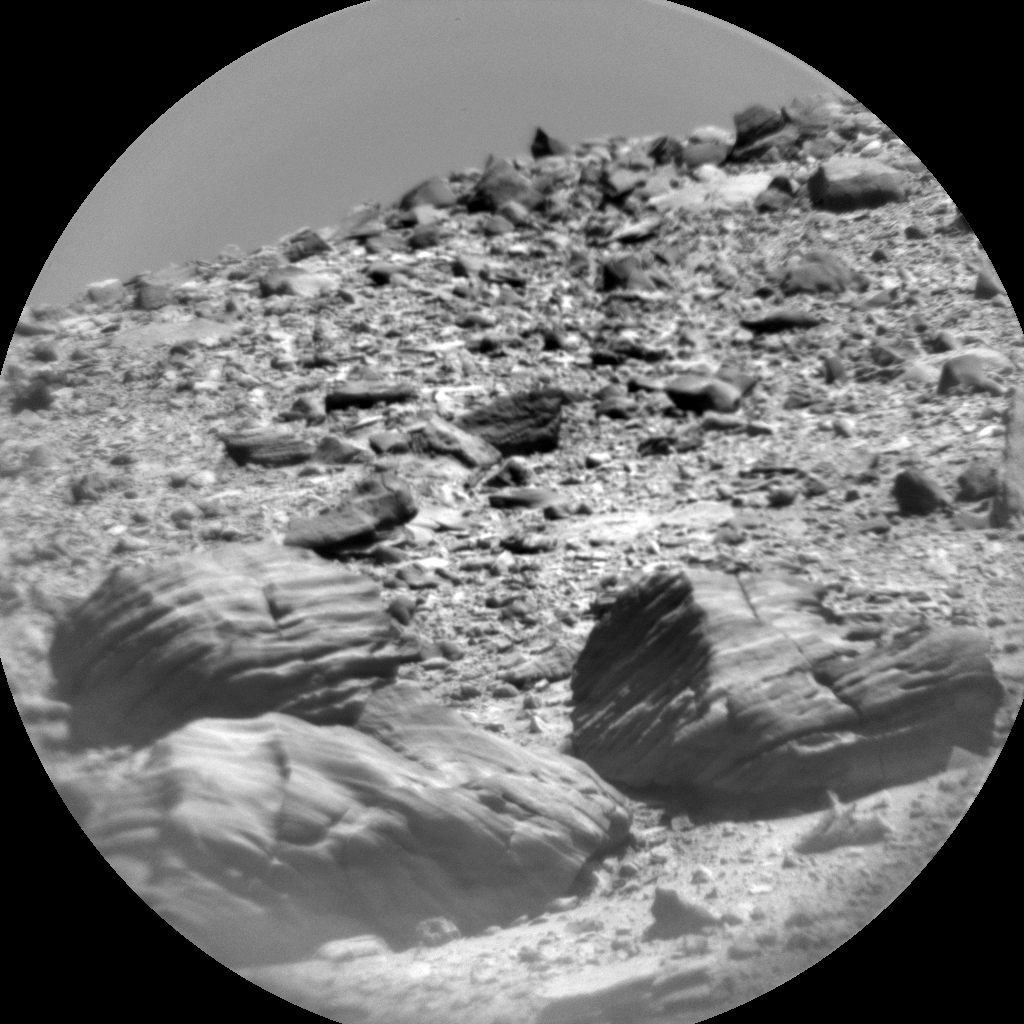
Curiosity Chemistry & Camera (ChemCam) Remote Micro-Imager (RMI) image acquired on Sol 3846, June 1, 2023.
Image credit: NASA/JPL-Caltech/LANL
A recent plan calls for two more RMIs looking into the distance to discern more of those sedimentary structures.
The rover’s Chemistry and Camera (ChemCam) is also keeping its laser busy on two bedrock targets, both also with nodules, which have the target names “Cariacau” and “Crique Yolande,” and there will be an AEGIS [Autonomous Exploration for Gathering Increased Science) after the drive. AEGIS is a software suite that permits the rover to autonomously detect and prioritize targets.
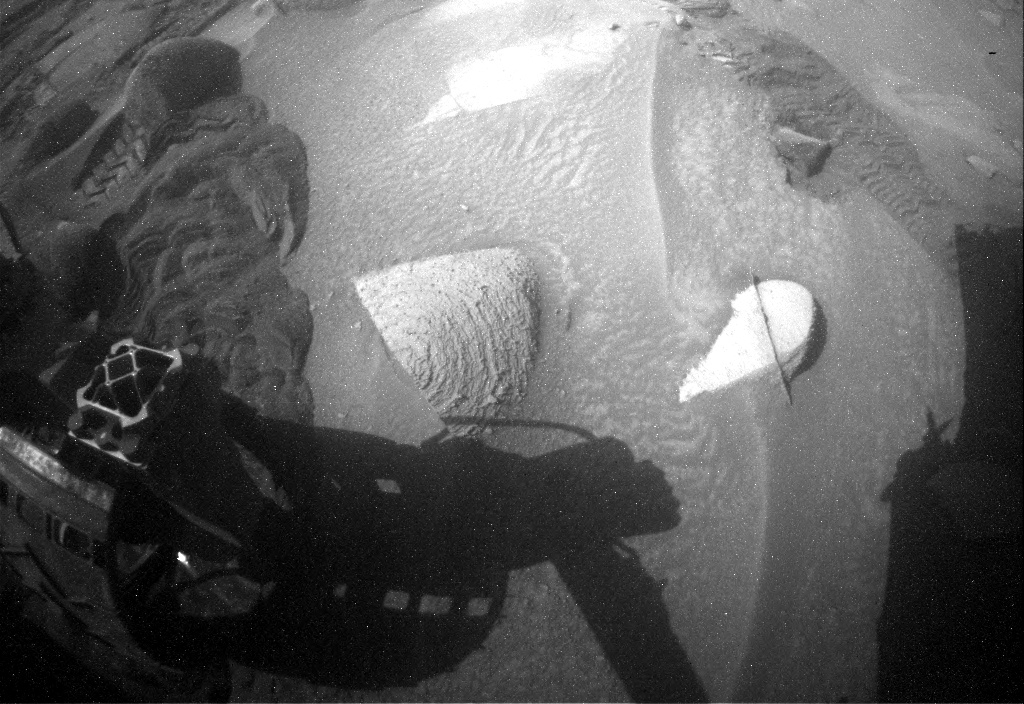
Curiosity Rear Hazard Avoidance Right B Camera photo taken on Sol 3846, June 1, 2023.
Image credit: NASA/JPL-Caltech
Environmental data
Also in the plan, Mastcam has two multispectral observations, one on the DRT spot, and one on target “Crique Rubin.” Mastcam further images targets “Cariacau” and “Paleomeu River,” and another target in front of the rover both to further document all the interesting features surrounding the vehicle.
In addition, the environmental theme group is to conduct the regular atmospheric monitoring, and also have the Dynamic Albedo of Neutrons (DAN) look for water in the underground and task the Mars Descent Imager (MARDI) to take an image after the drive.
“And now, raise a glass (or cup) with your favorite beverage,” Schwenzer concludes, “to wish the rover well navigating all the boulders ahead!”

Image credit: CMSA/CCTV/Inside Outer Space screengrab
China’s Shenzhou-15 astronauts are slated to return to Earth on June 4, following the transfer of space station control to the newly arrived Shenzhou-16 crew and the country’s second in-orbit crew rotation.
The trio of taikonauts – Fei Junlong, Deng Qingming and Zhang Lu – are slated to touchdown at a Dongfeng landing site in north China’s Inner Mongolia Autonomous Region.
The Shenzhou-15 crew members entered China’s Tiangong (Heavenly Palace) space station on Nov. 30 last year for a six-month stay.

Image credit: CMSA
During their stay in orbit, according to China Central Television (CCTV) the Shenzhou-15 crew completed four extravehicular activities (spacewalks), conducted eight human factors engineering research activities, 28 space medical experiments and 38 science experiments in the fields of life ecology, material science and fluid mechanics, and obtained valuable experimental data.
Duties for the Shenzhou-16 crew — Jing Haipeng, Zhu Yangzhu and Gui Haichao — include performing extravehicular activities, conduct in-orbit tests and experiments, and carry out equipment installation, debugging, maintenance and repair.
Depiction of Shenzhou-16 spacecraft approaching docking port.
Image credit: CCTV/Inside Outer Space screengrab
See-off ceremony
A “see-off ceremony” was staged between the two Shenzhou crews.
“On behalf of the Shenzhou-16 mission crew and after a thorough inspection and review, I have confirmed that there is no problem and will sign,” said Jing Haipeng, Shenzhou-16 commander.
“Then we will now sign for handover confirmation,” said Fei Junlong, Shenzhou-15 commander.
The crew members of Shenzhou-15 and Shenzhou-16 then signed the confirmation letters.
“I wish you full success in fulfilling your next tasks,” said Fei. “We have completed the in-orbit mission of Shenzhou-15. Now I hand over the keys to the space station to you, as arranged,” he noted.
“I thank the Shenzhou-15 crew for laying a good foundation for us,” said Jing.
New Shenzhou-16 crew onboard with Shenzhou-15 astronauts during handover ceremonies.
Image credit: CCTV/CNSA/Inside Outer Space screengrab
Handover process
According to Huang Weifeng, chief designer of China’s manned space program’s astronaut system, the handover process is a crucial step to ensuring the safety of both crews and the success of the upcoming missions.
“We have to ensure a complete handover, covering spacecraft status settings. Devices and equipment must be available to guarantee the normal operation of EVAs as well as astronauts’ healthy living and work, and we must ensure the status of laboratory facilities and equipment and the progress of in-orbit experiments as well as samples and materials,” Huang said in a CCTV interview.
“For each in-orbit rotation, we plan to leave one copy of the confirmation letters in the Tiangong space station, while astronauts bring the original letters back to Earth. For each new crew boarding the space station, they will find the names of their predecessors in the letters. I would call this a ‘historical inheritance,'” Huang added.

Earlier image shows practicing ground recovery crews at the Shenzhou-13 Dongfeng landing site in north China’s Inner Mongolia.
Credit: CCTV/Inside Outer Space screengrab
System-wide exercise
Meanwhile, the Dongfeng landing site is ready to receive the returning Shenzhou-15 crew. Similarly, at the Jiuquan Satellite Launch Center on Thursday, the last comprehensive system-wide exercise was held for the return of Shenzhou 15.
“After several years of construction, especially the performance of the three missions of searching and rescuing astronauts, the Dongfeng landing site has become more advanced in search and rescue technology with more reliable equipment, better search and rescue planning, and richer experience in organization and performance,” said Bian Hancheng, deputy chief designer of the landing site system of China Manned Space Program.

Image credit: CCTV/Inside Outer Space screengrab
“We have the ability and confidence to successfully complete this mission of searching and rescuing the astronauts,” Hancheng told CCTV.
Landing site situation
After receiving the fourth landing forecast, the air team reached the simulated landing site in ten minutes.
“Each of our aircraft is equipped with airborne direction finder, which receives signals from the beacon of the re-entry module to determine its basic direction and distance. The existent direction finders have been upgraded and refit, and they are now strong in receiving signals, accurate in positioning and simple in screen display,” said Li Linzhe, commander of air disposal unit of Shenzhou-15 search and rescue recovery mission.
The on-board optical equipment installed on the ground vehicles can also accurately capture the entire process of the re-entry capsule’s return, from the parachute opening to landing, providing real-time coordinates of the re-entry capsule, including the coordinates of the landing point.
“Through the communication link which transmits data back to the headquarters and from the headquarters to each search team, a network between air and ground is established, which provides a reliable basis for the quick and efficient search of the re-entry capsule in the air and on the ground,” said Li.

Credit: GLOBALink/Inside Outer Space screengrab
Special training
Chen Guodong, on-site disposal commander of the ground team of the Shenzhou 15 search and rescue recovery mission, said his team has conducted special trainings to cope with complex terrains of the landing site, including desert, Gobi, saline-alkali land, and grass lakes.
“Through post trainings, from simple road to complex road, from long-distance training to task exercise, from high visibility to low visibility, we have further improved our driving ability, and make sure we could reach the disposal site safe at the fastest speed,” Chen advised during a CCTV interview.
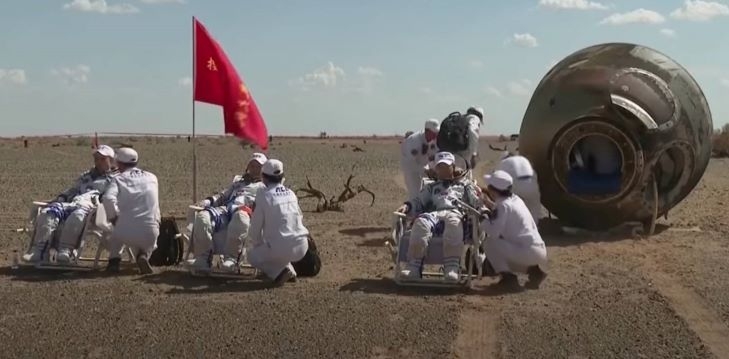
Image credit: CNSA/CCTV/Inside Outer Space screengrab
Comfort for returning crew
Work has also been done to make things more comfortable for the three Shenzhou-15 astronauts to get out of the cabin.
For example, the operation platform next to the returned capsule when it is upright is made of magnesium and aluminum alloy, and is lighter than before. It takes about five minutes for the work team to set up the operation platform. And its slope is smoother, making it more comfortable for astronauts to slide down.
According to CCTV, the landing site system has run two comprehensive search and recovery drills, more than 20 special trainings on tracking and capture, medical supervision and medical insurance, medical rescue and security.
For a video showcasing crew transfer of station tasks, go to:

Image credit: Library of Congress/Inside Outer Space screengrab
U.S. Poet Laureate Ada Limón has written a new poem that will fly into space aboard NASA’s Europa Clipper mission on a years-long journey to explore Jupiter’s icy moon Europa.
The poem, first shared publicly during a special reading at the Library of Congress, will be engraved on the spacecraft set to launch in October 2024.
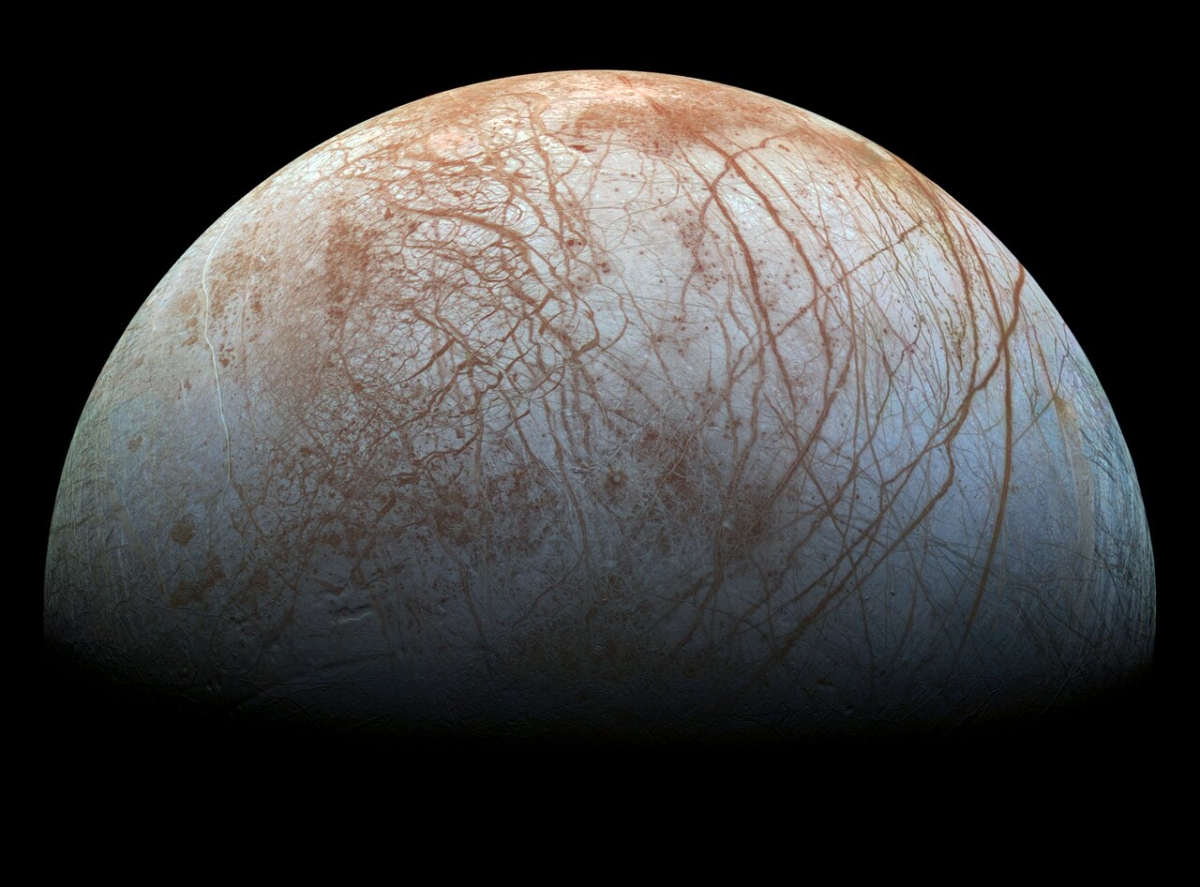
This reprocessed colour view of Jupiter’s moon Europa was made from images taken by NASA’s Galileo spacecraft in the late 1990s.
“Writing this poem was one of the greatest honors of my life, but also one of the most difficult tasks I’ve ever been assigned,” Limón said in a Library of Congress statement.
“Eventually, what made the poem come together,” Limón added, “was realizing that in pointing toward other planets, stars and moons, we are also recognizing the enormous gift that is our planet Earth. To point outward is also to point inward.”
To view the reading — “In Praise of Mystery: A Poem for Europa” – go to: https://www.youtube.com/live/D8UC3eQIQMw?feature=share
To sign, read the poem and hear Limón read the poem in an animated video, go to: https://europa.nasa.gov/message-in-a-bottle/sign-on/
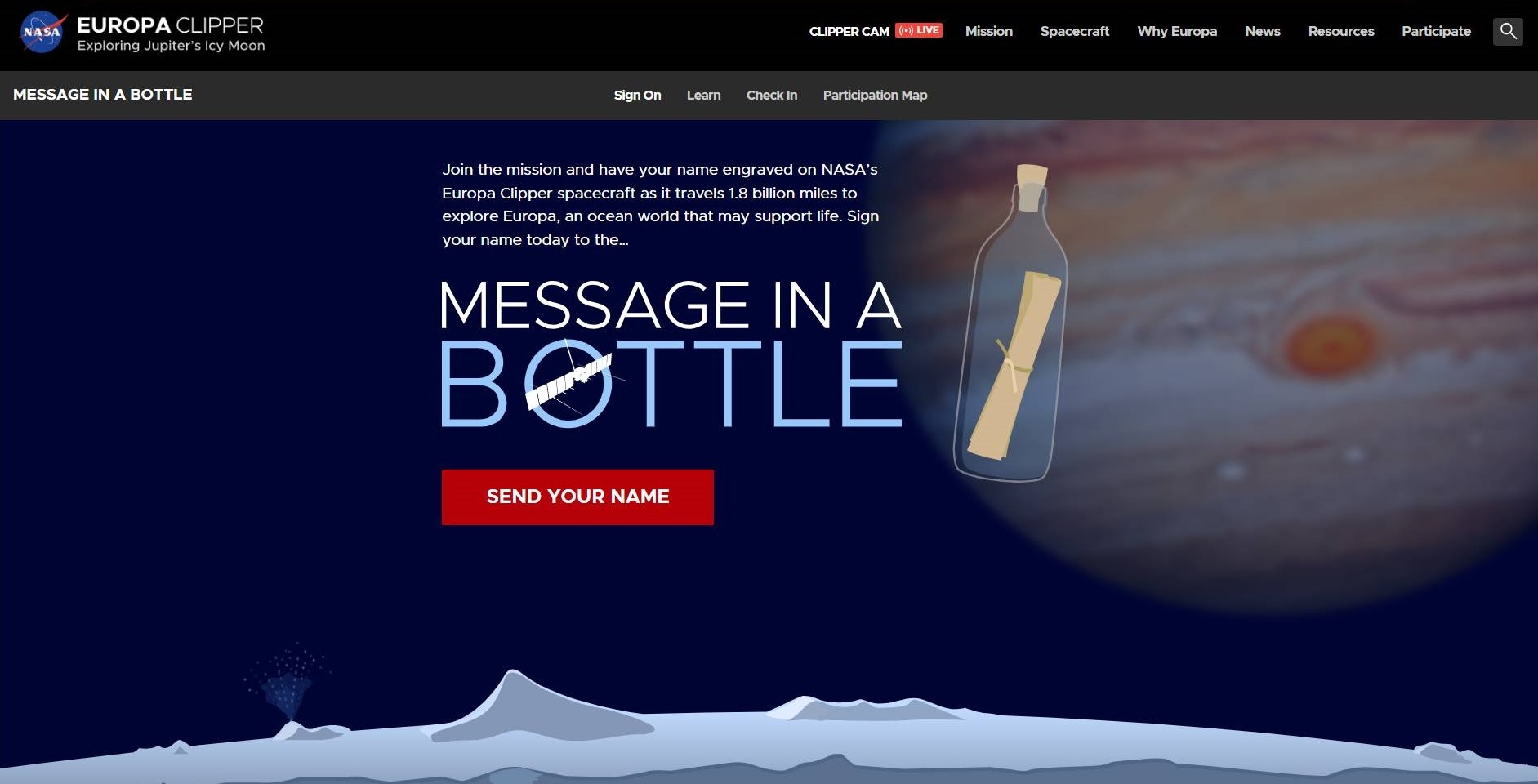
Image credit: NASA

Russia’s return-to-the-Moon Lunar-25 hardware undergoes testing.
Image credit: Roscosmos
Russia’s renewed robotic Moon effort — Luna-25 – has slipped to August 2023.
According to Russia’s Roscosmos and NPO Lavochkin, developer of the lunar lander, the craft is undergoing a final cycle of ground tests. Part of that testing is statistical modeling of the key stage of the mission — a soft landing on the lunar surface – and is being completed at the onboard control complex test bench.

Russia’s Luna-25 spacecraft.
Credit: Lavochkin/Roscosmos
“Domestic experience and the experience of a number of other countries that landed on the lunar surface shows that this stage, taking into account the complexity of the tasks of ballistic and navigation support for the flight of a spacecraft, is critical for the success of the entire mission as a whole,” a Roscosmos and Lavochkin communiqué explains.
Considered expedient
Luna-25 is to land in the vicinity of the south pole of the Moon.

Topographic map of the southern sub-polar region of the Moon showing the location of Boguslawsky crater.
Credit: Ivanov et al., 2015 via Arizona State University/LROC
In order to achieve the required reliability of the mission “it is necessary to carry out additional measures” to ensure the stable operation of ground controls during the stages of corrections and landing on the Moon’s surface.
Bottom line, and based on the need for more testing, it was “considered expedient” to launch the Luna-25 spacecraft in August 2023.
This Russian Moon mission continues the series of the former Soviet Union’s lunar exploration activities that ended back in 1976. Luna-24 successfully delivered about 170 grams of lunar soil to Earth.
The Luna-25 mission has undergone slip after slip for a lengthy period of time.

A flexible prototype antenna sheet for Caltech’s power transmitter array. Each orange square on the yellow tile is an antenna driven by a single transmitter.
Credit: Lance Hayashida/Caltech
Last January, a novel prototype of space solar power-beaming technology was placed into Earth orbit.
Caltech’s Space Solar Power Project (SSPP) has announced the experiment has wirelessly transmitted power in space and beamed detectable power to Earth for the first time.
Called MAPLE, short for Microwave Array for Power-transfer Low-orbit Experiment, it is one of three key technologies being tested by the Space Solar Power Demonstrator (SSPD-1).

(Left to Right) Sergio Pellegrino, Harry Atwater, and Ali Hajimiri, the principal investigators of the Caltech Space Solar Power Project. Image credit: Caltech
A Momentus Vigoride spacecraft launched on January 3 aboard a SpaceX rocket on the Transporter-6 mission carried the 110-pound (50-kilogram) SSPD-1 to space.
Energy broadcasting
MAPLE consists of an array of flexible lightweight microwave power transmitters driven by custom electronic chips that were built using low-cost silicon technologies. It uses the array of transmitters to beam the energy to desired locations, according to a Caltech statement.

Caltech’s power transmitter array.
Image credit: Caltech
MAPLE was developed by a Caltech team led by Ali Hajimiri, Bren Professor of Electrical Engineering and Medical Engineering and co-director of SSPP.
“Through the experiments we have run so far, we received confirmation that MAPLE can transmit power successfully to receivers in space,” Hajimiri reports in the Caltech statement. “We have also been able to program the array to direct its energy toward Earth, which we detected here at Caltech. We had, of course, tested it on Earth, but now we know that it can survive the trip to space and operate there.”

In-space photo taken from Space Solar Power Demonstrator (SSPD-1).
Image credit: Caltech

Image taken from Space Solar Power Demonstrator (SSPD-1).
Image credit: Caltech
LEDs: lighting the way
MAPLE is outfitted with two separate receiver arrays situated about a foot away from the transmitter to receive the energy, converts that energy to direct current electricity, and uses that energy to light up a pair of LEDs to exhibit the full run of wireless energy transmission at a distance in space.
MAPLE tested this in space by lighting up each LED individually and shifting back and forth between them.
MAPLE includes a small window through which the array can beam the energy. “This transmitted energy was detected by a receiver on the roof of the Gordon and Betty Moore Laboratory of Engineering on Caltech’s campus in Pasadena. The received signal appeared at the expected time and frequency, and had the right frequency shift as predicted based on its travel from orbit,” the Caltech statement adds.

Transmitted energy from space was detected by a receiver on the roof of the Gordon and Betty Moore Laboratory of Engineering on Caltech’s campus in Pasadena.
Image credit: Caltech

End of the power line. Space transmitted energy was detected by a receiver on the roof of Caltech’s Gordon and Betty Moore Laboratory.
Image credit: Caltech
Step-by-step evaluation
The Hajimiri-led team is assessing the performance of individual elements within the system, a meticulous process that can take up to six months to fully complete. The step-by-step evaluation will allow the team to sort out irregularities and trace them back to individual units, providing insight for the next generation of the system.

DOLCE is lowered onto the Vigoride spacecraft built by Momentus.
Image credit: Caltech/Momentus
Besides MAPLE, SSPD has two main experiments:
- DOLCE (Deployable on-Orbit ultraLight Composite Experiment), a structure measuring 6 feet by 6 feet that demonstrates the architecture, packaging scheme, and deployment mechanisms of the modular spacecraft; and
- ALBA, a collection of 32 different types of photovoltaic cells to enable an assessment of the types of cells that are the most effective in the punishing environment of space.
The ALBA tests of solar cells are ongoing, and the SSPP has not yet attempted to deploy DOLCE as of press time. Results from those experiments are expected in the coming months.
Meanwhile, Hajimiri is beaming with satisfaction: “To the best of our knowledge, no one has ever demonstrated wireless energy transfer in space even with expensive rigid structures. We are doing it with flexible lightweight structures and with our own integrated circuits. This is a first.”
“The work at the space solar power program at Caltech continues to produce very useful technology for the future of space solar power,” John Mankins, President of Artemis Innovation Management Solutions told Inside Outer Space. He is an internationally recognized leader in space systems and technology innovation and a leading advocate of space solar power.
For more information, go to:

Artist’s concept of NASA’s Ingenuity Mars Helicopter flying through the Red Planet’s skies. Credit: NASA/JPL-Caltech
Has something happened to NASA’s Mars Ingenuity helicopter?
The Internet’s Mars Guy looks into recent challenges communicating with Ingenuity. But why the mini-chopper hasn’t flown in more than a month. Is it a communication issue or something worse?
For that Mars Guy episode, go to: https://youtu.be/gQ3TrmOe_sw
Long range plan
In response to these questions, Mars Guy received a recent communiqué from space engineer Bob Balaram — a person with knowledge regarding the Mars helicopter effort. He offered these insights:

NASA’s Mars Perseverance rover is busy at work, on a roll to find evidence of past microbial life on the Red Planet. This rover’s selfie also captures Ingenuity, the Mars helicopter.
Image Credit: NASA/JPL-Caltech/MSSS
“Priority is to keep Ingenuity ahead of Perseverance. Flying deliberately into radio shadowed regions is therefore considered acceptable to Ingenuity’s operations team. Eventually the rover will complete its current science activities and, as part of its long range plan, move to locations favorable for communication,” Balaram said.
Distance, intervening terrain
Ingenuity’s automated landing site algorithm typically deflects the planned landing location by only a few meters, Balaram added, “so that does not significantly change the overall communication situation. A major factor is that the Ingenuity base station antenna is not in the most favorable location on the rover. As the helicopter was a late addition, that was the best that could be had.”

Balaram concludes by noting: “The metallic clutter on the rover then becomes a big factor at this location and makes the radio signal strength highly dependent on rover heading, which in turn varies a lot depending on the science operations underway. Distance and intervening terrain also reduce signal strength. The helicopter flight planning process uses a sophisticated radio propagation model that gives a very good estimate of the expected signal strength at any planned landing site for a given rover location and heading. This is used in conjunction with airfield selection tools, navigation performance models to estimate flight path delivery errors, and consultation with rover planners to plan each flight.”

Image credit: CCTV/CNSA/Inside Outer Space screengrab
China’s Shenzhou-16 crewed spaceship successfully docked with the Tiangong space station on Tuesday.
Following launch, the mission conducted a fast (6.5 hours) automated rendezvous and docked with the radial port of the space station core module Tianhe, forming a combination with three modules and three spacecraft.
Riding atop a Long March 2F Y16 carrier rocket, the taikonaut trio blasted off from the Jiuquan Satellite Launch Center in northwest China.
New Shenzhou-16 crew onboard with Shenzhou-15 astronauts.
Image credit: CCTV/CNSA/Inside Outer Space screengrab
Five month stay
The crew — Jing Haipeng, Zhu Yangzhu and Gui Haichao – are expected to stay in space for five months, during which they will witness the dockings of the Tianzhou-5 cargo craft and the Shenzhou-17 crew spaceship, as well as the departures of the Shenzhou-15 piloted spaceship and Tianzhou-5.
Shenzhou-16 astronauts joined the already orbiting Shenzhou-15 crew: Fei Junlong, Deng Qingming and Zhang Lu.
Depiction of Shenzhou-16 spacecraft approaching docking port.
Image credit: CCTV/Inside Outer Space screengrab
They will hand over tons of supplies including maintenance and operation tools, food, clothing, and test samples for application systems stocked up in the three-module configuration consisting of the core module Tianhe and two lab modules respectively named Wentian and Mengtian.

Image credit: CCTV/Inside Outer Space screengrab
“They will stay in orbit for five months and go through two times of rotation and work handover. They will swap places with the Shenzhou-15 crew and welcome the Shenzhou-17 crew,” said Huang Weifen, chief designer of the astronaut system.
Huang added that the new crew will also carry out a spacewalk, carry out long-term maintenance, perform a large number of space science experiments and tests, and deliver space lectures. “So, their workload is quite heavy.”
High-level research
The just-arrived crew are expected to under take high-level scientific research in the study of novel quantum phenomena, high-precision space time-frequency systems, the verification of general relativity, and the origins of life.

Image credit: CGTN/Inside Outer Space screengrab
The Shenzhou-16 mission is the first piloted flight after China’s space station entered a stage of application and development.
The mission represents China’s 11th crewed mission with the Shenzhou spacecraft series, now completing 15 flight missions, including 10 crewed spaceflights, since the Shenzhou-1 launched in 1999.
Given the Shenzhou-16 mission, there are now 17 people from 5 nations in low Earth orbit: onboard China’s station (6) and onboard the International Space Station (11).
For videos focused on the Shenzhou-16 launch, rendezvous and docking, go to:

