Archive for the ‘Space News’ Category
 Author:
  June 23rd, 2023
Curiosity’s location on Sol 3867. Distance driven to date: 18.73 miles/30.14 kilometers
Image credit: NASA/JPL-Caltech/Univ. of Arizona
NASA’s Curiosity Mars rover at Gale crater is now performing Sol 3867 duties.
In a fresh plan, the robot completed a drive taking it near, or just past the border of a new quad, reports Scott VanBommel, a planetary scientist at Washington University in St. Louis, Missouri.

Curiosity Front Hazard Avoidance Camera Right B image taken on Sol 3867, June 23, 2023.
Image credit: NASA/JPL-Caltech
“A quad, or quadrangle, is an area outlined where the rover may explore,” VanBommel explains. Several quads were outlined within Gale crater before Curiosity landed, each roughly 1.3 kilometers across.

Curiosity Left B Navigation Camera photo acquired on Sol 3867, June 23, 2023.
Image credit: NASA/JPL-Caltech
“Each quad has a theme based on a significant geologic feature on Earth, and the quads themselves are named after small towns near those geologic features,” VanBommel adds. “The regions where the geologic features are found dictates the names given to targets and features explored by the rover in that quad. Many quads are never visited by the rover.”

Curiosity Mast Camera Right B Navigation image taken on Sol 3866, June 22, 2023.
Image credit: NASA/JPL-Caltech/MSSS
Target names
A recent plan had Curiosity drive far enough to find itself in the “Kalavryta Quad,” named after a town in Greece.
“And with that, we had a fresh set of new names to choose from, including target names such as ‘Kastria Spring,’ ‘Feneos, ‘Niamata,’ and ‘Kerpini.’”

Curiosity Mast Camera Right image taken on Sol 3866, June 22, 2023.
Image credit: NASA/JPL-Caltech/MSSS
In a scripted two-sol plan (Sols 3866-3867) Curiosity started by completing Chemistry and Camera (ChemCam) and Mastcam activities, including analyses of Feneos.
A Dynamic Albedo of Neutrons (DAN) passive analysis and environmental activities followed with the rover then brushing the Kastria Spring target before imaging with the Mars Hand Lens Imager (MAHLI) and commencing a two-spot Alpha Particle X-Ray Spectrometer (APXS) analysis.

Curiosity Mars Hand Lens Imager photo produced on Sol 3866, June 22, 2023.
Image credit: NASA/JPL-Caltech/MSSS
Curiosity also completed a MAHLI mosaic of the Feneos target.

Curiosity Mast Camera Right image taken on Sol 3866, June 22, 2023.
Image credit: NASA/JPL-Caltech/MSSS
Before and after analysis
“The second sol of the plan focused on additional imaging activities, with Mastcam images of Niamata, Kerpini, and Kastria Spring, the latter of which included images before and after analysis by the ChemCam laser,” VanBommel adds.

Curiosity Mast Camera Right image taken on Sol 3866, June 22, 2023.
Image credit: NASA/JPL-Caltech/MSSS
The rover then completed yet another drive (with a planned distance of ~40 m) and acquired the necessary post-drive imaging before the decisional Mars Reconnaissance Orbiter (MRO) pass which is to relay the data necessary before the next tactical day kicks off, VanBommel concludes.
 Posted in

Prime Minister of India, Narendra Modi at the Indian Space Research Organization (ISRO).
Image Credit: ISRO
The recent meeting between U.S. President Joe Biden and Indian Prime Minister Narendra Modi has produced a number of space-related initiatives.
In a White House statement, the two “set a course to reach new frontiers across all sectors of space cooperation.”
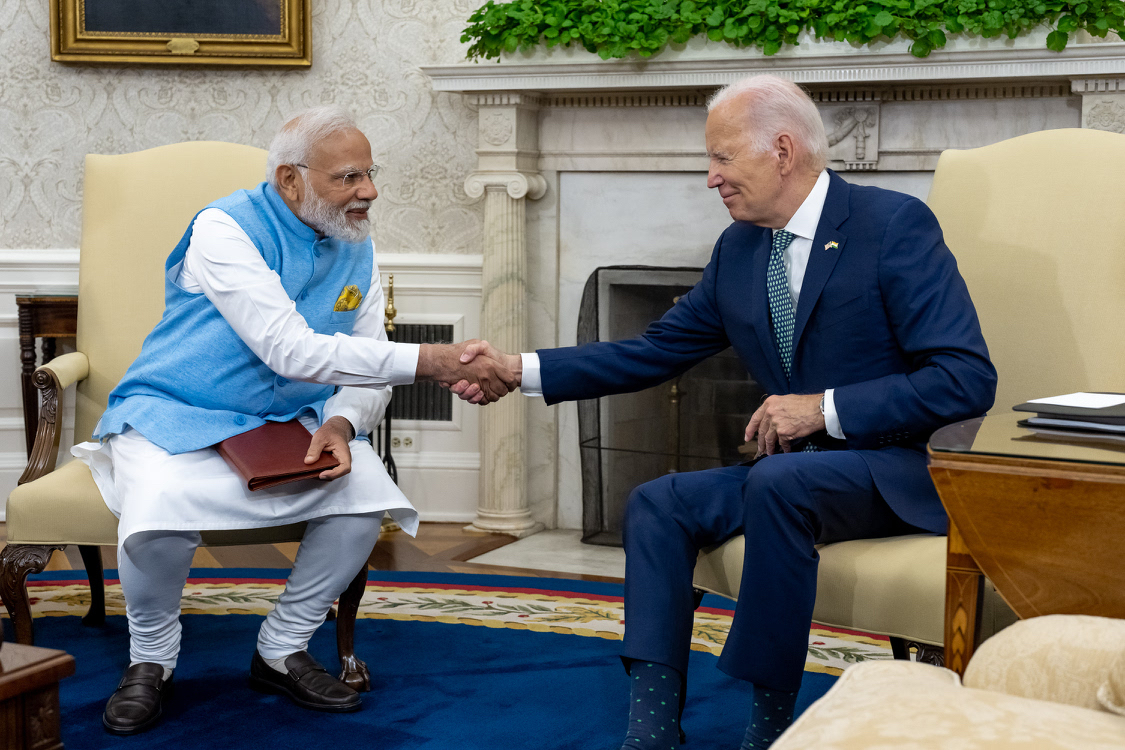
Image credit: White House
To that end, India has inked the growing list of countries signing the U.S.-led Artemis Accords and NASA will provide advanced training to Indian astronauts at the Johnson Space Center in Houston, Texas, “with a goal of mounting a joint effort to the International Space Station in 2024.”
Earlier, on June 21, the Republic of Ecuador became the 26th nation to sign the Artemis Accords.
As explained by the U.S. State Department, the Artemis Accords, which are grounded in the Outer Space Treaty of 1967, “are a set of non-legally binding principles to guide sustainable civil space exploration. These principles, which include transparency, peaceful purposes, registering of space objects and release of scientific data, help make the space environment safer and more predictable, and allow all nations – even those without space programs – to benefit from the data obtained in space.”
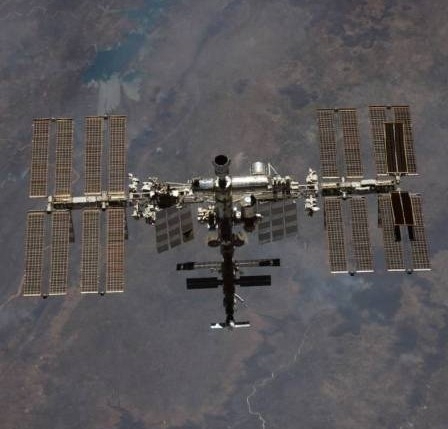
Image credit: Roscosmos/NASA
The Artemis Accords signatories are: Australia, Bahrain, Brazil, Canada, Colombia, Czech Republic, Ecuador, France, India, Israel, Italy, Japan, the Republic of Korea, Luxembourg, Mexico, New Zealand, Nigeria, Poland, Romania, Rwanda, Saudi Arabia, Singapore, Spain, Ukraine, the United Arab Emirates, the United Kingdom, and the United States.
Lunar research station
The U.S./Indian space cooperative initiatives signal a growing banding together of nations to explore space – outreach that is also underway in China.
A number of nations have also expressed interest to join China in establishing an international lunar research station (ILRS).
Russia, Pakistan, the United Arab Emirates and the Asia-Pacific Space Cooperation Organization (APSCO) have already signed agreements to participate in the China lunar effort.

International Lunar Research Station. Image credit: CNSA
The Chinese National Space Administration (CNSA) recently explained that the Moon station will be “open to all interested national and international partners.”
Phased flight missions
Reportedly, negotiations are underway with more than ten countries and organizations to participate in a joint program for the exploration of the moon. Malaysia and Venezuela, for example, have responded positively to the invitation to join this project.
As outlined by China space officials, the ILRS project aims to build a permanent lunar base in the 2025-2030s with an initial series of phased flight missions through the end of this decade.
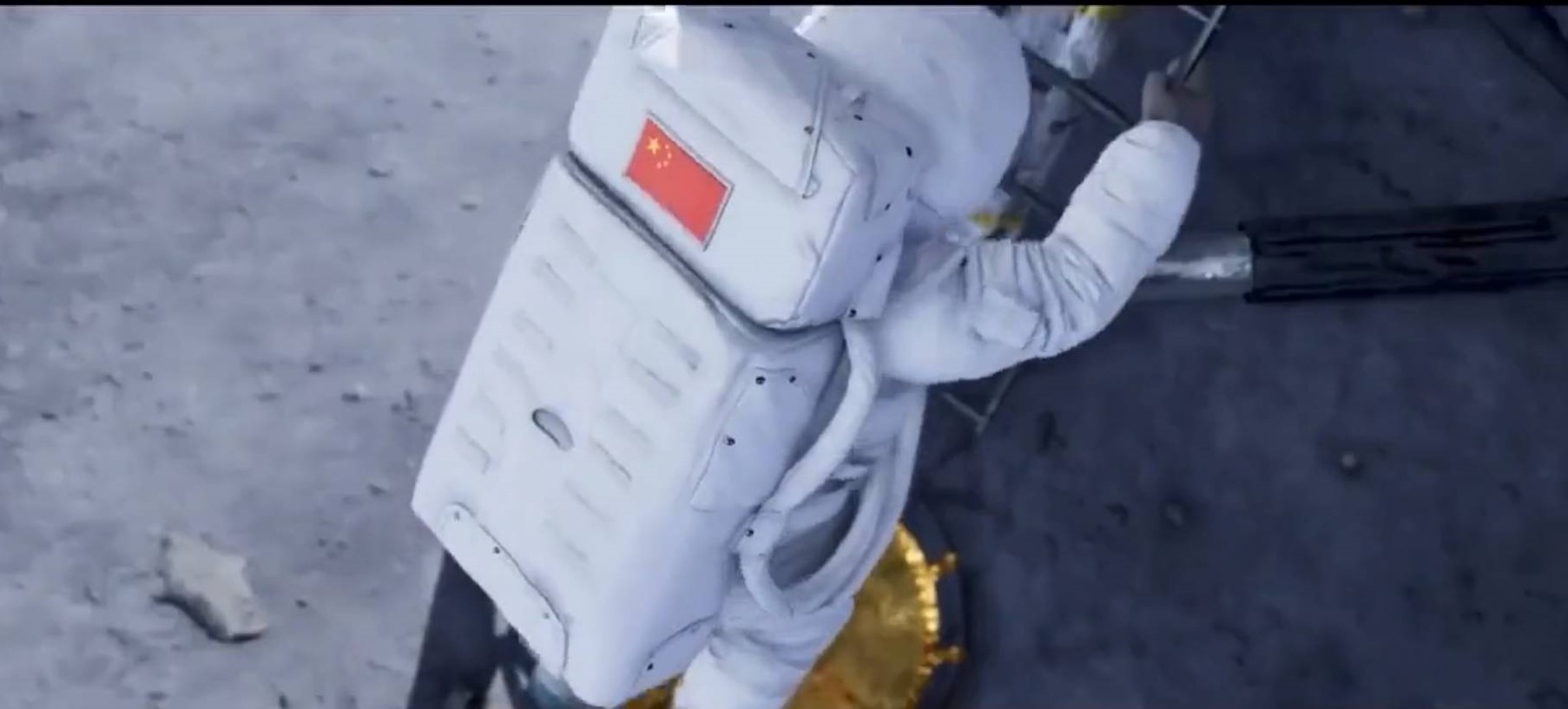
Image credit: CCTV/Inside Outer Space screengrab
Regulatory framework
A regulatory framework is reportedly being created to ensure the construction and operation of the ILRS. It has been noted that those joining in the early stages of blueprinting the Moon research facility will receive better terms and more rights as founding members.
Experts within China’s Deep Space Exploration Laboratory (DSEL) have noted that China intends to complete the signing of agreements and memorandums of understanding with global space agencies and organizations this fall.
In doing so, the intent is to establish an international integrated base for scientific experiments built on surface of the Moon.

Wait a minute!
Image credit: Barbara David
Perhaps there’s a new sidebar to looking for Unidentified Anomalous Phenomenon (UAP)?
That topic keeps me up and night, armed with my telescopes, binoculars and other “all seeing” instruments.
UAP, Unidentified Flying Objects (UFOs), crashed or still in the air flying saucers, alien visits…on and on!
This morning, in my daytime off-hours of sky patrolling, I’ve taken a read of the National Defense Authorization Act (NDAA) for Fiscal Year 2024.
Something caught my eye in the NDAA called “Moving Target Indicator Programs” of the Department of Defense.
I haven’t paid much attention to this topic, but maybe I should.

UAP have been reported by Navy pilots unlike anything they have ever witnessed.
Image credit: Enigma Labs/Lt. Cmdr. Alex Dietrich
Working group grope
Words of tactical intelligence, surveillance, reconnaissance, along with tasking, collection, processing, exploitation, and dissemination of data collected by moving target indicator systems – lots of lingo attached to whatever moving targets the Act is embracing.
The Act calls for the Secretary of Defense to establish a working group, to be known as the ‘‘Moving Target Indicator Working Group.” Army, Navy, Marine Corps, Air Force, and Space Force members are to be assigned to the working group.
“Not less frequently than biannually, the working group shall provide to the congressional defense committees a briefing on the status of any moving target indicator programs being developed,” the Act notes.

Image credit: Statista
Bottom line
Being the obsessive “Googleier,” I revved up the search engine for Moving Target Indicator Programs – lots of chat about radar techniques to find moving objects, like an aircraft, and filter out unmoving ones.
There are also advocates calling for a space-based, ground moving target indicator capability.
Whatever all this adds up to, the need for day/night, all-weather detection and tracking of ground and maritime targets for the warfighter is one bottom line, maybe a bottomless pit of uses.

Image credit: C-SPAN/Inside Outer Space screengrab
Synchronize efforts
Back in July 2022, the U.S. Department of Defense announced the establishment of the All-domain Anomaly Resolution Office, longhand for AARO.
“The mission of the AARO will be to synchronize efforts across the Department of Defense, and with other U.S. federal departments and agencies, to detect, identify and attribute objects of interest in, on or near military installations, operating areas, training areas, special use airspace and other areas of interest, and, as necessary, to mitigate any associated threats to safety of operations and national security. This includes anomalous, unidentified space, airborne, submerged and transmedium objects.”

Image credit: Yannick Peings, Marik von Rennenkampff/AIAA
One wonders whether there’s some prospect for synchronizing UAP study with the call for moving target indicator programs?
As George Harrison of the Fab Four wrote: “Something in the way she moves” most certainly not noting the wheels of government bureaucracy. But on the other hand, “You stick around now it may show…I don’t know, I don’t know.”
And if you have read this far…blame the coffee.
This morning I accidentally mixed Colombian and French Roast.

Image credit: Roscosmos
In the early “space race” days of the former Soviet Union and America there was an ongoing contest to claim space firsts.
One major milestone was achieved on June 13, 1963.
Sitting in her Vostok-6 spacecraft, Soviet cosmonaut Valentina Tereshkova became the first woman to travel into Earth orbit.
In just under three days, Tereshkova’s pioneering flight made 48 orbits of Earth. At journey’s end on June 19, she parachuted from the Vostok cabin, drifting slowly and safely down to terra firma from 20,000 feet altitude.
That landing process involved first riding an ejection seat from the descent vehicle, with the passenger departing that hardware and parachuting to Earth.

Image credit: Roscosmos/RSC Energia
Swamp survival
In a recent posting from Russia’s space agency, Roscosmos, Tereshkova’s “chair” is the only surviving one from early cosmonaut flights. Other chairs shattered from the fall.
“That is why the seats of almost all the first astronauts have not been preserved. Except one,” notes the Roscosmos via a Telegram channel communiqué. “By a lucky chance, the chair of the world’s first female cosmonaut, Valentina Tereshkova, fell not on a hard surface, but into a swamp, and therefore only partially collapsed.”
That very seat was recovered showing limited damage. It is now a unique exhibit item in the Russian museum of RSC Energia.

Image credit: USGS
Mining the Moon is near at hand.
What better group to assess what’s ripe for the picking on that desolate, cratered world than the U.S. Geological Survey. The name says it all.
When it comes to economic extraction and sustainable management of the Moon’s resources, the USGS has turned its attention skyward to understand the nature, quantity, and quality of available lunar resources.

Illumination map of the south polar region of the Moon. Areas in black receive no sunlight, and areas in warmer colors are illuminated a greater fraction of the time.
Image credit: Base image mosaic from NASA, Arizona State University, and Applied Coherent Technology Corp.
As a government group, the USGS falls under the Department of the Interior. But in this instance, maybe it’s better tagged as an arm of the “Department of the Exterior” for deep space decision-making.
For more information, go to my new Multiverse Media SpaceRef story – “US Geological Survey Prospects the Future of Harvesting the Moon’s Resources” – at:
Also, go to this just-released assessment of lunar resource exploration that builds on USGS methodology long in use to appraise resources right here on Earth.

The New Shepard NS-21 astronauts at apogee. Left to right: Victor Vescovo (upper left), Victor Correa Hespanha (lower left), Katya Echazarreta, Hamish Harding, Jaison Robinson, and Evan Dick. (June 4, 2022).
Image credit: Blue Origin
That missing submersible geared to visit the final resting spot for the Titanic has several links to space exploration and public space travel.
Onboard the tourist submarine is Hamish Harding who flew on Blue Origin’s suborbital New Shepard rocketship in June 2022.

Back on land, the crew of NS-21. Image credit: Blue Origin
Harding also joined Apollo 11 astronaut Buzz Aldrin to the South Pole in 2016, accompanying Aldrin as the moonwalker became the oldest person, at 86, to touchdown in the Antarctic.
In another space-related tie to the feared loss of the submersible, Alan Stern of the NASA New Horizon mission that explored Pluto and beyond, made a similar voyage to the Titanic in July 2022. On that dive, Stern was with two Blue Origin suborbital space crewmates: Dylan Taylor and Evan Dick.
I wrote about Stern and his voyage to the Titanic via OceanGate’s submersible here at:
https://www.space.com/pluto-explorer-dive-titanic
Here’s hoping the OceanGate Expeditions vessel and its five-person team are rescued after their harrowing lost-at-sea ordeal.
Wait a minute!
Image credit: Barbara David
A round of new papers has taken a sharp look at what’s now termed Unidentified Anomalous Phenomena, or UAP.
For some, UAP is a new three-letter term for Unidentified Flying Objects or UFOs – a flying saucer stand-in that conquers up crashed or captured craft of extraterrestrial origin, even recovered pilots or passengers from afar.
The scene is an aviation forum, held June 12-16 in San Diego, California, held by the influential American Institute of Aeronautics and Astronautics (AIAA).
Image credit: Yannick Peings, Marik von Rennenkampff/AIAA
At the recent forum a suite of papers were included, all dedicated to sorting out what’s behind UAP observations – and provide rigor to analyzing what’s going on with the reported sightings:
- Detection, Characterization, and Evaluation of Unidentified Anomalous Phenomena
- Recommendations to Improve Acquisition and Management of Aviation-Related UAP Data
- Aerodynamic Interactions and Turbulence Mitigation by Unidentified Aerospace-undersea Phenomena
Force field
One paper investigates the hypothesis that the apparent lack of interaction of fast-moving unidentified aerospace-undersea phenomena with their surrounding physical media can be attributed to the implementation of a “functionalized force field.”
“As UAP pose a significant risk to flight safety, our work plays an important role in comprehending how they may operate. This knowledge could lead to the development of technologies that aid in the recognition and avoidance of UAP by aviators, mitigating the risks associated with these unexplained phenomena,” the paper explains.
UAP have been reported by Navy pilots unlike anything they have ever witnessed.
Image credit: Enigma Labs/Lt. Cmdr. Alex Dietrich
Flight characteristics
Addressed at the AIAA forum is the “Gimbal” video, arguably the most recognizable publicly-available footage of UAP. It was recorded in January 2015 off the coast of Jacksonville, Florida by a U.S. Navy jet outfitted with a sensor-laden targeting pod.
The officially released video shows an infrared-significant object skimming over cloud, with the object appearing to stop and rotate in mid-air.
Geometrical reconstructions of the Gimbal UAP incident, the researchers explain, corroborate witness accounts of an object exhibiting highly anomalous flight characteristics.

Image credit: Yannick Peings, Marik von Rennenkampff/AIAA
“At the range given by naval aviators, mathematical reconstructions show that the object conducted advanced maneuvers, despite the apparent lack of wings or infrared signatures indicative of conventional means of propulsion,” report the independent researchers.
For access to this UAP assessment, go to:
https://www.youtube.com/watch?v=WsbMIm9QtEA
Weird nonsensical path
“This is not new work. It has been discussed for over a year,” Mick West, a former video game programmer and noted skeptic of the UAP video, told Inside Outer Space.
“Two paths emerge from the data,” West said, “one looks like the path of a plane, and one looks like it’s just an artifact of the camera jet’s path. The same curve but turned vertical in a way that’s entirely non-physical. Common sense would tell you to pick the first one, a distant plane.”

Mick West, debunker, skeptic, writer.
Credit: Mick West/Inside Outer Space screengrab
West added that “second-hand accounts of what happened, and years-old memories of the event that have changed over time, lead some to prefer the second, weird, nonsensical path.”
Also barely addressed, West continued, is the significant evidence that shows the apparent rotation of the object is actually due to the rotation of the camera, and the “object” being glare which obscures the true shape of the object.
“Based on the actual data we have, which has not changed since it was recorded, a distant plane or drone, flying away and to the left, fits best,” West said.

Shown at Congressional hearing, Video 1 2021 flyby movie showing a purported UAP.
Credit: Counterterrorism, Counterintelligence, and Counterproliferation Subcommittee/Inside Outer Space screengrab
Why AIAA?
Previously, under AIAA auspices, an Unidentified Anomalous Phenomena Integration & Outreach Committee was formed.
This group was fashioned to improve aviation safety by enhancing scientific knowledge of, and mitigating barriers to, the study of UAP.
That AIAA study group has three subcommittees chartered to perform outreach activities, address human factors issues, and support stakeholders with hardware factors analysis related to the detection, characterization, and evaluation of UAP.
Flight safety and national security
While AIAA and its members wrap their minds around UAP, another group has been organized: the Americans for Safe Aerospace – a military pilot-led 501(c)(3) nonprofit organization. It too is calling for transparency in the study of UAP, “operating in our airspace and posing a risk to flight safety and national security,” explains the group.
This new organization’s intent “is raising awareness of these issues, reducing the stigma of reporting and providing military and commercial pilot domain knowledge for policy makers.” It was founded by Ryan Graves, a former Lieutenant U.S. Navy F/A-18 pilot, who was the first active duty pilot to come forward to Congress about UAP.
Graves is also the sparkplug behind the AIAA’s Unidentified Anomalous Phenomena Integration & Outreach Committee.
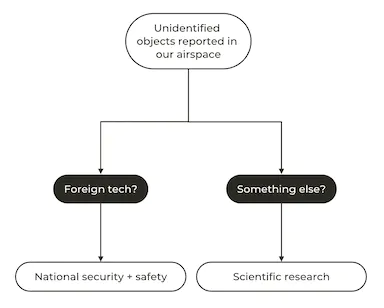
Transparent disclosure
“Let’s identify what’s in our skies,” is the group’s mission credo explains the group’s website. “Identifying domain awareness gaps is critical to U.S. national security. If UAP are foreign assets, we must respond appropriately. If UAP continue to defy conventional explanation — we must invest in scientific research.”
The newly formed organization “supports military and commercial pilots and aerospace workers impacted by UAP, scientists committed to investigating this mystery, and concerned citizens who believe in transparent disclosure from our government.”
For more information on Americans for Safe Aerospace, go to:

I was pleased to take part in a Space.com podcast to take a lighthearted look at NASA’s recent report on Unidentified Anomalous Phenomenon (UAP), co-hosted by Rod Pyle and Tariq Malik.
Go to:
This Week In Space podcast: Episode 66 —NASA’s UFO report explained with Leonard David at:
Valentina Tereshkova.Image credit: Roscosmos
Today marks 60 years since the first woman launched into space.
On June 16, 1963, the 26-year-old Soviet cosmonaut Valentina Tereshkova flew the single-seat Vostok-6 spacecraft, an event now 60 years ago.
Some 20 years later, on June 18, 1983, American Sally Ride flew onboard a space shuttle on the STS-7 mission.
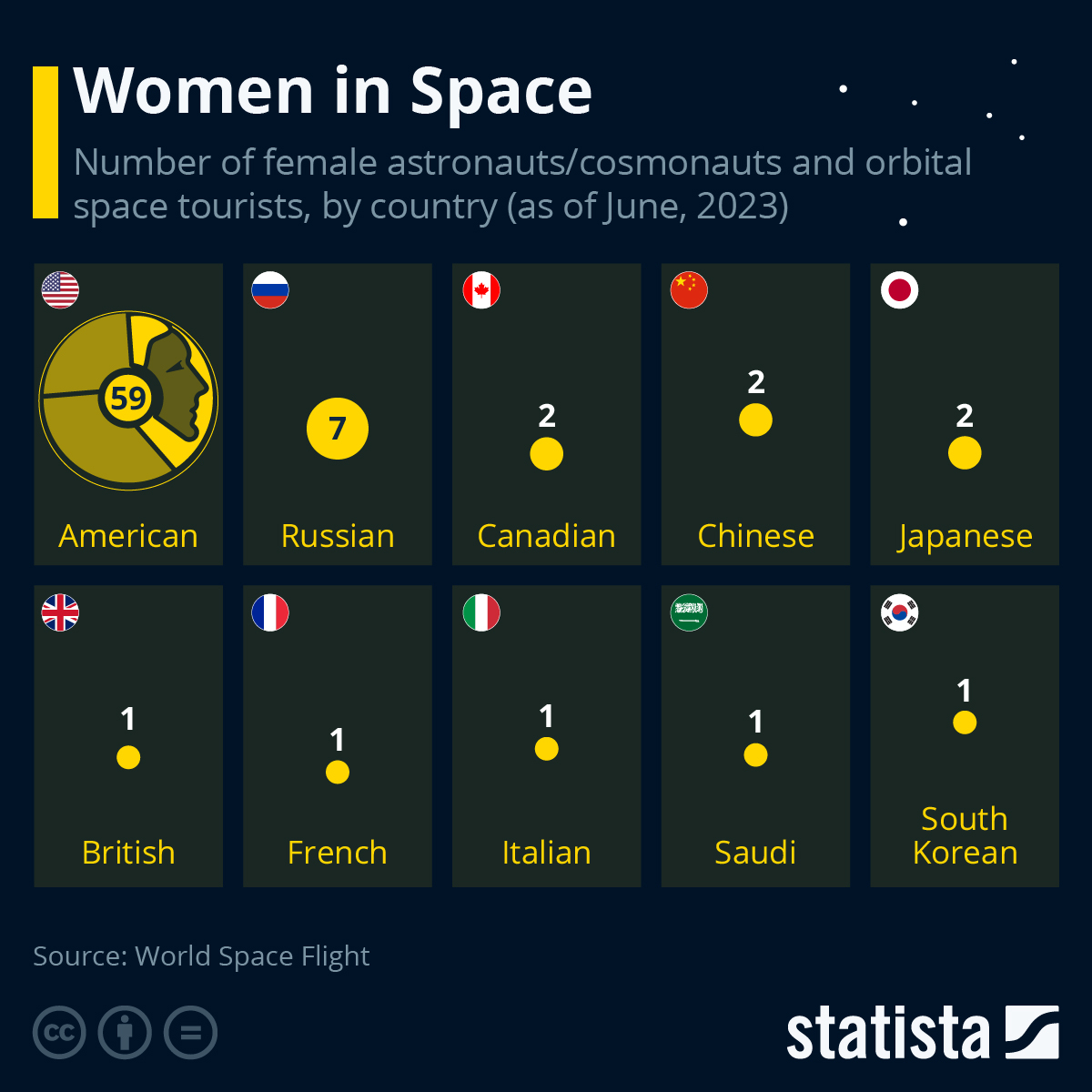
Statista has used data from World Space Flight to show which countries have seen the most female astronauts, cosmonauts, and taikonauts.
The U.S. takes the lead with 59, followed by seven Russians and then two Canadians, Chinese and Japanese nationals each.
Infographic credit: Statista
“A significant gap exists between the number of male and female astronauts/cosmonauts. A total of 325 men from the U.S. had become astronauts or orbital space tourists as of June 16, 2023,” reports Statista’s Anna Fleck. “The next highest numbers were 121 Russian men, 16 Chinese men, 14 Japanese men and 11 Canadian men.”
For more information on Statista, go to:
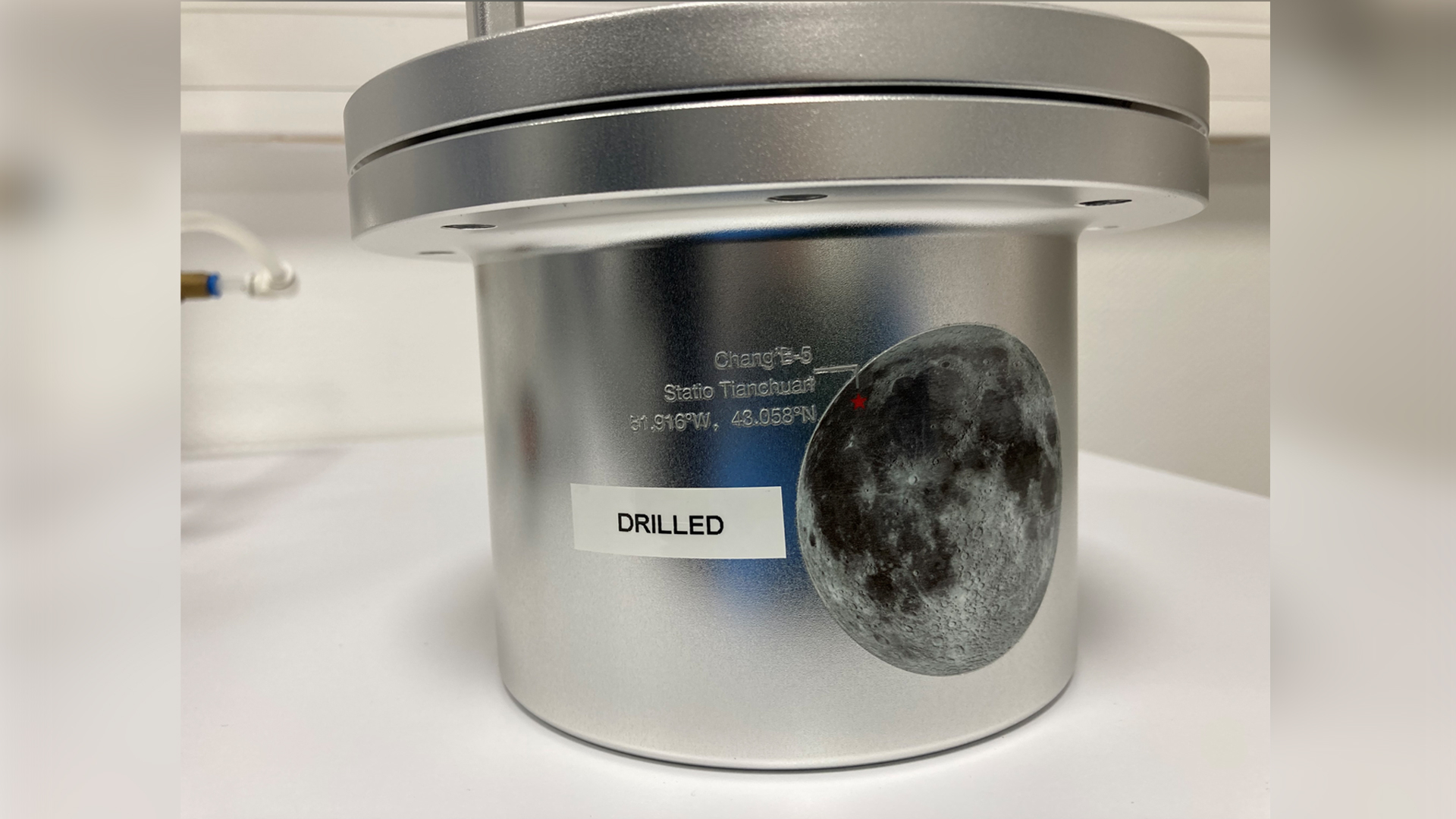
Image credit: French National Center for Scientific Research
Lunar samples returned to Earth by China’s Chang’e-5 Moon mission have been transported to the National Museum of Natural History in Paris.
Placed in an air-sealed container, the 1.5 grams of samples were given to France for scientific research during French President Emmanuel Macron’s visit to China last April.
Gift samples
As reported by the China Global Television Network (CGTN), the lunar samples originate from drilling and surface-gathering actions taken by Chang’e-5 in December 2020 at the Statio Tianchuan in the northeastern Oceanus Procellarum on the nearside of the Moon.

Box indicates Chang’e-5 lander on the basaltic plains of Oceanus Procellarum (“Ocean of Storms”) in December 2020. Image taken by Lunar Reconnaissance Orbiter. Image credit: NASA/GSFC/ASU
The gift samples will be studied in a joint effort by the French National Center for Space Studies (CNES), the French National Center for Scientific Research (CNRS), the Paris Institute of Earth Physics (IPGP) and the University of Paris-Sorbonne for the next five to seven years.
China has announced plans to carry instruments from the European and French space agencies for the country’s second sample return mission, Chang’e-6, in 2024 from the farside of the Moon.
Soviet Luna 16
China presented Russia with 1.5 grams of lunar samples when Russian President Vladimir Putin visited China. Russia reciprocated by providing China with 1.5 grams of lunar samples during Chinese President Xi Jinping’s visit to Russia in March 2023.
The Russian lunar samples given to China originate from the drilled samples by the former Soviet Union’s Luna 16 mission in 1970.

Photo taking during Chang’e-5 surface sampling.
Credit: CCTV/Inside Outer Space screengrab
As noted by CGTN, a regulation on the management of lunar samples was released by the China National Space Administration (CNSA) in December 2020 encourages international research and sharing of scientific achievements on lunar samples.
Scientists from Australia, Russia, France, the United States, the United Kingdom and Sweden have participated in scientific research on Chinese lunar samples, CGTN added.
Impact glass beads
Earlier, research scientists in China reported the finding of water inside tiny beads of glass scattered across the Moon by studying lunar soil brought back by China’s Chang’e-5 spacecraft.
Earlier this year, this finding was published in Nature Geoscience:
“A solar wind-derived water reservoir on the Moon hosted by impact glass beads” can be found here at:

