Archive for the ‘Space News’ Category
 Author:
  July 20th, 2023
Image credit: Barbara David
Wait a minute – here we go again!
Next week, the House Oversight Committee’s National Security Subcommittee in Congress will hold a hearing on Unidentified Anomalous Phenomena, or UAP.
The July 26 hearing is titled “Unidentified Anomalous Phenomena: Implications on National Security, Public Safety, and Government Transparency.”

Image credit: Yannick Peings, Marik von Rennenkampff/AIAA
Firsthand accounts
According to a statement the subcommittee hearing “will explore firsthand accounts of unidentified anomalous phenomena (UAP) and assess the federal government’s transparency and accountability regarding UAPs’ possible threats to U.S. national security.”
A key effort of the hearing is to bring transparency to the issue of UAPs.
“The Pentagon and Washington bureaucrats have kept this information hidden for decades, and we’re finally going to shed some light on it. We’re bringing in credible witnesses who can provide public testimony because the American people deserve the truth. We’re done with the cover-ups,” said Rep. Tim Burchett (R-Tenn.).
Show and tell time
Hearing witnesses are:
- Ryan Graves, Executive Director, Americans for Safe Aerospace
- Retired Commander David Fravor, Former Commanding Officer, Black Aces Squadron, U.S. Navy
- David Grusch, Former National Reconnaissance Office officer and representative, Unidentified Anomalous Phenomena Task Force, Department of Defense
Grusch has recently claimed, citing unnamed officials, that the U.S. has retrieved “intact and partially intact” vehicles of non-human origin and that the U.S. federal government maintains a hush-hush recovery program that has stashed away exotic spacecraft, even dead pilots.

Shown at Congressional hearing, Video 1 2021 flyby movie showing a purported UAP.
Credit: Counterterrorism, Counterintelligence, and Counterproliferation Subcommittee/Inside Outer Space screengrab
American public: in the dark
In 2022, at the direction of Congress, the Department of Defense created the All-domain Anomaly Resolution Office (AARO) to investigate UAP reports.
According to the statement, the federal government spends millions of dollars examining UAPs yet refuses to be forthcoming with the American people as it continues to declassify certain videos and studies on various UAP incidents with little clarity on the subject’s origins.”
“The status quo on the part of the U.S. government has been to leave the American public in the dark regarding information about UAPs, refuse to answer questions posed by whistleblowers, avoid the concerns Americans have about the possible threats UAPs pose to our national security and public safety, and default to extreme and unnecessary over-classification,” said Rep. Anna Paulina Luna (R-Fla.).

UAP have been reported by Navy pilots unlike anything they have ever witnessed.
Image credit: Enigma Labs/Lt. Cmdr. Alex Dietrich
Lawmaker Luna added: “If the last few months have taught me anything, it is that this is an issue that matters to Americans. It also impacts the transparency and accountability our government is supposed to grant to the people who it serves. I look forward to bringing this topic to light.”

Image credit: Statista
Solve this mystery
“My goal is to share my experience, but also elevate the voices of other pilots who are seeing UAP every day and deserve answers,” said Ryan Graves in a Americans for Safe Aerospace statement. More than 30 commercial aircrew and military UAP witnesses have approached the Americans for Safe Aerospace, he said, and the group is working to help share their reports with Congress and the All-domain Anomaly Resolution Office.
“It is encouraging to see Congress taking UAP witnesses seriously,” Graves added. “For too long stigma has clouded transparency on this topic, and I am encouraged by the continued pressure from elected officials to solve this mystery.”
The July 26 hearing begins at 10:00 a.m. Eastern Time, open to the public and live-streamed online at:

Image credit: Congressional Record/Inside Outer Space screengrab
UAP disclosure act
On July 13, in the Congressional Record of the U.S. Senate, a “UAP Disclosure Act of 2023” calls for public disclosure of all Federal, State, and local government, commercial industry, academic, and private sector endeavors that have collected, exploited, or used reverse engineer technologies of unknown origin or examined biological evidence of living or deceased non-human intelligence that pre-dates the date of the enactment of this Act.
The term ‘‘non-human intelligence’’ means, according to the Act, any sentient intelligent non-human lifeform regardless of nature or ultimate origin that may be presumed responsible for unidentified anomalous phenomena or of which the Federal Government has become aware.

Up close and personal! Scene from Earth vs. the Flying Saucers circa 1956.
Credit: Columbia Pictures
Object observables
In addition, the Act says that the term ‘‘unidentified anomalous phenomena’’ includes what were previously described as flying discs; flying saucers; unidentified aerial phenomena; unidentified flying objects (UFOs); and unidentified submerged objects (USOs).
The Act also stated that UAP are differentiated from both attributed and temporarily non-attributed objects by one or more of the following observables:
- Instantaneous acceleration absent apparent inertia.
- Hypersonic velocity absent a thermal signature and sonic shockwave.
- Transmedium (such as space-to-ground and air-to-undersea) travel.
- Positive lift contrary to known aerodynamic principles.
- Multispectral signature control.
- Physical or invasive biological effects to close observers and the environment.
To take a look at details of the UAP Disclosure Act of 2023, go to:
https://www.congress.gov/118/crec/2023/07/13/169/120/CREC-2023-07-13-pt1-PgS2953.pdf
 Posted in

NASA’s Origins, Spectral Interpretation, Resource Identification, Security-Regolith Explorer (OSIRIS-REx) spacecraft.
Credit: NASA/Goddard/University of Arizona
Practice makes perfect, as they say.
NASA’s first mission to collect a sample from an asteroid — Origins Spectral Interpretation Resource Identification Security Regolith Explorer (OSIRIS-REx) – is zipping its way back to Earth.

Utah drop zone landscape.
Image credit:
OSIRIS-REx collected specimens of asteroid Bennu in October 2020.
Drop zone
Loaded with those precious collectibles, the OSIRIS-REx spacecraft will drop off its sample return capsule on September 24.

Recovery team practice to prepare sample return capsule for helicopter pickup.
Image credit: NASA/Keegan Barber
The desert drop zone: The Department of Defense’s Utah Test and Training Range.

Image credit: NASA/Keegan Barber
Early this week, recovery teams toured the projected landing ellipse in Utah, as well as performed a lengthy to-do list for the real recovery of the capsule, including airlifting the cosmic cargo via helicopter to an awaiting clean room.

Image credit: NASA/Keegan Barber

Image credit: NASA/Keegan Barber

Immersive Mars Issue of Tech Briefs:
Mars: Past, Present, Future; NASA’s New, Resilient Approach to Moon, Mars Exploration; Robotic Exploration of Caves on Mars; Developing High–Fidelity Martian Regolith Simulants; Astronaut Smart Glove for Mars EVA Spacesuits; Earthly Twin Offers Test Bed for NASA’s Peserverance Mars Rover; and 3D–Printed Mars Habitat Simulated on Earth.
Go to:
https://www.nxtbook.com/smg/techbriefs/23TB07/index.php#/p/Intro

This outcrop in the center of image reminds one of a lion, lying on its side. Curiosity Front Hazard Avoidance Camera Right B photo taken on Sol 3892, July 19, 2023.
Image credit: NASA/JPL-Caltech
NASA’s Curiosity Mars rover at Gale Crater has just begun performing Sol 3893 tasks.
A recent weekend drive successfully brought the robot some 90 feet (28 meters), bringing it closer to the “crater cluster,” a series of small craters grouped close together, reports Catherine O’Connell-Cooper, a planetary geologist at the University of New Brunswick; Fredericton, New Brunswick, Canada.
Cluster close-ups
“These craters were created by meteoroid impacts, probably from a single meteoroid that broke up before it reached the surface,” O’Connell-Cooper adds. “So this mini campaign will bring us as close as possible to the cluster, for lots and lots of imaging to be analyzed, which will allow us to characterize the craters and potentially get an understanding of their origin. Hopefully we will even get close enough to get contact science on some material up here.”

Curiosity Chemistry & Camera (ChemCam) Remote Micro-Imager (RMI) photo taken on Sol 3892, July 19, 2023.
Image credit: NASA/JPL-Caltech/LANL

Curiosity Chemistry & Camera (ChemCam) Remote Micro-Imager (RMI) photo taken on Sol 3892, July 19, 2023.
Image credit: NASA/JPL-Caltech/LANL

Curiosity Front Hazard Avoidance Camera Left B image taken on Sol 3892, July 19, 2023.
Image credit: NASA/JPL-Caltech
Distinct layers
Curiosity recently focused instruments on one target, labeled as the “Lion’s Mane.”
Bedrock here — and all of the rover’s recent workspaces — typically has two variations, O’Connell-Cooper adds. The bulk of the outcrop is made up of blocks which are usually layered and often have lots of nodules – as can be seen in the body of the “lion.”
Then there are often minor occurrences of a more platy, brittle looking material. The head of the lion and its shaggy mane is made up of this material, where it has weathered into several distinct layers with ragged edges, O’Connell-Cooper points out.
This second type of outcrop was to be studied by the rover’s Alpha Particle X-Ray Spectrometer (APXS), first integrated over the target “Nasia” (located on the top of the “lion’s head”) and then Chemistry and Camera (ChemCam) will use Laser Induced Breakdown Spectroscopy (LIBS) on the same spot. This will be followed by using the Mars Hand Lens Imager (MAHLI) and Mastcam imaging of the same target.

Curiosity Left B Navigation Camera image taken on Sol 3891, July 18, 2023.
Image credit: NASA/JPL-Caltech
Interactions: rock, regolith, sand
O’Connell-Cooper reports that Mastcam was slated to also take two small mosaics (3 images each) in the near field of the workspace – “Zarelia” will look at some nearby laminated float blocks and the “Troughs” mosaic will look at… you guessed it …. some troughs.

Curiosity Left B Navigation Camera image taken on Sol 3891, July 18, 2023.
Image credit: NASA/JPL-Caltech
“More specifically, it will look at interactions between rock and regolith and sand in the workspace. Mastcam will also take a larger mosaic (a “15×3” mosaic, i.e., 3 rows of 15 images) focusing on the crater cluster,” O’Connell-Cooper adds.

Curiosity Left B Navigation Camera image acquired on Sol 3892, July 19, 2023.
Image credit: NASA/JPL-Caltech
Martian clouds
Meanwhile, the environmental theme group is busy as always.
“Mastcam will take a pair of tau measurements (measuring dust in the atmosphere), whilst Navcam will take a series of movies,” O’Connell-Cooper, notes, “examining martian clouds, their properties and abundances. The cloud ‘zenith’ movie looks directly upwards to look at clouds and their direction, whilst the ‘suprahorizon’ movie is targeted in a more horizontal direction, looking at clouds and variations in optical depth in the atmosphere above the southern rim of the crater.”
The Dynamic Albedo of Neutrons (DAN) and Rover Environmental Monitoring Station (REMS) measurements round out the environmental science plan.
Following this, the robot is slated to drive about 98 feet (30 meters), “skirting along the edge of the crater cluster, and setting us for further characterization of the crater cluster on Wednesday,” O’Connell-Cooper concludes.

Image credit: NASA
It is an early, up-front message from 20th century Apollo moonwalkers.
The Moon is one big dust bowl. It can jam up machines. It is abrasive to delicate science gear, and adheres to space suits. It’s also a hazard to humans breathing in the stuff within the comfy confines of a lunar habitat after a hard day’s work on the Moon’s surface.

Apollo 17 helmets and dusty spacesuits stuffed inside lunar lander following the last human treks on the Moon in December 1972.
Credit: NASA
“Mitigation technologies that quickly and effectively remove dust particles (down to microns in size) with minimal consumables, as well as meet tight mass, volume, and power constraints, are needed for future long-term lunar exploration,” explains Charles T. Pett, a PhD student
in aerospace engineering at the University of Maryland.

Lunar dust haunted Apollo moonwalkers. Can that dust offer a way to mitigate climate change on Earth?
Image credit: NASA/Azita Valinia
Handheld device
To tackle the talcum powder-like Moon dust, enter the “Gecko Roller” – a handheld device that functions in the same way as a common terrestrial lint roller.
The idea was inspired by studying the skin membrane of a gecko, a small lizard. Due to a multitude of microscopic hairs on their feet, these little critters can cling and climb with great finesse.
Pett and his research colleagues suggest a bit of biomimicry.

Top left shows topographical characteristics of gecko toes. Bottom left, scanning electron microscope images of manufactured gecko skin microstructure. Right, Gecko Roller after removing flour from a hard surface. Image credits: C. T. Pett, et al.
Cling appeal
“The synthetic gecko skin membrane is a silicone elastomer with micron-scale molded hair-like structures that increase the adhesion between the dust and the elastomer,” the research team explains. “The Gecko Roller requires no power when operated by an astronaut, but can become reusable via electrostatic cleaning if power is available.”
In preliminary work, the Gecko Roller has shown its cling appeal to effectively remove dust from hard surfaces, as well as a spacesuit fabric swatch at lab temperature and pressure.
Someone tell GEICO that the Gecko Roller is a dust busting insurance policy need for 21st century Moon walking crews.

Image credit: GEICO

Image credit: Roscosmos
Russia’s Luna-25 robotic Moon lander continues to make preparations for its launch from the Vostochny cosmodrome.
Recently, electrical and other spacecraft checkouts were carried out (from July 12 to July 16) with Russia’s Roscosmos adding that “the results are positive and without any comments!”
Liftoff of Luna-25 by a Soyuz-2.1b rocket with a Fregat upper stage is scheduled for August.
Luna-25 is Russia’s re-rendezvous with Moon exploration, picking up where the former Soviet Union left off in 1976.
South pole landing
The spacecraft is to try out technology for soft landing, take and analyze the soil and conduct other scientific research, as well as study the upper layer of the surface regolith in the region of the south pole of the Moon, as well as the lunar exosphere.

Image credit: Roscosmos
In terms of landing, Luna-25 is fundamentally different from its predecessors. Former Soviet lunar stations landed on the Moon in the equatorial zone. The new station should gently plop down on the Moon “in the circumpolar region with complex terrain,” notes Roscosmos.

Image credit: Roscosmos
Public poll
Meanwhile, a public poll has been taken to give a name to the talisman and its magical powers. Out of three top candidates, “Moon”; “Fox”; and “Sonata” are in the running, with “Sonata” in the lead, according to a Roscosmos Telegraph posting.
For more information on this upcoming mission, go to my new Space.com story “Russia’s Luna-25 moon lander reaches launch site for a reported August 11 liftoff” at:
https://www.space.com/russia-moon-mission-luna-25-at-launch-site

Image credit: China Manned Space Engineering Office
The China Manned Space Agency (CMSA) on Monday issued an announcement to solicit proposals for payloads to be carried by the country’s human Moon mission set to take place in 2030.
According to the CMSA, the lunar lander will carry scientific payloads solicited from research institutions, universities and high-tech enterprises.
Investigative fields would include lunar geology and lunar physics, observation, space life sciences, as well as deep drilling on the lunar surface and utilization of lunar resources, the CMSA stated, as reported by the Global Times and Xinhua news groups.

Image credit: China Manned Space Engineering Office
Lunar rover
Chinese astronauts will be able to explore the surface of the Moon using a two-seater lunar rover which will be able to collect samples within a range of 6 miles (10 kilometers), according to Zhang Hailian, deputy chief designer with the CMSA.
Zhang said that in addition to the two-person lunar rover, China also plans to launch a lunar mobile laboratory with large-scale mobile capabilities. It will be able to operate uncrewed on the lunar surface for a considerable time, and will be equipped to support the short-term stay of astronauts.

Image credit: China Manned Space Engineering Office
Preliminary plans
In recent days, China space experts have been detailing the country’s humans-to-the-Moon exploration plans, although cited as preliminary.
Last week, a preliminary plan for landing a Chinese crew on the Moon before 2030 was outlined, based on use of two carrier rockets to transfer a Moon lander and a crewed spacecraft into lunar orbit.
The two would then rendezvous and dock with each other. Crew transfer into the Moon lander would be done in lunar orbit. After crew touchdown on the Moon and lunar tasks are finished, the explorers would then rocket back into lunar orbit to dock with their orbiting spacecraft for return to Earth.

Image credit: China Manned Space Engineering Office
According to China Central Television (CCTV), Chinese researchers are working on the development of the Long March-10 carrier rocket, a new generation of piloted spacecraft, a lunar lander, a lunar landing spacesuit, a wheeled lunar rover for Moon explorers, and other equipment, citing Zhang speaking at a recent space industry forum in Wuhan, capital of central China’s Hubei Province.

Image credit: NASA/JPL-Caltech
NASA’s Ingenuity Mars Helicopter has relayed some new imagery, acquired on July 14.
A black and white image was taken by the mini-chopper’s Navigation Camera mounted in the helicopter’s fuselage and pointed directly downward to track the ground during flight.
The color image was produced by Ingenuity’s high-resolution color camera mounted in the helicopter’s fuselage and pointed approximately 22 degrees below the horizon.

Image credit: NASA/JPL-Caltech
Mars rocks!
Meanwhile, a “stunning discovery” by the Perseverance Mars rover may flip the script regarding the oldest rocks in Jezero crater.

Image credit: NASA/JPL-Caltech/Mars Guy
Where they formed from a thick lava flow or lava lake that once filled the crater?
New data challenges that idea, suggests Mars Guy.
Go to this new video at:

Image credit: ISRO
India’s Moon-bound Chandrayaan-3 lunar lander/rover is toting a NASA laser retroreflector array. In NASA acronym-land, better known as an LRA.
The device, mounted atop the lander, is from the LRA project based at NASA’s Goddard Space Flight Center.

NASA LRA mounted on Chandrayaan-3 lunar lander.
Image credit: ISRO/NASA
Daniel Cremons and Xiaoli Sun are leading the LRA project for the Chandrayaan-3 lander. They are also supplying LRA hardware for NASA’s Commercial Lunar Payload Services missions and the Smart Lander for Investigating Moon (SLIM) mission to be staged by the Japan Aerospace Exploration Agency, Cremons told Inside Outer Space.
At NASA Goddard there is a small team dedicated to designing, building, and flight-qualifying miniature LRAs.
Cremons also helped integrate the LRA on the SpaceIL Beresheet lander in November 2018. Beresheet was Israel’s first lunar mission and the first attempt by a private company to land on the Moon. That craft, however, was lost during an April 2019 landing attempt.
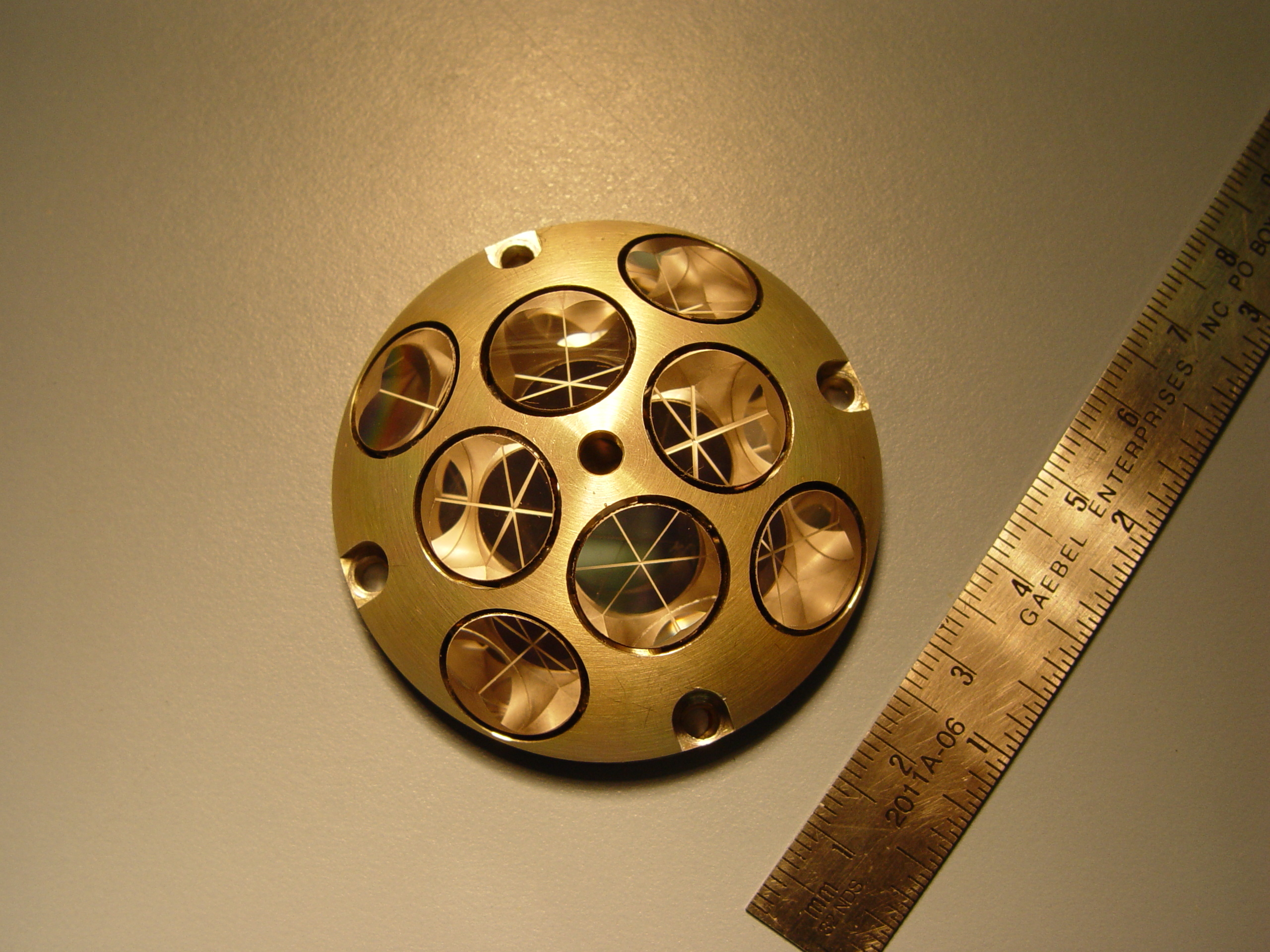
Small and compact, the laser retroreflector array.
Image credit: NASA/Goddard Space Flight Center
Tiny retroreflectors
The Laser Retroreflector Array (LRA) is too small to be used from Earth. They are designed to use reflected laser light from a laser altimeter or lidar on a spacecraft orbiting the Moon or landing on the Moon.
An LRA consists of eight tiny retroreflectors mounted on a small, high hemispherical platform. Total mass of the LRA is 20 grams, and requires no power.
According to LRA documentation, “retroflectors, unlike simple plane mirrors, reflect radiation from a broad range of incident angles back to its source, with minimal scattering, and brighter reflection.”

Intuitive Machines’ Nova-C lander undergoes testing. It is a NASA Commercial Lunar Payload Services mission.
Image credit: Intuitive Machines
Lander location
Another LRA is being carried by the Intuitive Machines’ Nova-C lander, scheduled to drop in on the crater rim of Malapert A near the south pole of the Moon. The Nova-C lander is expected to launch on a Falcon-9 rocket on its IM-1 mission later this year.
Mounted to the lander, the LRA reflects laser light directly backward to the orbiting spacecraft that emitted the laser light to precisely determine the lander’s location on the surface of the Moon.
As noted by Intuitive Machines, LRAs continue to be used as precision landmarks for guidance and navigation during the lunar day or night. “A few LRAs surrounding a landing site can serve as precision landmarks to guide the arriving landers by aiding in autonomous and safe landing,” the company explains.

On the prowl at Jezero Crater, NASA’s Mars Perseverance rover is loaded with scientific equipment.
Image credit: NASA/JPL-Caltech/MSSS
“The real voyage of discovery consists not in seeking new landscapes, but in having new eyes.” – Marcel Proust – a French novelist, literary critic, and essayist who wrote the novel In Search of Lost Time.
A new line of evidence points to the presence of a more intricate organic geochemical cycle on Mars than previously understood. It suggests the existence of several distinct reservoirs of potential organic compounds – and potential for the Red Planet to support life.
The new research makes use of data gathered by a first-of-its-kind instrument: The Scanning Habitable Environments with Raman and Luminescence for Organics and Chemicals.

Perseverance places SHERLOC about two inches above its target to gather data. It operates day or night on Mars.
Image credit: NASA/JPL-Caltech
That’s a Mars instrument mouthful, mercifully called SHERLOC. This device is onboard NASA’s Mars Perseverance rover now dutifully wheeling about Jezero Crater.
The why go there premise was clear.
That landing locale offers a high potential for past habitability: As an ancient lake basin, it contains an array of minerals, including carbonates, clays, and sulfates. These minerals have the potential to preserve organic materials and possible signs of ancient life.

Image credit: NASA/JPL-Caltech
Bingo!
“The potential detection of several organic carbon species on Mars has implications for understanding the carbon cycle on Mars, and the potential of the planet to host life throughout its history,” said astrobiologist Amy Williams, an assistant professor in the University of Florida’s Department of Geological Sciences in Gainesville.
“We didn’t initially expect to detect these potential organics signatures in the Jezero crater floor,” Williams said, “but their diversity and distribution in different units of the crater floor now suggest potentially different fates of carbon across these environments.”
Williams is a co-author of the just-published paper – “Diverse organic-mineral associations in Jezero Crater, Mars” — in the journal Nature.
Lead author of the new research is Sunanda Sharma, an interdisciplinary scientist at the Jet Propulsion Laboratory/Caltech focused on astrobiology research and currently supporting the SHERLOC instrument on the Mars Perseverance rover.

Jezero Crater – home base for Perseverance rover.
Credit: NASA/JPL-Caltech/MSSS/JHU-APL
Building blocks for life
The paper focuses on samples analyzed in two formations within Jezero crater that yielded detections by both fluorescence and Raman spectroscopy “consistent with organic material that is collocated with specific mineral assemblages.”
The confirmation of organic origin and specific identification of these molecules, the paper adds, “will require samples to be returned to Earth for laboratory analysis.”
In summary, key building blocks for life may have been present over an extended period of time on Mars, along with other as yet undetected chemical species that could be preserved within the two potentially habitable paleo-depositional settings in Jezero crater.

a: High Resolution Imaging Science Experiment (HiRISE) image of the region studied with the rover’s traverse marked in white, the boundary between the Séítah and Máaz formations delineated by the light blue line, and each rock target labelled. b: Average number of fluorescence detections (out of 1,296 points) from survey scans for each target interrogated by SHERLOC, arranged in order of observation. c: WATSON images of natural (red box) and abraded targets (Máaz is the blue box, Séítah is the green box) analysed in this study, with SHERLOC survey scan footprints outlined in white.
Image credit: Sharma, S., Roppel, R.D., Murphy, A.E. et al.
Significant step forward
The research paper concludes: “Our findings suggest there may be a diversity of aromatic molecules prevalent on the Martian surface, and these materials persist despite exposure to surface conditions. These potential organic molecules are largely found within minerals linked to aqueous processes, indicating that these processes may have had a key role in organic synthesis, transport or preservation.”
Those findings mark a significant step forward in exploring and understanding the intricacies of Mars, laying the groundwork for more research into the possibility of life beyond Earth.
“We are just now scratching the surface of the organic carbon story on Mars,” Williams said in a university statement, “and it is an exciting time for planetary science!”
To read the entire paper — “Diverse organic-mineral associations in Jezero Crater, Mars” – go to: https://www.nature.com/articles/s41586-023-06143-z

