Archive for the ‘Space News’ Category
 Author:
  September 5th, 2023
Image credit: NASA/GSFC/Arizona State University
India’s Chandrayaan-3 Moon Lander site has been eyed by NASA’s Lunar Reconnaissance Orbiter (LRO).
The Indian Space Research Organization’s (ISRO) Chandrayaan-3 lander/rover touched down on the Moon on August 23, 2023.

NASA’s Lunar Reconnaissance Orbiter (LRO).
Credit: NASA’s Goddard Space Flight Center Conceptual Image Lab
NASA’s LRO high-powered LROC system acquired this oblique view (42° slew angle) of the lander four days later.
The Chandrayaan-3 mission landing site is located over 370 miles (about 600 kilometers) from the lunar south pole.
The bright halo around the vehicle resulted from the rocket plume interacting with the fine-grained regolith (soil).
For more information on LRO’s spotting of the Indian lunar lander, go to:
https://www.lroc.asu.edu/posts/1314
 Posted in

Curiosity took 17 images in Gale Crater to create this mosaic making use of its mast-mounted Right Navigation Camera (Navcam). The rover took the images on August 28, 2023, Sol 3931. Image credit: NASA/JPL-Caltech
NASA’s Curiosity Mars rover at Gale Crater is now performing 3938 tasks.

Curiosity Right B Navigation Camera image acquired on Sol 3935, September 1, 2023.
Image credit: NASA/JPL-Caltech
Amelie Roberts, Graduate Student at Imperial College London, reports that the robot’s Mastcam has been busy producing two large, stereo mosaics of upper Gediz Vallis ridge and the nearby well-layered bedrock, which features enigmatic polygonal fractures.
“Curiosity will embark on its next drive along the layered sulfates, continuing the investigation on the cause of the alternating dark and light-toned banding,” Roberts notes.

Curiosity Right B Navigation Camera image acquired on Sol 3937, September 3, 2023.
Image credit: NASA/JPL-Caltech

Curiosity Right B Navigation Camera image acquired on Sol 3937, September 3, 2023.
Image credit: NASA/JPL-Caltech

Curiosity Front Hazard Avoidance Camera Left B image taken on Sol 3937, September 3, 2023.
Image credit: NASA/JPL-Caltech

Curiosity Mars Hand Lens Imager (MAHLI) photo produced on Sol 3937, September 3, 2023.
Image credit: NASA/JPL-Caltech/MSSS

Image credit: IET
On the Moon face of it, lunar football in the near-future may appear a little “poles apart” activity – a non-contact sport, with no out-of-bounds play and flexible suits with artificial reality (AR) helmets to deal with the harsh conditions of space.
“But, it will still remain an exciting game of skill, passion and creativity and we can’t wait for kick-off,” explains the Institution of Engineering and Technology (IET), one of the world’s largest engineering institutions with more than 154,000 engineering and technology professionals in 148 countries.
Must haves
An IET-sponsored team of visionary engineers and technology professionals have appraised the future of lunar football.
The vision is scoping out how to play football on the Moon as early as 2035.

Image credit: IET
“But, given the Moon has one-sixth of Earth’s gravity, a surface of dusty soil and no breathable atmosphere, the game will look very different,” according to an IET website spotlighting the first-ever Lunar Football Rule Book.
For instance, each player must carry their own oxygen tank and be wearing an airtight suit.
Due to the high contrast of light on the Moon, Lunar Football must take place at lunar noon to maximize visibility and avoid shadows.

Image credit: IET
Ball bounce
Then there’s the ball itself. It must be 1.5 times the size of a terrestrial football – making it a size 8 football. Ideally the ball will be mostly black to contrast with the lunar soil.
The ball must have a core of next-generation Aerogel to give the ball a compressibility to allow bouncing while not containing any air.
IET has created a science, technology, engineering, and mathematics (STEM) competition for kids that entails designing a “Moon United Football Kit” and open for entries from now until September 15, 2023.
To access the rule book, go to:
https://eabw.theiet.org/media/3476/lunar-football-moon-united-rule-book.pdf
For information on IET and its various innovative activities, go to:

Image credit: ISRO
India’s Chandrayaan-3 Moon lander/rover mission is busily gathering science data since its touchdown on August 23 with the country chalking up a first by landing in a region of the Moon’s south pole.
According to the Indian Space Research Organization (ISRO), the mooncraft mission activated a number of experiments:

Image credit: ISRO

Image credit: ISRO

Image credit: ISRO
The Instrument for Lunar Seismic Activity (ILSA) payload on the Chandrayaan-3 Lander is the first instance of a Micro Electro Mechanical Systems (MEMS) technology-based instrument on the Moon. It has recorded the vibrations occurring due to the movements of India’s on-the-prowl rover and other payloads.
ILSA is a cluster of six high-sensitivity accelerometers, with a primary objective to measure ground vibrations generated by natural quakes, impacts, and artificial events.

The vibrations recorded during the rover’s navigation on August 25, 2023, are depicted in the figure. Additionally, an event, seemingly natural, recorded on August 26, 2023, is also shown. The source of this event is currently under investigation.
Image credit: ISRO
Lunar plasma
The Radio Anatomy of Moon Bound Hypersensitive ionosphere and Atmosphere – Langmuir Probe (RAMBHA-LP) payload onboard the Chandrayaan-3 Lander has made the first on-the-spot measurements of the surface-bound lunar plasma environment over the south polar region.

Image credit: ISRO
The Langmuir probe is a device used for characterizing a plasma. It features a metallic spherical probe mounted on a one-meter boom attached to the Chandrayaan-3 Lander’s upper deck. The extended boom length ensures that the spherical probe operates within the undisturbed lunar plasma environment, isolated from the lander’s body.
The initial assessment indicates that the plasma encompassing the lunar surface is relatively sparse, characterized by a number density ranging from approximately 5 to 30 million electrons per cubic meter. This evaluation specifically pertains to the early stages of the lunar daytime.
“These ongoing observations hold significant implications for comprehending the process of charging within the lunar near-surface region,” ISRO explains, “particularly in response to the fluctuations in solar space weather conditions.”

India’s Moon rover operates its Alpha Particle X-ray Spectrometer (APXS).
Image credit: ISRO
Soil and rock analysis
Toted by the lunar rover is an Alpha Particle X-ray Spectrometer (APXS) for in-situ analysis of the elemental composition of soil and rocks on the surface of planetary bodies having little atmosphere, such as the Moon.
APXS carries radioactive sources that emit alpha particles and X-rays onto the surface sample. The atoms present in the sample in turn emit characteristic X-ray lines corresponding to the elements present. By measuring the energies and intensities of these characteristic X-rays, researchers can find the elements present and their abundances.
“APXS observations have discovered the presence of interesting minor elements, including sulfur, apart from the major expected elements such as aluminum, silicon, calcium, and iron,” an ISRO website explains.
In addition, the LASER Induced Breakdown Spectroscope (LIBS) instrument onboard the rover also confirmed the presence of sulfur. LIBS can derive the chemical composition and infer mineralogical composition of the lunar topside.
Detailed scientific appraisal of these observations is in progress.

India Moon lander makes use of Surface Thermo physical Experiment (ChaSTE) and Instrument for Lunar Seismic Activity (ILSA)
Image credit: ISRO
Rover re-activation?
In a statement from ISRO, the Chandrayaan-3 rover has completed its assignments.
“It is now safely parked and set into sleep mode. APXS and LIBS payloads are turned off. Data from these payloads is transmitted to the Earth via the Lander. Currently, the battery is fully charged. The solar panel is oriented to receive the light at the next sunrise expected on September 22, 2023. The receiver is kept on,” ISRO states.
“Hoping for a successful awakening for another set of assignments! Else, it will forever stay there as India’s lunar ambassador,” the ISRO X tweet concludes.

Image credit: ISRO

Image credit: ISRO
Retro-reflector array
Now on the Moon, mounted atop the Chandrayaan-3 Moon lander is a NASA laser retro-reflector array. In NASA acronym-land, the device is better known as an LRA, supplied by the LRA project based at NASA’s Goddard Space Flight Center.

Image credit: ISRO/NASA
The ultra-small, compact LRA is designed to use reflected laser light from a laser altimeter or lidar on a spacecraft orbiting the Moon or landing on the Moon. They are too small to be radiated by laser light shot from the Earth.
An LRA consists of eight tiny retro-reflectors mounted on a small, high hemispherical platform. Total mass of the LRA is 20 grams, and requires no power.
“Since LRA is a passive payload, there are no milestones for the LRA unit itself beyond a safe landing,” said Daniel Cremons of Goddard’s Planetary Geology, Geophysics, and Geochemistry Laboratory.

Image credit: ISRO/NASA
Cremons told Inside Outer Space that the Lunar Orbiter Laser Altimeter (LOLA) on NASA’s Lunar Reconnaissance Orbiter (LRO) is the only NASA laser altimeter capable of ranging to LRA in lunar orbit right now.
The LOLA team will be attempting to range to LRA using LOLA once the Chandrayaan-3 lander and rover missions are complete, Cremons said. “Since LOLA was not designed for precision targeting, this may not be successful on the first attempt but that is our plan right now,” he said.

Image credit: RAND
Moving day in space has a “you-haul” feel to it.
But is there a business in removing space junk from Earth orbit? Numbers of groups are coming up with concepts on grappling with worrisome debris. Nonetheless, estimates of how much troublesome litter – from huge chunks of space scrap to tiny paint chips and even radioactive particles – are daunting and tricky projections.

Photo illustration by Thomas Gaulkin for the Bulletin of the Atomic Scientists’ January 2022 issue (used with permission)
Leftover litter
When a satellite receives a come-to-blows punch by leftover litter or an explosion occurs in Earth orbit, particularly at higher altitudes, the detrimental results are additive. The debris resulting from these high-speed happenings lingers for years, decades, even centuries.
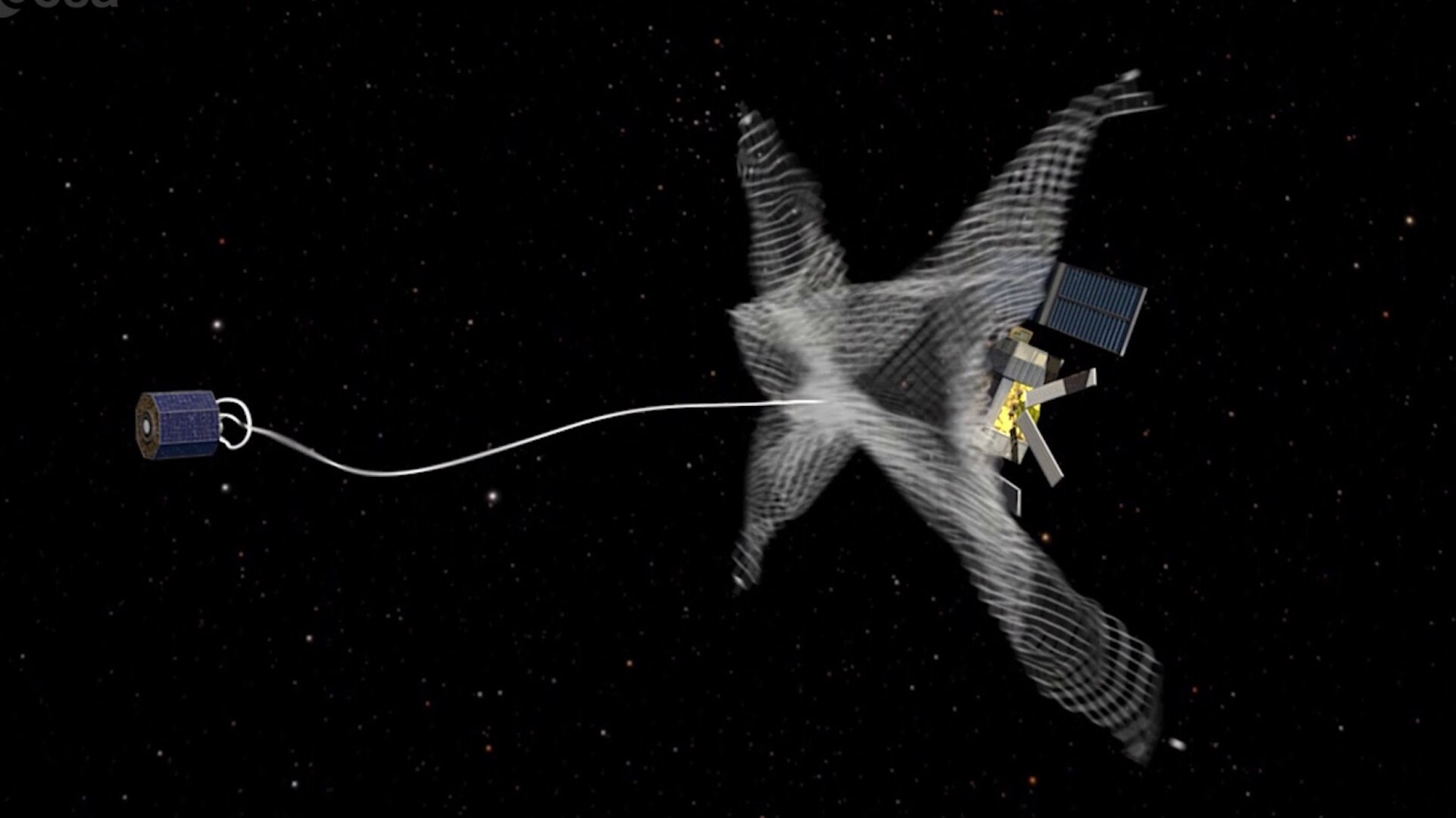
Netting of orbital debris has been studied, among a number of space junk-snatching ideas.
Image credit: ESA/D.Ducros
There’s no doubt about it. Earth orbit is a messy place.
For more information, go to my new Space.com story — “Taking out the trash: Here’s how private companies could be vital for space debris removal – To keep a watchful, more-informed eye on orbital debris, much better approaches are needed” – at:

Image credit: NASA/JPL-Caltech
More air time for NASA’s Ingenuity Mars helicopter.
New imagery shows the August 26th flight, the date for the craft’s 56th soaring journey.
The stats: Horizontal Distance roughly 1,345 feet (410 meters); Maximum altitude about 39 feet (12 meters); Flight duration 140.9 seconds.

Image credit: NASA/JPL-Caltech
Black and white imagery was acquired by the rotorcraft using its navigation camera, mounted in the helicopter’s fuselage and pointed directly downward to track the ground during flight.
Color imagery was also gained using Ingenuity’s high-resolution color camera, mounted in the helicopter’s fuselage and pointed approximately 22 degrees below the horizon.

Image credit: NASA/JPL-Caltech

Image credit: NASA/JPL-Caltech

During preparations for descent to the surface, Russia’s Luna-25 Moon lander experienced an anomaly that caused it to impact into the southwest rim of Pontécoulant G crater on Aug. 19, 2023, at 7:58 a.m. EDT (11:58 a.m. UTC).
Image credits: NASA’s Goddard Space Flight Center/Arizona State University
The lunar leftovers of Russia’s failed Luna-25 robotic craft have likely been spotted by NASA’s Lunar Reconnaissance Orbiter (LRO).
Before and after imagery of the suspected Luna 25 impact site taken by LRO’s powerful LROC imaging system show landscape disturbance at the southwest rim of Pontécoulant G crater. The kicked-up terrain from the impact is roughly 250 miles (400 kilometers) short of Luna 25’s intended landing point.

Before and after images of Luna-25 impact site (click to activate). This GIF alternates between LRO views from June 27, 2020, and Aug. 24, 2023 – before and after the appearance of a new impact crater likely from Russia’s Luna 25 mission.
Credits: NASA’s Goddard Space Flight Center/Arizona State University
“Since this new crater is close to the Luna 25 estimated impact point, the LRO team concludes it is likely to be from that mission, rather than a natural impactor,” according to a NASA statement.
The fresh crater is about 33 feet (10 meters) in diameter. The impact point was on the steep (greater than 20-degree grade) inner rim of Pontécoulant G crater.

Image credit: Roscosmos/IKI/NPO Lavochkin
Off-design orbit
During the descent to the surface, the Russian spacecraft Luna 25 experienced an anomaly that caused it to impact.
As noted by Russia’s Roscosmos, in accordance with the flight program of Luna-25, on August 19 it was planned to issue an impulse to form its pre-landing elliptical orbit.

Russian mishap group is deciphering why Luna-25 mission failed.
Image credit: Roscosmos
However, “due to the deviation of the actual pulse parameters from the calculated ones, the automatic station switched to an off-design orbit and ceased to exist as a result of a collision with the lunar surface,” Roscosmos stated. Attempts on August 19-20 to regain contact with Luna-25 “did not produce any results.”
A specially formed interdepartmental commission has been established to identify the reasons for the loss of Luna-25.
Launched on June 18, 2009, NASA’s LRO is managed by the space agency’s Goddard Space Flight Center in Greenbelt, Maryland for the Science Mission Directorate at the agency’s Headquarters in Washington, D.C. LRO continues to collect a treasure trove of data, operated under the guidance of Arizona State University in Tempe, Arizona.

Artwork depicts NASA’s venerable Lunar Reconnaissance Orbiter (LRO), on-duty since swinging into orbit around the Moon on June 23, 2009.
Image credit: NASA/Goddard Space Flight Center

Image shows the night side of Venus glowing in thermal infrared, captured by Japan’s Akatsuki spacecraft.
Credit: JAXA/ISAS/DARTS/Damia Bouic
Hellish Venus is hot, not only temperature-wise but the planet is a hot topic for exploration. That cloud-veiled world might be a haven for high-altitude life.
Such a prospect is fostering the first-ever private interplanetary mission to Venus to search for signs of life in the clouds by detecting organic chemistry. The mission is planned for launch in January 2025 aboard Rocket Lab’s Electron rocket, an entrepreneurial launch vehicle provider.

Venus cloud encounter – a private sector investigation.
Credit: Rocket Lab
Even prior to that liftoff, researchers are scoping out a set of missions to gather information regarding the Venusian clouds as a possible extraterrestrial home address for life.

Image credit: Morning Star Missions to Venus/MIT
For more information, go to my new Multiverse Media SpaceRef story – “Coming Soon – Missions Hunting for Life in the Cloudy Skies of Venus” at:
https://spaceref.com/science-and-exploration/coming-soon-missions-hunting-life-cloudy-skies-venus/

Curiosity Front Hazard Avoidance Left B Camera image take on Sol 3931, August 28, 2023.
Image credit: NASA/JPL-Caltech
Curiosity is wrapping up its mini-campaign of science collection at the upper Gediz Vallis Ridge reports Emma Harris, a graduate student at the Natural History Museum in London.
“Before we leave however, we want to collect as much data as we can! Next, Curiosity will be driving back to the nominal Mount Sharp Ascent Route (MSAR). We diverted from the MSAR back in June in order to navigate some tricky terrain, and then again briefly here at the uGVR [Gediz Vallis Ridge].”

Curiosity Left B Navigation Camera photo taken on Sol 3931, August 28, 2023.
Image credit: NASA/JPL-Caltech
Jam-packed plan
According to a recent plan, there’s a jam-packed two sols [Sols 3930-3931] in wrapping up at the ridge, Harris explains.
On tap is documenting five float rocks in the rover’s workspace that the robot “bumped” to in driving roughly 23 feet (7 meters) previously.

Curiosity Left B Navigation Camera photo taken on Sol 3931, August 28, 2023.
Image credit: NASA/JPL-Caltech
Over the next 2 sols, the rocks “Styx,” “Knossos,” and “Stravia” will be documented by Mastcam multispectral analysis.
ChemCam Laser Induced Breakdown Spectroscopy (LIBS) observations will be undertaken on Styx and on another float rock named “Elafonisos.”

Curiosity Mast Camera Right photo acquired on Sol 3931, August 28, 2023.
Image credit: NASA/JPL-Caltech/MSSS
“Elafonisos also receives complimentary Mastcam documentation,” Harris adds. “The terrain around here has been tricky to navigate, making it precarious to unstow Curiosity’s arm if we are perched on unstable rocks, but tosol was successful!”
Further afield
The arm was to be unstowed for Alpha Particle X-Ray Spectrometer (APXS) and Mars Hand Lens Imager (MAHLI) documentation of Knossos and the fifth and final float rock documented in this plan named “Meteora.”
“Aside from the immediate workspace, we also had time in the plan to look further afield,” Harris notes.

Curiosity Mast Camera Right photo acquired on Sol 3931, August 28, 2023.
Image credit: NASA/JPL-Caltech/MSSS
A Mastcam mosaic of the Mount Sharp Ascent Route and future drive direction will be taken, as well as two Mastcam mosaics of blocks and float rocks higher up within the Gediz Vallis Ridge, Harris reports.

Curiosity Left B Navigation Camera photo taken on Sol 3931, August 28, 2023.
Image credit: NASA/JPL-Caltech
Back to ascent route
The rover’s Chemistry and Camera (ChemCam) instrument is to take the lead for making two Long Distance Remote Micro-Imager (RMI) photo shoots of a block named “Argos” in the Gediz Vallis Ridge, and a second long distance RMI of the yardang unit higher up on Mount Sharp, Harris adds.

Curiosity Mars Hand Lens Imager (MAHLI) photo produced on Sol 3931, August 28, 2023.
Image credit: NASA/JPL-Caltech/MSSS
“Finally, the plan is rounded off with a Navcam dust devil survey and some morning atmospheric observations. Whilst I’m sure there are many folks that wish we could hang out at the uGVR [Gediz Vallis Ridge] for a while longer, Mount Sharp won’t climb itself, and it’s time to get back to the Mount Sharp Ascent Route,” Harris concludes. “Thanks Gediz Vallis Ridge!”
As always, dates/details of planned rover activities described in these reports are subject to change due to a variety of factors related to the Martian environment, communication relays and rover status.

Curiosity Mast Camera Left image taken on Sol 3931, August 28, 2023.
Image credit: NASA/JPL-Caltech/MSSS

Wait a minute!
Image credit: Barbara David
Just in case you didn’t notice.
The U.S. State Department is embracing the concept of an “International Lunar Year” – coordinating programs around a one-to-two-year celebration of the study and exploration of the Moon later in the decade.
“As multiple nations and commercial entities plan a near-term return to the Moon on an unprecedented scale, now is the right time to consider planning an International Lunar Year,” a State Department website adds.

Earth’s Moon is a destination point for renewed human exploration. Image credit: NASA
“A sustained program might combine elements of public outreach and scientific collaboration to fashion a vibrant interdisciplinary and multilateral effort, demonstrating how lunar exploration can be responsible, peaceful, and sustainable, as we begin to establish an enduring presence at the Moon.”
Indeed, such a celebration was put forth in a White House Office of Science and Technology Policy (OSTP) Cislunar Science & Technology Strategy Cislunar Science & Technology Strategy released in 2022.

Photo taking during Chang’e-5 surface sampling.
Credit: CCTV/Inside Outer Space screengrab
Sample swaps
One avenue to explore is activating Moon sample swaps.
For instance, China has now opened access to the Chang’e-5 returned lunar samples to the international scientific community. That “get up and go” set of samples was rocketed to Earth back in mid-December 2020.
The haul from the Moon added up to roughly 61 ounces of lunar collectibles, including a core sample.

Chinese President Xi Jinping inspects Chang’e-5 lunar sample return capsule.
Credit: CCTV/Inside Outer Space screengrab
Chang’e-5 was the first lunar sample-return mission since the Soviet Union’s Luna 24 in 1976, making China the third country to return lunar samples after the United States and the former Soviet Union.
The Moon looms large in China’s space exploration plans over the next several years, and shooting to our home planet additional lunar samples is on their agenda.
Meanwhile, the Chinese National Space Administration (CNSA) has outlined opportunities and set the rules for future management of international cooperation in lunar samples and scientific data. Proposals will be reviewed every six months.
For full details, go to the CNSA website at:
https://www.cnsa.gov.cn/english/n6465652/n6465653/c10086003/content.html

Moonwalking geologist, Apollo 17’s Jack Schmitt.
Credit: NASA
Diplomatic gestures
In retro-reflective mode, understanding the Moon has been revolutionized through the study of samples collected between 1969 and 1976 by the six Apollo human landing missions, along with three Luna missions carried out by the former Soviet Union.
“The legacy of the bilateral exchange of lunar samples as diplomatic gestures of goodwill transcends generations of lunar scientists,” explains a paper presented at a Lunar Exploration Analysis Group gathering back in 2021.
“As we enter this new golden era of lunar exploration, the U.S. and other nations must recognize the lasting legacy and benefit of the Apollo-Luna sample exchange program of the 1970s and explore new opportunities to share returned samples in the future,” the paper explains, led by planetary scientist, Jessica Barnes at the University of Arizona.

Image credit: NASA
Current restrictions
So what next?
A recent gathering of the Extraterrestrial Materials Analysis Group (ExMAG) made note of access to China’s Chang’e lunar samples.
ExMAG is a community-based, interdisciplinary group that offers a forum for discussion and analysis of matters concerning the collection, curation, and analysis of extraterrestrial samples, including planning future sample return missions
A member gathering of ExMAG earlier this month noted that China has now opened access to the Chang’e-5 returned lunar samples to the international scientific community.
“ExMAG appreciates NASA’s efforts to pursue avenues of sample sharing with China and their Chang’E samples, though we recognize this is not possible under current restrictions,” an ExMAG finding explains.

Image credit: NASA
Bilateral exchange
“ExMAG understands that sample loans made via this mechanism are considered bilateral agreements, which are prohibited for U.S. Government-funded researchers,” with the group recommending that U.S. Government-funded researchers who are interested in working on Chang’e-5 sample “form or join research teams with researchers in other nations who can request the samples for joint work.”

Credit: White House
Bottom line: Given the White House/U.S. State Department moves on an International Lunar Year perhaps there’s a window opening to find avenues for U.S.-China Moon sample cooperation?
Perhaps it’s time to provide some new Moonwalking legs to build upon the legacy of bilateral exchange?
Your views are welcomed!
For more information on this topic, go to these resources:
U.S. State Department Plans “International Lunar Year”
https://www.leonarddavid.com/u-s-state-department-plans-international-lunar-year/
White House Report: Cislunar Strategy
https://www.leonarddavid.com/white-house-report-cislunar-strategy/

