Archive for the ‘Space News’ Category
 Author:
  May 27th, 2026
Mark 1 lunar lander.
Image credit: Blue Origin
In a statement from Blue Origin, “lunar permanence is only possible with recurring access to the Moon, and it starts this year. Proud to support NASA Moon Base at the lunar South Pole with our Blue Moon MK1 vehicles delivering high-cadence, low-cost access—MK1-101 Endurance (Moon Base 1), followed by MK1-102 VIPER, and two additional MK1 missions supporting Lunar Terrain Vehicles (LTVs).”
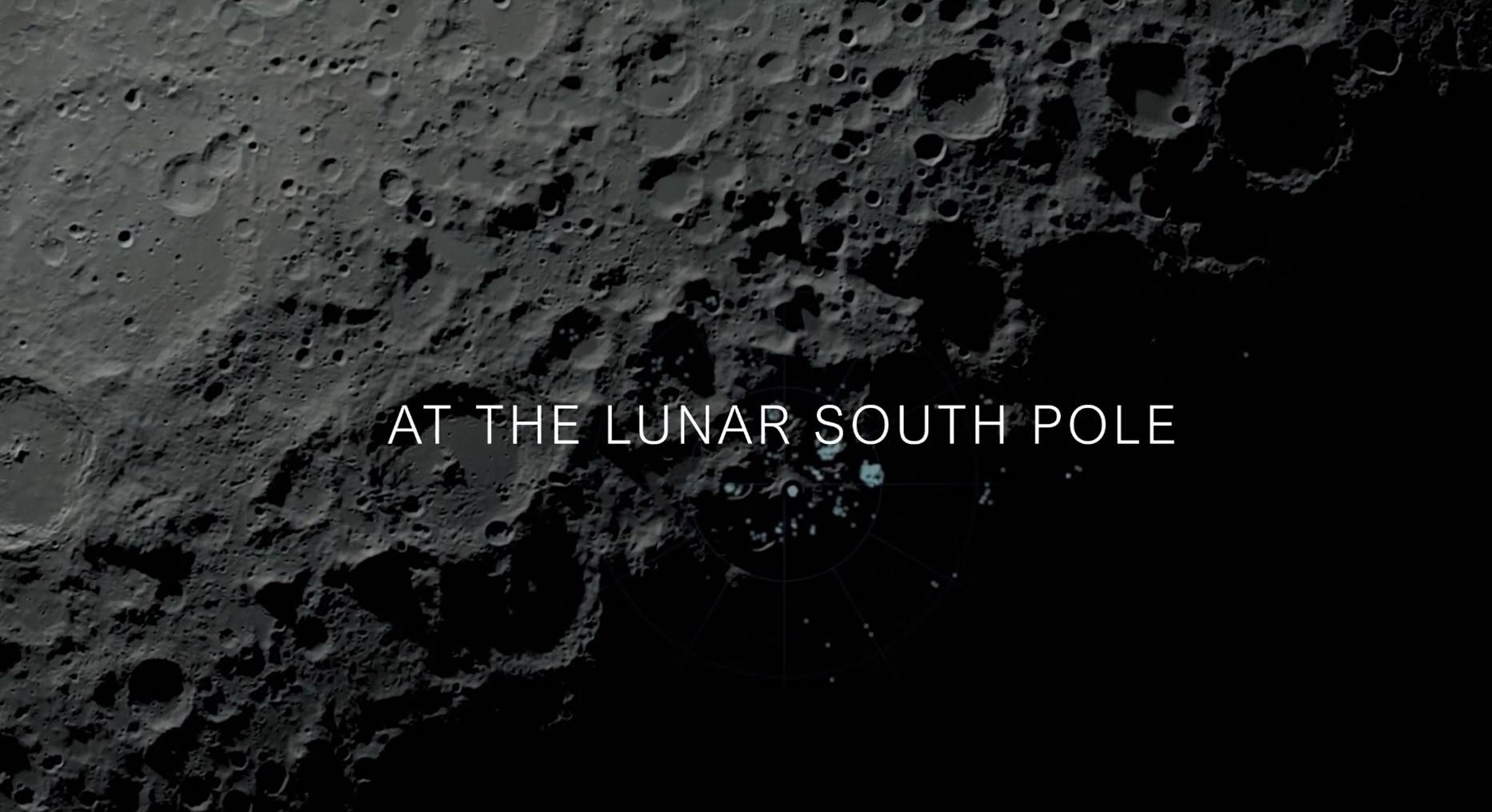
Image credit: NASA/Inside Outer Space screengrab
This first MK1 mission will land on the Shackleton Connecting Ridge to demonstrate capabilities that reduce risk for future crewed Artemis landing missions in 2028.
Moon Base I: Targeted for launch no earlier than fall 2026, this mission will use Blue Origin’s Blue Moon Mark 1 Endurance lander to deliver NASA payloads.
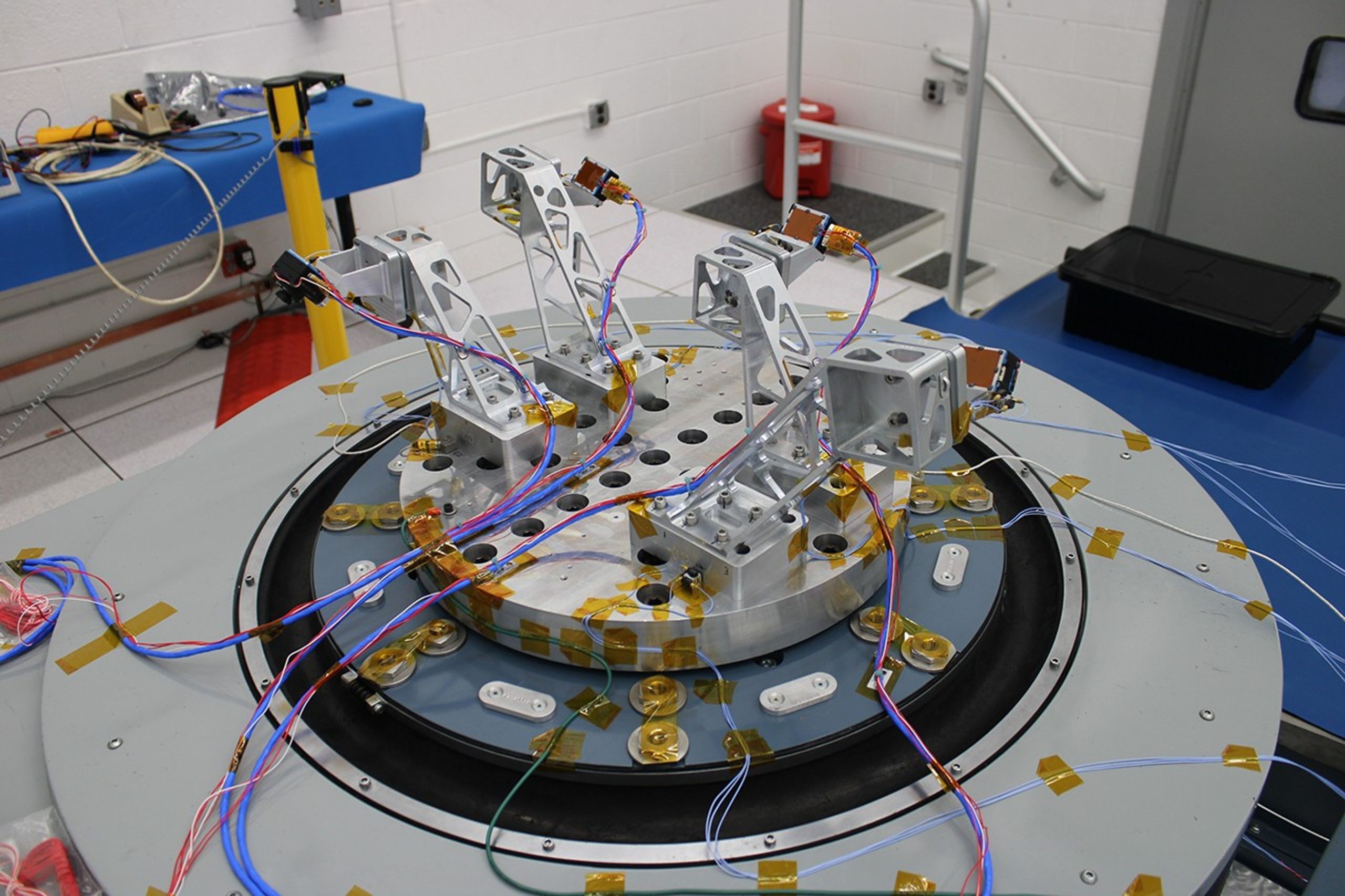
Stereo Cameras for Lunar Plume-Surface Studies (SCALPS)
Image credit: NASA

Laser Retroreflective Array.
Image credit: NASA
NASA equipment onboard Endurance:
Stereo Cameras for Lunar Plume-Surface Studies instrument to study how thrusters interact with the Moon’s surface.
A Laser Retroreflective Array, which helps orbiting spacecraft determine a more precise location using reflected laser light.

Image credit: NASA/Inside Outer Space screengrab
 Posted in

Image credit: NASA
NASA provided today a contract-packed update on the space agency’s Moon Base strategy. The base is to serve as a lunar habitat for long duration exploration and science.
Moon Base is NASA’s lunar exploration and infrastructure initiative designed to enable sustained human presence and expanded scientific and commercial activity at the lunar South Pole.
As detailed today, robotic missions will work alongside Artemis astronauts to study the Moon and help prepare NASA for future Mars missions.
Moon base movement: 2026
During the event, NASA scoped out “Moon Base” phases:
Moon Base I: Targeted for launch no earlier than fall 2026, this mission will use Blue Origin’s Blue Moon Mark 1 Endurance lander to deliver NASA payloads. Equipment will include the Stereo Cameras for Lunar Plume-Surface Studies instrument to study how thrusters interact with the Moon’s surface, and the Laser Retroreflective Array, which helps orbiting spacecraft determine a more precise location using reflected laser light. The mission will land on the Shackleton Connecting Ridge to demonstrate capabilities that reduce risk for future crewed Artemis landing missions in 2028.
Moon Base II: Planned for launch later this year, this mission will deliver more than 1,100 pounds of cargo on Astrobotic’s Griffin lander, including Astrolab’s FLIP rover, to mature mobility systems that inform future lunar terrain vehicle, or LTV, operations.
Moon Base III: Also targeted for this year, this mission will fly the first payload selected through NASA’s Payloads and Research Investigations on the Surface of the Moon initiative. Its anchor investigation, Lunar Vertex, will fly on Intuitive Machines’ Nova-C Trinity lunar lander and study lunar swirls, or light spots on the surface of the Moon, to improve understanding of surface evolution and material behavior under extreme conditions. The mission will include payloads from ESA (European Space Agency) and the Korea Astronomy and Space Science Institute, reflecting commercial and international participation in Moon Base activities.

Artwork depicts two Artemis astronauts planting an American flag at the lunar south pole.
Image credit: NASA/Daniel O’Neal
New industry partners
During a live news event from NASA Headquarters, agency leaders discussed progress on the Moon Base program, including new industry partners and mission plans.
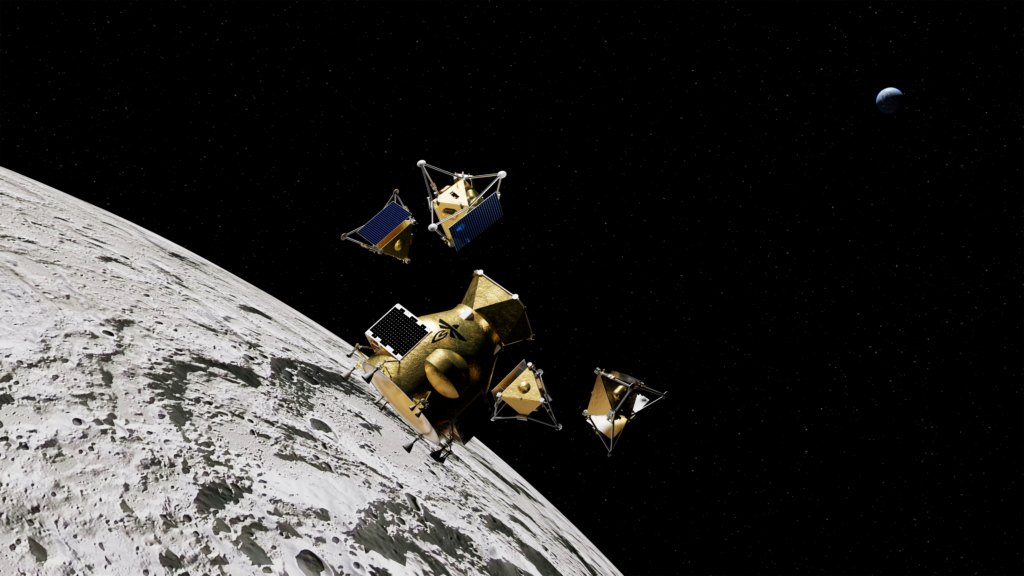
Image credit: Firefly Aerospace
Firefly Aerospace was awarded a subcontract from the Jet Propulsion Laboratory (JPL) to deliver three or four drones to the Moon’s south pole in support of NASA’s MoonFall mission, targeted to launch no earlier than 2028.
MoonFall is part of the first phase of NASA’s Moon Base initiative.
JPL is building the drones and managing the mission for NASA, which will source the launch vehicle for MoonFall.
Go to my earlier story at Space.com:
Drone deploying spacecraft
Upon launching, Firefly’s Elytra spacecraft will carry the drones over a 45-day transit to the Moon and enter lunar orbit before deorbiting and performing a braking maneuver to deploy the drones approximately 50 km above the Moon’s south pole.
The drones will then land and operate for up to 14 days to survey the lunar south pole terrain ahead of future human missions under NASA’s Artemis program.
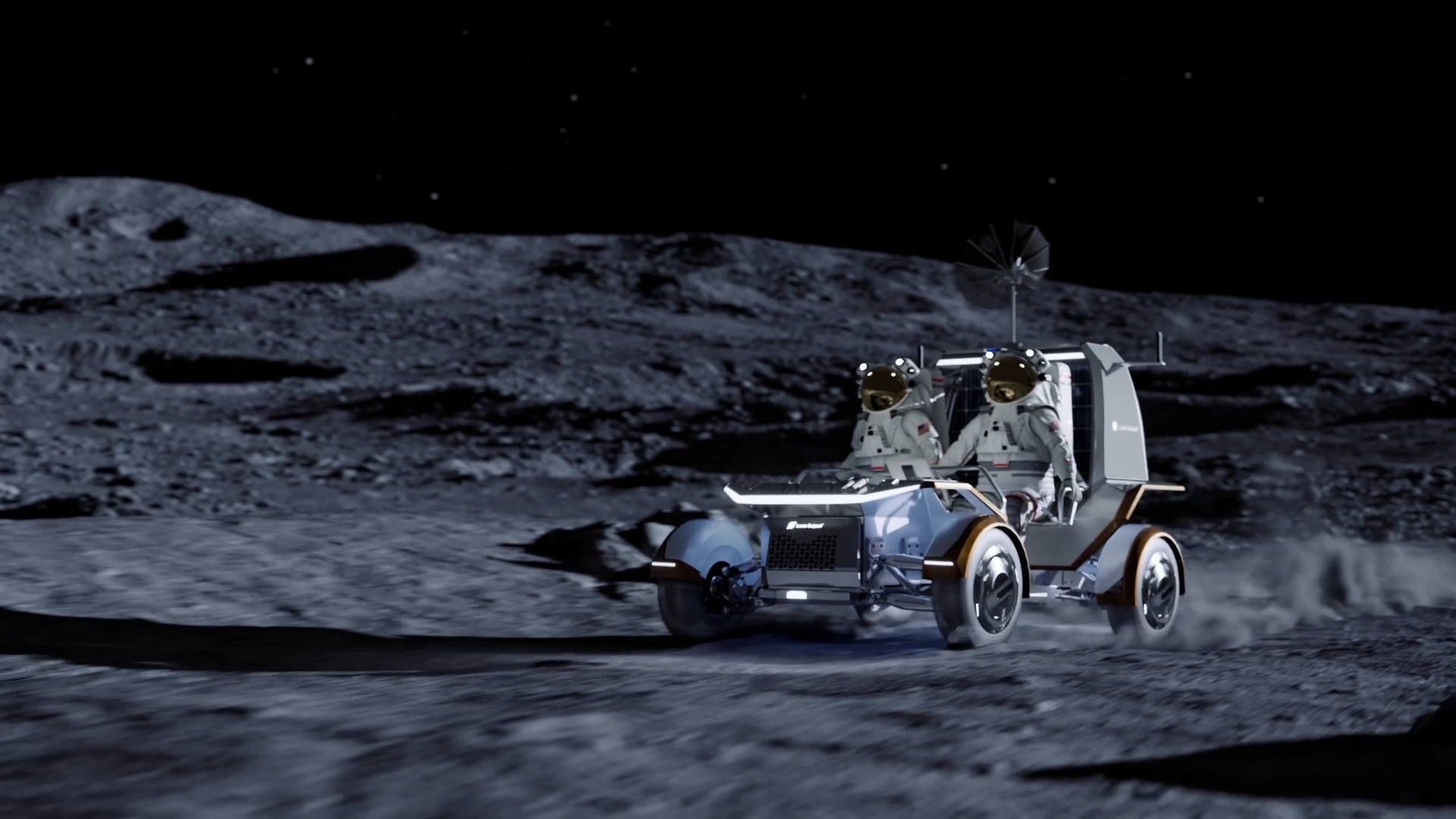
Image credit: Lunar Outpost
Next-generation mobility on the moon
Carlos García-Galán, program executive, Moon Base, also detailed a new contract with Lunar Outpost for its Lunar Terrain Vehicle Services (LTVS) program, advancing the company’s new Pegasus vehicle as a next-generation mobility platform for permanent lunar operations.
Also selected is Venturi Astrolab, Inc. (Astrolab) as a provider of a crewed lunar rover for the Artemis campaign, advancing the agency’s plans to establish sustained surface mobility at the lunar South Pole.
Endurance lander
Lastly, targeted for launch no earlier than fall 2026, Blue Origin’s Blue Moon Mark 1 Endurance lander is to deliver NASA payloads to the lunar landscape.
The mission will land on the Shackleton Connecting Ridge to demonstrate capabilities that reduce risk for future crewed Artemis landing missions in 2028.
In related news, NASA will provide an update on the agency’s Artemis III mission and announce the astronauts assigned to the test flight in Earth orbit during a live event at 11 a.m. EDT on Tuesday, June 9, at the agency’s Johnson Space Center in Houston.
Artemis III will launch four astronauts from NASA’s Kennedy Space Center in Florida aboard the Orion spacecraft on the Space Launch System rocket. The mission will test needed rendezvous and docking capabilities between the Orion spacecraft and commercial human landing systems, required seating to deliver astronauts to the Moon’s surface.
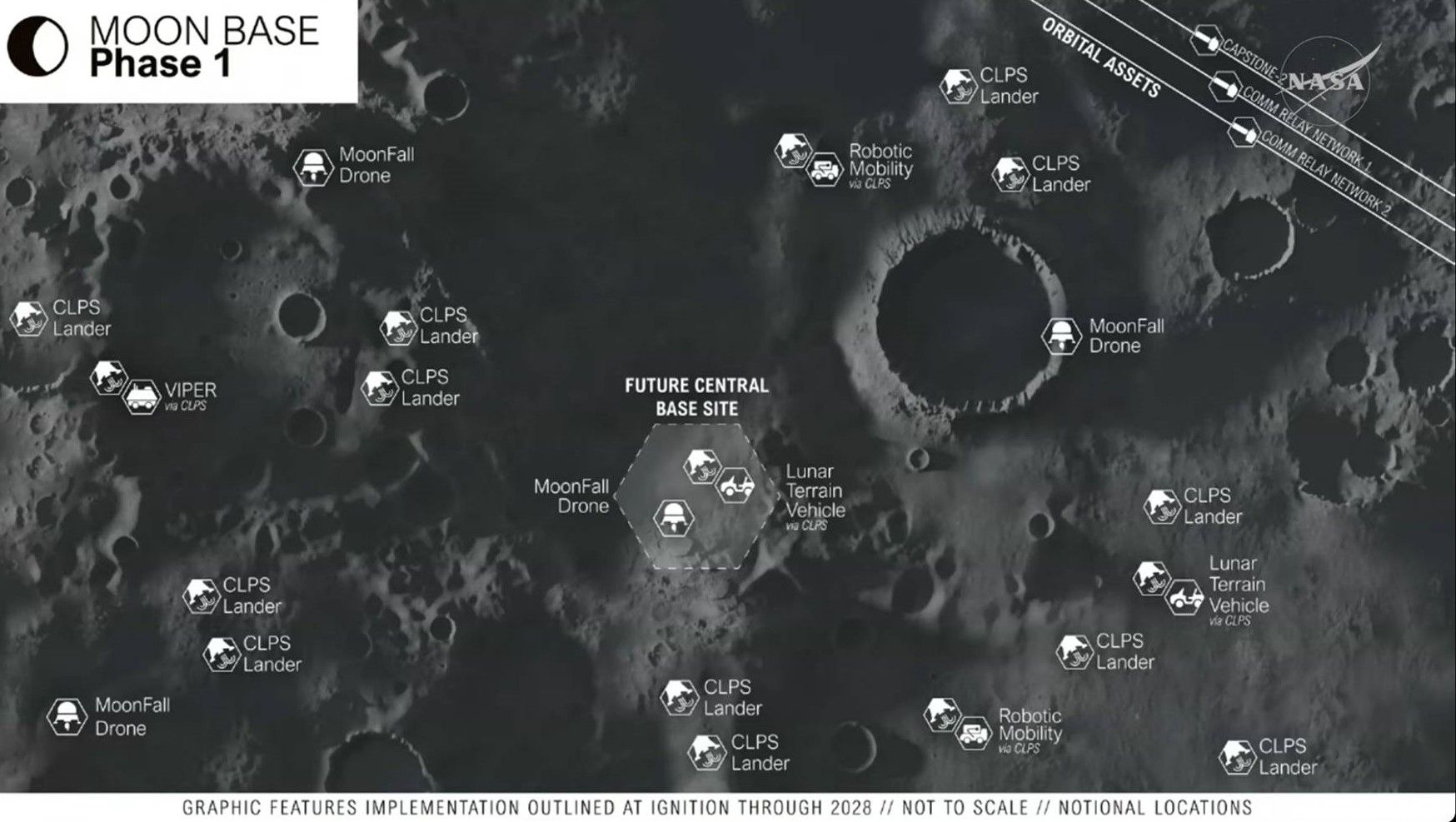
Image credit: NASA
For full Moon Base details, go to:
https://www.nasa.gov/news-release/nasa-provides-update-on-moon-base-rovers-landers-missions/
Also, go to:
https://www.nasa.gov/moonbase/
For a replay of the briefing, go to:

Image credit: CMSA/CCTV/Inside Outer Space screengrab
China successfully launched its Shenzhou-23 crewed spaceship on May 24 from the Jiuquan Satellite Launch Center in northwest China atop a Long March-2F Y23 carrier rocket.
A fast, automated rendezvous and docking mode of roughly 3.5 hours after launch permitted the Shenzhou-23 to attach to the radial port of the Tianhe core module.
An upgraded laser radar guided the Shenzhou-23 to flawlessly dock with China’s Tiangong space station.

Image credit: CCTV/Inside Outer Space screengrab
Now safely onboard the station are mission commander Zhu Yangzhu and fellow astronauts Zhang Zhiyuan and Lai Ka-ying, who is the first astronaut from China’s Hong Kong Special Administrative Region.
Handover
After completing a handover of the Tiangong space station with the Shenzhou-21 crew — Zhang Lu, Wu Fei, and Zhang Hongzhang, the Shenzhou-23 astronauts will start their mission.
According to China Central Television (CCTV), one of the new space travelers will conduct a one-year in-orbit stay, double the usual duration of previous Shenzhou missions.
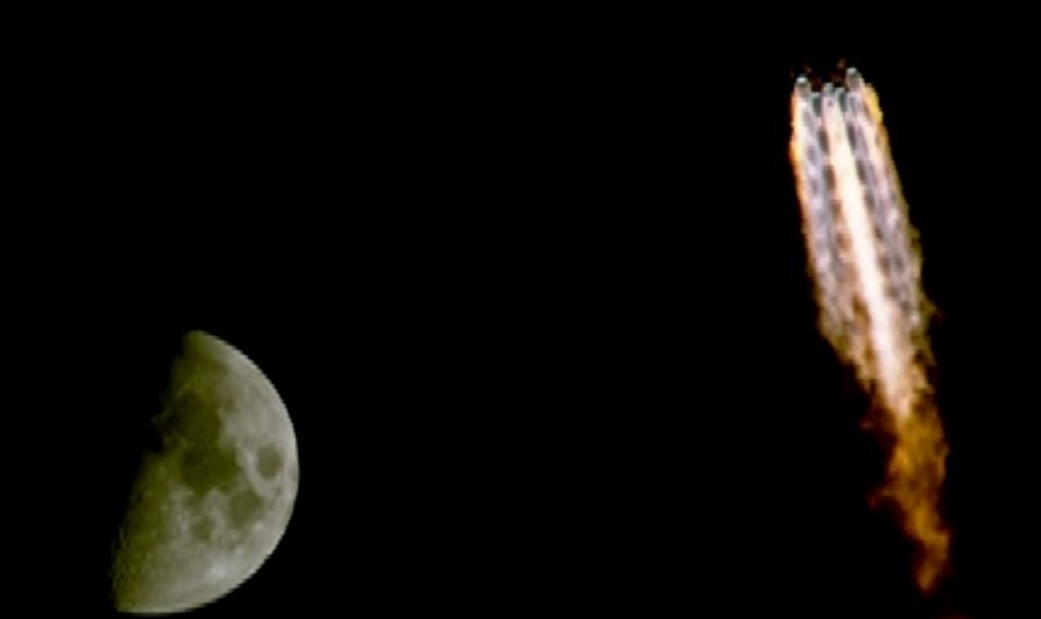
Image credit: CMSA/CCTV/Inside Outer Space screengrab
The flight of Shenzhou-23 marks the 40th flight of China’s manned spaceflight program and the seventh manned flight mission since the Tiangong space station entered its application and development phase in late 2022.
Currently, there are 13 people in low Earth orbit: six onboard China’s orbital outpost, seven on the International Space Station.
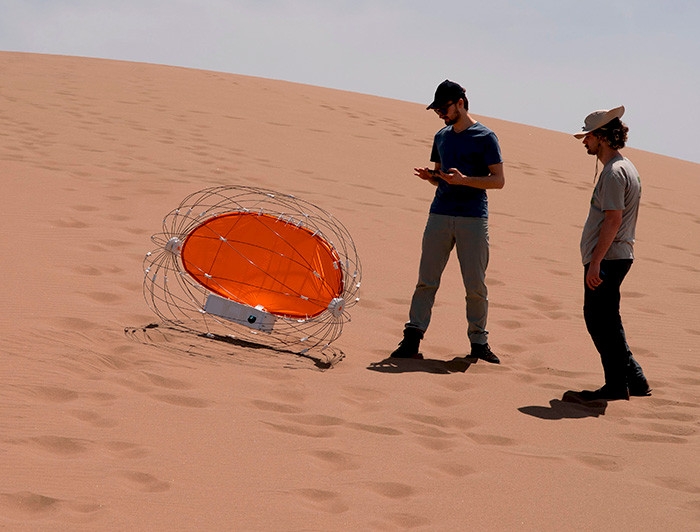
The wind-blown “rover” successfully completed the first of ten days of desert testing.
Image credit: Nicole Saffie
The Atacama Pontifical Catholic University of Chile’s (UC) Alto Patache Station in has served as the base of operations for testing a Mars exploration device – one that uses no wheels or fuel. It’s powered by wind energy.
The Tumbleweed Mars team is an international project working on a lightweight prototype driven by wind energy. The device is outfitted with equipment that can collect a large amount and variety of data.
Testing was done in the heart of Chile’s Tarapacá Region, in what is known as the “absolute desert,” the hyper-arid core of the Atacama Desert.
Years in the making
The project began a decade ago, led by researchers from Delft University of Technology (TU Delft) in the Netherlands, and supported by the European Space Agency (ESA) and the Europlanet Society, among other institutions.
Why the Atacama Desert?
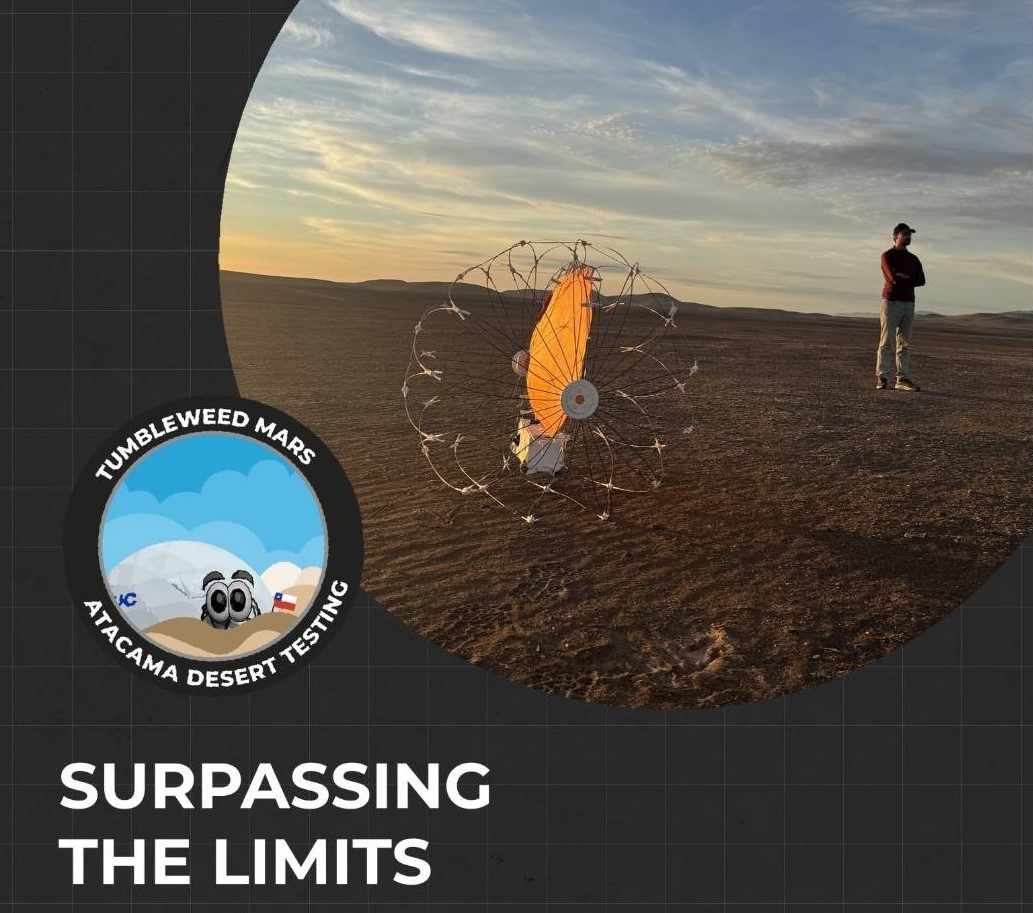
Image credit: Tumbleweed Mars project
Because the winds there are similar to those on Mars, peaking in the afternoons and then subsiding during the night and mornings, explains James Kingsnorth, principal investigator of Tumbleweed Mars .
“So we can test how the prototype works autonomously in this environment,” Kingsnorth adds.
Mission scenario
Without wheels or fuel, the Tumbleweed Mars hardware is capable of reaching 35 miles per hour (57 kilometers per hour).
A mission scenario is having Tumbleweed Mars dropped over the Martian north pole. The Tumbleweeds act as their own parachutes, unfolding on the way down.
Once landed, a swarm of Tumbleweeds can make the best of strong winds. As the wind propels them towards the equator, the rovers gather valuable data through their various integrated sensors.
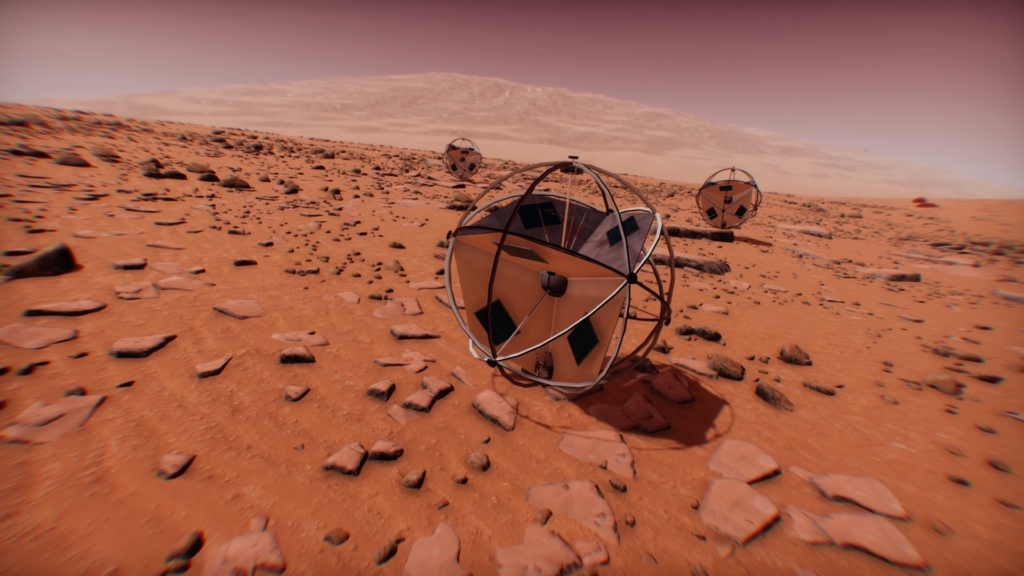
Image credit: Tumbleweed Mars project
Shaped like an ellipse
Tumbleweed Mars is being designed to cover long distances and handle different types of surfaces – such as sand, rocks, and clay — with a high degree of autonomy.
Onboard Tumbleweed Mars is a box serving as the “brain” of the device. It contains a camera, microphone, GPS, a gamma-ray spectrometer, a magnetometer, and sensors that collect a wide variety of data: temperature, atmospheric pressure, humidity, wind, and ultraviolet radiation, among others.
The rover is shaped like an ellipse, a very lightweight structure that weighs roughly 8 pounds (3.5 kilograms). Its frame is made of carbon fiber cables, allowing it to harness wind power.
Road to Mars
The team has officially wrapped up a testing campaign at the Alto Atacama Station, utilizing one of Earth’s most extreme environments to simulate Martian craters and plains.
According to a team report, they gathered critical data that will define the next generation of Tumbleweed Mars.
“We didn’t just meet our goals, we surpassed them, specifically in uphill mobility and impact resistance. Every vibration identified and every structural limit tested out here brings us one step closer on our road to Mars,” they report.

Image credit: CCTV/Inside Outer Space screengrab
China is integrating its robotic Chang’e Moon exploration program with the country’s human spaceflight activities to assure the first Chinese human landing on the lunar surface takes place by 2030.
Zhang Jingbo, spokesman of the China Manned Space Agency (CMSA) agency, made the announcement at a press conference at the Jiuquan Satellite Launch Center in northwest China.
“To fully leverage the technological expertise and practical experience accumulated over decades through the Manned Space Flight Mission and Chang’e program, the existing manned lunar landing and unmanned lunar exploration efforts will be integrated across three areas of missions, resources, and teams,” Zhang said.
“The integrated program is called the Lunar Exploration Program,” said Zhang.

Image credit: CCTV/Inside Outer Space screengrab
Demonstration tests
Zhang pointed to past low-altitude demonstration tests of the Long March-10 carrier rocket system and maximum-dynamic-pressure escape tests of the Mengzhou spacecraft system.
Those tests are paving the way for a reusable crewed transportation system and future crewed lunar landings, said Zhang.
Spare no effort
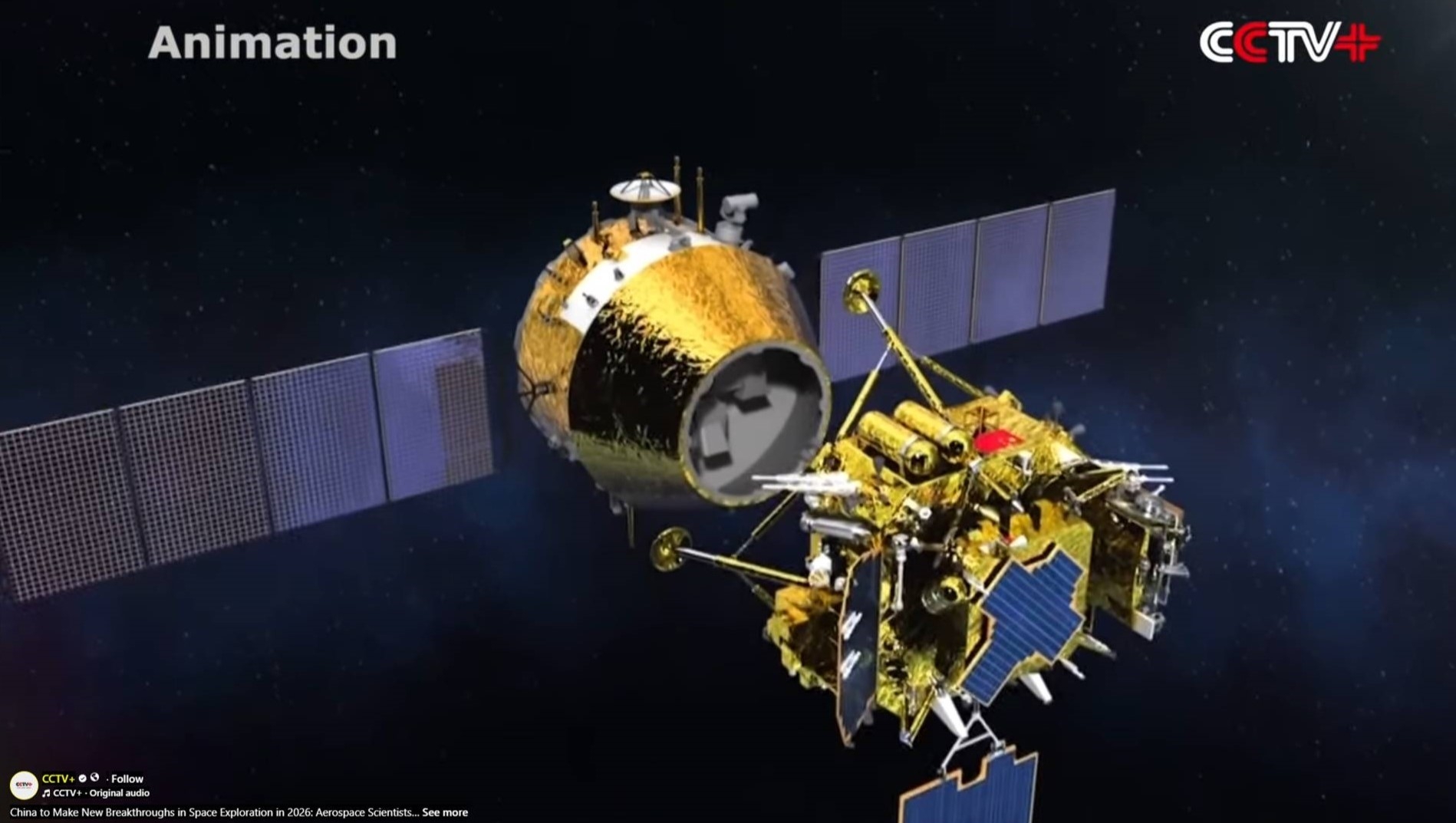
In April this year, China’s Chang’e-7 lunar probe was transported to the Wenchang Space Launch Site.
Preparations for pre-launch testing are now underway, with the mission slated for launch in the second half of the year, reportedly this August.
Chang;e-7 artwork. Image credit: CCTV/Inside Outer Space screengrab
The Chang’e-7 mission will include orbiting, landing, roving, and a lunar hopper to study the environment and resources of the lunar south pole, while also carrying out international cooperation, said Zhang.
“Next, we plan to complete some key missions, including technical verification flights of the Long March-10 carrier rocket and maiden flights of the Mengzhou spacecraft and Lanyue [Moon] lander.
“We will spare no effort to strive for the goal of achieving the first Chinese landing on the Moon by 2030,” Zhang added.
Space station foundation
China’s space station missions are intended to lay a solid foundation for the country’s first crewed lunar landing in 2030.
“Our space station has been operating steadily in orbit for nearly four years now, and it has deployed and verified a number of key technologies needed for crewed lunar landing,” said Zhang.
Zhang said that the newly launched Tianzhou-10 cargo supply craft carried an experiment on how liquid sloshes inside a surface tension tank amid microgravity.

Artwork depicts China’s Tiangong space station.
Image credit: China Manned Space Agency
This is to verify the precision and rationality of technical specifications we set for manned lunar landing spacecraft,” Zhang added.
Technical maturity
The Long March-10A carrier rocket and the Mengzhou spacecraft that perform space station missions, shares integrated design and development engineering required for lunar exploration, said Zhang.
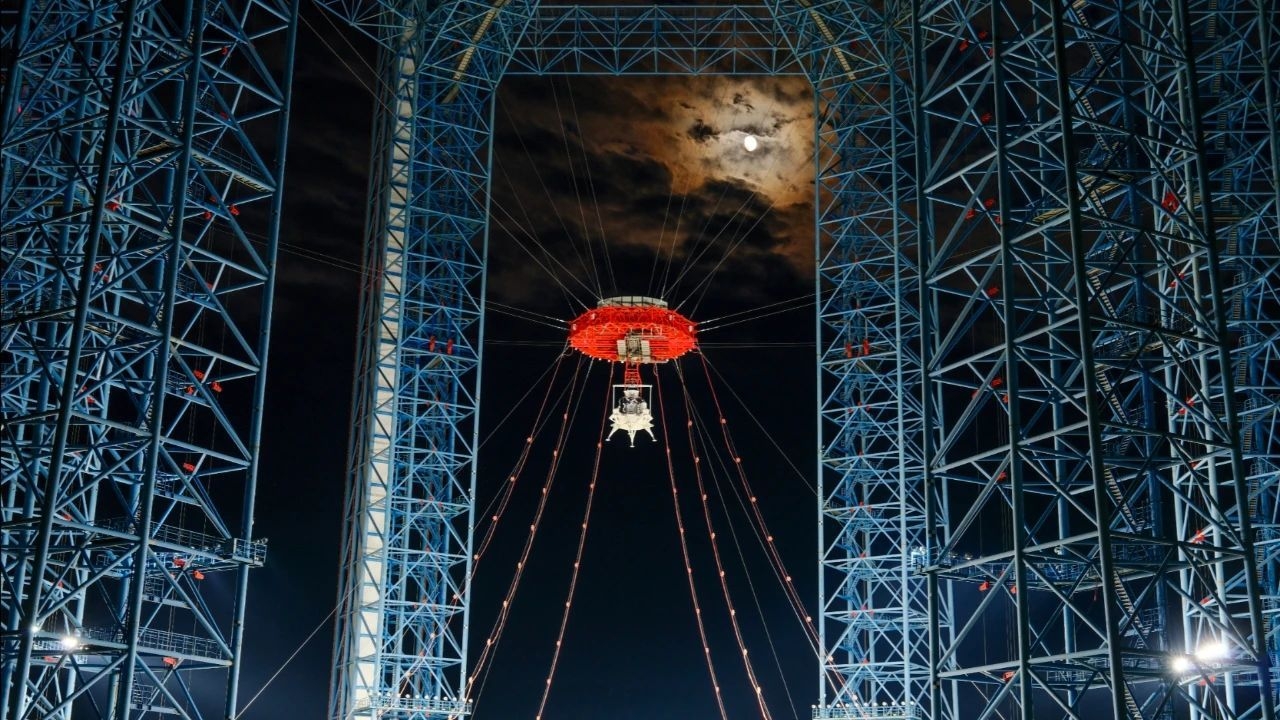
China completed a comprehensive test of its crew-carrying Lanyue lunar lander in north China’s Hebei Province, August 6, 2025. Image credit: CGTN//China Media Group.
“Through verifications in multiple space station flight missions over the next two years,” noted Zhang, “we will comprehensively boost relevant technical maturity and task reliability, so as to lay a solid foundation for China’s first crewed lunar landing.”
In addition, the long-term in-orbit operation of the space station can provide more and larger platforms in space, Zhang said, to support future missions like lunar research and development as well as deep-space exploration.

Lai Ka-ying, Zhu Yangzhu, and Zhang Zhiyuan.
Image credit: CCTV/Inside Outer Space screengrab
China’s Shenzhou-23 crew will consist of Zhu Yangzhu, Zhang Zhiyuan and Lai Ka-ying.
The taikonaut trio was introduced to the world at a press event.
Zhu will be the commander and flight engineer, Zhang will be the spacecraft pilot, and Lai the payload specialist.
Zhu previously participated in the Shenzhou-16 space mission.
Zhang and Lai come from the third and fourth batches of astronauts respectively, and will embark on their first spaceflight mission. Before being selected, Zhang was an air force pilot, and Lai worked in the Hong Kong Police Force.
Lai Ka-ying is the first astronaut from China’s Hong Kong Special Administrative Region (SAR).
Launch day set
China’s Shenzhou-23 crewed spaceship is scheduled to be launched at 11:08 p.m. Sunday, May 24 (Beijing Time) from the Jiuquan Satellite Launch Center in northwest China, the China Manned Space Agency (CMSA) announced today.
This Shenzhou-23 mission marks the seventh crewed spaceflight during the application and development phase of China’s space station, and the 40th flight of China’s human spaceflight program.
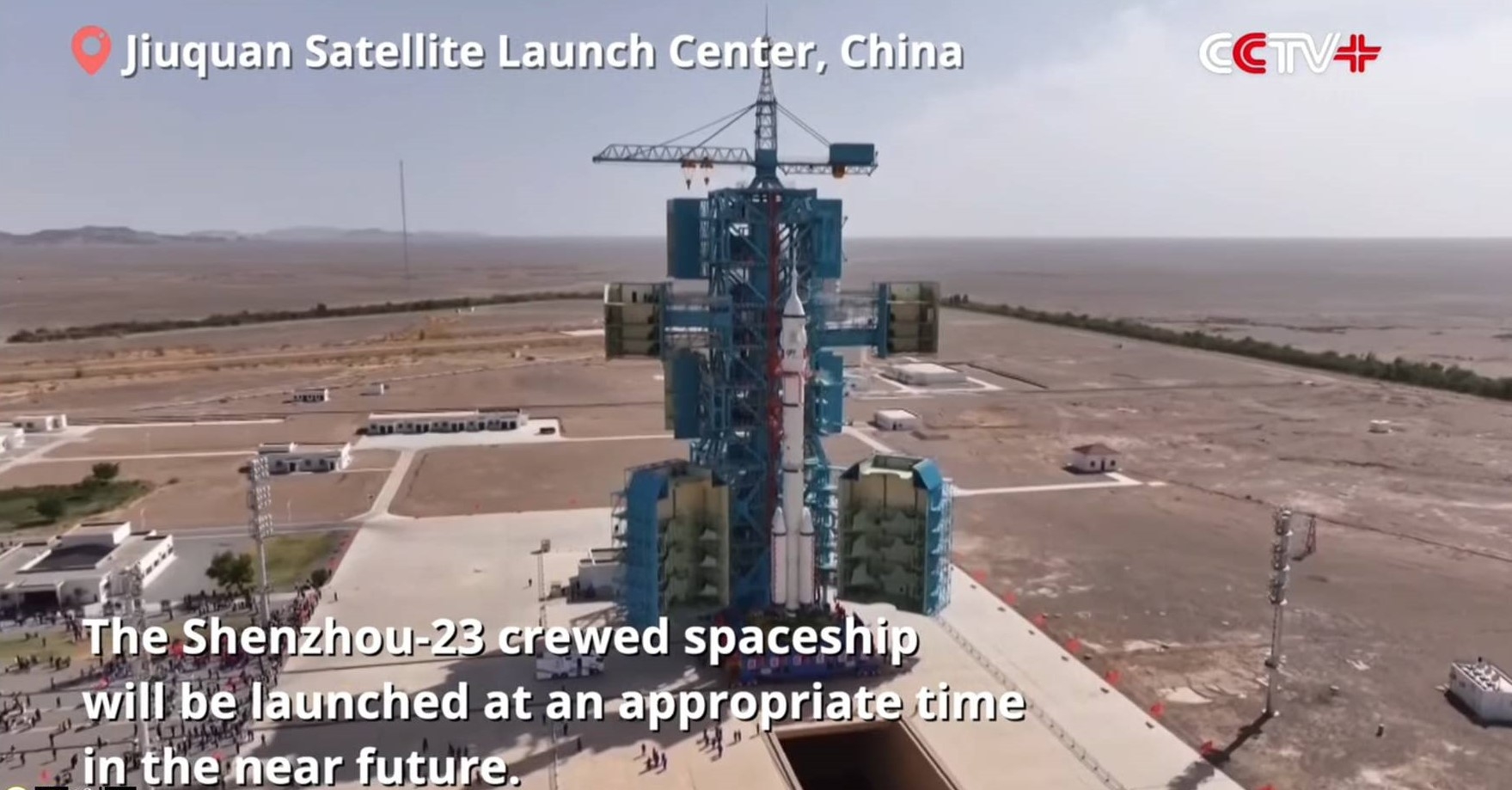
Image credit: CCTV/Inside Outer Space screengrab
After entering orbit, the Shenzhou-23 spacecraft will make a fast and autonomous rendezvous to dock with the radial port of Tianhe, China’s core space station module.
Extended stay
The crew will conduct more than 100 new science and application projects, focusing on frontier fields such as space life science, materials science, microgravity fluid physics, aerospace medicine and new space technologies, CMSA spokesperson Zhang Jingbo said at a press conference held one day prior to the launch of the Shenzhou-23 mission.
One of the Shenzhou-23 crew will be selected for a year-long stay in space. That person will be determined based on how the mission unfolds in orbit, said Zhang.

Image credit: CCTV/Inside Outer Space screengrab
During the year-long residency, Zhang said, China will implement its first space-based human body research program to collect crucial data on astronaut exposed to long-duration spaceflight environments.
“Assigning an astronaut to a one-year in-orbit stay is not simply doubling the duration of two six-month missions,” said Zhang.
In-orbit handover
Meanwhile, the now orbiting Shenzhou-21 crew will return to the Dongfeng landing site after completing the in-orbit handover with the Shenzhou-23 crew, said Zhang.
The Shenzhou-21 crew, now up for rotation, has already spent 203 days in orbit and is poised to set a record for the longest single mission duration by a Chinese astronaut crew so far.
Go to these new videos that focus on the upcoming mission of Shenzhou-23 at:
https://www.facebook.com/reel/997327809408810
https://www.facebook.com/reel/1950518928908083
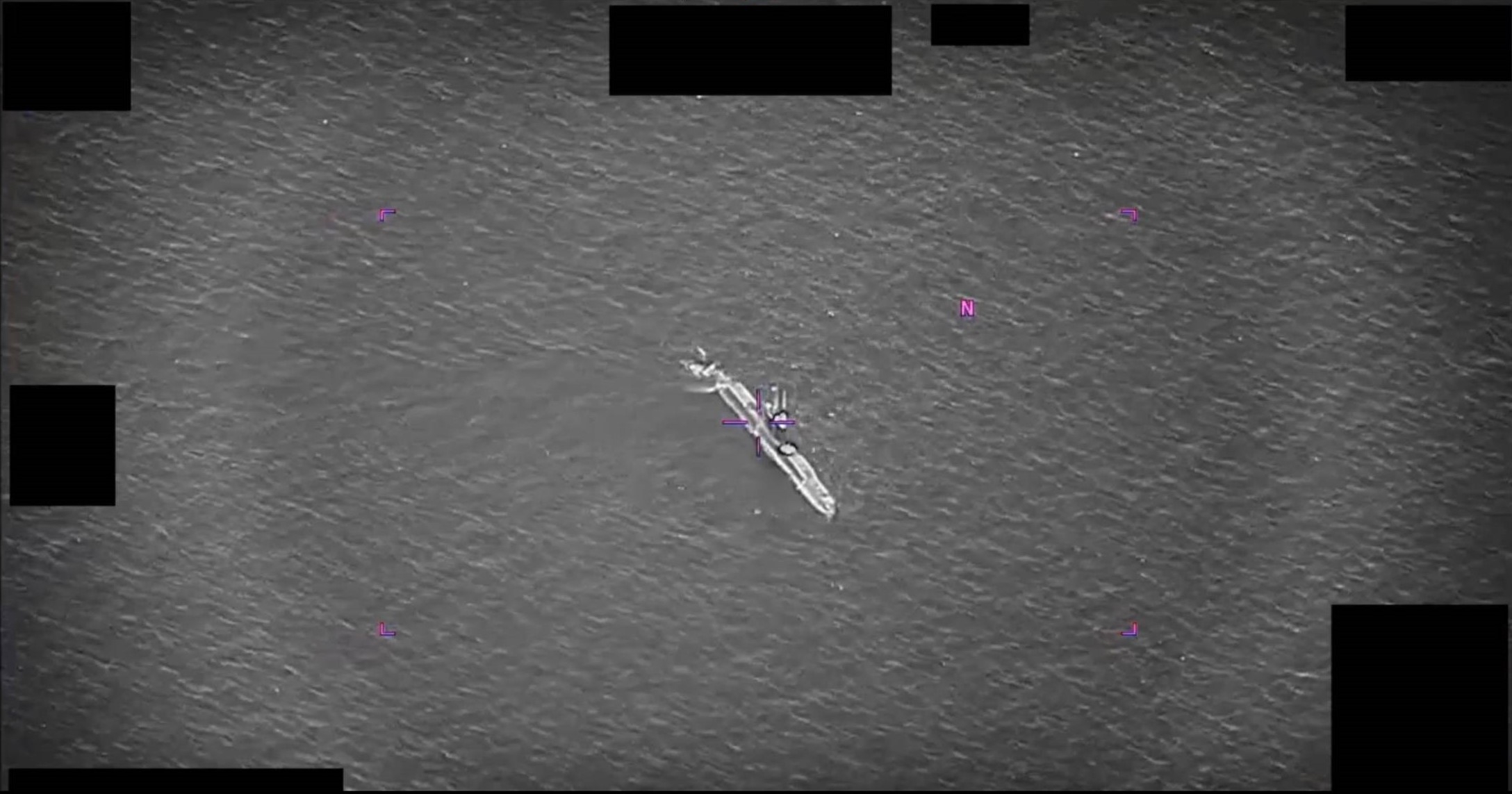
“Multiple Spherical UAP USO near Sub. [CALLSIGN] 2022/03/25 in and out of water,” is likely derived from an infrared sensor aboard a U.S. military platform. A user uploaded this video to a classified network in May 2024.
Another slug of files regarding Unidentified Anomalous Phenomena (UAP) has been released.
Sean Parnell, Assistant to the Secretary of War for Public Affairs and Chief Pentagon Spokesman, said today this second release of declassified and historical UAP files is part of the Presidential Unsealing and Reporting System for UAP Encounters (PURSUE).
“The collection continues to be housed on WAR.GOV/UFO, and additional files will be released on a rolling basis,” Parnell said.
Worldwide interest
According to the Department of War, since the site’s launch on May 8, 2026, WAR.GOV/UFO has received over 1 billion hits worldwide.” That fact highlights “the unprecedented levels of interest in both this topic and the Trump administration’s historic transparency effort.”
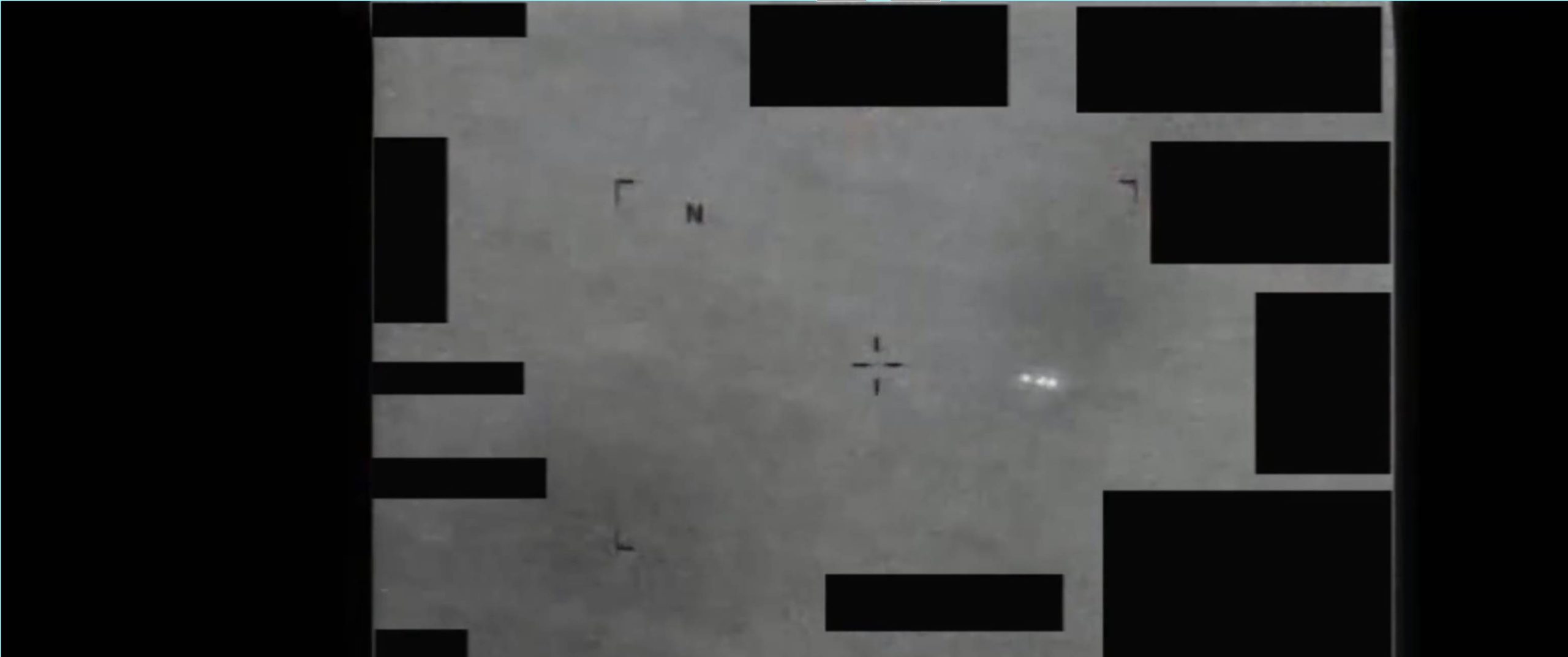
“UFOs in formation over Persian Gulf?”
Also noted by the Department of War is that they and agency partners “are actively working on the third release of UAP files, which will be announced in the near future.
Chain-of-custody
As noted within the files, on March 6, 2026, eight members of the U.S. House of Representatives requested access to 51 potentially UAP-related records allegedly held by the Department of War and the Intelligence Community.

Pantex is one of six production facilities in the National Nuclear Security Administration’s Nuclear Security Enterprise. As the cornerstone of the nation’s Nuclear Security Enterprise, Pantex applies unique capabilities to ensure the effectiveness of the U.S. nuclear stockpile in support of the Nation’s nuclear deterrent. We accomplish this through executing nuclear explosive assembly and disassembly, special nuclear material testing and evaluations, and manufacturing and assessing high explosives at our historic site.
“The All-domain Anomaly Resolution Office (AARO) identified a collection of responsive materials held on a classified network. Many of these materials lack a substantiated chain-of-custody,” states the Department of War.
Part of this second release includes NASA audio files of astronauts describing particles outside their spacecraft, at: https://www.war.gov/UFO/?releaseDate=Release+02#NASA-UAP-D009-Apollo-17-Audio-Excerpt-December-7-1972
To inspect this second outing of data, go to:
Also, go to my earlier Space.com story regarding the initial release of files — “The UFO files: What did we learn from the Pentagon’s 1st big release?” — at:
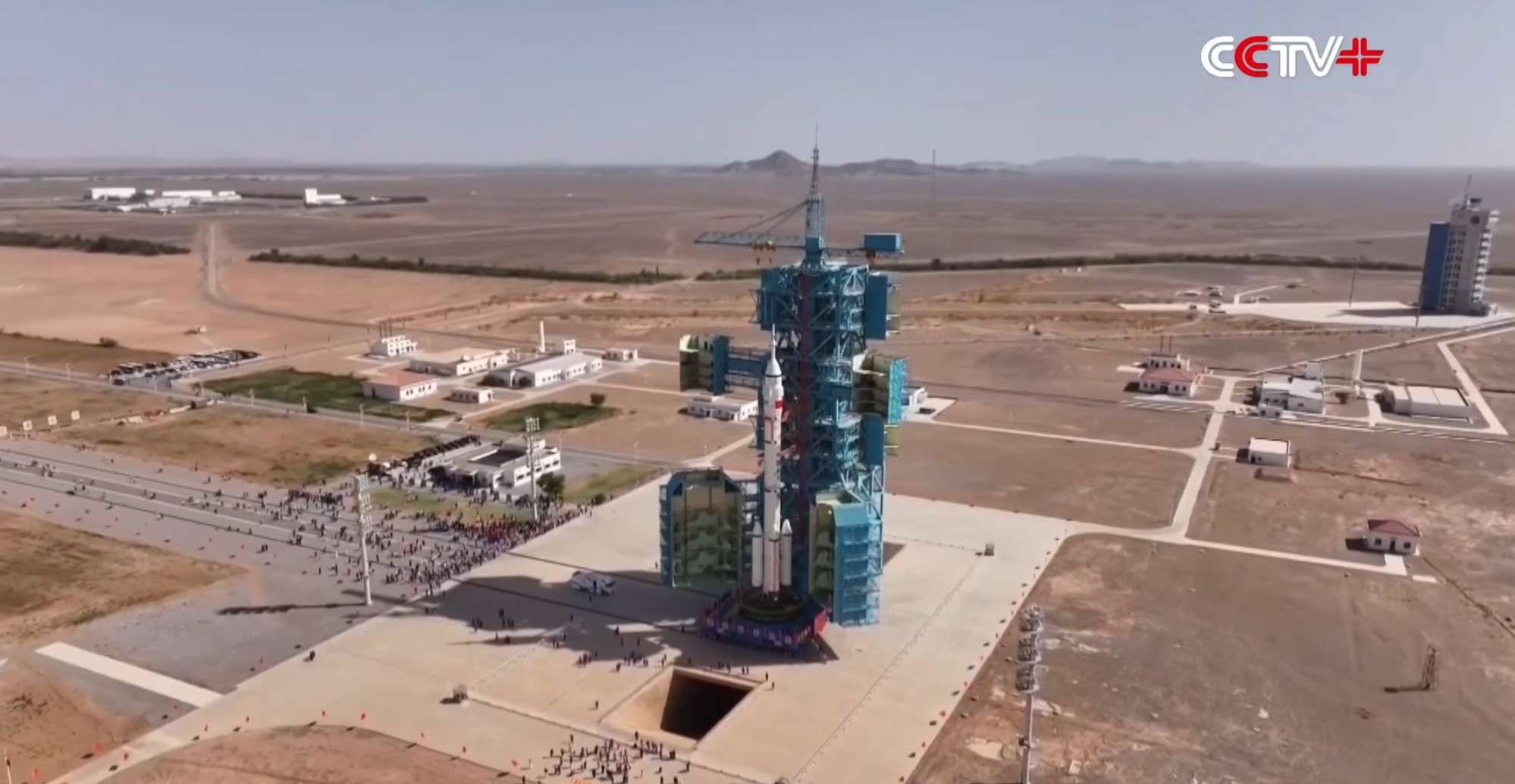
Shenzhou-23 mission spacecraft and booster being readied for upcoming liftoff.
Image credit: CCTV/Inside Outer Space screengrab
China’s next human spaceflight is near at hand as technicians conducted a whole-system rehearsal for the piloted Shenzhou-23 mission to the country’s space station.
The crewed spaceship will depart the Jiuquan Satellite Launch Center. The combination of the spaceship and a Long March-2F carrier rocket was transferred to the launching area last Saturday, with all facilities and equipment at the launch site in good condition, according to the China Manned Space Agency (CMSA).
Comprehensive verification
Those involved in the Shenzhou-23 mission participated in the run through, a rehearsal that included exercises in launch preparations, ignition and rocket-spaceship separation.
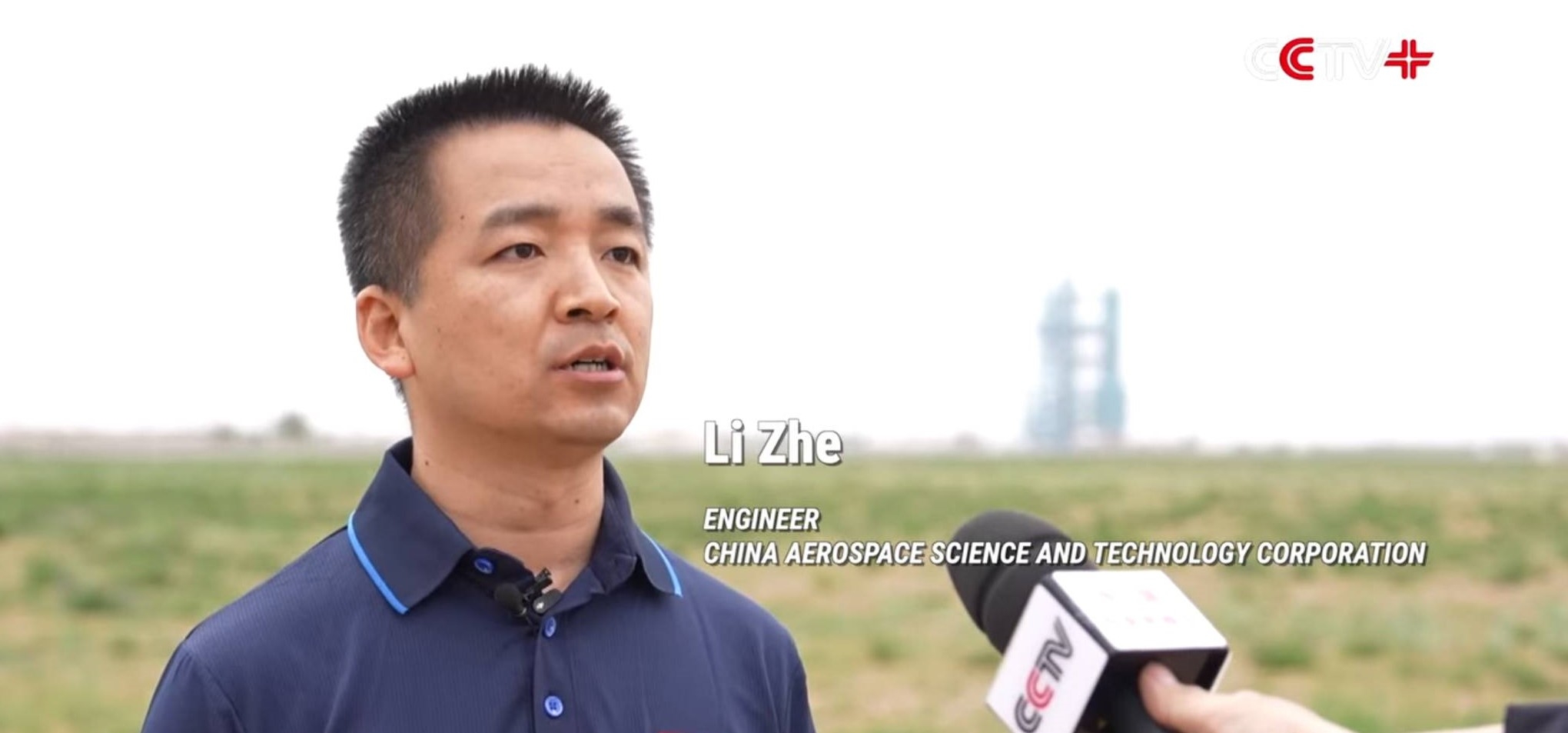
Image credit: CCTV/Inside Outer Space screengrab
“In terms of the spaceship system,” said Li Zhe, an engineer from China Aerospace Science and Technology Corporation, “we mainly rehearsed the work at the pre-launching and launching stages at the launch area, and then conducted a comprehensive verification of the spacecraft’s interfaces with the launch site, the measurement and control communication system, astronauts and application systems.”
The rehearsal also covered a medical examination of the astronauts, and simulated the send-off ceremony, module status setting, and procedures after the entry of astronauts into the spacecraft.
Teamwork
Wang Lizhi from the Astronaut Center of China told China Central Television that the crew members engaged in good teamwork, while the coordination with the ground command team went smoothly.
“Next, we will review and summarize the whole-system rehearsal,” Wang said. “For the astronauts, the most important task is to keep themselves in a good physical and mental condition to ensure the best state for the mission.”
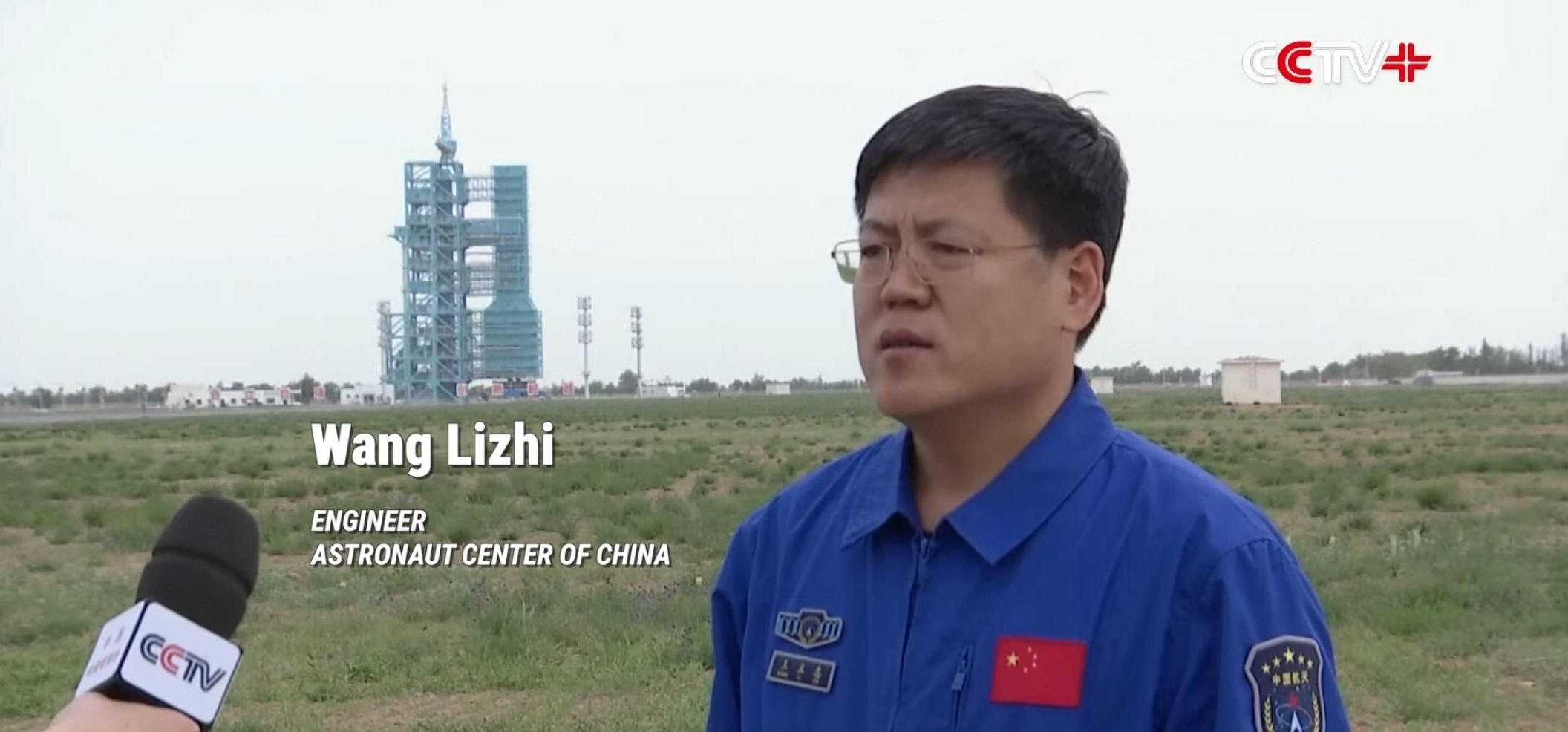
Image credit: CCTV/Inside Outer Space screengrab
Go to this video to view Shenzhou-23 launch preparations at:
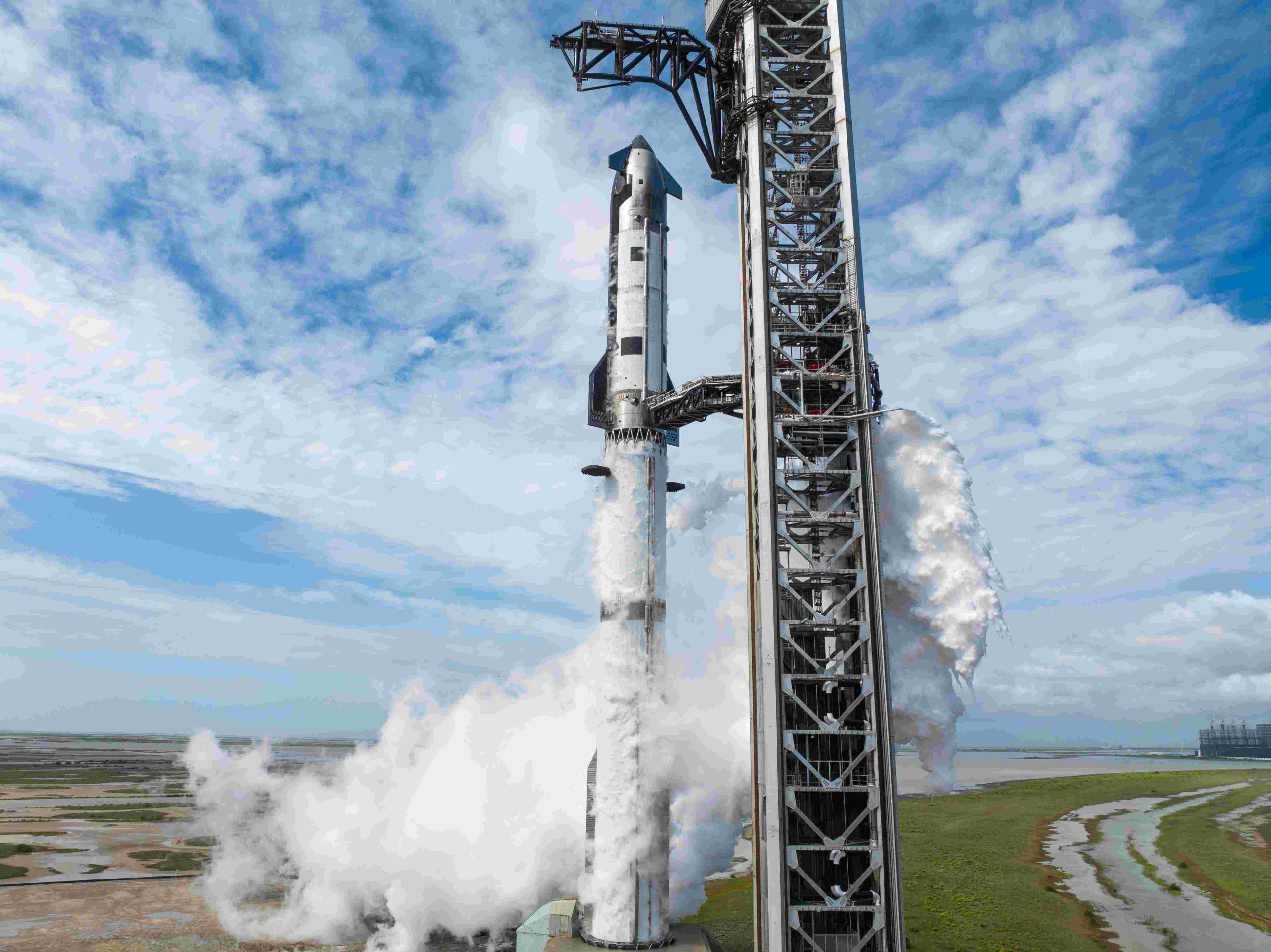
Image credit: SpaceX
NOTE: TECHNICAL ISSUES DELAYED LAUNCH!
The twelfth flight test of Starship is preparing to launch today, Thursday, May 21. The launch window will open at 5:30 p.m. “Central Texas Time” (CT).
As is the case with all developmental testing, the schedule is dynamic and likely to change.
For status reports, keep an eye on this site at https://x.com/SpaceX
A live webcast of the flight test will begin about 45 minutes before liftoff.
Go to:
https://www.spacex.com/launches/starship-flight-12
Primary test objective
As noted by a SpaceX posting, “the upcoming flight will debut the next generation Starship and Super Heavy vehicles, powered by the next evolution of the Raptor engine and launching from a newly designed pad at Starbase.”
The booster’s primary test objective, SpaceX explains, “will be executing a successful launch, ascent, stage separation, boostback burn, and landing burn at an offshore landing point in the Gulf of America. As this is the first flight test of a significantly redesigned vehicle, the booster will not attempt a return to the launch site for catch.”
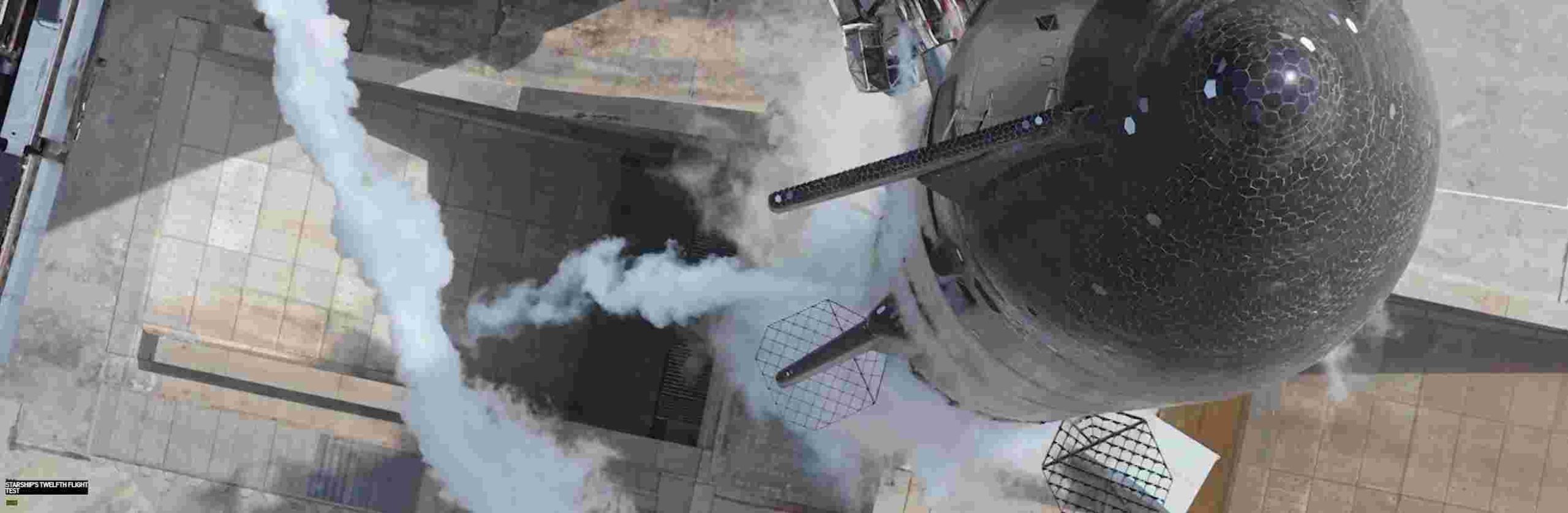
Image credit: SpaceX
Upper stage targets
Post liftoff, the Starship’s upper stage will target multiple in-space and reentry objectives, including a payload deployment of 20 Starlink simulators, similar in size to next-generation Starlink V3 satellites, and two specially modified Starlink satellites.
The two modified satellites will test hardware planned for Starlink V3 and will attempt to scan Starship’s heat shield and transmit imagery down to operators.
By using this technique, it will test methods of analyzing Starship’s heat shield readiness for return to launch site on future missions.
Several tiles on Starship have been painted white to simulate missing tiles and serve as imaging targets in the test. All of the deployed payloads will be on the same suborbital trajectory as Starship.
A relight of a single Raptor engine while in space is also planned.

Image credit: SpaceX
Experimental actions
For Starship entry, SpaceX explains, “a single heat shield tile has been intentionally removed to measure the aerodynamic load differences on adjacent tiles when there is a tile missing.”
The ship will also perform experimental actions tested on previous flight tests, including a maneuver to intentionally stress the structural limits of the vehicle’s rear flaps and a dynamic banking maneuver to mimic the trajectory that future missions returning to Starbase will fly.
To read about the upgrades debuting on Starship, Super Heavy, Raptor, and the launch pad on Flight 12, go to:
https://www.spacex.com/updates#starship-v3
To watch “Test Like You Fly”, the first episode in a new Starship series that takes you inside the factories and onto the launch pads as these first vehicles prepared for flight, go to:
https://www.spacex.com/content/starship/test-like-you-fly
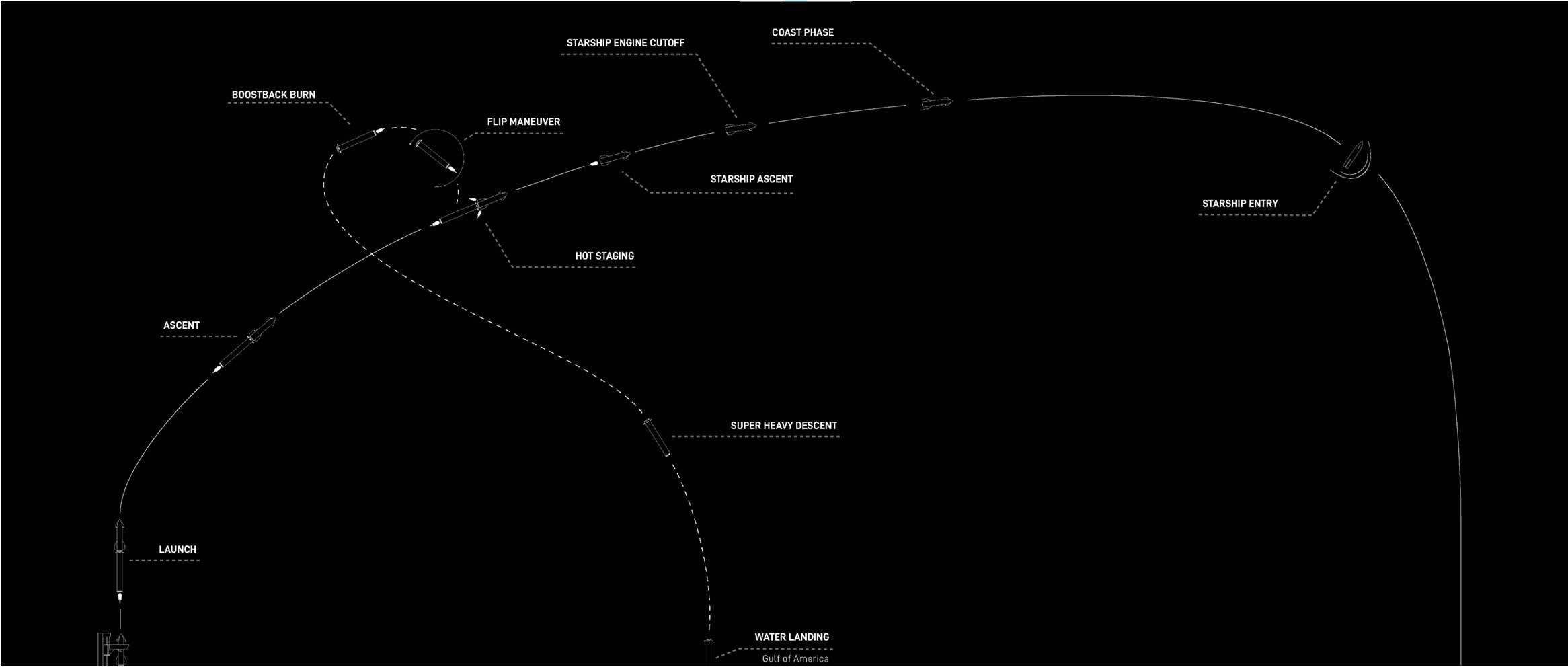
Image credit: SpaceX

Image credit: Marco Schmidt/University of Würzburg
On Mars, could a robot get ticketed for swerving across Martian sands?
Not if you’re VaMEx – short for the Valles Marineris Explorer – a wheeled automaton that makes swimming motions to explore the vast valley on the Red Planet.
VaMEx is an initiative of the German Space Agency at the German Aerospace Centre (DLR). This Mars machinery uses innovative wheels, which, like those of a desert lizard, can “swim” through sand.
Do the locomotion
A research group at the University of Würzburg has now translated the sandfish’s locomotion mechanism into a Mars rover that reportedly outperforms other models in moving across sand.
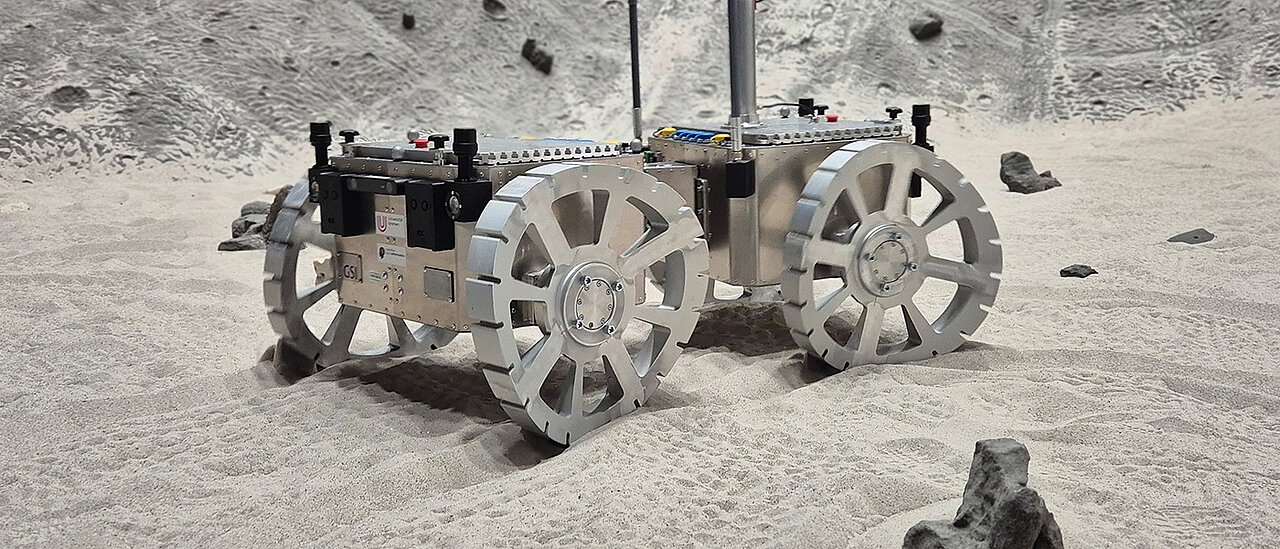
Image credit: Marco Schmidt/University of Würzburg
The team is led by Marco Schmidt, a university computer scientist and head of the Chair of Embedded Systems and Sensors for Earth Observation (ESSEO).
Collaborating with researchers from Bremen, the wheels imitate the animal’s characteristic interaction with the ground, generating both longitudinal and lateral forces. That movement leaves sinusoidal tracks in the sand.
Uneven terrain
Mars rovers must cope with sand, gravel, slopes, and generally uneven terrain while maintaining their mobility, stability, and efficiency.
“Conventional wheel designs are often optimized for low-speed travel and tend to slip, sink, or get stuck on soft ground,” says Amenosis Lopez, a researcher in Schmidt’s group.
The sandfish locomotion is adopted from Scincus scincus, a lizard living in the Sahara and able to burrow and then literally “swim” through the desert sand to hunt or escape predators.

Image credit: BioDB
Control strategies
The work is ongoing, with further refinements predicted to improve performance on mixed terrain.
In addition to hardware development, the ESSEO team aims to expand its contribution to VaMEx towards software-driven mobility.
Plans are afoot to develop control strategies that explicitly take into account slippage, sinking and the interaction between terrain and wheel, thus enabling more stable and adaptable behavior of the rover in granular environments.
Scroll down to access a video clip of this robot. Go to:
https://www.uni-wuerzburg.de/aktuelles/einblick/single/news/sandfisch-marsrover/
Also, go to “Rovers, crawlers & drones on #Mars – the Valles Marineris Explorer project” at:
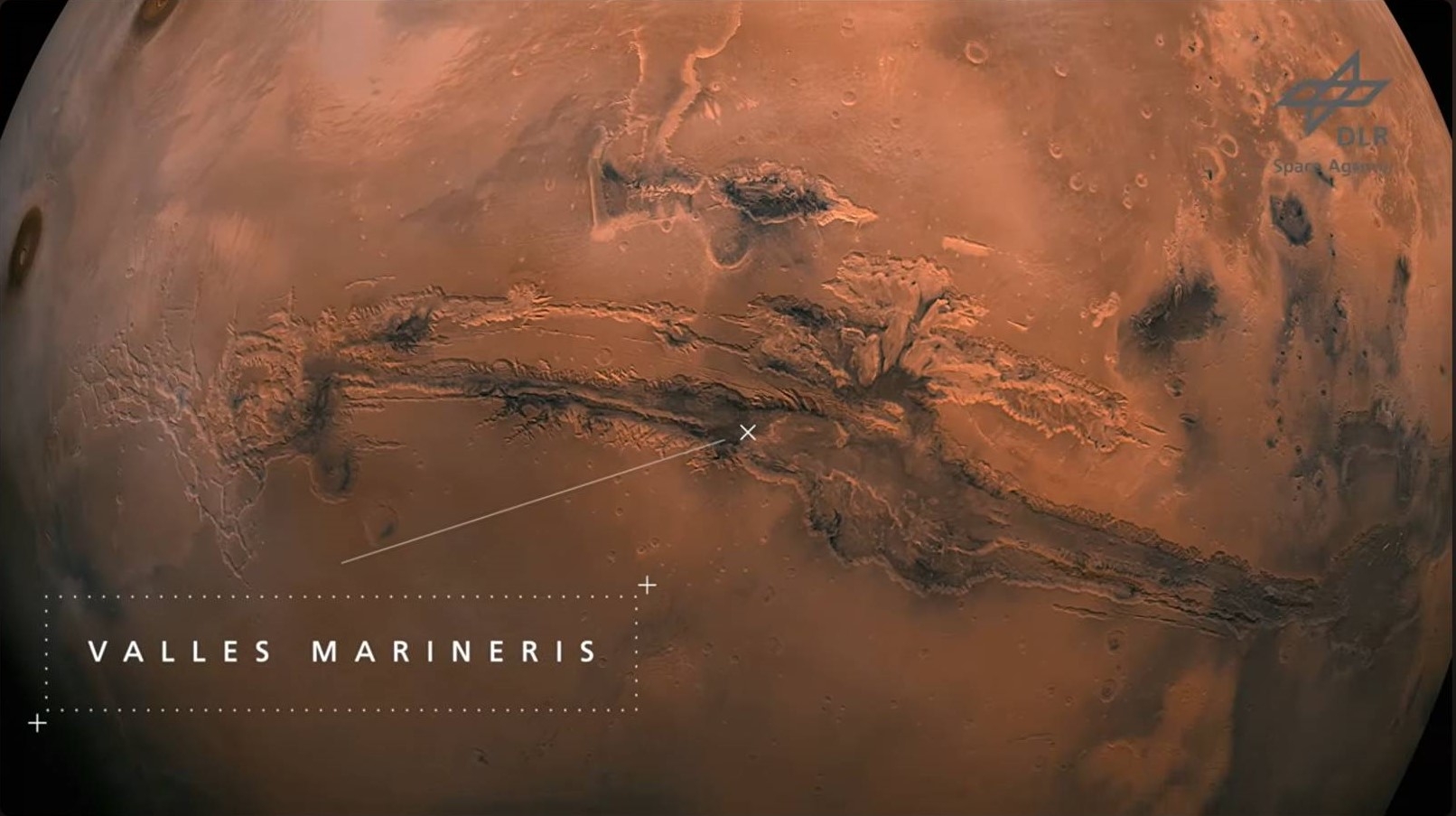
Image credit: DLR

