Archive for the ‘Space News’ Category
 Author:
  September 15th, 2023
Image credit: SpaceX
The Federal Aviation Administration (FAA) SpaceX Boca Chica Project Team reports that the FAA has not authorized SpaceX’s proposed Flight 2.
The report comes in the form of a September 15 update on FAA license determinations for SpaceX’s proposed Starship-Super Heavy Flight 2.
SpaceX conducted a test flight of the Starship/Super Heavy at Boca Chica, Texas on April 20, 2023. As a result of that launch, SpaceX completed a mishap investigation with FAA oversight; this investigation analyzed the launch, mishap events, and corrective actions.
Modified license
According to the FAA team statement, before SpaceX is okayed to conduct a second Starship/Super Heavy launch, “SpaceX must obtain a modified license from the FAA that addresses all safety, environmental, and other regulatory requirements.”
As part of that license application determination process, the FAA will review new environmental information, including changes related to the launch pad, as well as other proposed vehicle and flight modifications.

Drone view of recent SpaceX Booster 9 static fire test.
Image credit: SpaceX/Inside Outer Space screengrab
Written reevaluation
The FAA will complete a Written Reevaluation (WR) to the 2022 Programmatic Environmental Assessment (PEA) evaluating the new environmental information, including Endangered Species Act consultation with the U.S. Fish and Wildlife Service.
If the FAA determines through the WR process that the contents of the PEA do not remain valid in light of the changes proposed for Flight 2, additional environmental review will be required.
“Accordingly, the FAA has not authorized SpaceX’s proposed Flight 2,” the team statement notes.
The FAA will provide updates with notification of any license determination or results of additional environmental review.

Starship vehicle is fully stacked at Starbase in South Texas on Sept. 5, 2023.
Image credit: SpaceX
 Posted in

NASA Administrator Bill Nelson provides remarks during a media briefing to discuss the findings from an unidentified anomalous phenomena (UAP) independent study team. Image credit: NASA/Aubrey Gemignani
NASA’s Unidentified Anomalous Phenomena (UAP) Independent Study Team published on September 14 its final report containing a series of recommendations for how the agency could help to move the understanding of UAP forward.
Reaction to the study’s release has sparked several groups to review the findings and offer viewpoints.
Scientific openness
For one, the Scientific Coalition for UAP Studies (SCU) wholly endorses NASA’s decision to follow their study team’s recommendation and embrace the scientific questions surrounding the nature of unidentified anomalous phenomena (UAP) and appoint a NASA Director of UAP Research.

Image credit: SCU
“NASA is the right U.S. agency to lead this effort,” the SCU said in a press statement. However, the group flags NASA’s avenue to contribute to UAP studies via the Pentagon’s All-domain Anomaly Resolution Office (AARO).
“NASA is our premier aerospace organization with the necessary capabilities to address the UAP question with scientific openness. NASA should lead the entire UAP science endeavor over the long term, not AARO,” said the SCU. “AARO is tied to national defense organizations and is driven by the needs of our defense industry, which necessarily cannot promote scientific openness.”

Image credit: Yannick Peings, Marik von Rennenkampff/AIAA
Independent lead
NASA’s UAP program should be funded, the SCU statement continues, to support academic research within our nation’s universities and scientific organizations to further the study of UAP. “This necessitates funding and guidance directly from Congress, not via AARO.”
While SCU acknowledges that AARO is necessary to investigate the defense-related aspects of UAP, the group “strongly recommends” that Congress provide the necessary funding and resources to allow NASA to independently lead U.S. UAP scientific research programs.
Historic development
In a statement from Americans for Safe Aerospace (ASA), this group saluted NASA for listening to pilots about UAP and committed to a serious research and data collection effort to identify what is in our skies.

UAP have been reported by Navy pilots unlike anything they have ever witnessed.
Image credit: Enigma Labs/Lt. Cmdr. Alex Dietrich
Ryan Graves, co-founder of Americans for Safe Aerospace and a former Lt. U.S. Navy F/A-18 fighter pilot who was the first active duty military pilot to come forward about UAP and recently testified to U.S. Congress called NASA’s report “a historic development in UAP transparency.”
“It’s clear that NASA values pilot reports to study UAP as an aerospace safety, national security, and scientific issue. NASA is leading the charge to solve the mystery in our skies by following the data and eliminating stigma,” Graves said in a statement.
Confidential…voluntary…non-punitive
Graves said that NASA’s recommendation to adapt the space agency’s Aviation Safety Reporting System (ASRS) to receive UAP reports from commercial pilots “is significant progress and will enable widespread UAP data collection for the first time in U.S. history.”

Image credit: Statista
According to the ASRS website, the system is founded on a “confidential…voluntary…non-punitive” standard.
The majority of UAP witnessed by commercial and military pilots go unreported, explains the statement from Americans for Safe Aerospace. “Stigma and the lack of official reporting channels for commercial pilots remain a barrier to assessing and evaluating UAP.”
Americans for Safe Aerospace launched an aircrew and military UAP witness program earlier this year.
Graves along with the ASA team has met with dozens of pilots who have confidentially shared their accounts of UAP activity routinely sighted during their flight routes.
To access the video of NASA’s press event in releasing the UAP study, go to:
https://www.youtube.com/watch?v=eoY2sGo7ZiY
The complete UAP report from the independent study group is available at:

Image credit: Barbara David
NOTE: Late Thursday NASA re-released a UAP press release, sharing the name of the NASA UAP Director.
According to the statement: “While NASA still is evaluating the report and assessing the independent study team’s findings and recommendations, the agency is committed to contributing to the federal government’s unified UAP effort by appointing Mark McInerney director of UAP research.”
McInerney previously served as NASA’s liaison to the Department of Defense covering limited UAP activities for the agency.
Per NASA, in the director role, McInerney will centralize communications, resources, and data analytical capabilities to establish a robust database for the evaluation of future UAP.
McInerney will also leverage NASA’s expertise in artificial intelligence, machine learning, and space-based observation tools to support and enhance the broader government initiative on UAP.
Since 1996, McInerney served various positions at NASA’s Goddard Space Flight Center in Greenbelt, Maryland; the National Oceanic and Atmospheric Administration; and the National Hurricane Center.
Transparency
Of all the revelations today from a NASA-released study of Unidentified Anomalous Phenomena (UAP) by an “independent” study group was keeping the identity of its new UAP Research Director under wraps.
“We will not give his name out,” said Nicola Fox, associate administrator for NASA’s science mission directorate.
Meanwhile, NASA leader, Bill Nelson said the NASA UAP Research Director would work on the implementation of the agency’s vision for UAP research, like using NASA’s expertise to work with other agencies to analyze UAP, making use of artificial intelligence and machine learning “to search the skies for anomalies.”

Nelson repeatedly opined that NASA will do its UAP work “transparently” and evoked the mantra of “scientific process.”
I guess you need to bring your own Windex when you spot-clean those windows of transparency?
For more information, go to:
NASA has released its Unidentified Anomalous Phenomena (UAP) report completed by an independent study team the space agency commissioned in 2022.
On June 9, 2022, NASA announced that the agency is commissioning a study team to examine unidentified anomalous phenomena (UAPs) – that is, observations of events in the sky that cannot be identified as aircraft or known natural phenomena – from a scientific perspective. The study will focus on identifying available data, how best to collect future data, and how NASA can use that data to move the scientific understanding of UAPs forward.
In an earlier posting, the UAP study group made note that there are currently a limited number of high-quality observations of UAP, which make it impossible to “draw firm scientific conclusions about their nature.”
That just-issued report is available at:

Image credit: NASA
Whole-of-government framework
In an executive summary, the report explains that “NASA is in an excellent position to contribute to UAP studies within the broader whole-of-government framework” – led by the All-domain Anomaly Resolution Office (AARO).
The report explains that the study of Unidentified Anomalous Phenomena (UAP) presents a unique scientific opportunity that demands a rigorous, evidence-based approach.
“Addressing this challenge will require new and robust data acquisition methods, advanced analysis techniques, a systematic reporting framework and reducing reporting stigma.”
Public engagement: crowdsourcing
The new NASA report explains that engaging the public is also a critical aspect of understanding UAP.

Image credit: Scientific Coalition for UAP Studies
The panel sees several advantages to augmenting data collection efforts using modern crowdsourcing techniques, including open-source smartphone-based apps that simultaneously gather imaging data and other smartphone sensor metadata from multiple citizen observers worldwide.
“NASA should therefore explore the viability of developing or acquiring such a crowdsourcing system as part of its strategy.
According to the report, NASA’s very involvement in UAP will play a vital role in “reducing stigma associated with UAP reporting, which almost certainly leads to data attrition at present.”
According to NASA chief Bill Nelson, the space agency has selected a still-to-be-named Director of UAP Research, a person that will develop and oversee the implementation of NASA’s scientific vision for UAP research, “including using NASA’s expertise to work with other agencies to analyze UAP and applying artificial intelligence and machine learning to search the skies for anomalies. NASA will do this work transparently for the benefit of humanity.”
Airspace threat
Finally, the report also points out that the threat to U.S. airspace safety posed by UAP is “self-evident.”
“NASA’s long history of partnership with the FAA should be leveraged to investigate how advanced, real-time analysis techniques could be applied to future generations of air traffic management (ATM) systems.”
Image credit: Yannick Peings, Marik von Rennenkampff/AIAA
As the report concludes, “at this point there is no reason to conclude that existing UAP reports have an extraterrestrial source. However, if we acknowledge that as one possibility, then those objects must have traveled through our solar system to get here.”
“Using unclassified data was essential for our team’s fact-finding, open-communication collaboration, and for upholding scientific rigor to produce this report for NASA,” said David Spergel, president of the Simons Foundation and chair of the UAP independent study team. “The team wrote the report in conjunction with NASA’s pillars of transparency, openness and scientific integrity to help the agency shed light on the nature of future UAP incidents. We found that NASA can help the whole-of-government UAP effort through systematic data calibration, multiple measurements and ensuring thorough sensor metadata to create a data set that is both reliable and extensive for future UAP study.”

A weather ballooon sails into the sky after release from the Cape Canaveral weather station in Florida. Image credit: NASA

A new report — Thriving in Space: Ensuring the Future of Biological and Physical Sciences Research: A Decadal Survey for 2023-2032 – underscores a major finding:
Continued U.S. leadership in human and robotic space exploration will require increased government commitments to research at the frontiers of biological and physical sciences.

Image credit: NASA
Public trust, global cooperation
One takeaway in the report deals with public trust and global cooperation.
Space exploration in the next decade will be undertaken in a landscape of conflicting national and corporate interests and growing legal complexities, with private space entrepreneurship expected to expand, and more countries likely to launch space agencies to join the over 70 currently in existence, the report notes.
Though governed by international treaties and the emerging field of space law, abilities to enforce compliance are currently limited, and ethical conduct in space will depend on international cooperation, mutual respect, and dialogue over shared values.

Earth orbit is a junkyard of human-made space clutter.
Credit: Space Junk 3D, LLC. Melrae Pictures
Controversial matters
It is critical, the report adds, that biological and physical sciences (BPS) researchers and NASA generally, work to increase public trust and ensure that space exploration proceeds in a transparent manner where benefits are shared.
Public engagement is needed on potentially controversial matters such as the use of animals in space research, the environmental consequences of low Earth orbit satellites and associated space debris, and alteration of habitats on other planets through natural resource extraction.
For more information on the report — Thriving in Space: Ensuring the Future of Biological and Physical Sciences Research: A Decadal Survey for 2023-2032 – go to these informative resources at:
— https://nap.nationalacademies.org/resource/26750/interactive/
— https://nap.nationalacademies.org/resource/26750/BPS-decadal-slides.pdf

Curiosity Right B Navigation Camera image acquired on Sol 3946, September 12, 2023.
Image credit: NASA/JPL-Caltech
NASA’s Curiosity Mars rover at Gale Crater is now performing Sol 3947 duties.
Lauren Edgar, a planetary geologist at the USGS Astrogeology Science Center in Flagstaff, Arizona reports:
“Curiosity is making good progress towards our next potential drill location in a region of alternating light and dark banding,” reports “Before we get there, we’re collecting a lot of great contact science on these blocks of broken up bedrock to document compositional and textural changes.”

Curiosity Front Hazard Avoidance Camera Left B photo taken on Sol 3946, September 12, 2023.
Image credit: NASA/JPL-Caltech
Power, data, time
A recent two-sol plan (Sols 3946-3947) scripted contact science and driving on the first sol, followed by untargeted remote sensing on the second sol.
Edgar notes that planning comes together and fits within the robot’s power, data, and time of day constraints, while accomplishing important science.
The recent plan was to start by using the Dust Removal Tool (DRT) to expose a fresh surface at the bedrock target “Antikythera,” followed by use of the Alpha Particle X-Ray Spectrometer (APXS) to assess its chemistry.
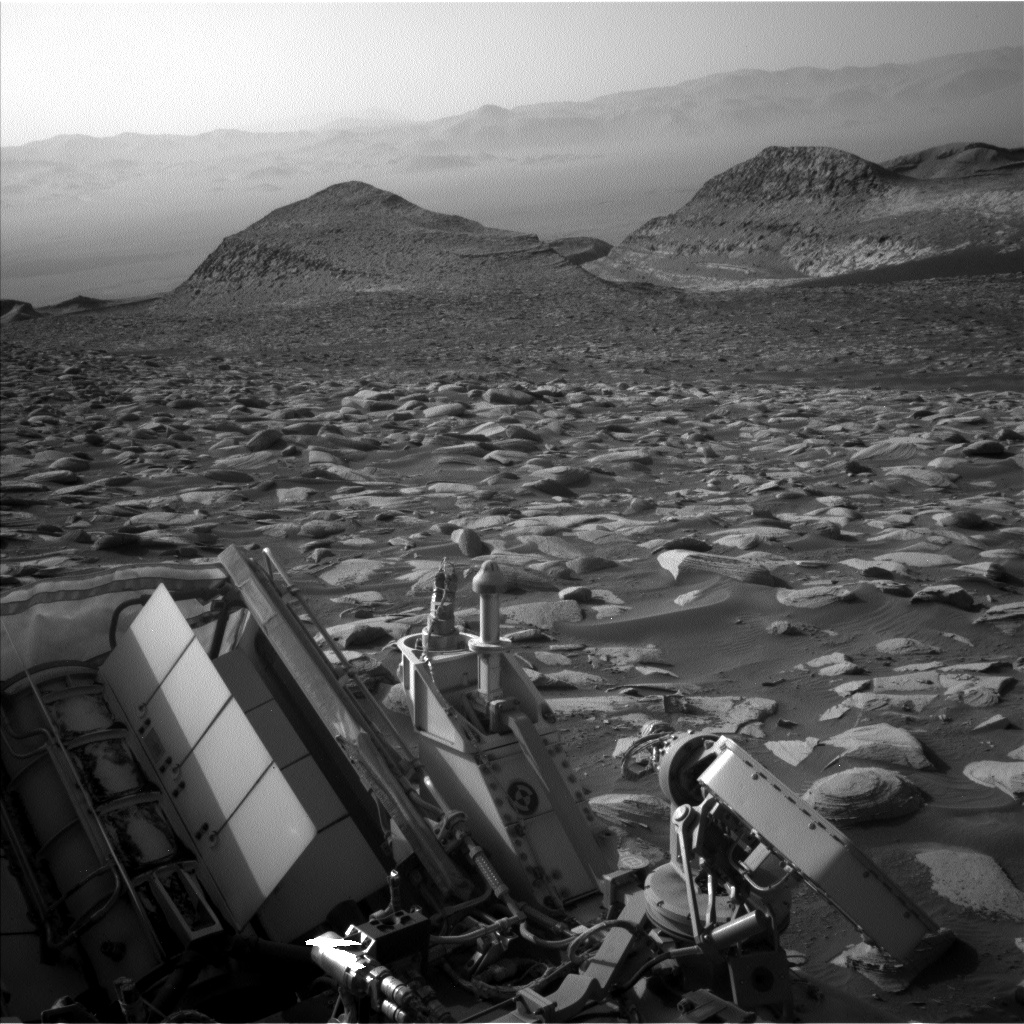
Curiosity Left B Navigation Camera image taken on Sol 3946, September 12, 2023.
Image credit: NASA/JPL-Caltech
Then there’s use of Curiosity’s Chemistry and Camera (ChemCam) and Mastcam multispectral to collect some additional chemistry observations on the same target, Edgar adds.
Edge-on view
“The team also planned several Mastcam mosaics at “Delphi,” “Mycenae,” and “Zagori” to assess the local bedrock and some resistant fins, and to document a nearby ripple field with an edge-on view of the bedform crests,” Edgar reports.
Also on the plan was using the ChemCam Remote Micro-Imager (RMI) to acquire a long distance mosaic looking back towards Peace Vallis, and take a Mastcam tau observation to assess atmospheric opacity.
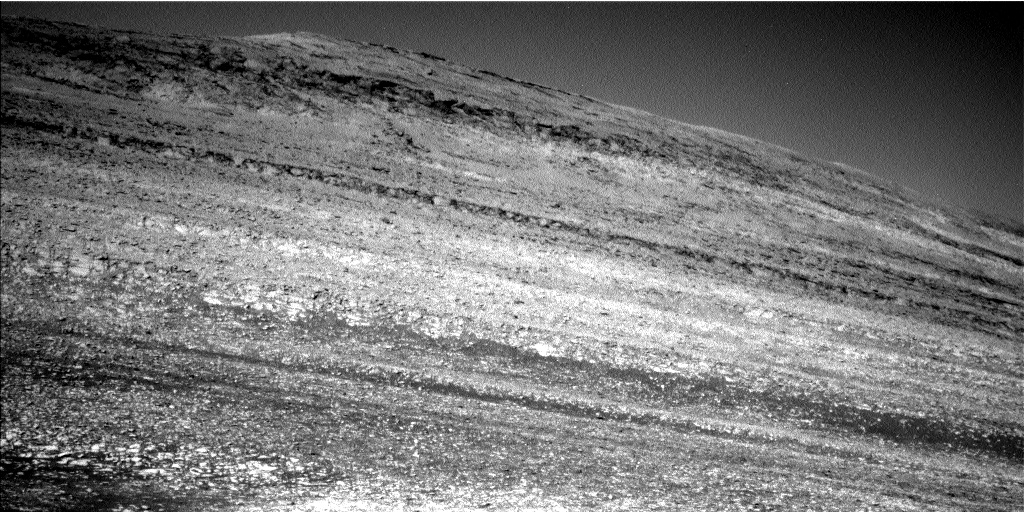
Curiosity Left B Navigation Camera image taken on Sol 3946, September 12, 2023.
Image credit: NASA/JPL-Caltech
In the afternoon, MAHLI will image the DRT target “Antikythera,” followed by a rover drive of 85 feet (roughly 26 meters) and imaging to prepare for the next plan. The second sol includes an autonomously selected ChemCam target, and Navcam observations to assess dust in the atmosphere and search for dust devils.

Curiosity Left B Navigation Camera image taken on Sol 3946, September 12, 2023.
Image credit: NASA/JPL-Caltech
Bishop quad
“The planned drive should put us in a new mapping quadrangle, informally known as the Bishop quad,” Edgar points out.
“Our informal naming convention is to divide up the exploration region into square quadrangles (0.025 degrees of latitude or longitude on a side) and each quad is assigned a name of a town with a population less than 100,000 people,” Edgar explains.

Curiosity Chemistry & Camera (ChemCam) Remote Micro-Imager (RMI) photo acquired on Sol 3946, Septembert 12, 2023.
Image credit: NASA/JPL-Caltech/LANL

Curiosity Rear Hazard Avoidance Camera Left B Sol 3946, September 12, 2023.
Image credit: NASA/JPL-Caltech
As Curiosity investigates targets within a quad, Edgar adds that the Mars study team assign names to targets that correspond to geological formations and features from near that town on Earth.
“Bishop California is located in Owens Valley, and is the starting point for trips into the High Sierra, including some awesome geology,” Edgar concludes. “It feels like a fitting name for the next part of Curiosity’s ascent of Mt. Sharp!”

Image credit: KARI/Ministry of Science, ICT
Korea’s lunar orbiter, Danuri, has imaged the landing spot of India’s Chandrayaan-3 Moon lander/rover mission.
A newly-released image of Shiv Shakti Point, the country-labeled touchdown locale of Chandrayaan-3, has been issued by the Ministry of Science, Information and Communication Technology, and the Korea Aerospace Research Institute (KARI).

Korea Moon orbiter.
Credit: KARI
To snag the shot, Korea’s robotic lunar orbiter used one of its payloads, a high-resolution camera, on August 27th from the lunar mission orbit of about 62 miles (100 kilometers) above the Moon’s surface.
The image is to commemorate humanity’s first-ever lunar south pole region landing by the Chandrayaan-3 on August 23rd.
Upcoming announcements
According to the Ministry of Science/IST (MSIT), Korea’s Moon-circuiting orbiter is planned to perform various scientific and technological missions while circling the lunar mission orbit until December 2025.
These missions include capturing images of potential lunar landing sites, observation of polarized light and gamma ray for drafting a map of lunar surface elements and minerals, measurement of lunar magnetic activity that will lead to the understanding of the origin of the Moon, and validation of space internet technology.
The Ministry of Science/IST statement added that in December, MSIT and KARI plan to disclose a variety of achievements, including photos of potential lunar landing sites, five types of lunar element maps, radiological environment measurements of the Moon, and many more, in order to commemorate the 1st anniversary of Danuri’s mission to the Moon.
Danuri is South Korea’s first lunar orbiter. The mission was launched in August 2022 and was inserted into orbit around the Moon on December 16, 2022.

Image credit: JAXA
It would seem odd that a spacecraft could seek the origin of fear and terror.
But that is the objective of Japan’s Martian Moons eXploration mission, a bold undertaking set to survey two oddballs circling Mars – the moons Phobos (fear) and Deimos (panic), name tags drawn from Greek mythology.

Phobos is 150-times smaller than Earth’s moon. Deimos in background is 280-times smaller than Earth’s moon and about half the size of Phobos.
Combined images credit: NASA’s Goddard Space Flight Center; NASA/JPL-Caltech; Malin Space Science Systems; Texas A&M University; University of Arizona
Backed by the Japan Aerospace Exploration Agency (JAXA), this ambitious Martian Moons eXploration (MMX) spacecraft is headed for a 2024 sendoff. It will visit the two moons loaded with a rich to-do list.
To learn more, go to my new Multiverse Media SpaceRef article — “Japan’s Mission to the Red Planet – Probing the Mysterious Moons of Mars” at:

Tianzhou-5 cargo craft departs for controlled re-entry.
Image credit: CCTV/Inside Outer Space screengrab
China’s resupply ship – the Tianzhou-5 cargo craft – decoupled from the orbiting Tiangong space station and has re-entered the atmosphere in a controlled manner early Tuesday, September 12, Beijing Time.
According to the China Manned Space Agency (CMSA), most of the spacecraft’s components burned up during the re-entry, and a small amount of its debris fell into the predetermined remote waters of the South Pacific.
Tianzhou-5 was lofted on November 12, 2022 from the Wenchang Spacecraft Launch Site in the southern island province of Hainan.

Tianzhou-5 cargo craft is guided in a controlled re-entry into Earth’s atmosphere.
Image credit: CCTV/Inside Outer Space screengrab
The cargo ship carried into Earth orbit propellants, materials for scientific experiments and supplies for crews onboard the orbiting facility.
In-orbit testing
According to the state-run Xinhua news group, the in-orbit test of space hydrogen-oxygen fuel cells was an experiment onboard the Tianzhou-5. It provided data and theoretical support for China’s future manned lunar explorations.
Other key payloads include space high-energy particle detection equipment, which completed an extravehicular mission.
At present, three batches of application projects have been carried by unpiloted Tianzhou supply ships into space. The CMSA said future crewed space missions will continue to open its cargo craft payloads to the public.

Now onboard China’s space station, the Shenzhou-16 crew.
Image credit: CCTV/Inside Outer Space screengrab
Independent flight
Prior to its demise, the cargo craft had separated from the space station combination on May 5, then re-docked with the space station after a 33-day independent flight, and continued to carry out space technology experiments before its ocean ditching.
The craft was undocked from the front port of China’s Tianhe core module – one of several modules that constitute the Chinese space station.
For a newly released video, go to:

Ready and waiting. Dante Lauretta, OSIRIS-REx’s principal investigator from the University of Arizona holds a mock up of the asteroid collection device.
Image credit: Barbara David
A NASA spacecraft is nearing Earth in express delivery mode.
Launched way back in September 2016, NASA’s Origins Spectral Interpretation Resource Identification Security Regolith Explorer (OSIRIS-REx) is toting a collection of asteroid bits and pieces. They were plucked from asteroid Bennu, an ancient rubble pile of odds and ends from the early days of solar system creation about 4.5 billion years ago.
Full-stop
On September 24, those deliverables are to parachute into the Department of Defense Dugway Proving Ground in the Utah Test and Training Range, roughly 80 miles west of Salt Lake City, Utah.
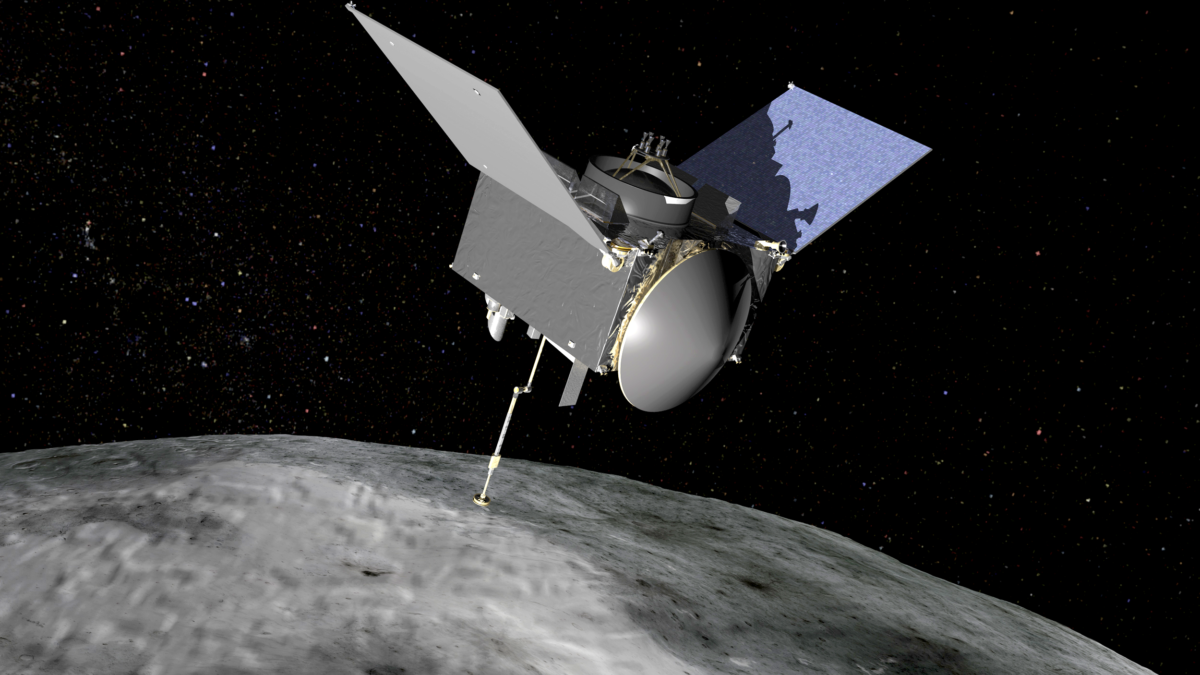
Artwork shows OSIRIS-REx spacecraft at Bennu.
Credit: NASA/University of Arizona
I recently talked with Dante Lauretta, OSIRIS-REx’s principal investigator from the University of Arizona in Tucson, in anticipation of the full-stop touchdown of specimens from asteroid Bennu.
For the full story, go to my new Space.com article – “OSIRIS-REx’s Dante Lauretta shares final preparations for Sept. 24 asteroid-sample return” at:
https://www.space.com/dante-lauretta-man-on-mission-osiris-rex-sample-recovery

