Archive for the ‘Space News’ Category
 Author:
  October 4th, 2023
NASA’s Perseverance rover now busy at work on Mars carries a microphone mounted onto the robot’s SuperCam mast unit.
Image credit: NASA/JPL-Caltech/Malin Space Science Systems
Consider it sound advice.
The use of tiny microphones on NASA’s Mars Perseverance has proven big time beneficial to both engineers and scientists. They can identify wind gusts even hear the staccato popping sounds made by instrument-generated laser pulses.
Similarly, the swirling blades of the Ingenuity Mars helicopter have been picked up, as has the pumping rhythm of an oxygen-making experiment.

Hear, hear! Flights of the Ingenuity Mars helicopter have been picked up by the Perseverance rover, offering both valuable engineering and scientific data.
Image credit: Ralph Lorenz, et al., NASA/JPL-Caltech, University of Arizona/HiRISE
Thanks to the Perseverance machinery rolling about within Jezero Crater, it’s time to turn up the volume on microphones for extra-planetary exploration.
For more information, go to my new Space.com story – “Microphones in space: Why scientists want to listen in on alien worlds” – at:
https://www.space.com/microphones-in-space-listen-to-alien-worlds
 Posted in
In the early morning hours of September 24, NASA’s first sample return mission of bits and pieces of an asteroid successfully parachuted into the Department of Defense Dugway Proving Ground in the Utah Test and Training Range, roughly 80 miles west of Salt Lake City, Utah.
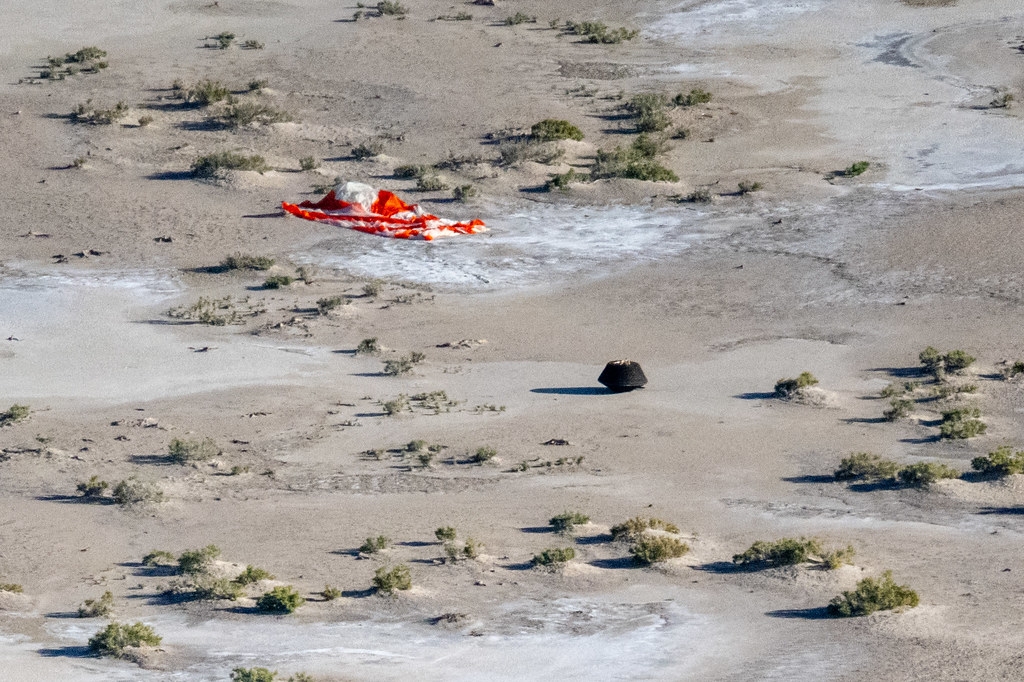
Following its high-speed re-entry, the OSIRIS-REx sample return capsule served as an artificial meteor before parachuting into the desert landscape of the Department of Defense’s Utah Test and Training Range.
Image credit: NASA/Keegan Barber

Diagram indicates the various stages of a sample return capsule flight (not to scale). Infrasound and seismic stations, depending on their location, can detect acoustic signatures generated by the re-entry. The arrow indicates direction of travel.
Image credit: Elizabeth Silber, et al.
That extraterrestrial freight from afar came capsule-contained courtesy of the Origins Spectral Interpretation Resource Identification Security Regolith Explorer (OSIRIS-REx) mission.
Off shoot
But there was an “off shoot” from the capsule’s scorching re-entry as it hot-footed its way to Earth.
Go to my new Multiverse Media/SpaceRef story – “Scientific Bonanza – OSIRIS-REx Asteroid Return Capsule Studied as “Artificial Meteor” – at:
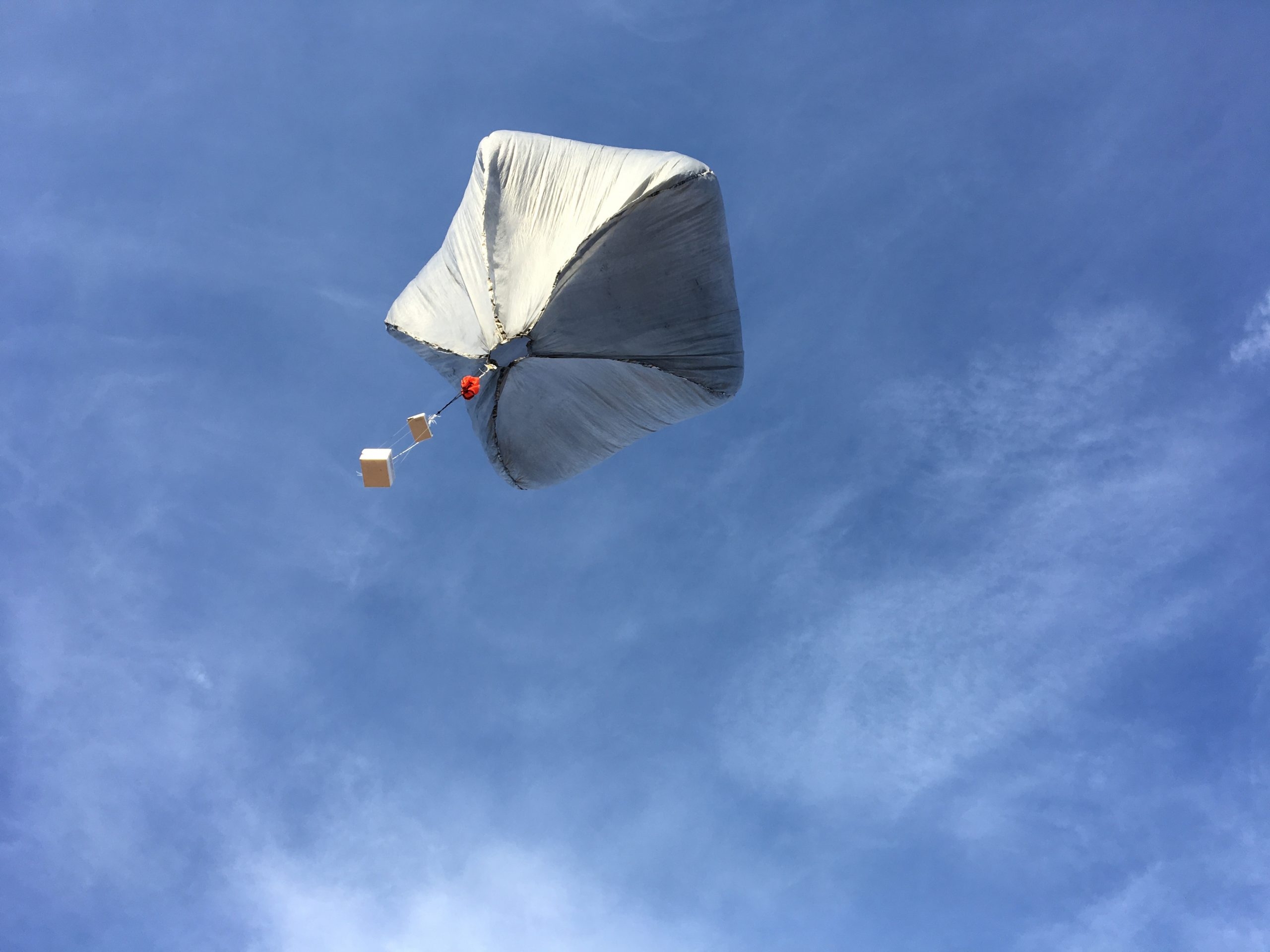
A Sandia National Laboratories balloon taking flight bears sensors including a GPS tracker and reusable infrasound sensor. This type of flight hardware was used to support data-gathering during the re-entry of the OSIRIS-REx capsule into Utah.
Image credit: Sandia National Laboratories

Part of the network of sensors used to record the in-coming OSIRIS-REx capsule re-entry.
Image credit: Sandia National Laboratories/Elizabeth Silber

Sensor equipment was placed right under the point of peak heating by the OSIRIS-REx capsule as it made its way to a Utah landing.
Image credit: Johns Hopkins University/Benjamin Fernando

Image credit: Roscosmos/Inside Outer Space screengrab
Russia’s Roscosmos chief, Yuri Borisov, explains that Russia will decide on extending the operation of the International Space Station after 2028, based on the condition of the station.
Speaking at the International Astronautical Congress in Baku, he spoke about plans to create a modular Russian orbital station, which is planned to be deployed in the period 2027-2032.

Image credit: Roscosmos/Inside Outer Space screengrab
Borisov noted that the Russian side is open to international cooperation in this project, providing opportunities for foreign partners both to send cosmonauts and to build individual modules.
The Russian space leader also focused on the problem of pollution of near-Earth space. Russia plans to develop space monitoring by creating a new one on the basis of the existing system – “Milky Way.”
Go to this informative video at:

China’s Chang’e-6 lunar sample return mission elements.
Credit: CNSA
China Moon exploration planners are detailing the country’s next robotic lunar probe mission, the Chang’e-6 to be launched around 2024.
This Moon lander is to set down in the south pole-Aitken Basin on the lunar far side and gather lunar samples, then rocket the specimens to Earth.
According to the China National Space Administration (CNSA), Chang’e-6 operations are to be supported by a newly developed lunar relay satellite Queqiao-2, or Magpie Bridge-2, to be in position within the first half of 2024.
Similar to the successful Chang’e-5 return sample probe, Chang’e-6 will consist of four components: an orbiter, lander, ascender and Earth re-entry module. The Chang’e-6 will seek to retrieve one to two kilograms (4.4 pounds) of lunar samples.
If the mission succeeds, Chang’e-6 will mark the first returned samples from the Moon’s far side.

Photo taking during Chang’e-5 surface sampling.
Credit: CCTV/Inside Outer Space screengrab
International payloads
China has launched five lunar exploration spacecraft since 2007. The most recent mission, the Chang’e 5, landed on the Moon in December 2020, rocketing back to Earth 1,731 grams of lunar rocks and soil.
In addition, the Chang’e 4 mission deployed the Yutu 2 lunar rover, still operating for nearly five years, earning its stripes as the world’s longest-operating lunar rover.
“Chang’e-6 will collect samples and back to the Earth after that, so it won’t stay too long on the surface of the Moon,” said Tang Yuhua, deputy chief designer of Chang’e-7 mission with the Lunar Exploration and Space Program Center of the CNSA.
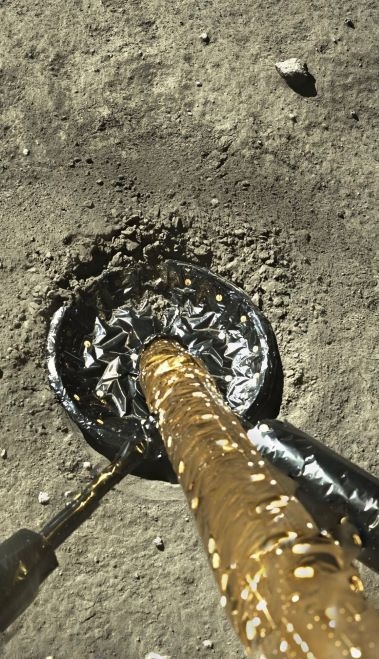
Landing leg of Chang’e-5 lander.
Credit: CNSA/CLEP
CNSA added that the Chang’e-6 lunar mission will carry payloads from France to detect radioactive gas radon, an Italian laser corner reflector to calibrate radar systems, a European Space Agency-provided negative ion detector, and a CubeSat, a square-shaped miniature satellite from Pakistan.
Near, far side differences
China Central Television (CCTV) reports that, originally, Chang’e-6 served as backup to the Chang’e-5 mission in case of failure.
The Queqiao-2 relay satellite is necessary to provide relay communication services as the Chang’e-6 lander, due to its far side site, will not have a direct communication link with Earth, said Wang Qiong, deputy chief designer of the Chang’e-6 mission.

Chang’e-5 return capsule holding lunar specimens.
Credit: National Astronomical Observatories, CAS
“There are very big differences between the near and far side of the Moon. The far side of the Moon is basically the ancient lunar crust and the lunar highlands, and many scientific discoveries will be found there,” said Li Chunlai, deputy chief designer of the third-phase lunar exploration project.

Wang Qiong, deputy chief designer of the Chang’e-6 mission.
Image credit: CCTV/Inside Outer Space screengrab
Wang added that for scientific considerations, “we need to obtain samples from different ages and regions. For engineering considerations, we mainly focus on the feasibility of the project. First, the slope must be relatively gentle, and second, it must be relatively flat, making it easy to land.”
Research station
As planned, the fourth phase of China’s lunar exploration program, including the Chang’e-6, Chang’e-7, and Chang’e-8 missions, is aimed to initially build a basic model of an international lunar scientific research station at the Moon’s south pole.
The Moon’s south pole is a region of extreme low temperature and complicated terrain containing low-lying crater pits and towering peaks. The intense sunlight and possible water ice existing in permanently shadowed regions is viewed as important to establishing a station at that location.

International Lunar Research Station. Image credit: CNSA
“There are some highlands in the south pole with very good lighting conditions. They may be covered by light for 70 to 80 percent of the time throughout the year. These locations are very conducive to scientific exploration. On the other hand, there are sunken pits in permanent shadows in the south sole. In these pits, there is no sunlight all year round. Scientists believe that water ice may exist in these places,” said Wang.
Countries around the world now regard the Moon’s south pole as a focus area for exploration, added Wang. “In the future, there will be multiple missions from many countries, such as the United States, Japan, and China, that have to land in the south pole. Therefore, the Moon’s south pole will become more and more crowded, and more and more detection modules will work here,” Wang told CCTV.

Credit: CNSA/CCTV/Inside Outer Space screengrab
Humans to the Moon
Meanwhile China is now developing a new carrier rocket and crewed spacecraft as part of its goal to land astronauts on the Moon by 2030. That booster, the Long March-10, is reportedly to make its inaugural flight in 2027.
Rong Yi, a rocket expert with the China Academy of Launch Vehicle Technology (CALT) under the China Aerospace Science and Technology Corporation (CASC), told CCTV that the Long March-10 uses liquid hydrogen, liquid oxygen and kerosene as propellants. It has a total length of about 92 meters; a takeoff weight of about 2,187 tons; a takeoff thrust of about 2,678 tons, and will have a carrying capacity of no less than 27 tons to be hurled on an Earth-Moon transfer orbit.

Rong Yi, chief designer of Long March-2F carrier rocket at China Academy of Launch Vehicle Technology (CALT).
Image credit: CCTV/Inside Outer Space screengrab
“At present, various research and development works are being advanced in an orderly and rapid manner. The typical feature of the carrier rocket is that it uses non-toxic liquid oxygen kerosene as propellant. The rocket has a core diameter of 5 meters and is bundled with a 5-meter-diameter booster. Therefore, its future carrying capacity for the Earth-Moon transfer orbit will be 27 tons, which is more than three times higher than that of the Long March-5,” said Rong, chief designer of Long March-2F carrier rocket at CALT.
The new piloted spacecraft is modular in design, consisting of an escape tower, a return capsule and a service module to meet the needs of near-Earth and deep space missions, CCTV reports.

Image credit: Visual Capitalist/Miranda Smith
Nearly 7,000 satellites orbit the Earth, serving vital functions such as communication, navigation, and scientific research.
In 2022 alone, more than 150 launches took place, sending new instruments into space, with many more expected over the next decade.
But who owns these objects?
Industry leader
Visual Capitalist utilized data from the Union of Concerned Scientists to highlight the leaders in satellite technology.
Writer Bruno Venditti and graphics/design expert, Miranda Smith, have produced a helpful guide to understand which companies own the most satellites.
“SpaceX, led by Elon Musk, is unquestionably the industry leader, currently operating the largest fleet of satellites in orbit—about 50% of the global total,” Venditti writes.
“The company has already completed 62 missions this year,” Venditti adds, “surpassing any other company or nation, and operates thousands of internet-beaming Starlink spacecraft that provide global internet connectivity. Starlink customers receive a small satellite dish that self-orients itself to align with Starlink’s low-Earth-orbit satellites.”

Credit: SpaceX/Starlink
Intense competition
In second place is a lesser-known company, British OneWeb Satellites.
The company, headquartered in London, counts the UK government among its investors and provides high-speed internet services to governments, businesses, and communities. Like many other satellite operators, OneWeb relies on SpaceX to launch its satellites.
Despite Starlink’s dominance in the industry, the company is set to face intense competition in the coming years as Amazon’s Project Kuiper plans to deploy 3,236 satellites by 2029 to compete with SpaceX’s network. The first of the fleet could launch as early as 2024.

Most satellites in orbit
“After the top private companies, governments also own a significant portion of satellites orbiting the Earth. The U.S. remains the leader in total satellites, when adding those owned by both companies and government agencies together,” explains Venditti.
American expenditures on space programs reached $62 billion in 2022, five times more than the second one, China.
“China, however, has sped up its space program over the last 20 years and currently has the highest number of satellites in orbit belonging directly to government agencies,” Venditti points out. “Most of these are used for Earth observation, communications, defense, and technology development.”
Non-web users
Despite the internet being taken for granted in major metropolitan areas and developed countries, Venditti observes that “one out of every three people worldwide has never used the web.”
Furthermore, the increasing demand for data and the emergence of new, more cost-effective satellite technologies are expected to present significant opportunities for private space companies.
“In this context, satellite demand is projected to quadruple over the next decade,” Venditti concludes.
Visual Capitalist is an online, global publisher that’s focused on topics including markets, technology, energy and the global economy.
To access the original “Which Companies Own the Most Satellites?” go to:
https://www.visualcapitalist.com/who-owns-the-most-satellites/

Image credit: NASA
NASA’s Office of Technology, Policy, and Strategy has issued a report — Artemis, Ethics and Society: Synthesis from a Workshop — focused on two key study questions:
1) How should NASA consider the ethical, legal, and societal implications of the Artemis and Moon to Mars efforts?
2) What are the key ethical and societal implications that need consideration?

Image credit: NASA
Open to interpretation
Among a host of report observations, participants flagged the fact that the Outer Space Treaty, National Aeronautics and Space Act, and Artemis Accords all call for space exploration to be done for the benefit of all humankind.
“However, what that means for NASA is very much open to interpretation, and there are many questions that this simple statement raises,” the report notes.

Image credit: NASA
Furthermore, pressing ethical issues may emerge unexpectedly as a second-order effect of NASA decisions.
Sanctity of the Moon
“In light of this, proactive exploration of future ethical and societal issues is needed. For example, a cultural sensitivity about commercial payloads with human remains flying alongside NASA Commercial Lunar Payload Services (CLPS) deliveries is a key example discussed in the report and involves diffuse responsibilities,” the report points out.

Image credit: NASA
While NASA has said it would not send human remains to the Moon without consulting U.S. tribal nations, “the CLPS initiative’s funding of commercial deliveries on private landers has enabled non-NASA payloads, including human remains to become manifested on these private flights,” notes the report.
“Some cultures see the Moon as having spiritual significance and believe placing human remains on the Moon can disturb the sanctity of the Moon,” points out the report.
It is noted in the report that the views and options offered represent those of the participants at the workshop, and do not necessarily reflect the views of NASA or the U.S. Government.
To read the full document — Artemis, Ethics and Society: Synthesis from a Workshop – go to:

Earth’s Moon is a destination point for renewed human exploration.
Image credit: NASA
Without doubt, Earth’s Moon looms as nations and for-profit private concerns have our celestial next-door-neighbor in their exploration cross-hairs.
The drum beat of back to the Moon, then putting humans on a permanent footing there, is on the upswing made practical by harvesting lunar resources. One need-to-have top priority is water ice, thought resident within permanently shadowed polar craters.
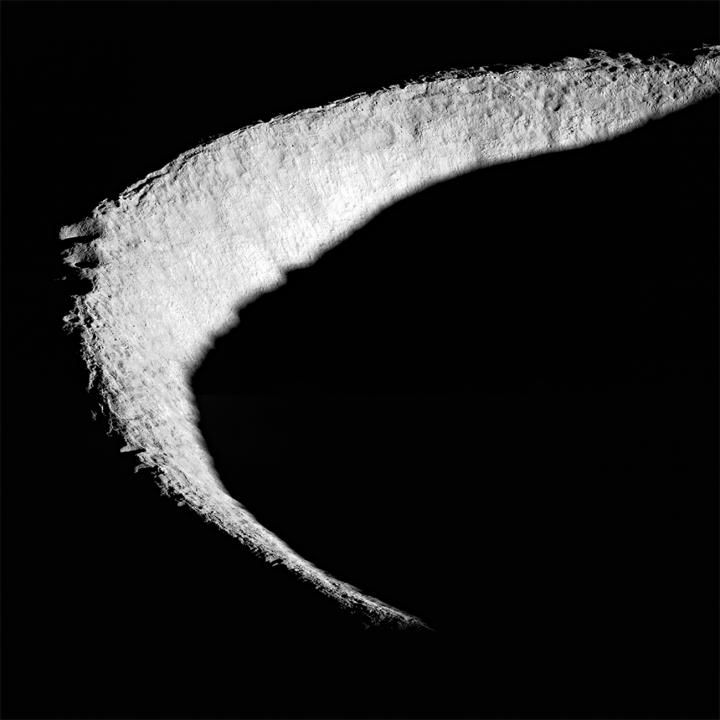
Shackleton Crater, the floor of which is permanently shadowed from the Sun, appears to be home to deposits of water ice.
Credit: NASA/GSFC/Arizona State University
But new research by Planetary Science Institute (PSI) senior scientist Norbert Schörghofer changes the prediction as to where water ice is on the Moon. The work also dramatically alters estimates for how much water ice is available on the Moon.
To read the full story, go to my new Multiverse Media SpaceRef article at:
https://spaceref.com/science-and-exploration/water-ice-moon-cold-facts-resource-reckoning/

Image credit: Euroconsult
Lunar exploration is the catalyst behind an unprecedented surge in the space exploration sector which saw global government investment rise to an impressive $26 billion during 2023.
A new report has been issued by Euroconsult pointing to ambitious lunar missions that are projected to boost investment to nearly $33 billion by 2032.
That’s a growth trajectory which underscores lunar exploration’s pivotal role in shaping the future of space exploration, the new report adds.
Critical capabilities
“Developing a sustainable presence on the Moon is a long process expected to occur over at least the next two decades, requiring complex infrastructure across technical areas. Affordable transportation, communications and navigation, and power are critical capabilities to enable all other lunar activities,” the report explains.

Image credit: Euroconsult
NASA, the European Space Agency and others to follow, Euroconsult points out, are expanding public- private partnerships for lunar exploration. “They seek to act as strategic partners and future customers of commercial lunar services to achieve a cost-effective sustainable model for space exploration.
The figures are revealed in the just published fourth edition of Euroconsult’s “Prospects for Space Exploration” report. For more information, go to:
https://digital-platform.euroconsult-ec.com/product/prospects-for-space-exploration/

I’m 60! Saturday Night Live’s Molly Shannon. Image credit: SNL
NASA’s Ingenuity Mars Helicopter has now completed 60 flights since first taking to the skies above the Red Planet on April 19, 2021.
Newly posted imagery show the high-flying mini-chopper scooting skyward on September 26, the date of Ingenuity’s 60th flight.

Image credit: NASA/JPL-Caltech

Image credit: NASA/JPL-Caltech
That aerial hop covered roughly 1,116 feet (340 meters) in horizontal distance; reaching approximately 52 feet (62 meters) in altitude; and flying for 132.8 seconds.
Flight log stats
Those 60 aerial assaults by Ingenuity collectively add up to completing 108.8 flying minutes, covering 8.5 miles (13.6 km), and reaching altitudes as high as 65.6 ft (20.0 meters).
Using its navigation camera mounted in the helicopter’s fuselage and pointed directly downward to track the ground during flight, black and white imagery shows the view from above the Mars landscape.

Wait a minute!
Image credit: Barbara David
Utah Test and Training Range – Exciting times here as I watched the OSIRIS-REx sample return capsule make its safe and sound touchdown at this remote military outpost.
Taking nothing away from this huge step in asteroid research, there are a couple of items of note to keep an eye on.

In-space images show that the OSIRIS-REx mission successfully placed the spacecraft’s sample collector head into its Sample Return Capsule.
Image credit: NASA/Goddard/University of Arizona/Lockheed Martin

OSIRIS-REx sample return capsule is seen shortly after touching down in the desert, Sunday, Sept. 24, 2023, at the Department of Defense’s Utah Test and Training Range. The sample was collected from the asteroid Bennu in October 2020 by NASA’s OSIRIS-REx spacecraft.
Image credit: NASA/Keegan Barber
Keeping samples safe
With the prospect of an October 1st government shutdown still looming, there is concern about the impact on NASA’s handling of the just-returned freight from Bennu and the scientific integrity of the samples.
“We want to make sure that these samples are safe,” said Lori Glaze, Director of NASA’s Science Mission Directorate’s Planetary Science Division.
“These are incredibly valuable samples and we’re working through our normal processes for how we make sure that we achieve that,” Glaze told Inside Outer Space. “NASA will make sure they are kept safe,” she emphasized.

Pre-launch image shows parachute installation in the OSIRIS-REx sample return capsule.
Image credit: Lockheed Martin
Technical hiccups?
There may have been some technical hiccups in the capsule’s speedy and red-hot descent through Earth’s atmosphere, said Tim Priser, Lockheed Martin’s chief engineer for deep space exploration.
The aerospace firm is builder of not only the novel air filter-like Touch-And-Go Sample Acquisition Mechanism (TAGSAM), but the return capsule and the spacecraft itself.
Specifically, the capsule’s drogue chute deployment may have been an issue prior to a far-higher and earlier-than-expected main parachute unfurling.
Sequence of events
“Some things in our sequence may or may not have behaved itself exactly the way we expected it to but the subsequent things in the sequence made up for the fact,” Priser said in a post-landing press event.

Not-to-plan parachute sequence.
Image credit: University of Arizona/Heather Roper
“At the end of the day when that main chute deployed it basically corrected any of the sins that may have happened ahead of it,” Priser said.
Engineers will reconstruct the sequence of events that occurred during the return capsule’s dive through Earth’s atmosphere to its full-stop, “soft as a dove,” touchdown in Utah, said Priser.
One of the advantages of landing at the Utah Test and Training Range, Priser added, is the ground and aerial imagery capability used to monitor the capsule’s sky-rocketing re-entry.
“You have your data. You have your models. You have your observations and you’ve got to put all those pieces together so you reconstruct what happened,” Priser told Inside Outer Space.

Dante Lauretta, OSIRIS-REx’s principal investigator from the University of Arizona holds a mock up of the asteroid collection device.
Image credit: Barbara David

