Archive for the ‘Space News’ Category
 Author:
  October 12th, 2023
Image credit: DARPA/Inside Outer Space Archives
When talking about the Moon, throw some LOGIC into the mix.
In this case it’s the Lunar Operating Guidelines for Infrastructure Consortium or LOGIC for short.
This consortium is being put in place by the Defense Advanced Research Projects Agency. Better known as DARPA, its purpose is to develop operational guidelines and pathways to close interoperability gaps for commercial lunar infrastructure.

Watch this space! Image credit: ESA Matthias Maurer
Stakeholders
DARPA intends to bring “international stakeholders across industry, academia, and government to identify critical lunar infrastructure interoperability and interface needs,” the agency explains in a statement.
The Johns Hopkins University Applied Physics Laboratory (APL) will administer LOGIC, providing technical leadership and management of the consortium.
“We are proud to support DARPA and NASA in achieving their integrated goals in the cislunar domain,” said Bobby Braun, head of APL’s Space Exploration Sector.
“Whether for scientific, security or economic objectives, development of cislunar technology has long been a focus at APL. We are excited to apply our team’s capabilities to the benefit of our nation,” said Braun.

The U.S. Defense Advanced Research Projects Agency (DARPA) is moving forward on the Novel Orbital and Moon Manufacturing, Materials and Mass-efficient Design (NOM4D) program. (Image credit: DARPA)
NASA is tied in through APL’s operation of the civil space agency’s Lunar Surface Innovation Initiative (LSII) and Lunar Surface Innovation Consortium (LSIC) in which hundreds of universities and businesses are participating in NASA’s Artemis lunar exploration program.
NOM4D, LunA-10, LOGIC
Over several years, DARPA has increasingly zeroed-in on the Moon.
Last year, DARPA selected teams for its Novel Orbital Moon Manufacturing, Materials, and Mass Efficient Design (NOM4D) program.

Image credit: DARPA/Inside Outer Space Archive
More recently, DARPA initiated the 10-Year Lunar Architecture (LunA-10) Capability Study to spur the development of a future civil lunar framework for peaceful U.S. and international use.
DARPA said that LunA-10 seeks to rapidly develop foundational technology concepts “that move away from individual scientific efforts within isolated, self-sufficient systems, toward a series of shareable, scalable systems that interoperate — minimizing lunar footprint and creating monetizable services for future lunar users.”
On the horizon
“Widespread exploration and commerce on and around the Moon are on the horizon,” said Michael “Orbit” Nayak, program manager in DARPA’s Strategic Technology Office.

Wanted: Interoperability standards for commercial lunar infrastructure.
Image credit: DARPA
“With LunA-10, we’re studying the technologies that can help to get us there – and interoperability needs to be part of the picture from the start,” Nayak added.
“While other efforts focus on technology development,,” Nayak said, “LOGIC will zero in how systems work together. We’re looking for maximum participation from the public and private sectors and from international stakeholders.”
 Posted in

Wait a Minute!
Image credit: Barbara David
Often linked (perhaps wrongly so) to alien-occupied flying saucers that have stopovers on Earth from the outer reaches of deep space is an equally puzzling enigma: Unidentified Anomalous Phenomenon, or UAP.

Image credit: SCU
Specialized sensors are now being dispatched into the field. This gear is built to sight UAP and decipher what’s behind frequent sightings in certain hot spots of activity. For years now, the UAP mystery has blossomed, driven in-part by military pilots that have recalled their related encounters.

Image credit: RAND
Congressional hearings, specially set up military organizations, even NASA itself – all have been engaged in their own close-encounters with UAP. So far, a consistent cry is “more data.”
For a “data driven” story on what’s up with figuring out UAP, go to my new Space.com story – “Unidentified anomalous phenomena: Hot spots and the quest for better UFO data” – at:
https://www.space.com/unidentified-anomalous-phenomena-hot-spots-quest-data

Near-Earth asteroid Bennu is 1,600 feet (500 meters) wide and contains hydrated minerals, according to scientists working on the NASA OSIRIS-REx spacecraft mission.
Image credit: NASA/Goddard/University of Arizona
The early science look at NASA’s OSIRIS-REx (Origins, Spectral Interpretation, Resource Identification and Security – Regolith Explorer) has begun. Initial studies of the 4.5-billion-year-old asteroid Bennu sample collected show evidence of high-carbon content and water, which together could indicate the building blocks of life on Earth may be found in the rock. Still to come, opening up the large canister that holds the majority of the asteroid collectibles.
Also, go to my Scientific American story at: https://www.scientificamerican.com/article/osiris-rexs-asteroid-samples-are-finally-down-to-earth/

Image credit: NASA TV/Inside Outer Space

Image credit: NASA TV/Inside Outer Space

Image credit: NASA TV/Inside Outer Space

Image credit: NASA TV/Inside Outer Space

Image credit: NASA TV/Inside Outer Space

Image credit: Mars Guy
NASA’s Perseverance Mars rover at Jezero Crater has found features resembling reef-like structures.
Mars Guy reports that, in the very place it might be reasonable to expect, Perseverance discovered circular rock structures resembling ones formed by microbial communities in some lakes on Earth. “This exciting possibility called for a closer look.”

Image credit: Mars Guy/Simeon Schmauß
Go to this video at:
https://youtu.be/7lwarWtXABA?si=t3va5cA2c9PSSpoA

Curiosity’s location as of Sol 3972. Distance driven to date 19.3 miles/31.06 kilometers.
Credit: NASA/JPL-Caltech/Univ. of Arizona
NASA’s Curiosity Mars rover at Gale Crater has just started Sol 3973 duties.
“Winter is almost half over in Gale, but this rover doesn’t hibernate,” reports Natalie Moore, mission operations specialist at Malin Space Science Systems, based in San Diego, California.
The last time the rover stopped for more than a few sols was at the Ubajara drill site back in early May, almost a kilometer and 150 sols ago.

Curiosity Left B Navigation Camera photo acquired on Sol 3972, October 9, 2023.
Image credit: NASA/JPL-Caltech
“Now, five months later, we’re approaching our next drill site in this area of alternating banded layers dispersed across lithified sand,” Moore added. “The scientist jury is still out on which block is their favorite, but the operations team is already preparing to begin a two-to-three week drill campaign in the near future. With solar conjunction fast approaching, it’ll be interesting to see how much of a drill campaign we can fit between now and November 11th.”

Curiosity Left B Navigation Camera photo acquired on Sol 3972, October 9, 2023.
Image credit: NASA/JPL-Caltech
Two-sol plan
For the recently scripted two-sol (Sols 3968-3969) unrestricted plan, Moore said there’s a remote science block containing two Navcam activities to measure the atmospheric opacity and search for dust devils, noting “we’ve seen some large ones recently!”
Mastcam will follow up with a mono, Mastcam Right-only mosaic of the upper Gediz Vallis ridge that Curiosity has been driving parallel to since a crater cluster campaign.
The robot’s Chemistry and Camera (ChemCam) is to finish off the block with a 5×1 Laser Induced Breakdown Spectroscopy (LIBS) raster on a nodular bedrock target named “Black Giant,” with Mastcam Right scheduled to document the effort afterwards.

Curiosity Left B Navigation Camera photo acquired on Sol 3972, October 9, 2023.
Image credit: NASA/JPL-Caltech
Filter wheel stalled
On sol 3953 (September 20th, 2023) the Mastcam-34mm (Mastcam Left) filter wheel stalled between filters L0 (clear) and L1 (green) while running a multispectral atmospheric opacity (tau) imaging sequence, explains Moore.
“Since then, the Mastcam team has been sending a series of diagnostic commands with varying motor drive parameters, in an effort to characterize the problem and get the filter wheel back to the L0 position where it is most often used,” Moore said. “To date, some progress has been made, and the team is hopeful that the L0 position will be reached soon.”
Analysis will then continue to determine if the filter wheel can be safely returned to normal service. “Remember, this rover has been outside Earth’s protection since late 2011! This isn’t the first time our engineering team fixed something remotely and it won’t be the last,” Moore reported.

Curiosity Front Hazard Avoidance Camera Left B image taken on Sol 3971, October 8, 2023.
Image credit: NASA/JPL-Caltech
Evening integration
After another Mastcam Left diagnostic activity was set to complete, the first arm backbone was slated to kick off and includes two contact science targets: “Helen Lake” (a less dusty dark-toned layer) and “Marion Peak” (a slightly dustier dark-toned layer).
The rover’s Mars Hand Lens Imager (MAHLI) was scheduled to take a full-suite of images on Helen Lake from 25, 5, and 2centimeters away and another mini-suite of images on Marion Peak from 25 centimeters and 5 centimeters away.
After the imaging, the robot’s arm turret was to spin to the Alpha Particle X-Ray Spectrometer (APXS) frame for their evening integrations on the two targets.

Curiosity Mars Hand Lens Imager photo produced on Sol 3972, October 9, 2023.
Image credit: NASA/JPL-Caltech/MSSS
Nap the night away
The first orbiter to pass over Curiosity will be the [European Space Agency] Trace Gas Orbiter, which should send data packages back to Earth.
“We mostly nap the night away, and on the second sol we’ll wake up with another remote sensing block starting again with a Navcam dust devil movie. Mastcam will follow up this time with some near-field mosaics of sand troughs between blocks, and ChemCam will shoot their second LIBS target named “Bridgeport” on a smoother piece of bedrock,” Moore explained.
With Curiosity’s arm activities done, rover operators will be ready to drive and potentially end up near the rover’s next drill site.

Image credit: Visual Capitalist
Visual Capitalist – an online publisher focused on topics and markets such as technology, energy and the global economy – has issued an informative look at Moon exploration.
Preyash Shah of Visual Capitalist has provided an interesting overview of attempted and successful Moon landings:
Since before Ancient Greece and the first Chinese Dynasties, people have sought to understand and learn more about the Moon.
Curiosity and centuries of study culminated in the first Moon landing in the 1960s. But there have been many other attempted Moon landings, both before and after.
A chart by Shah illustrates all the Moon landings using NASA data since 1966 when Soviet lander Luna 9 touched down.

Image credit: Visual Capitalist
Race to the Moon
The 1960s and 1970s marked an era of intense competition between the U.S. and the Soviet Union as they raced to conquer the Moon.
During the Cold War, space became a priority as each side sought to prove the superiority of its technology, its military firepower, and its political-economic system.
In 1961, President John F. Kennedy set a national goal to have a crewed lunar landing and return to Earth.
After several failed attempts from both sides, on July 20, 1969, the Apollo 11 mission was successful and astronauts Neil Armstrong and Buzz Aldrin became the first humans to set foot on the Moon.

Credit: NASA/Inside Outer Space Archives
Fervor waned
After the Apollo missions, the fervor of lunar exploration waned. From 1976 to 2013, no Moon landing attempts occurred due to budget constraints, shifting priorities, and advances in robotic missions.
However, a new chapter in space exploration has unfolded in recent years, with emerging players entering the cosmic arena. With its Chang’e missions, China has made significant strides, landing rovers on the Moon and exploring the far side of the Moon.
India, too, has asserted its presence with the Chandrayaan missions. In 2023, the country became the 4th nation to reach the Moon as an unmanned spacecraft landed near the lunar south pole, advancing the country’s space ambitions to learn more about the lunar ice, potentially one of the Moon’s most valuable resources.

Image credit: NASA/Inside Outer Space Archives
Exploring Lunar Water
Since the 1960s, even before the historic Apollo landing, scientists had theorized the potential existence of water on the Moon.
In 2008, Brown University researchers employed advanced technology to reexamine lunar samples, discovering hydrogen within beads of volcanic glass. And in 2009, a NASA instrument aboard the India’s Chandrayaan-1 probe confirmed the presence of water on the moon’s surface.

Image credit: NASA/Inside Outer Space Archives
Water is deemed crucial for future space exploration. Beyond serving as a potential source of drinking water for future Moon explorations, ice deposits could play a pivotal role in cooling equipment. Lunar ice could also be broken down to produce hydrogen for fuel and oxygen for breathing, essential for supporting extended space missions.
With a reinvigorated interest in exploring the Moon, manned Moon landings are on the horizon once again. In April 2023, NASA conducted tests for the launch of Artemis I, the first American spacecraft to aim for the Moon since 1972. The agency aims to send astronauts to the Moon around 2025 and build a base camp on the lunar surface.
To access the original Visual Capitalist material, go to:
https://www.visualcapitalist.com/cp/visualizing-all-attempted-and-successful-moon-landings/

Image credit: Virgin Galactic
Virgin Galactic’s suborbital space travel company will carry out “Galactic 04” on October 6th, the company’s fifth spaceflight this year and ninth spaceflight to date. Runway departure time scheduled for 9:00am Mountain Daylight Time.

Ron Rosano, Namira Salim, Trevor Beattie.
Image credit: Virgin Galactic
Onboard, the three private astronauts are:
Astronaut 017 – Ron Rosano from the United States.
Astronaut 018 – Trevor Beattie from the United Kingdom.
Astronaut 019 – Namira Salim from Pakistan, marking first person to fly to space from this country.

Virgin Galactic’s regular cadence of commercial suborbital travel. Shown is SpaceShipTwo zipping skyward over New Mexico’s Spaceport America.
Image credit: Virgin Galactic
For flight updates from Spaceport America in New Mexico, stay tuned to Virgin Galactic’s social channels at:
https://www.virgingalactic.com/
https://twitter.com/VirginGalactic
https://www.facebook.com/VirginGalactic/

Image credit: Virgin Galactic

Image credit: IAC/Inside Outer Space screengrab
Starship and Beyond!
A conversation with SpaceX Elon Musk.
Broadcast from the International Astronautical Congress (IAC) 2023 in Baku.
IAC 23 Baku – Day 4
Go to (start 3:12:00) at:
https://www.youtube.com/watch?v=kg3Z0wj9xDI&t=13689s

Image credit: IAC/Inside Outer Space screengrab

Image credit: SpaceX

Artistic view of China Space Station Telescope.
Image credit: NAOC
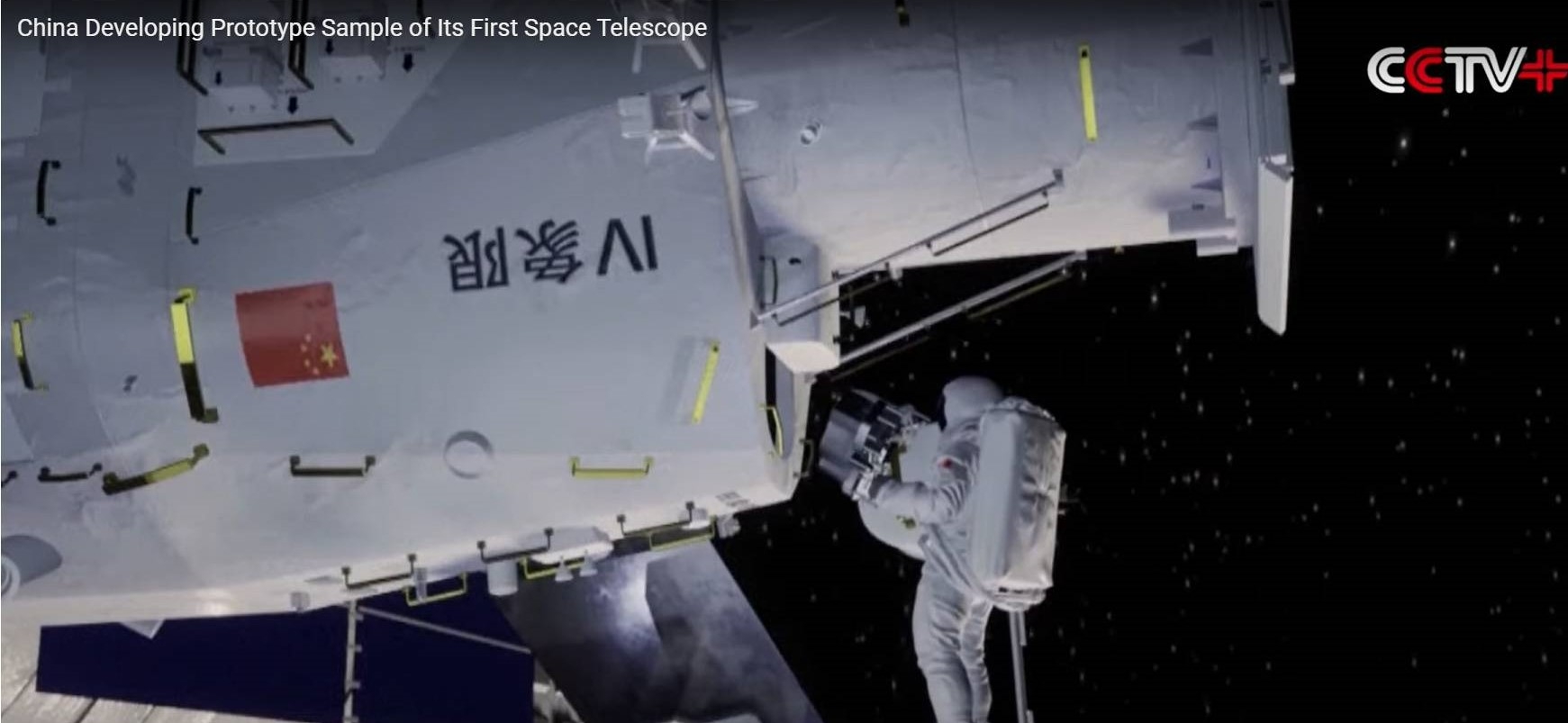
China is readying a major project that not only augments their research agenda for astronomy but bolsters use of the country’s space station complex.
There are bragging rights associated with China’s star-studded venture.
Credit: CCTV/Inside Outer Space screengrab
The spacecraft is called Xuntian, known as the Chinese Survey Space Telescope, but also the Chinese Space Station Telescope (CSST). The name “Xuntian” can be literally translated as “surveying the sky” or “survey to heavens.”

NASA’s venerable and productive Hubble Space Telescope.
Image credit: NASA
Scheduled for launch next year, the bus-sized CSST houses a two-meter (6.6 foot) diameter primary mirror. This ultraviolet-optical space telescope is to co-orbit with the country’s Tiangong orbital outpost. It has a nominal mission lifetime of 10 years, but the observatory’s space duties could be extended.
For more information on this upcoming Chinese endeavor, go to my new Space.com story – “Chinese astronomers say their new space telescope will outdo Hubble” – at:
https://www.space.com/china-space-telescope-xuntian

Credit: NPO Lavochkin
That failed Russian Luna-25 robotic lunar lander was likely taken out by out-of-whack accelerometer hardware, part of the BIUS-L component that provides angular velocity measurements.
Russia’s rekindling of its lunar program following the former Soviet Union’s pioneering Moon exploration initiatives that ended in 1976 will move forward, according to Roscosmos chief, Yuri Borisov.

During preparations for descent to the surface, Russia’s Luna-25 Moon lander experienced an anomaly that caused it to impact into the southwest rim of Pontécoulant G crater on Aug. 19, 2023, at 7:58 a.m. EDT (11:58 a.m. UTC).
Image credits: NASA’s Goddard Space Flight Center/Arizona State University
In a look into the Luna-25 mishap, the craft’s propulsion system on August 19 operated for 127 seconds instead of a planned 84 seconds – an incorrect propulsive maneuver that sent the lander onto a crashing finish on the Moon.
On August 19 that impulse was meant to form the probe’s pre-landing elliptical orbit. However, communication with the automatic station was interrupted. A subsequent search for Luna-25 did not produce results.

Post-crash photo shows Roscosmos chief, Yuri Borisov inspecting Luna-25 test facility. Image credit: Roscosmos
Abnormal functioning
According to a Roscosmos posting, the culprit was the abnormal functioning of the on-board control complex, “associated with the failure to turn on the accelerometer unit in the BIUS-L device (angular velocity measurement unit) due to the possible entry into one data array of commands with different priorities for their execution by the device. In this case, the distribution of commands in data arrays is random (probabilistic) in nature.”

Image credit: Roscosmos/Lavochkiin/IKI
The on-board control complex received zero signals from the accelerometers of the BIUS-L device. Reportedly, this hardware had not been previously flown under actual space conditions.
“This did not allow, when issuing a corrective pulse, to record the moment the required speed was reached and to timely turn off the spacecraft propulsion system, as a result of which its shutdown occurred according to a temporary setting,” the Roscosmos Telegram communiqué adds.

Russian mishap group dug into why Luna-25 mission failed.
Image credit: Roscosmos
Moving forward
Recommendations to avoid a similar issue on subsequent lunar missions have been formulated.
At the now-underway International Astronautical Congress meeting in Baku, Yuri Borisov also reported that the interdepartmental commission to determine the reasons for the abnormal functioning of the Luna-25 automatic station had completed its work and that a report was being prepared to the Government of the Russian Federation.

Luna-26
Image credit: Roscosmos/IKI/Inside Outer Space archives
Roscosmos is considering the option of carrying out flights of the Luna-26 and Luna-27 missions at an earlier date.

Luna-27
Image credit: Roscosmos/IKI/Inside Outer Space archives
“No one is going to fold their arms, and we are determined to continue the lunar program. Moreover, we are considering the possibility of shifting the Luna-26 and Luna-27 missions to the left in order to get the results we need as quickly as possible,” Borisov said.

