Archive for the ‘Space News’ Category
 Author:
  October 20th, 2023
That view is tremendous said Mercury astronaut John Glenn during his pioneering 1962 flight.
Image credit: NASA
“Capsule is turning around. Oh, that view is tremendous.”
This comment from space about the Earth came over 6 decades ago, voiced by John Glenn, America’s first person to circuit the Earth back in February 1962. That off-Earth outlook has now been uttered by hundreds of people hurled high above the planet on both suborbital and orbital treks.
Altitude and attitude
While there are many hungry to gain altitude to claim that attitude for themselves there is a way to eye distinctive Earth features – and Moon and Mars-like landscapes too – without rocketing skyward.

Virgin Galactic suborbital passengers eye the Earth high above their New Mexico Spaceport America departure and return point.
Image credit: Virgin Galactic
For more information, go to my new Multiverse Media SpaceRef story – “The Overview Effect at Home: Exploring Otherworldly Terrain With Space Tourists on Earth” – at:
Visit the planets without leaving Earth is the calling of Planex, https://planex.space/ – a planetary experience consulting group. It provides up-close-and-personal multi-day expeditions to New Mexico’s most space-like landscapes similar to landforms on the Moon, Mars, Jupiter’s moon Io, and elsewhere in the Solar System.
 Posted in

Image credit: ISRO
The countdown is underway for India’s milestone-making launch of the Gaganyaan TV-D1 – an “In-flight” abort demonstration of the crew escape system.
Project Gaganyaan is India’s effort to become a member of the elite cadre of countries capable of independent human spaceflight.

Image credit: ISRO
This TV-D1 test flight is scheduled for October 21, 2023 between 7 am and 9 am (Indian Time), (October 20 – 9:30 p.m. Eastern Time) with Live Streaming available at: https://www.youtube.com/watch?v=BMig6ZpqrIs
Escape tower test
For the Test Vehicle Abort mission-1, an unpressurized, uncrewed module will be used, lobbed skyward by a single-stage liquid rocket developed for this abort mission. The flight involves an escape tower outfitted with fast-acting solid motors.

Image credit: ISRO
“This Test Vehicle mission with this CM is a significant milestone for the overall Gaganyaan program as a near-complete system is integrated for a flight test,” explains the Indian Space Research Organization (ISRO). “The success of this test flight will set the stage for the remaining qualification tests and unmanned missions, leading to the first Gaganyaan mission with Indian Astronauts.”
Bay of Bengal recovery
The crew module houses all the systems for the deceleration and recovery, a complete set of parachutes, recovery aids actuation systems and pyros.

Image credit: ISRO
The avionics systems in the mock crew module are in a dual redundant mode configuration for navigation, sequencing, telemetry, instrumentation and power. This module is extensively instrumented to capture the flight data to evaluate the performance of various systems.
Liftoff of the Gaganyaan TV-D1 will take place at the Satish Dhawan Space Centre SHAR (SDSC SHAR), Sriharikota, one of the lead centers of the ISRO. Following the test flight, lasting roughly 9 minutes, the crew module will be recovered in the Bay of Bengal, using a dedicated vessel and diving team from the Indian Navy.

Image credit: CCTV/Inside Outer Space screengrab
China’s next human spaceflight — the Shenzhou-17 mission — is scheduled to be launched “in the coming days” to transport three astronauts to the country’s Tiangong space station, the China Manned Space Agency (CMSA) has stated.
The Shenzhou-17 spacecraft atop its booster, a Long March 2F rocket, were moved on Thursday morning to the service tower at the Jiuquan Satellite Launch Center in northwestern China’s Gobi Desert.
The booster and spacecraft are to undergo final function checks with an all-systems rehearsal set to occur shortly.

Now onboard China’s space station, the Shenzhou-16 crew.
Image credit: CCTV/Inside Outer Space screengrab
Six-month flight
China Daily adds that the six-month-long Shenzhou-17 mission will be the nation’s 12th piloted space mission and the sixth crewed flight to Tiangong.
Who is onboard Shenzhou-17 has not been disclosed at this stage.
The possible launch date is October 26, according to some reports.
That crew will take over in-space operations of the orbital outpost from the current trio of Shenzhou-16 astronauts: mission commander Major General Jing Haipeng; Colonel Zhu Yangzhu, spaceflight engineer; and Professor Gui Haichao, the mission’s science payload specialist.

Image credit: CGTN/Inside Outer Space screengrab
Current configuration
Wrapping up its duties, the now-orbiting Shenzhou-16 crew has circled Earth for nearly five months and will return to Earth several days after the new crew arrives.
As currently configured (with new modules likely to be added) the Tiangong orbital outpost consists of three major components: the Tianhe core module and the Wentian and Mengtian science lab segments. Also attached to the complex are the Shenzhou-16 crew ship and the Tianzhou-6 cargo ship.
For a video of the Shenzhou-17 rollout, go to:
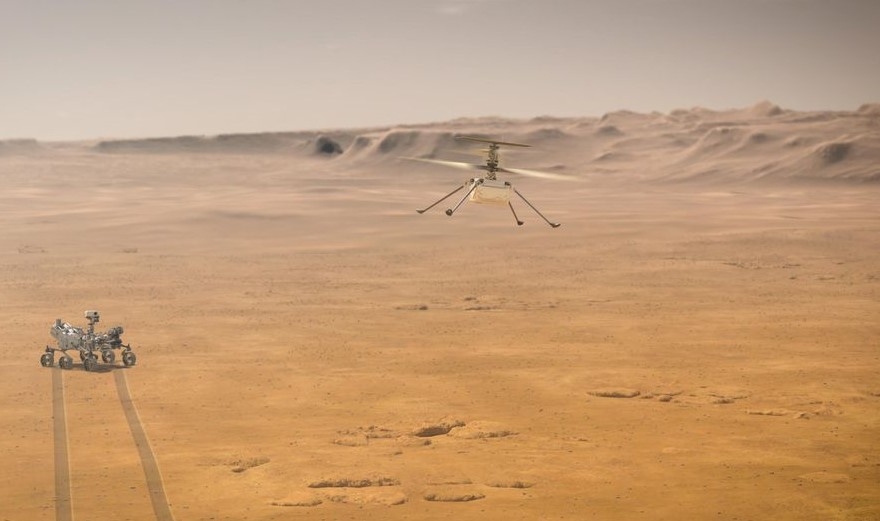
Image credit: NASA/JPL-Caltech
It is now official.
NASA’s Ingenuity Mars Helicopter made its 62nd flight on October 12, 2023.
As posted by NASA/JPL:
Horizontal distance: roughly 880 feet (268 meters); Maximum altitude: roughly 59 feet (18 meters): soaring for 121.1 seconds.

Image credit: NASA/JPL-Caltech

Image credit: NASA/JPL-Caltech

Image credit: NASA/JPL-Caltech

Image credit: NASA/JPL-Caltech
Several black and white images collected during the flight include those taken by the navigation camera mounted in the helicopter’s fuselage and pointed directly downward to track the ground during flight.
The aerial craft also acquired color imagery using its high-resolution color camera carried in Ingenuity’s fuselage and pointed approximately 22 degrees below the horizon.
According to the official NASA/JPL flight log the craft has, over the 62 flights, now accumulated roughly 112.9 minutes of flight time; has flown over 9 miles (roughly 13,913 kilometers); and reached the highest altitude of roughly 79 feet (24 meters).

Image credit: NASA/MEPAG
Planetary protection requirements should address pollution by shot-from-Earth chemicals and materials.
That’s from a new opinion piece appearing in the Proceedings of the National Academy of Sciences (PNAS), a peer reviewed journal of the National Academy of Sciences.
Thus far, “there has been little research on the impacts of anthropogenic chemicals and materials in the context of Planetary Protection, nor has there been an effort to compose regulations or agreements that consider these impacts. This needs to change,” the opinion piece argues, with lead pen held by John Hader of the Department of Environmental Science at Stockholm University in Sweden.

Anthropogenic debris from various robotic rover missions on Mars. Toss in plausible emission routes of chemicals and materials from a crewed Martian base. Shown here are: (A) leftovers of the Perseverance rover’s backshell and parachute in Jezero Crater (2022); (B) smoke plume rising from the crash site of the “Skycrane” used to lower the Perseverance rover onto the Martian surface (2021); (C) string-like material from the Perseverance rover’s landing system (2022); (D) debris from the Curiosity rover (potentially associated with its landing; 2012); (E) heatshield from the Opportunity rover (2004); (F) Some emissions pathways. Image credits: NASA/JPL–Caltech (A–C); NASA/JPL–Caltech/Malin Space Science Systems (D); NASA/JPL–Caltech/Cornell University (E); and NASA (F).
Image credits: NASA/JPL–Caltech (A–C); NASA/JPL–Caltech/Malin Space Science Systems (D); NASA/JPL–Caltech/Cornell University (E); and NASA (F).
Uncontrolled manner
The researchers note that at this moment there is evidence on Mars “that humanity’s robotic explorers of the past decades have contaminated the environment with chemicals and engineered materials in an uncontrolled manner.”
They call on the astrobiology, planetary protection sages, and environmental chemistry communities to come together to examine how anthropogenic pollution, via chemicals and materials associated with human exploration, may behave in the environments of celestial bodies.
Pollution prevention
“Humanity is reaching farther into the solar system,” the opinion piece explains. “If we are to explore our celestial environment in a sustainable and ethical way, we must understand the potential impacts of chemical and material pollution on other planets before such pollution occurs.”
It is therefore vital, they write, “that we learn more about pollution prevention on other worlds and that we incorporate that knowledge into existing planetary protection guidelines.”
To view the PNAS opinion piece – “Planetary Protection requirements should address pollution from chemicals and materials” – go to:

Wait a Minute!
Image credit: Barbara David
There has been a long research trail in deciphering what happens when Earth’s atmosphere is intruded by incoming, human-made space debris.
Much of this past research involved modeling and squeaking out potential and early warning sign findings.
Enter new rarefied research.
Unnatural dust
The just-issued results in the Proceedings of the National Academy of Sciences (PNAS), an investigation led by Dan Murphy, a researcher at the National Oceanic and Atmospheric Administration (NOAA), is welcomed and cautionary news.

Image credit: NOAA
This investigative team of experts detected more than 20 elements in ratios that mirror those used in spacecraft alloys. They found that the mass of lithium, aluminum, copper and lead from spacecraft reentry far exceeded those metals found in “natural” cosmic dust.
Their appraisal flagged the fact that nearly 10% of large sulfuric acid particles — the particles that help protect and buffer the ozone layer — contained aluminum and other spacecraft metals.
Atmospherics
As part of NASA’s Airborne Science Program, NOAA’s Murphy and his group flew a WB-57 airplane to sample the atmosphere 11.8 miles (19 kilometers) above the ground in Alaska, where circumpolar clouds tend to form.
Purdue University’s Daniel Cziczo, professor and department head of Earth, Atmospheric, and Planetary Sciences, is a member of that research group and subsequent report.

Chemical Science Laboratory’s Mike Lawler installs the PALMS (Particle Analysis by Laser Mass Spectrometry) instrument into the nose of the WB-57. Photo: Chelsea Thompson, NOAA
Atmospheric measurements were also made by Cziczo and his group from an ER-2 aircraft over the continental United States. By flying those instruments only the freshest, most undisturbed air is sampled.
“We are finding this human-made material in what we consider a pristine area of the atmosphere,” said Cziczo in a Purdue statement. “And if something is changing in the stratosphere — this stable region of the atmosphere — that deserves a closer look.”
Meteorite smoke
Over the years, one response to early thinking about human-made clutter “burning up” in the Earth’s atmosphere was flagging the load of meteoritic material already saturating our biosphere.
“Shooting stars streak through the atmosphere,” Cziczo said. “Often, the meteor burns up in the atmosphere and doesn’t even become a meteorite and reach the planet. So the material it was made from stays in the atmosphere in the form of ions. They form very hot gas, which starts to cool and condense as molecules and fall into the stratosphere. The molecules find each other and knit together and form what we call meteorite smoke.”

Falcon 9 booster topped with sixty Starlink satellites.
Credit: SpaceX
Chemical fingerprint
Purdue’s Cziczo adds, however, that scientists recently started noticing that the chemical fingerprint of these meteoritic particles was starting to change.
That prompted researchers to ask: ‘Well, what changed?’ because meteorite composition hasn’t changed. But the number of spacecraft has, Cziczo responds.
According to the published paper: “The space industry has entered an era of rapid growth. With tens of thousands of small satellites planned for low Earth orbit, that increased mass will be divided into many more reentry events. Given that 10% of stratospheric particles now contain enhanced aluminum, with many more reentry events, it is likely that in the next few decades, the percentage of stratospheric sulfuric acid particles that contain aluminum and other metals from satellite reentry will be comparable to the roughly 50% that now contain meteoric metals.”
What next?
As pointed out in the Purdue statement, there’s an estimate floating about that as many as 50,000 more satellites may reach orbit by 2030.

Space debris plunges to Earth, burning its way through the atmosphere.
Image credit: The Aerospace Corporation
The NOAA research team calculates that in the next few decades, up to half of stratospheric sulfuric acid particles would contain metals from reentry.
But what impact that could have on the atmosphere, the ozone layer and life on Earth is yet to be evaluated.
“Changes to the atmosphere can be difficult to study and complex to understand,” Cziczo said. “But what this research shows us is that the impact of human occupation and human spaceflight on the planet may be significant — perhaps more significant than we have yet imagined. Understanding our planet is one of the most urgent research priorities there is.”
This newly published research in PNAS – found at: https://doi.org/10.1073/pnas.2313374120 — was supported by National Oceanic and Atmospheric Administration climate funding and NOAA’s Earth’s Radiation Budget Initiative and NOAA’s Chemical Sciences Laboratory. This work also involved NASA grant money, as well as grant money from the UK Natural Environment Research Council.
Bottom line – more work to be done. What next? And how best to perform those studies?
Bottom line (2) – watch this space.

Taking the fall. Space hardware dives into Earth’s atmosphere with some fragments making their way to the ground.
Image credit: ESA/D.Ducros
Image credit: NOAA Graphic/Chelsea Thompson
Scientists have linked exotic metal particles in the upper atmosphere to re-entering rockets and satellite leftovers.
The just-issued findings come from work by the National Oceanic and Atmospheric Administration (NOAA).
Measurements show that about 10% of the aerosol particles in the stratosphere contain aluminum and other metals that originated from the “burn-up” of satellites and rocket stages during reentry, according to the NOAA work.
While direct health or environmental impacts at ground level are seen as unlikely, these measurements have broad implications for the stratosphere and higher altitudes.
Research plane
The new NOAA work explains that, with many more launches planned in the coming decades, metals from spacecraft reentry could induce changes in the stratospheric aerosol layer.
NOAA researchers made use of data collected by a high-altitude research plane over the Arctic during a NOAA Chemical Science Laboratory mission called Stratospheric Aerosol processes, Budget and Radiative Effects or SABRE.
Chemical Science Laboratory’s Mike Lawler installs the PALMS (Particle Analysis by Laser Mass Spectrometry) instrument into the nose of the WB-57. Photo: Chelsea Thompson, NOAA
This NASA WB-57 research aircraft found aluminum and exotic metals embedded in about 10 percent of sulfuric acid particles, which comprise the large majority of particles in the stratosphere. Researchers were able to match the ratio of rare elements they measured to special alloys used in rockets and satellites.
That sealed the deal, confirming their source as metal vaporized from spacecraft reentering Earth’s atmosphere.
Distinct elements
“This discovery by NOAA scientists represents the first time that stratospheric pollution has been unquestionably linked to reentry of space debris,” reported NOAA in a statement.
For example, NOAA stated that Niobium and hafnium do not occur as free elements in nature, but are refined from mineral ores. They are used in semiconductors and superalloys.

Credit: ESA
“In addition to these two unusual elements,” the NOAA statement adds, “a significant number of particles contained copper, lithium and aluminum at concentrations far exceeding the abundance found in meteorics, or ‘space dust.’”
“The combination of aluminum and copper, plus niobium and hafnium, which are used in heat-resistant, high-performance alloys, pointed us to the aerospace industry,’’ said Dan Murphy, a NOAA scientist and leader of the appraisal.
All in all, scientists identified over 20 distinct elements from spacecraft and satellite reentry in particles sampled during SABRE, including, silver, iron, lead, magnesium, titanium, beryllium, chromium, nickel, zinc and lithium.
To view the research results, go to – “Metals from spacecraft reentry in stratospheric aerosol particles” – at: https://www.pnas.org/doi/full/10.1073/pnas.2313374120

Curiosity Right B Navigation Camera photo acquired on Sol 3976, October 13, 2023.
Image credit: NASA/JPL-Caltech
NASA’s Curiosity Mars rover at Gale Crater is now performing Sol 3977 duties.
Curiosity is now in position to start new drill operations, as early as this weekend, reports Conor Hayes, a graduate student at York University in Toronto, Ontario, Canada.
“Drilling and the activities that accompany it can be quite power-intensive, which means that we have less flexibility in planning other observations,” Hayes notes.

A Left Navcam image from sol 3974, October 11, 2023, showing off the nameplate on the rover’s arm and Curiosity’s next drill target “Sequoia” just right of center.
Image credit: NASA/JPL-Caltech
Drill target
To initiate the robot’s next drilling stint, the plan calls for unstowing the rover’s arm to do some pre-drilling investigation of the drill target “Sequoia.”
This includes use of the Alpha Particle X-Ray Spectrometer (APXS) as well as Mars Hand Lens Imager (MAHLI) imaging before and after clearing away the dust on Sequoia with the Dust Removal Tool (DRT), Hayes adds.

Curiosity Front Hazard Avoidance Camera Left B image taken on Sol 3975, October 12, 2023.
Image credit: NASA/JPL-Caltech
“We will then perform what’s known as a ‘preload test’ where we will place the drill down on Sequoia (without activating the drill) to see how the rock responds to that force,” Hayes reports. “The results of the preload test will be documented by MAHLI.”
The recently scripted plan calls for use of the Laser Induced Breakdown Spectroscopy (LIBS) device to investigate the target “Saddlehorn,” take some Mastcam images of the future site of the Sequoia drill hole, and image the Sample Analysis at Mars (SAM) Instrument Suite inlet covers with Mastcam and Navcam.

Curiosity Right B Navigation Camera photo of inlet covers taken on Sol 3975, October 12, 2023.
Image credit: NASA/JPL-Caltech
The first sol of this plan (Sol 3975) finishes off with some evening APXS integrations.

Curiosity ChemCam Remote Micro-Imager (RMI) photo taken on Sol 3976, October 13, 2023.
Image credit: NASA/JPL-Caltech/LANL
Atmospheric dust
On the second sol of the plan (Sol 3976), the rover was slated to wake up and perform Chemistry and Camera (ChemCam) activities, including a LIBS observation of “Kern River,” some passive (no LIBS) observations with Remote Micro-Imager (RMI) imaging of Sequoia, and RMI imaging of the upper Gediz Vallis ridge, Hayes points out.

Curiosity Right B Navigation Camera photo acquired on Sol 3976, October 13, 2023.
Image credit: NASA/JPL-Caltech
The robot’s Mastcam will then document the aftermath of the two LIBS activities in this plan.
“We will finish off with a 4×1 Navcam mosaic of the north crater rim,” Hayes reports, “to measure the amount of dust in the atmosphere between the rover and the edge of Gale Crater.”
Also on the plan, routine observations from the Rover Environmental Monitoring Station (REMS), Radiation Assessment Detector (RAD) and the Dynamic Albedo of Neutrons (DAN) tools “as we look forward to drilling another hole in the Martian surface in the coming sols,” Hayes concludes.

In an effort to increase the affordability of Artemis, NASA is preparing to award a sole-sourced services contract, known as the Exploration Production and Operations Contract (EPOC), to Deep Space Transport, LLC (DST)—a newly formed joint venture of The Boeing Company and Northrop Grumman Systems Corporation—for the production, systems integration, and launch of at least 5 and up to 10 Space Launch System (SLS) flights beginning with Artemis V scheduled for 2029.
What’s the view of NASA’s Office of Inspector General (OIG) and its recommendations?
The OIG analysis shows a single SLS Block 1B will cost at least $2.5 billion to produce—not including Systems Engineering and Integration costs—and NASA’s aspirational goal to achieve a cost savings of 50 percent is “highly unrealistic.”

Out of sight SLS costs.
Image credit: NASA
Potential cost reduction
That said, moving SLS production from separate cost-reimbursable contracts to a combined commercial services approach may “potentially reduce” SLS production costs in the long term if a fixed-price contract is used to codify a reduced price. However, the Agency has yet to determine the extent to which fixed-price contracts will be used with Deep Space Transport, LLC, the OIG report observes.
Considering the $4.3 billion cost increase NASA Incurred with cost-reimbursable contracts used to build the space flight systems for the first Artemis mission, continuing to use this type of contract under EPOC calls into question the suitability, affordability, and effectiveness of NASA’s contracting approach to SLS production, the OIG report points out.
Also, NASA’s ability to negotiate less costly services with Deep Space Transport, LLC will be hindered by the lack of competition given EPOC is not subject to competition but rather sole sourced to the existing SLS contractors, the OIG report notes.
Read the full NASA OIG report at: https://oig.nasa.gov/docs/IG-24-001.pdf

Image credit: PAVER Consortium
The European Space Agency’s Paving the road for large area sintering of regolith (PAVER) project has investigated the feasibility of melting regolith for lunar roadmaking.
Paved surfaces on the Moon, such as roads and landing pads, are possible using a sunlight-focusing Frensel lens to melt lunar regolith.
No word yet on patching potholes.
PAVER consortium consists of Germany’s BAM Institute of Materials Research and Testing with Aalen University in Germany, LIQUIFER Systems Group in Austria and Germany’s Clausthal University of Technology, with support from the Institute of Materials Physics in Space of the German Aerospace Center, DLR.
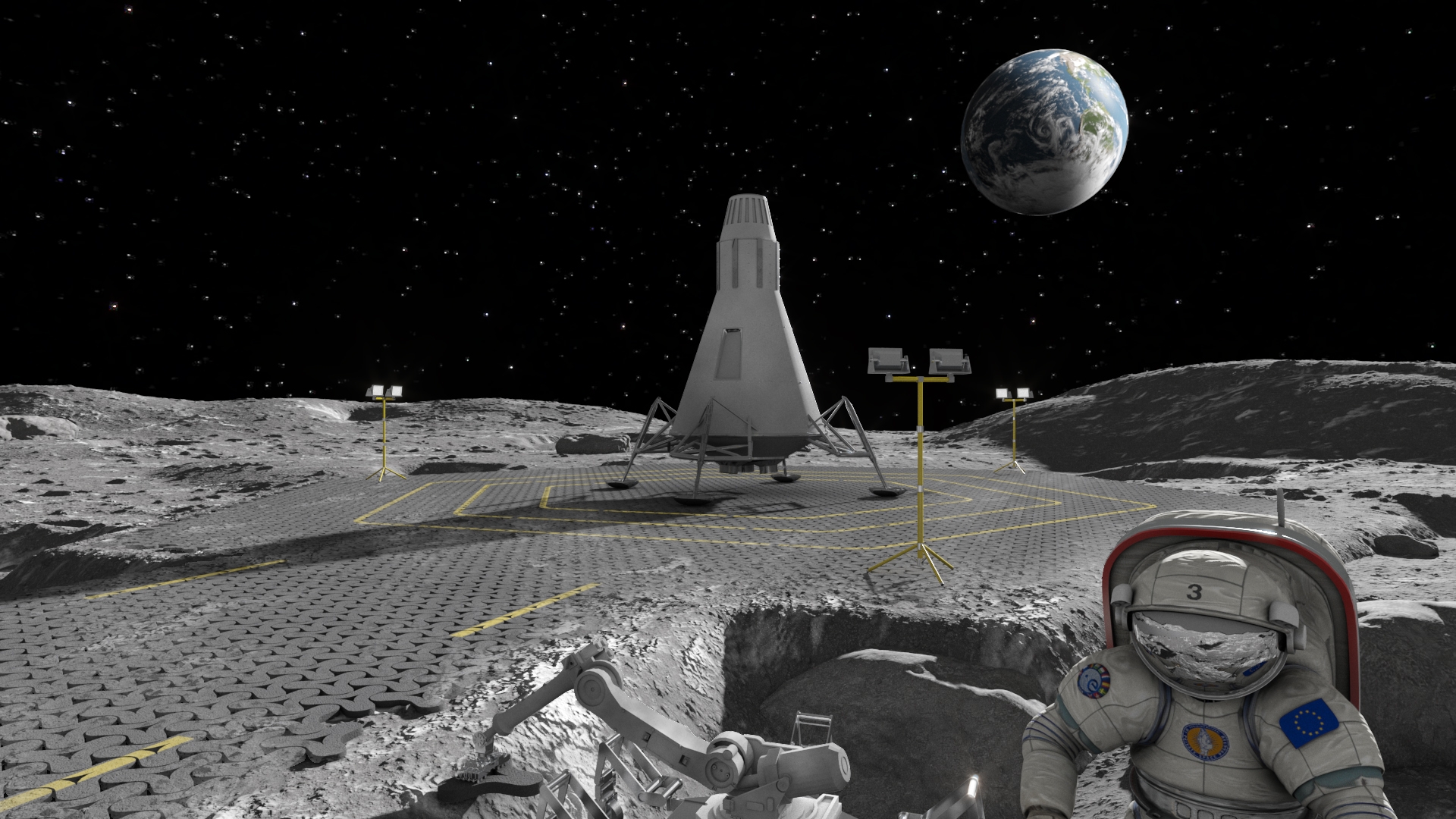
Image credit: PAVER consortium/LIQUIFER Systems Group

