Archive for the ‘Space News’ Category
 Author:
  November 4th, 2023
Modeling by Cornell astronomers finds that telescopes could more easily detect an exoplanet with higher levels of atmospheric oxygen than modern Earth, as existed during the dinosaur age.
Image credit: Rebecca Payne/Carl Sagan Institute
“Dinosaurs Discovered on Exoplanet!”
Now that’s a headline, surely above the fold if you’re still reading newspapers.
Research by Cornell astronomers suggest that telescopes could more easily detect an exoplanet with higher levels of atmospheric oxygen than modern Earth, as existed during the dinosaur age.
According to the new work, their analysis of the most recent 540 million years of Earth’s evolution — known as the Phanerozoic Eon — finds it feasible that detection of potential chemical signatures of life in the atmosphere of an Earth-like exoplanet might more closely resemble the age of the dinosaurs here on Earth.
Heavy on the “light fingerprint”
A possible tyrannosaur tipoff involves two key biosignature pairs – oxygen and methane, and ozone and methane. They appeared stronger in models of Earth roughly 100 million to 300 million years ago, when oxygen levels were significantly higher.
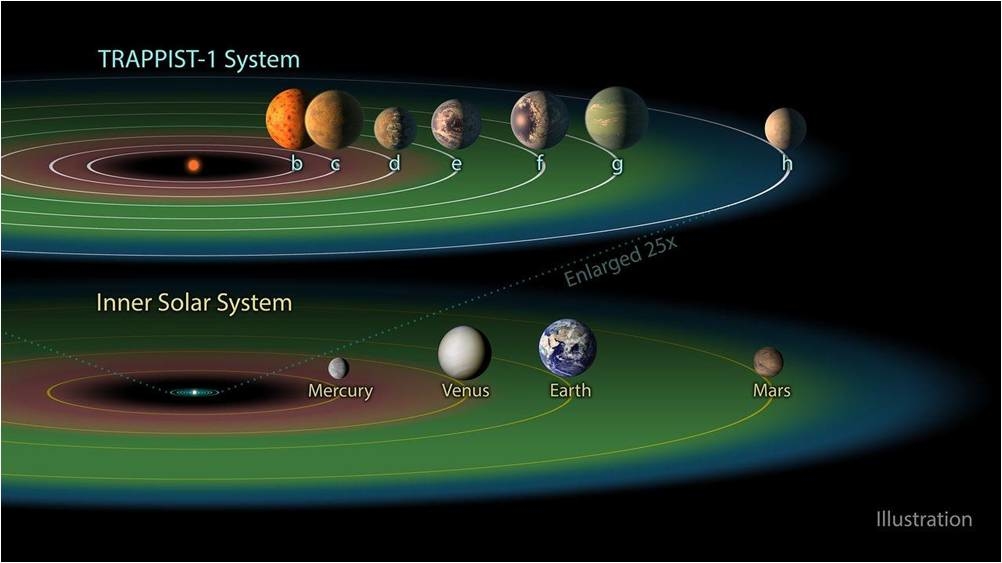
Illustration of the seven planets orbiting the TRAPPIST-1 ultra-cool low mass star. Planets e, f, and g orbit in the suspected habitable zone (green) based on the spectral type and
modeling of the system. Note: the size of the planets is greatly exaggerated compared to their orbital
radii and that the radial dimension of the TRAPPIST-1 system has been enlarged by a factor of 25. In
other words, the entire TRAPPIST-1 system would fit well inside the orbit of Mercury.
SOURCE: NASA/JPL-Caltech
Could the “light fingerprint” of these conditions suggest a weighty tyrannosaur traipsing across on Trappist-1e, perhaps a protoceratops on Proxima Centauri b, or a quetzalcoatlus on Kepler 1047c?
“Modern Earth’s light fingerprint has been our template for identifying potentially habitable planets, but there was a time when this fingerprint was even more pronounced – better at showing signs of life,” said Lisa Kaltenegger, director of the Carl Sagan Institute (CSI) and associate professor of astronomy in the College of Arts and Sciences.
“This gives us hope that it might be just a little bit easier to find signs of life – even large, complex life – elsewhere in the cosmos,” Kaltenegger stated in a university press statement.
More oxygen
One catch: while similar evolutionary processes leading to roaming dinosaurs may or may not unfold on exoplanets, the new modeling fills in the missing puzzle piece of what a Phanerozoic Earth would look like to a telescope. That modeling in hand is helping to create new templates for habitable planets with varying atmospheric oxygen levels.
The new research led by Rebecca Payne, a research associate exoplanet detective at CSI and in the Department of Astronomy and co-authored by Kaltenegger, appears in the Monthly Notices of the Royal Astronomical Society: Letters, Volume 527, Issue 1, January 2024.
Regardless of the prospect of exoplanets being a denizen of dinosaurs, the models confirm that from a great distance, such a planet’s light fingerprint would stand out more than a modern Earth’s.

Image credit: Universal Pictures
“Hopefully we’ll find some planets that happen to have more oxygen than Earth right now, because that will make the search for life just a little bit easier,” Kaltenegger said. “And who knows, maybe there are other dinosaurs waiting to be found.”
Jurassic Park – live-action remake?
To date, about 40 rocky exoplanets have been found in habitable zones where oceans could exist. Planets like Phanerozoic Earth are viewed as extremely promising targets for finding life in the cosmos.
While it may be too early to send moviemaker Steven Spielberg and crew for a Jurassic Park live-action remake, the research is seen as “a tool to plan and optimize our observation strategy, train retrieval methods, and interpret upcoming observations with ground- and space-based telescopes in order to identify life on Earth-like exoplanets.”
To access this intriguing new work, go to:
 Posted in

Image credit: Virgin Galactic
Virgin Galactic has successfully completed “Galactic 05” – a suborbital flight on November 2 that saw the VSS Unity space plane converted into a suborbital lab for space-based scientific research for the second time.
Astronaut 020 – Dr. Alan Stern, U.S. Planetary Scientist and Associate Vice President in Southwest Research Institute’s (SwRI) Space Sector
Astronaut 021 – Kellie Gerardi, U.S. Payload Specialist and Bioastronautics Researcher for the International Institute for Astronautical Sciences (IIAS)
Astronaut 022 – Ketty Pucci-Sisti Maisonrouge, Private Astronaut
“The team will now proceed with post-flight analysis, along with planned vehicle inspections, before re-commencing standard pre-flight readiness procedures ahead of our next commercial space mission, “Galactic 06″, scheduled for January next year,” Virgin Galactic stated in a post-flight update.

Image credit: Virgin Galactic
Flight facts
VSS Unity was piloted by Commander Mike Masucci and Pilot Kelly Latimer, with Astronaut Instructor Colin Bennett on board.
Mothership VMS Eve was piloted by Commander Jameel Janjua and Pilot Andy Edgell.
‘Galactic 05’ in-flight facts:
Take-off Time: 11:00 am Eastern Time
Altitude at Release: 44,701 ft
Apogee 54.2 miles: (87.2 kilometers)
Top Speed: Mach 2.96
Landing Time: 11:59 am Eastern Time

Image credit: Virgin Galactic
Experiments
As for experiments flown, Stern flew with two human-tended investigations, including a biomedical harness to collect physiological data related to human spaceflight. He also conducted practice routines and procedures in preparation for a future NASA-funded suborbital research flight.
Gerardi flew with three payloads, two of which evaluated novel healthcare technologies in microgravity conditions through the collection of biometric data. The third payload examined how confined fluid behaves to inform future healthcare technologies in space.
Galactic 05 was Virgin Galactic’s sixth spaceflight carrying microgravity and space-based research and its second in 2023, following ‘Galactic 01,’ a research mission with the Italian Air Force and National Research Council.

Image credit: NASA/JPL-Caltech
NASA’s Ingenuity Mars helicopter made its flight #64 on October 27, 2023.
According to NASA/JPL’s posting, the craft flew a Horizontal distance: 411 meters (roughly 1,348 feet; gained a Maximum altitude of 12 meters (roughly 39 feet); and carried out its flight in 139.1 seconds.
This technology demonstration craft has now accumulated an overall flight time of roughly 117.6 minutes; Distance flown of 9 miles ( roughly 14,903 kilometers); and has soared to roughly 79 feet (24 meters) in altitude since its first flight back on April 19, 2021.
Imagery posted from the October 27 flight taken by the chopper’s high-resolution color camera, mounted in the helicopter’s fuselage and pointed approximately 22 degrees below the horizon:

Image credit: NASA/JPL-Caltech

Image credit: NASA/JPL-Caltech

Image credit: NASA/JPL-Caltech

Shenzhou-16 crew landing.
Image credit: CGTN/Inside Outer Space screengrab
China’s Shenzhou-16 crew returned safely back to Earth on Tuesday after completing their five-month stay aboard the country’s Tiangong space station.
The Shenzhou-16 return capsule, carrying astronauts Jing Haipeng, Zhu Yangzhu and Gui Haichao, touched down at the Dongfeng landing site in north China’s Inner Mongolia Autonomous Region at 08:11 (Beijing Time) on Tuesday morning, with the crew all being helped out of the return capsule by 09:10, according to the China Manned Space Agency (CMSA).

Shenzhou-16 crew.
Image credit: CGTN/Inside Outer Space screengrab
Later on Tuesday, the three astronauts arrived in Beijing by plane after their safe return to Earth. They will now enter a period of quarantine and will undergo comprehensive medical examinations and health evaluations, according to the CMSA.
Space experiments
The Shenzhou-16 crew was launched on May 30 and was the first crewed mission since construction of China’s space station entered its application and development stage following its construction.
The Shenzhou-16 crew, who remained in orbit for 154 days, carried out a total of 70 space experiments, performed a space walk, delivered a live lecture from the space station, and on several occasions assisted with the movement of cargo.

CCTV/Inside Outer Space screengrab
According to Jiang Yue, a senior official from the Chinese Academy of Sciences associated with the space experiments, the experimental samples are mainly body cells, living nematodes and seedlings, and two kinds of alloys, which will provide theoretical guidance and scientific methods for the development and application of cutting-edge fields.
Life science
“This time, the space application system brought back life science experimental samples and materials science experimental samples through the Shenzhou-16 mission,” Jiang told China Central Television (CCTV).
“The life science experimental samples mainly include human liver cells, bone cells and endothelial cells. The animal part includes samples of biological macromolecules and living nematodes. The plant part includes samples of Arabidopsis thaliana seedlings. There are 22 kinds of samples, with a total weight of about 25 kilograms. We will collect 18.1 kilograms of samples at the landing site, and retrieve the rest after the capsule is transported back to Beijing,” said Jiang.

CCTV/Inside Outer Space screengrab
Special transfer device
The sample recovery team also developed a low-temperature insulation equipment, ensuring the samples’ maximum activity during the transportation of around 2,000 kilometers, according to Jiang.
“All biological samples must be transported to the laboratory in Beijing as quickly as possible for processing and solidification. For this process, we have also developed a special transfer device, which can maintain a temperature of minus 20 Celcius degrees for more than 24 hours, ensuring the activity of the samples to the greatest extent,” said Jiang.

Image credit: CGTN/Inside Outer Space screengrab
National space laboratory
Jiang noted that China’s space station cause has entered the application and development stage. At present, the space station has the ability to carry out large-scale scientific experiments.
“Therefore, I believe that in the near future, with the continuous development of new technologies, we will continue to carry out more, better and more valuable scientific experimental projects through manned space missions and cargo spacecraft deliveries. We will make good use of the space station as the national space laboratory to produce more and better scientific experimental results,” Jiang said told CCTV.

New Shenzhou-16 crew onboard with Shenzhou-15 astronauts during handover ceremonies.
Image credit: CCTV/CNSA/Inside Outer Space screengrab
The Shenzhou-17 crew is now resident on the space station, assigned a number of tasks to enhance the functionality of the orbital outpost.
The newly-arrived Shenzhou-17 crew members — mission commander Senior Colonel Tang Hongbo, Lieutenant Colonel Tang Shengjie and Lieutenant Colonel Jiang Xinlin – are taking over management of China’s Tiangong space station.
A number of videos are available of the Shenzhou-16 return and recovery operations at:
https://youtu.be/AE3fw6thUhs?si=1Y5LBl4H3G-xKdvN
https://youtu.be/AKhMoIgmywg?si=lDbEh4SwgT4s9sRw
https://youtu.be/Fn9RhKFEqcc?si=1hOVWLB_CByxCaVc
https://youtu.be/LtgqphD_UNE?si=2jje6vETu1Y7Hb8t

Image credit: JAXA
Mars itself is a world of puzzlement, particularly whether or not it’s home for past or even present-day life. But put that aside for the moment. The Red Planet is circled by a couple of oddballs.
The two moons of Mars, Phobos and Deimos, are brainteasers as to how they got there and what they are made of. Nobody knows for sure.

Image credit: DLR
But now an audacious, adventurous undertaking is being readied for launch. Japan’s Martian Moons eXploration (MMX) spacecraft mission involves drilling and sampling Phobos, then rocket the collectibles to Earth.
For more information on this creative mission go to – “New Japanese spacecraft aims to explore the mysterious moons of Mars: Those two moons of Mars are celestially eccentric oddities” – at:

Image credit: CCTV/Inside Outer Space
The Shenzhou-16 astronauts handed over control of the Tiangong space station to the newly arrived Shenzhou-17 crew on Sunday.
Tang Hongbo, the commander of Shenzhou-17 mission, took over the key to the hatch door of the Tiangong space station at the handover ceremony.
Due to return to Earth on October 31 is the Shenzhou-16 crew members Jing Haipeng, Zhu Yangzhu and Gui Haichao (October 30, 8:11 pm Eastern Daylight Time EDT).

Image credit: CCTV/Inside Outer Space
The crew-carrying spaceship will parachute into the Dongfeng Landing Site, located in north China’s Inner Mongolia Autonomous Region.
Search and rescue practice
This will be the fifth mission the landing site has conducted to recover a crewed spacecraft and the crew.
Ground personnel have undergone various search and rescue exercises for the upcoming mission.
Remaining in Earth orbit, the Shenzhou-17 crew, consisting of mission commander Tang and astronauts Tang Shengjie and Jiang Xinlin, will stay in orbit for about six months.
A video of the handover ceremony is available at:

Shenzhou-17 liftoff. Image credit: CCTV/CNSA/Inside Outer Space screengrab
China’s Shenzhou-16 crew is preparing for touchdown at the Dongfeng Landing Site in Inner Mongolia’s Gobi desert in north China.
The trio of taikonauts — Jing Haipeng, Zhu Yangzhu and Gui Haichao – are slated to land there on Tuesday after a five-month stay in space, according to the China Manned Space Agency (CMSA).

Shenzhou-16 and Shenzhou-17 crews now onboard the Tiangong space station. Image credit: CMS/Inside Outer Space screengrab
At the landing site, recovery teams are practicing for the crew return to Earth.
Final drills
According to China Central Television (CCTV) more than 10 search and rescue groups, five helicopters and nearly 100 vehicles with different functions are in final drills.
Equipment used at the ground site has been improved to ensure efficient search for and safe arrival of the Shenzhou-16 crew in a landing zone with complex topography.
The landing site near the Jiuquan Satellite Launch Center was put into practical use in September 2021, when it received the return of three astronauts of the Shenzhou-12 crewed space mission.

Earth orbit is a junkyard of human-made space clutter.
Credit: Space Junk 3D, LLC. Melrae Pictures (used with permission)
Space debris repairs
Meanwhile, newly-arrived Shenzhou-17 crew members — mission commander Senior Colonel Tang Hongbo, Lieutenant Colonel Tang Shengjie and Lieutenant Colonel Jiang Xinlin – are taking over management of China’s Tiangong space station.
Among their duties during a projected six-month orbital journey, Tang’s crew will perform experimental repair operations during spacewalks to help sustain space debris impacts on the orbital complex.
CCTV reports that the solar arrays on the Tiangong have already been slightly damaged by debris.

Russian President Vladimir Putin recently visited the Energia rocket and space corporation.
Image credit: Roscosmos/Inside Outer Space screengrab
Russian President Vladimir Putin recently visited the Energia rocket and space corporation, receiving a briefing on the Russian Orbital Station, among other work-in-progress space projects.
The October 26th visit by Putin included a meeting with young employees of various space industry enterprises.
The head of Roscosmos, Yuri Borisov briefed Putin, a visit also involving Deputy Prime Minister – Minister of Industry and Trade Denis Manturov, along with General Designer of RSC Energia Vladimir Solovyov.

Image credit: Roscosmos/Inside Outer Space screengrab
Also on the agenda for Putin was inspection of samples of small spacecraft engines, mock-ups of reusable launch vehicles, including the Transport Energy Module, a new inter-orbital tug based on a nuclear power propulsion system.

Russia Orbital Station artwork.
Image credit: Roscosmos/Inside Outer Space screengrab
November design decision
Putin said that the first module of the Russian Orbital Station can be launched into orbit in 2027 as the resources of the International Space Station are exhausted, adding that the decision on Russia’s station must be made quickly.
RSC Energia plans to complete work on adjusting the preliminary design of the Russian Orbital Station by November.

Next-generation Russian spacecraft approaches Russia Orbital station.
Image credit: Roscosmos/Inside Outer Space screengrab

Russia’s next-generation spacecraft to replace the Soyuz spacecraft.
Image credit: Roscosmos/Inside Outer Space screengrab
Recently, Roscosmos’s Borisov said on Russian state television that the International Space Station “is approaching the finish line of its existence.”
Borisov noted that “we extended the operation of the Russian segment by government decision until 2028, but, unfortunately, it has already exceeded all permissible periods of existence,” he said. “Eighty percent of the Russian equipment is beyond the warranty period.”

Image credit: NASA
It is clear that planet Venus is a cloudy, scientifically cool place, albeit a hellish world.
Work is underway on developing a literal “new entry” in deciphering the origin, evolution, and present state of Venus.
NASA’s Deep Atmosphere Venus Investigation of Noble gases, Chemistry, and Imaging mission is mercifully abbreviated to DAVINCI. But that longhand name underscores the constant swirl of on-going questions about Earth’s sister planet.

Image credit: NASA/Goddard Space Flight Center
To learn more about this deep-diving mission into the Venusian clouds, go to my new Multiverse Media SpaceRef story – “DAVINCI’s Big Reveal – NASA’s Deep Dive into Mystifying Venus” – go to:
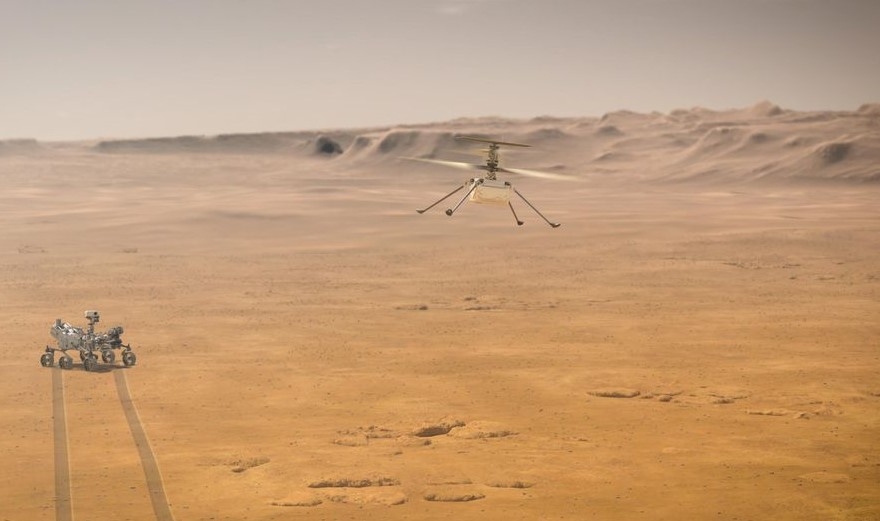
Artwork depicts Ingenuity Mars helicopter in flight.
Image credit: NASA/JPL-Caltech
NASA’s Ingenuity Mars helicopter is on tap to make flight #64, with an expected flight date of today, October 27.
According to a NASA/JPL-Caltech posting the expected horizontal flight distance will be 1,339 feet (408.435 meters). The mini-chopper is anticipated to fly 124.5 seconds, rising to a flight altitude of 39 feet (12 meters) above the Martian landscape at Jezero Crater.
The goal of the flight that will be on a heading North is to reposition the aerial device for future survey work.
Meanwhile, color imagery has been posted showing Ingenuity’s last flight, #63 that was carried out on October 19:

Image credit: NASA/JPL-Caltech

Image credit: NASA/JPL-Caltech

Image credit: NASA/JPL-Caltech

Image credit: NASA/JPL-Caltech

Image credit: NASA/JPL-Caltech

