Archive for the ‘Space News’ Category
 Author:
  November 23rd, 2023
Shelter – lunar style.
Image credit: Thales Alenia Space/ASI
It is tagged as the Multi-Purpose Habitat or MPH for lunar shorthand. MPH aims to be the first permanent outpost on the Moon.
Thales Alenia Space recently signed a contract with the Italian Space Agency (ASI) to initiate activities on the concept, building upon work to develop and provide three pressurized modules dedicated to Lunar Gateway: ESPRIT and I-HAB for the European Space Agency (ESA) and HALO for Northrop Grumman.
According to NASA’s Element Initiation Review, crucial functionalities of the Artemis lunar surface architecture, such as the Italian MPH module, are being scoped out.
In line with ASI’s and NASA’s requirements, the next step will be to complete the Mission Concept Review, expected in the first quarter of 2024.

Moon encampment involves multi-nation participation.
Image credit: ESA
Life-support solutions
“This will be a key milestone to move the project forward to the next phases of critical technology design and development of the module,” explains a Thales Alenia Space statement. “Life-support solutions, even for short-to-medium durations in the inhospitable lunar environment, demand cutting-edge technologies to provide protection from regolith and survive the cold lunar nights.”
In this initial phase, adds the Thales Alenia Space statement, it will be tasked with coordinating an industrial consortium of large, small, and medium-sized companies from the national supply chain, to advance the program to its implementation phase.
Overall, the main objective is to deliver a secure, comfortable, and multifunctional habitation module for astronauts, able to interface with other systems and components in the Artemis architecture.
 Posted in

Space debris plunges to Earth, burning its way through the atmosphere.
Image credit: The Aerospace Corporation
The recent revelation concerning pollution input into Earth’s stratosphere due to reentering spacecraft, rocket bodies, and atmospheric dumping of other human-made clutter is striking a nerve in space law circles.
First, the problem.
New research using high-flying aircraft armed with special collection devices have discovered significant amounts of metals in aerosols in the atmosphere. This residue is likely from increasingly frequent launches and returns of spacecraft and satellites. Most notably, the uptick in Starlink constellations of satellites put in place by SpaceX – with other competitive systems by other firms and countries to follow.
That mass of in-falling refuse is altering atmospheric chemistry in ways that could well impact Earth’s atmosphere and ozone layer.

Credit: The Aerospace Corporation/Center for Space Policy and Strategy
Rarefied region
“We are finding this human-made material in what we consider a pristine area of the atmosphere,” said Dan Cziczo, one of a team of scientists involved in a recent National Oceanic and Atmospheric Administration (NOAA) study. He is a co-author of the NOAA work reported in the Proceedings of the National Academy of Sciences.
“And if something is changing in the stratosphere—this stable region of the atmosphere—that deserves a closer look,” says Cziczo, professor and head of the Department of Earth, Atmospheric, and Planetary Sciences in Purdue’s College of Science. He is an expert in atmospheric science who has spent decades studying this rarefied region.

Starlink satellites.
Credit: SpaceX
Orbital use fee
One legal beagle legal assessment and approach to dealing with the issue – an “orbital use fee” — will appear in a forthcoming publication of Southern Methodist University’s Journal of Air Law and Commerce.
“More specifically, I am arguing that the proceeds of such a fee would go towards funding the research and remediation regarding compositional changes to Earth’s upper atmosphere caused by FCC-mandated satellite reentry.”
That’s the view of Michael Runnels, an assistant professor of business law at California State University in Los Angeles.
Titled “On Who Should Pay When Orbital Debris ‘Trickles-down’ in a Tragedy of the Low Earth Orbit Commons,” the purpose of the article is to tackle the question of who should pay when orbital debris “trickles down” in a manner that compromises Earth’s satellite-reliant infrastructure and otherwise causes damage to Earth’s environment, persons, and property.

Clutter in the cosmos.
Credit: Used with permission: Melrae Pictures/Space Junk 3D
Tragedy of the commons
Runnels describes the low Earth orbit (LEO) environment as a classical “tragedy of the commons” scene and draws from studies conducted by NASA, the Government Accountability Office, the Congressional Budget Office, as well as the United Nations.
What’s recommended by Runnels is specific language to amend Title III of the Communications Act of 1934. That Act created and charged the Federal Communications Commission (FCC) with regulating commercial satellite systems. A satellite constellation “orbital use fee” (OUF) would be established. That OUF would then fund orbital debris remediation projects, related research, and remediation of the environmental impacts of satellite constellations.
Maelstrom of orbital debris
As the paper points out, experts note that the global space market grew by 8 percent to $424 billion in 2022 and is expected to be valued at more than $737 billion by 2030.

The atmospheric layers from the ground up to the boundary with space, showing natural phenomena, human inputs and resultant impacts. These human inputs impact the troposphere (by enhancing climate change), the stratosphere (through ozone loss from multiple causes), the mesosphere (by influencing metal chemistry and accumulation and increasing noctilucent clouds), and the thermosphere (by likely causing contraction which will impact orbiting satellites).
Image credit: Jamie D. Shutler, et al.
That market will certainly be impacted if LEO is enshrouded in an impenetrable maelstrom of orbital debris moving at speeds seven times faster than a bullet.
“Given that the U.S. leads the world in the total number of satellites in space per country, and SpaceX will own more satellites than each country in the world combined once it fully deploys Starlink,” the Runnels paper concludes by arguing that “the U.S. is uniquely positioned to engage its allies in forging the foundation of customary international space law.”
Similarly, as pointed out by Cziczo and research colleagues, an estimation is that as many as 50,000 more satellites may reach orbit by 2030. In the next few decades, up to half of stratospheric sulfuric acid particles would contain metals from reentry. What effect that could have on the atmosphere, the ozone layer and life on Earth is yet to be understood.

Image credit: KCNA
That just-launched North Korea satellite — Malligyong-1 – is indeed in Earth orbit, a first for the country after repeated attempts.
According to Marco Langbroek who runs SatTrackCam in Leiden, the Netherlands, “the U.S. Military Space Tracking network CSpOC has published orbits for two objects resulting from this launch, confirming the North Korean claim of a successful orbit insertion.”

Image credit: Marco Langbroek/SatTrackCam
Object A — tagged as nr 58400, 2023-179A — is likely the payload, Malligyong-1, and is in a 97.43 degree inclined, 512 x 493 kilometer sun-synchronous orbit.
Langbroek also notes that on November 21, according to the State News Agency KCNA, its new Malligyong-1 military reconnaissance satellite was lofted from Sohae platform 2 using a (also new) Chollima-1 rocket.
The U.S. Space Force is tracking two objects at roughly 310 miles in altitude (500 kilometers), “which supports the launch being successful,” reports T.S. Kelso of
CelesTrak.
CelesTrak has tracking data for two objects from the launch: 2023-179A and 2023-179B.

Image credit: Marco Langbroek/SatTrackCam

Rocket watcher, North Korea leader, Kim Jong Un.
Image credit: KCNA
“This was the third launch attempt,” Langbroek adds. Two earlier attempts, on May 31 and August 23 failed to reach orbit due to malfunctions of respectively the second and third Chollima stages.

Image credit: SpaceX
SpaceX has posted an overview from the Starship integrated flight test that took place November 18 from the company’s Starbase in Texas.
The second flight provided invaluable data to continue rapidly developing Starship, explains the posting, with the vehicle achieving a number of major milestones:

Image credit: SpaceX/Inside Outer Space screengrab
— All 33 Raptor engines on the Super Heavy Booster started up successfully and, for the first time, completed a full-duration burn during ascent.
— Starship executed a successful hot-stage separation, powering down all but three of Super Heavy’s Raptor engines and successfully igniting the six second stage Raptor engines before separating the vehicles. This was the first time this technique has been done successfully with a vehicle of this size.
— Following separation, the Super Heavy booster successfully completed its flip maneuver and initiated the boostback burn before it experienced a rapid unscheduled disassembly (RUD). The vehicle breakup occurred more than three and a half minutes into the flight at an altitude of roughly 55 miles (90 kilometers) over the Gulf of Mexico.
–Starship’s six second stage Raptor engines all started successfully and powered the vehicle to an altitude of approximately 93 miles (150 kilometers) and a velocity of roughly 24,000 kilometers/hour, “becoming the first Starship to reach outer space and nearly completing its full-duration burn.”
— The flight test’s conclusion came when telemetry was lost near the end of second stage burn prior to engine cutoff after more than eight minutes of flight. The team verified a safe command destruct was appropriately triggered based on available vehicle performance data.

Super Heavy Booster experiences RUD. Image credit: SpaceX/Inside Outer Space screengrab
— The water-cooled flame deflector and other pad upgrades performed as expected, requiring minimal post-launch work to be ready for upcoming vehicle tests and the next integrated flight test.
“Data review is ongoing as we look for improvements to make for the next flight,” the SpaceX posting adds. “The team at Starbase is already working final preparations on the vehicles slated for use in Starship’s third flight test, with Ship and Booster static fires coming up next.”
For SpaceX video of the Starship flight, go to:
https://twitter.com/i/broadcasts/1dRKZEWQvrXxB

What? Me Worry
Image credit: Elon Musk by Walter Isaacson/Simon & Schuster

Image credit: SpaceX/Inside Outer Space screengrab

Image credit: NASA
A coordinated international lunar resource evaluation campaign could form the foundation of a cislunar economy and a sustained/permanent human presence on the Moon.
A new research paper led by Clive Neal at the University of Notre Dame’s Department of Civil & Environmental Engineering & Earth Sciences, spells out how to address issues related to prospecting on the Moon, including why it needs to be international in nature and how to start and evolve this global coordination.
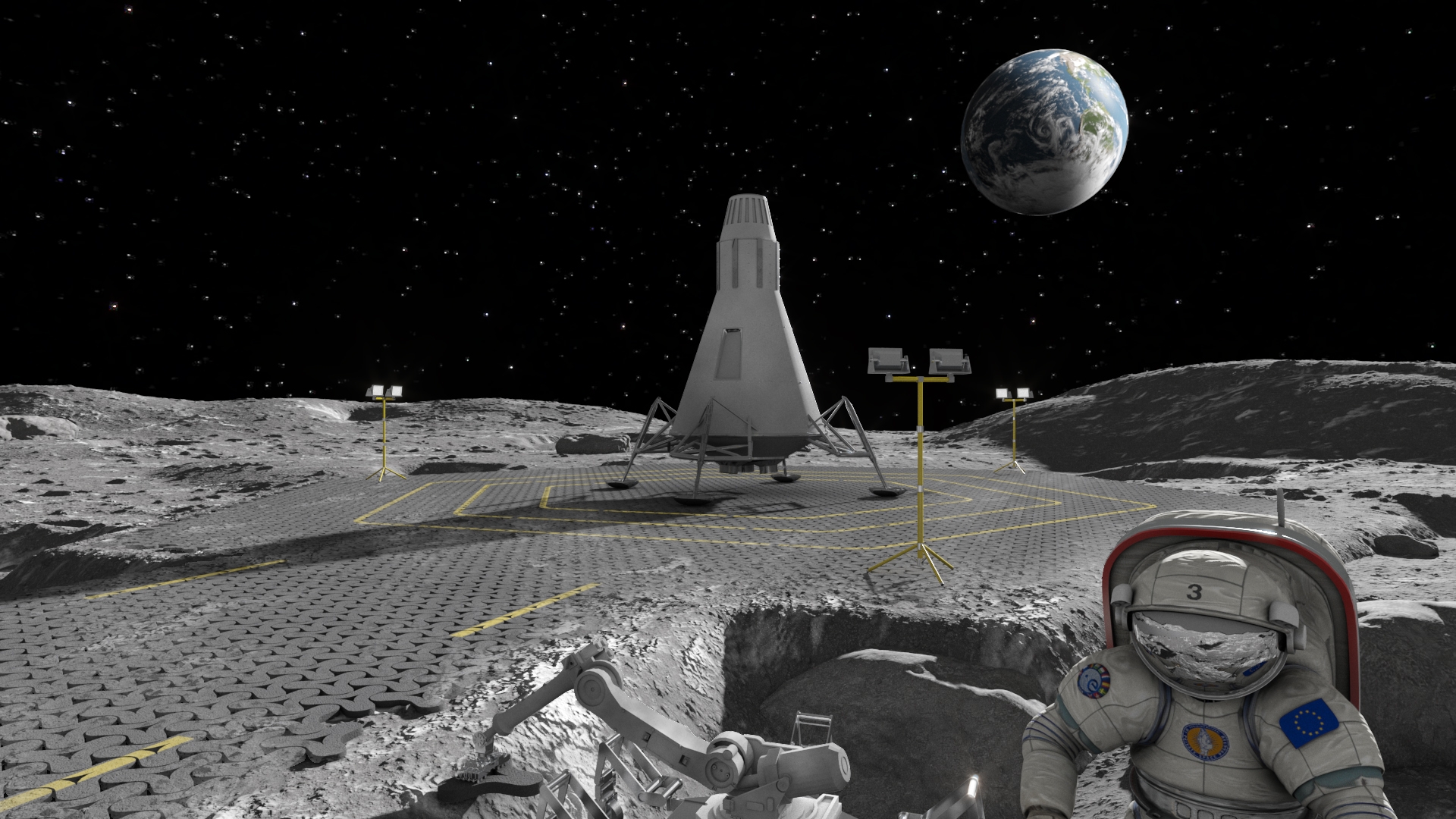
Image credit: PAVER consortium/LIQUIFER Systems Group
Critical distinction
For one, there is a critical distinction required around the terms “resources” and “reserves,” to appreciate the full scientific, exploration, and commercial potential of lunar resources.
The United States Geological Survey defines these as:
Resource: a concentration of naturally occurring solid, liquid, or gaseous materials in or on the crust in such form that economic extraction of a commodity is regarded as feasible.
Reserve: That portion of an identified resource from which a usable mineral or energy commodity can be economically and legally extracted at the time of determination.

Newly developed extraction technique for the Moon, thermal mining, makes use of mirrors to exploit sun-shy, water ice-laden polar craters.
Credit: School of Mines/Dreyer, Williams, Sowers
Validating cost
Take for example the issue of available water ice thought to be sequestered in sun-shy craters. Such a product could be processed to produce water to sustain crews, even turned into rocket fuel.
“Until we know the details of the lunar water ice derived from polar volatile deposits in permanently shadowed regions (PSRs), this question cannot be addressed, and neither can the assumptions and costs associated with lunar resources (extraction, refinement, storage, and transportation of products) be validated,” the paper suggests.
Lunar resources have the potential “to enable sustainable human space exploration, develop a vibrant cislunar economy, and directly benefit society here on Earth,” the paper notes. “However, recent rhetoric about the importance and value of these resources has used the term as if we know they are reserves.”

Image credit: Clive Neal, et al.
Immediate next step
Pinning down best sites on the Moon for evaluation and possible prospecting won’t be easy – lots of territory to survey. Therefore, no one space agency will have the budget or mandate to conduct such survey work alone, the paper points out.
But if it is international in nature, “it provides a great opportunity to test and refine the applicable legal framework while being intentional in setting precedents that positively shape the conduct of lunar (and space) resource activities,” the paper adds, in accordance with the United Nations Outer Space Treaty.

Image credit: Clive Neal, et al.
An immediate next step could begin with a collective commitment of nations to achieving a permanent human presence on the Moon, once the reserve potential of lunar resources has been better quantified.
“However, if we cannot make the Moon sustainable, we definitely will not do that at Mars. The Moon, therefore, becomes a blueprint for sustainability in human space exploration, and an enabling asset to allow humanity to move out into the Solar System while at the same time improving society here on Earth,” concludes the paper.
The paper – “The moon needs an international lunar resource prospecting campaign” – appears in Acta Astronautica, the official journal of the International Academy of Astronautics.
To access the work, go to:
https://www.sciencedirect.com/science/article/abs/pii/S0094576523005842?via%3Dihub

The strategic value of having an off-Earth destination in our own back yard represents an opportunity to expand humanity into the Solar System while benefitting society on Earth (indicated by the arrow to and from the Moon) through creating a new sector of our economy in cislunar space.Image credit: Clive Neal, et al.

SIIRIUS-23 crew enters isolation facility to mimic deep space exploration.
Image credit: Roscosmos/Inside Outer Space screengrab
Russia kicked off last week another of its Scientific International Research In Unique terrestrial Station (SIRIUS) project initiatives, a 360-day isolation of individuals to imitate flight conditions of an interplanetary journey.
The nearly year-long stint by the six-person crew is carried out under the auspices of the legendary Institute for Bio-Medical Problems (IBMP) under the Russian Academy of Sciences. Last month, IBMP celebrated 60 years of research since its establishment to investigate issues related to long-term human space exploration.

Image credit: Roscosmos/Inside Outer Space screengrab
Fourth stage
SIRIUS-23 is the fourth stage of earlier IBMP isolation experiments: SIRIUS-17 (17 days in 2017); SIRIUS-19 (120 days in 2019), with the stage-3 SIRIUS-23 mission taking place in 2021 and lasting 240 days.
The SIRIUS-23 crew entered their home-away-from-home isolation facility on November 14.
What’s the assignment?
Go to my new Space.com story – “Russia’s long-duration space journey on Earth put 6 people in isolation for a year” – at:
https://www.space.com/russia-sirius-23-astronaut-isolation-study

Image credit: CMSA
China’s next supply ship – the Tianzhou-7 – is now being readied for launch early next year to the country’s three-module space station.
Now onboard China’s station, the Shenzhou-17 crew consists of commander Tang Hongbo, Tang Shengjie and Jiang Xinlin.
The China Manned Space Agency (CMSA) said on Sunday the cargo spacecraft will undergo assembly, testing and other tasks before it is launched from the Wenchang Spacecraft Launch Site in south China’s Hainan Province in early 2024.

Tianzhou-7 cargo ship logo.
Image credit: CMSA
CMSA also released logos for four launch missions that will be conducted in 2024: the Tianzhou-7 and Tianzhou-8 cargo spacecraft, and the Shenzhou-18 and Shenzhou-19 crewed spaceflight missions.
More modules
Since initial construction of the orbital outpost was completed in 2022, China’s space station has entered a phase of application and development that will span more than 10 years.

Handover ceremonies between Shenzhou-16 and Shenzhou-17 crews onboard the Tiangong space station.
Image credit: CMS/Inside Outer Space screengrab
During that time, two piloted spacecraft and one or two cargo spacecraft will be launched each year, the CMSA has previously reported.
According to several Chinese space sources, the China space station is set to expand to have a cross-shaped configuration. Also, the facility may include additional modules to double its size in the coming years.
The station currently consists of three modules: the Tianhe core module and the Wentian and Mengtian lab modules.

Image credit: Shujianyang Wikimedia Commons, CC BY-SA
Cross shape station
According to Lin Xiqiang from CMSA, China will launch an extension module at an appropriate time and upgrade the basic configuration of the space station from the current T shape to a cross shape.

Image credit: CGTN/Inside Outer Space screengrab
In early October at the 74th International Astronautical Congress, Zhang Qiao of the Academy of Space Technology (CAST) stated the station may expand to six modules from the existing three.
Yang Yuguang, vice chair of the space transportation committee at International Astronautical Federation said the additional fifth or sixth module would be reserved as space labs.

Image credit: CGTN
The Tianhe core module is able to manage and control the power supply and maintain the orbit of a station that’s as heavy as 180 tons, according to Yang.
By adding another module that also means additional docking and berthing ports at the station – there are three at the moment. The new module would also allow the possibility of connecting modules to China’s station from other countries.
Go to this informative China Global Television Network (CGTN) “Tech Please” video at:
https://www.youtube.com/watch?v=vCeprk8k2NY
As for those new logos issued by the CMSA, here they are:

Shenzhou-18 logo.
Image credit: CMSA

Shenzhou-19 logo.
Image credit: CMSA

Tianzhou-8 logo.
Image credit: CMSA
Logo lexicon
Word from the CMSA is that the logo of the Tianzhou-7 mission features the number “7”, with an image of the Tianzhou-7 cargo craft in the middle, symbolizing the advancing space industry of China and heartfelt blessing for this mission.
The Tianzhou-7 cargo craft is scheduled to be launched from the Wenchang Spacecraft Launch Site in early 2024. The spacecraft has been transported to the launch site, and will go through tests after the final assembly.
The logo for the Tianzhou-8 mission combines the number “8” with the tail flame of the spacecraft. The flame in the three colors of red, yellow and blue signifies the inclusiveness of China’s space cause and its contributions to the diversified and harmonious development of the world’s space industry.
The logo for the manned Shenzhou-18 mission centers on China’s space station, and highlights the place where the Shenzhou-18 spaceship will dock with the space station with a yellow line. The logo takes the number “18” as its backdrop.
The logo for the Shenzhou-19 mission incorporates the image of an ascending dragon, a legendary auspicious creature in Chinese mythology. The 19 stars dotting around the logo signifies prosperity of China’s space industry.
The CMSA has received more than 320 submissions from over 200 organizations and individuals across China since the launch of the logo call on Aug 31 this year.
Image credit: SpaceX
The second test flight of the SpaceX Starship took to the air November 18, departing the Starbase/Boca Chica, Texas launch facility.
All 33 raptor engines of the mega-booster appeared to have operated fully and the hot-stage separation system between booster and 2nd stage worked. However, the first stage underwent a Rapid Unplanned Disassembly (RUD), exploding over the Gulf of Mexico.
Plowing skyward following stage separation, the Starship continued on its suborbital trajectory phase. However, ground control reported activation of the flight termination system and destruction of that stage some 10 minutes after takeoff.

Actual photo of stage separation via SpaceX tracking camera. Image credit: SpaceX

Image credit: SpaceX/Inside Outer Space screengrab

Image credit: SpaceX/Inside Outer Space screengrab

Image credit: SpaceX/Inside Outer Space screengrab
Image credit: SpaceX/Inside Outer Space screengrab
The plan had called for Starship to make a controlled reentry and ocean splashdown near Hawaii.
“The booster experienced a rapid unscheduled disassembly shortly after stage separation while Starship’s engines fired for several minutes on its way to space,” SpaceX later reported. “With a test like this, success comes from what we learn, and today’s test will help us improve Starship’s reliability as SpaceX seeks to make life multiplanetary.

Image credit: SpaceX
“Recursive improvement”
Overall, SpaceX saluted the flight today, one that reached several new milestones in contrast to the Starship maiden flight last April that ended in an explosive destruction.
This Integrated Flight Test 2 was projected to see the two-stage Starship launch vehicle depart its now water-cooled pad, then the booster was to separate 170 seconds into flight and return to an ocean splashdown approximately 20 miles (32 kilometers) off the shore in the Gulf of Mexico.
The Starship second stage was to follow a suborbital trajectory and perform an unpowered splashdown roughly 62 miles (100 kilometers) off the northwest coast of Kauai (Hawaii).
The second flight test did successfully debut a hot-stage separation system and a new electronic Thrust Vector Control (TVC) system for Super Heavy Raptor engines.
In addition, reinforcements to the pad foundation and a water-cooled steel flame deflector, among other enhancements, appeared to function well, although a post-launch assessment will be necessary.
“Recursive improvement is essential as we work to build a fully reusable transportation system capable of carrying both crew and cargo to Earth orbit, help humanity return to the Moon, and ultimately travel to Mars and beyond,” an earlier SpaceX posting noted.
Image credit: SpaceX/Inside Outer Space screengrab
FAA: “Mishap occurred”
Meanwhile, the Federal Aviation Administration (FAA) issued this post launch statement, noting that this information is preliminary and subject to change:
“A mishap occurred during the SpaceX Starship OFT-2 launch from Boca Chica, Texas, on Saturday, Nov. 18. The anomaly resulted in a loss of the vehicle. No injuries or public property damage have been reported.”
Furthermore, the FAA stated it “will oversee the SpaceX-led mishap investigation to ensure SpaceX complies with its FAA-approved mishap investigation plan and other regulatory requirements.”
As background, the FAA added in the statement:
“A mishap investigation is designed to further enhance public safety, determine the root cause of the event, and identify corrective actions to avoid it from happening again.”
“The FAA will be involved in every step of the mishap investigation process and must approve the final mishap report, including the corrective actions.”
“A return to flight of the Starship Super Heavy vehicle is based on the FAA determining that any system, process, or procedure related to the mishap does not affect public safety.”

Image credit: SpaceX/Inside Outer Space screengrab
Valuable learning experience
The American Institute of Aeronautics and Astronautics (AIAA) issued the following statement from AIAA Executive Director Dan Dumbacher:
“Congratulations to the SpaceX team on today’s test flight of Starship from Starbase, Texas. It is exciting to witness a new launch vehicle achieving so many of its test objectives toward reaching orbit. The art and science of engineering requires testing and taking risks to understand the limits of systems and where designs should be improved. This test flight is a valuable learning experience, especially around the performance of its boosters. We look forward to seeing the team’s progress toward enhancing this new space launch capability and flying again.”
“With Starship, SpaceX is taking a step toward humans living and working off our planet. Flight tests, taking risks, and pushing new technologies that are still in development will lead to this future.”
“We are excited to see commercial space launch companies advancing technology in the cislunar ecosystem and pushing on to Mars. Expanding the boundaries leads to success.”
Go to launch replay at: https://www.spacex.com/launches/mission/?missionId=starship-flight-2
What, Me Worry?
Image credit: Elon Musk by Walter Isaacson/Simon & Schuster

Image credit: JAXA/ISAS
A Japanese spacecraft is headed for the Moon, on course to attempt a pinpoint landing using technology that transforms descending onto the lunar landscape where it is “easy to land” to touching down “where you want to land.”
Japan’s Smart Lander for Investigating Moon (SLIM) was launched September 7, departing Earth atop an H-IIA launch vehicle from the Yoshinobu Launch Complex at the Japan Aerospace Exploration Agency’s (JAXA) Tanegashima Space Center.

Image credit: JAXA/TOMY Company/Sony Group Corporation/Doshisha University
SLIM – also called “Moon Sniper” — successfully transitioned into a lunar transfer orbit early last month, and the vehicle is slated to touchdown near Shioli crater sometime early in 2024.
Given mission success early next year, Japan becomes the 5th country to soft land a spacecraft on the surface of the Moon.
For more details, go to my new Multiverse Media Parabolic Arc story at:
https://parabolicarc.com/2023/11/17/landing-slim-and-smartly-on-the-moon/

Image credit: SpaceX
SpaceX is confirming that the second flight test of a fully integrated Starship from their Texas starport is set to launch Saturday, November 18.
A twenty-minute launch window opens at 7:00 a.m. Central Time.
“As is the case with all developmental testing, the schedule is dynamic and likely to change, so be sure to stay tuned to our X account for updates,” a SpaceX central posting explains.

Image credit: SpaceX
Flight stages
This Integrated Flight Test 2 is projected to see the two-stage Starship launch vehicle depart its now water-cooled pad, then the booster is expected to separate 170 seconds into flight and return to an ocean splashdown approximately 20 miles (32 kilometers) off the shore in the Gulf of Mexico.
The Starship second stage will follow a suborbital trajectory and perform an unpowered splashdown roughly 62 miles (100 kilometers) off the northwest coast of Kauai (Hawaii).
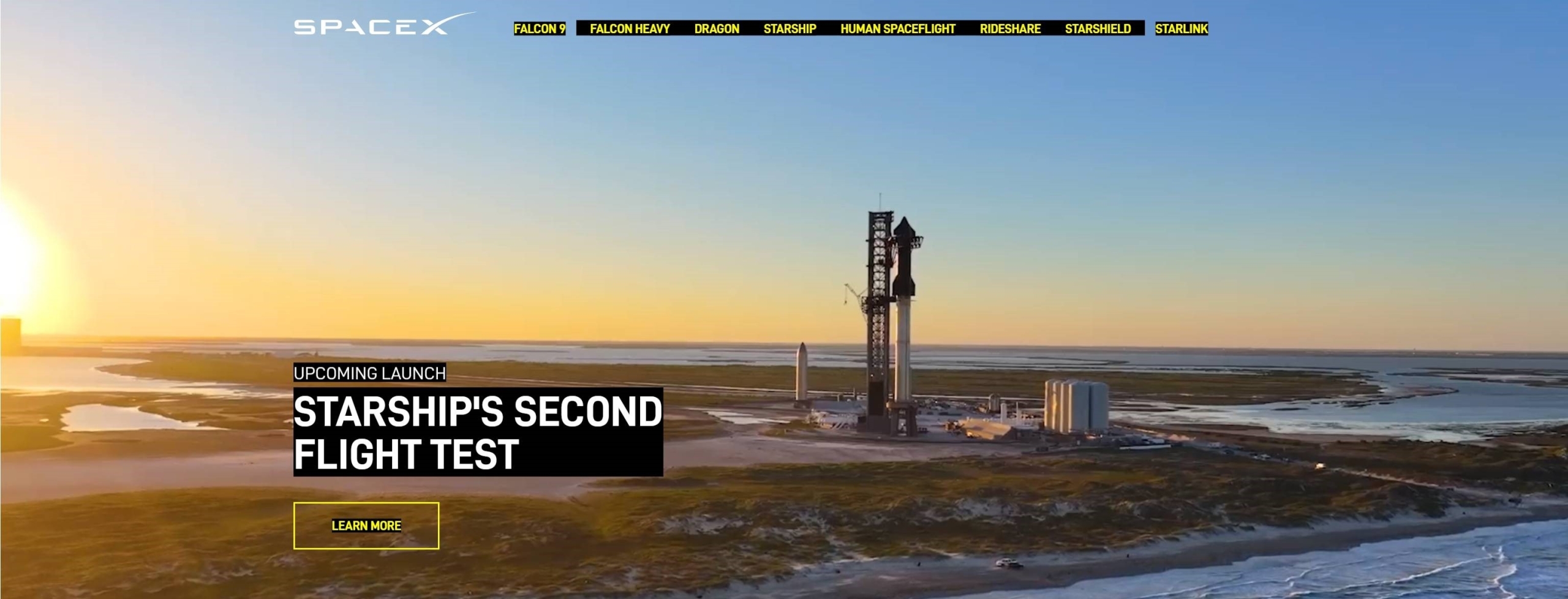
Image credit: SpaceX
Image credit: SpaceX/Inside Outer Space screengrab
Recursive improvement
“Starship’s first flight test provided numerous lessons learned that directly contributed to several upgrades to both the vehicle and ground infrastructure to improve the probability of success on future flights,” the SpaceX posting adds.
“The second flight test will debut a hot-stage separation system and a new electronic Thrust Vector Control (TVC) system for Super Heavy Raptor engines, in addition to reinforcements to the pad foundation and a water-cooled steel flame deflector, among many other enhancements,” SpaceX points out. “Recursive improvement is essential as we work to build a fully reusable transportation system capable of carrying both crew and cargo to Earth orbit, help humanity return to the Moon, and ultimately travel to Mars and beyond,” the SpaceX posting concludes.
Go to this informative video at:
Starship preparing to launch as early as November 17, pending final regulatory approval → https://t.co/bJFjLCiTbK pic.twitter.com/qRKv9ugWsR
— SpaceX (@SpaceX) November 11, 2023
To follow the Starship second test flight launch, go to:
https://www.spacex.com/launches/mission/?missionId=starship-flight-2
“What, Me Worry?”
Image credit: Elon Musk by Walter Isaacson/Simon & Schuster
Image credit: SpaceX/Inside Outer Space screengrab

