Archive for the ‘Space News’ Category
 Author:
  February 2nd, 2024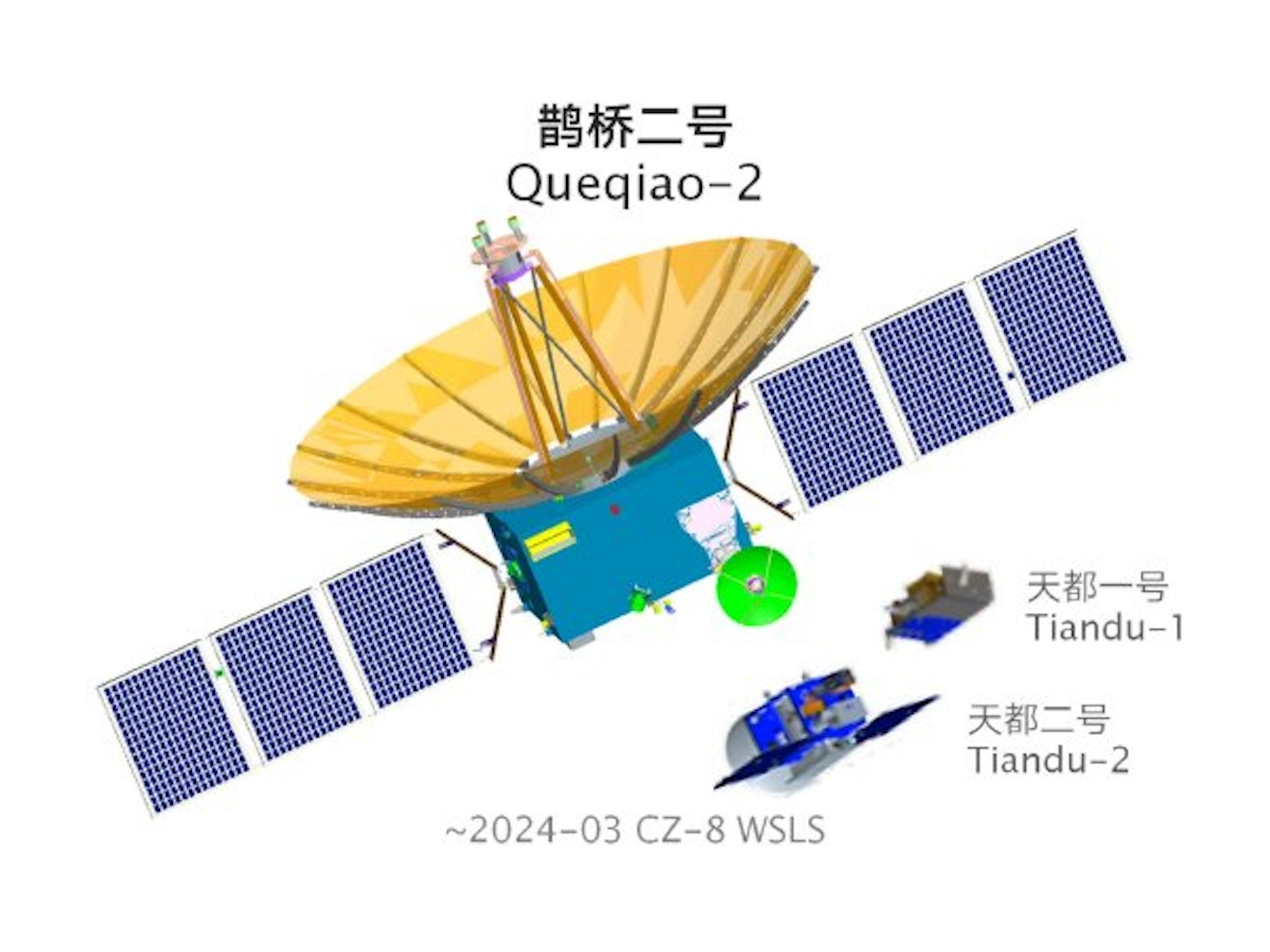
Image credit: CNSA
China’s Queqiao-2 – a relay satellite for the country’s Moon missions – arrived February 2 at the Wenchang launch center in south China’s Hainan Province.
According to China’s National Space Administration (CNSA), testing of the spacecraft will soon be underway with launch in the first half of this year.
Once on duty, Queqiao-2 will make use of a 4.2 meter parabolic antenna to enable communication between China’s lunar surface operations and ground controllers, providing relay support for the already on the Moon Chang’e-4, and upcoming missions of Chang’e-6, Chang’e-7 and Chang’e-8 robotic lunar probes.
Chang’e-6, to be launched later this year, is to attempt the first-ever sample return to Earth of lunar specimens from the Moon’s far side.

Image credit: CNSA
Fourth phase
Queqiao-2, or Magpie Bridge-2, is a key part of the fourth phase of China’s lunar exploration program, ahead of a projected human lunar expedition by 2030.
This new and upgraded relay sentinel follows Queqiao-1, launched in May 2018. It supported China’s Chang’e-4 mission. That robotic lander and Yutu rover mission made the first soft landing on the far side of the Moon back in January 2019.
Test satellites, science payloads
The upgraded Queqiao-2 relay reportedly will carry two Queqiao communication technology test satellites, Tiandu-1 and Tiandu-2 designed by China’s Deep Space Exploration Laboratory.

China’s Chang’e-6 lunar sample return mission elements.
Credit: CNSA
Queqiao-2 also totes a trio of scientific payloads: An extreme ultraviolet camera, an array neutral atom imager, and an Earth-Moon Very-long-baseline interferometry (VLBI) system.
To achieve better visibility of the Moon’s south pole region, the Queqiao-2 relay spacecraft is to be stationed in a stable, “frozen” elliptical orbit around the Moon.
Its designed lifetime is more than 8 years.
 Posted in
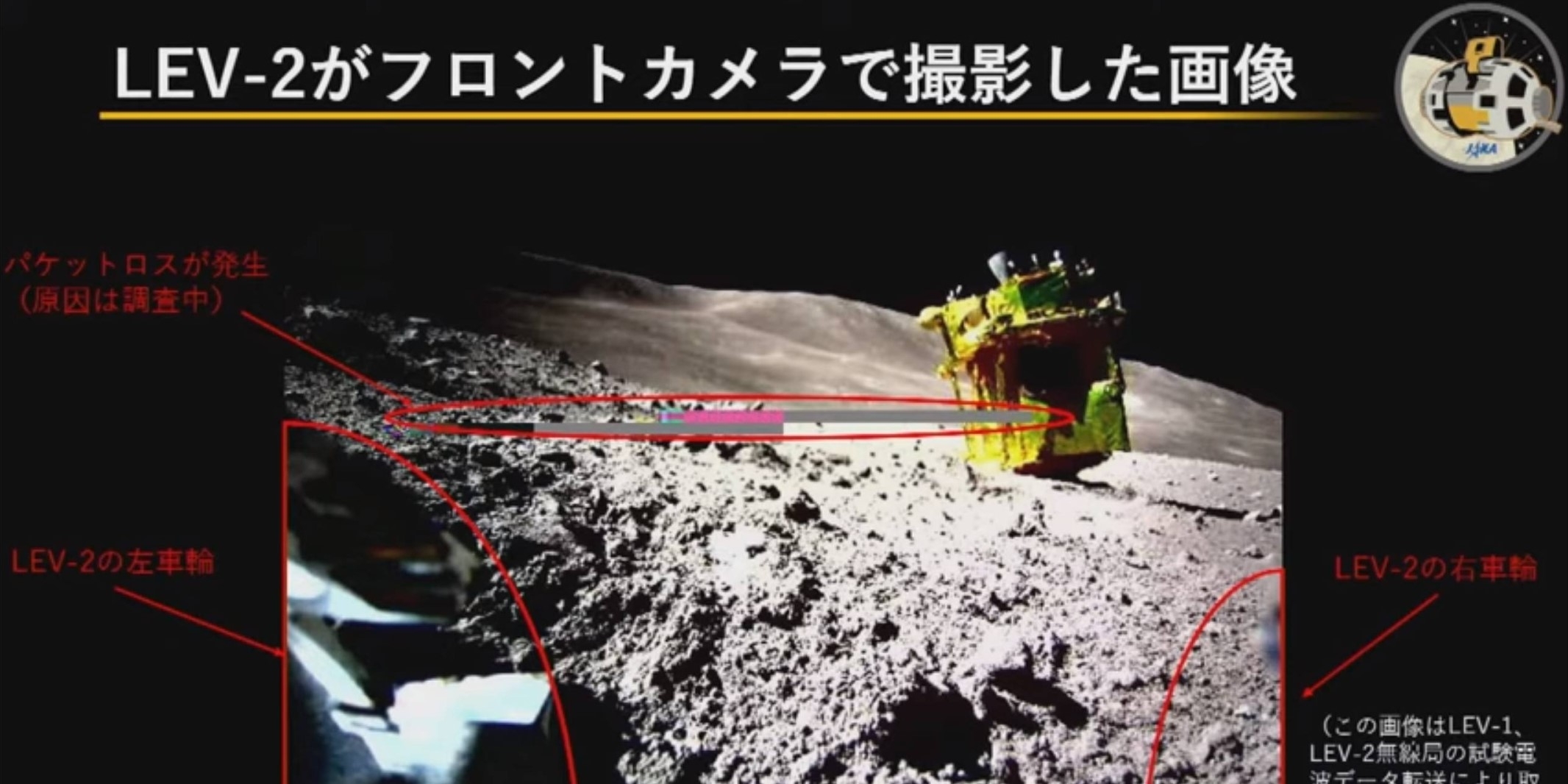
Ultra-small SORA-Q (LEV-2) photo of SLIM. Image credit: JAXA/Inside Outer Space screengrab
Japan’s SLIM lunar lander has now entered a dormant state, slipping into a two-week stint of sun-shy induced silence.
According to the Japan Aerospace Exploration Agency (JAXA) Institute of Space and Astronautical Science (ISAS), the ground control team for the Smart Lander for Investigating Moon (SLIM) said a last photo session was taken.

SLIM’s multi-band spectroscopic camera took this lunar landscape image created by synthesizing 257 low-resolution monochrome pictures. Based on this landscape image, the team is sorting out rocks of interest, assigning a nickname to each of them, with intent of communicating their relative sizes smoothly by the names.
Image credit: JAXA/Inside Outer Space screengrab
No response
“Last night [Jan. 31 into February 1] we sent a command to switch on SLIM’s communicator again just in case, but with no response, we confirmed SLIM had entered a dormant state.”
SLIM was launched last year, on September 6, 2023. Japan’s SLIM lander touched down on the Moon on January 19, making Japan the 5th nation to land on lunar territory.
Harsh lunar night
The spacecraft has now entered a two week dormancy period, a 14-day lunar night, 14-day lunar day cycle.

Image credit: JAXA/ISAS
“Although SLIM was not designed for the harsh lunar nights, we plan to try to operate again from mid-February, when the Sun will shine again on SLIM’s solar cells,” a JAXA/ISAS X/Twitter posting explained.
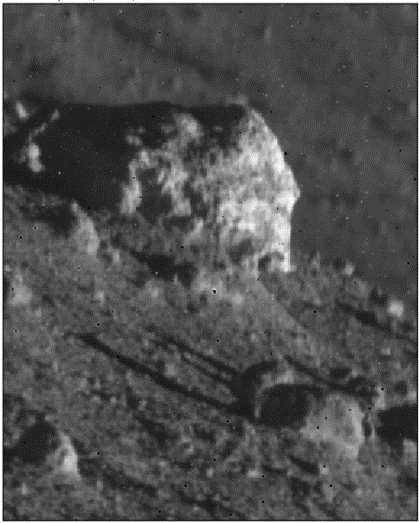
Image credit: JAXA/ISAS
Despite a failed rocket motor engine that led to blowing off its thruster nozzle, the craft made an unplanned “nose down” landing.
Descent landing woes aside, SLIM’s autopilot guidance led to a near pinpoint touchdown near Shioli crater – a goal of the mission.
Multiple robot exploration
Carried by SLIM was a multiband spectroscopic camera that relayed images before the craft’s power ebbed.

Image credit: JAXA/ISAS
In addition, imagery of the SLIM’s final, nose-down landing locale was taken by the SORA-Q, a baseball-sized mobile rover – a transformer-like toy device produced by the Takara Tomy Corporation.
During SLIM’s lunar descent, the ultra-small SORA-Q, dubbed LEV-2, was ejected. So too was LEV-1, a sidekick robot that executed leaping movements across the lunar landscape, including inter-robot test radio wave data transmission from the transformable lunar robot, LEV-2.

Artwork depicts the palm-sized Lunar Excursion Vehicle, LEV-2.
Image credit: JAXA/ISAS
LEV 1 and LEV 2 are the world’s first completely autonomous robots to explore the Moon, and the world’s first simultaneous lunar surface exploration by multiple robots, according to a JAXA statement.
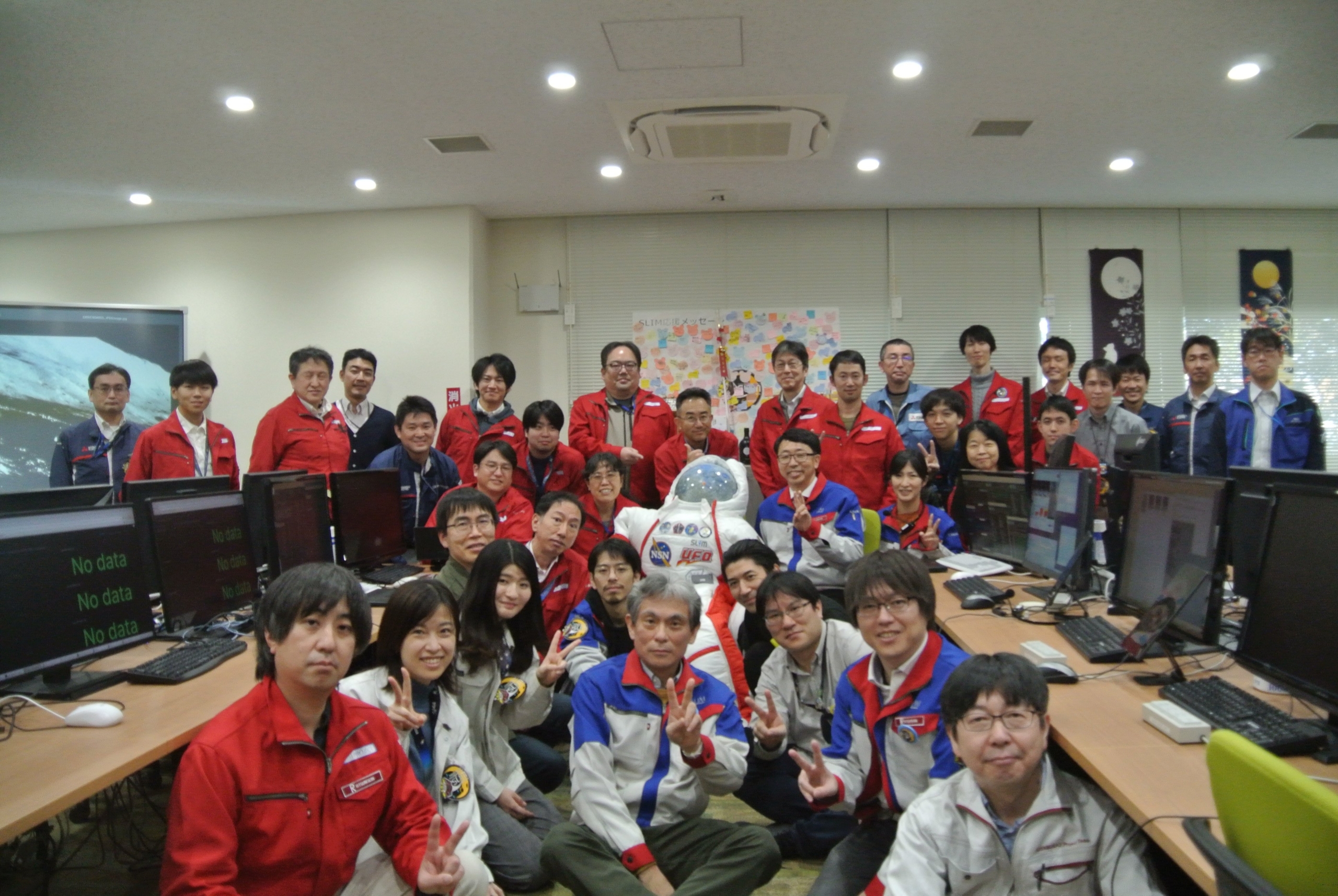
Japan’s SLIM team.
Image credit: JAXA/ISAS

New Mexico’s Very Large Array (VLA) – on the SETI trail.
(Image credit: Bettymaya Foott, NRAO/AUI/NSF)
To spot other star folk occupying space out there in the great beyond, first you must cast the net wide by using an array of techniques and technologies.
Indeed, any “fishing expedition” for ET includes close-in studies of life in extreme environments, be they right here on Earth, on Mars, or deep diving through the icy facade of Jupiter’s moon, Europa.

Artistic view of the NASA data-gathering Transiting Exoplanet Survey Satellite (TESS). Scientists are now sifting through its findings for possible technosignatures indicating an extraterrestrial civilization.
Image credit: NASA
Also blend in use of space-based telescopes to inspect Earth-like planets circling their home stars. Then there’s cupping a radio telescopic ear to the cosmos to pick up any bustling interstellar civilization or perhaps look for far-off laser-pulsed communiqués from extraterrestrial homebodies.
I recently caught up with Bill Diamond, President and CEO of the SETI Institute for an exclusive, mind-stretching close-encounter discussion regarding the mounting evidence for extraterrestrial intelligence.
For more information, go to my new SPACE.com story – “’It’s getting closer and closer for sure.’ How SETI is expanding its search for alien intelligence (exclusive)” – at:

Enigmatic Venus holds tight its secrets under thick clouds. Image shows the night side of Venus glowing in thermal infrared, captured by Japan’s Akatsuki spacecraft.
Credit: JAXA/ISAS/DARTS/Damia Bouic
An international team of researchers have proposed Mount Etna – one of the most active and monitored volcanoes on Earth – as a suitable terrestrial laboratory to get a handle on possible active volcanism on Venus.
And there’s more.
This research probing of the Sicilian volcano Etna is proposed within the “AVENGERS” initiative. In Venusian verbiage, AVENGERS stands for Analogs for VEN us’ GE ologically R ecent S urfaces.

Mt. Etna in Sicily, Italy (left) viewed by ESA Sentinel-1 Earth-circling spacecraft and Idunn Mons in Imdr Regio on Venus (right) as observed by NASA’s Magellan radar system.
Image credit: P. D’Incecco, et al.
The global research team members come from organizations in Italy, Russia, the U.S., Great Britain, India, Spain, and the Netherlands.
Appearing in the journal Icarus, lead author of the paper, “Mount Etna as a terrestrial laboratory to investigate recent volcanic activity on Venus by future missions: A comparison with Idunn Mons, Venus,” is Piero D’Incecco of the Abruzzo Astronomical Observatory of the National Institute of Astrophysics of Italy.
Eruptive styles
Mount Etna offers the opportunity to analyze multiple eruptive styles, both monitoring active volcanism and identifying the possible occurrence of pyroclastic activity on Venus, they explain. “The eruptive style at Mount Etna of the last 2,500 years gives rise to different types of lava flows.”

Cinder cones on the western flank of Mt. Etna (left) observed by ESA Sentinel-1 and a shield volcanoes in Imdr Regio on Venus (right) from NASA Magellan radar system.
Image credit: P. D’Incecco, et al.
And as they submit, timing is everything.
Given government and private-sector initiatives to further explore Venus, “one key scientific question to be addressed by these future missions is whether Venus remains volcanically active, and if so, how its volcanism is currently evolving,” the research team explains.
“We directly compare Mount Etna with Idunn Mons, one of the most promising potentially active volcanoes of Venus,” D’Incecco and colleagues explain. “Despite the two structures show a different topography, they also show some interesting points of comparison, and in particular: a) comparable morpho-structural setting, since both volcanoes interact with a rift zone, and b) morphologically similar volcanic fields around both Mount Etna and Idunn Mons.”

Mt. Etna is one of the world’s most active volcanoes and is located on the Italian island of Sicily. Image taken in 2001 shows a plume of steam and smoke rising from the crater drifts over several dark lava flows that cover its slopes.
Image credit: ASTER Volcano Archive (AVA)
First step
Given its ease of access, the scientists also propose Mount Etna as an analog site for laboratory spectroscopic studies to identify the signatures of unaltered volcanic deposits on Venus.
While the research paper points out that there is no perfect analog to match what’s served up in the solar system, the case is also made that it will be fundamental to select and analyze several suitable analogs on Earth.
Each terrestrial analog can help researchers to better study and understand some specific aspects of the current volcanic activity on Venus. “Indeed, each suitable analog on Earth can reveal to us a part of the volcanic history of Venus,” the team adds.
Indeed, the proposed analysis of Mount Etna can be considered as the first step of the AVENGERS initiative “that will indeed select and analyze suitable analog volcanic structures on Earth for the analysis and identification of active volcanism on Venus,” they conclude in the new paper.

Image credit: NASA/Goddard Space Flight Center
Revolution in exploration
“Venus really matters as we analyze the treasures from asteroid Bennu, explore Mars with Curiosity and Perseverance on the road to returning samples, and embark on new journeys with James Webb Space Telescope to Venus-like exoplanets that could be in evolutionary states different from our Venus next door,” said James Garvin, principal investigator of the DAVINCI mission to Venus at NASA’s Goddard Space Flight Center in Greenbelt, Maryland.
Garvin is a co-author of the Icarus paper.
Researchers can study Venus from Earth as preparations are underway for such missions as NASA’s DAVINCI, VERITAS, the European Space Agency’s EnVision, and others now, Garvin told Inside Outer Space.
“Studies of Mt. Etna and other analogues are helping,” Garvin said, “as well as great lab work here in the U.S. and in Germany, and via testing of new capabilities that we need to work at Venus.”
In Garvin’s view, “we are now in a state of revolution in exploration that rivals those days 500 years ago when Renaissance over-ocean explorers were launching to new vistas for political, economic, and even science. The next 10 years should be juicy as we discover what the solar system can tell us.”
To read the full Icarus journal paper – “Mount Etna as a terrestrial laboratory to investigate recent volcanic activity on Venus by future missions: A comparison with Idunn Mons, Venus” – go to:
https://www.sciencedirect.com/science/article/pii/S0019103524000174?via%3Dihub

A Lunar Crater Radio Telescope on the moon’s far side, a proposed idea funded by the NASA Innovative Advanced Concepts (NIAC) program.
Image credit: Volodymyr Vustyansky
Space scientists are eager to protect the option of doing astronomy from Earth’s Moon.
What’s foreseen in future years is planting hardware on the lunar landscape such as super-cooled infrared telescopes, a swath of gravitational wave detectors, large Arecibo-like radio telescopes, even peek-a-boo instruments tuned-up to seek out evidence for “out there” aliens.

Lunar Surface Electromagnetics Experiment-Night (LuSEE-Night) to probe the “Dark Ages” of the early Universe.
Image credit: Firefly Aerospace
Tomorrow land beckons
But the urgency to save from harm probing the surrounding Universe by Moon -based astronomical gear looms as a present-day issue.
Efforts are ongoing to scope out and provide protection plans to the United Nations in the hope of fostering international support.
Go to my new Space.com story – “The moon could be perfect for cutting-edge telescopes — but not if we don’t protect it: ‘We are entering a new era of science investigations from our nearest neighbor in space.’” – at:
https://www.space.com/moon-perfect-for-lunar-astronomy-protection

Wait-a-Minute!
Image credit: Barbara David
The NASA Aerospace Safety Advisory Panel’s Annual Report for 2023 is just out and about for your reading critique.
ASAP was established by Congress in 1968 to provide advice and make recommendations to the NASA Administrator, as well as Congress, on safety matters.
There are some fascinating “wait-a-minute” takeaways to ponder.
“Make, manage, or buy?”
One of those eye-catchers is that NASA should try to figure out how it implements “make, manage, or buy” decisions on future programs or projects.
The ASAP reports notes that NASA is no longer the sole driver or customer for human space flight capabilities and related technology, nor is it the sole organization creating demand.

Image credit: ASAP
“NASA, however, still has a critical role and responsibility in the space sector, and the Agency’s decisions, opinions, and direction have weight and merit in the industry and across the globe,” the report adds.
Therefore, NASA must anticipate risks that otherwise might go unknown or unforeseen.

Image credit: NASA
Top down, bottoms-up
The space agency’s major human spaceflight endeavor, the aspiring Artemis “reboot the Moon” program was also eyed by the ASAP.
“NASA should manage Artemis as an integrated program with top-down alignment, and designate a Program Manager endowed with authority, responsibility, and accountability, along with a robust bottoms-up, collaborative feedback process for both Systems Engineering and Integration (SE&I) and risk management.”
Deorbiting the beast
Another flagged concern regards the deorbit plans for dumping the big beast of a Earth orbiting megatonnage, the International Space Station (ISS).

Image credit: Roscosmos
While discussions about ISS are ongoing between NASA and the Russian Space Agency to make the controlled deorbit plan more robust, “the ASAP reiterates its concern first stated in 2012, about the lack of a well-defined, fully funded controlled reentry and deorbit plan for the ISS that is available on a timeline that supports the planned ISS retirement. Furthermore, the Panel recognizes that the ISS partners are operating at risk, today, without the capability to deal with a contingency situation that would lead to a deorbit.
Risk to public safety
“The risk to public safety and space sustainability,” the report points out, “is increasing every year as the orbital altitudes in and around the ISS continue to become more densely populated by satellites, increasing the likelihood that an unplanned emergency ISS deorbit would also impact other resident space objects.”
NASA should define an executable and appropriately budgeted deorbit plan, the report adds, “that includes implementation on a timeline to deliver a controlled reentry capability to the ISS as soon as practicable — to be in place for the need of a controlled deorbit in event of an emergency as well as in place before the retirement of the ISS — to ensure that the station is able to be deorbited safely.”

Image credit: Roscosmos
NASA response
In a response to the ASAP by NASA leadership, the space agency has made progress toward solicitation of a U.S. Deorbit Vehicle to serve as the nominal ISS deorbit capability to be used in conjunction with Russian thrusters.
NASA is still coordinating with Russia’s Roscosmos on sustaining ISS operations until nominal deorbit and providing contingency deorbit capability with existing Progress and Service Module thrusters.
For a full look at the report — NASA Aerospace Safety Advisory Panel’s Annual Report for 2023 – go to:
https://www.nasa.gov/wp-content/uploads/2024/01/asap-2023-annual-report-tagged.pdf

The epicenter of one of the strongest moonquakes ever recorded by the Apollo Passive Seismic Experiment could not be accurately determined. Researchers tracked multiple possible locations using a relocation algorithm specifically adapted for the sparse seismic networks near the Pole. Blue boxes show locations of proposed Artemis III landing regions, while the small red marks represent scarps. Image credit: NASA/ LRO/ LROC/ASU/ Smithsonian Institution
New research indicates that potential landing sites at the Moon’s south pole for robotic and human-carrying Artemis missions are vulnerable to quakes and landslides.
Science results published in the Planetary Science Journal show linkage of a group of faults located in the Moon’s south polar region to one of the most powerful moonquakes recorded by seismometers planted by Apollo moonwalkers over 50 years ago.

Image credit: NASA
Active thrust faults
“The potential of strong seismic events from active thrust faults should be considered when preparing and locating permanent outposts and pose a possible hazard to future robotic and human exploration of the south polar region,” explains the paper, lead by Thomas Watters, a senior scientist emeritus in the National Air and Space Museum’s Center for Earth and Planetary Studies.
“Our modeling suggests that shallow moonquakes capable of producing strong ground shaking in the south polar region are possible from slip events on existing faults or the formation of new thrust faults,” said Watters in a University of Maryland press statement.

Rendering of Artemis astronauts exploring a lunar south pole crater. A water ice-rich resource ready for processing?
Image credit: NASA
Landslides from seismic shaking
Nicholas Schmerr, a co-author of the paper and an associate professor of geology at the University of Maryland, said this means that shallow moonquakes can devastate hypothetical human settlements on the Moon, in the university statement.
The research team made use of computer models to simulate the stability of surface slopes in the south pole region, finding some areas were particularly vulnerable to landslides from seismic shaking.
“As we get closer to the crewed Artemis mission’s launch date, it’s important to keep our astronauts, our equipment and infrastructure as safe as possible,” Schmerr said in the university release.
“This work is helping us prepare for what awaits us on the Moon,” Schmerr adds, “whether that’s engineering structures that can better withstand lunar seismic activity or protecting people from really dangerous zones.”

Apollo 11 astronaut Buzz Aldrin with deployed seismic experiment.
Image credit: NASA
Magnitude 5 moonquake
Unlike earthquakes here on Earth that tend to last only a few seconds or minutes, shallow moonquakes can last for hours and even a whole afternoon, the researchers report.
The magnitude 5 moonquake recorded by the Apollo Passive Seismic Network in the 1970s was connected to a group of faults found by NASA’s Lunar Reconnaissance Orbiter (LRO) more recently.
The research paper concludes: “The potential of strong seismic events from active thrust faults should be considered when preparing and locating permanent outposts and pose a possible hazard to future robotic and human exploration of the south polar region.”
For access to the paper in the Planetary Science Journal – “Tectonics and Seismicity of the Lunar South Polar Region” – go to:

Curiosity’s location as of Sol 4078. Distance driven to date 19.43 miles/31.27 kilometers.
Image credit: NASA/JPL-Caltech/Univ. of Arizona
NASA’s Curiosity Mars rover at Gale Crater is now wrapping up Sol 4078 duties.
“We arrived at a workspace with bedrock delightfully dotted with resistant features whose granular appearance and gray color were intriguing,” reports Michelle Minitti, a planetary geologist at Framework in Silver Spring, Maryland.
Those features were intriguing enough to warrant attention from a number of Curiosity instruments: Alpha Particle X-Ray Spectrometer (APXS), Chemistry & Camera (ChemCam), as well as the Mars Hand Lens Imager (MAHLI).

Curiosity Left B Navigation Camera image acquired on Sol 4078, January 26, 2024.
Image credit: NASA/JPL-Caltech
More data the better
These Curiosity instruments were targeted to one of these features, “Tehipite Dome,” while MAHLI and APXS were set to target a different feature on the same block, “Sierra Columbine,” after the dust removal tool brushes it.
“When we are investigating such features,” Minitti adds, “the more data the better!”
ChemCam also planned long distance imaging of two of the features dominating the rover’s skyline — the “Kukenan” butte and the Gediz Vallis Ridge.

Curiosity Left B Navigation Camera image acquired on Sol 4078, January 26, 2024.
Image credit: NASA/JPL-Caltech
Sun safety
“The mosaics had to be carefully planned to avoid any risk of sun getting into the ChemCam optics — what we colloquially refer to as “sun safety.” The mosaics balance sun safety with imaging the exact features of interest on each rise,” Minitti says, “a delicate dance to achieve great science!”
The robot’s Mastcam joined in imaging of the Gediz Vallis Ridge, overlapping the ChemCam-targeted area to provide context and additional coverage.

Curiosity Left B Navigation Camera image acquired on Sol 4078, January 26, 2024.
Image credit: NASA/JPL-Caltech
“Mastcam’s other planned mosaics focused closer to the rover, capturing different structures and features of interest,” reports Minitti. “Frozen Pass Lake” looks at the light and dark banding Mars scientists have been exploring from their current perspective on it.

Curiosity Mars Hand Lens Imager (MAHLI) photo produced on Sol 4078, January 26, 2024.
Image credit: NASA/JPL-Caltech/MSSS
Near-vertical vein
“Rough Spur” captures a near-vertical vein that sharply divides a bedrock block, Minitti notes.
“On one side of the vein, the bedrock exhibits thin layers, but on the other side of the vein, the bedrock is structureless,” Minitti observes. “The ‘Mule Ears’ bedrock block has multiple subparallel veins that artfully fan out through the block.”

Curiosity Front Hazard Avoidance Camera Right B image taken on Sol 4078, January 26, 2024.
Image credit: NASA/JPL-Caltech
Minitti says that, before the rover drives further south and uphill for the weekend, Navcam is scheduled to look for dust devils and clouds near midday.

Curiosity Front Hazard Avoidance Camera Right B image taken on Sol 4078, January 26, 2024.
Image credit: NASA/JPL-Caltech
Delightful workspace
Dynamic Albedo of Neutrons (DAN) DAN passive, the Rover Environmental Monitoring Station (REMS) and the Radiation Assessment Detector (RAD) were to run before, during and after the drive, “and REMS and RAD continue long into the wee hours before the next plan begins.”

Curiosity Chemistry & Camera (ChemCam) Remote Micro-Imager (RMI) photo acquired on Sol 4078, January 26, 2024.
Image credit: NASA/JPL-Caltech/LANL
Once the rover is settled in at its next, hopefully equally delightful workspace, Minitti says, Navcam and Mastcam will measure the amount of dust in the atmosphere in the late afternoon and the Mars Descent Imager (MARDI) was slated to image the terrain beneath the rover near twilight.
“Whatever will we find next?”

High-definition images of China’s space station were taken by the departing Shenzhou-16 crew last October 30.
Image credit: CMS
China is pressing forward on its space station plans, readying the next two crew flights with selected astronauts undergoing active training.
This will be a busy year for China’s space launches, with six major missions planned, including the recently launched cargo craft Tianzhou-7 now docked to the orbiting outpost.
Upcoming missions
Tianzhou-8 and the crewed spaceships Shenzhou-18 and Shenzhou-19, as well as the return of Shenzhou-17 and Shenzhou-18 will take place in 2024, said Yang Liwei, deputy chief designer of China’s crewed spaceflight project and China’s first astronaut in space.

Yang Liwei, deputy chief designer of China’s crewed spaceflight project and China’s first astronaut in space.
Image credit: CCTV/Inside Outer Space screengrab
Meanwhile, the six astronauts for Shenzhou-18 and Shenzhou-19 missions have been finalized, Yang told China Central Television (CCTV). In addition to basic training, they are also undergoing specific trainings related to the tasks they will perform on the space station this year, he said.
Hardware lifespan
“During the operational phase, the main task will be scientific experiments conducted in the space station, as well as maintenance, repairs, and assembly tasks,” Yang added.
“This includes the replacement of certain components that have reached their lifespan. Our astronauts will be responsible for these,” Yang continued. “There may also be some unexpected or temporary tasks, such as the maintenance of the solar panels this time.”

Shenzhou-17 crew. Image credit: CCTV/Inside Outer Space screengrab
Currently, the space station is occupied by three Shenzhou-17 astronauts that arrived there on Oct 26, 2023. As the sixth batch of inhabitants of the Tiangong station, they are scheduled to return to Earth around April after wrapping up their space mission for about six months.
Moon expedition
Yang also reported progress in China’s human lunar exploration project.
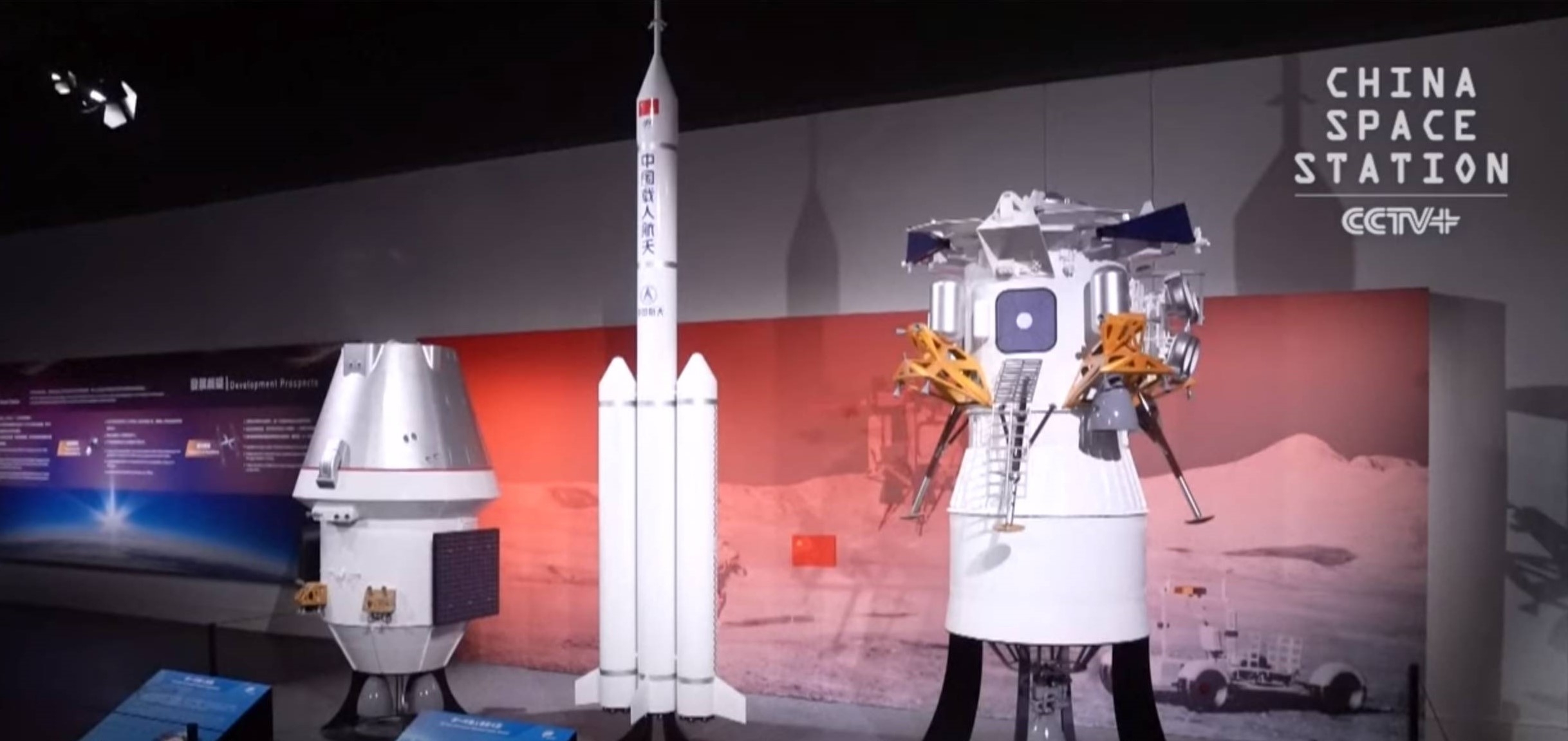
China’s plans for human crews on the Moon are being shaped.
Image credit: CCTV/Inside Outer Space screengrab
In the preliminary stage before the project was approved last year, “we had already worked a lot on technological breakthroughs and project feasibility,” Yang told CCTV.
“After the project was approved, we’ve worked out the prototype samples of the rocket systems, spacecraft, and lunar landers. Next we’ll work on the formal samples and some experiments, and we’ve already made breakthroughs in many key technologies,” he concluded.

Image credit: JAXA/Inside Outer Space screengrab
New details regarding the successful landing of Japan’s Smart Lander for Investigating Moon (SLIM) have been released at a January 25 press briefing held by the Japan Aerospace Exploration Agency (JAXA).
It has been confirmed that on January 20, the Lunar Excursion Vehicle (LEV-1), a small robot deployed from SLIM did carry out activities on the lunar surface. Telemetry data was sent directly to Earth from the small robot.

SLIM team members spotlight results.
Image credit: JAXA/Inside Outer Space screengrab
That data indicates that, after deployment from SLIM, the LEV-1 executed planned leaping movements and direct communication with ground stations, including inter-robot test radio wave data transmission from the Transformable Lunar Robot (LEV-2, nicknamed “SORA-Q”).
Standby state
Currently, LEV-1 has completed its planned operational period on the lunar surface, depleted its designated power, and is in a standby state on the lunar surface.
While the capability to resume activity exists contingent on solar power generation from changes in the direction of the sun, efforts will be maintained to continue receiving signals from LEV-1.
SLIM’s multi-band spectroscopic camera took this lunar landscape image created by synthesizing 257 low-resolution monochrome pictures. Based on this landscape image, the team is sorting out rocks of interest, assigning a nickname to each of them, with intent of communicating their relative sizes smoothly by the names.
Image credit: JAXA/Inside Outer Space screengrab
Both LEV-1 and LEV-2 have become Japan’s first lunar exploration robots.
JAXA stated that LEV-1’s leaping movements on the lunar surface, inter-robot communication between LEV-1 and LEV-2, and fully autonomous operations “represent groundbreaking achievement.”
Attitude of SLIM
Regarding the SLIM spacecraft, due to it not being at the planned attitude upon landing, power generation was not possible from the solar cells.
Subsequently, SLIM was shut down with a command from the ground. The multi-band spectroscopic camera (MBC) onboard SLIM was operated on a trial basis and captured images until the power was turned off, JAXA announced.

Lunar topography captured by the Indian spacecraft Chandrayaan-2, overlaid with images acquired by the SLIM navigation camera during the HV2 (second hovering) at an altitude of about 50 meters. The two blue frames are images acquired during the obstacle detection at HV2. The SLIM footprint in the red frame is the safe landing zone set autonomously by SLIM based on the obstacle detection during HV2.
Image credit: JAXA/ISRO
Analysis of the data acquired before shutting down the power confirmed that SLIM had reached the Moon’s surface approximately 180 feet (55 meters) east of the original target landing site.
Pinpoint landing achieved
“While more detailed evaluation continues, it is reasonable to mention that the technology demonstration of pinpoint landing within an accuracy of 328 feet (100 meters), which has been declared to be the main mission of SLIM, has been achieved,” JAXA said.
All technical data on the navigation guidance leading to the landing, and navigation camera image data captured during the descent and on the lunar surface that is necessary for future pinpoint landing technology were obtained from the spacecraft.
Engine issue
Regarding SLIM’s attitude on the lunar surface after touchdown, it is a position that could not generate power from the solar cells.
Analysis of technical data revealed that at an altitude of 50 meters — just prior to the start of the obstacle avoidance maneuver — the thrust from one of the two main engines was most likely lost.
Image credit: JAXA/ISAS
The SLIM onboard software autonomously identified the anomaly, and while controlling the horizontal position as much as possible, SLIM continued the descent with the other engine and moved gradually towards the east.
SLIM landed “upside down” with the thruster up. No two-step landing was performed.
Below design range
The descent velocity at the time of contact with the ground was approximately 1.4 meters per second or less, which was below the design range.
Conditions such as the lateral velocity and attitude were outside the design range, and this is thought to have resulted in a different attitude than planned.
The cause of the loss of the main engine functionality is now being investigated.
As for future activities, JAXA said that further analysis has shown that SLIM’s solar cells are currently facing west, suggesting that there is the possibility for power generation and thus recovery of SLIM as the sunlight illumination condition improves with time.
Japan has become the 5th country to successfully soft land a spacecraft on the surface of the Moon.
The SLIM project is led by members of the JAXA Institute of Space and Astronautical Science (ISAS), and researchers from universities and other institutions across the country.
SLIM was launched last year on September 7, departing Earth atop an H-IIA launch vehicle from the Yoshinobu Launch Complex at JAXA’s Tanegashima Space Center.
Go to this informative video showcasing the Transformable Lunar Robot (LEV-2), nicknamed “SORA-Q.”
https://youtu.be/PupLqwt4d2o?si=Z8V4poXC2Tvx2zPG
Image credit: JAXA/ISAS

Lunar surface mosaic image captured by the SLIM-mounted Multi-Band Camera (MBC). The grey area on the right of the mosaic lacks data due to the discontinuation of scanning operation.
Image credit: JAXA/University of Aizu/Ritsumeikan University

