Archive for the ‘Space News’ Category
 Author:
  June 7th, 2026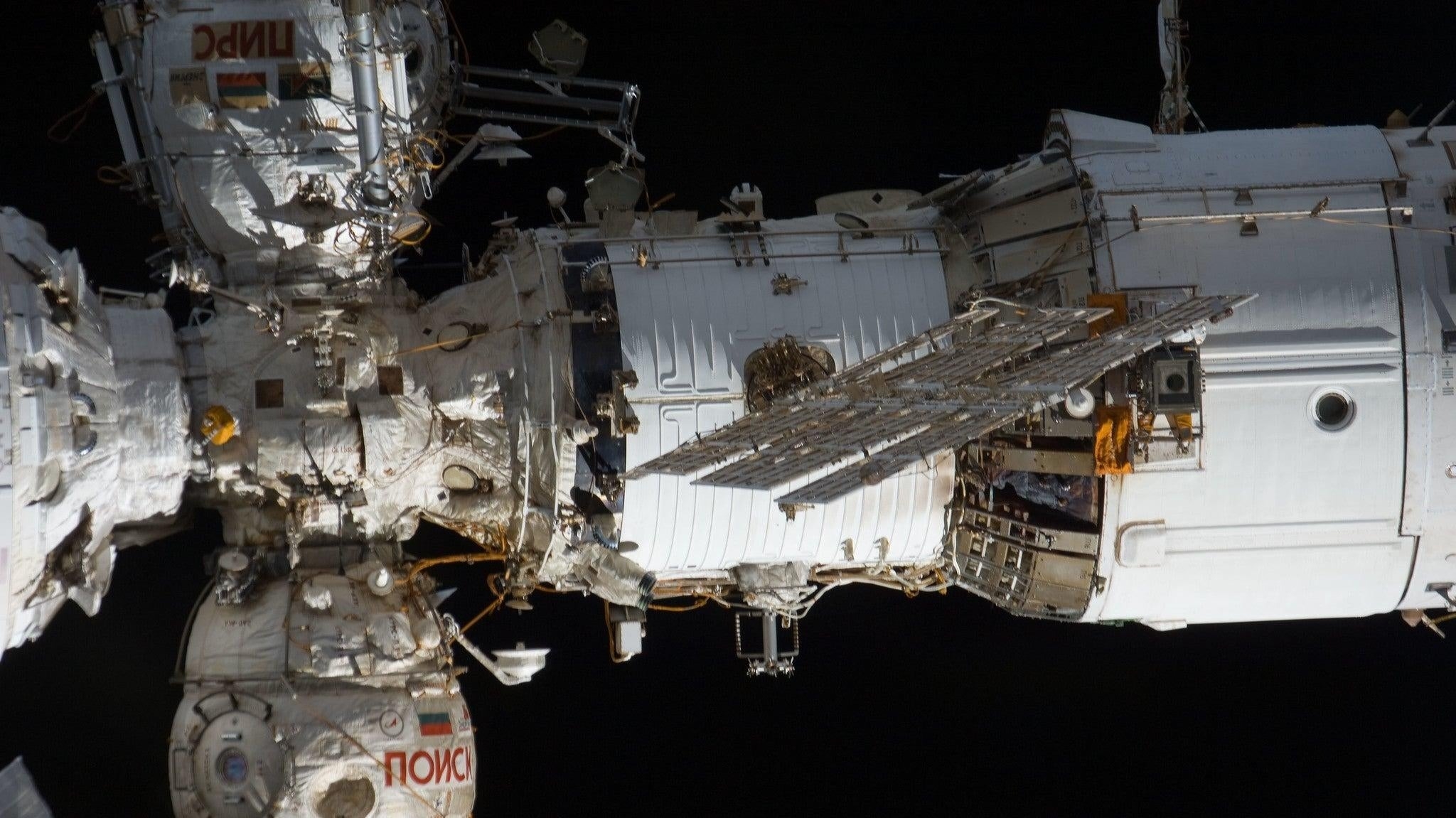
Image credit: NASA
On June 5, while pressurizing the Zvezda module’s transfer chamber (Tcha) to International Space Station (ISS) pressure, specialists from the ISS Russian Segment’s lead operations team detected a leak in the Tcha.
During an inspection of the Tcha, the cosmonauts discovered two potential air leaks. The first was quickly sealed with the first layer of Germetal-1, a two-component sealant. The second leak is located on the conical portion of the Tcha. Preparations are underway to seal it.
Stable situation
In an official comment from Russia’s Roscosmos State Corporation, the situation on the ISS has been detailed relating to the detection of leaks in the hardware’s transfer chamber.
“The situation does not pose a threat to the safety of the crew or onboard systems; the pressure on board the ISS is stable and maintained at the calculated level,” explains Roscosmos.
“NASA astronauts, who were transferred to the docked Crew Dragon spacecraft during repairs to the transfer chamber, have returned to the ISS to resume normal operations.”

Image credit: NASA
Root cause
The Zvezda Service Module was the first fully Russian contribution to the ISS. The module provides station living quarters, life support systems, electrical power distribution, data processing systems, flight control systems and propulsion systems. It provides a communications system that includes remote command capabilities from ground flight controllers, and a docking port for Russian Soyuz and Progress spacecraft.
The Zvezda service module’s transfer tunnel has experienced cracks since 2019 that have resulted in small atmosphere leaks and prompted ongoing monitoring and repair efforts by Roscosmos.
NASA and Roscosmos have worked together to identify the root cause while Roscosmos has been applying leak mitigation measures, including temporary and permanent sealants.
 Posted in

Vickie and Alan.
I am saddened to report the passing of my dear friend, Alan Hale – an astronomer that made us all look up and ponder about a visitor from afar – the noted Hale Bopp comet. That object was one of the most widely observed space intruders of the 20th century.
When it passed perihelion on April 1, 1997, reaching about magnitude −1.8, its massive nucleus size made it visible to the naked eye for a record 18 months.
From Vickie Stone Moseley Hale in Cloudcroft, New Mexico: “Today the love my life, Father, Grandfather, Astronomer, Comet discoverer, passed away in his home. I am heart broken.”
I will always remember Alan Hale in an interview telling me, after first seeing the object late night, something like, “and then I took my life in my hands and woke up my wife,” inviting her to his telescope’s eye piece to marvel at what he observed.
I’ll miss you Alan, but now you are among the stars, planets, and other objects that you loved to keep an eye on.
Leonard

Image credit: SpaceX
Question: Who Owns the Most Satellites?
SpaceX leads all operators. Commercial networks now outscale legacy public and state-backed space operators by about 12-to-1.
Satellites are becoming the backbone of the modern space economy. From broadband internet to Earth observation, orbital infrastructure now supports industries far beyond aerospace.
Those are among key takeaways from Cody Good at Visual Capitalist using data from AEI Space Data Navigator and in partnership with Global X Canada.
Ranking order
A snapshot of space assets was taken on May 12th showing SpaceX dominates the global satellite count with 10,262 operational satellites at that time. That’s more than 16 times OneWeb’s 632 satellites, the next-largest named operator.
Rank Satellite Operator Fleet Count
1 SpaceX 10,262
2 OneWeb 632
3 National Reconnaissance Office 285
4 US Military 244
5 Chinese Military 168
6 Planet Lab 144
7 Russian Military 107
8 NASA 90
9 Iridium 80
10 Globalstar 26
— Other 3,409
Source: AEI Space Data Navigator.
According to Good, “the ranking shows how quickly private networks have scaled since the beginning of the space race. Public organizations like NASA and national militaries now operate a minor portion with just 894 satellites among the named owners in the dataset.”

Credit: SpaceX/Starlink
Starlink: a defining example
SpaceX operates Starlink, the largest satellite fleet ever deployed. Its scale alone accounts for about two-thirds of the 15,447 satellites shown in the dataset.
“Instead of launching a handful of high-value satellites,” says Good, “Starlink relies on scale. As a result, the network has become a defining example of commercial orbital infrastructure.”
“The gap between SpaceX and legacy operators signals a major turning point,” Good notes. “Businesses now own and operate satellite networks at a scale once reserved for governments. This matters because satellites are no longer niche government research assets. Instead, they are becoming critical infrastructure for connectivity, data, and national resilience.”

Image credit: Planet Labs
Investment theme
As for investing in space, as commercial networks grow, orbital infrastructure may become a larger investment theme. “Satellites, launch systems, and space-enabled services all sit within this expanding ecosystem,” Good says. “The space economy is already moving into logistics, agriculture, defense, and communications. As a result, investors may increasingly look for exposure to companies enabling these trends.”
Investors looking to learn more can explore the Global X Space Tech Index ETF (ORBX), which provides exposure to companies at the forefront of the space economy.
Go to:
https://www.globalxetfs.com/funds/ORBX
Check out Visual Capitalist at:
https://www.visualcapitalist.com/
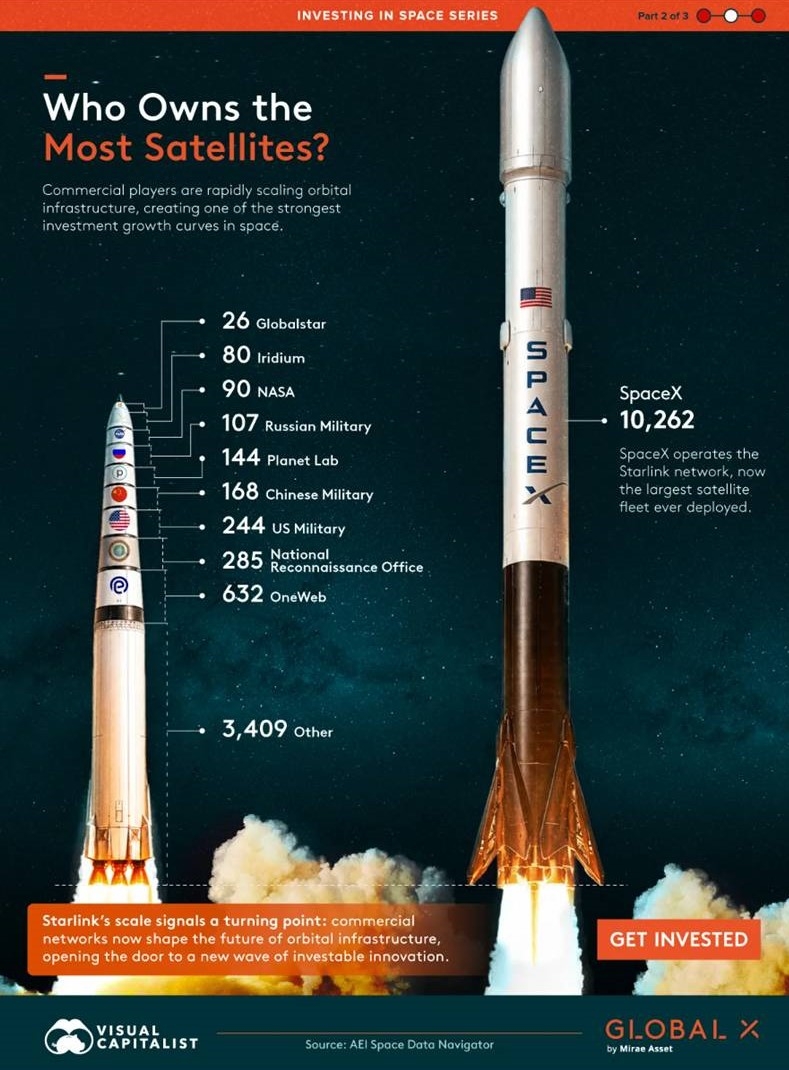
Image credit: Visual Capitalist

Image credit: CCTV/Inside Outer Space screengrab
China successfully launched on June 1 the Long March-12B Y1 carrier rocket into space from the Dongfeng commercial space innovation pilot zone.
According to China Central Television (CCTV) it took 21 months for the carrier rocket to go from the concept validation stage to the completion of product development. In doing so, it set a new record for the development cycle of the country’s new-generation rockets.
The booster sent a group of networking satellites destined for the Qianfan Constellation, also known as the Spacesail Constellation, into their preset orbits.
Maiden flight
This mission was the maiden flight of the Long March-12B, a new-generation reusable rocket developed by China Aerospace Science and Technology Commercial Launch Vehicle Group (CACL) – a commercial rocket manufacturing company under the China Aerospace Science and Technology Corporation.
Long March-12B features a single-core, two-stage configuration. The rocket has a body diameter of 4.37 meters, a fairing diameter of 5.2 meters, and a total length of approximately 72 meters.
Racing against time
It is the tallest rocket that has successfully made its maiden flight in China so far, CCTV reported, showcasing developing and launching the new rocket more quickly and safely. Transferring the rocket from its technical zone to the launch area took just 50 minutes.
“Fast speed is a defining feature of the Long March 12B team,” said Liang Yanqian, a rocket designer at CAST’s commercial launch vehicle group. “Whether during the development or the technical validation, we had consistently followed the principle of racing against time,” said Liang.
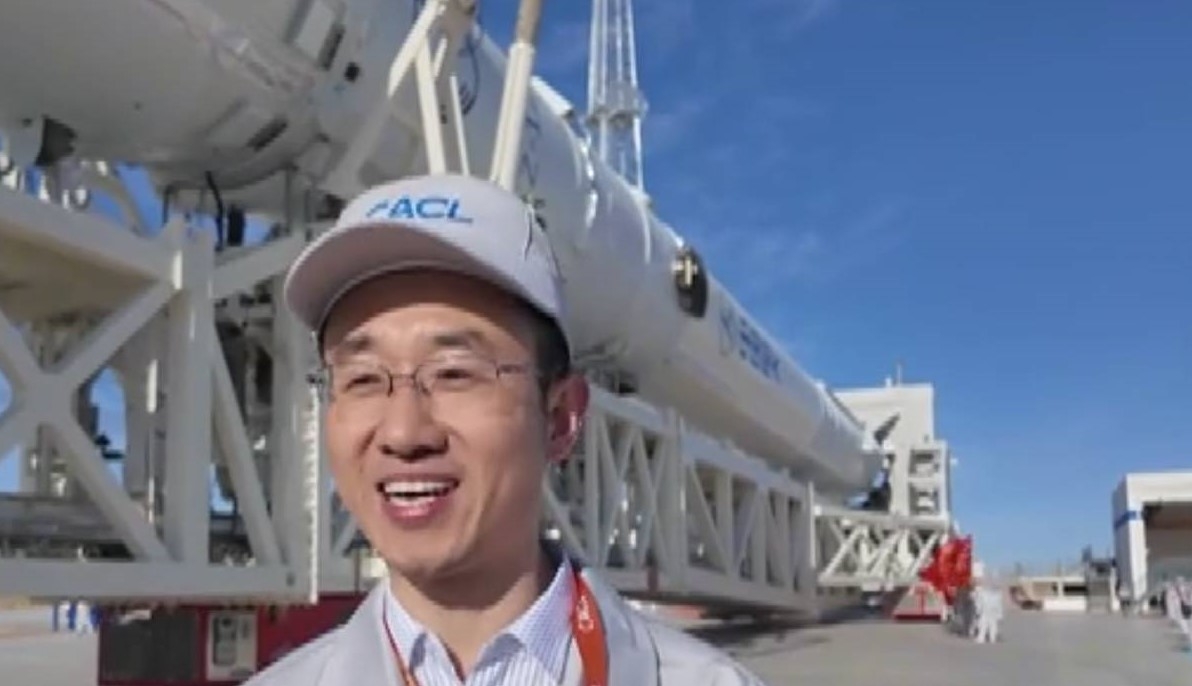
Liang Yanqian, rocket designer, China Aerospace Science and Technology Commercial Launch Vehicle Group (CACL).
Image credit: CCTV/Inside Outer Space screengrab
The team built a simulation platform from scratch, verifying more than 50 key technologies during all stages of the development.
“We had conducted over 200 experiments and verified more than 50 key technologies throughout the entire development process. We all raced against the clock and completed the tasks one by one solidly,” Liang said.
Launch area workload
The rocket adopts a launch mode of horizontal assembly, horizontal testing and horizontal transfer, with all the complex tasks completed in the technical zone in advance to ensure a smooth and faster launch process.
“This giant plate is the interface connecting the rocket to the launch pad. Without it, a lot of work needs to be done to secure the rocket and connect it to the launch pad after it reaches the launch area. Now, everything can be done in the technical zone, so our workload at the launch area is greatly reduced,” said Liang.
Go to this video of the launch at:
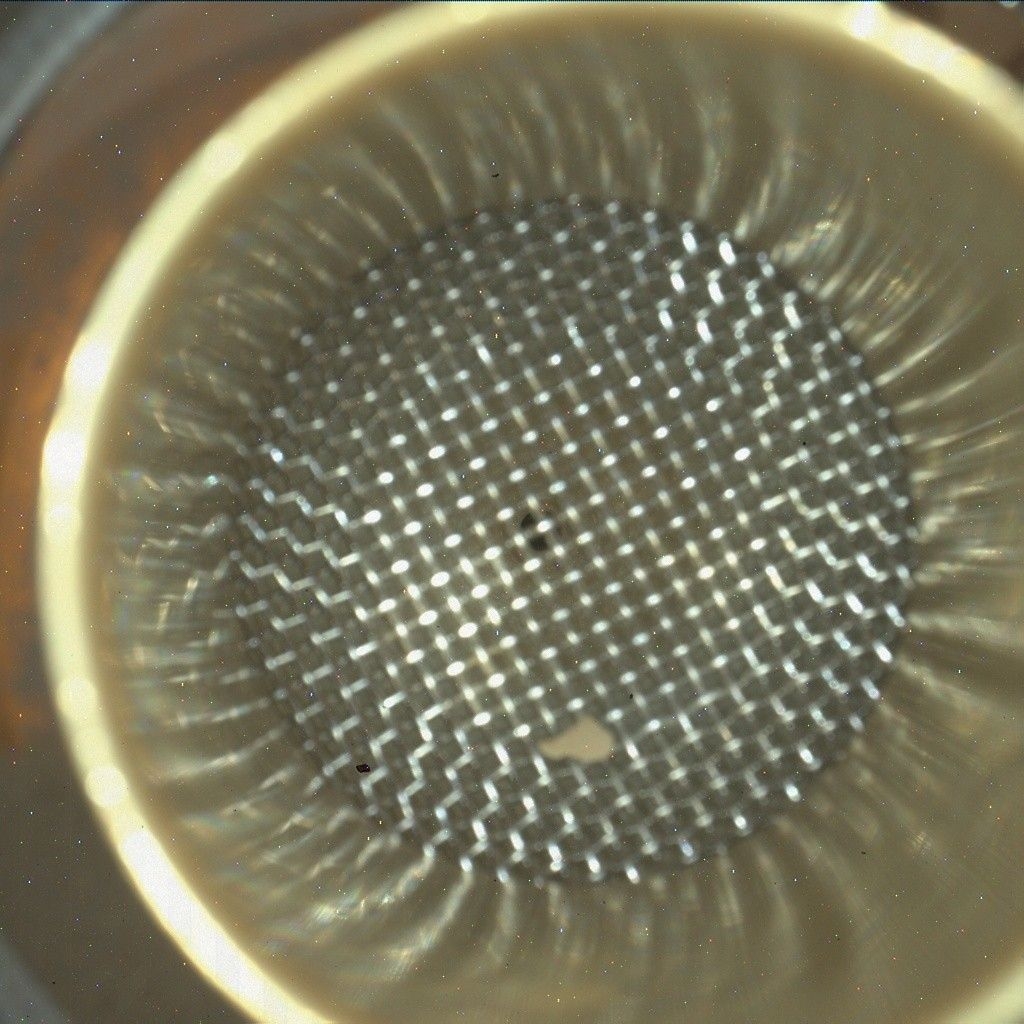
NASA’s Curiosity Mars rover acquired this image of the inlet on its Chemistry & Mineralogy X-Ray Diffraction instrument (CheMin). It analyzes the chemical composition of rocks and soil. Curiosity captured the image using its Mars Hand Lens Imager (MAHLI), a close-up camera located on the turret at the end of the rover’s robotic arm, on May 28, 2026 — Sol 4908.
Image credit: NASA/JPL-Caltech/MSSS
“Drilling always keeps the rover in place for a little while, and our 47th successful drill, ‘Campo Marte,’ was no exception,” reports Susanne Schwenzer, a professor of planetary mineralogy at The Open University in the United Kingdom.
“The team used the time wisely and on top of the drilling, we also have many observations,” adds Schwenzer. “We are driving onward to reach the next area up the hill on Mount Sharp.”
The Campo Marte drill was successful, and subsequently researchers are investigating the aftermath of that drilling.
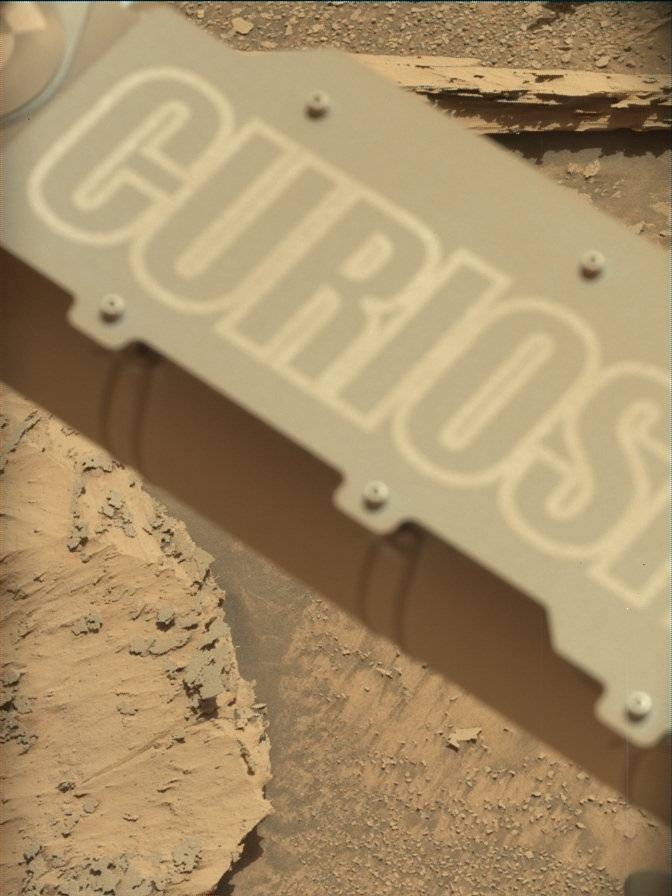
Image taken by MastCam Left onboard Curiosity on Sol 4916, June 5, 2026.
Image credit: NASA/JPL-Caltech/MSSS
Curiosity’s Chemistry & Mineralogy X-Ray Diffraction instrument (CheMin) obtained mineralogical data and the Sample Analysis at Mars (SAM) instrument inspected the volatile releases.
The robot’s Chemistry and Camera (ChemCam), Alpha particle X-ray spectrometer (APXS), the Mars Hand Lens Imager (MAHLI) and the rover’s Mastcam were also busy documenting the drill hole and the drill fines, as well as how much sample there was available overall, notes Schwenzer.
Different formation conditions?
“Of course, Curiosity also had a very good look at the other interesting targets in the area! Besides all the work on the drill hole, ChemCam carried out an expert’s targeting exercise by setting two targets up to aim at two different layers on adjacent spots on the finely laminated sediments,” says Schwenzer. “That involves aiming at millimeter-sized targets, named “Corcovado” and “Junakas,” respectively, about 3 meters away (about 10 feet).”
Mars investigators are curious if the layers are chemically different, which would tell them about different formation conditions, or if they are similar and the conditions when those layers formed were more similar.

This image taken by Mast Camera (Mastcam) onboard NASA’s Mars rover Curiosity on Sol 4916, June 5, 2026.
Image credit: NASA/JPL-Caltech/MSSS
Layered bedrock
ChemCam is also looking at the target “Palcaya” to get more data on the chemistry of the layered bedrock, and will investigate the target “Alcamachi,” which is a float rock that looks intriguingly dark.
“Maybe that tells us it’s got a different chemistry? We will find out when we get the data,” points out Schwenzer.
In addition to the chemistry measurements, ChemCam will also carry out a spectral investigation on the target “Magallanas,” which was a little too far away to also point the laser at it, but is intriguingly dark.

This image taken by Left Navigation Camera onboard NASA’s Mars rover Curiosity on Sol 4916, June 5, 2026.
Image credit: NASA/JPL-Caltech
Record breaking
Curiosity’s ChemCam also planned three long-distance Remote Microscopic Imager (RMI) sessions to document the sedimentary structures — younger and older ones — in the surrounding area.
“One of them drew the suspicion that it might break a record: it might be the longest strip of RMI images we have taken in one mosaic! The jury is out, it’s 24 frames and this way links up with an earlier, shorter set of images,” Schwenzer reports.
The reason the mosaic is so long, the Mars scientist adds, is because it images a small ridge with sedimentary textures that could tell us about the depositional conditions when the rock layers formed.
“But how cool is that — at 13+ years to still break our own records?”
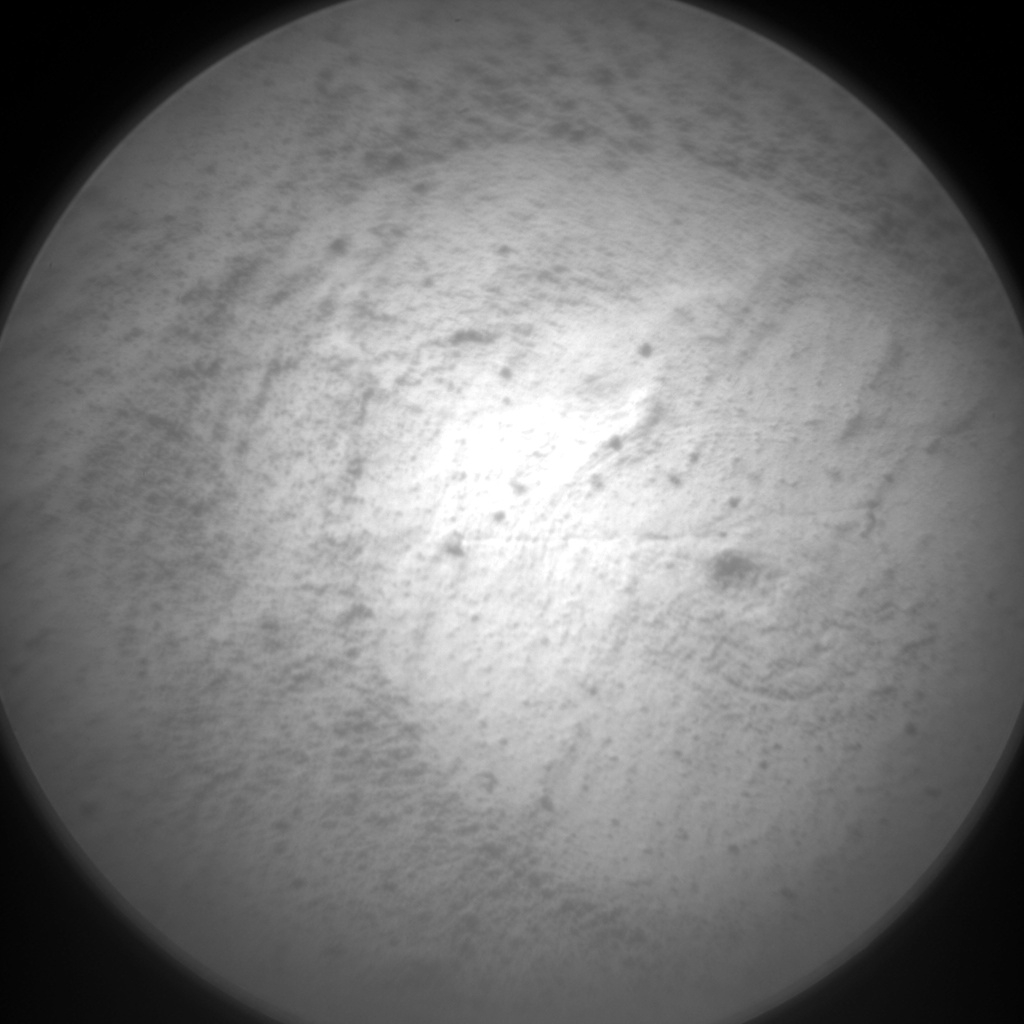
This image taken by Chemistry & Camera (ChemCam) onboard NASA’s Mars rover Curiosity on Sol 4916, June 5, 2026.
Image credit: NASA/JPL-Caltech/LANL/CNES/CNRS/IRAP/IAS/LPG
Nighttime experiment
Meanwhile, Mastcam has been very busy getting the entire region around the robot imaged. In addition, some higher-resolution mosaics have been taken, most notably one of the locations where the remaining sample was dropped, and then of the workspace to see again how much sample might — or might not — have been left in the drill stem and fallen out when Curiosity did the motions that are designed to shake any remaining sample out of the drill, to leave it prepared for the next time.
“Another imaging task, but for MAHLI, is to always image the sample inlets, also, to see if they are clean and prepared for the next sample,” says Schwenzer. The MAHLI imagery of the CheMin inlet shows a little rock.
“It’s with us for a while, and the CheMin team now calls it “our pet rock,” notes Schwenzer. “APXS joined the drill-hole investigations and has been focused on it even more than usual. The team decided that this is a very good opportunity to increase counting statistics beyond the usual and well-tested levels by significantly increasing the measurement time.”
Schwenzer explains to achieve that, it measured the Campo Marte drill fines in and MAHLI used its LED lights to finish the experiment with a sparkling nighttime MAHLI experiment to document it all.
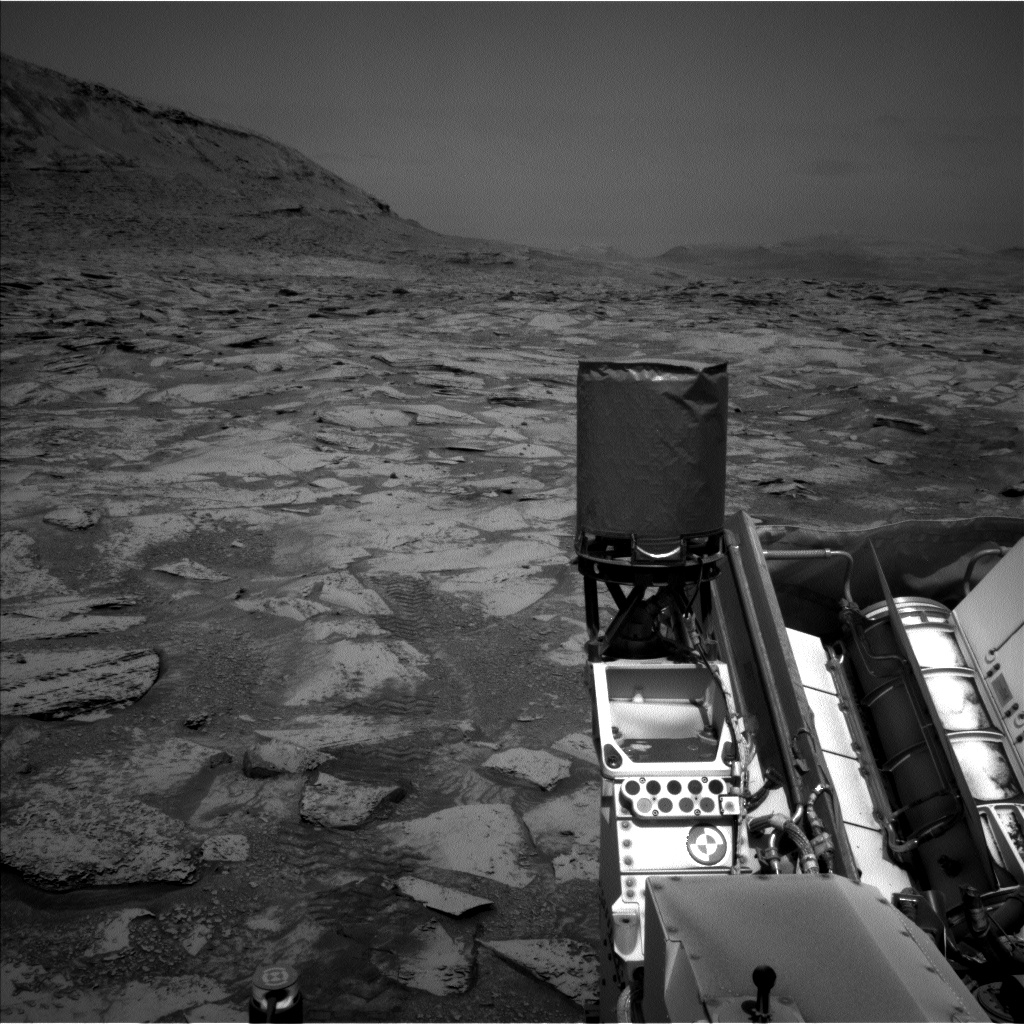
Image taken by Curiosity’s Left Navigation Camera on Sol 4916, June 5, 2026.
Image credit: NASA/JPL-Caltech
Up the hill
“Our environmental team has kept the rover busy by looking at atmospheric opacity, dust activity, dust-devil activity and, of course, also monitoring the environment in general,” Schwenzer adds.
“With all this finished, the rover will continue its way up the hill to the next interesting area. I heard something like “cross-bedding” during the discussions.
As a mineralogist, Schwenzer notes that such a decision was taken by people who know more about sediments than she does, “while I am itching to see the CheMin mineralogy results!”

Free-floater in microgravity.
Image credit: NASA
In the micro-gravity of space, the human body loses muscle and bone density.
Not only that but eyes change and fluids shift to the brain, among other issues.
The European Space Agency (ESA) is deep diving into dry-immersion baths as a way to recreate aspects of living in microgravity, part of their human spaceflight research.
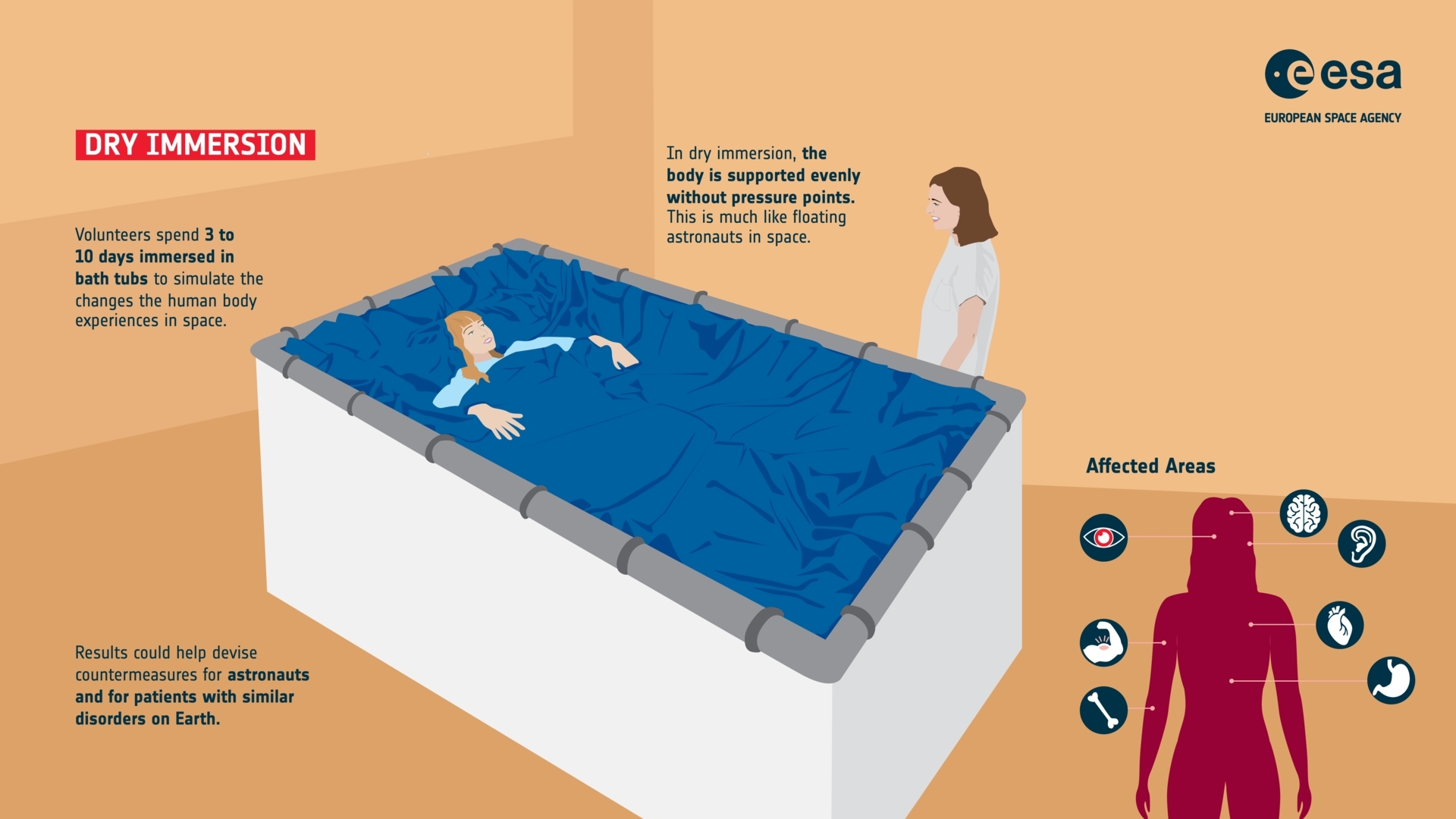
Image credit: ESA
In suspension
Similar to bath tubs, large containers hold study participants in suspension for many days.
ESA explains that the studies benefit from placing less pressure on the body as volunteers are supported and suspended evenly in the tub. In that way a condition is created that mimics the floating astronauts experience on the International Space Station.
“Results from this type of research,” ESA states, “does not only benefit astronauts but has implications for people on Earth who are bedridden for long periods of time.”

Image credit: NASA
A research team advocates use of Earth’s moon as a secure site for biocontainment of extraterrestrial samples, particularly from Mars, but also from other exploration locales, like Enceladus, a moon of Saturn.
For more details, go to my new Space.com story – “Should we store Mars samples on the moon to keep alien germs away from Earth? – The Moon may become humanity’s first line of biological defense” — at:
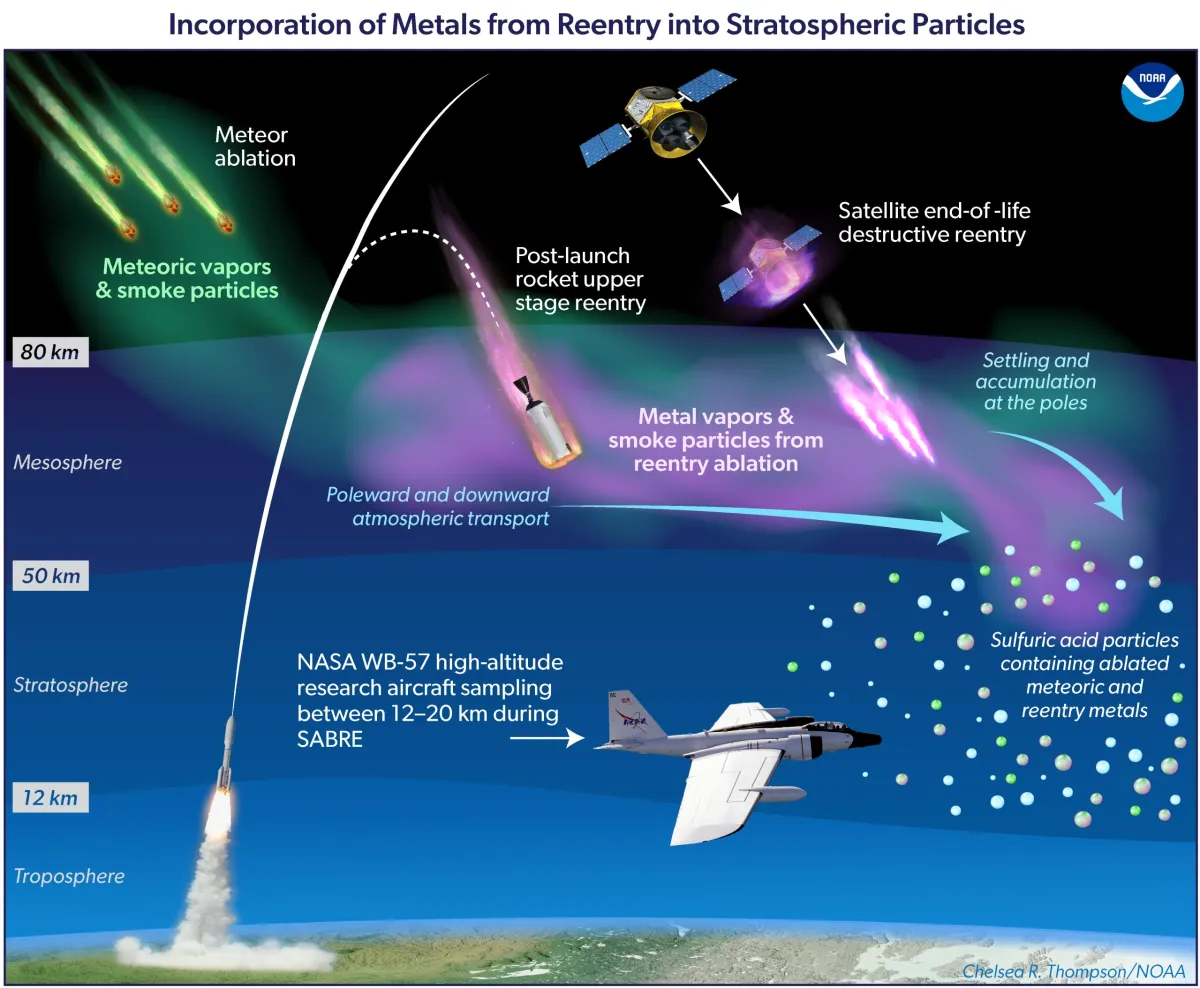
Incorporation of metals from space hardware re-entry into stratospheric particles.
Graphic: Chelsea Thompson, NOAA
BOULDER, Colorado – Increased attention is being given to the rising intrusion of exotic materials into Earth’s atmosphere from satellite and space hardware re-entry. Exasperating the situation is the ongoing proliferation of satellite “megaconstellations” being undertaken by multiple nations.
Atmospheric impacts of spacecraft launches and re-entries, what is known and unknown, along with research priorities was detailed at the 2026 European Geosciences Union held May 3-8 in Vienna, Austria.
Go to my new SpaceNews story – “Researchers call for regulations to protect low Earth orbit environment – Experts call for an end to an unsustainable ‘Wild West’ approach to space” – at:
https://spacenews.com/researchers-call-for-regulations-to-protect-low-earth-orbit-environment/
Voyager Technologies has signed an agreement to acquire Astrobotic Technology, Inc., the Pittsburgh-based commercial lunar delivery, lunar power and reusable rockets firm.
“We are building the infrastructure foundation that will make America’s permanent presence on the Moon a reality,” said Dylan Taylor, Chairman & CEO, Voyager. “With Astrobotic, Voyager is now a lunar platform that will have capability at every infrastructure layer needed to put Americans on the lunar surface and keep them there.”
According to a Voyager Technologies statement, the acquisition directly supports NASA’s Artemis program and NASA Administrator Jared Isaacman’s commitment to a permanent American presence on the Moon by 2028.
“Voyager intends to accelerate investment to scale Astrobotic’s lunar and reusable rocket programs in support of America’s Moon Base plans,” the statement explains.
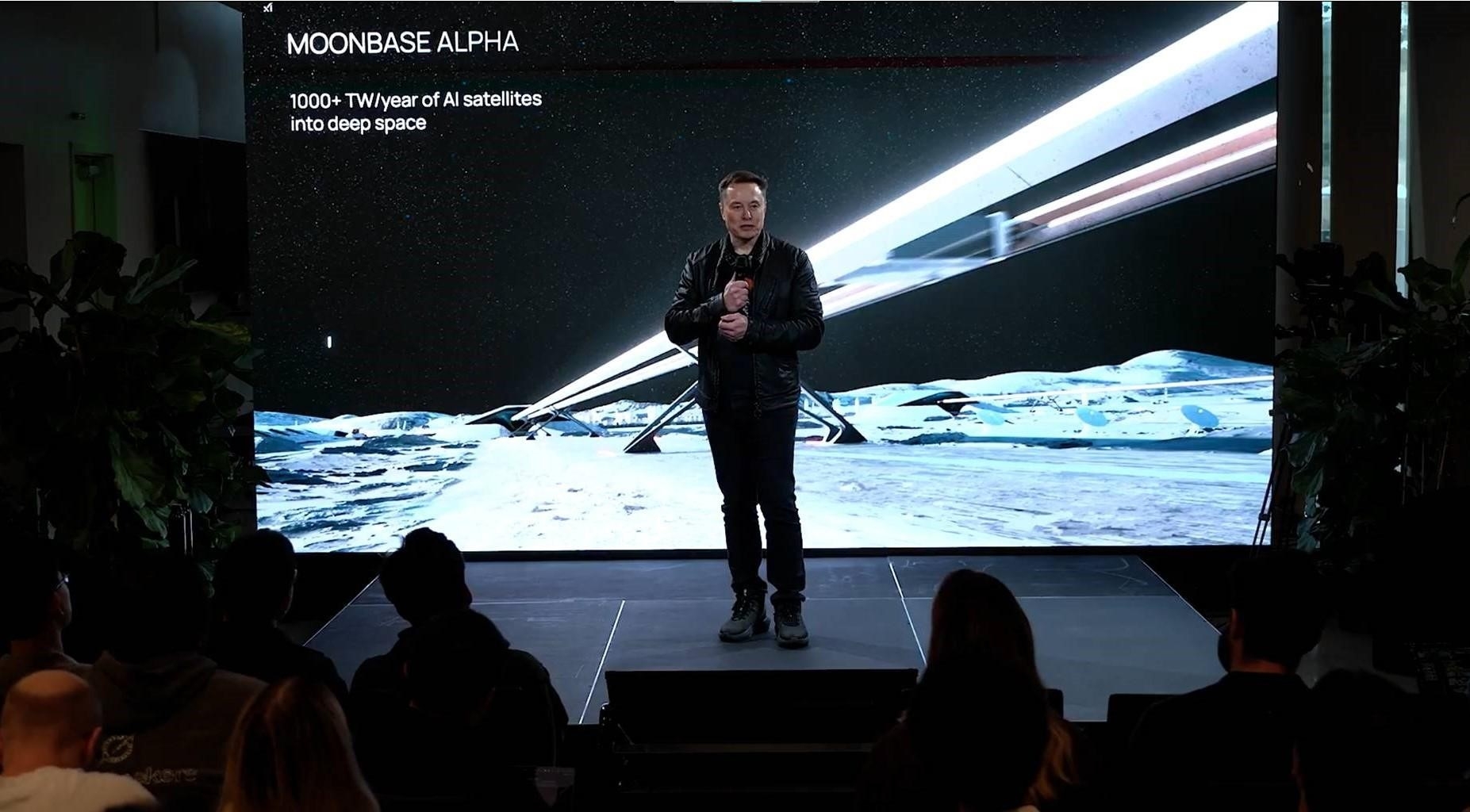
Image credit: SpaceX
SpaceX filed on May 20 with the United States Securities and Exchange Commission key documentation for an initial public offering (IPO) of stock.
An IPO signals that a private company sells shares of its stock to the public on a stock exchange. This long-anticipated public offering could become the largest IPO in history, roughly a two trillion dollar valuation, and will be soon listed under the ticker SPCX.
Number of challenges
As noted by SpaceX, “this prospectus contains forward-looking statements that are subject to a number of risks and uncertainties, many of which are beyond our control,” explains SpaceX. “You should read this entire prospectus carefully before making an investment decision.”

SpaceX mission statement is to “make life multiplanetary, understand the true nature of the universe, and extend the light of consciousness to the stars.”
Image credit: SEC filing/SpaceX
The prospectus adds: “We face a number of challenges relating to our business and growth strategy and, ultimately, the achievement of our mission to make life multiplanetary, understand the true nature of the universe, and extend the light of consciousness to the stars.”
I reached out to a number of experts about what the SpaceX IPO means for markets and individual investors – and the implications for a new wave of high-tech listings seeking fame and fortune.
Go to my new Space.com story — Will SpaceX still be a launch company after its historic IPO? — at:

