Archive for the ‘Space News’ Category
 Author:
  March 28th, 2024
Wait a minute!
Image credit: Barbara David
In classic “wait a minute” style, for ConkSat where there’s will, there’s a way – with X postings offering some challenging marketing concepts.
“For years, spaceflight companies have discussed means for reducing the amount of space junk in low Earth orbit (LEO). As visionaries at ConkSat, we have never been satisfied with the status quo – and that means going against popular thinking. That’s why we’re announcing the first spacecraft dedicated to increasing the amount of space junk in LEO,” explains a ConkSat posting.

“FragSat is more than a satellite – it’s a cloud of over 70 billion steel ball bearings packed into a payload fairing. Say goodbye to your competitor’s megaconstellations with FragSat, guaranteed to increase the rate of collisions in orbit by orders of magnitude. Taking advantage of the increase in payload to orbit offered by new launchers, we’re planning on up to twenty launches per year of pure steel, rendering entire families of orbits unusable for centuries,” continues the posting from ConkSat.
“Just another way we’re bringing space down to Earth.”

Image credit: ConkSat
Quality Unassurance
Another X posting from ConkSat spotlight they fired their entire quality assurance team.
“How are we going to keep our rockets, satellites, and missiles at the quality expected of the ConkSat brand? Simple – we aren’t. We can’t let quality assurance hold us back from true innovation. From this point forward, we aren’t keeping lengthy or dated records. We won’t be “doing critical maintenance.” Our engineers will be motivated by the desire to push humanity forward, and by the fact that we required them to live downrange of the launch site.”

Bringing space down to Earth. At high speed.
Image credit: ConkSat
What’s the point?
“People called us crazy. People called us names. Some hurtful. People told us we were “violating federal regulations” and would be “shut down immediately.” But you don’t become a leading defense contractor without stepping on a few toes.”

Image credit: ConkSat
“Let’s be honest. Everybody’s worst nightmare is dumping $1bn in seed money into a rocket startup, only to have them churn out an ugly looking launch vehicle with weird fins at the top. If you’re embarrassed to release the promotional hype video, what’s the point? That’s why we at ConkSat recognize the importance of a smooth profile. Our launch vehicles are guaranteed to be 100% smooth with no protrusions or ugly changes in diameter that could render your investment silly.”
Artificial intelligence
“At ConkSat, we know AI is the future. Everything we do is powered by AI – every email, every spreadsheet, and every piece of code is created 100% by ChatGPT. Our launch vehicles are guided completely by onboard neural networks: even we don’t know where our rockets will land! Curious about how we’ll create the future of spaceflight? So are we! Hopefully we figure it out before our investors do.”
Thank you ConkSat for all that you do! — Leonard David
 Posted in

Image credit: CNSA
The Moon has gained a new companion – China’s lunar relay satellite, the Queqiao-2.
Following roughly 112 flight hours after launch, the spacecraft performed a near-Moon braking procedure, placing it in circumlunar orbit, reported the China National Space Administration (CNSA) on Monday.
Upcoming is for the relay craft to adjust its altitude and inclination and enter its target elliptical orbit around the Moon.

Pre-launch photo of lunar relay satellite.
Image credit: CCTV/CNSA/Inside Outer Space screengrab
Test satellites
Meanwhile, two communication and navigation technology test satellites, Tiandu-1 and Tiandu-2, also completed near-moon braking on the same day and entered their circumlunar orbits.

Tiandu-1 and Tiandu-2 subsatellites are to trial-run lunar communications technology.
Image credit: DSEL
The separation of the two satellites will be carried out as planned, the CNSA said.

Technicians prepare lunar relay satellite for launch.
Image credit: CCTV/CNSA/Inside Outer Space screengrab
Communication services
Queqiao-2, which translates to “magpie bridge 2,” was launched on March 20 to provide Earth-Moon communication services, a key duty given the upcoming launch, likely in May, of China’s Change’-6 lunar lander.

Image credit: CGTN
That probe is slated to sit down softly on the farside of the Moon, collect specimens, then launch that treasure trove of bits and pieces from the lunar south pole back to the Earth.
Queqiao-2 is designed to serve as a relay platform for the fourth phase of China’s lunar exploration program, providing communications services for the already landed Chang’e-4 lander/rover on the farside, along with the Chang’e-6, Chang’e-7, and Chang’e-8 Moon missions.

Image credit: CCTV/Inside Outer Space screengrab
Go to this informative video at:
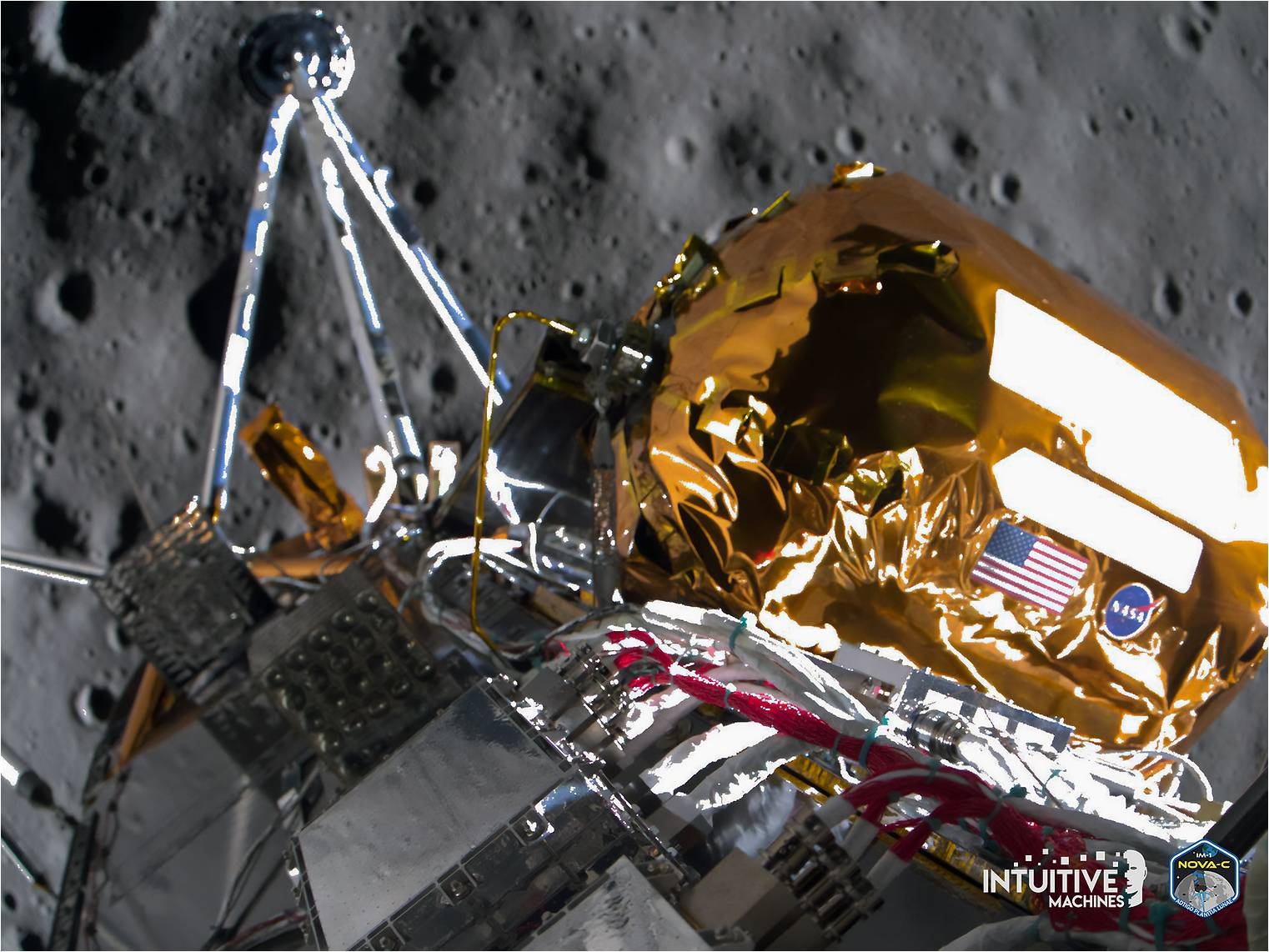
Odysseus captured this image less than 100 feet (30 meters) above the lunar surface while his main engine throttled down
Image credit: Intuitive Machines
Mum’s the word from Odysseus – that Intuitive Machines lunar lander that plopped down on the Moon in February.
Odysseus — also dubbed “Odie” — arrived at the Malapert-A crater area on February 22, making a rough and tumble landing, tipping over at the site compromising its ability to perform all its duties.
This privately-built craft was sponsored by NASA’s Commercial Lunar Payload Services (CLPS) initiative.
The Intuitive Machines (IM-1) lander officially ended seven days after landing – but with a hopeful caveat.

Image credit: ILOA/Steve Durst
Call home
While not designed to survive the super-chilly temperatures of the lunar night, ground controllers had hoped the solar paneled Odysseus may spring back to life.
“Before its batteries were depleted, flight controllers tucked Odie into a configuration that could call home if various systems outperformed manufacturer expectations,” states Intuitive Machines.
Ground teams began listening for the lander’s wake-up signal on March 20, anticipating there might be enough sunlight reaching Odysseus to possibly perk up the lander’s power system and turn on its radio system.

Rough and tumble landing of Odysseus Moon lander, damaging its landing gear in the process.
Image credit: Intuitive Machines
Radio silence
“As of March 23rd at 1030 A.M. Central Standard Time, flight controllers decided their projections were correct, and Odie’s power system would not complete another call home,” Intuitive Machines has announced.
“This confirms that Odie has permanently faded after cementing its legacy into history as the first commercial lunar lander to land on the Moon,” the statement concludes.
Take a look at my new Scientific American story – “In NASA’s Push for the Moon, Commercial Partners Soar—And Stumble: NASA’s partnership with private industry to accelerate the U.S.’s return to the Moon is delivering lunar payloads—and mixed results” – at:
https://www.scientificamerican.com/article/whats-behind-nasas-commercial-lunar-hits-and-misses/
Also, go to my recent Space.com story – “Astrobotic readies next lunar lander following failed Peregrine moon mission” – at:
https://www.space.com/astrobotic-next-lunar-lander-failed-peregrine-mission

Image from International Lunar Observatory Association’s ILO-X wide field-of-view imager taken on February 22, 2024 about 4.2 minutes prior to Odysseus touchdown. It shows craters in the Moon’s south pole region as well as the IM-1 Odysseus lunar lander.
Image credit: ILOA Hawai’i

Drilling down deep for ice on Mars via RedWater technology.
Image credit: Honeybee Robotics
Things are looking up for digging deep on Mars. Progress is palpable on how best to extract subsurface ice to yield made-on-Mars drinkable water, rocket fuel, and other useful resources.
But boring down from the topside of Mars to reach available icy reservoirs is no slam dunk.
Tackling that future desire is Honeybee Robotics, dubbing their approach the RedWater concept.

RedWater system undergoes end-to-end testing in the company’s cold chamber to simulate super-cold conditions on Mars.
Image credit: Honeybee Robotics
Cold shoulder
Meanwhile, there’s the work of the Subsurface Water Ice Mapping (SWIM) on Mars project team, busily charting the whereabouts of water ice on the Red Planet.
Then there’s the fact that Mars is going to give us the cold shoulder. That is, drilling even one meter in ice on that world can be hard to do!
For more information, go to my new Space.com story – “Drilling for water ice on Mars: How close are we to making it happen?” at:
https://www.space.com/mars-water-ice-drill-honeybee-robotics

Image credit: CCTV/CGTN/Inside Outer Space
China’s commercial launch activity in Wenchang is on the upswing, evident in launch pad construction that involves “cutting-edge” technologies and the ability to handle different types of rockets.
Reportedly, by using modular steel structure compared with traditional launch pads, construction time has been cut in half.
Launch Pad No. 1 construction began in July 2022 and was completed at the end of 2023.
The building of Launch Pad No. 2 is now underway with on-site equipment installation to be finished by the end of May 2024.
The No.2 launch pad can accommodate 19 models of nine rocket companies. “That means these rockets can all be launched on this launch pad,” Guo Qiang, deputy secretary of the Party branch in Hainan International Commercial Spacecraft Launch Center told China Central Television (CCTV).
Pad technologies
“The construction of Launch Pad No. 1 marks the implementation of several cutting-edge technologies for the first time,” said Ge Lixin, head of Equipment Department of the Hainan International Commercial Aerospace Launch Co., Ltd.
Ge told China Global Television Network (CGTN) that the pad uses a cone exhaust guide and extrusion water spray system for cooling and noise reduction processes.
“The construction of this launch pad began in July 2022 and has now entered the final stages of equipment installation, nearing completion,” Ge said.

Image credit: CCTV/CGTN/Inside Outer Space
Economies of scale
Both Launch Pad No. 1 and Launch Pad No. 2 have been designed to accommodate over ten different types of rockets from nine manufacturers, said Bian Pengfei, project manager, Launch Pad 2 for Hainan International Commercial Aerospace Launch Co., Ltd.
“By maximizing the number of rocket launches, economies of scale can be achieved, leading to lower overall costs per launch,” Bian said. “To optimize efficiency, both launch pads have been specifically designed to facilitate up to 16 launches per year, ensuring the maximum utilization of the facilities.”
According to CGTN, citing launch experts, the number of Chinese commercial satellites in orbit is projected to exceed 1,200 within the next five years. This surge is reflected by the substantial increase in launch demands.
Last month, the annual blue paper released by state-owned China Aerospace Science and Technology Corporation (CASC) said a new milestone this year is attaining roughly 100 orbital launches.

Kang Yonglai, chief executive officer, Space Pioneer.
Image credit: CCTV/Inside Outer Space
SpaceX-like rocket
Meanwhile, a Chinese private rocket company is readying its SpaceX-like “Falcon 9 equivalent” for a first launch.
As reported by China’s Global Times, Space Pioneer, a Chinese private rocket company, is eyeing July for the maiden flight of its new large liquid-propellant reusable rocket model TL-3 (Tianlong-3) – specially designed for China’s low-orbit satellite internet constellation construction.

Image credit: Space Pioneer
The first stage of the TL-3 will have the ability for autonomous return and reusability. Furthermore, according to the Global Times, the rocket includes “stainless steel 3D printed engines, liquid nitrogen vaporization pressurization, gas injection accumulators, triple redundant computers, nine-engine parallel configuration, full carbon fiber fairings, single-layer common bottom storage tanks and non-pyrotechnic separation, significantly enhancing cost-effectiveness.”
The power system of TL-3 is the Tianhuo-12 rocket engine with the rocket able to toss more than 30 satellites into orbit at once, according to the Space Pioneer firm.

Curiosity’s location as of Sol 4132. Distance driven 19.55 miles/31.46 kilometers since landing in Gale Crater on Aug. 5, 2012.
Image credit: NASA/JPL-Caltech/Univ. of Arizona
NASA’s Curiosity Mars rover at Gale Crater is now performing Sol 4134 duties.
The rover is driving south along the eastern edge of the upper Gediz Vallis Ridge or uGVR in geological shorthand, reports Sharon Wilson Purdy, a planetary geologist at the Smithsonian National Air and Space Museum in Washington, D.C.

Curiosity Right B Navigation Camera taken on Sol 4133, March 22, 2024.
Image credit: NASA/JPL-Caltech
Wide range of activities
“The rover drove up to the uGVR last summer and investigated several rocks; now with the beautiful ‘Fascination Turret’ section of the uGVR in sight,” Purdy notes, the team is excited to have another opportunity to “further characterize the material within the ridge and assess the nature of its contact with the underlying Mt. Sharp bedrock.”

Curiosity Right B Navigation Camera taken on Sol 4133, March 22, 2024.
Image credit: NASA/JPL-Caltech
Purdy notes that the robot’s excellent power situation for a recently scripted two-sol plan (Sols 4132-4133) yielded the ability to do a wide range of activities.

Curiosity Right B Navigation Camera taken on Sol 4133, March 22, 2024.
Image credit: NASA/JPL-Caltech

Curiosity Right B Navigation Camera taken on Sol 4133, March 22, 2024.
Image credit: NASA/JPL-Caltech

Curiosity Right B Navigation Camera taken on Sol 4133, March 22, 2024.
Image credit: NASA/JPL-Caltech

Curiosity Right B Navigation Camera taken on Sol 4133, March 22, 2024.
Image credit: NASA/JPL-Caltech

Curiosity Right B Navigation Camera taken on Sol 4133, March 22, 2024.
Image credit: NASA/JPL-Caltech
Laminated ridge
In the workspace in front of Curiosity, the Mars Hand Lens Imager (MAHLI) inspected a vertical banded rock with veins at “Col de Doodad.”
“We used the dust removal tool (DRT) and MAHLI to characterize the grain size and material in a flat bedrock target named ‘Three Tooth Doodad,” Purdy adds.
The rover’s Chemistry and Camera (ChemCam) Laser Induced Breakdown Spectroscopy (LIBS) was slated to analyze a laminated ridge within bedrock at the “Kuna Crest” target with Mastcam providing a complementary context image.

Curiosity Right B Navigation Camera taken on Sol 4133, March 22, 2024.
Image credit: NASA/JPL-Caltech
Upcoming route
Mastcam planned stereo mosaics within the workspace were scheduled to document “small-scale laminations and to investigate the nature of subtle variations between light and dark bedrock at the ‘East Vidette’ target. The ‘Giant Forest Mastcam mosaic was scheduled to document interesting fractures in the nearby bedrock,” reports Purdy.
“Looking off in the distance, the plan includes several observations of the Fascination Turret section of the uGVR so we can view it from different angles as we drive along our upcoming route,” Purdy observes.

Curiosity Chemistry & Camera (ChemCam) Remote Micro-Imager (RMI) photo acquired on Sol 4133, March 22, 2024.
Image credit: NASA/JPL-Caltech/LANL

Curiosity Mast Camera (Mastcam) Right image produced on Sol 4132, March 21, 2024.
Image credit: NASA/JPL-Caltech/MSSS
ChemCam was able to fit two long distance Remote Micro-Imager (RMI) photos into the plan that document interesting ledges within Fascination Turret, Purdy says, while Mastcam put together a mosaic of the lower portion of the ridge to evaluate the composition, structure, and its relationship with the underlying bedrock.
“Our plan incorporates several ENV [environment] activities including a dust devil survey, a suprahorizon movie, and a sky survey,” Purdy concludes. “Keep on humming along, Curiosity!”

Curiosity Mast Camera (Mastcam) Right image produced on Sol 4132, March 21, 2024.
Image credit: NASA/JPL-Caltech/MSSS

Curiosity Mast Camera (Mastcam) Right image produced on Sol 4132, March 21, 2024.
Image credit: NASA/JPL-Caltech/MSSS

Dust Removal Tool (DRT) close-up. Curiosity Mast Camera (Mastcam) Right image produced on Sol 4132, March 21, 2024.
Image credit: NASA/JPL-Caltech/MSSS
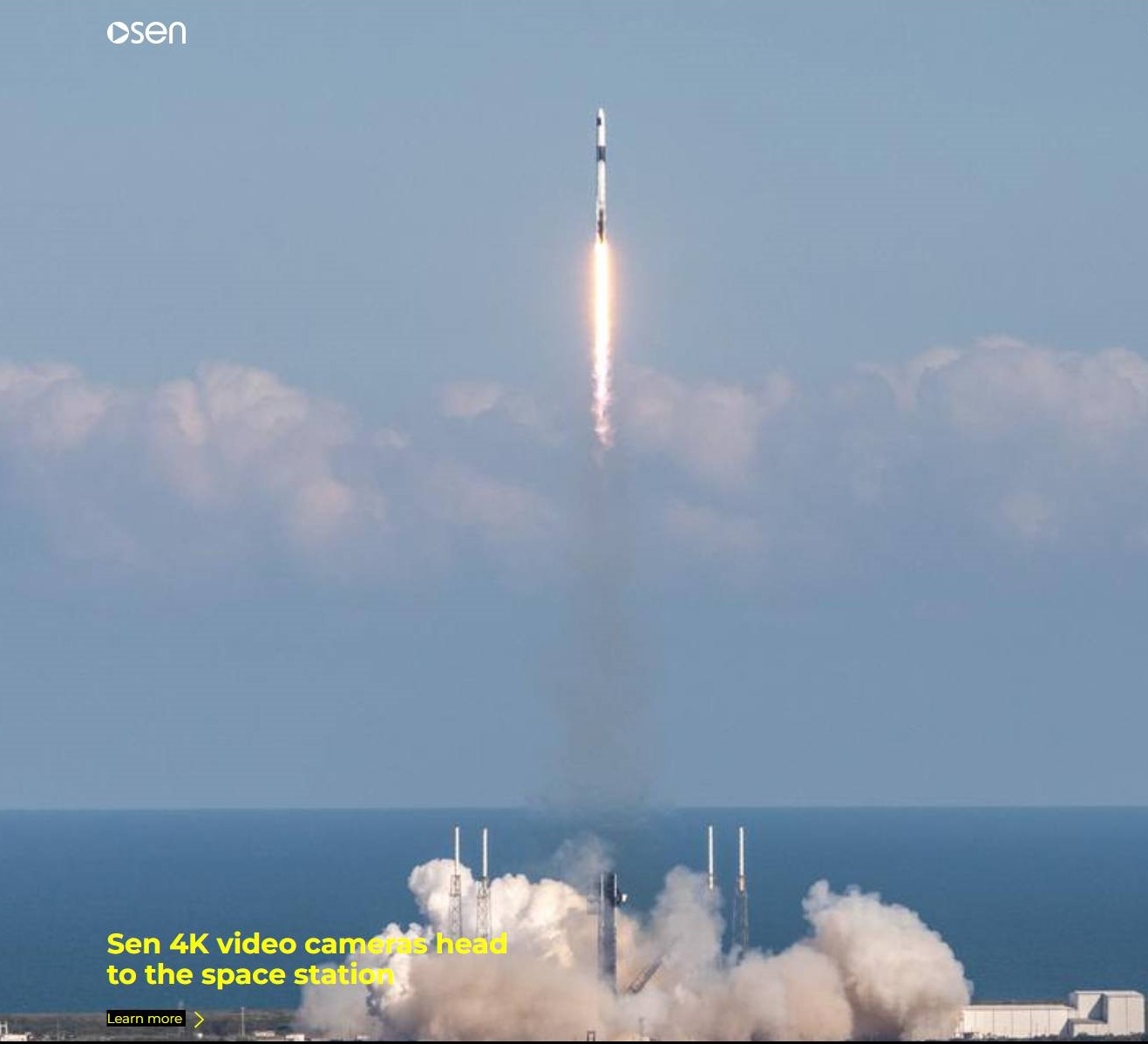
Image credit: Sen/Inside Outer Space screengrab
The vision is to democratize space using high-definition video.
That’s the mission of Charles Black, founder and CEO of the London-based Sen that was founded in 2014.
Sen’s mission to livestream Earth in 4K is literally a real-time event. Now onboard the SpaceX supply ship launched on March 21, the private group’s payload is due to arrive at the International Space Station on Saturday March 23.
May deployment
“Once at the space station it will be stored for a few weeks before it is placed on the outside of the station by the robotic arm,” Black says in a Sen communiqué. “It should be deployed in May after which we can start livestreaming Earth in 4K. We have two camera views of Earth – the horizon and straight down.”
Sen also have cameras pointing at the forward facing docking port of the space station to film coming and going spacecraft, Black adds.

Image credit: NASA
Commercial payload agreement
Sen’s payload, called “SpaceTV-1”, will be hosted on the outside of the ISS through a commercial payload agreement with Airbus U.S. Space & Defence, supported by the International Space Station National Laboratory.
All cameras will film in 4K and at least one camera will be livestreamed continuously.
In addition to 4K video, Sen is aiming to demonstrate real-time Augmented Reality, enabling viewers to see real-time mapping information on the nadir camera view as it orbits the Earth.

Image credit: Sen/Inside Outer Space screengrab
Tell the story
Sen’s own satellite, ETV-A1, is now in orbit and the company is working on launching further satellites from early 2025 as it works on building a constellation of satellites in low Earth orbit.
Black recently told BBC News: “Our goal is to bring a whole new way of seeing space, Earth and the Moon,” he said, noting Sen cameras are projected to be in lunar orbit, on the Moon itself and on lunar rovers.
“We want to tell that story,” Black said.

Artemis explorers at the Moon.
Image credit: NASA
Informed consent
According to Sen’s vision statement: “As humans and robots explore space beyond Earth, billions of people on Earth have an interest and a right to hear the story, to provide informed consent for a multi-world democracy. Sen’s mission is to tell the story of humanity’s exploration of the Solar System and one day beyond, democratizing space for all humanity.”
You can register on Sen.com – it’s free and you can view 4K videos from their first satellite. The livestream from the space station will be accessible on sen.com and in the app in due course, according to the group.
For more information about Sen, go to:

Image credit: IAA
There’s a growing and passionate call for preserving radio silence on the farside of the Moon.
A first-of-its-kind international symposium is being held this week, turning up the speaker volume to mull over the prospect of protecting real estate on the Moon’s farside exclusively for dedicated scientific purposes.
Yes, despite the Moon being surrounding by a vacuum, there’s an air of urgency to the meeting.

Cup a radio ear to listen for other starfolk via farside radio telescope observations.
(Image credit: Breakthrough Listen/Danielle Futselaar)
Held under the auspices of the International Academy of Astronautics (IAA), a Moon Farside Protection meeting is taking place March 21-22 in Turin, Italy.
The goal of the gathering is to set off a wake-up call that engages the global scientific, political, and industrial community to be aware of a growing list of concerns.
For more information go to my new Space.com story – Astronomers call for radio silence on the far side of the Moon – “We are at risk of a Wild West scenario” – at:

Departure of new Moon relay spacecraft. Image credit: CCTV/Inside Outer Space screengrab
All seems good to go with China’s en route to the Moon Queqiao-2 relay satellite – an essential element of the country’s expanding lunar exploration agenda.
Riding atop a Long March-8 Y3 carrier rocket departing on Wednesday (Beijing Time) from the Wenchang Spacecraft Launch Site, the relay craft entered a planned Earth-Moon transfer orbit.
Queqiao-2’s solar panels and communication antennas were unfolded, according to reports.
Image credit: CNSA
“It will undergo mid-course corrections and near-moon braking to a capture orbit, adjust and finally settle into the lunar orbit,” according to the China Global Television Network (CGTN).
Relay services
The satellite is an upgraded version of Queqiao, the relay satellite used for China’s Chang’e-4 lunar lander/rover.
Tiandu-1 and Tiandu-2 subsatellites are to trial-run lunar communications technology.
Image credit: Deep Space Exploration Laboratory (DSEL)
According to China Central Television (CCTV), as the designed lifespan of the first Queqiao is about to end, Queqiao-2 will continue to provide relay communication services for the Chang’e-4 lander/rover already on the Moon.

Chang’e-4 farside lander and Yutu-2 rover.
Image credit: CNSA/CLEP
Furthermore, this new relay satellite, also named Magpie Bridge 2, will provide relay support for the upcoming Chang’e-6 farside lander and follow-on Chang’e-7 and Chang’e-8 Moon missions.
Queqiao-2 is more powerful and has a longer lifespan for more missions.
The Long March-8 Y3 booster also carried two experiment satellites for trial-running lunar communications technology – the Tiandu-1 and Tiandu-2.
Step-by-step
In December 2021, the fourth phase of the lunar project was approved and put in motion, including the Chang’e-4, Chang’e-6, Chang’e-7 and Chang’e-8 missions.

Photo taking during Chang’e-5 surface sampling.
Credit: CCTV/Inside Outer Space screengrab
The Chang’e-4 was launched in December 2018, making the first soft-landing on the farside of the Moon. The Chang’e-4 mission began its survey of the Von Karman Crater in the South Pole-Aitken Basin on the farside of the Moon on January 3, 2019.
In December 2020, the Chang’e-5 lunar spacecraft hauled back to Earth 1,731 grams of samples from the Moon, marking the completion of China’s three-step lunar exploration program of orbiting, landing and return.

China’s Chang’e-6 lunar sample return mission elements.
Credit: CNSA
Upcoming, reportedly in May, sendoff of the Chang’e-6 mission to attempt a touch down on the Moon’s farside, then grab, stash, and return lunar specimens for return to Earth.
The follow-on Chang’e-7 and Chang’e-8 are planned to form the basic structure of a lunar research station.
Braking operation
China media reports that Queqiao 2 was developed by the China Academy of Space Technology, based on the CAST2000 satellite framework. It weighs about 1.2 metric tons and has two major payloads: a 4.2-meter parabolic antenna for communications with lunar probes and a 0.6-meter parabolic antenna used to transmit data to ground control.
Over the next few days, Queqiao 2 is to perform a series of maneuvers such as a mid-course trajectory correction and a braking operation before it enters an “elliptical frozen orbit” around the Moon.
Once arrived at its predetermined orbital position, Queqiao 2 will conduct two-way communication tests with the Chang’e-4 lander/rover mission now on the lunar surface as well as the soon-to-be-launched Chang’e-6, now being readied for flight to the Moon atop a Long March 5 heavy-lift rocket.

Change’6 lunar sample return scenario. Image credit: CNSA
Fourth phase
Due to the Moon’s perpetual one-side facing away from Earth, probes landing on the farside are obstructed by the Moon itself, hindering direct measurement, control communication, and data transmission with Earth.
“As the fourth phase of China’s lunar exploration project focuses on landing exploration and sampling sites primarily situated in the Moon’s south pole and farside areas, the need arises for more versatile and robust relay satellites. And these satellites will serve as a new relay communication station on the Moon for communication,” explains CCTV.
China’s fourth phase of lunar exploration has the goal of scientific investigation of the Moon’s south pole and set up a fundamental type of lunar scientific research station. Known as the International Lunar Research Station, this facility is to be constructed in the 2030s.
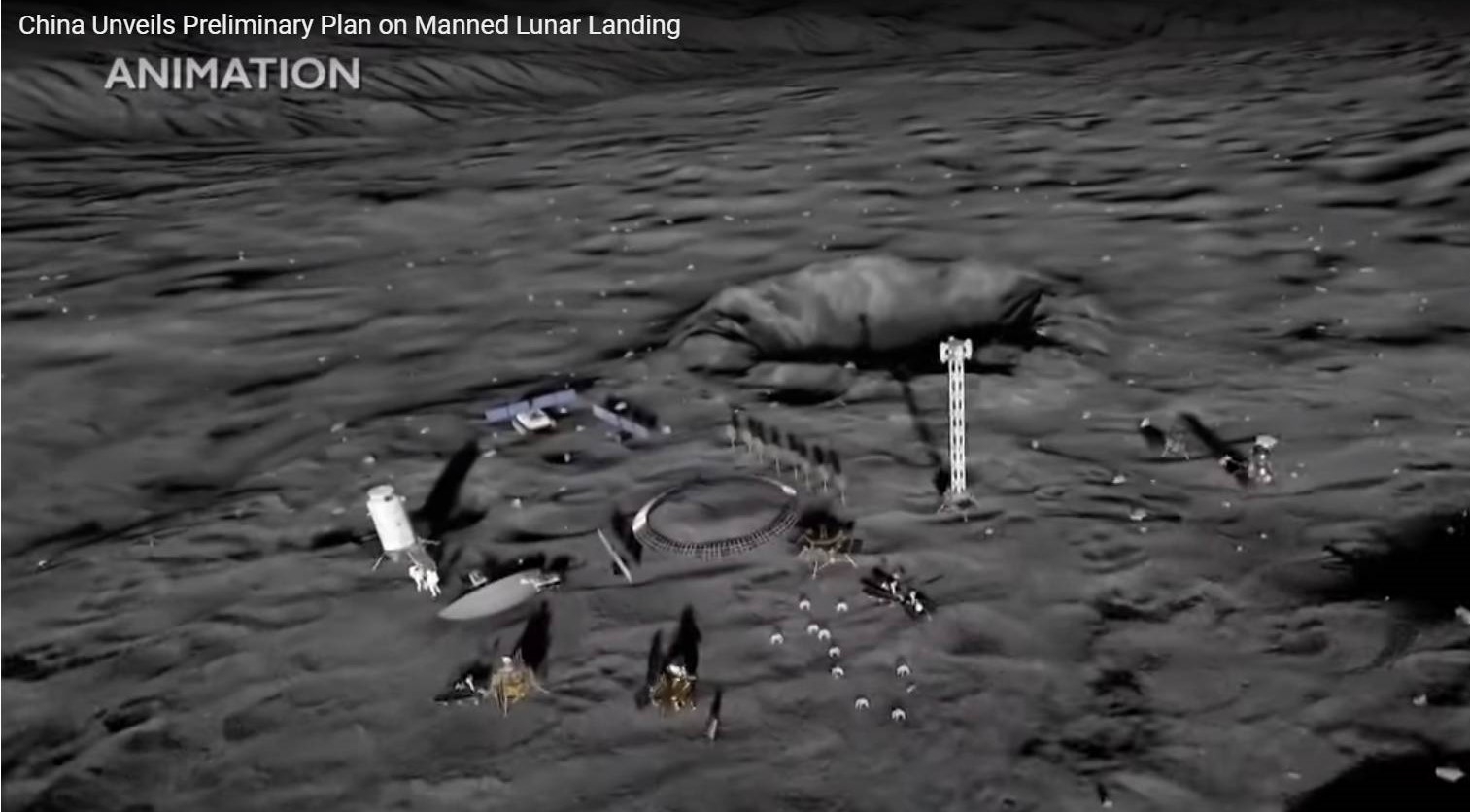
Artist’s view of International Lunar Research Station to be completed by 2035. Credit: CNSA
The fourth phase will be carried out in three steps, with the Chang’e-6, Chang’e-7 and Chang’e-8 probes being launched before 2030, CCTV notes. The Chang’e-8 will constitute, together with Chang’e-7, the basic model of a lunar research station.
Multi-level, multi-type cooperation
Ge Ping, deputy director of the Center of Lunar Exploration and Space Engineering of the China National Space Administration (CNSA) told CGTN that China is willing to carry out Moon exploration-related multi-level and multi-type cooperation with other countries and international organizations.
“China has opened up applications for Chang’e-5’s moon soil samples for the international science community. It’s also looking for cooperation in the lunar program’s fourth step and other planetary exploration projects,” Ge said.

Chang’e-5 return capsule holding lunar specimens.
Credit: National Astronomical Observatories, CAS
The CNSA opened applications for access to the returned cache of Chang’e-5 lunar samples to international scientists in late 2023.
Late last year, NASA worked with Congress to allow NASA-funded researchers to apply to CNSA for access to the Chang’e-5 samples. Subsequently, CNSA received nearly a dozen applications from U.S. proposers.
Still to come is NASA guidance on how space agency funding may be used to support research efforts on Chang’e-5 samples, according to Lori Glaze, director of NASA’s Science Mission Directorate’s Planetary Science Division.
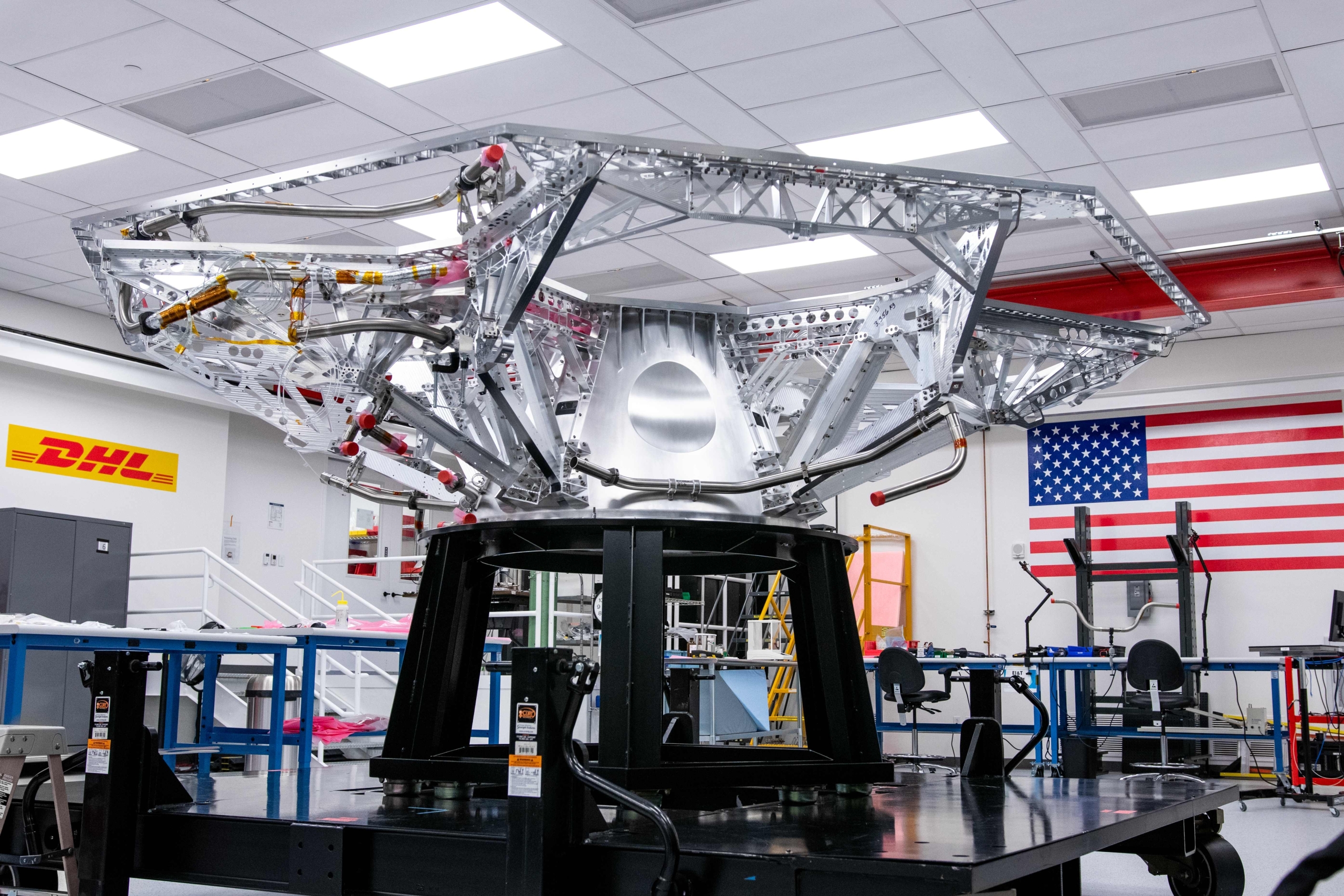
Factory floor work on readying the Astrobotic Griffin Mission One lunar lander that will carry to the moon NASA’s VIPER robot.
Image credit: Astrobotic Technology
Despite the failure of the first U.S. commercial lunar lander to ever operate in space, Astrobotic Technology is pressing forward on its next moon mission still on the calendar for sendoff before year’s end.
Notes a final update for the Peregrine Mission One on the Astrobotic website:
“Peregrine has flown so Griffin may land. Ad luna per aspera,” the communiqué concludes in a nod to a Star Trek motto, “To the stars through difficulty.”
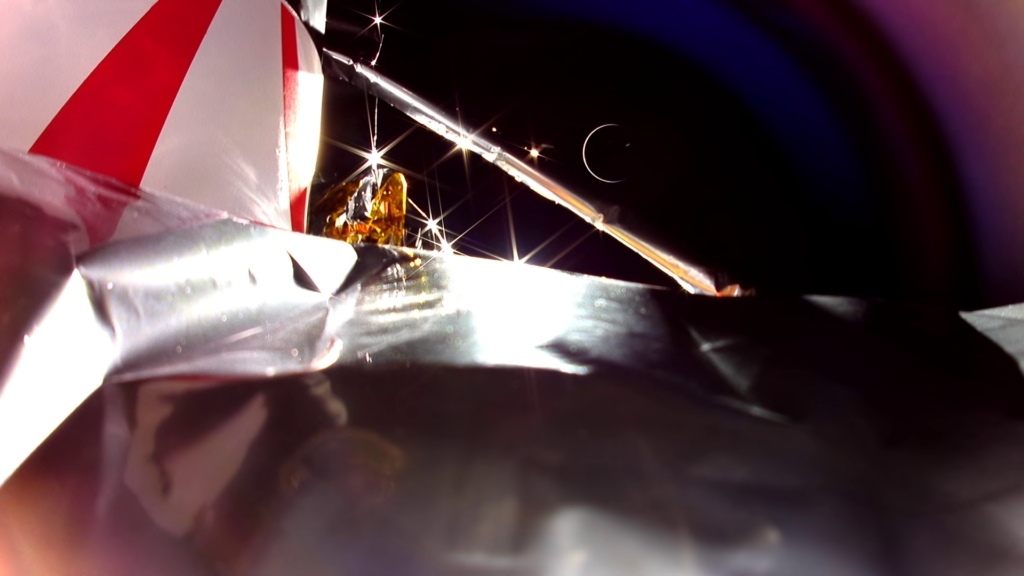
Peregrine lunar lander imaged the Earth as it headed for destructive dive into the South Pacific ocean.
Image credit: Astrobotic Technology
Now on view
The build-up of hardware for the Astrobotic Griffin Mission One lander is now on view at the Pittsburgh-based private firm from the adjoining Moonshot Museum.
Griffin is the largest lunar lander since the Apollo lunar module.
There’s no doubt about it. The upcoming flight is not just a big one for NASA’s Commercial Lunar Payload Services (CLPS) initiative in which American companies are contracted to deliver science and technology to the lunar surface.

Artwork depicts NASA’s VIPER, on the prowl for water and other resources.
Image credit: NASA Ames/Daniel Rutter
It also signals an important bridge to the NASA Artemis human exploration agenda for the moon via the space agency’s VIPER rover.
For more information, go to my new Space.com story – “Astrobotic readies next lunar lander following failed Peregrine moon mission” – at:
https://www.space.com/astrobotic-next-lunar-lander-failed-peregrine-mission

