Archive for the ‘Space News’ Category
 Author:
  April 3rd, 2024
Image credit: ICON
NASA has been working with a robotics and artificial intelligence group to hammer out construction methods for a Moon outpost.
Part of that partnership is characterizing the lunar topside to understand the Moon’s exact regolith makeup – creating a library of lunar dust and associated bits and pieces.
In November 2022, NASA selected ICON for a $57.2 million grant to develop lunar construction technology. ICON’s primarily feedstock for structures on the Moon is using local lunar resources as building materials, putting to use 3D-printing technology.

Image credit: ICON
However, minerals and glass in lunar soil vary widely from sample to sample and the 3D-printing process is sensitive to changes in mineralogy.
Extraterrestrial minerals
To help move lunar construction concepts forward, a research task is underway at Northwestern University in Evanston, Illinois. The idea is to create a library of potential lunar sample compositions using what’s called “simulants” to optimize the building process on the Moon.
Northwestern University mineralogist Steven Jacobsen has received funding from NASA’s Marshall Space Flight Center to develop that lunar sample library.
“Off-world construction comes with many challenges,” said Jacobsen, the project’s principal investigator.

Sample of a lunar soil simulant in the lab.
Image credit: Shane Collins/Northwestern University
“The Moon’s soil is not like that on Earth. On the Moon, soil is formed from meteoroid impacts that have crushed the surface. So, the Moon is essentially coated in a thick layer of pulverized flour. The types of minerals and glass found in lunar soil depend on many factors. The material can vary widely within even a small area,” Jacobsen said in a university statement.
Moon bricks
Jacobsen pointed out it’s not feasible to send conventional Earth-based construction equipment and materials to the Moon. The payload would be too heavy, he said.
“So, this plan is a lot more practical,” Jacobsen said. “Just as the first bricks on Earth were made out of terrestrial soil, the first bricks on the Moon will be made out of lunar soil.”
The task at hand is to anticipate the likely variability in lunar soil and come up with a way to measure it on the fly, onboard a 3D printer.

Various samples of lunar soil simulants in the lab.
Image credit: Shane Collins/Northwestern University
Once the variability in realistic lunar sample is determined, the next step is to probe how the composition of lunar materials can affect the melting process used in robotic construction.
Melting point
Once planted on the Moon, ICON’s lunar construction systems would scoop up lunar soil and melt it for printing. After printing, the melted dirt will harden and cool into a ceramic material.
“Different minerals in lunar dirt melt at different rates,” Jacobsen noted, “so the 3D-printing process is very sensitive to changes in mineralogy.”
One scoop of lunar topside might have a different melting point than the next scoop. The 3D-printing technology needs to be nimble enough to know how to handle these subtle differences.

Image credit: NASA
Scoop diagnostics
By having a sample library, a 3D printer can be ready for all possible lunar material mixes, performing diagnostics of each scoop and then adjusting the printer’s laser parameters for heating and cooling.
“Without understanding the characteristics of the soil, it’s difficult to understand the variability of the final printed materials,” Jacobsen said.
“Using the library that we create from simulants — cross-checked against the lunar soil — the printer will know how to process each piece to produce the best ceramic,” Jacobsen added. “That detailed library of information will play a part in making the imagined outpost a reality.”

ICON’s Project Olympus is a space-based construction system under active development to support the future exploration of the Moon with NASA and for commercial lunar construction projects. The Olympus construction system is being designed and engineered to construct landing pads, roadways, non-pressurized structures,
and pressurized habitats.
Image credit: ICON
 Posted in

The Music of Space: Scoring the Cosmos in Film and Television by Chris Carberry; McFarland Books (2024); 307 pages; Softcover: $39.95.
Music to my ears…that somebody has written an account of the music of space-aged movies and television, as well as about off-Earth performances!
This well-researched and thoughtful book underscores the role of music in such classics as 2001: A Space Odyssey, Star Trek, and one of my all-time favorites, The Day the Earth Stood Still.
Chris Carberry, CEO of the non-profit organization Explore Mars, Inc., has written an informative account regarding the use of film scores that play a transformative role in how we perceive space. “Music has the capacity to capture and articulate the human experience and emotions than can be expressed in words,” he explains.
The Music of Space is divided into 12 sections, with an impressive chapter notes and excellent bibliography.
Covered in its pages, the book kicks-off with the first 50 years of space films, from silence to sound, through the 1950s, 1960s, and 1970s that saw a turning point in space music thanks to composer John Williams and his Star Wars contributions. Highlighted too is the space horror classic, Alien, the return of Star Trek, and into the 1980s, anchored by Steven Spielberg’s E.T. the Extraterrestrial. You will also find his discussion of The Martian, Interstellar, and a number of space-based television epics.
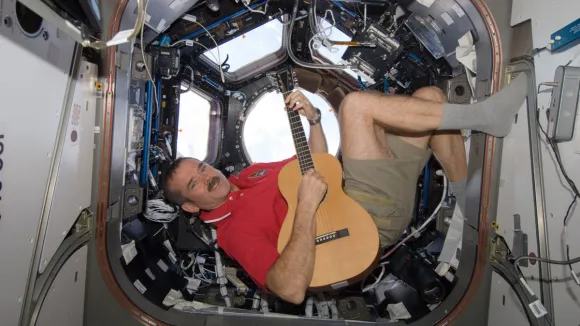
ISS Astronaut, Chris Hadfield, picks out David Bowie’s Space Oddity.
Image credit: NASA
Carberry doesn’t skimp on details, showcasing his matchless research skills.
Near the book’s concluding remarks, the reader will find a nicely explained section on music in “real” space, be it played via harmonicas, guitars, keyboard, flutes, bells, saxophones, even a didgeridoo. Similarly, music in other forms is included, from the Beatles’ song “Across the Universe” broadcast toward the star Polaris to Apollo 17 moonwalkers singing a takeoff of “While Strolling Through the Park.”
I was drawn in by this author comment: “As the pace of real space activities accelerates, it is likely that space-related content will continue. However, the sound of space will also inevitably change,” he writes, “as these stories become less and less the realm of science fiction, and reflect reality.”
The Music of Space is an exceptional treasure on a topic that needed notice – and in chronicling this subject matter, Carberry has struck the right chord.
For more information on this book, go to:

Image credit: Barbara David
Wait a minute!
Is there a possible connection between that ISS battery pallet reentry last month and an object crashing through a person’s ceiling and floor in Florida?
A high-speed cylindrical object reportedly fell through the roof of Alejandro Otero’s home in Naples, Florida last month.

Image credit: WINK News/Inside Outer Space screengrab
According to WINK News – a CBS station in southwest Florida – an apparent human-made cylindrical-shaped object weighing nearly two pounds smashed through the ceiling and tore through the floor of Otero’s house.

Image credit: WINK News/Inside Outer Space screengrab
Otero told WINK News that he thought it could be related to the ISS battery pack reentry.
Final trajectory
According to satellite skywatcher, Marco Langbroek, the time and location indeed matches with the final trajectory for the multi-ton Exposed Pallet 9 (EP9) and its battery stack that reentered the Earth’s atmosphere on March 8.

Image credit: NASA
In reaching out to NASA Kennedy Space Center, space agency spokesperson Joshua Finch told Inside Outer Space: “NASA collected an item in cooperation with the homeowner, and will analyze the object at NASA’s Kennedy Space Center in Florida as soon as possible to determine its origin. More information will be available once the analysis is complete.”
As for when that analysis would be finished, Finch added: “It would be inappropriate to speculate on the timeline for completing the examination. We will provide more information after the object is analyzed.”
Multi-ton leftover
Here’s the overall background regarding that nearly 3-ton leftover tossed overboard from the International Space Station. The multi-ton Exposed Pallet 9 (EP9) was robot-arm jettisoned from the space station back in March 2021.
At the time, it was reported to be the most massive object ever tossed overboard from the International Space Station.
The European Space Agency (ESA) Space Debris and Independent Safety Offices were closely monitoring the reentry of the pallet of used ISS batteries.
The batteries, nine in total, will undergo “a natural reentry” said ESA pre-reentry, predicted between approximately 15:35 CET and 22:25 CET on March 8.
“The total mass of the batteries is estimated at 2.6 metric tonnes, most of which may burn up during the reentry,” the ESA statement adds. “While some parts may reach the ground, the casualty risk – the likelihood of a person being hit – is very low.”
Here’s the original WINK News story: “Object from the sky crashes through Naples family’s ceiling and floor” at:
https://winknews.com/2024/03/15/object-crashes-through-naples-ceiling-floor/
For more details on this incident, check out an excellent story by Stephen Clark of Ars Technica at:

The Asteroid Hunter: A Scientist’s Journey to the Dawn of our Solar System by Dante S. Lauretta; Grand Central Publishing & Hachette Book Group (2024); 336 pages; Hardcover: $30.00
It is not often that a 21st century author is a milestone-making participant that digs billions of years into the past to further the future.
Dante Lauretta is a cosmic “rock hound.” And this book is far from being a tell-all tale of his stellar leadership in the Origins, Spectral Interpretation, Resource Identification, and Security-Regolith Explorer mission, mercifully shortened to OSIRIS-REx.
The Asteroid Hunter is a story of his personal quest in shaping a remarkable scientific career. This very enjoyable, insightful and moving volume is must reading for all that hunger to understand the rough and tumble cosmos at large – along with the delicate nature and audacity of human spirit necessary to tangle with the unknown.
Launched in 2016, OSIRIS-REx reached asteroid Bennu in September 1999, then performed snag, stash, and send-off maneuvers, express delivering those space rock specimens to Earth on Sept. 24, 2023.

Dante Lauretta, OSIRIS-REx’s principal investigator from the University of Arizona holds a mock up of the asteroid collection device – TAGSAM.
Image credit: Barbara David
OSIRIS-REx released its capsule of extraterrestrial goodies over Earth’s atmosphere. That container then parachuted into the Department of Defense’s Utah Test and Training Range as the OSIRIS-REx team – and the author — was on location to welcome it home.
That voyage to asteroid Bennu and back to our planet took seven years. OSIRIS-REx was the first U.S. mission to collect a sample from an asteroid and deliver it to Earth. And that space trek alone – proposing, building, and flying the craft — is a tale in itself.
Starting in 2011, Lauretta served as the principal investigator for OSIRIS-REx asteroid sample return mission. But he offers so much more in this well-written, cleaver and personal prose of a story.
A reader will find his professional and personal memoir instructive. Indeed, as Lauretta notes “the universe is our classroom, our laboratory, our muse” and that “our journey of exploration has only just begun.”
For more information on this remarkable book, go to:
BTW: go to the Amazon offerings to hear the author read a section of the book at:
https://www.amazon.com/Asteroid-Hunter-Scientists-Journey-System/dp/1538722941

Curiosity Left B Navigation Camera image taken on Sol 4142, March 31, 2024.
Image credit: NASA/JPL-Caltech
NASA’s Curiosity Mars rover at Gale Crater is now performing Sol 4143 duties.
Lauren Edgar, a planetary geologist at the USGS Astrogeology Science Center in Flagstaff, Arizona, reports that the rover is approaching an intriguing pile of rocks called “Hinman Col” – a poorly sorted collection of clasts located along the margin of Gediz Vallis ridge.

Curiosity Front Hazard Avoidance Camera Left B image acquired on Sol 4142, March 31, 2024.
Image credit: NASA/JPL-Caltech
Mars researchers were anticipating a closer look at this deposit over the recent weekend, to set up for contact science on the different rock types this week.
“In doing so, we hope to investigate where the different clasts might have come from and how this feature (which looks like a bit of a mess!) relates to the rest of Gediz Vallis ridge,” Edgar adds.

Curiosity Chemistry & Camera (ChemCam) Remote Micro-Imager (RMI) photo taken on Sol 4142, March 31, 2024.
Image credit: NASA/JPL-Caltech/LANL
A clast is a fragment of geological debris: chunks, and smaller grains of rock broken off other rocks by physical weathering.

Curiosity Left B Navigation Camera image taken on Sol 4142, March 31, 2024.
Image credit: NASA/JPL-Caltech
Bedrock science
A recently plotted out plan for Sols 4141-4143 is focused on contact science on the bedrock in the robot’s workspace, remote sensing to understand the rover’s surroundings, and a short bump to prepare for contact science at Hinman Col this week.

Curiosity Left B Navigation Camera image taken on Sol 4142, March 31, 2024.
Image credit: NASA/JPL-Caltech
“Before we get to Hinman Col, we have another opportunity to assess the light-toned, laminated bedrock in our workspace,” Edgar points out.
The science team planned three contact science targets, including use of the Dust Removal Tool (DRT), THE Mars Hand Lens Imager (MAHLI), and the Alpha Particle X-Ray Spectrometer (APXS) on the target “Rose Lake” to assess the chemistry and textures in typical bedrock.

Curiosity Left B Navigation Camera image taken on Sol 4142, March 31, 2024.
Image credit: NASA/JPL-Caltech

Curiosity Left B Navigation Camera image taken on Sol 4142, March 31, 2024.
Image credit: NASA/JPL-Caltech

Curiosity Left B Navigation Camera image taken on Sol 4142, March 31, 2024.
Image credit: NASA/JPL-Caltech

Curiosity Left B Navigation Camera image taken on Sol 4142, March 31, 2024.
Image credit: NASA/JPL-Caltech
“We also planned a MAHLI stereo mosaic on ‘Whorl Mountain’ to model the rock surface and study bedding orientations around some disrupted laminations,” Edgar added, “and another MAHLI/APXS target called “Little Slide Canyon” to investigate the texture and composition of the more convoluted bedding.”
Layering and clast configuration
Curiosity’s geology theme group also planned Chemistry and Camera (ChemCam) Laser Induced Breakdown Spectroscopy (LIBS) on two bedrock targets, “Robinson Lake” and “Ward Mountain.”
That robot task would characterize rougher and smoother parts of the local bedrock.
ChemCam will also be used to acquire long distance Remote Micro-Imager (RMI) mosaics to assess parts of upper Gediz Vallis Ridge at the location known as “Fascination Turret.”
Meanwhile Mastcam will be busy documenting the ChemCam targets, Edgar continues, and acquiring mosaics to assess layering and clast configuration in the vertical face of “Fascination Turret.”
Short drive
“Then Curiosity will take a very short drive to get into just the right position in front of Hinman Col, hopefully with a variety of rocks in the workspace. After the drive we’ll take some post-drive imaging to prepare for future targeting,” Edgar reports.

Curiosity Left B Navigation Camera image taken on Sol 4142, March 31, 2024.
Image credit: NASA/JPL-Caltech
The third sol (4143) includes an untargeted science block, so the team planned an Autonomous Exploration for Gathering Increased Science (AGEIS) session – a software suite that permits the rover to autonomously detect and prioritize targets.
AEGIS activity will add to the bedrock survey of compositional variations.
“Throughout the plan, the Environmental theme group planned a lot of great monitoring activities to search for dust devils and clouds, assess atmospheric opacity, and monitor the movement of fines on the rover deck,” Edgar concludes. “Looking forward to learning more about this messy pile of rocks and unraveling the clues that they might record about their emplacement!”

Image credit: Sanctuary On The Moon Project
There’s a new mission to the Moon – one that intends to deliver a time capsule via NASA’s multi-pronged Artemis program for “rebooting” the human exploration of Earth’s celestial companion.
Announced in Paris on March 21, the effort is called “Sanctuary On The Moon” and has been launched by French engineer Benoit Faiveley and a team of international scientists, researchers, designers and artists.

Benoit Faiveley, founder, inspecting one of the genome disc. Image credit: Sanctuary On The Moon/Benedict Redgrove
The project’s countdown is targeted for a 2027 sendoff and consists of 24 sapphire discs engraved with “the very essence of humanity,” the initiative declares.
Repository of knowledge
In order to weather the hash climes of the Moon, a durable, vault-like container is to be designed, one that meets the space certification requirements of NASA.
“We are delighted to take Sanctuary to the Moon”, remarks Joel Kearns, NASA’s Deputy Associate Administrator for Exploration in NASA’s Science Mission Directorate. “We believe that this internationally curated repository of knowledge on the Moon will serve as an inspiration today and for many generations to come,” according to a Sanctuary to the Moon website posting.

The Sanctuary team looking at the ‘Life’ disc. Image credit: Sanctuary On The Moon/Benedict Redgrove
Cosmic hello
Sanctuary will be delivered to the Moon’s surface using an automatic space probe from NASA’s Commercial Lunar Payload Services (CLPS) initiative.
In a statement, Faiveley explains that Sanctuary “will constitute a ‘cosmic hello’ to our descendants or perhaps even visitors from elsewhere. It will be a variegated portrait of our species engraved in micropixels – up to 7 billion per disc.”
The discs are currently being engraved at the French Alternative Energies and Atomic Energy Commission (CEA).
Faiveley adds that narrative threads by way of text, images, diagrams and data representation are an aspect of the engraving, “important examples from astrophysics, particle physics, astronomy and planetary science.”
Genomenauts
Sanctuary’s archival time capsule team is made up of a multidisciplinary team of scientists, engineers, astrophysicists, paleontologists, cosmologists and artists.
Along with NASA, Sanctuary has also received the support of organizations such as CNES, the French space agency, as well as UNESCO.

Image credit: Sanctuary On The Moon
The discs will not only include examples of mathematics, culture, paleontology, art and science but also the human genome.
“For the first time in history, the collective human ‘recipe’ in the form of male and female genomes will be taken to another world,” the Sanctuary website adds.
The sequencing was done in Canada’s Michael Smith Genome Sciences Centre at BC Cancer in Vancouver.
The ‘Genomenauts’ were chosen through a double-blind selection process.

French engineer Benoit Faiveley.
Image credit: Sanctuary On The Moon
Our world, our epoch
Part of the time capsule will be dedicated to UNESCO’s designated sites such as World Heritage and Biosphere reserves, as well as to key international UNESCO declarations on bioethics and the human genome.
“The Sanctuary project is a message for the very long term. We want future explorers to step back in time and join us in our exploration of ourselves, our world and our epoch,” Faiveley concludes.
Over the next few years, the Sanctuary team will include additional original content that will also be exploited in different exhibitions, conferences and documentaries.
For more about Sanctuary On The Moon, go to:

Image credit: NASA
Let’s face it. Looking at all those “free-floaters” inside the multi-billion dollar International Space Station it must be a cool experience.
Unchained from the tug of Earth gravity, astronaut antics in microgravity are a way to take the edge off all those on-the-clock duties.
But now new research shows that space travelers, free from the pull of gravity, gain an uncanny ability to orient themselves and gauge distance travelled within the confines of their orbital home-away-from-home.

Image credit: NASA
Dozen astronauts
Björn Jörges of the Center for Vision Research at York University in Canada led the research work.
The findings of the study – “The effects of long-term exposure to microgravity and body orientation relative to gravity on perceived traveled distance” – has been published in the journal npj Microgravity. It was done in collaboration with a dozen ISS astronauts.
Written informed consent from all participants was acquired. The investigation was approved by the local ethics committee at York University as well as by the Canadian Space Agency (CSA), NASA, the Japan Aerospace Exploration Agency (JAXA), and the European Space Agency (ESA).

Image credit: NASA
Explicit goal of project
“As space flight programs start to move past some of their biases in astronaut recruitment — like the fact that NASA only selected young, white, male astronauts during its first 20 years — it becomes increasingly important that microgravity studies ensure representative participant samples,” states supplemental data attached to the primary research paper.
“As a small step in this direction, one of the explicit goals of the VECTION project, funded by the Canadian Space Agency, was to assess whether exposure to microgravity affected male and female astronauts differently.
Go to this video on the VECTION project at:
Self-motion
The way people move about is more like flying, says co-investigator, Laurence Harris of York University, an expert on vision and the perception of motion. He also heads up the Multisensory Integration Lab and is the former director of the Center for Vision Research at York.
“It has been repeatedly shown that the perception of gravity influences perceptual skill,” York explains in a university statement.
“The most profound way of looking at the influence of gravity is to take it away, which is why we took our research into space,” York added.

Image credit: NASA
Open question
It is an open question, the research paper points out, how exactly visual, vestibular and other cues are integrated to develop the perception of self-motion – particularly when self-motion is evoked purely by optic flow.
Based on research findings, York said that it seems as though humans are surprisingly able to compensate adequately for the lack of an Earth-normal environment using vision.
“People have previously anecdotally reported that they felt they were moving faster or further than they really were in space, so this provided some motivation to actually record this,” York explains.
The research explains that astronauts’ performance of their estimate of the distance of self-motion, either in terms of accuracy or precision, did not change significantly in response to microgravity exposure.

A screenshot from the hallway in which the post-flight participants were immersed. B The target is shown at the beginning of each trial.
Image credit: Jörges, B., et al
Crew safety
The study contrasted the performance of six men and six women before, during, and after their stints onboard the ISS.
It was found that the astronaut sense of how far they travelled remained largely intact. That has implications for crew safety in space and could potentially give clues to how aging affects people’s balance systems here on Earth.
“On a number of occasions during our experiment, the ISS had to perform evasive maneuvers,” Harris recalls. “Astronauts need to be able to go to safe places or escape hatches on the ISS quickly and efficiently in an emergency. So, it was very reassuring to find that they were actually able to do this quite precisely.”
Astronauts are unlikely to be exposed to dangers due to an unusual perception of traveled distance when in space, the paper points out, such as when sensitive equipment and machinery must be operated manually and in a visually guided fashion in the absence of gravity.

Image credit: Jörges, B., et al
First of three papers
The study, a decade in the making, represents the first of three papers that will emerge from investigating the effects of microgravity exposure on different perceptual skills including the estimation of body tilt, travelled distance, and object size.
York said that this newly published work finds that self-motion is largely unaffected, suggesting the balance issues that frequently come from old age may not be related to the vestibular system.

Image credit: NASA
“It suggests that the mechanism for the perception of movement in older people should be relatively unaffected, and that the issues involved in falling may not be so much in terms of the perception of how far they’ve moved, but perhaps more to do with how they’re able to convert that into a balance reflex,” York states in the university statement.
To view the full paper – “The effects of long-term exposure to microgravity and body orientation relative to gravity on perceived traveled distance” – go to:
https://www.nature.com/articles/s41526-024-00376-6
Also, go to this tool used in the study at:

Curiosity at Gale crater as of Sol 4139. Image credit: NASA/JPL-Caltech/Univ. of Arizona
NASA’s Curiosity Mars rover at Gale Crater is now performing Sol 4142 tasks.
Reports Conor Hayes, a graduate student at York University in Toronto, Ontario, Canada, the rover is producing stunning photos as it drives up along the side of the upper Gediz Vallis Ridge “and the pile of phenomenal images we have of this area will continue to grow.”

A Navcam image looking back towards the northern rim of Gale Crater. “Now that we’re nearing the peak of the dusty season on Mars, it can sometimes be challenging to see the crater rim through all of the dust in the atmosphere,” reports Conor Hayes, a graduate student at York University in Toronto, Ontario, Canada. Curiosity Right Navigation Camera image acquired on Sol 4137, March 26, 2024.
Image credit: NASA/JPL-Caltech
In the plan for Sols 4139-4140, Curiosity continued to inspect the bedrock in its workspace, first getting Alpha Particle X-Ray Spectrometer (APXS) observations of “Rainbow Falls” and then five Laser Induced Breakdown Spectroscopy (LIBS) shots at “Crystal Turret.”

Chemistry & Camera (ChemCam) Remote Micro-Imager (RMI) photo acquired on Sol 4141, March 30, 2024.
Image credit: NASA/JPL-Caltech/LANL
Fascination Turret
The robot’s Chemistry and Camera (ChemCam) was scheduled to then turn its eye to Fascination Turret, which it has imaged from other angles in previous plans, taking two long-distance Remote Micro-Imager (RMI)mosaics.
“As an aside, ‘long-distance’ is definitely a relative term here,” Hayes adds. “The part of Fascination Turret we’re imaging is about 25–30 meters away, which feels like nothing compared to the RMI mosaics of the northern rim of Gale that we’ve taken in the past, which is over 30 kilometers away!”

Curiosity Right B Navigation Camera on Sol 4141, March 31, 2024.
Image credit: NASA/JPL-Caltech
Drive target
The plan called for post-ChemCam use of Curiosity’s Mastcam to shine with documentation images of Cristal Turret post-LIBS, a mosaic of our eventual drive target “Hinman Col,” as well as context imaging of the upper Gediz Vallis Ridge, Hays reports, to help Mars researchers choose targets in the future and two color images of the areas captured in the RMI mosaics earlier.

Curiosity Right B Navigation Camera on Sol 4141, March 30, 2024.
Image credit: NASA/JPL-Caltech
“After we’re finished taking a look around us, we’ll turn back to our workspace for one last time, taking MAHLI [Mars Hand Lens Imager] photos of Rainbow Falls and ‘Rancheria Falls,’” Hayes notes, then drive away towards Hinman Col, taking Mastcam images to assist operators build the next few plans for the rover to carry out.

Curiosity Mars Hand Lens Imager (MAHLI) photo produced on Sol 4141, March 31, 2024.
Image credit: NASA/JPL-Caltech/MSSS
Power nap
“Overnight, we take a nice long rest to help recharge our batteries before waking up in the early morning to take another Mastcam mosaic of Fascination Turret,” Hayes observes, noting that it’s definitely living up to its name. The mosaic will be taken this time under different illumination conditions than what Curiosity captures in the midsol or afternoon.

Curiosity Right B Navigation Camera on Sol 4141, March 31, 2024.
Image credit: NASA/JPL-Caltech
“After a quick one hour power nap, we’ll wake up again for some more remote sensing science. As is typical after a drive, we let ChemCam choose its own post-drive target with AEGIS before moving into some environmental science,” Hayes reports.
AEGIS stands for Autonomous Exploration for Gathering Increased Science) – a software suite that permits the rover to autonomously detect and prioritize targets.

Curiosity Right B Navigation Camera on Sol 4141, March 30, 2024.
Image credit: NASA/JPL-Caltech
Dust-focused
“We’re rapidly nearing the peak of the dusty season, so the environmental science team’s observations are very dust-focused,” Hayes adds. “We begin by using Navcam to take some images of the northern crater rim to observe the amount of dust between the rover and the rim.”
There is quite a bit of dust in the air at the moment, Hayes observes. “You really have to squint to just barely make out the crater rim!”
Also in the plan is taking “deck monitoring” imagery to see how the wind and the rover’s motion as it drives affects the sand that has gathered on top of the rover deck since landing.
After that, the recently scripted plan includes surveying the area around us for dust devils and taking a “Suprahorizon Movie.”

Curiosity Right B Navigation Camera on Sol 4141, March 30, 2024.
Image credit: NASA/JPL-Caltech
“The Suprahorizon Movie is usually used to look for clouds over Gale,” Hayes reports, “but we’ve adjusted the direction that it points to look over a large sand patch that we drove past about 260 sols ago so that it can pull double-duty to hunt for wind-driven sand lifting or dust devils in addition to clouds.”
Curiosity was slated to sleep the rest of the plan away, briefly waking up several times to send data back to Earth.
The robot will carry out ongoing tasks via the Rover Environmental Monitoring Station (REMS), the Radiation Assessment Detector (RAD), and the Dynamic Albedo of Neutrons (DAN) throughout this plan “to monitor the weather and radiation environment and look for hydrated minerals in the subsurface,” Hayes concludes.

(Left) Image credit: Roscosmos/Inside Outer Space screengrab
Space technicians are readying the first test flight of Russia’s Angara A5 launch vehicle from the Vostochny.
This flight development test from the Amur space rocket complex signals the projected start of future operations of the heavy-lift rocket system from this cosmodrome.

Image credit: Roscosmos/Inside Outer Space screengrab
According to Roscosmos, liftoff of the Angara-A5 with an Orion upper stage and a mass simulator payload from Cosmodrome Site 1A is targeted for an April 6 to April 10 time period.

Image credit: Roscosmos/Inside Outer Space screengrab
Cosmodrome chaos
Angara, developed by the Khrunichev State Research and Production Space Center, is slated to replace the venerable Russian Proton booster. The Orion belongs to the DM family of upper stages.

Image credit: Roscosmos/Inside Outer Space screengrab
Over the years, development of the Vostochny launch site has been besieged by escalating cost, corruption and embezzlement issues, along with worker pay delays.
The Vostochny Cosmodrome is situated above the 51st parallel north in the Amur Oblast, in the Russian Far East, built to help reduce Russia’s dependency on the Baikonur Cosmodrome in Kazakhstan.
Vostochny also launches Soyuz boosters, doing so on February 19, boosting into orbit an Iranian satellite and 18 Russian satellites.

Image credit: Roscosmos/Inside Outer Space screengrab

SLIM shot after 2nd awakening.
Image credit: JAXA/SLIM
From the Japan Aerospace Exploration Agency, the Smart Lander for Investigating Moon (SLIM) has reawakened from another dose of lunar night that extends for some 14 days.
“Last night, we received a response from SLIM, confirming that the spacecraft made it through the lunar night for the second time! Since the sun was still high and the equipment was still hot, we only took some shots of the usual scenery with the navigation camera.”
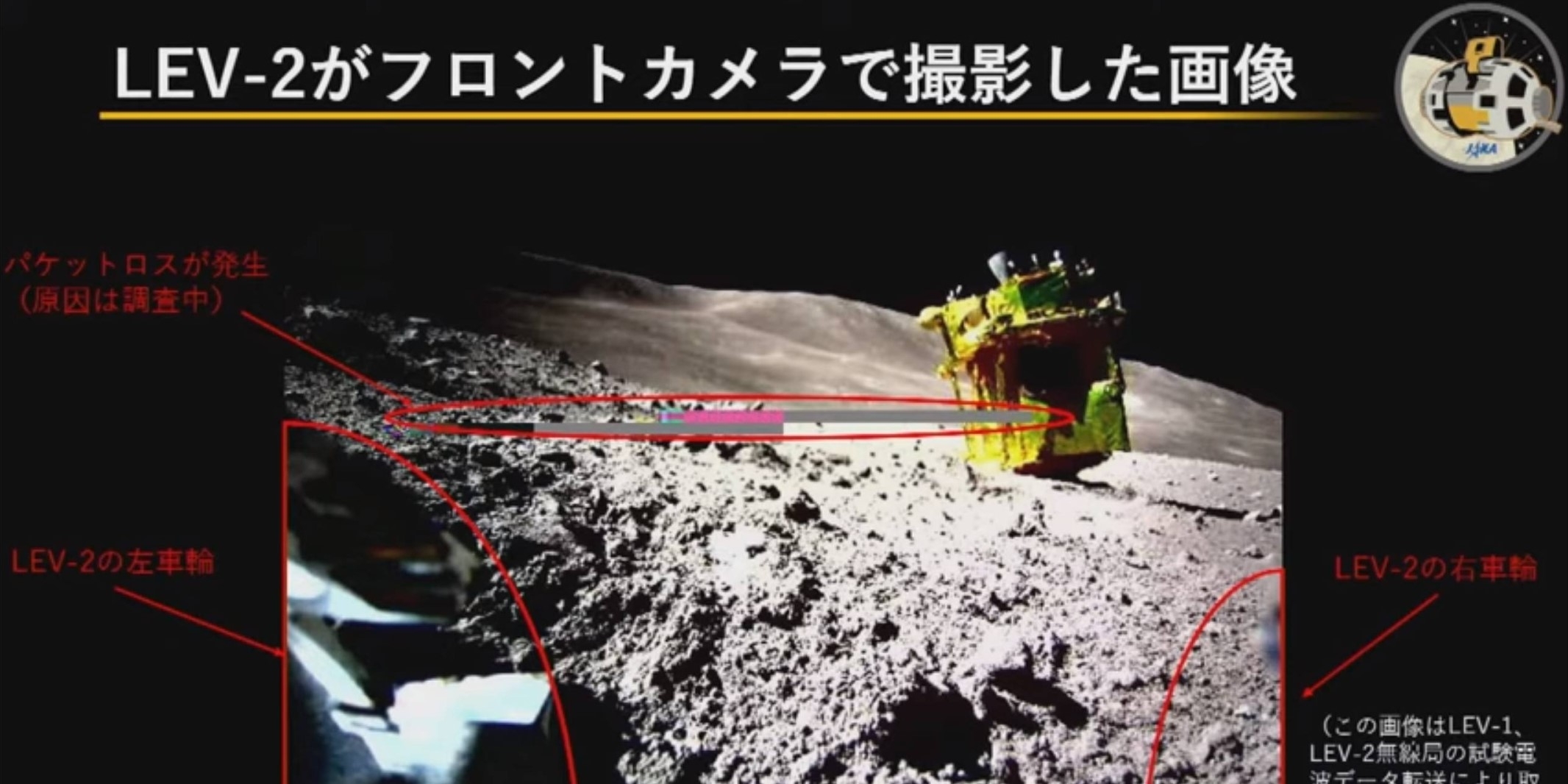
Image taken shortly after landing, the Ultra-small SORA-QI photo of SLIM in nose-down mode. Image credit: JAXA/Inside Outer Space screengrab
Repeat temperature swings
On March 1, the Sun had set on the Shioli Crater and SLIM re-entered a period of dormancy. “Although the probability of a failure increases with the repeated severe temperature cycles, SLIM operation will attempt to resume when the sun rises,” the JAXA/SLIM group said at that time.
“According to the acquired data,” a JAXA/SLIM statement explains, “some temperature sensors and unused battery cells are starting to malfunction, but the majority of functions that survived the first lunar night was maintained even after the second lunar night!”
SLIM made its lunar landing on January 19, 2024 making Japan the fifth country to soft-land a spacecraft on the Moon.

