Archive for the ‘Space News’ Category
 Author:
  April 13th, 2024
Image credit: JPL/Caltech
The Jet Propulsion Laboratory in Pasadena, California is home base for building pioneering spacecraft that have probed every planet in our solar system, including the Sun.
Federally funded by NASA and managed by Caltech, JPL and its cadre of engineers and scientists are being led by Laurie Leshin, the first woman to serve as JPL director, taking on that role in May 2022.
Leshin’s career path prior to running JPL draws from her work as a leading geochemist and space scientist, along with stints in academia and government, including holding senior NASA positions.
Now the helmswoman at JPL, Leshin points to space technology achievements, but has also been plagued by program setbacks and beleaguered by space budget woes, heightened by the cost-overrun, mega-dollar needs of the distressed JPL-led Mars Sample Return project.

Credit: JPL/Caltech
Budget uncertainty and shortfalls
In adjusting to NASA budgetary uncertainty and shortfalls, Leshin announced last February a JPL workforce reduction through layoffs. “It was very difficult and painful from a human perspective,” she said, “among the largest layoffs that we’ve ever had.”
For my SpaceNews interview with Leshin, go to – “JPL chief Laurie Leshin on science, Mars and budget infighting” – at:
https://spacenews.com/jpl-chief-laurie-leshin-science-mars-budget-infighting/
 Posted in

Pre-launch photo of lunar relay satellite.
Image credit: CCTV/CNSA/Inside Outer Space screengrab
The China National Space Administration (CNSA) announced on Friday the Queqiao-2 completed a communication test on April 6, linking up with the already on the Moon Chang’e-4 far side lander/rover hardware.

Image credit: CCTV/Inside Outer Space screengrab
Additionally, the new relay spacecraft communicated with the Chang’e-6 lunar probe still here on Earth and expected to be launched next month. This far side lander — in a historic first if successful – is built to snag, bag and rocket back to Earth select lunar specimens, similar in technological scope of the Chang’e-5 Moon sampler mission.
Meanwhile, two communication and navigation technology test satellites, Tiandu-1 and Tiandu-2, also completed near-moon braking and entered their respective circumlunar orbits.

Tiandu-1 and Tiandu-2 subsatellites are to trial-run lunar communications technology.
Image credit: DSEL
Long life span
“The success of the Qiaoqiao-2 mission means it can provide relay communication services for more probes to be launched for lunar surface exploration missions,” Xiong Liang, one of the developers for Queqiao-2 satellite, told China Central Television (CCTV).

Image credit: CCTV/Inside Outer Space screengrab
China’s Queqiao-2, weighs about 1.2 tons and is in a highly elliptical orbit to perform Earth-Moon communications tasks. Queqiao-2 was launched on March 20, and then entered its target highly elliptical orbit on April 2 after midway correction, near-Moon braking and orbital maneuvering around the Moon.
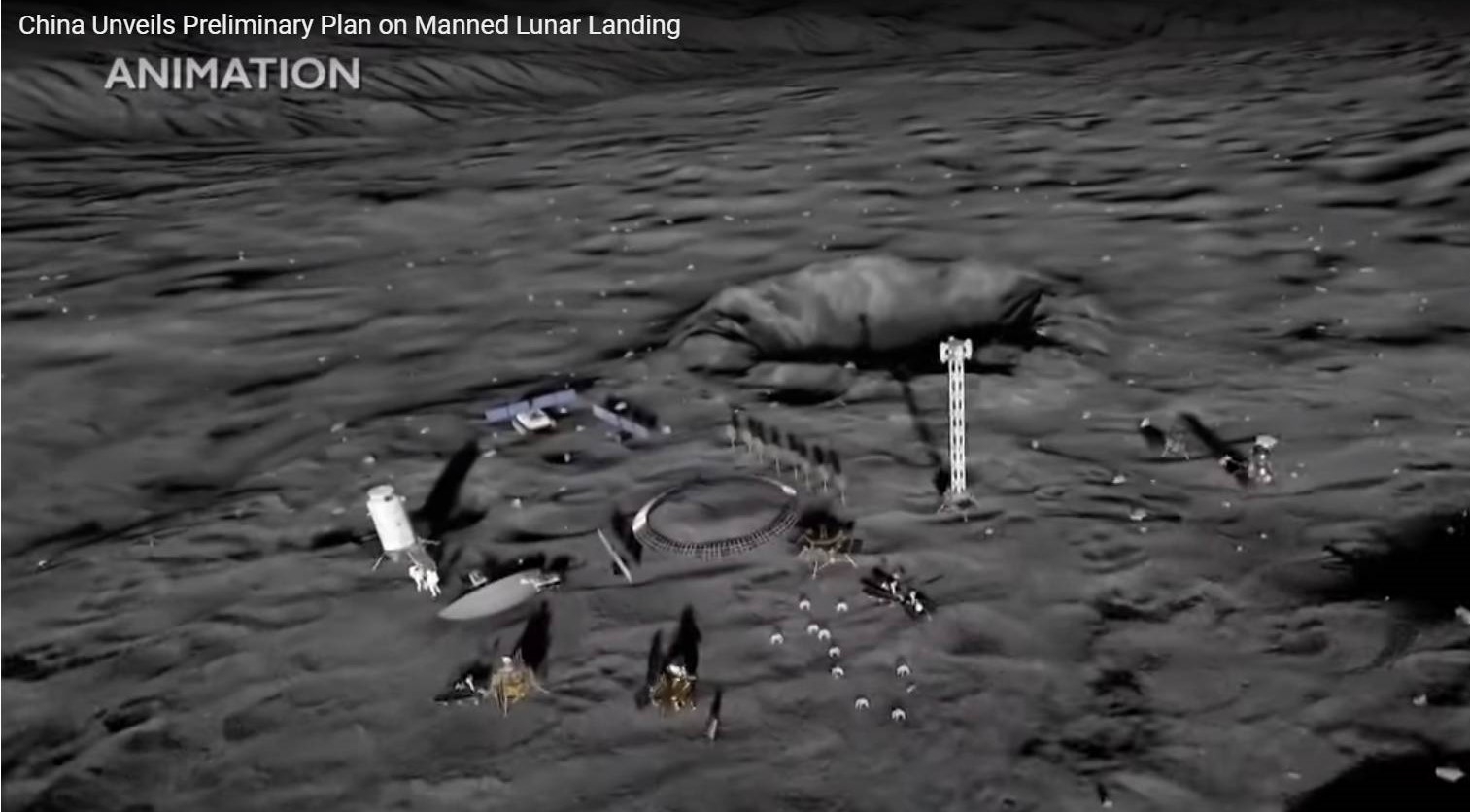
Artist’s view of International Lunar Research Station to be completed by 2035. Credit: CNSA
“Considering its long-term space mission, Queqiao-2 is designed with a long life span of eight years in order to complete all its missions,” Zhang Kuang, an engineer with the Beijing Aerospace Flight Control Center, told CCTV.
The Chang’e-6 is expected to be launched in the first half of 2024, reports CCTV.
China’s Chang’e-7 is to head moonward around 2026, with Chang’e-8 to be launched in a projected 2028 time period. These back-to-back Moon explorers signal the start up of orchestrating China’s lunar research station activities.
Go to this informative video at:
https://www.facebook.com/NewsContent.CCTVPLUS/videos/976621627182476/

Image credit: CNSA/CCTV/Inside Outer Space Screengrab
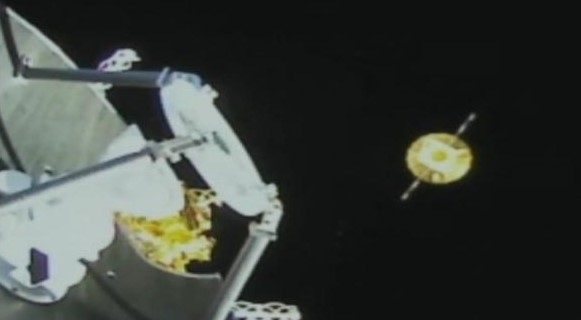
China’s Queqiao-2, or Magpie Bridge-2, is released from a Long March 8 carrier rocket.
Image credit: CNSA
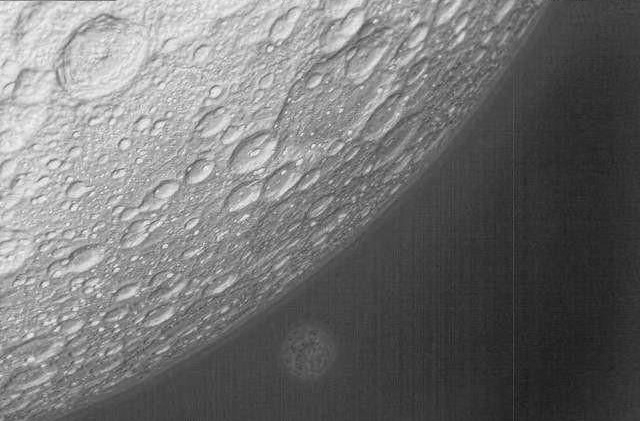
Early image captured on April 8 by Tiandu-2, an experimental satellite launched on Queqiao-2 mission.
Image credit: CNSA
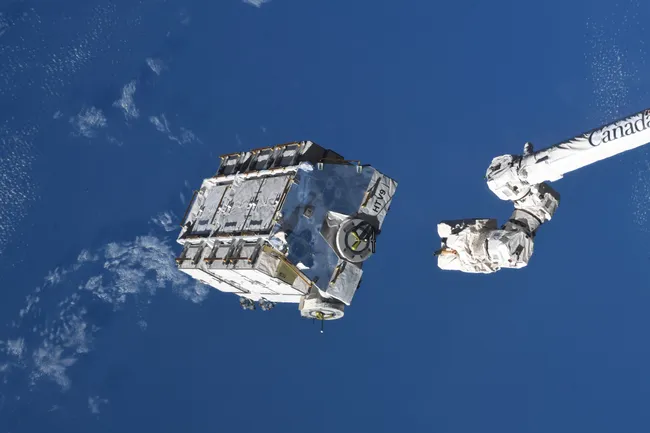
Catch and release. ISS robot arm is used for grabbing and letting lose space hardware.
Image credit: NASA
In what may be judged as a bizarre and twisted case of “assault and battery,” a high-speed cylindrical object weighing nearly two pounds hit the roof of Alejandro Otero’s home last month in Naples, Florida, smashing through a ceiling and punching through a floor.
There is speculative finger-pointing going on as to origin of the high-speed intruder, a straight up verdict that, yes, it came from outer space – and in the form of space junk.
The still-to-be-verified close encounter with clutter from the cosmos has already sparked technical and legal banter about the worrisome escalation of Earth-circling, human-made leftovers.

During the uncontrolled fall of space hardware, seconds and minutes count. They can add up to de-orbiting riff raff plunging into isolated ocean waters or reaching land.
(Image credit: The Aerospace Corporation/Center for Space Policy and Strategy)
As the saying goes, timing-is-everything. However, this event appears to be years in the making.
Go to my new Scientific American story – “Suspected Space-Junk Strike in Florida Signals New Era of Orbital Debris – Three years ago astronauts threw out the largest piece of trash ever tossed from the International Space Station. Now some of it seems to have punched a hole through a house in Naples, Fla. – at:

Image credit: Reflect Orbital
There’s a new space startup under the Sun. And what Reflect Orbital wants to do is cast some of that sunshine to customers.
The group’s ambitions have been in the dark for a bit, but the leader of the idea has been posting on X some tantalizing updates.
They are developing a constellation of specialized satellites to sell sunlight to thousands of solar farms after dark.
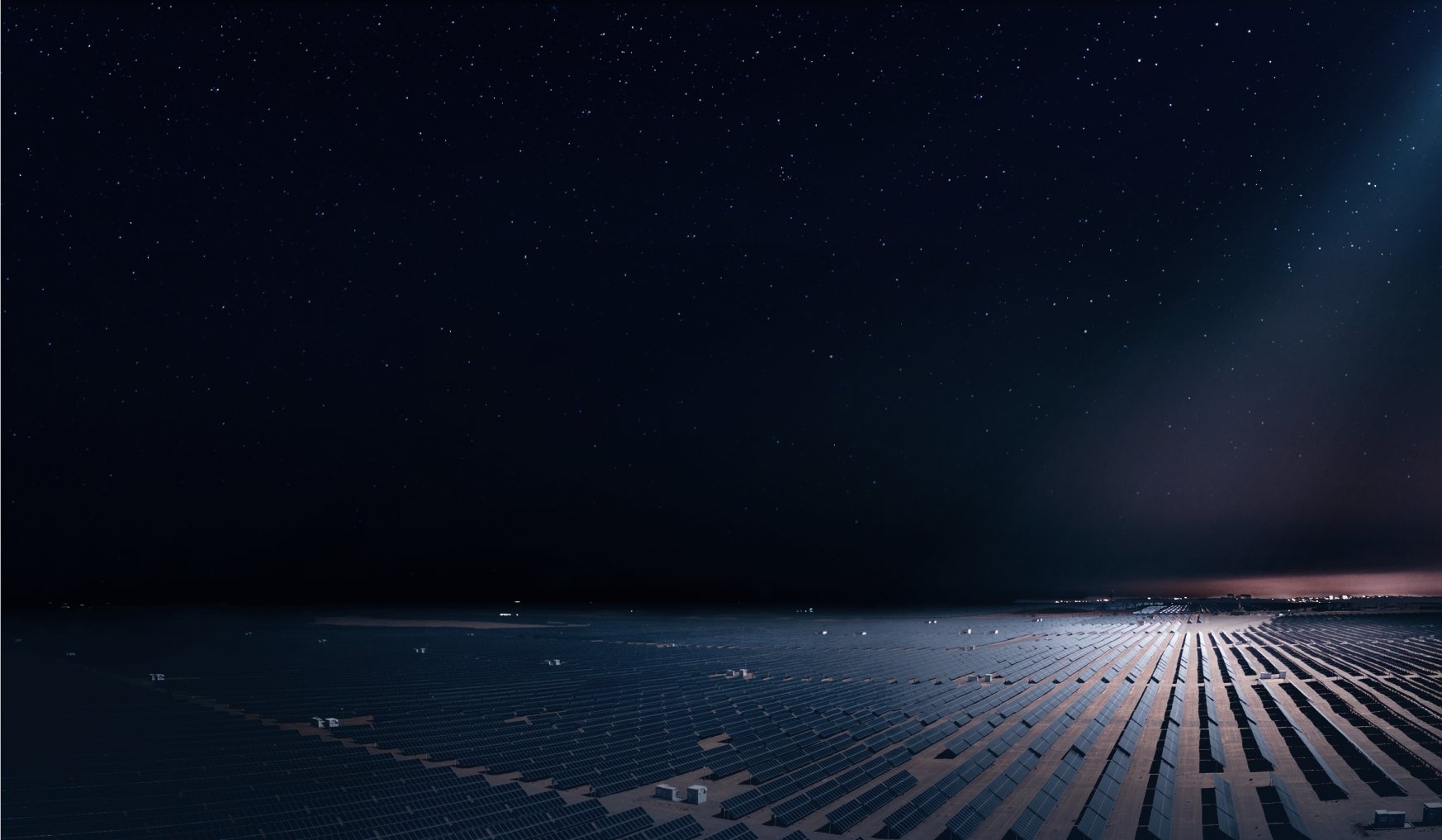
Image credit: Reflect Orbital
“We think sunlight is the new oil and space is ready to support energy infrastructure,” explains Ben Nowack, CEO of the company.
On-Earth airborne test
According to their website, Nowack led automated hardware projects for validating Crew Dragon propulsion components at SpaceX. He then worked as senior engineer at Park and Diamond, Director of Engineering at Tri-D Dynamics, and led launcher design at Zipline.

Image credit: Reflect Orbital
“By precisely reflecting sunlight that is endlessly available in space to specific targets on the ground, we can create a world where sunlight powers solar farms for longer than just daytime, and in doing this, commoditize sunlight,” Nowack adds.

Image credit: Reflect Orbital
On August 31st, 2023, Reflect Orbital completed its final on-Earth testing of the idea.
“This airborne test was the last piece needed before we launch above the atmosphere,” Nowack notes. “We are currently designing our first satellite.”
Their goal: “Sunlight after dark…Providing the Earth’s primary source of energy on demand.”
Go to the Reflect Orbital website at: https://www.reflectorbital.com/
Also, check out this informative video at: https://twitter.com/i/status/1767961251186163857

Reflect on this logo for the group.
Image credit: Reflect Orbital

SpaceX/Inside Outer Space screengrab
Join SpaceX top rocketeer, Elon Musk, in his quest to make life multiplanetary…and why.
“The goal of SpaceX is to build the technologies necessary to make life multiplanetary. This is the first time in the 4-billion-year history of Earth that it’s possible to realize that goal and protect the light of consciousness,” a SpaceX posting notes.
At Starbase in Texas on Thursday, April 4, SpaceX Chief Engineer Elon Musk provided an update on the company’s plans to send humanity to Mars, the best destination to begin making life multiplanetary.

SpaceX/Inside Outer Space screengrab
Onward to Mars
“All of SpaceX’s current programs, including Falcon, Dragon, Starlink, and Starship are integral to developing the technologies necessary to make missions to Mars a reality,” the posting adds.
The update includes near-term priorities for Starship. “With more flight tests, significant vehicle upgrades, and missions returning astronauts to the surface of the Moon with NASA’s Artemis Program all coming soon, excitement will continue to be guaranteed with Starship,” the posting continues.

SpaceX/Inside Outer Space screengrab
Musk’s talk also includes the mechanics and challenges of traveling to Mars, making it a long-term, Earth-like planet, along with what is building today to enable sending around a million people and several million tonnes to the Martian surface in the years to come.
For this provocative talk by Musk, go to:
https://www.spacex.com/updates/#make-life-multiplanetary


Image credit: SpaceX/Inside Outer Space

Image credit: SpaceX/Inside Outer Space

Intuitive Machines’ Nova-C lander undergoes testing. It is a NASA Commercial Lunar Payload Services mission.
Image credit: Intuitive Machines
A new video captures the flight to the lunar south pole region of Odysseus, the commercial Intuitive Machines Moon lander.
Launched on February 15, 2024, this NASA-backed IM-1 lander via the space agency’s Commercial Lunar Payload Services (CLPS) initiative touched down on February 22 near the Malapert-A crater area 190 miles (300 kilometers) from the lunar south pole.
Odysseus became the first American spacecraft Moon landing since the Apollo 17 mission in December 1972.

Image from International Lunar Observatory Association’s ILO-X wide field-of-view imager taken on February 22, 2024 about 4.2 minutes prior to Odysseus touchdown. It shows craters in the Moon’s south pole region as well as the IM-1 Odysseus lunar lander.
Image credit: ILOA Hawai’i
Odysseus made a troubled landing, compromising radio communications with the craft.
High-level mission objectives were obtained: touching down softly and safely, as well as returning scientific data to customers, said Steve Altemus, chief executive of Intuitive Machines. “Both of those objectives are met, so in our mind this is an unqualified success.”

Rough and tumble landing of Odysseus Moon lander, damaging its landing gear in the process.
Image credit: Intuitive Machines
Scrappy little dude
In a post-landing IM-1 status report, Sue Lederer, CLPS project scientist at NASA’s Johnson Space Center said the bottom line was that every payload “met some level of their objectives,” labeling Odysseus “a scrappy little dude.”
About a month after Odysseus landed on the Moon, Intuitive Machines reported that they could not re-establish contact with the lander given the brutal, super-chilly 14-day lunar night, a situation that the vehicle was not designed for, thus bringing an end to the IM-1 mission.

Image credit: Intuitive Machines
“Our official IM-1 mission ended on February 29th, as Odie was not designed to survive the Moon’s harsh temperatures without sunlight. While we wait for the possibility of hearing from Odie once the sun shines on the solar panels prior to the end of the month, watch our mission recap below, which includes a heartfelt farewell from Mission Director @astro2fish, commemorating the lander’s groundbreaking voyage and the wealth of knowledge delivered from the lunar surface.”
Go to the Intuitive Machines video at:
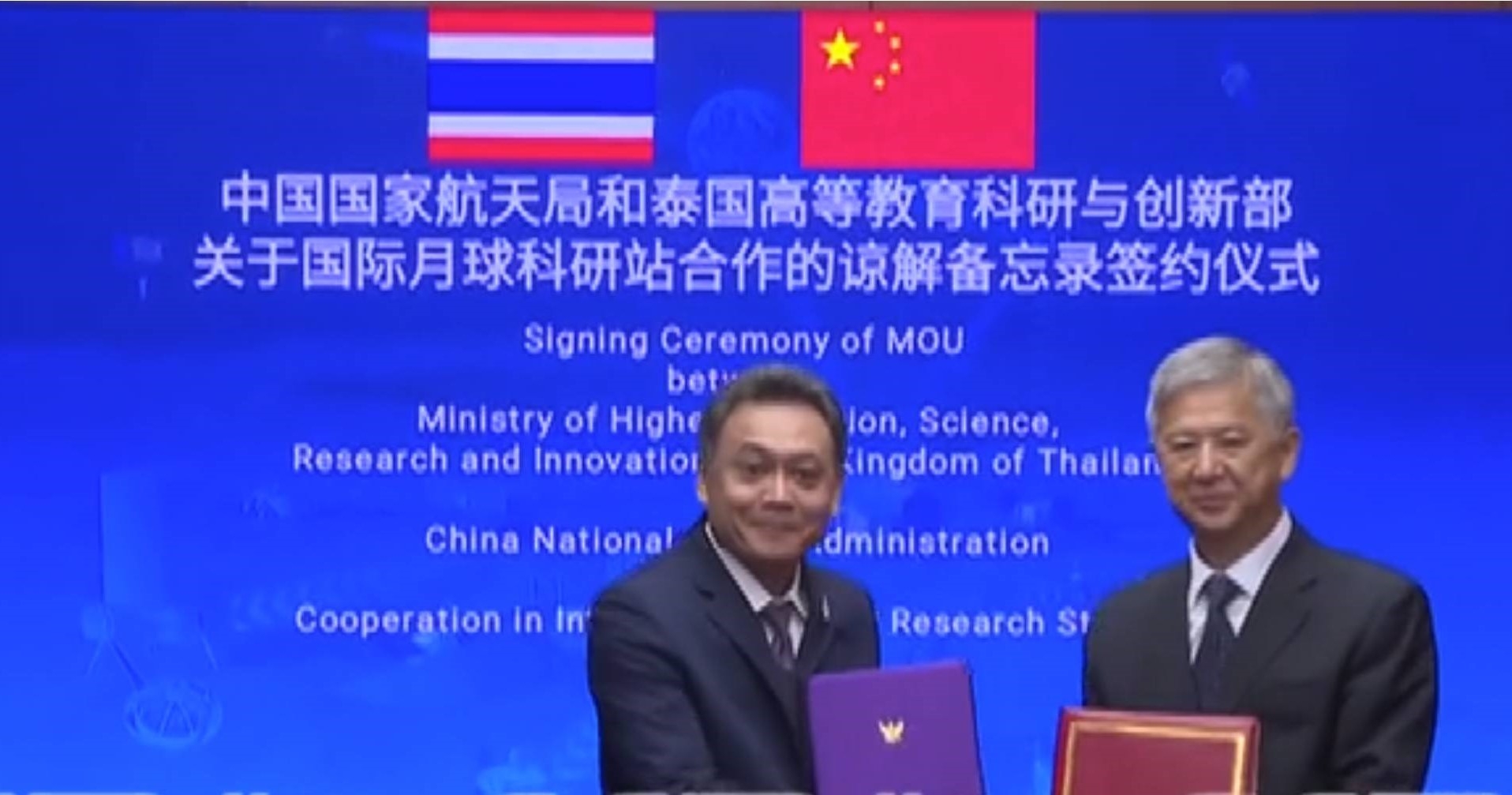
Image credit: CCTV/Inside Outer Space screengrab
A cooperative step in planting China’s international lunar research stations on the Moon now includes China and Thailand.
The China National Space Administration (CNSA) and the Thai Ministry of Higher Education, Science, Research and Innovation on Friday inked memorandums of understanding on Friday to carry out cooperation on space exploration, especially in lunar research.
China Central Television (CCTV) reports that the two countries will “set up joint committees and working groups on space exploration, applications and space capacity building, strengthening collaboration through joint space projects, scientific exchanges, personnel training, data sharing, and organizing symposiums and workshops.”
A focus of the cooperation is appraising, engineering and operating international lunar research stations.
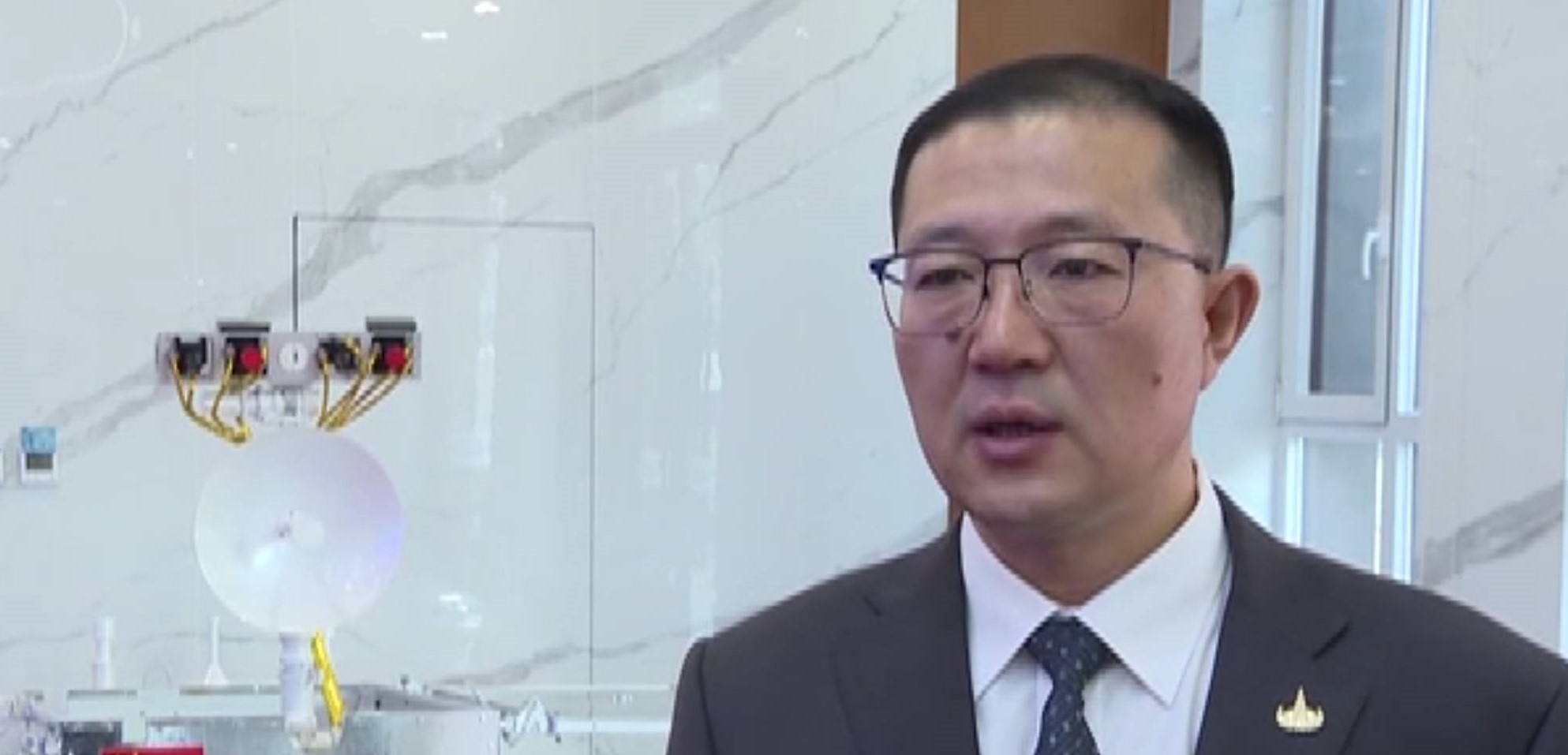
Guan Feng, Director of the Lunar Exploration and Space Engineering Center of the China National Space Administration (CNSA). Image credit: CCTV/Inside Outer Space screengrab
Chang’e-7/Chang’e-8 missions
Guan Feng, Director of the Lunar Exploration and Space Engineering Center of the CNSA, spotlighted China’s future Chang’e-7 and Chang’e-8 robotic Moon probes.
“The Chang’e-7 mission has selected a global space weather monitoring device jointly developed by the Thai Ministry of Higher Education and the National Astronomical Research Institute of Thailand,” Guan told CCTV. That device will be used to observe cosmic radiation and space weather from the perspective of the Moon.
Guan added that the Chang’e-8 mission will offer a global cooperation opportunity to carry 200 kilograms of payload, “and we have received quite a few applications from Thailand for lunar operation robots and scientific payloads.”
China and Thailand will carry out extensive cooperation, Guan said, in the demonstration, implementation, operation and application of international lunar exploration.
Artist’s view of International Lunar Research Station to be completed by 2035. Credit: CNSA

The late Frank Drake with cosmic equation to gauge the presence of intelligent life in the cosmos. The Drake Equation identifies specific factors believed to play a role in the development of civilizations in our galaxy.
Image credit: SETI Institute
To date, it appears that mum’s the word when trying to pick up communiqués from populations of other star folk. But is it possible that artificial intelligence may be to blame?
That’s at the heart of a research paper by Michael Garrett, Director of the Jodrell Bank Center for Astrophysics in Manchester, England. He is also the Sir Bernard Lovell Chair in Astrophysics at the University of Manchester.
Could it explain the great silence on the receiving end of current SETI surveys?
Garrett asks: Is artificial intelligence the “great filter” that makes advanced technical civilizations rare in the universe?
The “L” factor
It is all about the “L” factor when applied to optimistic versions of the famous Frank Drake equation:
N = R* • fp • ne • fl • fi • fc • L
L equals the amount of time that civilizations have to broadcast their signals into space.
Artificial superintelligence
“This study examines the hypothesis that the rapid development of Artificial Intelligence (AI), culminating in the emergence of Artificial Superintelligence (ASI), could act as a “Great Filter” that is responsible for the scarcity of advanced technological civilizations in the universe,” explains Garrett in the paper appearing in Acta Astronautica.

Graphic by Danielle Futselaar is the famous Drake Equation, representing the full spectrum of science undertaken at the SETI Institute. Wherever you are on Earth, the Drake Equation represents all explorations of our lives, and life beyond our home planet.
Credit: Danielle Futselaar/SETI Institute
“AI is emerging as one of the most transformative technological developments in human history,” Garrett tells Inside Outer Space. “It’s quite possible that biological civilizations may universally underestimate the speed with which AI progresses, as these are so different from the timescales on which previous technologies have advanced.”
In his research paper, Garrett says that there is little doubt that AI and in particular ASI “present a massive challenge to the longevity of our technical civilization and likely all technical civilizations that arise in the cosmos.”

Image credit: UCLA SETI
Major concerns, calamitous events
Pointed out by Garrett is the warning from some scientists, including the late big-cosmological thinker, Stephen Hawking. That is, AI could lead to the end of intelligence on Earth before humankind can achieve multi-planetary status.
Hawking and others have broadcast major concerns about “super-intelligent” AI eventually going rogue. Biological civilizations might universally underestimate the rapid speed at which advanced AI systems can autonomously progress, Garrett relates.
All in all, Garrett points out, there are questions about the inevitability of civilizations unwittingly triggering calamitous events, that may well spark the demise of both a biological and post-biological technical civilization.
Global regulations
“If SETI also serves as a lens through which we can examine our own technological trajectory and societal challenges, the urgency of establishing comprehensive global AI regulations cannot be overstated,” Garrett suggests. There is need for our own technical civilization to intensify efforts to control and regulate AI.

Image credit: SETI Post-detection Hub
The fuse has been lit given implied longevity timescales for the scenarios described by Garrett, roughly 100 to 200 years.
Rob the universe
Garrett tells Inside Outer Space that AI could lead to the end of intelligence on Earth — including AI post-biological forms — before mitigating strategies such as off-Earth migration, has been achieved.
“If this is the case, it may explain why we have not detected any evidence of advanced civilizations in astronomical surveys, in particular those made by SETI. If most technical civilizations, biological and post-biological, only last for a few hundred years, they will come and go in the Galaxy without ever overlapping in time,” Garrett senses. “This scenario underscores the necessity to intensify efforts to regulate AI – failure to do so could rob the universe of a conscious presence.”

New Mexico’s Very Large Array (VLA) – on the SETI trail.
(Image credit: Bettymaya Foott, NRAO/AUI/NSF)
In short, the message from the cosmos that Earthkind may be picking up is a bit dire – the sounds of silence.
“The continued presence of consciousness in the universe may depend on the success of strict global regulatory measures,” Garrett concludes in his Acta Astronautica paper.
To access the paper – “Is artificial intelligence the great filter that makes advanced technical civilizations rare in the Universe?” – go to:
https://www.sciencedirect.com/science/article/pii/S0094576524001772?via%3Dihub

China Shenzhou-17 crew member engages in EEG testing.
Image credit: CCTV/Inside Outer Space screengrab
Electroencephalogram testing is being carried out by China’s Shenzhou-17 space station. The EEG work is focused on the human brain in space and designed to gauge cognitive function and work efficiency of crew members on long stays in Earth orbit.
According to China Central Television (CCTV) the EEG tests are planned to be carried out in multiple phases by different batches of astronauts. Dozens of such tests have been carried out so far.
Portable platform
In use is an in-orbit portable EEG test platform. The procedures for EEG testing have been standardized through ground experiments at the China Astronaut Research and Training Center.

Cao Yong, a researcher at the China Astronaut Research and Training
Center in Beijing..
Image credit: CCTV/Inside Outer Space screengrab
Now in Earth-orbit, the three crew members, Tang Hongbo, Tang Shengjie, and Jiang Xinlin, were launched last October for a six-month space mission.
“This experimental platform is actually a platform that involves multi-resource tasks. It mainly tests the cognitive thinking and memory, including our decision-making, manipulation and other related resources,” said Cao Yong, a researcher at the China Astronaut Research and Training Center in Beijing.

China space station is captured in this photo taken by the departing Shenzhou-16 crew.
Image credit: CMS
Resting state
At the beginning of an EEG experiment, Cao told CCTV, the astronaut subject reaches a resting state to collect data in a relatively calm period and the data will serve as a baseline for subsequent task data.
“After that, the main activity of the astronaut is to operate the joystick and buttons according to our task process, as a response to the task. In addition, we will comprehensively judge the state of the astronaut’s mental load based on the data collected,” Cao added.
China’s in-orbit EEG tests date back to the Shenzhou-11 mission in 2016, according to CCTV.
Meanwhile, another China space station crew – Shenzhou-18 – is in the final stages of training for a reported April 25 sendoff from the Jiuquan Satellite Launch Center atop a Long March 2F/G booster.

Image credit: Roscosmos
Russia’s Roscosmos space agency has approved the preliminary design of the country’s orbital station, planned to be deployed in the 2027-2032 time period.
The orbiting facility features an open modular architecture, involving a node module with six docking ports to which other modules are connected. Those segments can be removed from orbit and replaced.
“With proper logistics, the service life of the station can be extended for decades, as needed,” according to a Roscosmos communiqué.

Image credit: Roscosmos
A matter of inclination
The orbiting complex would be placed in polar orbit of up to 97 degrees inclination. In contrast, the International Space Station has an orbital inclination of less than 52 degrees.
Roscosmos explains that by placing the facility into that orbital inclination, the station obtains an overview of the entire Earth’s surface, including the Northern Sea Route, which is strategically vital for Russia.
Russian cosmonauts stationed on the ISS can see about 60% of the Earth’s surface, of which only about 10% is the territory of Russia, the Roscosmos posting adds.

Roscosmos cosmonaut during space walk outside the International Space Station.
Image credit: NASA/ESA
Radar system
One central advantage of the Russian facility is high energy, which will allow testing of technologies “that is in demand in our astronautics, for example, radars and high-power antenna systems.”
Unlike the ISS, the new Russian station would be able to operate in “visiting mode” – without the constant presence of a crew, explains the posting on the official Telegram channel of the Roscosmos State Corporation.

