Archive for the ‘Space News’ Category
 Author:
  April 19th, 2024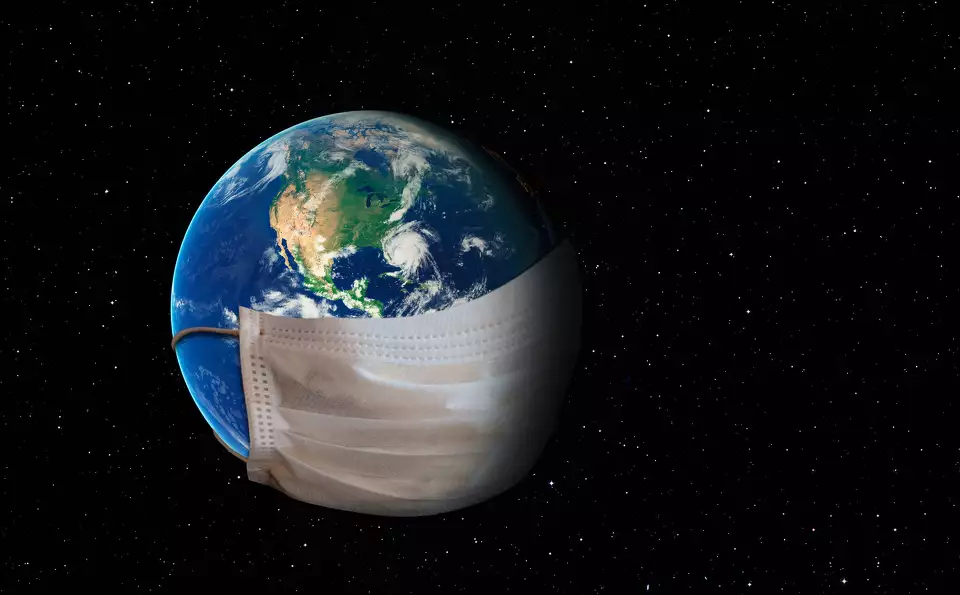
Image credit: Bipartisan Commission on Biodefense
Last Monday, NASA shared the agency’s recommendations regarding a path forward for the costly Mars Sample Return initiative, but within a balanced overall science program.
The idea of bringing back to Earth select samples from Mars has long been a major goal of international planetary exploration.
NASA is now reaching back to government, industry and academic teams to come up with innovative ideas – ways to perform a lower-costing and timely shoot and ship effort to rocket back to Earth bits and pieces of Mars.

Perseverance rover deposits select rock and soil samples in sealed tubes on Mars’s surface for future missions to retrieve and bring back to Earth for detailed study.
NASA/JPL-Caltech
Strain gauge
But the quest to bring collectibles to Earth from Mars has long been steeped in controversy in some quarters. That is, there are worries regarding the introduction of ecologically-hungry Martian microbes into Earth’s biosphere.
For sci-fi movie-goers, it’s real-time Andromeda Strain.
Interestingly, raising their hand of concern about misbehaving microbes from afar are members of the Bipartisan Commission on Biodefense. They were set up to evaluate the status of U.S. biodefense efforts, “Protecting U.S. public health security beyond party lines,” according to their website.
“Is the U.S. ready for extraterrestrials? Not if they’re microbes,” explains a recently issued opinion piece.
For more information, go to my new Space.com story – “’Astrobiodefense:’ Thinktank calls for defending Earth from space bugs” – at:
https://www.space.com/mars-sample-return-op-ed-astrobiodefense
 Posted in

High-speed return from lunar distance, the thermal protection system of Orion’s crew module must endure blistering temperatures to keep crew members safe. Measuring 16.5 feet in diameter, Orion’s heat shield is the largest of its kind developed for missions carrying astronauts.
Image credit: NASA)
Earlier this year, NASA announced it had pushed out to 2025 the Artemis II swingby of the Moon by a crew – a practice run to prepare for a follow-on Artemis III “rebooting” of Earth’s nearby celestial companion with humans.
One reason cited for the delay was getting to the bottom of re-entry heat shield data from the first Orion capsule flight.

Arc Jet Complex at NASA’s Ames Research Center in California’s Silicon Valley has been used to study unexpected heat shield issues found after Orion capsule’s Artemis I flight in 2022.
Image credit: NASA Ames Research Center
The capsule’s multi-week fling out beyond the Moon and back to terra firma in 2022 came to full-stop on December 11 of that year, with the Orion capsule parachuting into Pacific Ocean waters off Baja California.

Orion heat shield features ablative material, called Avcoat.
Image credit: Lockheed Martin
There has been an aggressive look-see at the results from the shakeout cruise of the uncrewed Orion capsule on its Artemis I flight – particularly, how the craft’s heat shield performed.
Go to my new Space.com story – “NASA still investigating Orion heat shield issues from Artemis 1 moon mission – The landmark 2022 moon mission was a success, but questions remain about how Orion’s heat shield performed” – at:
https://www.space.com/nasa-investigate-orion-heat-shield-artemis-1-mission

Image credit: CCTV/Inside Outer Space screengrab
China’s Shenzhou-18 crewed spacecraft has been rolled out to its launching area atop a Long March-2F carrier rocket, stated the China Manned Space Agency (CMSA) on Wednesday.
The Shenzhou-18 will become China’s 13th human spaceflight and the first crewed mission to visit China’s Tiangong station this year.
CMSA said all facilities and equipment to handle the upcoming liftoff from the Jiuquan Satellite Launch Center in northwest China are in good condition.
A set of pre-launch checkouts are planned, with takeoff of the still-unannounced crew to occur at an appropriate time in the near future, said the CMSA. April 25 is a possible launch date, according to sources.

Image credit: CCTV/Inside Outer Space screengrab
Winds and dust
Wang Xuewu, deputy director, Jiuquan Satellite Launch Center, told China Central Television (CCTV ) that the piloted mission will be the first flight of a crew performed in April since China began building the country’s space station.
“Considering the characteristics of high winds and dust during this season,” Wang said, “we have conducted statistical analysis of meteorological data over the past 30 years in the launch site, and formulated targeted preventive measures and response strategies.”
Wang added that there has been a power supply system update of certain facilities, as well as collaborative training of personnel, including emergency drills.
“We have also improved the comprehensive situational awareness and critical information collection and dissemination capabilities of the launch site, optimized our product testing projects and timing, therefore, further improving the site’s ability to handle continuous missions,” Wang said.

Now orbiting Shenzhou-17 space station crew.
Image credit: CCTV/Inside Outer Space screengrab
Current crew: return to Earth
The in-orbit Shenzhou-17 crew — mission commander Senior Colonel Tang Hongbo and crew members Lieutenant Colonel Jiang Xinlin and Lieutenant Colonel Tang Shengjie — are scheduled to return to Earth this month.
That now-orbiting trio arrived at the orbiting outpost on October 26 of last year. By the end of April, the Shenzhou-17 team will have been circling Earth in the station for six months.
Later this year, another set of astronauts — a Shenzhou-19 crew — is slated to take over space station operations.
Go to this video of the Shenzhou-18 rollout at:

Credit: Piplsay
If all the reports of mysterious objects buzzing our skies are taken as true encounters, the Earth appears to be under assault.
But spoiler alert.
For chief leader of the SETI Institute, established to search for and understand life beyond Earth, there’s need to cuddle up to a cup of cosmic reality.
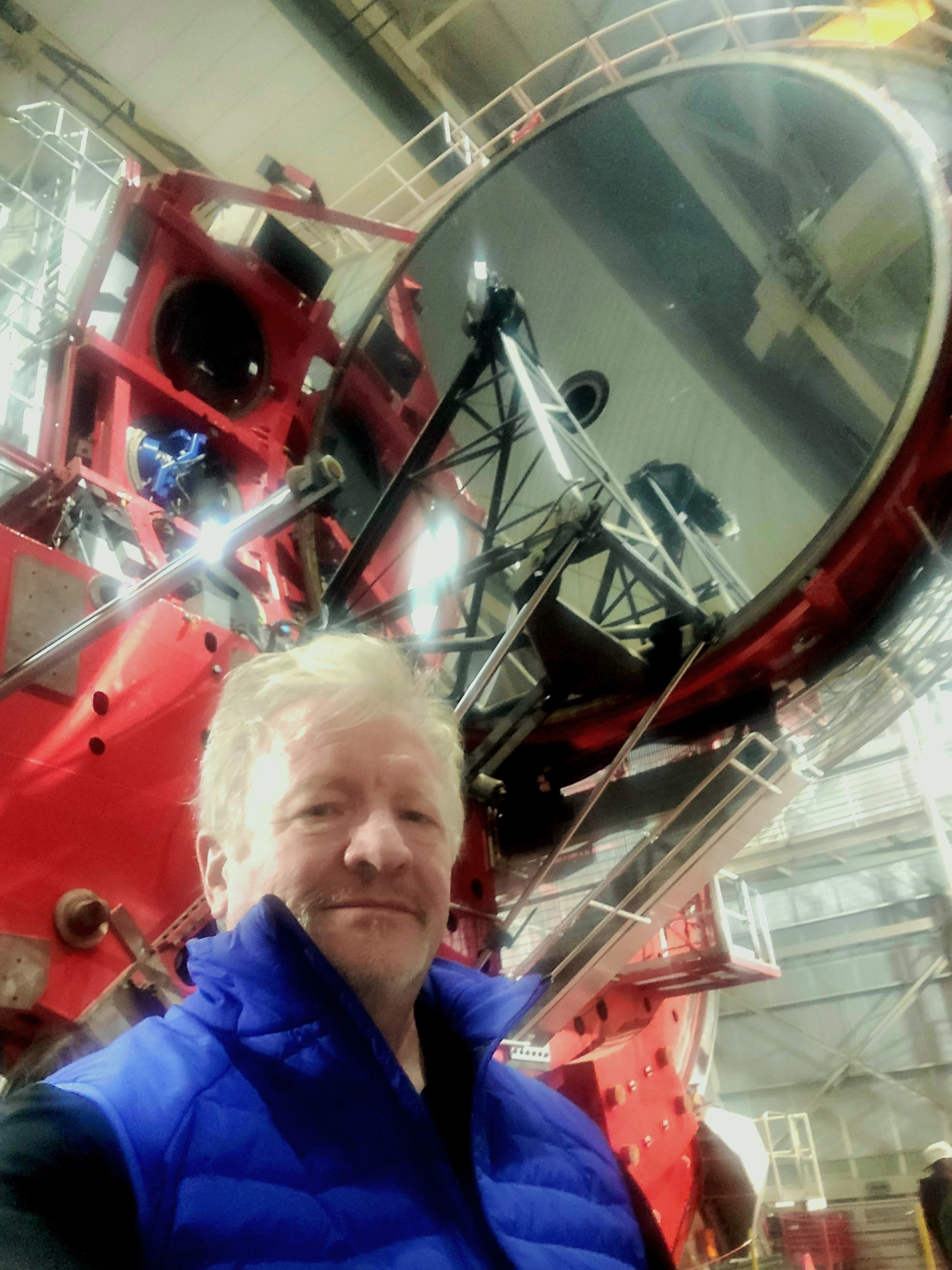
Image credit: Bill Diamond
Bill Diamond is president and chief executive officer of the SETI Institute, headquartered in Mountain View, California. The organization is a key research contractor to NASA and the National Science Foundation, and collaborates with industry partners throughout Silicon Valley.
I caught up with Diamond for a close-encounter with his own thoughts and counterpoints to alien visitation and whether there’s any signal in all the UFO prattle.
Go to my new Space.com story – “SETI chief says US has no evidence for alien technology. ‘And we never have” – at:
https://www.space.com/seti-chief-bill-diamond-ufos-alien-visitation
Scientific American: Editor’s Note (4/16/24): This article has been updated to include information about NASA’s completed analysis of the object that struck a house in Florida.
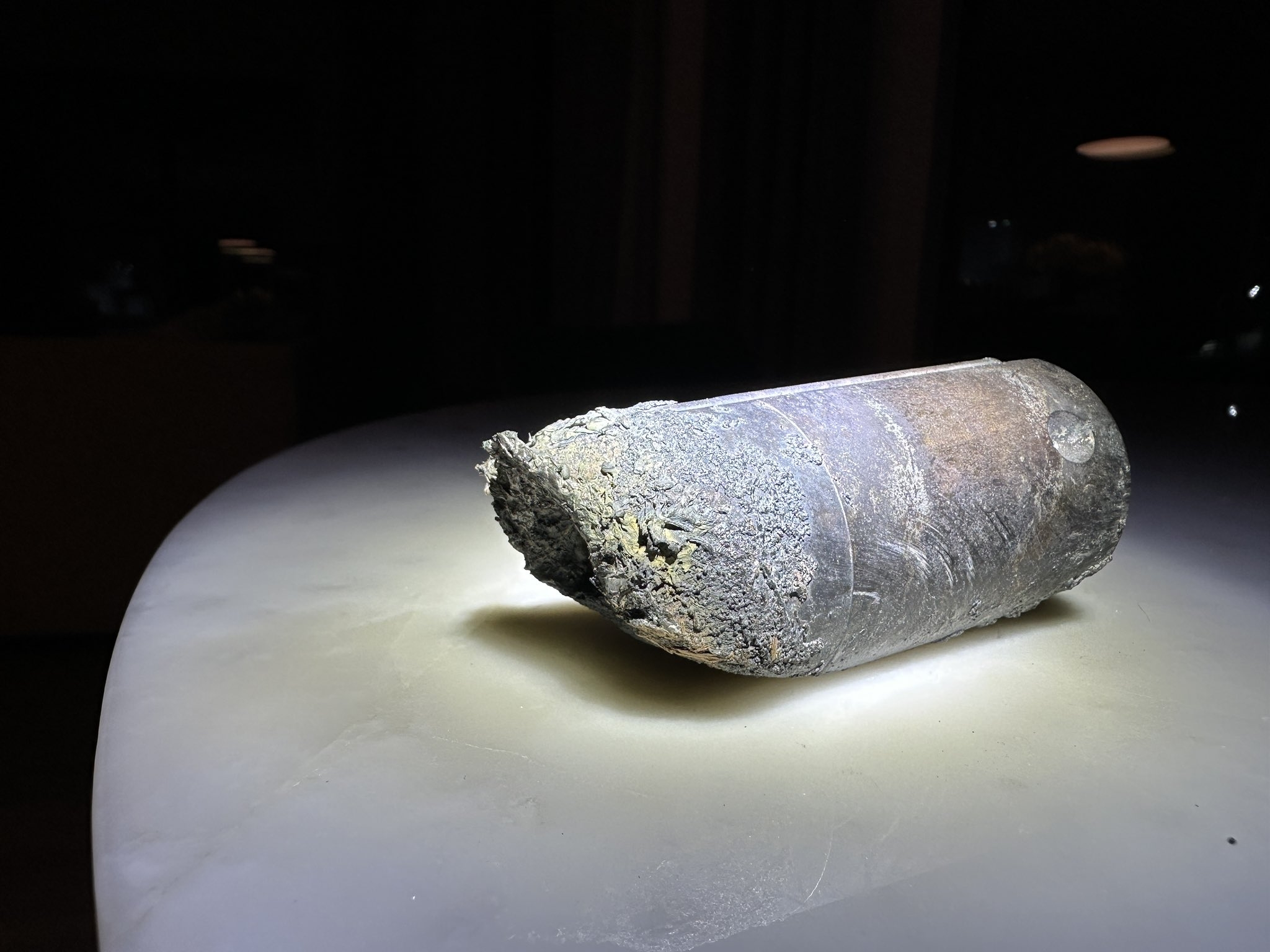
A Naples, Florida home reported possible space junk damage.
Image credits: Alejandro Otero postings on X
Space-Junk Strike in Florida Signals New Era of Orbital Debris – Three years ago astronauts threw out the largest piece of trash ever tossed from the International Space Station. Now some of it has punched a hole through a house in Naples, Fla.
By Leonard David
In what may be judged as a bizarre and twisted case of “breaking and entering,” last month a plummeting cylindrical object weighing nearly two pounds hit the roof of Alejandro Otero’s home in Naples, Fla., smashed through a ceiling and punched through a floor.
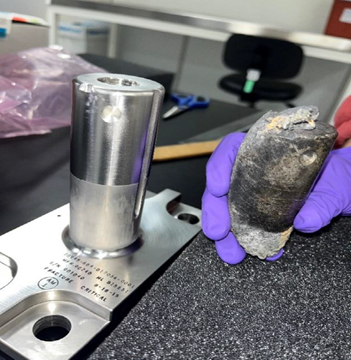
Recovered stanchion from the NASA flight support equipment used to mount International Space Station batteries on a cargo pallet. The stanchion survived re-entry through Earth’s atmosphere on March 8, 2024, and impacted a home in Naples, Florida.
Image credit: NASA
When this story was first published, this high-speed home invasion from the heavens had yet to be officially verified as a space junk strike. Now, however, after retrieving and studying the object, NASA has confirmed it is debris from trash tossed three years ago from the International Space Station (ISS) that subsequently reentered Earth’s atmosphere. As the latest close encounter with clutter from the cosmos, the event has already sparked technical and legal banter about the worrisome escalation of Earth-circling, human-made refuse.

Taking out the trash. Multi-ton pallet tossed off years ago returns to Earth.
Image credit: NASA/Mike Hopkins
TAKING OUT THE TRASH
Back in March 2021 astronauts onboard the ISS used a Canada-supplied robotic arm to tip an abnormally hefty hunk of refuse into space—the heaviest object ever jettisoned from the space station, in fact. NASA explained at the time that the trash, called Exposed Pallet 9 (EP9), had the approximate mass of a large SUV “and is safely moving away from the station and will orbit Earth between two to four years before burning up harmlessly in the atmosphere.”
After being ferried to the ISS via a Japanese cargo ship the previous year, EP9 had been filled with 5,800 pounds of spent nickel-hydrogen batteries. But a series of logistical complications—chief among them the fact that the battery pallet could only fit in Japan’s cargo ships, of which there were no more to fly—left EP9 stranded, taking up precious space on the ISS. So NASA decided to throw it overboard. After a few years of drifting aimlessly through space, EP9 finally met its fiery fate on March 8 when its decaying orbit sent it nose-diving into Earth’s atmosphere over the Gulf of Mexico.

Image credit:
EU Space Surveillance and Tracking (SST)
The European Space Agency’s Space Debris and Independent Safety Offices closely monitored the reentry of the pallet of used ISS batteries. These batteries were to undergo “a natural reentry,” said ESA in a pre-reentry communiqué, using a twist on the term for an uncontrolled plunge from space.
“The total mass of the batteries is estimated at 2.6 metric tonnes, most of which may burn up during the reentry,” ESA stated. “While some parts may reach the ground, the casualty risk—the likelihood of a person being hit—is very low.”

Image credit: WINK News/Inside Outer Space screengrab
A SERIOUS CANDIDATE
Before NASA’s analysis was complete, Marco Langbroek, a devoted satellite tracker and a faculty member in aerospace engineering at the Delft University of Technology in the Netherlands, told Scientific American that it certainly looked possible that the object in Florida stemmed from the reentry of the EP9 battery pack.
Langbroek had reviewed EP9’s ground track as well as the reported timing and trajectory of its reentry. Handily, there was also a time-stamped security video and sound clip of the object that pierced the homeowner’s roof.

Image credit: WINK News/Inside Outer Space screengrab
After entering the atmosphere and losing much of its speed, the debris piece probably spent a couple of minutes in subsonic free fall, Langbroek said.
“Reentries take multiple minutes, with the object fragmenting and the reentering fragments spreading along the trajectory over a stretch that can be hundreds of miles long,” he added. “Given the force of impact, I think this is a serious candidate for potential debris from this [EP9] reentry. It might well be a part of one of the nickel-hydrogen battery cells.”
At that time, Tobias Lips, managing director of satellite aerodynamics company Hyperschall Technologie Göttingen in Germany, told Scientific American that there was not much guesswork here. As a specialist in reentry analysis, he robustly simulated the fall of the ISS pallet of batteries days before the actual event occurred using “moderately conservative” rather than “worst-case” assumptions. Even so, his results suggested more than 130 fragments would survive to reach the surface. That’s “about 10 times more than for a typical reentry object of this size and mass,” he said.
Most of those predicted fragments, Lips said, would be cylinders made of Inconel—a high-strength nickel-chromium superalloy often used in aerospace applications. Nearly 350 such cylinders were in the EP9 pallet’s payload of spent batteries, where they served as power cells. “The fragment found in Naples, Florida, is most likely one of these cylinders,” Lips said.
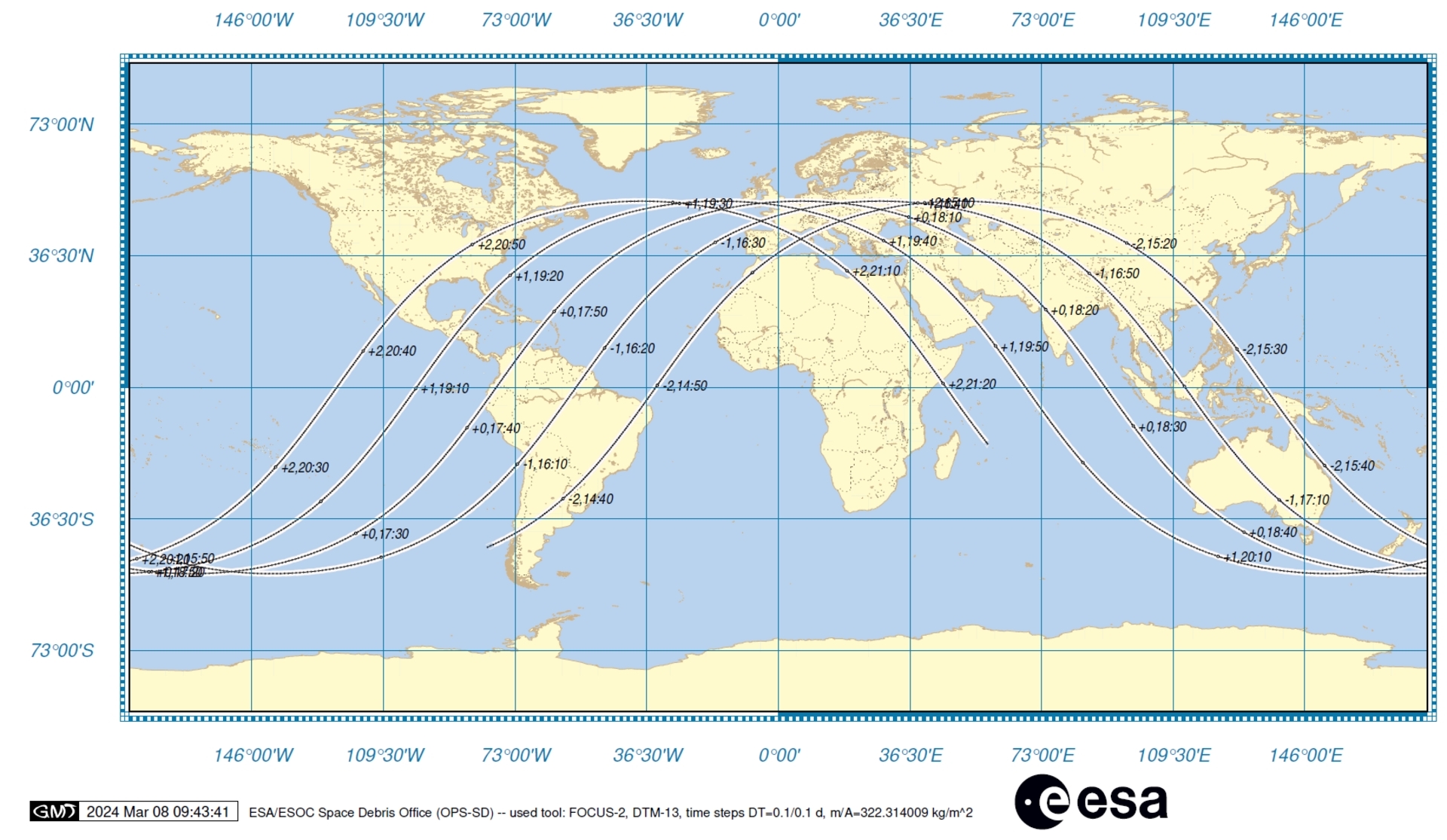
Chart shows ground track of a set of used Nickel-Hydrogen batteries jettisoned from the International Space Station in 2021. Chart indicates situation as of March 8, and forecasts a reentry between approximately 15:35 CET and 22:25 CET on Friday March 8. The reentry zone effectively stretches from -51.6deg south to 51.6deg north.
Image credit: ESA
“The recovered fragment was reported to be about two pounds in weight. Thirty-eight percent of my [simulation’s] surviving fragments are within this mass class,” he explained. “I would be very surprised if investigations of this fragment don’t confirm it being a battery cell from the ISS.”
NASA’S ANALYSIS
After NASA officials, in cooperation with Otero, took custody of the object for closer study at the agency’s nearby Kennedy Space Center, space agency spokesperson Joshua Finch told Scientific American that “more information will be available once the analysis is complete.”
At that time, Mike Weaver, a space debris expert at the Aerospace Corporation, told Scientific American that NASA’s analysis would likely begin with a rigorous examination of the object’s trajectory—as well as that of EP9—tracked against the locations of any other recovered debris.
“In this case, the location of the object in Naples, Florida, appears to be consistent with the timing and the location of the ISS battery pallet reentry,” Weaver said. “However, this is not sufficient to positively identify an object.”

During the uncontrolled fall of space hardware, seconds and minutes count. They can add up to de-orbiting riff raff plunging into isolated ocean waters or reaching land.
(Image credit: The Aerospace Corporation/Center for Space Policy and Strategy)
Alongside the trajectory work, scrutinizing the candidate chunk of space junk for signs of scorching, melting and other effects of reentry heating would be desirable, Weaver said. Metallurgical analysis to determine its composition could be useful as well.
Sometimes serial numbers or part numbers can be found on an object, Weaver noted, which would rapidly simplify things.
Subsequently, in the April 15 blog post in which NASA announced the completion of its analysis, the agency confirmed that the item was in fact an Inconel cylinder. But rather than being part of a battery, the cylinder was a stanchion from the space agency’s “flight support equipment used to mount the batteries on the cargo pallet.”
WHAT GOES UP MUST COME DOWN
Threats from incoming orbital rubbish are real and set to grow, says Darren McKnight, a senior technical fellow at LeoLabs, a commercial provider of space domain awareness services, based in Menlo Park, Calif. As more space systems are deployed in low-Earth orbit, the old adage applies: what goes up must come down.

Space debris plunges to Earth, burning its way through the atmosphere.
Image credit: The Aerospace Corporation
The vexing nub of the problem is that removing ever proliferating small pieces of orbital debris is vital for maintaining a safe space environment—and uncontrolled atmospheric reentry is by far the easiest way to do it. In fact, this happens automatically for objects in low-Earth orbit, which begin to fall as they bleed off momentum against the outer edges of our planet’s atmosphere. Yet the hands-off nature of this process means any sizable piece of unguided debris has a large swath of the planet upon which it or its fragments might fall, potentially constituting a low but real risk to multiple aviation corridors and population centers.
“The issue of aviation and ground hazard from space operations is a problem that will not go away any time soon,” McKnight says.
LEGAL LIABILITY
Before the downed debris in question was confirmed as coming from the ISS, Joanne Gabrynowicz, a professor emerita of space law at the University of Mississippi, told Scientific American that such a finding would likely prompt a dialogue about liability.

Signing of Outer Space Treaty.
Image credit: United Nations
Some of the provisions of the United Nations Outer Space Treaty and its Convention on International Liability for Damage Caused by Space Objects, as well as the ISS International Governmental Agreement (IGA), could be relevant, said Gabrynowicz, who is also editor in chief emerita of the Journal of Space Law.
An analysis of various provisions in these sources and how they interrelate would probably be necessary, Gabrynowicz said, including Article II of the U.N.’s Liability Convention. Article II states that any country launching anything into space shall be responsible for damage any associated space objects may cause back on Earth’s surface.
In the case of an object striking a house, the launching nation would, at minimum, be liable for funding requisite structural repairs. Gabrynowicz added, however, that while this protocol is simple in principle, its translation to reality can become extremely complex. Things would get murky, for instance, if the errant object that struck Otero’s house had proved to be part of the spent batteries from EP9’s reentry: the batteries are NASA’s property, but they were attached to EP9—a payload launched by the Japan Aerospace Exploration Agency (JAXA).
“That could be complicated, requiring analysis of various contracts, treaties, insurance policies and the IGA. Of course, the entities involved can also agree as to how to resolve the situation,” Gabrynowicz concluded.
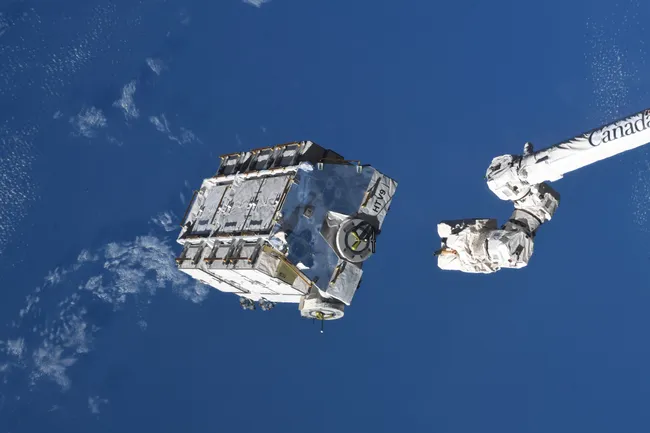
Catch and release. ISS robot arm is used for grabbing and letting lose space hardware.
Image credit: NASA
AN ACT OF ABANDONMENT
“NASA will want to minimize this by saying chucking stuff off the ISS is rare and this isn’t a satellite or rocket body … and therefore is disconnected to increasing launch rates,” said Ewan Wright, a Ph.D. candidate at the University of British Columbia and a junior fellow of the Outer Space Institute, in an interview with Scientific American prior to the agency’s April 16 announcement.
“But clearly there is an issue here that uncontrolled reentries are fairly accepted, and nobody thought to look into it much further,” Wright said. One reason for laxity, he noted, is that the risks from uncontrolled space debris reentry are literally and figuratively dumped in the ocean, which covers most of Earth’s surface. But treating Earth’s seas as a space junkyard is unlikely to be sustainable forever.
“There are over 50,000 ships in the ocean at any given time and hundreds of thousands of smaller boats. The chance of a ship being hit by space debris is likely to be small, but it’s growing, and we don’t know the number for sure,” Wright said. “A cruise ship being hit by uncontrolled space debris may not kill someone, but it would raise serious questions about our continued abandonment of space debris in orbit. And the launching state would be liable to pay damages.”
Many aerospace companies employ an ethos of “design for demise” for their space-bound components to try to ensure that if the parts do reenter, they reliably burn up at high altitude. Yet even leaving aside growing concerns about the resulting contamination of Earth’s upper atmosphere with heavy metals and other pollutants, some experts consider the practice ill-advised at best.

Launch and reentry particle emissions in the Earth’s stratosphere.
Image credit: The Aerospace Corporation
Moriba Jah, an expert in space debris tracking and management at the University of Texas at Austin and a co-founder and chief scientist at Privateer Space, a group focused on space sustainability issues headquartered on the island of Maui in Hawaii, is one such critic.
Jah emphasizes that discarding our detritus in low-Earth orbit in hopes that this material will “naturally reenter” the atmosphere “is not a responsible disposal method but rather an act of abandonment.” Even if not legally classified as such, uncontrolled reentry “is inherently irresponsible due to the potential risks it poses to life and property on Earth,” Jah says.
NASA officials have said that they’re on the case. “The International Space Station will perform a detailed investigation of the jettison and re-entry analysis to determine the cause of the debris survival and to update modeling and analysis, as needed,” the space agency noted in its April 15 announcement.
In some sense, the unlikely intersection of a probable piece of orbital debris with a home could ultimately prove to be a good thing: it could provide another wake-up call to policymakers, major aerospace players and the public at large that when it comes to space junk in low-Earth orbit, the sky really is falling.
LEONARD DAVID is author of Moon Rush: The New Space Race (National Geographic, 2019) and Mars: Our Future on the Red Planet (National Geographic, 2016). He has been reporting on the space industry for more than five decades.

Taking the fall. Space hardware dives into Earth’s atmosphere with some fragments making their way to the ground.
Image credit: ESA/D.Ducros

Image credit: Mars Guy/Inside Outer Space screengrab
The last look at NASA’s Ingenuity helicopter on Mars reveals surprises.
Mars Guy notes that from the closest vantage point we’ll ever see, the NASA Perseverance rover at Jezero Crater shot some pictures of Ingenuity’s final resting place and then drove away.

The imagery, aided by the work of Simeon Schmauß, reveal new details of the crash site that may help explain the final moments of the helicopter’s last flight.
Go to video at: https://youtu.be/VHTJR3UxxgM?si=obgTu9wkk_u5HfE7

Moon encampment involves multi-nation participation.
Image credit: ESA
GOLDEN, Colorado — There is growing interest by space agencies and the private sector in how to extract resources on the moon to sustain a long-term human presence on that desolate world.
Known as in-situ resource utilization, or ISRU, this off-Earth ability involves the production of oxygen and water for life-support, as well as churning out rocket fuel. Then there’s pulling out metals from the moon to fabricate lunar lodging, landing pads, along with other structures and products.
ISRU is a primary focus of the Center for Space Resources, an interdisciplinary research and technology development hub here at the Colorado School of Mines.
Take a look at my new SpaceNews story on the School of Mines and their ISRU agenda:
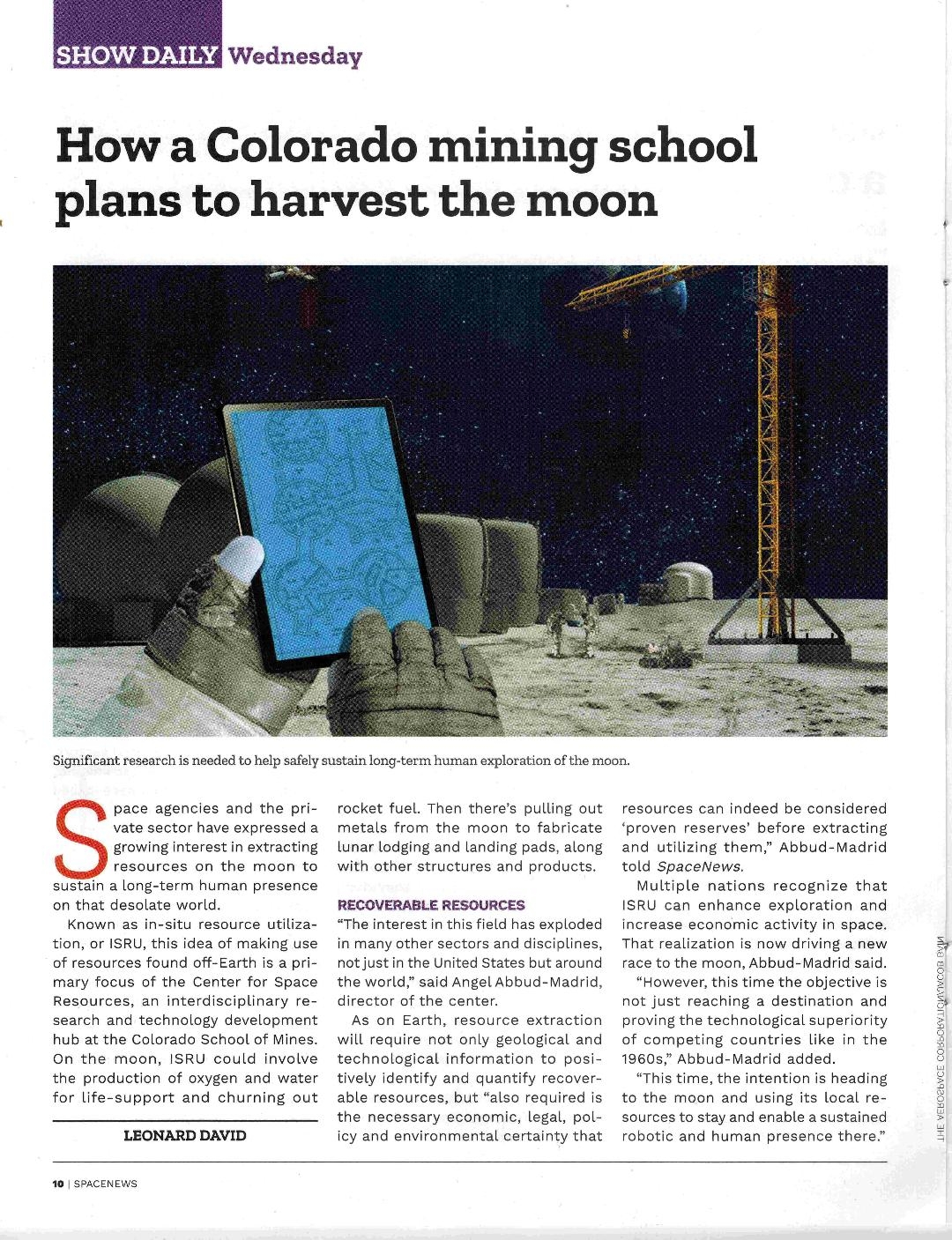
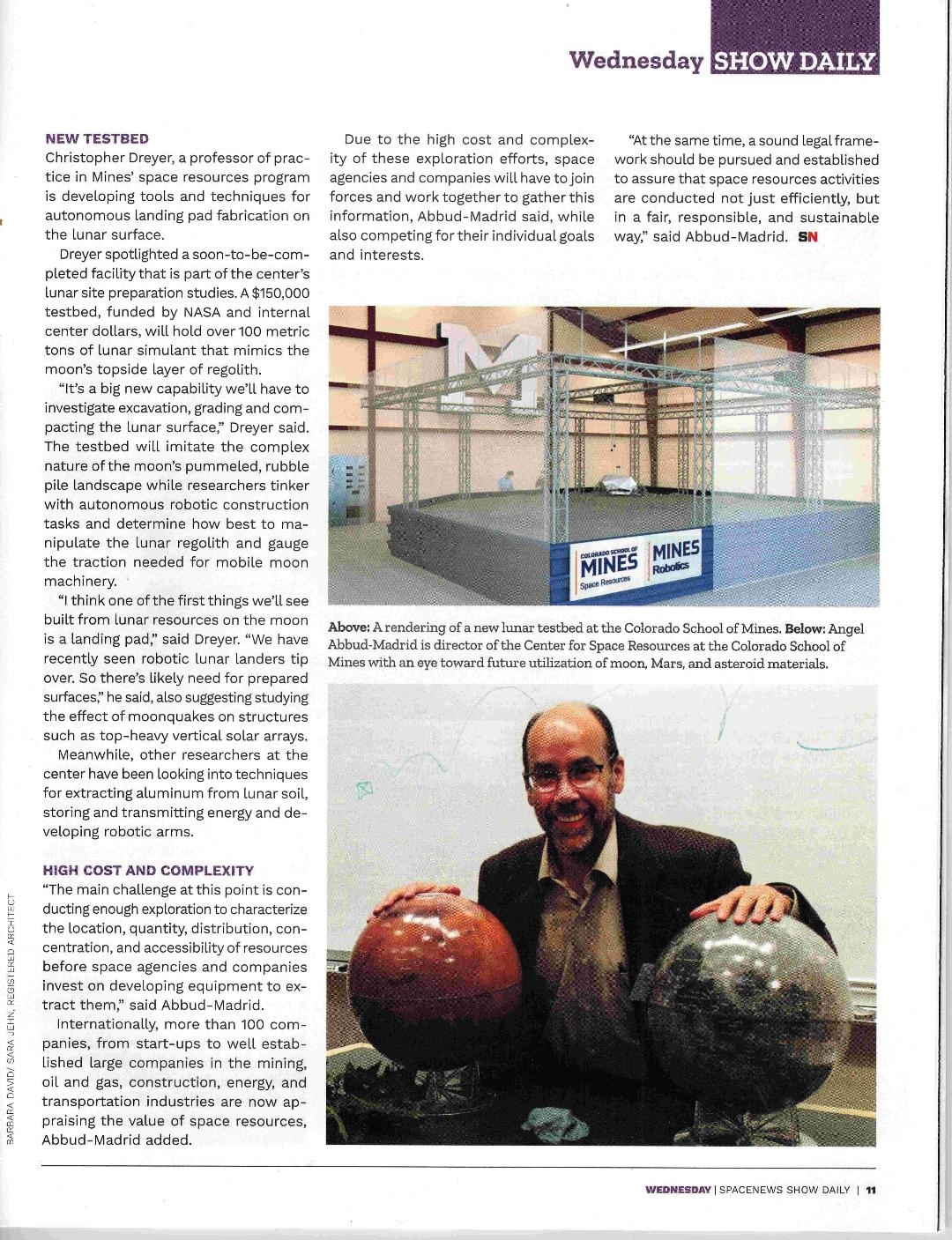

Image credit: CCTV via China ‘N Asia Spaceflight
China’s reusable rocket engine research is engaged in multiple challenges, including use of various, on the factory floor, manufacturing processes.
Chinese engineers have overcome various technical difficulties in developing an engine for reusable rockets, which recently underwent its 30th ignition test.
Developing a reusable engine can make a rocket land accurately, be more durable and easier to repair, China Central Television (CCTV) reports.
CCTV reports that another major problem faced by the research team is what kind of materials can be utilized and how to control the manufacturing process to produce an engine with high technical standards and reliable quality.

Song Yaqing, 11th Institute, Academy of Aerospace Propulsion Technology, China Aerospace Science and Technology Corporation (CASC).
Multiple ignitions
“First of all, it [the engine] has to be used for a long time or for multiple ignitions,” explains Song Yaqing, 11th Institute, Academy of Aerospace Propulsion Technology, China Aerospace Science and Technology Corporation (CASC).
Song told CCTV that the most important thing is identifying the lifespan of every component and the entire machine after extremely accurate adjustment, which cannot be simulated. “The only way is to have constant test runs.”

Liu Chaofeng, senior engineer, Xi’an Aerospace Engine Company, Academy of Aerospace Propulsion Technology at CASC.
Repeatability, durability and reliability
Rocket engine production was spotlighted by Liu Chaofeng, senior engineer, Xi’an Aerospace Engine Company, Academy of Aerospace Propulsion Technology at CASC.
“Focusing on the requirement of technical indicators including repeatability, durability and reliability of the reusable engine, we have tackled a series of key issues and carried out a series of research projects,” Liu told CCTV.
“There were nearly 70 major research projects, which have greatly improved the technological level and stability of our engine’s manufacturing process, and ensured the consistency and reliability of our products’ quality,” Liu added.

Zhou Xianqi, a researcher with the Sixth Academy of CASC.
Image credit: CCTV/Inside Outer Space screengrab
Liquid oxygen-kerosene engine
Zhou Xianqi, a researcher with the Sixth Academy of the CASC reports that China successfully completed two consecutive ignition tests of the 130-ton reusable liquid oxygen-kerosene engine last Friday, laying a foundation for the maiden flight of reusable carrier rockets.
“The key characteristic of the reusable engine is safe and reliable, which can meet relevant requirements. We ran so many tests mainly to find out the state of the engine in these tests,” Zhou told CCTV.
The engine with multiple-start capability, CCTV reports, was developed on the basis of the existing high-thrust liquid oxygen and kerosene engine. It can increase the thrust while reducing its weight and “rocket space occupation,” thus making reusable rockets possible.

Image credit: CCTV via China ‘N Asia Spaceflight

This illustration shows a concept for multiple robots that would team up to ferry to Earth samples collected from the Mars surface.
Image credit: NASA/JPL-Caltech
NASA is set to offer its response to that hard-hitting report issued last September by the Mars Sample Return Independent Review Board, including the rolling out of next steps for the program.
This Monday, NASA will share the agency’s recommendations regarding a path forward for the costly Mars Sample Return initiative, but within a balanced overall science program.
Indeed, such an enterprise has long been a major goal of international planetary exploration for the past two decades.
But the concept of snag, bag, and hurling samples from Mars back to Earth has also been met with controversy in some quarters; for one, the specter of Andromeda Strain and putting the Earth’s biosphere in jeopardy by ecologically-hungry martian microbes continues to be a topic of concern.

The Andromeda Strain – the 1971 movie, but how real for a 21st century return to Earth of Mars samples?
Image credit: Universal Pictures
Space bugs
“Is the U.S. ready for extraterrestrials? Not if they’re microbes. How to defend Earth from space bugs” is an opinion piece posted April 11 by the Houston Chronicle.
Under the rubric of the Bipartisan Commission on Biodefense, former Democratic Congresswoman Donna Shalala and Susan Brooks, a former U.S. Attorney and Republican Congresswoman. Together they serve on the Bipartisan Commission on Biodefense.
Donna Shalala served as Secretary for Health and Human Services in the Clinton Administration. Brooks served parts of Indiana.
The Bipartisan Commission on Biodefense is a privately funded entity established in 2014, set up to evaluate the status of U.S. biodefense efforts and issues recommendations to produce meaningful change.
Image credit: Bipartisan Commission on Biodefense
Unforeseen dangers
“Space exploration provides some of the greatest challenges and opportunities of our time. But as we venture further into the unknown, we also expose ourselves to new and previously unforeseen dangers,” Shalala and Brooks write.
While many debate the possibility of advanced, intelligent life elsewhere, few consider the probability of non-intelligent alien microorganisms. These life forms could exist on other planets or moons, hitchhike on spacecraft, or move through the universe in the asteroids they inhabit. They could also be Earth microbes that mutate or evolve in response to the stress of spaceflight, becoming more virulent, resistant, or invasive. Either would seriously threaten the public health, safety, and security of humans, animals, and plants operating in space or living on Earth,” they note.
Labeling it “Astrobiodefense,” as they term it, is an expression anchored in the defense against biological threats in space and on Earth that result from space exploration.
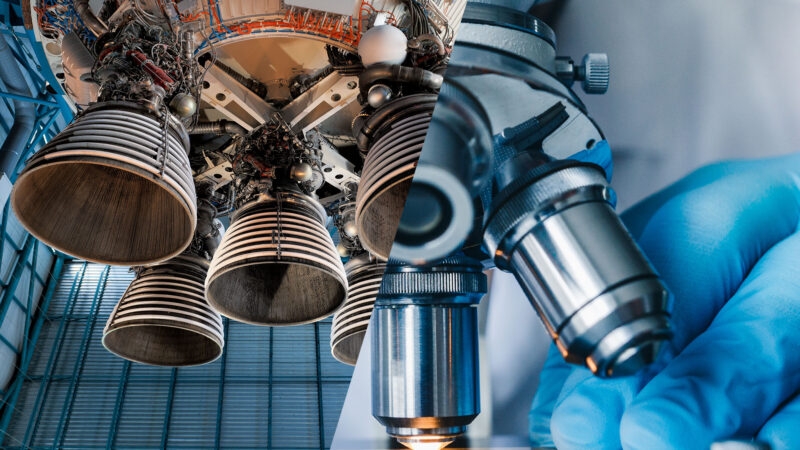
Image credit: Bipartisan Commission on Biodefense
Neither hypothetical nor fictional
There are two goals, Shalala and Brooks point out: to prevent the contamination of extraterrestrial environments with Earth organisms; and to prevent extraterrestrial or mutated terrestrial microbes from harming Earth’s inhabitants.
“As fantastical as it may sound, astrobiodefense is neither hypothetical nor fictional,” they observe, calling for urgent attention and action.
“For the United States, NASA has already started programs to prevent forward and backward contamination, ensure the health and safety of astronauts, and identify and control biological hazards. The FAA [Federal Aviation Administration] is also responsible for monitoring the payloads of commercial spaceflight and how they might affect public health.”
But now, they write, given more missions into space, the potential dangers are mounting.
Wanted: coordination and collaboration
“Recent missions, for example, brought specimens back from asteroid Bennu and aimed to drop human remains on the Moon. We need to do more and soon,” they add.
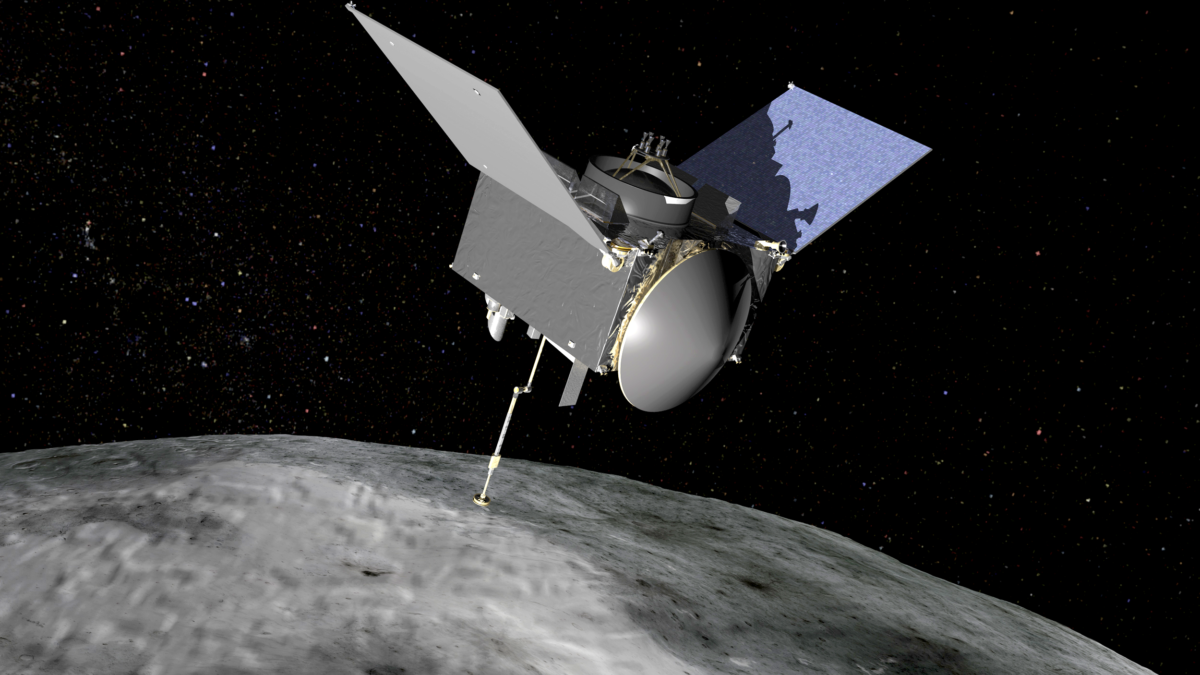
Artwork shows OSIRIS-REx spacecraft at asteroid Bennu.
Image credit: NASA/University of Arizona
Shalala and Brooks state that the U.S. needs to invest in research and development of new technologies and medical countermeasures to detect, diagnose, treat, and prevent diseases in space and on Earth.
Furthermore, there is need to enhance our bio-surveillance and symptom monitoring to track and analyze space-related biological threats in real time.
“We need to strengthen our coordination and collaboration between agencies and partners, both nationally and internationally,” they continue, “to share information and resources without compromising the kinds of competition that result in scientific advances and economic gains.”

Image credit: ESA/Hubble & NASA
Perils of the unknown
Additionally, they observe, there is need for more than modest, and fluctuating, budgets, a wing, and a prayer. “More policymakers and decision-makers in Washington need to understand the importance and benefits of astrobiodefense in particular and the space program in general.”
In closing, Brooks and Shalala state in our pursuit of promise, “we have a duty to protect ourselves and our planet from the perils of the unknown, and to preserve and respect the integrity and diversity of life in the universe.”
By investing in and strengthening astrobiodefense, they conclude, “we can ensure that our quest for discovery does not jeopardize our security and survival. Let’s get ahead of this problem, before we are ‘go’ to launch.”
For more information, visit the Bipartisan Commission on Biodefense website at:
https://biodefensecommission.org/
To read the op-ed in its entirety, go to:

Wait a minute!
Image credit: Barbara David
Suspected Space-Junk Strike in Florida Signals New Era of Orbital Debris – Three years ago astronauts threw out the largest piece of trash ever tossed from the International Space Station. Now some of it seems to have punched a hole through a house in Naples, Fla.
BY LEONARD DAVID in Scientific American.
A pallet of batteries discarded in low-Earth orbit from the International Space Station.
Catch and release. ISS robot arm is used for grabbing and letting lose space hardware.
Image credit: NASA
A heavy pallet filled with tons of spent nickel-hydrogen batteries drifts above the Earth in March 2021, shortly after being discarded from the International Space Station. A nearly two-pound metallic cylinder that recently struck a house in Florida may be debris from the pallet’s uncontrolled atmospheric reentry.
Taking out the trash. Multi-ton pallet tossed off years ago returns to Earth.
Image credit: NASA/Mike Hopkins
Space Exploration
In what may be judged as a bizarre and twisted case of “breaking and entering,” last month a plummeting cylindrical object weighing nearly two pounds hit the roof of Alejandro Otero’s home in Naples, Fla., smashed through a ceiling and punched through a floor.
Although yet to be officially verified as such, the most likely explanation for this high-speed home invader appears to be that it’s a piece of space junk cast off from the International Space Station (ISS) in low-Earth orbit. As the latest close encounter with clutter from the cosmos, the space junk strike has already sparked technical and legal banter about the worrisome escalation of Earth-circling, human-made refuse.
As the saying goes, timing is everything. This event appears to have been years in the making, however.
Image credit: WINK News/Inside Outer Space screengrab
TAKING OUT THE TRASH
Back in March 2021 astronauts onboard the ISS used a Canada-supplied robotic arm to tip an abnormally hefty hunk of refuse into space—the heaviest object ever jettisoned from the space station, in fact. NASA explained at the time that the trash, called Exposed Pallet 9 (EP9), had the approximate mass of a large SUV “and is safely moving away from the station and will orbit Earth between two to four years before burning up harmlessly in the atmosphere.”
Image credit: WINK News/Inside Outer Space screengrab
After being ferried to the ISS via a Japanese cargo ship the previous year, EP9 had been filled with 5,800 pounds of spent nickel-hydrogen batteries. But a series of logistical complications—chief among them the fact that the battery pallet could only fit in Japan’s cargo ships, of which there were no more to fly—left EP9 stranded, taking up precious space on the ISS. So NASA decided to throw it overboard. After a few years of drifting aimlessly through space, EP9 finally met its fiery fate on March 8 when its decaying orbit sent it nose-diving into Earth’s atmosphere over the Gulf of Mexico.
Image credit:
EU Space Surveillance and Tracking (SST)
The European Space Agency’s Space Debris and Independent Safety Offices closely monitored the reentry of the pallet of used ISS batteries. These batteries were to undergo “a natural reentry,” said ESA in a pre-reentry communiqué, using a twist on the term for an uncontrolled plunge from space.
“The total mass of the batteries is estimated at 2.6 metric tonnes, most of which may burn up during the reentry,” ESA stated. “While some parts may reach the ground, the casualty risk—the likelihood of a person being hit—is very low.”
During the uncontrolled fall of space hardware, seconds and minutes count. They can add up to de-orbiting riff raff plunging into isolated ocean waters or reaching land.
(Image credit: The Aerospace Corporation/Center for Space Policy and Strategy)
A SERIOUS CANDIDATE
Marco Langbroek, a devoted satellite tracker and a faculty member in aerospace engineering at the Delft University of Technology in the Netherlands, says it certainly does look possible that the object in Florida stems from the reentry of the EP9 battery pack.
Langbroek has reviewed EP9’s ground track as well as the reported timing and trajectory of its reentry. Handily, there’s also a time-stamped security video and sound clip of the object that pierced the homeowner’s roof.
After entering the atmosphere and losing much of its speed, the debris piece probably spent a couple of minutes in subsonic free fall, Langbroek says.
“Reentries take multiple minutes, with the object fragmenting and the reentering fragments spreading along the trajectory over a stretch that can be hundreds of miles long,” he adds. “Given the force of impact, I think this is a serious candidate for potential debris from this [EP9] reentry. It might well be a part of one of the nickel-hydrogen battery cells.”

Image credit: The Aerospace Corporation
There’s not much guesswork here, says Tobias Lips, managing director of satellite aerodynamics company Hyperschall Technologie Göttingen in Germany. As a specialist in reentry analysis, he robustly simulated the fall of the ISS pallet of batteries days before the actual event occurred using “moderately conservative” rather than “worst-case” assumptions. Even so, his results suggested more than 130 fragments would survive to reach the surface. That’s “about 10 times more than for a typical reentry object of this size and mass,” he says.
Most of those predicted fragments, Lips says, would be cylinders made of Inconel—a high-strength nickel-chromium superalloy often used in aerospace applications. Nearly 350 such cylinders were in the EP9 pallet’s payload of spent batteries, where they served as power cells. “The fragment found in Naples, Florida, is most likely one of these cylinders,” Lips says.
“The recovered fragment was reported to be about two pounds in weight. Thirty-eight percent of my [simulation’s] surviving fragments are within this mass class,” he explains. “I would be very surprised if investigations of this fragment don’t confirm it being a battery cell from the ISS.”
Space debris plunges to Earth, burning its way through the atmosphere.
Image credit: The Aerospace Corporation
ONGOING ANALYSIS
Whatever it is, the Florida object in question was handed over to NASA’s neighboring Kennedy Space Center. NASA spokesperson Joshua Finch tells Scientific American that in cooperation with Otero, the agency collected the item for deeper study to determine its origin. “More information will be available once the analysis is complete,” Finch says.
NASA’s analysis will likely begin with a rigorous examination of the object’s trajectory—as well as that of EP9—tracked against the locations of any other recovered debris, says Mike Weaver, a space debris expert at the Aerospace Corporation.
“In this case, the location of the object in Naples, Florida, appears to be consistent with the timing and the location of the ISS battery pallet reentry,” Weaver says. “However, this is not sufficient to positively identify an object.”
Alongside the trajectory work, scrutinizing the candidate chunk of space junk for signs of scorching, melting and other effects of reentry heating would be desirable, Weaver says. Metallurgical analysis to determine its composition could be useful as well.
Sometimes serial numbers or part numbers can be found on an object, Weaver notes, which would rapidly simplify things.
Launch and reentry particle emissions in the Earth’s stratosphere.
Image credit: The Aerospace Corporation
WHAT GOES UP MUST COME DOWN
Threats from incoming orbital rubbish are real and set to grow, says Darren McKnight, a senior technical fellow at LeoLabs, a commercial provider of space domain awareness services, based in Menlo Park, Calif. As more space systems are deployed in low-Earth orbit, the old adage applies: what goes up must come down.
The vexing nub of the problem is that removing ever proliferating small pieces of orbital debris is vital for maintaining a safe space environment—and uncontrolled atmospheric reentry is by far the easiest way to do it. In fact, this happens automatically for objects in low-Earth orbit, which begin to fall as they bleed off momentum against the outer edges of our planet’s atmosphere. Yet the hands-off nature of this process means any sizable piece of unguided debris has a large swath of the planet upon which it or its fragments might fall, potentially constituting a low but real risk to multiple aviation corridors and population centers.
“The issue of aviation and ground hazard from space operations is a problem that will not go away any time soon,” McKnight says.

Signing of the Outer Space Treaty. Soviet Ambassador Anatoly F. Dobrynin,
UK Ambassador Sir Patrick Dean, US Ambassador Arthur J. Goldberg, US President
Lyndon B. Johnson and others observe as US Secretary of State Dean Rusk signs the
Outer Space Treaty on January 27, 1967 in Washington, DC
Source: UNOOSA.
LEGAL LIABILITY
If the downed debris in question is confirmed as coming from the ISS, a dialogue about liability would likely begin, says Joanne Gabrynowicz, a professor emerita of space law at the University of Mississippi and editor in chief emerita of the Journal of Space Law.
Some of the provisions of the United Nations Outer Space Treaty and its Convention on International Liability for Damage Caused by Space Objects, as well as the ISS International Governmental Agreement (IGA), could be relevant, Gabrynowicz says.
An analysis of various provisions in these sources and how they interrelate would probably be necessary, Gabrynowicz says, including Article II of the U.N.’s Liability Convention. Article II states that any country launching anything into space shall be responsible for damage any associated space objects may cause back on Earth’s surface.
In the case of an object striking a house, the launching nation would, at minimum, be liable for funding requisite structural repairs. Gabrynowicz adds, however, that while this protocol is simple in principle, its translation to reality can become extremely complex. Things get murky, for instance, if the errant object that struck Otero’s house is proved to be part of the spent batteries from EP9’s reentry: the batteries are NASA’s property, but they were attached to EP9—a payload launched by the Japan Aerospace Exploration Agency (JAXA).
A Naples, Florida home reported possible space junk damage.
Image credits: Alejandro Otero postings on X
“That could be complicated, requiring analysis of various contracts, treaties, insurance policies and the IGA. Of course, the entities involved can also agree as to how to resolve the situation,” Gabrynowicz concludes.
AN ACT OF ABANDONMENT
“NASA will want to minimize this by saying chucking stuff off the ISS is rare and this isn’t a satellite or rocket body … and therefore is disconnected to increasing launch rates,” says Ewan Wright, a Ph.D. candidate at the University of British Columbia and a junior fellow of the Outer Space Institute.
“But clearly there is an issue here that uncontrolled reentries are fairly accepted, and nobody thought to look into it much further,” Wright says. One reason for laxity, he notes, is that the risks from uncontrolled space debris reentry are literally and figuratively dumped in the ocean, which covers most of Earth’s surface. But treating Earth’s seas as a space junkyard is unlikely to be sustainable forever.
“There are over 50,000 ships in the ocean at any given time and hundreds of thousands of smaller boats. The chance of a ship being hit by space debris is likely to be small, but it’s growing, and we don’t know the number for sure,” Wright says. “A cruise ship being hit by uncontrolled space debris may not kill someone, but it would raise serious questions about our continued abandonment of space debris in orbit. And the launching state would be liable to pay damages.”
Taking the fall. Space hardware dives into Earth’s atmosphere with some fragments making their way to the ground.
Image credit: ESA/D.Ducros
Many aerospace companies employ an ethos of “design for demise” for their space-bound components to try to ensure that if the parts do reenter, they reliably burn up at high altitude. Yet even leaving aside growing concerns about the resulting contamination of Earth’s upper atmosphere with heavy metals and other pollutants, some experts consider the practice ill-advised at best.
Moriba Jah, an expert in space debris tracking and management at the University of Texas at Austin and a co-founder and chief scientist at Privateer Space, a group focused on space sustainability issues headquartered on the island of Maui in Hawaii, is one such critic.
Jah emphasizes that discarding our detritus in low-Earth orbit in hopes that this material will “naturally reenter” the atmosphere “is not a responsible disposal method but rather an act of abandonment.” Even if not legally classified as such, uncontrolled reentry “is inherently irresponsible due to the potential risks it poses to life and property on Earth,” Jah says.

Credit: NASA
In some sense, the unlikely intersection of a probable piece of orbital debris with a home could ultimately prove to be a good thing: it could provide another wake-up call to policymakers, major aerospace players and the public at large that when it comes to space junk in low-Earth orbit, the sky really is falling.
LEONARD DAVID is author of Moon Rush: The New Space Race (National Geographic, 2019) and Mars: Our Future on the Red Planet (National Geographic, 2016). He has been reporting on the space industry for more than five decades.

