Archive for the ‘Space News’ Category
 Author:
  April 28th, 2024
Image credit: Dongfang Hour /Inside Outer Space screengrab
China’s ramping up of Moon exploration involves a space-based lunar infrastructure.
The Dongfang Hour presents an excellent review of spacecraft and ground-based vehicles that will increasingly need positioning and communication services at the Moon.
Enter China’s plan to establish a lunar satellite constellation called the “Queqiao constellation.” The focus of that country’s far side and lunar south pole investigations also means that communications will require relay satellites.

Image credit: Dongfang Hour /Inside Outer Space screengrab
Essential milestone
In preparation for this lunar constellation, expected in the 2030s, China has been launching single Queqiao spacecraft: the “Queqiao” in 2018, “Queqiao-2” in March 2024, and “Queqiao-3” by the end of the decade.
In this informative video, the Dongfang Hour covers this quest for lunar infrastructure, a low key but essential milestone for the establishment of China’s future lunar outpost, the International Lunar Research Station (ILRS).
Go to the video at:
 Posted in

Chang’e-5 return capsule holding lunar specimens.
Credit: National Astronomical Observatories, CAS
The China National Space Administration (CNSA) is considering applications from NASA-funded researchers to study lunar samples brought back to Earth by China’s Chang’e-5 moon mission.
According to the South China Morning Post these applications are to be considered April 26 in a review meeting being held at the China University of Geosciences’ Nanwangshan campus in the central Chinese city of Wuhan.
In December 2020, China’s Chang’e-5 lunar mission rocketed back to Earth 3.8 pounds (1,731 grams) of lunar rocks and soil from its Oceanus Procellarum exploration site on the near side of the Moon.

Photo taking during Chang’e-5 surface sampling.
Credit: CCTV/Inside Outer Space screengrab
NASA coordination
NASA has green-lighted space agency-funded researchers to apply for access to China’s lunar samples returned to Earth via that country’s Chang’e-5 Moon mission.
In a statement provided today by NASA to Inside Outer Space: “NASA is continuing to coordinate with U.S. researchers that applied for Chang’e-5 lunar samples. The agency is aware that as part of the application process CNSA will interview the international loan applicants soon, virtually and in-person. NASA understands that five U.S. applicants have been selected to participate.”
Late last year, in a communiqué from the NASA Solicitation and Proposal Integrated Review and Evaluation System (NSPIRES) the space agency explained that it had certified its intent to Congress to allow NASA-funded researchers to apply for access to the Chang’e-5 samples.

Chinese President Xi Jinping inspects Chang’e-5 lunar sample return capsule.
Credit: CCTV/Inside Outer Space screengrab
“The Chang’e-5 samples originate from regions of the moon not yet sampled by NASA and are expected to provide valuable new scientific insight on the geological history of the moon, which could provide new understanding of the Earth-moon system and potentially inform NASA’s future lunar exploration plans,” the NSPIRES statement added. “Applying for samples will ensure that United States researchers have the same research opportunities as scientists around the world.”
More lunar samples
In the meantime, China Moon exploration planners are detailing the country’s next robotic lunar probe mission, Chang’e-6, expected to be launched May 3, from the Wenchang Satellite Launch Center on Hainan island.

China’s Chang’e-6 lunar sample return mission elements.
Credit: CNSA
This Chinese lunar lander is to set down in the south pole-Aitken Basin on the lunar far side and gather samples, then rocket those specimens to Earth. The targeted far side landing site is within the South Pole-Aitken (SPA) basin on the floor of the Apollo basin.
Similar to the successful Chang’e-5 return sample probe, Chang’e-6 will consist of four components: An orbiter, lander, ascender and Earth re-entry module.
Chang’e-6 will seek to retrieve one to two kilograms (4.4 pounds) of lunar samples, according to Chinese lunar experts. If successful, Chang’e-6 would mark the first returned samples from the Moon’s far side.
Moon cooperation
As noted by James Head, a lunar expert at Brown University, Chang’e-6 experiments onboard the lander that were not carried on Chang’e 5 include DORN, a radon detection experiment from France, NILS, a lunar surface negative ion detector from Sweden/ESA, and INNRI, a passive laser retro-reflector from Italy.

Image credit: CNSA
“The landing site is most likely to be in the mare patch in southern part of the Apollo basin and will return not only the first far side mare samples, but also fragments excavated and deposited from the Apollo and SPA basins,” Head explains.
For more information, go to my earlier Space.com story — “China’s Chang’e 5 moon samples, beyond NASA’s reach for years, are finally available to US scientists” – at:
https://www.space.com/china-moon-samples-change-5-nasa-researchers
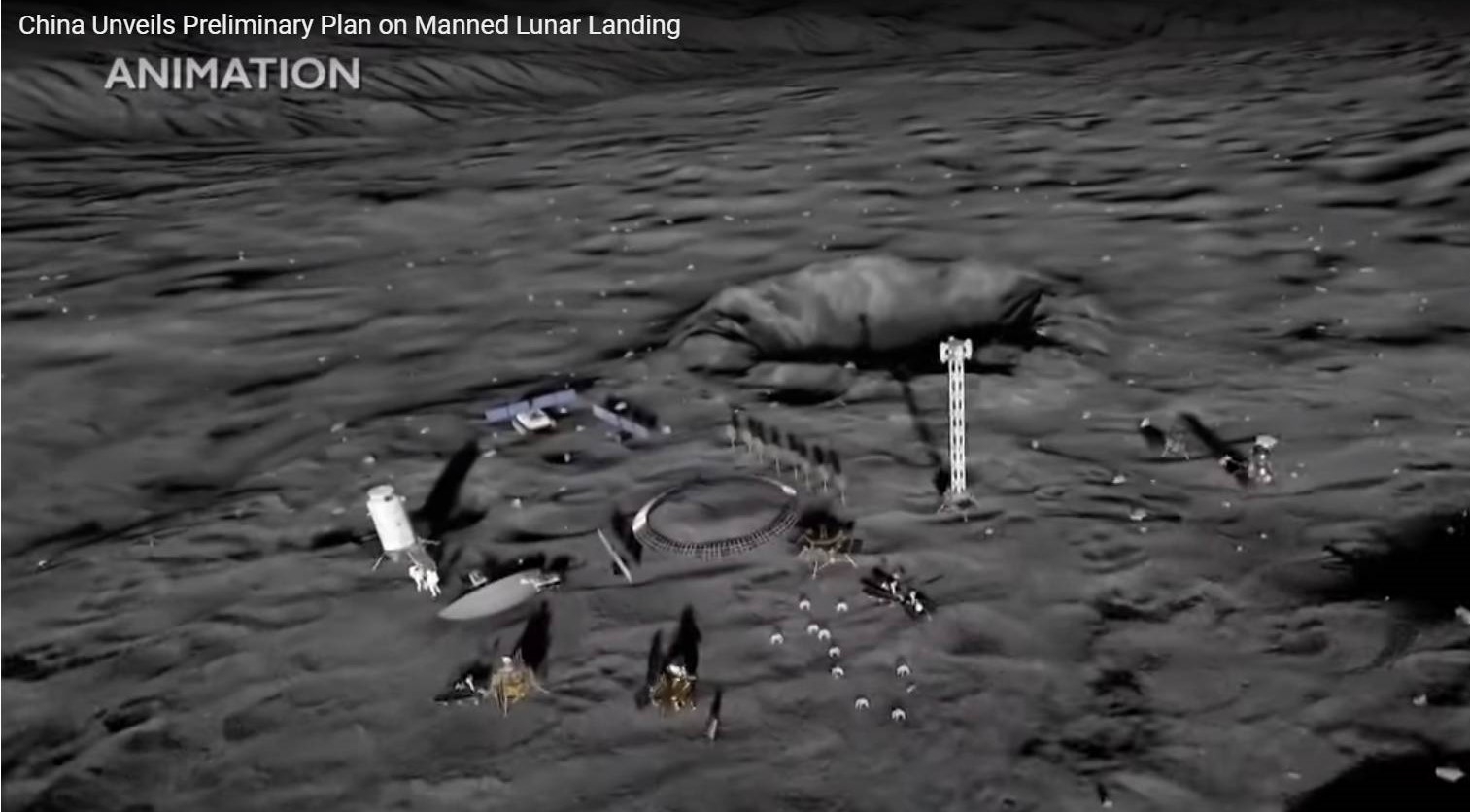
Artist’s view of International Lunar Research Station to be completed by 2035. Credit: CNSA
China is providing new details regarding the country’s plan to establish an International Lunar Research Station.
The International Lunar Research Station (ILRS), according to state-run outlets, will consist of sections on the lunar surface, sections in lunar orbit and sections on Earth, and it will be built in two phases.
Wu Weiren, chief designer of China’s lunar exploration program, rolled out current ILRS thinking while attending a space conference as part of Space Day of China activities. The China conference started on Wednesday in Wuhan, capital of central China’s Hubei Province.

CCTV/Inside Outer Space screengrab
First, second phase
Wu said the first phase of the ILRS construction project will see a “basic station” built by 2035 in the lunar south pole region, one that will constitute scientific facilities, able to carry out scientific experiments to develop and utilize local lunar resources on a limited scale.
The second phase will see expansion of the station, set for completion by 2045.
This phase involves a Moon-orbiting space station as a research hub for lunar research – as well as scientific experiments and research for a future human landing on Mars, according to the Xinhua news agency.
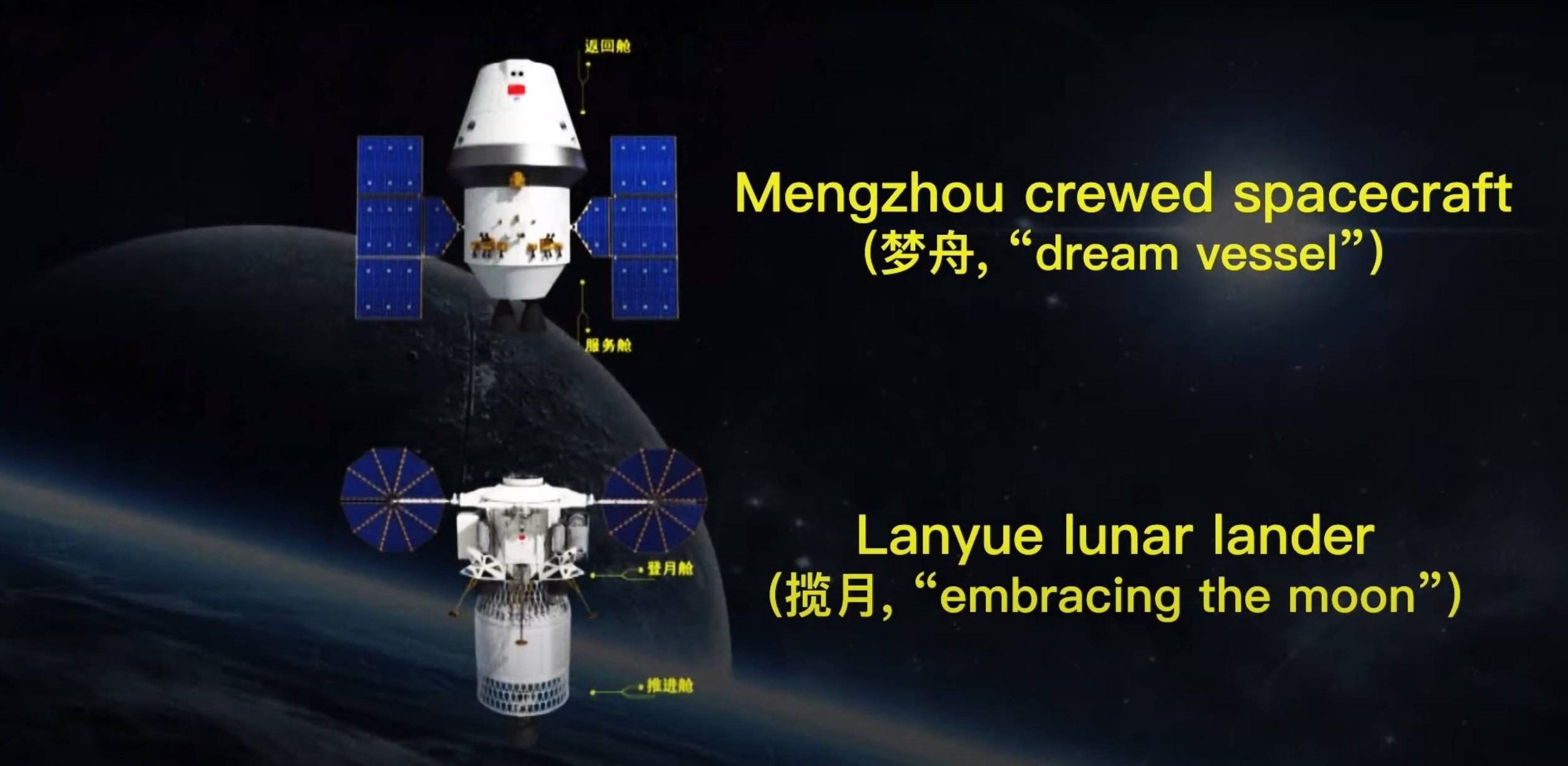
Image credit: China National Space Administration (CNSA)/China Central Television (CCTV)/SciNews.ro/Inside Outer Space screengrab
Robotic lunar exploration
Wu noted that the basic ILRS will benefit by a sequence of lunar robotic mission: the upcoming Chang’e-6 sample return mission to the Moon’s far side; Chang’e-7 in 2026 to do environment and resource surveys in the lunar south pole region; and Chang’e-8 in 2028 to carry out tests aimed at the on-the-spot utilization of lunar resources.
According to Wu, after completion, the ILRS will consist of the lunar surface section, the lunar orbit section and the Earth surface section, with infrastructure such as an energy power system, a command and information system, and a lunar surface transportation system.
“This stage of the ILRS will have energy supply, central control, communication and navigation, Earth-moon roundtrip transport, and lunar surface scientific research functions,” reports Xinhua. “It will be capable of carrying out multi-disciplinary and multi-target scientific and technological activities on a large scale over a long period of time, with activities including scientific exploration, resource development and technology verification.”

Image credit: China Manned Space Agency
International involvement
China’s ILRS program, Wu said, is to embrace 50 countries, 500 international research institutions and 5,000 overseas researchers to help develop the station, manage facilities, and share scientific research results.
The ILRS has been initiated by China and is jointly developed by multiple countries and organizations. New ILRS partners include Nicaragua, the Asia-Pacific Space Cooperation Organization and the Arab Union for Astronomy and Space Sciences.
China’s Global Times reports that the ILRS is currently led by the China National Space Administration (CNSA) and Russia’s Roscosmos.

China’s Tianwen-1 Mars orbiter.
Credit: CNSA
Mars return sample
According to the Global Times, Wu also stated that China plans to launch the Tianwen-2 mission around 2025, to carry out flyby exploration and return samples from a small asteroid.
Around 2030, Tianwen-3 is planned to be launched to execute a sample return mission from Mars, Wu said.

Illustration of the scientific payloads mounted on Zhurong Mars rover that landed on the Red Planet in May 2021. The group picture of the rover (left) and the lander (right) was taken by the WiFi camera (Image Credit: the ChinaNational Space Administration (CNSA). NaTeCam: Navigation and Terrain camera. RoMAG: Mars Rover Magnetometer. MSCam: Multispectral Camera. MSC-1: MarsClimate Station (Wind field and sound probe). MSC-2: Mars Climate Station (Air
temperature and pressure probe). MarSCoDe: Mars Surface Component Detector. RoPeR(CH1): Mars Rover Penetrating Radar (channel 1). RoPeR (CH2): Mars Rover
Penetrating Radar (channel 2).
Credit: Steve Yang Liu, Et al.
“Currently, looking at the progress of various countries around the world, our country is expected to become the first country to return samples from Mars,” Wu remarked. China has begun planning the construction of the world’s first Mars sample laboratory.
Also, a feasibility study is underway for a Tianwen-4 mission to explore Jupiter and its moons, followed by the arrival at Uranus, according to Wu.
Wenchang Moonport
In related news, Lin Xiqiang, deputy director of the CMSA also noted the country’s planned human lunar landing program.
“The program development for major flight products, including the Long March-10 carrier rocket, the manned spacecraft Mengzhou, the lunar lander Lanyue and the lunar landing suits, is all done, and their prototype production and tests are underway in full swing,” said Lin.

Image credit: CCTV/Inside Outer Space screengrab
Lin added that work on China’s human-carrying Moon lander has been basically completed. Also, the Wenchang launch center to be the human lunar exploration departure point is under construction.
Per China Central Television (CCTV), Lin said that unlike the space station effort, the Moon landing mission needs taikonauts to master the operation of Mengzhou spacecraft and Lanyue lander in normal and emergency flight conditions, including rendezvous and docking of the spacecraft and lander, and manually avoiding obstacles during the lander’s descent.

Shenzhou-18 crew: astronauts Li Guangsu, Ye Guangfu, Li Cong.
China’s next human spaceflight is targeting an April 25 liftoff of the three-person Shenzhou-18 crew to the country’s space station They will be launched at 8:59 p.m. Beijing Time on Thursday from the Jiuquan Satellite Launch Center in northwest China.
Chinese astronauts Ye Guangfu, Li Cong and Li Guangsu will carry out the Shenzhou-18 mission with Ye as the commander.
Ye was crew member of China’s Shenzhou-13 mission, with both Li Cong and Li Guangsu making their first flight, selected from the country’s third-batch of taikonauts.

Shenzhou-18 logo.
Image credit: CMS
Six month stay
The soon-to-be-launched crew are scheduled to stay in orbit for about six months and return to the Dongfeng landing site in north China’s Inner Mongolia Autonomous Region in late October.
According to China Central Television (CCTV), the new crew will perform two to three spacewalks and implement six cargo outbound deliveries through the space station’s cargo airlock module.
The now orbiting Shenzhou-17 trio will meet with the Shenzhou-18 crew prior to that threesome returning to Earth on April 30 at the Dongfeng landing site.

Image credit: JAXA/SLIM
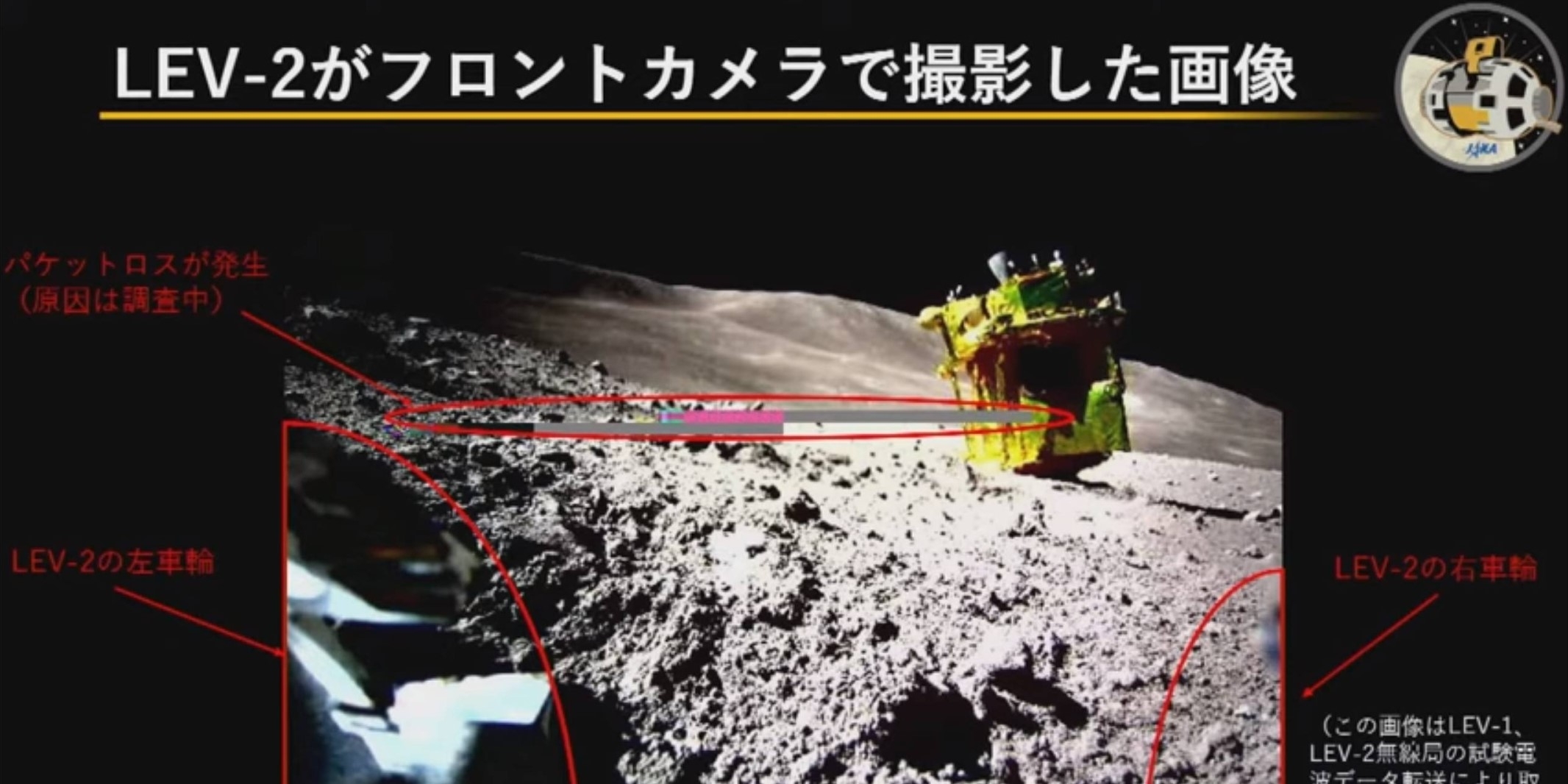
Image taken shortly after landing, the Ultra-small SORA-QI photo of SLIM in nose-down mode. Image credit: JAXA/Inside Outer Space screengrab
It’s Alive (again!).
Last night (the night of April 23rd), control teams for Japan’s Smart Lander for Investigating Moon (SLIM) reported they were able to successfully communicate with SLIM. They confirmed that SLIM had survived the lunar night cycle for the third time.
“SLIM has maintained its primary functions even after three overnight stays, which was not anticipated in its design. We will continue to closely monitor SLIM’s condition and hope to identify areas that deteriorate depending on the lunar day and night environment, as well as areas that are not prone to deterioration,” a SLIM posting notes on X.
A photo of the surface of the Moon taken after the overnight awakening was taken with SLIM’s navigation camera. The Moon is bright overall and the shadows are very short.
SLIM landed on the Moon on January 19, 2024.

Go-getter space entrepreneur and pragmatic rocketeer, Peter Beck of Rocket Lab..
Image credit: Barbara David
Extremely busy with an eye on the future.
That’s a short and sweet assessment of Peter Beck, Rocket Lab’s founder and CEO. In the pantheon of private space groups, Rocket Lab is a roaring success and Beck wants to keep it that way.

Rocket Lab Electron launcher on New Zealand LC-1 launch pad.
Image credit: Kieran Fanning/Rocket Lab
Ask Peter Beck to weigh the firm’s past and where it’s headed. His response: “We joke that a Rocket Lab year is like a dog year. One Rocket Lab year feels like five.”

Artwork depicts Neutron launch vehicle for deploying large spacecraft and satellite constellations.
Image credit: Rocket Lab
In my exclusive interview with Beck, I caught up with the enterprising entrepreneur during the Space Foundation’s 39th Space Symposium, held earlier this month.
For Beck’s look at today and what’s ahead for his company, go to my new Space.com story — Building rockets and looking for life on Venus: Q&A with Rocket Lab’s Peter Beck – at:
https://www.space.com/rocket-lab-peter-beck-interview-april-2024

Book Review: Space and the Warfighter – How Space Technologies Transformed U.S. Military Actions; Spacehistory101.com Press (2023); 232 pages; softcover; $28.97.
I recently returned from the Space Foundation’s mega-symposium in Colorado Springs, a meeting that highlighted U.S. military space prowess and issues of warfighting.
The reader will greatly benefit by taking a read of this informative volume, one that takes you into the history, background, and evolving U.S. Air Force thinking regarding military conflict in space.
Anchored primarily in past military operations, such as Desert Shield and Desert Shield, and noting the formation of the U.S. Space Force, the book features contributions by leading military historians.
Space has become a vital part of the national defense plan of the United States. The message is that use of space systems for warfare in the past was not as understood, nor appreciated as they are today. Desert Storm did involve the full arsenal of military space systems – the first large-scale integration of space systems in support of warfighting.
This book not only underscores the history of utilizing space for military means, but also the progression and organization of space doctrine and policy.

Image credit: U.S. Air Force/SSgt Vanessa Valentine
I was particularly drawn to what influence the 9/11 attacks in September 2001 had on the application of space systems and also the need for security of those assets. To this point, protection of launch facilities, including at that time space shuttle operations like the mission of STS-108. That flight of Endeavor was the first space shuttle launch following the September 11 attacks.
Space and the Warfighter spotlights military need for early warning, communications, satellite-gleaned weather data, as well as positioning, navigation and timing capabilities. For instance, roughly 100 satellites supported military operations in Afghanistan and the surrounding region; use of the Global Positioning System (GPS) has become omnipresent over time.
In an afterwords section, this fact is flagged: “The two Gulf Wars, and the decade separating them, generated and demonstrated a revolutionary transformation in American warfighting – a transformation in which space-based communications and [Positioning, Navigation and Timing] PNT, among other systems, used capabilities originally conceived and developed for strategic purposes to support theater or tactical operations.”
This has fundamentally changed, the book continues, with the U.S. military now relying heavily on orbiting space systems “in an increasingly congested and contested domain.”
For more information on this book, under the SPACE 3.0 Foundation, go to:
https://www.amazon.com/s?i=stripbooks&rh=p_30%3ASpacehistory101.com+Press

Image credit: CAS
China has released a set of geologic atlases of the Moon, providing high-definition map data for future lunar exploration – an aide in selecting the location for the country’s lunar research station and utilizing lunar resources.
This set of geologic atlas, available in Chinese and English, includes the Geologic Atlas of the Lunar Globe and the Map Quadrangles of the Geologic Atlas of the Moon, according to the Institute of Geochemistry, Chinese Academy of Sciences (CAS).

Ouyang Ziyuan, a CAS academician and lunar scientist .
Image credit: CCTV/Inside Outer Space screengrab
Site selection, resource utilization
“The geological atlas of the moon is of great significance for studying the evolution of the Moon, selecting the site for a future lunar research station and utilizing lunar resources,” Ouyang Ziyuan, a CAS academician and lunar scientist told China Central Television (CCTV).
“The world has witnessed a significant progress in the field of lunar exploration and scientific research over the past decades, which have greatly improved our understanding of the Moon,” added Liu Jianzhong, a senior researcher from the Institute of Geochemistry, CAS.

Liu Jianzhong, a senior researcher from the Institute of Geochemistry, CAS.
Image credit: CCTV/Inside Outer Space screengrab
Apollo era maps
Liu noted that the lunar geologic maps published during the Apollo era have not been changed for about half a century, and are still being used for lunar geological research.
“With the improvements of lunar geologic studies, those old maps can no longer meet the needs of future scientific research and lunar exploration,” Liu added.
According to China Daily, since 2012, Ouyang and Liu have led a team of scientists and cartographers from various research institutions in efforts to compile the atlas.
Liu said that the atlas set has been integrated into the digital lunar cloud platform built by Chinese scientists.
China’s Chang’e-6 lunar sample return mission elements.
Credit: CNSA
Far side science
Liu said that atlas set will serve lunar scientific research and science education, as well as landing site selection, lunar resource exploration and path planning for China’s future lunar exploration projects.
The soon-to-launch Chang’e-6 mission is targeted to collect samples in the Apollo Basin within the South Pole-Aitken Basin on the far side of the Moon, which means materials ejected from ancient terrain may be collected in the process.
“Our map can provide a macroscopic geological background to improve the purpose and efficiency of the sample research,” Liu said.

Image credit: CCTV/Inside Outer Space screengrab
All is in readiness for the liftoff of China’s next human space outing – the flight of the Shenzhou-18 crew.
Over the weekend, a full-system rehearsal was staged at the Jiuquan Satellite Launch Center.
This week’s projected takeoff, reportedly on April 25, is the 13th piloted mission of China and the 18th overall flight of the Shenzhou program.

High-definition images of China’s space station were taken by the departing Shenzhou-16 crew last October 30.
Image credit: CMS
A still-to-be-identified three-person crew is to rocket to the China space station for a six-month stay onboard the facility.
The Astronaut Center of China says the Shenzhou-18 crew is in good condition, with all systems for their takeoff in go condition.
Once launched atop a Long March-2F Y18 carrier rocket, the Shenzhou-18 crew will join the already orbiting three-member crew of Shenzhou-17.

Curiosity’s location as of Sol 4159. Distance driven at that time: 19.68 miles/31.67 kilometers.
Image credit: NASA/JPL-Caltech/Univ. of Arizona
NASA’s Curiosity Mars rover is performing its duties at Gale Crater, landing on Mars in August, 2012.
“Curiosity continues to make progress along the margin of upper Gediz Vallis ridge, investigating the broken bedrock in our workspace and acquiring images of the ridge deposit as the rover drives south,” reports Lauren Edgar, a planetary geologist at USGS Astrogeology Science Center in Flagstaff, Arizona.

Curiosity Right B Navigation Camera on Sol 4160 April 19, 2024.
Image credit: NASA/JPL-Caltech
A recently scripted two sol plan — Sols 4159-4160 — focused on a Dust Removal Tool (DRT) activity, contact science, and a drive on the first sol, followed by untargeted remote sensing on the second sol.

Curiosity Right B Navigation Camera on Sol 4160 April 19, 2024.
Image credit: NASA/JPL-Caltech
Weekend activities
“The team had to make some decisions at the start of planning about whether to drive on the first or second sol of this plan, and how that would affect the upcoming weekend activities,” Edgar adds.
“As it turned out, the team was able to fit all of the desired contact science and remote sensing activities on the first sol, in addition to the drive on the first sol, which means we’ll be able to downlink more information about our end-of-drive location to better inform planning for the weekend,” Edgar noted.

Curiosity Right B Navigation Camera on Sol 4160 April 19, 2024.
Image credit: NASA/JPL-Caltech
Assess the stratigraphy
The first sol of this scripted plan is “fully loaded,” Edgar reports. The plan begins with a DRT activity to expose a fresh surface on the bedrock target ‘Tilden Lake,’ followed by Alpha Particle X-Ray Spectrometer (APXS) integrations to investigate its composition.
Then the geology theme group planned several hours of remote sensing activities, including Chemistry and Camera (ChemCam) Laser Induced Breakdown Spectroscopy (LIBS) on the bedrock target “Curry Village,” which has a similar “dragon scale” texture (or “tire tracks”) to what researchers had observed in the previous workspace.

Curiosity Mast Camera Right on Sol 4159 April 18, 2024.
Image credit: NASA/JPL-Caltech/MSSS

Curiosity Mast Camera Right on Sol 4159 April 18, 2024.
Image credit: NASA/JPL-Caltech/MSSS
Long distance imagery
This big remote sensing block also includes ChemCam long distance Remote Micro-Imager (RMI) mosaics to assess the stratigraphy at Gediz Vallis ridge and the distant butte Kukenan.
“These long distance RMI images reveal a lot of great detail about distant targets, like the diversity of clasts at Gediz Vallis ridge,” Edgar points out.

Curiosity Mast Camera Right on Sol 4159 April 18, 2024.
Image credit: NASA/JPL-Caltech/MSSS

Curiosity Mast Camera Right on Sol 4159 April 18, 2024.
Image credit: NASA/JPL-Caltech/MSSS
“The plan also includes a number of Mastcam activities to characterize local textures, sedimentary structures, dark rocks, and sandy aeolian bedforms (known as Transverse Aeolian Ridges, aka TARs) in a nearby trough,” Edgar reports.
“The environmental theme group also planned activities to monitor the movement of fines on the rover deck, search for dust devils, and monitor atmospheric dust,” Edgar says.

Curiosity Mast Camera Right on Sol 4159 April 18, 2024.
Image credit: NASA/JPL-Caltech/MSSS

Curiosity Mast Camera Right on Sol 4159 April 18, 2024.
Image credit: NASA/JPL-Caltech/MSSS
Driving south
After this big remote sensing block, Curiosity will use Mars Hand Lens Imager (MAHLI) to image the contact science target, and then continue driving south.
The second sol includes untargeted activities like an autonomously selected ChemCam “AEGIS” target, additional Navcam deck monitoring, and Navcam line-of-sight observations.
AEGIS stands for Autonomous Exploration for Gathering Increased Science) – a software suite that permits the rover to autonomously detect and prioritize targets.
After the drive, the scripted plan called for taking post drive imaging to prepare for the next plan.
Concludes Edgar: “Looking forward to seeing what other surprises our next workspace will reveal!”

Curiosity Mast Camera Right on Sol 4159 April 18, 2024.
Image credit: NASA/JPL-Caltech/MSSS

