Archive for the ‘Space News’ Category
 Author:
  May 20th, 2024
High-definition images of China’s space station were taken by the departing Shenzhou-16 crew last October 30.
Image credit: CMS
China’s now orbiting Shenzhou-18 crew onboard the country’s Tiangong space station have completed the assembly, testing and outside attachment of a second material exposure experiments.
The three Chinese astronauts — Ye Guangfu, Li Cong and Li Guangsu — were sent to the space station for a six-month mission on April 25.
A tribology experiment box for solid-liquid compound lubrication is one of the major facilities on the station used for scientific research. The focus of the investigation is “super-lubrication” or zero-wear in mechanical movement in the brutal space environment.
Extended service life

China’s Shenzhou-18 crew.
Image credit: CCTV/Inside Outer Space screengrab
According to China Central Television (CCTV), a variety of lubricants have been used in space, applied to moving components of spacecraft and the space station, including solar arrays and antenna systems, thereby extending the service life of spacecraft.
Exposing lubricants and testing equipment to space can better test their reliability, as the experimental environment in space has complexities that can’t be simulated in a terrestrial laboratory, explained Wang Desheng, a researcher at the Lanzhou Institute of Chemical Physics of the Chinese Academy of Sciences in northwestern China to CCTV.

Wang Desheng. Image credit: CCTV/Inside Outer Space screengrab
“Environmental factors for space science experiments include ultra-high vacuum, high and low temperature alternation, and space radiation environments such as microgravity, and atomic oxygen irradiation in particular, are important to study the damage patterns to lubricating materials,” said Wang.
Technical reserves
The institute’s Cai Meirong added that they will study the samples in the laboratory to build technical reserves for future research and development of lubricating materials with longer service life and higher reliability.

Cai Meirong. Image credit: CCTV/Inside Outer Space screengrab
“We will analyze the structural and physicochemical properties of a sample, including its viscosity, thermal stability and other property changes, and observe whether there is any change in its structure and physicochemical properties in the space environment,” Cai told CCTV.
Go to this video at: https://fb.watch/sbfoRyrZ6B/
 Posted in

Artwork depicts Chang’e-6 now in Moon orbit.
Image credit: CNSA/CGTN/Inside Outer Space screengrab
China’s robotic Chang’e 6 lunar farside sample return mission is now in orbit around the Moon, ready to execute a landing attempt.
The multi-component spacecraft is currently awaiting optimum illumination conditions in the Apollo basin interior landing area on the farside, with a touchdown generally planned for early June.
Prior to that next step, the now-circling lunar probe is spending some 20 days to find the best position for a soft landing at the Moon’s farside of the by the lander/ascender components.

Image credit: CCTV/Inside Outer Space screengrab
That pre-selected touchdown spot on the enigmatic farside of the Moon, is a huge impact basin called South Pole-Aitken (SPA) basin. SPA basin occupies an immense area, roughly 1,550 miles (2,500 kilometers) in diameter.

Artwork of Chang’e-6 landing on Moon’s far side.
Image credit: CGTN/CNSA/Inside Outer Space screengrab
Projected 53-day mission
Within 48 hours after touchdown, a robotic arm will be extended to scoop rocks and soil from the lunar surface and a drill will bore into the lunar topside.
Those lunar collectibles will be placed within the ascender for departure from the Moon and docking with the orbiter/returner in lunar orbit.
After completing all tasks, the Chang’e-6 mission will start its homeward-bound leg. After roughly five days of flight, a returner capsule is to re-enter the atmosphere and land in the Siziwang Banner of north China’s Inner Mongolia.

Image credit: Xingguo Zeng, et al.
From launch on May 3 to the Moon and return to Earth of the capsule-contained Moon specimens adds up to a projected 53-day mission.
Landing zone
As the largest and oldest impact structure on the Moon, the SPA basin is among the highest priority sites for future lunar exploration and lunar sample return.
One of the candidate landing areas of Chang’E−6 mission is the “cryptomare” south of the Apollo basin, termed region 1.
That region is not only on the landing zone agenda for China’s Chang’E−6 mission.
A potential NASA lunar mission, Endurance, is designed to traverse the entire basin through the basin center, and also return samples from the area.

Image credit: Xing Wang , et al.
Samples collected by these missions from the central cryptomaria would be critical ground truth for assessing the early thermal history of the lunar farside, and their comparison with Apollo/Luna/Chang’E samples collected from the lunar nearside would also help to unravel the causes of the hemispherical asymmetry of mare deposits.
Go to this informative paper – “Lunar Farside South Pole-Aitken Basin Interior: Evidence for More Extensive Central Cryptomaria in the South Pole-Aitken Compositional Anomaly (SPACA)” — led by Xing Wang at the Key Laboratory of Lunar and Deep Space Exploration, National Astronomical Observatories, Chinese Academy of Sciences, in Beijing, China at:
https://agupubs.onlinelibrary.wiley.com/doi/full/10.1029/2023JE008176
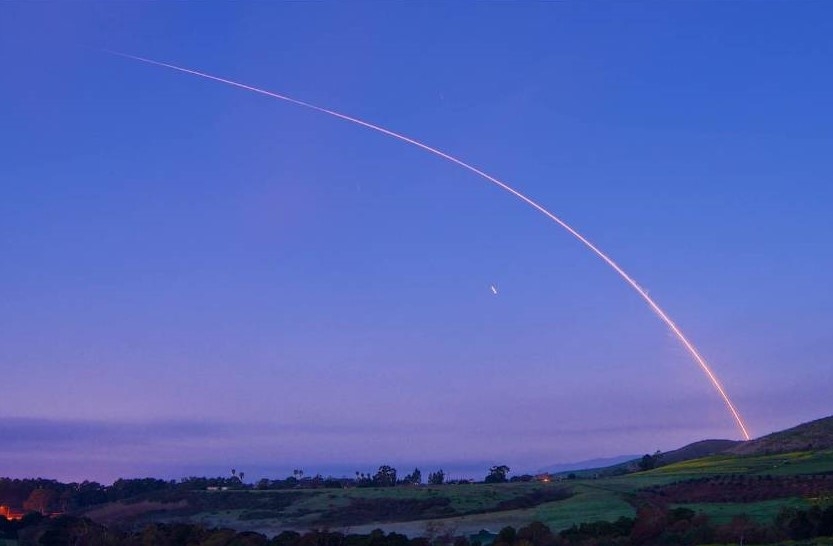
Image credit: Celestis
The folks at Celestis are offering space — memorial capsule space — for its upcoming Perseverance Flight.
Billed as the first spaceflight ever to take memorial space capsules into space to orbit Earth and then deliver them safely home again, the mission is to be staged at Vandenberg Space Force Base, California.
Celestial keepsakes
Celestis explains the mission will fly individually engraved Flight Capsule that carries a loved one’s cremated remains or DNA sample to space and back to Earth, “into the waiting arms of family, who can keep these celestial keepsakes forever.”
Image credit: Celestis
This Perseverance mission is the tenth Celestis Earth Rise service, departing Vandenberg Space Force Base aboard a Space X Falcon 9 launch vehicle no earlier than February 2025.
This will be Celestis’ 25th overall memorial spaceflight since its founding in 1994.
Orbital recovery vehicle
The inaugural launch-orbit-return memorial flight is scheduled to launch in 2025 and makes use of The Exploration Company’s Nyx orbital recovery vehicle. The name Nyx is taken from the ancient Greek goddess of the cosmos creation.
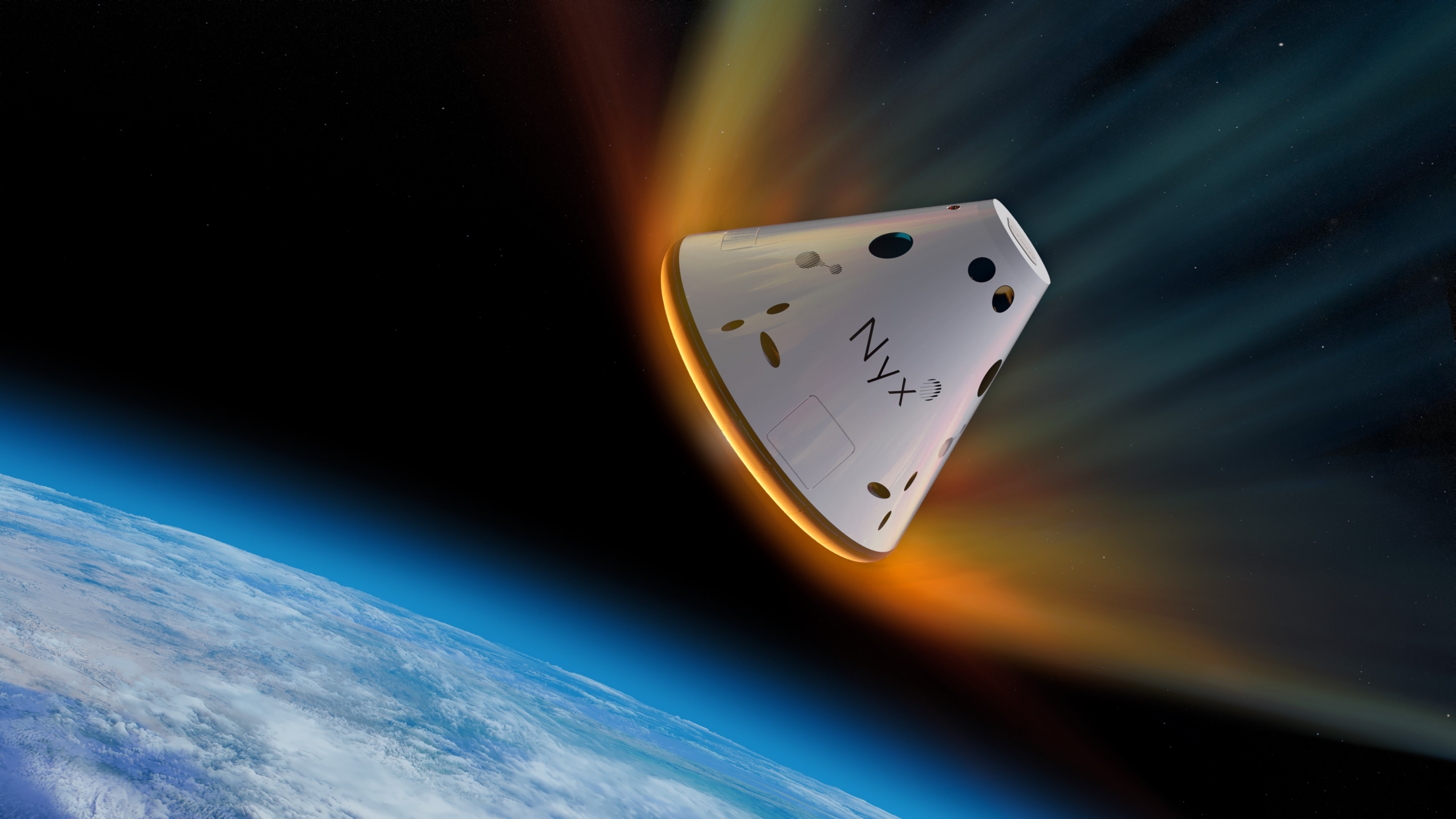
Artwork credit: The Exploration Company
A memorial capsule starts at $3,495, with the returned capsule accompanied by a flight certificate authenticating and recording the exact mission trajectory, verifying the capsule reached space, circled the Earth at 500 miles altitude at roughly 17,000 miles per hour for three hours to complete two to three full Earth orbits.
“Touch the Sky… Seek the Stars… Return Home,” adds Celestis.
For more information, go to:
https://www.celestis.com/launch-schedule/perseverance-flight/

Image credit: ESA/Mlabspace
The long-delayed European ExoMars Rosalind Franklin mission to the Red Planet got a boost for its projected launch in 2028.
A new Memorandum of Understanding was inked May 16 by the European Space Agency (ESA) and NASA, thereby officially joining forces on the endeavor.
Two years ago, ESA cut ties with its Russian Roscosmos partner on ExoMars due to the Russian invasion of Ukraine, skipping an intended launch window for the interplanetary mission.

ExoMars 2022 mission was a joint ESA/Roscosmos project. Shown is rover ready to depart Russia-provided landing module and science landing platform.
Credit: Thales Alenia Space/Master Image Programmes
Now ESA, its Member States and European industry, along with NASA, are hammering out new synergies and partnerships.
U.S. contributions
Here’s the new deal for ExoMars:
The U.S. will provide the launch service, elements of getting ExoMars down safe and sound on Mars, as well as heater units for the Rosalind Franklin rover.
In a statement from ESA, besides the launch service and throttleable braking engines, the main update is that NASA, in partnership with US Department of Energy (DOE), will provide the lightweight radioisotope heater units (RHUs) for the rover.
In parallel, work on the development and certification of a European RHU to fly on the mission will continue, led by the UK.

Credit: ESA/Mlabspace
Called the ESA GSTP/ENDURE program (ENDURE standing for ‘European Devices Using Radioisotope Energy’), the UK work is focused on delivery of an end-to-end European capability for radioisotope heat and power systems by the end of this decade.
Drilling down – politically and scientifically
ESA’s Rosalind Franklin rover is built to drill to a depth of up to 6.5 feet (two meters) below the surface.
Doing so, samples of Mars that have been protected from surface radiation and extreme temperatures will be studied onboard the rover.
In an exclusive interview last month with Space.com, Josef Aschbacher, ESA’s Director General, spotlighted ExoMars at the Space Foundation’s 39th Space Symposium, held in Colorado Springs, Colorado.

Josef Aschbacher, ESA’s Director General.
Image credit: Barbara David
“ExoMars started around 2010-201l, with NASA originally a partner. But budget issues had NASA drop out. So then in working with Russia it moved forward for about 10 years. With war in Ukraine and the sanctions that our member states imposed on Russia, I could not finish the program,” Aschbacher said.
“And this is something quite drastic. The ExoMars rover was finished and ready for launch in September 2022. The war started in February 2022 so I stopped and terminated the cooperation with Russia,” Aschbacher said.
Finding some microbes?
As for how important ExoMars is in the ongoing study of the Red Planet, Aschbacher is ready for new, prime-time revelations.
“It will drill into the surface which is quite unique. There’s no chance to find life on the surface. You have to go down, and exobiologists are saying at least 1.5 meters and we go down 2 meters,” said Aschbacher.
“Can you imagine how exciting this will be? Just imagine finding some microbes of life and to analyze whether there is DNA or no DNA. Would the DNA be similar to ours or not? Unimaginable…and we just don’t know,” the ESA Director said.

Last year, SIIRIUS-23 crew members enterr isolation facility to mimic deep space exploration.
Image credit: Roscosmos/Inside Outer Space screengrab
The six crew members of a year-long space voyage passed their half-way point on May 14, isolated for scientific and psychological study under Russia’s Scientific International Research In Unique terrestrial Station (SIRIUS) project.
Using a unique scientific facility, life support systems, space activities, medical controls and prevention, crew performance and dynamics can be assessed, as well as crew autonomy and associated physiological and psychological stress.

Simulated space ship is at the core of the SIRIUS-23 mission in a 360-day isolation experiment.
Image credit: IBMP
Stay-at-home interplanetary journey
Undergoing their 360-day “flight” of isolation, they are imitating flight conditions of an interplanetary journey. The SIRIUS-23 crew entered their home-away-from-home isolation facility on November 14, 2023.
SIRIUS-23 is being carried out under the auspices of the legendary Institute for Bio-Medical Problems (IBMP) under the Russian Academy of Sciences.

Image credit: SSC/IBMP/RAS
This current initiative is another step of IBMP isolation experiments: SIRIUS-17 (17 days in 2017); SIRIUS-19 (120 days in 2019), with the stage-3 SIRIUS-23 mission taking place in 2021 and lasting 240 days.
Isolation
The main goal of the SIRIUS-23 experiment is to study adaptation of the human body to isolation in a hermetic facility with the artificial habitat simulating a human space flight.
Also being evaluated is gauging means of preventing the negative effects of isolation, as well as minimizing the risks to crew undertaking long-term interplanetary flights.
On the IBMP agenda for the crew is appraising the behavioral aspects of a person’s stay in conditions of long-term autonomous stay in space, taking into account limited space within a spacecraft, limited resources and possible communication delays.

Image credit: SSC/IBMP/RAS
IBMP is investigating actions of the crew in the event of various types of technical malfunctions, say an accident with serious consequences that might pose a threat to the health and life of crew members.
Furthermore, IBMP is looking into problems of intragroup interaction, leadership in a cross-cultural crew with different gender composition.
Moonwalks
Over the course of 180 days, the SIRIUS-23 team saw the arrival of two transport ships to their “orbital station” on December 15, 2023 and March 7, 2024. During the unloading of the supply ships, studies were conducted on the effect of 36-hour sleep deprivation on the psychological state of the crew.

Image credit: SSC/IBMP/RAS
Two cycles of crew separation and spacewalks (EVA) were carried out (January 15–19 and March 18–22, 2024).
A Moon mission simulation includes a flyby to search for a landing site, multiple landings of four crew members for surface operations, orbiting the Moon, and remote control of a rover on the surface.
During these periods, the expedition’s landing detachment, consisting of four crew members, utilized a lunar takeoff and landing module. A “Planetary Surface” module was also used.
In each of the two cycles, two EVAs were performed per day for three days, in pairs. The simulated extravehicular activities involve virtual reality systems and simulation of lunar gravity (the “Constellation-Sirius” experiment). All in all, a dozen surface exits were carried out.

Image credit: SSC/IBMP/RAS
Neurocognitive games
IBMP experiments on the isolated crew is based on the principle of repeatability of cycles. There are daily measurements of intra-ear temperature, stress control, filling out a questionnaire at each meal, etc. A number of experiments aimed at assessing the microflora of humans and the environment have been successfully carried out.
On a weekly basis, neurocognitive games are played by the crew and recording EEG recordings at rest are taken.
Most physiological and psycho-physiological examinations are done on a monthly time period.

Image credit: SSC/IBMP/RAS
Flight cyclogram
According to IBMP officials, the year of isolation is divided into three four-month cycles, each of which includes a repeating set of experimental tasks and techniques. At the end of each cycle, a series of standardized studies and tests are carried out, the results of which make it possible to provide a comprehensive assessment of the state of the physiological systems of the crew members’ bodies during a given period of time.
“All crew members have maintained health and high performance,” explains the IBMP. “The scientific research program is being carried out in full and in strict accordance with the ‘flight’ cyclogram.”

Curiosity Left B Navigation Camera image taken on Sol 4185, May 15, 2024.
Image credit: NASA/JPL-Caltech
NASA’s Curiosity Mars rover at Gale Crater is now surveying its surroundings.
Emma Harris, a graduate student at the Natural History Museum in London, England is studying “Texoli butte” to see very high detail of rocks hundreds of meters away via the robot’s suite of instruments.

Curiosity Chemistry & Camera (ChemCam) Remote Micro-Imager (RMI) photo acquired on Sol 4185, May 15, 2024.
Image credit: NASA/JPL-Caltech/LANL

Curiosity Chemistry & Camera (ChemCam) Remote Micro-Imager (RMI) photo acquired on Sol 4185, May 15, 2024.
Image credit: NASA/JPL-Caltech/LANL
Curiosity’s Chemistry and Camera (ChemCam) instrument has gazed long distance at Texoli butte by way of the Remote Micro-Imager (RMI).
Glimpse between buttes
A recent plan also called for looking at a structure further up Gediz Vallis channel that the rover won’t be driving up to named “Milestone Peak.”

Curiosity Left B Navigation Camera image taken on Sol 4185, May 15, 2024.
Image credit: NASA/JPL-Caltech
“The long-distance observations are really useful in ensuring we can see everything we need to, even if we don’t drive super close,” Harris reports. “We then take a glimpse between the buttes of Gediz Vallis and above the sulfate-bearing unit we are currently driving in to the yardang unit for the final long-distance RMI of this plan.”

Curiosity Left B Navigation Camera image taken on Sol 4185, May 15, 2024.
Image credit: NASA/JPL-Caltech
Close-in duties too
Curiosity’s super vision is also looking at the atmosphere, Harris notes, with the rover’s Mastcam gauging the amount of dust in the atmosphere in a tau measurement, and Navcam will take a suprahorizon movie as well as being on the lookout for dust devils.

Curiosity Front Hazard Avoidance Camera Left B Sol 4185 taken on May 15, 2024.
Image credit: NASA/JPL-Caltech
As well as really far away, Curiosity is a specialist at looking and taking measurements of rocks right in front of us.
Closer-in duties involve Curiosity taking Alpha Particle X-Ray Spectrometer (APXS) measurements and Mars Hand Lens Imager (MAHLI) observations on two nearby rocks named ‘Tenaya Lake’ and ‘Buck Lake.’

Curiosity Left B Navigation Camera image taken on Sol 4185, May 15, 2024.
Image credit: NASA/JPL-Caltech
Morning light on Mars
On the same rock as Buck Lake, ChemCam will be taking a Laser Induced Breakdown Spectroscopy (LIBS) measurement on a target named ‘Illilouette Falls,’ and another rock a little further away called ‘Redwood Canyon,’ as well as a passive observation on a dark-toned rock named ‘Cox Col.’

Curiosity Left B Navigation Camera image taken on Sol 4185, May 15, 2024.
Image credit: NASA/JPL-Caltech
“Mastcam will document these observations, as well as looking back at the south side of Pinnacle Ridge we have just driven around,” Harris explains. In total, Mastcam will spend 1 hour documenting the rocks at the Gediz Vallis Ridge, including a 15×3 mosaic during an early morning wake-up call to take advantage of the morning light on Mars.

Curiosity Left B Navigation Camera image taken on Sol 4185, May 15, 2024.
Image credit: NASA/JPL-Caltech

Curiosity Right Navigation Camera image taken on Sol 4185, May 15, 2024.
Image credit: NASA/JPL-Caltech

Ingenuity Mars helicopter yielded sweeping, low-level, imagery over its 72 flights.
Image credit: NASA/JPL-Caltech
The NASA Ingenuity Mars helicopter chalked up many a milestone during 72 airborne flights before incurring a destructive encounter with a sand dune. That “hit-the-dirt” mishap caused rotor-blade damage that now prevents it from additional aerial treks.

Ingenuity made use of commercial, off-the-shelf (COTS) high-tech hardware.
(Image credit: NASA/JPL-Caltech/Theodore Tzanetos)
Not only was Ingenuity’s flight experience exemplary, the rotorcraft achievements have opened the door for follow-on aerial craft to fly the friendly but thin atmospheric skies of the Red Planet.
As a technology demonstrator goal, Ingenuity was assigned the duty to make up to five flights over 30 days. But from its celebrated April 19, 2021 first voyage to its last airborne journey on January 18, 2024, Ingenuity pushed its self-made envelope in altitude attained, distance flown, and speed reached over those nearly three years.

A Mars craft concept is now being appraised, a Mars Science Hexacopter that is far larger and more capable than Ingenuity.
Image credit: NASA/JPL-Caltech/Theodore Tzanetos
For more information on what Ingenuity taught us…and what next thinking, go to my new Space.com story – “How NASA’s Ingenuity helicopter opened the Mars skies to exploration” – at:
https://www.space.com/mars-helicopter-ingenuity-opened-red-planet-skies-exploration

Earth’s Moon and cis-lunar space are new destinations for numbers of nations. To what extent is that presence demand or promote a military presence?
Image credit: Inside Outer Space
There is increasing interest in defining the military utility of cislunar space.
But just how valuable is that “open space” to armed forces of various nations? What is potentially promising, after so many decades of going to the Moon robotically and with humans, is the prospect of an economic kick-back.
But what are the implications for defending economically valuable extraterrestrial turf?

Framework for In-situ Resource Utilization (ISRU) of lunar water and asteroids.
Credit: Aiden O’Leary/Jason Aspiotis/Booz Allen Hamilton
Debatable topic
The Aerospace Corporation’s Center for Space Policy and Strategy has a series for sponsoring debates on national security space topics.
The first of the series features two essays written by experts external to The Aerospace Corporation under the title: High Ground or High Fantasy: Defense Utility of Cislunar Space.
The essays are authored by Namrata Goswami, a space policy expert at the Thunderbird School of Global Management, and Bleddyn Bowen, an associate professor of international relations at the University of Leicester in the United Kingdom.

The U.S. Defense Advanced Research Projects Agency (DARPA) is moving forward on the Novel Orbital and Moon Manufacturing, Materials and Mass-efficient Design (NOM4D) program. (Image credit: DARPA)
Shades of gray
“This paper presents two perspectives, but there is a spectrum of views on the military utility of cislunar space,” comments Robert S. Wilson, a systems director at The Aerospace Corporation’s Center for Space Policy and Strategy.
“Our goal has not been to capture all positions about this debate but to showcase opposing arguments that can help policymakers and non-specialists understand where their own views fit on this spectrum,” Wilson comments.
While there are those that see this issue as black and white, Wilson adds that others will see it in shades of gray “and those different shades could mean different levels of defense investment in cislunar space as well as different roles and operations for the Space Force.”

President Donald Trump signs S.1790, the National Defense Authorization Act for Fiscal Year 2020 on, Friday, Dec. 20, 2019 at Joint Base Andrews. The act directed the establishment of the U.S. Space Force as the sixth branch of the armed forces.
Credit: Airman 1st Class Spencer Slocum, 11th Wing Public Affairs
Rapid-fire rebuttal
The debate about the military importance of the Moon and cislunar space can be difficult to follow, suggests Wilson, and the Bowen and Goswami essays “clarify the issues at the heart of it.”
After having written their essay, the external authors had the opportunity to review the opposing essay and offer a rebuttal.
Page link is here at:
https://csps.aerospace.org/papers/high-ground-or-high-fantasy-defense-utility-cislunar-space

What’s brewing on Mars?
Image credit: Explore Mars
The National Academies has assembled a new committee to gather and review information for a report: “A Science Strategy for the Human Exploration of Mars.”
”It will identify high-priority science objectives in all relevant disciplines to be addressed by human explorers across multiple science campaigns on the surface of Mars,” explains Colleen Hartman, Director, Aeronautics, Astronomy, Physics, and Space Science at the National Academies of Sciences, Engineering, and Medicine.

Credit: Lockheed Martin
“We are performing the work under two of my Boards: the Space Studies Board (SSB) and the Aeronautics and Space Engineering Board (ASEB),” Hartman told Inside Outer Space.
The study co-chairs are two leading researchers: Lindy Elkins-Tanton from Arizona State University and MIT’s Dava Newman.
Four panels are to be formed to provide input to the steering committee. Those panels are focused on: Atmospheric Science and Space Physics, Geosciences, Biological and Physical Sciences and Human Factors, and on Astrobiology.

Overview map shows proposed Exploration Zones (EZ)/human landing sites for NASA’s humans-to-Mars undertaking.
Credit: ICA/NASA
Landing sites
One output from the report is identifying preliminary criteria for the selection of appropriate landing sites on Mars, Hartman advised. The committee will also take up commonalities with Moon exploration.
For the highest priority science campaigns, the blue-ribbon group will identify preliminary criteria for appropriate landing sites, based on available data, that will enable science objectives to be met.

Human explorers on Mars will enlist a variety of tools to reveal the secrets of the Red Planet.
Image credit: NASA
Examples of criteria that might be considered include: 1) ice within a certain surface depth, 2) salt-bearing materials accessible to crew, or 3) caves with accessible entrance points for human explorers.
A number of meetings are to be held this year, into 2025.
Wanted: senior scientist for Mars
Meanwhile, the hunt is on at NASA for a senior scientist for Mars Exploration within the agency’s Planetary Science Division.

Image credit: NASA
That person will serve as a senior science advisor on all matters concerning scientific content and strategy for Mars exploration, including the Mars Exploration Program, as well as the forthcoming restructuring of the Mars Sample Return program.
Among other tasks, the senior scientist will also lead NASA science planning and coordination, in collaboration with international partners, in preparation for delivery of Mars samples.

Photo taking during Chang’e-5 surface sampling.
Credit: CCTV/Inside Outer Space screengrab
Back in December 2020, China’s Chang’e-5 spacecraft returned Moon samples, hauling them back to Earth from the Ocean of Storms.
Fast forward to today.
The delicate nature of Chinese/NASA cooperation regarding those Chang’e-5 returned collectibles was discussed by Lori Glaze, Director of NASA’s Science Mission Directorate’s Planetary Science Division.
Glaze spoke May 13, briefing the Extraterrestrial Materials Analysis Group (ExMAG), a meeting being held this week in Houston, Texas.

Chang’e-5 return capsule holding lunar specimens.
Credit: National Astronomical Observatories, CAS
Limited exemption
Key points that Glaze spoke to:
China opened applications for access to Chang’e-5 lunar samples to international scientists in late 2023.
In November 2023, NASA chief Bill Nelson certified to Congress NASA’s intent to allow NASA-funded researchers to apply to the China National Space Agency (CNSA) for access to the Chang’e-5 returned specimens.
What is termed a “limited exemption” under the Wolf Amendment is advancing NASA coordination with U.S. researchers that applied for the Chang’e-5 samples.

Chinese President Xi Jinping inspects Chang’e-5 lunar sample return capsule.
Credit: CCTV/Inside Outer Space screengrab
The Wolf Amendment was passed by the U.S. Congress in 2011, shaped by then-U.S. Representative Frank Wolf. Its language prohibits NASA from using government funds to engage in direct, bilateral cooperation with the Chinese government and China-affiliated organizations from its activities without explicit authorization from the U.S. Congress, even the Federal Bureau of Investigation.
Application process
Glaze noted that NASA is aware that as part of the application process, the CNSA recently interviewed the international loan applicants, and U.S. researchers were interviewed virtually.
A second opportunity for international proposers for Chang’e-5 samples is expected in the summer of 2024.
Artwork depicts Chang’e-6 now in Moon orbit.
Image credit: CNSA/CGTN/Inside Outer Space screengrab
Glaze advised that NASA is aware of the U.S. science communities’ interest in access to further samples – such as from the Chang’e-6 lunar sampling mission now underway – and will pursue this in the future based on outcomes of the Chang’e-5 lunar sample process.
Far side samples
After its May 3 launch, Chang’e-6 performed a braking maneuver and is now circling the Moon.
The 8.2 metric ton Chang’e-6 is targeted for a touchdown in the South Pole-Aitken Basin on the lunar far side. The overall mission spacecraft consists of four components: an orbiter, a lander, an ascender and a reentry module.
Image credit: Xingguo Zeng, et al.
If all goes to plan, within 48 hours after Chang’e-6 landing its robotic arm is to be extended, then scoop up rocks and soil from the lunar surface, as well as perform drilling duties to probe below the lunar topside.
Up to 4.4 pounds (2 kilograms) of lunar bits is to be collected, stashed and packed in a vacuum-sealed metal container inside an ascender.
The ascender then rockets off the Moon and auto-docks with the Chang’e-6 orbiter circling the Moon.
Following a roughly five-day journey from the Moon, a returner capsule, stuffed with lunar samples, is to parachute into a pre-determined site in Inner Mongolia.
The entire flight — from Earth launch to return sample capsule landing back on Earth — is expected to last about 53 days.

