Archive for the ‘Space Book Reviews’ Category
 Author:
  March 15th, 2023
The annual report of worldwide threats to the national security of the United States has been issued by the U.S. Office of the Director of National Intelligence.
This 2023 Annual Threat Assessment Report includes appraisals of China and Russian space activities.
Overall, the report states that China is steadily progressing toward its goal of becoming a world-class space leader, with the intent to match or surpass the United States by 2045. Even by 2030, China probably will achieve world-class status in all but a few space technology areas.

Image credit: CGTN/Inside Outer Space screengrab
“China’s space activities are designed to advance its global standing and strengthen its attempts to erode U.S. influence across military, technological, economic, and diplomatic spheres,” states the report, adding:
— China’s space station began assembly and crewed missions in 2021, and reached full operational capability in 2022. Beijing plans to conduct additional lunar exploration missions, and it intends to establish a robotic research station on the Moon and later, an intermittently crewed lunar base.
— The People’s Liberation Army (PLA) will continue to integrate space services—such as satellite reconnaissance and positioning, navigation, and timing—and satellite communications into its weapons and command-and-control systems in an effort to erode the U.S. military’s information advantage.

China’s first commercial carrier rocket departs the Jiuquan Satellite Launch Center, northwest China.
Credit: CCTV-Plus
Commercial space
“China’s commercial space sector is growing quickly and is on pace to become a major global competitor by 2030. Beijing’s policies to encourage private investment in space activities have influenced a broad range of firms to enter the commercial market. State-owned enterprises and their subsidiaries will remain the primary players in the Chinese commercial space sector, which also includes research and development spinoffs, established companies, and a growing number of startups,” noting:
— Some Chinese commercial space companies will attempt to compete by providing services in niche markets with little or no global competition, such as hyperspectral imaging, and also will continue attempts to undercut the price of Western firms in more competitive markets. Counterspace operations will be integral to potential PLA military campaigns, and China has counterspace weapons capabilities intended to target U.S. and allied satellites. The PLA is fielding new destructive and nondestructive ground- and space-based antisatellite (ASAT) weapons.

China sea launch. Credit: CCTV/Inside Outer Space screengrab
— China already has fielded ground-based counterspace capabilities including electronic warfare systems, directed energy weapons, and ASAT missiles intended to disrupt, damage, and destroy target satellites. China also has conducted orbital technology demonstrations, which while not counterspace weapons tests, prove China’s ability to operate future space-based counterspace weapons.
Russia’s space-sector problems
Concerning Russia’s space activities, the intelligence report notes that Russia will remain a key space competitor, “but it may have difficulty achieving its long-term space goals because of the effects of additional international sanctions and export controls following its invasion of Ukraine, a myriad of domestic space-sector problems, and increasingly strained competition for program resources within Russia.”

Roscosmos chief, Yuri Borisov.
Image credit: Roscosmos
“Moscow probably will focus on prioritizing and integrating space services—such as communications; positioning, navigation, and timing; geolocation; and intelligence, surveillance, and reconnaissance—deemed critical to its national security,” the report adds.
— Moscow is capable of employing its civil and commercial remote sensing satellites to supplement military-dedicated capabilities that reduce the U.S. ability to perform sensitive military activities undetected. In addition to improving its launch capability, it is working to support human spaceflight and future deep space missions.
— Russia warned during a UN meeting in October 2022 that commercial infrastructure in outer space used for military purposes “can become a legitimate target for retaliation.”

Credit: SpaceX/Starlink
“Russia continues to train its military space elements and field new antisatellite weapons to disrupt and degrade U.S. and allied space capabilities. It is developing, testing, and fielding an array of nondestructive and destructive counterspace weapons—including jamming and cyberspace capabilities, directed energy weapons, on-orbit capabilities, and ground-based ASAT capabilities—to try to target U.S. and allied satellites,” states the report.
Similar to the space sector, resource and technology challenges could have an impact on the quality and quantity of Russia’s future counterspace capabilities, with the report observing:
— Russia is investing in electronic warfare and directed energy weapons to counter Western on-orbit These systems work by disrupting or disabling adversary C4ISR capabilities and by disrupting GPS, tactical and satellite communications, and radars. Russia also continues to develop ground-based ASAT missiles capable of destroying space targets in low Earth orbit.
To access the full report — 2023 Annual Threat Assessment Report – go to:
https://www.dni.gov/files/ODNI/documents/assessments/ATA-2023-Unclassified-Report.pdf
 Posted in

This exceptional work is divided into three parts to embrace seven solid chapters that range from the dawn of the global space age, applied witchcraft and technical wizardry to spacepower at war and war on the cosmic coastline
Bleddyn E. Bowen is an associate professor of international relations at the University of Leicester, specializing in space policy and military uses of outer space.
The reader will benefit from Bowen’s meticulous research skills, well-documenting the book’s premise that “space technology’s original sin goes much further than missile and nuclear technology.”
As the book concludes, whatever form political changes may take, “they cannot come about without studying astropolitics as it is today and accepting the original sin of space technology.”
I’m not prying out of the book any specifics on what connotes the “original sin,” but a reader will find that nomenclature justified in detail.
“The twists and turns of the maturation of space technologies as they met the needs of warfare was not a clear-cut path of technological ‘progress’ nor merely a story of rational policy making,” says Bowen.
I particularly appreciated the writer’s analogy of Earth orbit as a “coastal or littoral zone” and analyzing the common drumbeat metaphor that Earth orbit is the “ultimate high ground.”
The book concludes by detailing the anarchy that’s resident in the Global Space Age.
There’s an excellent notes section and a very helpful bibliography to propel the reader forward to ponder other writings on this rich – at times terrifying – look into the ever-evolving militarization of outer space.
For more information on this book, go to:
https://global.oup.com/academic/product/original-sin-9780197677315?cc=us&lang=en&
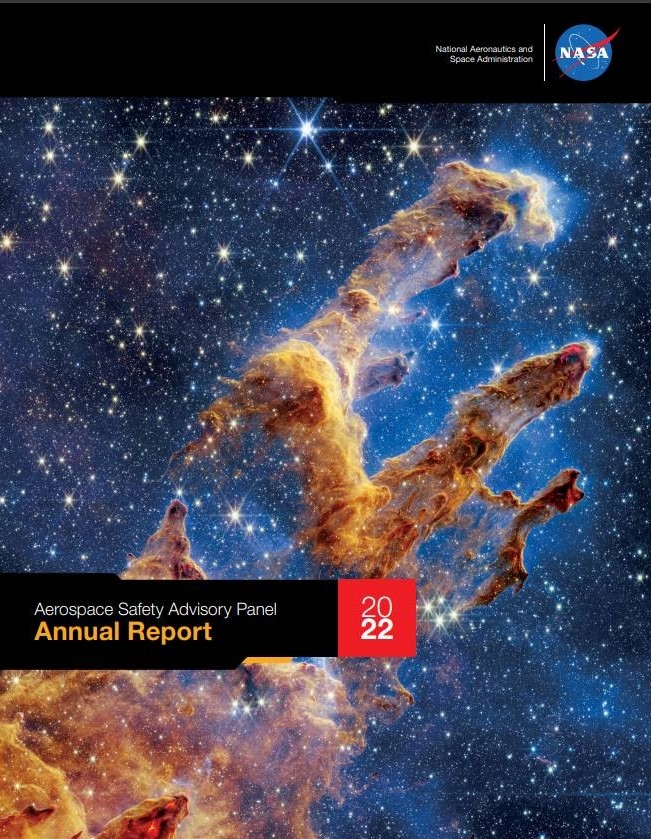
The NASA Aerospace Safety Advisory Panel has submitted its annual report for 2022 to the U.S. Congress and the NASA Administrator.
In its report, the ASAP has flagged a number of issues and concerns, as well as making recommendations to NASA.
One worrisome topic noted by the ASAP is that the orbital debris hazard persists and continues to grow exponentially as space becomes ever more congested.
“For example, CubeSats and other small satellites are being launched with increasing frequency, and several companies are now deploying mega-constellations with hundreds, or even thousands, of satellites,” the report explains. “Some of these satellites incorporate the use of electric propulsion and autonomous onboard maneuvers with very short turnaround times, increasing the difficulty of tracking and planning for collision avoidance.”

Clutter in the cosmos.
Credit: Used with permission: Melrae Pictures/Space Junk 3D
Close calls are not rare
The report underscores the importance to recognize the prevalence of the issue.
“Orbital debris events and close calls are not rare, but they are in fact becoming more and more frequent as space becomes more congested and as national and international space players—who rightfully seek to leverage the high ground of space for commerce, science, and national prestige—continue to populate the space domain with new satellites.”
The risks are growing, the ASAP feels, and a more strategic approach to the problem is now necessary to arrest the risks and to assure that the domain of space remains sustainable.
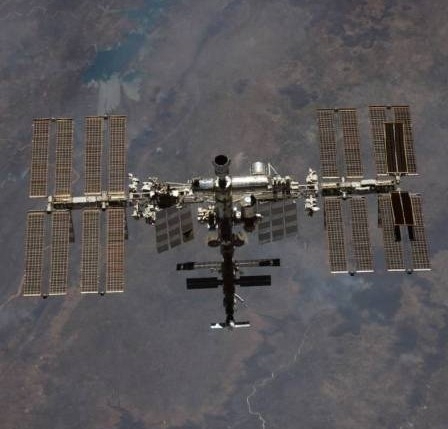
Image credit: Roscosmos/NASA
ISS: controlled deorbit
Another area flagged by the ASAP is the controlled deorbit of the International Space Station (ISS).
“Although discussions are ongoing between NASA and the Russian Space Agency to make the controlled deorbit plan more robust, the ASAP reiterates its concern first stated in 2012, about the lack of a well-defined, fully funded controlled re-entry and deorbit plan for the ISS that is available on a timeline that supports the planned ISS retirement,” the report notes.
Furthermore, the ASAP recognizes that the ISS partners are operating at risk, today, without the capability to deal with a contingency situation that would lead to a deorbit.
“The risk to public safety and space sustainability is increasing every year as the orbital altitudes in and around the ISS continue to become more densely populated by satellites, increasing the likelihood that an unplanned emergency ISS deorbit would also impact other resident space objects,” the report says.

Credit: NASA
Board of directors
The NASA Aerospace Safety Advisory Panel has recommended the space agency should create a “board of directors.”
“As a part of an overall risk management approach and in order to develop and execute its strategic vision for the future of space exploration, the ASAP says that NASA should establish and provide leadership through a ‘board of directors’ that includes the Center Directors and other key officials, “with the emphasis on providing benefit to the Agency’s mission as a cohesive whole, and not to the individual components of the Agency.”
In a January 23 transmittal letter of the report to NASA chief, Bill Nelson, a noteworthy risk area for Agency attention is namely the future of missions in Low-Earth Orbit (LEO).
“While lunar and deep space exploration grow in prominence, the key role played by operations in LEO toward understanding and managing exploration risk cannot be discounted,” says Patricia Sanders, Chair of the Aerospace Safety Advisory Panel.
To access the full 2022 ASAP report, go to:
https://oiir.hq.nasa.gov/asap/documents/ASAP_2022_Annual_Report.pdf

Space Race 2.0 – SpaceX, Blue Origin, Virgin Galactic, NASA, and the Privatization of the Final Frontier by Brad Bergan; The Quarto Group/Motorbooks (2022); 176 pages; Hardcover: $40.00.
This is a splendid read, chocked full of impressive images that showcase the entrepreneurial get-up-and-go that is opening up space to private exploration.
Science journalist Brad Bergan has authored a perspective on the private space sector, a business that is providing cargo and supply services, as well as lofting astronauts to low Earth orbit…and eventually beyond.
This is a well-written and nicely packaged product – a ground floor look at what the future holds. As Bergan notes, the pace of Space Race 2.0 “is and will be relentless, as countless scientists, engineers, and politicians join hands with a few billionaire space barons to signify humanity’s first solid steps into a wider universe.”

The book’s contents are divided into 8 sections, from healthy servings of Elon Musk at SpaceX to Richard Branson as the space knight, along with Jeff Bezos and his empire of dreams to detailed looks at the long road to reusability and sustainability, the race itself, and the future of conflicting realities.
There’s a festival of little-seen photos included in this volume, documenting both successes and missteps. The reader will also find a section on China’s emerging role in shaping the second space race.
“Until very recently, it seemed a foregone conclusion that the second Space Race would be a friendly, if at times rude, rivalry between major aerospace firms vying for contracts with NASA and other major space agencies,” the author notes. “But in the last several years, a new power has rapidly accelerated its own growth into space exploration…that new power is the Middle Kingdom: China.”
Bergan offers illuminating and distinctive thoughts in the book, asking what will sustainable practices mean in space? Also, the author pointedly observes that much like the first Space Race, the international dynamic of Space Race 2.0 is likewise serving as “an extended domain for mounting tensions between rival nations.”
Once again, this informative and nicely packaged book is well-worth reading, both a retroflection on private space growth and where it stands today, as well as what’s in the offing and challenges ahead.
For more information on this book, go to:
https://www.quartoknows.com/books/9780760375549/space-race-2-0
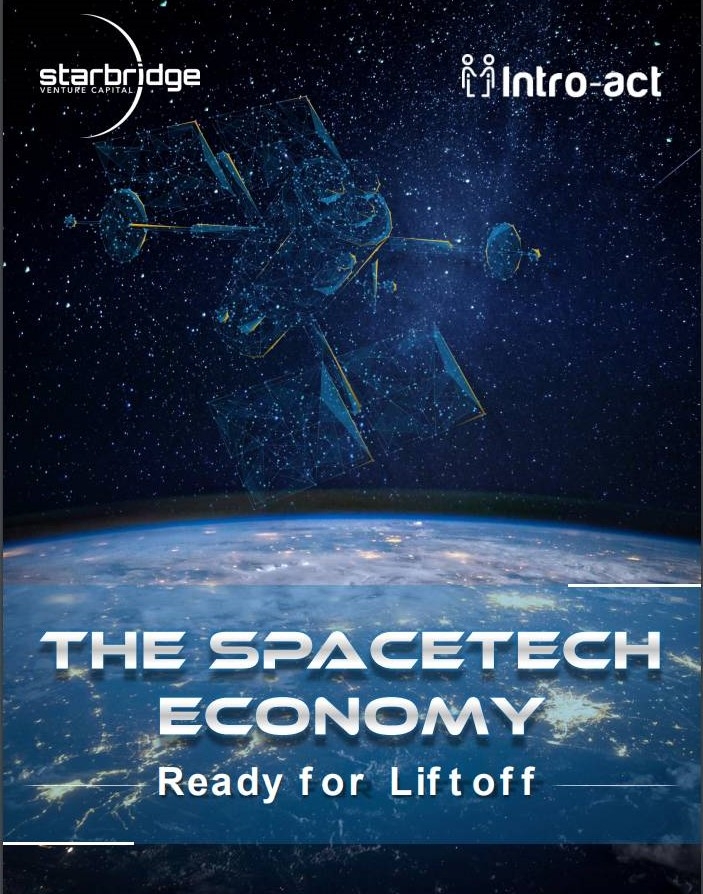
A new report — The SpaceTech Economy – Ready for Liftoff — advises that the Global SpaceTech Ecosystem – worth $386 billion in 2021 and $1 trillion+ by 2030 “has seen a sharp maturity curve in the last few years, but there is belief it is set to move to an accelerated growth path in the coming decade, driven by the confluence of “five megatrends.”
To access this free report issued by Intro-act, Inc., go to:
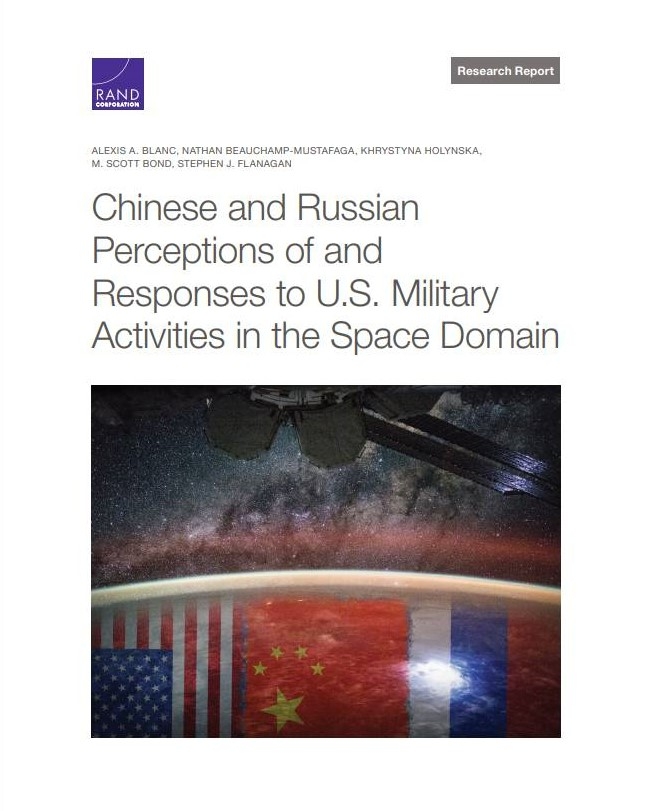
Credit: RAND
RAND researchers have issued a new report: “Chinese and Russian Perceptions of and Responses to U.S. Military Activities in the Space Domain.”
Their findings are based on a systematic review of a variety of Chinese and Russian primary sources to gain insights into internal Chinese and Russian perceptions of developments in U.S. military activities related to space and counterspace doctrine, exercises, and organization.
Washington, Beijing, and Moscow appear to be caught in an action-reaction cycle that perpetuates justifications for continued military actions in space based on previous adversary activities, is an output from the report.
One report observation: “As China and Russia increase cooperation in space, such as remote sensing, satellites, a potential joint lunar base, and even missile early warning, will this drive a further convergence of a common perspective of U.S. space activities and greater coordination on the international stage?
To access the full report – “Chinese and Russian Perceptions of and Responses to U.S. Military Activities in the Space Domain” — Go to:
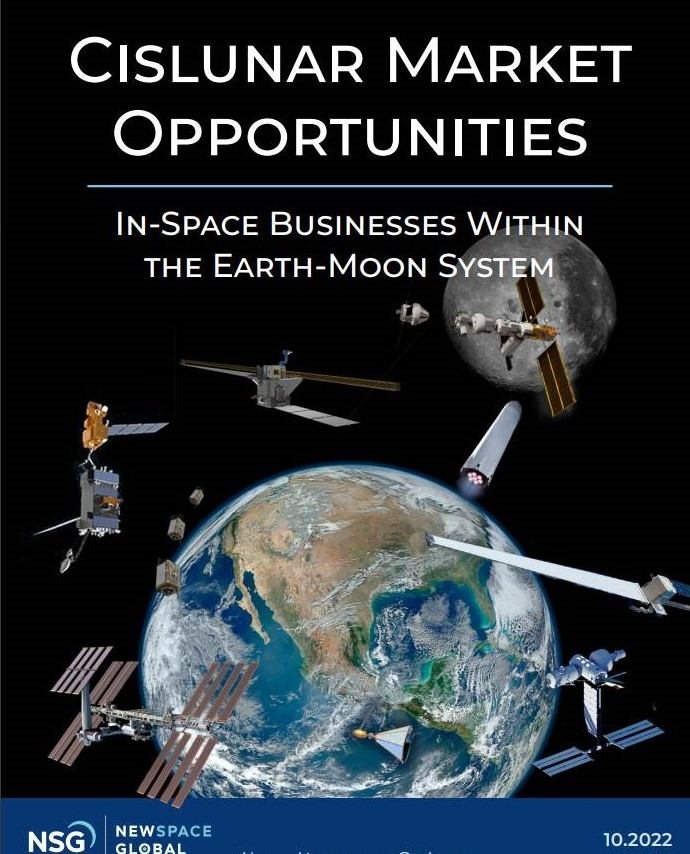
Credit: NewSpace Global (NSG)/Multiverse Media Group
A new report, “Cislunar Market Opportunities – In-Space Business within the Earth-Moon System,” provides a well-researched, in-depth analysis of this emerging economy.
As explained in the report, a cislunar economy will involve a much more expansive, interconnected, and sustainable paradigm for space development.
“Instead of disposable satellites operating independently of other spacecraft, there are interactions among spacecraft that can remain active indefinitely,” notes the report. “Instead of satellite businesses that serve only users on Earth, there are spacecraft businesses that provide services that enable other spacecraft to fulfill their purpose.”
One key message of the report is that in most every sector of in-space development, there are companies with significant funding and capabilities.
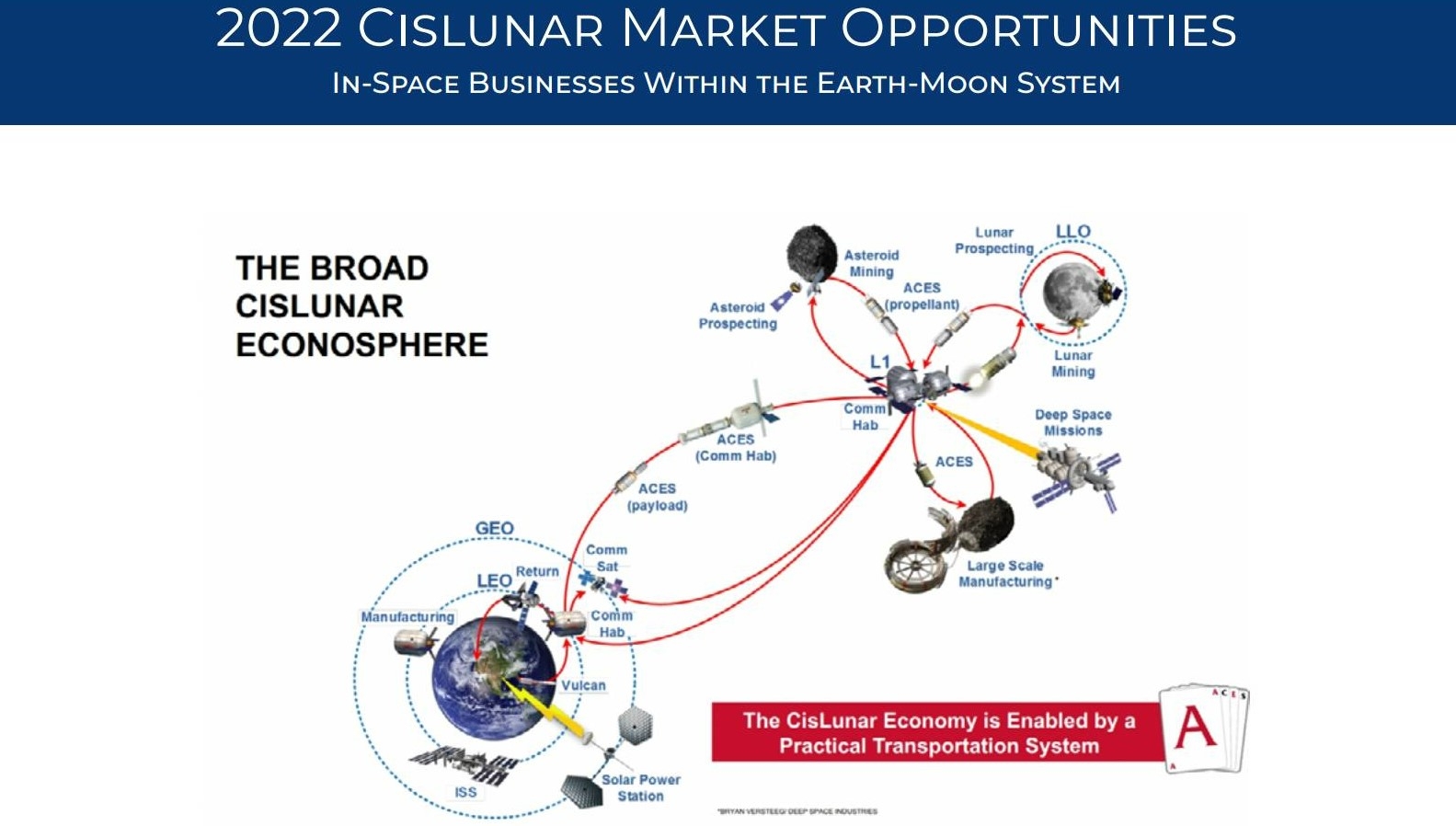
CisLunar econosphere graphic presented by Tory Bruno, CEO of United Launch Alliance, depicts the various space vehicles, habitats, and other elements involved in creating
a cislunar economy
Credit: NewSpace Global (NSG)/Multiverse Media Group
“Furthermore, most of the companies either have systems in space or have launch dates for their first missions,” the report points out.
Five focus areas
The 161-page report is divided into five sections:
— Chapter 1. An overview of the sector.
— Chapter 2. In-Space Infrastructure in Earth Orbit – satellite servicing and life extension, in-space assembly and manufacturing, propellant depots, orbital platforms, space tugs, transfer vehicles, space debris removal and more.
— Chapter 3. Lunar Markets – commercial robotic missions, resource extraction and utilization, communications and navigation satellites, power systems, science and technology R&D, sponsorships and promotions and data storage.
— Chapter 4. Human Cislunar Activity – Commercial space stations, NASA’s Artemis program and other commercial opportunities.
— Chapter 5. The Decade Ahead – A look at how the cislunar economy will develop in the 2020’s.
Published by NewSpace Global (NSG), a wholly owned subsidiary of the Multiverse Media Group, NSG is a leading market analysis firm specializing in emerging commercial space opportunities since 2011.
For more information about “Cislunar Market Opportunities – In-Space Business within the Earth-Moon System” and acquiring the full study, go to:

Credit: Amazon Prime Video
As you read this, there are a trio of robots alive and well and purging Mars of its secrets: NASA’s Curiosity and Perseverance rovers, as well as China’s wheeled Zhurong machinery.
All this get-up-and-go on the Red Planet owes a major thank you to two earlier robotic explorers: NASA’s Spirit and Opportunity that landed on the planet in 2004.
Both had expected lifetimes of about 90 days, a warranty that was greatly surpassed.
Of the two, Spirit was first to expire. After March 22, 2010, mission controllers at NASA’s Jet Propulsion Laboratory (JPL) were not able to regain contact with Spirit. NASA officially concluded its recovery efforts May 25, 2011.
The Opportunity Mars rover was declared dead to that world on February 13, 2019 more than eight months after the robot fell mute during an intense dust storm. Final calls to awaken the rover yielded no response.
Good Night Oppy is a film that primarily focuses on the story of Opportunity, a live-long-and-prosper robot that survived for 15 years trekking about on Mars. But the film is far more than a travelogue of technology clunking its way on that distant world.
What has been captured is an emotional link between humans and automatons, the thrill of exploration, and even heartbreak given Opportunity’s last picture show. The robot was a product of years of teamwork, tenacity, and determined will to open up Mars to a new set of scouting eyes. Following its airbag-bouncing landing, Opportunity delivered on every expectation and delivered so much more.
Good Night Oppy premiered at the recent Telluride Film Festival, now moving to theatrical release from Amazon on November 4, followed by its availability on Amazon Prime Video starting November 23.
Ryan White is the film’s director, and co-writer. White and colleagues have produced a truly moving account of the unexpected fifteen-year sojourn of Opportunity and the surprising bond that formed between the robot and the team of scientists and engineers operating the probe, wheeling and dealing with what Mars threw at them.
Featuring photo-real special visual effects and animation by Industrial Light & Magic and the voice of Angela Bassett, Good Night Oppy charts Oppy’s unforgettable journey – and delivers on the promise that Mars still has much to tell us.
Go to this Good Night Oppy Official Trailer at:

Missions to Mars – A New Era of Rover and Spacecraft Discovery on the Red Planet by Larry Crumpler; HarperCollins; (2021) 336 pages; Hardcover: $35.00.
There is nothing like reading a first-rate book on Mars expertly written by a person that’s moved across the Martian landscape – that is, through the eyes of a robotic surrogate.
This book is an enthralling read. It is beautifully packed with photos and engaging text, telling the story of how to think of Mars as “Coyote Mars,” as the author coins it, an eternal “trickster” that’s both a wise figure but mischievous in coughing up its truths.
Larry Crumpler was one of the long-term planning leads for NASA’s Mars Exploration Rover Project, the effort that landed Spirit and Opportunity on the Red Planet. He helped control the daily communications between the space agency and the dual mini-rovers that roamed the planet to draw together key scientific data.
“There are probably just a few of moments in human history when a small group of humans stood on the margins of a vast new world, and it is no stretch of the romantic imagination that the arrival of two rovers on the surface of another planet was surely one of them,” Crumpler explains.
Divided into three parts – Knowing the Unknown; Roving a New World; and Becoming Martians – Crumpler has written 12 chapters that sweep across a plethora of subjects, concluding with “Future Mars: Mars Exploration Next.”
Crumpler notes that the question of life on Mars, past and possibly there now, has the planet “stringing humans along and doing the bait-and-switch.”

Credit: NASA
The reader will find a rich, wonderful and vibrant narrative about Mars pre-machinery to “wheels on the ground,” what has been discovered so far, as well as the ups, downs and demands of life as a scientist taking part in opening up the frontier of Mars for exploration and discovery.
As the author notes, taking the cue from the author, playwright and poet, Oscar Wilde: “An optimist will tell you the glass is half-full; the pessimist, half empty; and the engineer will tell you the glass is twice the size it needs to be.”
One cleaver aspect of this volume is how best to do geology on that faraway world. Crumpler contrasts the geologist in the field…and a rover on Mars. He details the “time-honored way that geologists go about understanding the history of a place.”
Mars is currently a world of telepresence, a planet inhabited solely by robots. The book spotlights both the NASA Curiosity and Perseverance activities, as well as the Ingenuity helicopter’s first powered flight on another planet.
Taking on the when and why humans will set boot on Mars, Crumpler points to the difficult tasks ahead in planting a human presence on the Red Planet.
“Mars is a difficult place to get to and to explore,” Crumpler adds. “One thing that we can probably be assured of, given the complete and utter fascination that Mars has held for humanity over the course of civilization, is that we will get there. When finally we do arrive, the humans will begin the long and no doubt exciting journey of leaving tracks on the red planet on foot.”
For more information about Missions to Mars – A New Era of Rover and Spacecraft Discovery on the Red Planet, go to:
https://www.harpercollins.com/products/missions-to-mars-larry-crumpler?variant=33105337188386

How can we measure the space economy?
Almost 80 countries have a satellite in orbit. Yet even though the services derived from space activities are increasingly important to society, international comparability of space economy statistics remains limited. The newly revised Organization for Economic Co-operation and Development (OECD) Handbook on Measuring the Space Economy aims to encourage and facilitate data collection among both incumbents and new actors.
This second edition of the Handbook on Measuring the Space Economy responds to the needs of policymakers from multiple economic sectors that are reflecting on such changes in their measurement strategies.
Evolving landscape
It takes account of the evolving landscape of space activities, technologies and user needs surrounding two core observations:

SpaceX Falcon 9 liftoff.
Credit: SpaceX
- Increasingly, a wide diversity of actors is involved in space activities: Government actors more than ever pursue strategic objectives in the space economy in tandem with commercial actors. A better tracking of the effects of public and private expenditure in the space economy is required if the overall impact of such trends is to be assessed.
- Studying the economics of space activities has become professionalized but measuring the space economy remains a challenge: The range of space activities has evolved significantly over the past ten years. Critical infrastructures such as telecommunications and an increasing number of commercial digital applications now depend heavily on space capabilities. In advanced economies, the space economy is becoming more complex and the line between space and non-space activities is increasingly difficult to assess.
Chapter call outs
The Handbook is structured according to the following chapters:
Chapter 1: Introducing the OECD Handbook on Measuring the Space Economy
Chapter 2: Progress in concepts, definitions and measurement of the space economy
Chapter 3: Monitoring the evolving cast of space actors
Chapter 4: Using industry surveys to better understand the space economy
Chapter 5: Strengthening assessment of the impacts of the space economy.
To access the Handbook, go to:

