Archive for the ‘Space Book Reviews’ Category
 Author:
  August 25th, 2024
Book Review: Still As Bright: An Illuminating History of the Moon, from Antiquity to Tomorrow by Christopher Cokinos; Pegasus Books; 2024; Hardcover, 448 pages; $32.00.
From the moment you open the cover of this volume, the reader is literally moonbound.
Author Cokinos has written a suburb book about our nightlight in the sky, Earth’s celestial partner, the Moon. His early eyepiece fascination with the Moon, dashing across the rugged lunar landscape via a three-inch reflector telescope stuck with him – and the reader is forever enriched thanks to that early attraction.
This book is true treasure thanks to his tasty style of poetic and philosophic prose and, as he observes that the Moon is more than a rock. It’s a story. Within the 13 chapters, you’ll find a rich tapestry of space exploration events that has captured – sometimes failing – to tell us the true story of our Moon.
The blend of Space Race anecdotes with the allure of our Moon that still propels our exploration instincts is skillfully told, underscoring humankind’s attributes, albeit sometimes also demonstrating our shortcomings.
“When I look at the Moon I see a scumble of violence and change that I register as terrain and that my mind knows is time,” the author writes. Elsewhere in the book you’ll find Cokinos grappling with the UN Outer Space Treaty, who owns the Moon debates, protecting cultural heritage sites on the Moon, and as he points out: “So if the Moon belongs to us, it means the first thing we do is talk with the lawyers.”
By completing this honest, witty and wondrous read, it’s a given you’ll never look at the Moon the same way again. “The Moon has proven to be a patient teacher,” Cokinos explains.
So grab this book and let’s all be students of the unknown together.

Image credit: The Planetary Society/Inside Outer Space screengrab
Christopher Cokinos is a Professor, Emeritus of English at the University of Arizona and is the author of The Fallen Sky: An Intimate History of Shooting Stars, as well as Hope Is the Thing with Feathers: A Personal Chronicle of Vanished Birds. His articles, poems and essays about space and astronomy have been published in Sky & Telescope, the Los Angeles Times, has been featured in other venues, including NPR’s “All Things Considered.”
I want to spotlight a recent interview with Cokinos about this brilliant book. Take a view of “Talking with author Chris Cokinos about STILL AS BRIGHT” – a video from The Planetary Society’s Book Club, hosted by the firm-footed, but out of this world interviewer, Mat Kaplan, at:
https://www.planetary.org/video/talking-with-author-chris-cokinos
For more information on this book, go to:
http://www.pegasusbooks.com/books/still-as-bright-9781639365692-hardcover
 Posted in
A newly released report details the outcomes from potential near-term space-related scenarios that could significantly impact U.S. public perception, resourcing, and policy.

Image credit: OpenAI’s DALL·E.
The series of high-stakes, seminar-style wargames is designed to prepare U.S. leaders for possible space occurrences over the next two to three decades.
The simulations focused on scenarios that might plausibly confront the United States within the next two administrations.
A number of the scenarios were direct challenges by the People’s Republic of China (PRC) to U.S. leadership in space.

Image credit: AFPC
Space scenarios
Reacting to Major Space Events at or Below Geostationary Orbit is a report of the American Foreign Policy Council (AFPC). The organization is “dedicated to bringing information to those who make or influence the foreign policy of the United States.”

Image credit: OpenAI’s DALL·E.
Scenario 1: Incident in the Cosmos — The Downing of a U.S. Satellite
Scenario 2: The Red Celestial Guard—PRC’s Co-orbital ASAT Constellation
Scenario 3: Orbital Tensions—Satellite Sabotage Showdown
Scenario 4: Celestial Vanguard—PLA’s Spaceplane Squadron Emergence
Scenario 5: Solar Sentinel—PRC’s Leap in Space-Based Power
Scenario 6: Celestial Core—PRC’s First Space Nuclear Reactor

Image credit: OpenAI’s DALL·E.
Strategic recommendations
The report offers strategic recommendations, such as the need to invest in critical technologies for maintaining and accelerating U.S. space leadership.
How best to prioritize space nuclear power and propulsion, space-based solar power satellites, and spaceplanes?
For the full report – Reacting to Major Space Events at or Below Geostationary Orbit — go to:
https://www.afpc.org/uploads/documents/Workshop_1_-_After_Action_Report_-_6.20.24.pdf

Book Review: After the Flying Saucers Came: A Global History of the UFO Phenomenon by Greg Eghigian; Oxford University Press, 2024; Hardcover, 400 pages; $29.99.
In this highly embraced volume the author explores how individuals, scientists, governments and the media responded to reports of UFO sightings and alien abductions, and what those responses say about the human experience.
Eghigian expertly tells this compelling tale via eight chapters, such as “Spaceships, Conspiracies, and the Birth of the UFO Detective, 1948-1953,” “Science and UFOs in the 1960s,” with a concluding segment “Where To, Where From, Wherefore?”

Image credit: Penn State/Inside Outer Space screengrab
“The UFO phenomenon essentially has been asking us to think of ourselves historically: what has been our past, what is going on right now, and what does the future hold?,” Eghigian writes. “The last question is one that has haunted the flying saucer mystery from the very beginning, and it was one that was acutely pressing during the Cold War.”
This book is a valuable contribution to unraveling (maybe snarl your mind more) the countless questions that swirl around UFOs, aliens from afar, and the significance of taking the time, pondering the plausible and implausible, and coming up with your own conclusions.
For an informative overview of the book, go to this article by Francisco Tutella at:
Also, go to this video featuring the author, Greg Eghigian, as he details why he wrote this book and his feelings about the intriguing, perplexing world of UFOs in the past, the present, and what the future portends at:

Who Owns the Moon? – In Defence of Humanity’s Common Interests in Space by A.C. Grayling; Oneworld Publications/distributed by Simon & Schuster (2024); Hardcover, 224 pages; $26.95.
Multiple countries have the Moon within its cross-hairs, for scientific purposes, for industrial gain, as well as to salute its military usefulness. Of late, China has put into action a lunar agenda that includes outreach to the Moon, planting taikonaut footprints there in the time-aged, dusty topside.
Meanwhile, NASA’s Artemis project also aims to “reboot” the Moon in a few years time.
So not only is this book timely reading – it’s a must-read. As the world’s superpowers and corporations jostle for control in space, it asks: who really can claim ownership of that world?
“To answer this question we have to look at some highly relevant precedents,” the author writes, as this is the aim of the volume.
Grayling is the founder and principal of the New College of the Humanities at Northeastern University, London, and its Professor of Philosophy.
Within its pages, the key chapters discuss the global commons, Antarctic protection, the high seas and deep oceans, as well as tackling a major issue of the day: Is the United Nations Outer Space Treaty “good enough” or ripe for an overhaul?
A space spinoff for discussion is addressed in this volume. That is, is there something available to humankind that is more powerful than partisan self-interest, be it profit motive, diplomatic power and national prestige?
The book concludes with a section, “what will happen…what can be done?” Grayling writes that the answer will take maturity, wisdom – “neither of which has evolved to a sufficient degree so far,” but there are some encouraging signs.
The book has a handy bibliography and very healthy section of notes for the reader to pursue.
Grayling makes the case for a new global consensus, one that recognizes the rights of everyone who lives on this planet, but also longingly looks at the Moon and ponders how it fits into our 21st century landscape of posturing politics, resource requirements, and whether the Moon is an extension of human conflict.
For more information on this timely book, go to:
https://www.simonandschuster.com/books/Who-Owns-the-Moon/A-C-Grayling/9780861547258
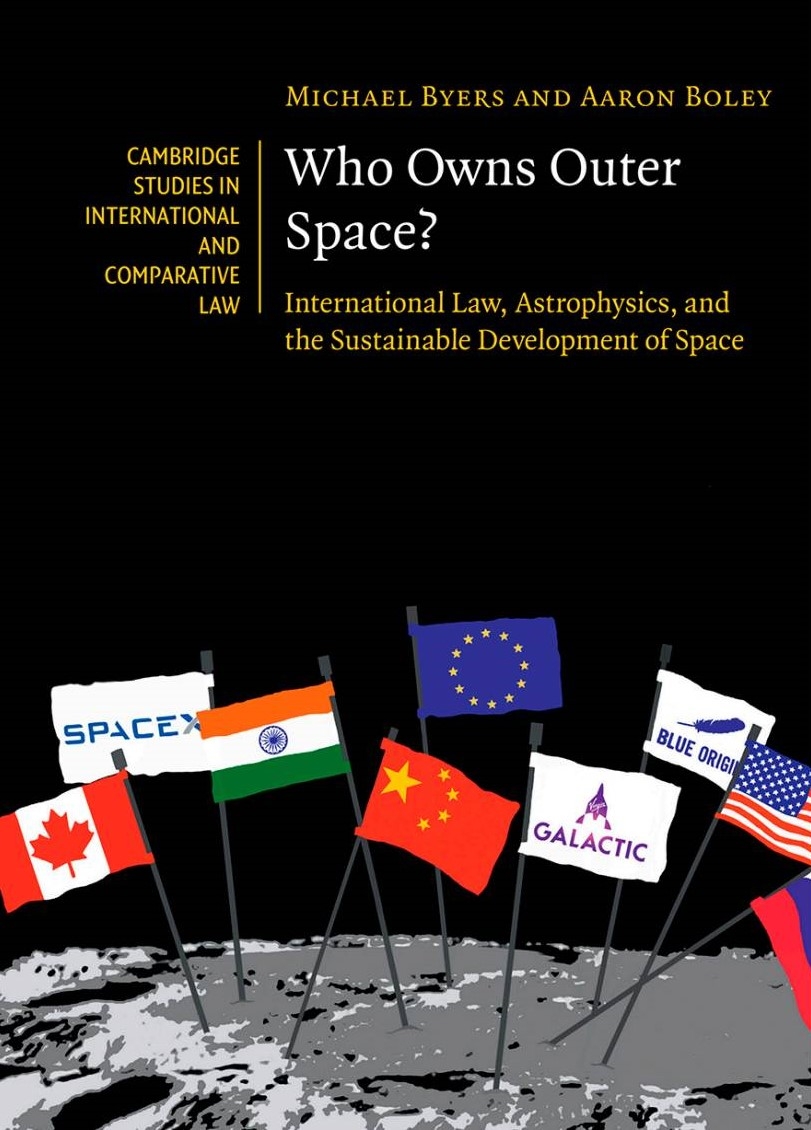
Who Owns Outer Space? – International Law, Astrophysics, and the Sustainable Development of Space by Michael Byers and Aaron Boley; Cambridge University Press/Cambridge Studies in International and Comparative Law (2023); 428 pages; Available by Open Access.
This highly acclaimed book melds space activities, international law, and global governance to underscore major, now-looming, environmental, safety, and security challenges now on full-boil.
Authors Byers and Boley are from the University of British Columbia, Vancouver and this incredibly rich, information-packed book should give the reader pause in how to grapple with perplexing issues of today. The volume offers proposed “actionable solutions” to those challenges.
“Social scientists and lawyers are needed to ensure that solutions are politically feasible, and to carry them forward into lasting rules and institutions. Engineers are needed to develop technologies that can be used in beneficial ways, with environmental scientists guiding us forward by identifying what is beneficial, and what might not be,” they write in the volume’s introduction.
The book is divided into 9 solid chapters: Space Tourism, Mega-constellations, Mega-constellations and International Law, Abandoned Rocket Bodies, as well as sections on Space Mining, Planetary Defense, Space Security, Anti-satellite Weapons and International Law, and ending with a conclusion chapter – Where to from Here?

Credit: DARPA/DSO
That’s a diverse suite of subject topics. But this very readable, fully-referenced book launches a warning flare that space activities of today and tomorrow can be endangered, and just how those undertakings — and space itself — should be sustainably governed.
Who Owns Outer Space? – International Law, Astrophysics, and the Sustainable Development of Space reviews existing international treaties and state practices, but also details limitations in those treaties and practices.
Ideally, by strengthening those elements the hope is to short-circuit calamitous incidents. “War in space has no good outcomes,” they write, while observing that “long-term solutions to grand challenges in space require approaches that integrate multiple disciplines.”
On May 8 of this year, this book won the prestigious 2023 Donner Prize.
Go to this video capturing the views of Byers and Boley at:
For more information about this book, and to gain free access to its contents, go to:
https://www.cambridge.org/core/books/who-owns-outer-space/960CCB0464744F845B09434D932699EC
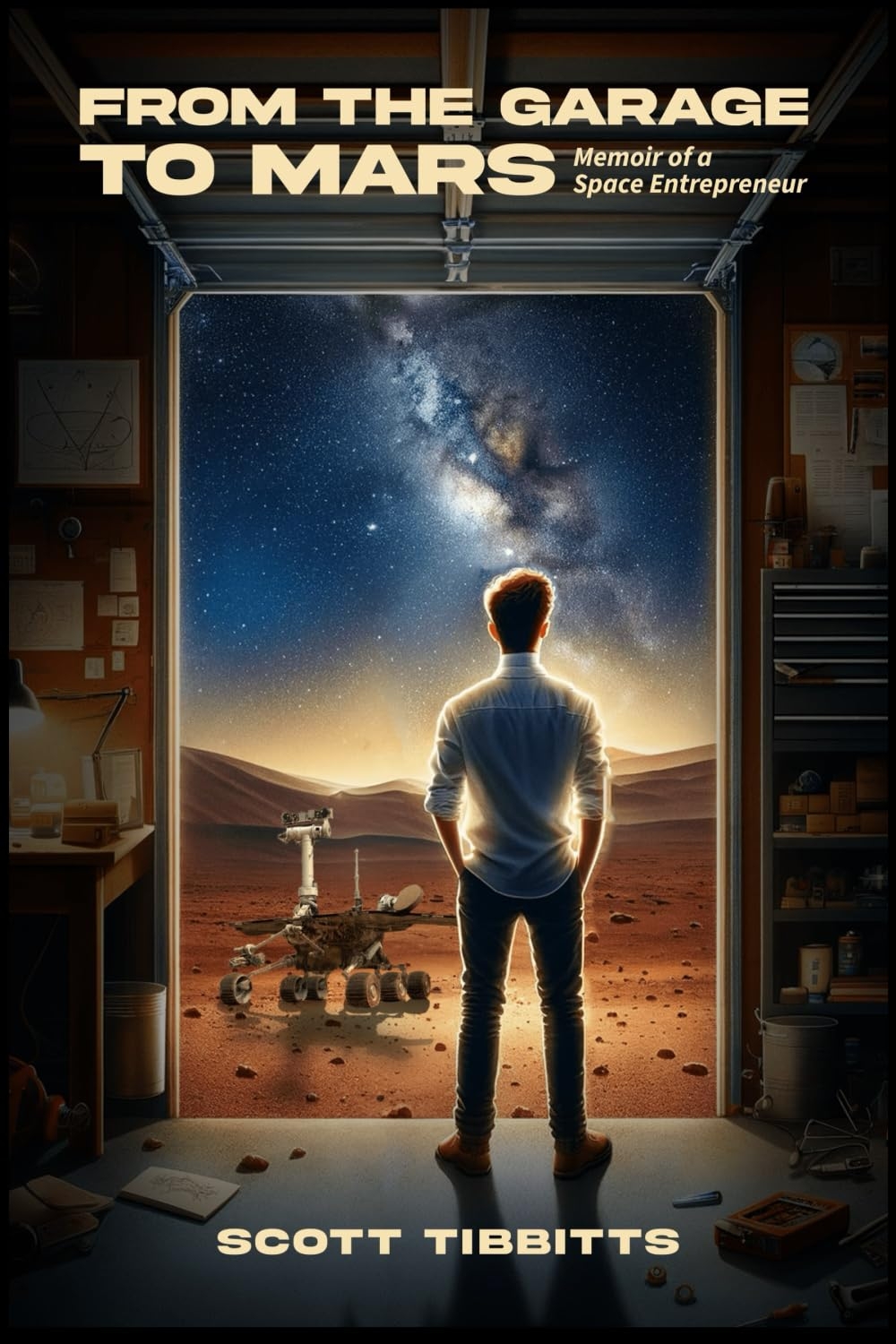
From the Garage to Mars: Memoir of a Space Entrepreneur by Scott Tibbitts; HenschelHAUS Publishing (March 2024); 254 pages; softcover; $24.95.
If you’ve got entrepreneurial dollars aligned with the needed spunk and spine to create a new space company, this book provides an insider, industrial strength look at what kind of roller coaster ride you may encounter.
The author founded Starsys Research Corporation of Boulder, Colorado, an innovative business that, quite literally, had wax flowing through its veins. Starsys pioneered thermal “actuator” technology and mechanical systems for spacecraft – critical items that open, close, deploy, and move components on spacecraft, like opening lens caps.
Such devices can make or break a mission, be it in Earth orbit or crossing the intervening void to reach Mars, Saturn, and elsewhere.
Tibbitts candid and sleep-stealing worries included confronting this self-imagined and calamitous news headline:
“Space Motor Made by Small Space Company in Boulder, Colorado Fails. Billion Dollar NASA Mission Lost. CEO/Entrepreneur Scott Tibbitts says: “I’m stumped…it seemed to be working just fine before we put it on the rocket.”
When NASA’s Spirit rover plopped down on the Red Planet back in 2004, the first pictures transmitted back to Earth included the Starsys logo; the small company had built 27 motors powering the mini-rover and its instruments. “The best product placement ever,” recalls Tibbitts, “one of the coolest things our team ever did.”
While getting to Mars was a company high point, the Starsys track record over a span of 20 years built more than 4,000 devices that flew on 350 spacecraft. As Tibbitts explains, the firm’s success was anchored in a corporate culture that emphasized technical competence bolstered by emphasis on fun and family, team building, and having an easily accessible “Gripe Box” for employees.
In tell-it-like-it-was fashion, the volume is peppered with “Tibbitts Tips,” from the power of play, protecting the price, and the value of 3-day weekends to stop doing what you suck at and let go or be dragged.
In the building of a space company from scratch, the author details both the highs and lows endured, with one chapter bluntly titled: “Entrepreneurial Hell.”
Starsys was acquired by SpaceDev in 2006 with Tibbitts poignantly writing about the angst incurred in “giving up the company I had invested 20 years of my life to create.” SpaceDev was renamed Sierra Nevada Space Systems after a subsequent acquisition in 2008.
This book is well-written, giving the reader a full monty memoir of living on the edge of success to personal upheavals, dealing with tragic and soul-searching events, and what lessons learned were uncovered along the long, winding road.
“I had no idea that seven dollars in hardware-store parts, some wax, and a certainty that, ‘this is so cool. There has to be some use for it…’ would lead to my three-decade journey,” Tibbitts concludes, “which is far from over.”
In short, wax aside, the author himself became an “actuator” and this volume underscores that fact.
For more information on this book, go to:
https://henschelhausbooks.com/product/from-the-garage-to-mars-memoir-of-a-space-entrepreneur/

Book Review: Space and the Warfighter – How Space Technologies Transformed U.S. Military Actions; Spacehistory101.com Press (2023); 232 pages; softcover; $28.97.
I recently returned from the Space Foundation’s mega-symposium in Colorado Springs, a meeting that highlighted U.S. military space prowess and issues of warfighting.
The reader will greatly benefit by taking a read of this informative volume, one that takes you into the history, background, and evolving U.S. Air Force thinking regarding military conflict in space.
Anchored primarily in past military operations, such as Desert Shield and Desert Shield, and noting the formation of the U.S. Space Force, the book features contributions by leading military historians.
Space has become a vital part of the national defense plan of the United States. The message is that use of space systems for warfare in the past was not as understood, nor appreciated as they are today. Desert Storm did involve the full arsenal of military space systems – the first large-scale integration of space systems in support of warfighting.
This book not only underscores the history of utilizing space for military means, but also the progression and organization of space doctrine and policy.

Image credit: U.S. Air Force/SSgt Vanessa Valentine
I was particularly drawn to what influence the 9/11 attacks in September 2001 had on the application of space systems and also the need for security of those assets. To this point, protection of launch facilities, including at that time space shuttle operations like the mission of STS-108. That flight of Endeavor was the first space shuttle launch following the September 11 attacks.
Space and the Warfighter spotlights military need for early warning, communications, satellite-gleaned weather data, as well as positioning, navigation and timing capabilities. For instance, roughly 100 satellites supported military operations in Afghanistan and the surrounding region; use of the Global Positioning System (GPS) has become omnipresent over time.
In an afterwords section, this fact is flagged: “The two Gulf Wars, and the decade separating them, generated and demonstrated a revolutionary transformation in American warfighting – a transformation in which space-based communications and [Positioning, Navigation and Timing] PNT, among other systems, used capabilities originally conceived and developed for strategic purposes to support theater or tactical operations.”
This has fundamentally changed, the book continues, with the U.S. military now relying heavily on orbiting space systems “in an increasingly congested and contested domain.”
For more information on this book, under the SPACE 3.0 Foundation, go to:
https://www.amazon.com/s?i=stripbooks&rh=p_30%3ASpacehistory101.com+Press
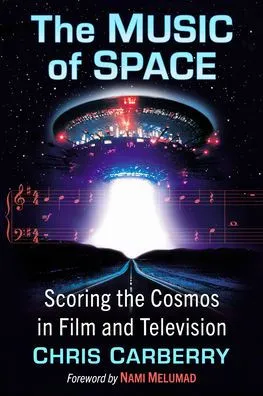
The Music of Space: Scoring the Cosmos in Film and Television by Chris Carberry; McFarland Books (2024); 307 pages; Softcover: $39.95.
Music to my ears…that somebody has written an account of the music of space-aged movies and television, as well as about off-Earth performances!
This well-researched and thoughtful book underscores the role of music in such classics as 2001: A Space Odyssey, Star Trek, and one of my all-time favorites, The Day the Earth Stood Still.
Chris Carberry, CEO of the non-profit organization Explore Mars, Inc., has written an informative account regarding the use of film scores that play a transformative role in how we perceive space. “Music has the capacity to capture and articulate the human experience and emotions than can be expressed in words,” he explains.
The Music of Space is divided into 12 sections, with an impressive chapter notes and excellent bibliography.
Covered in its pages, the book kicks-off with the first 50 years of space films, from silence to sound, through the 1950s, 1960s, and 1970s that saw a turning point in space music thanks to composer John Williams and his Star Wars contributions. Highlighted too is the space horror classic, Alien, the return of Star Trek, and into the 1980s, anchored by Steven Spielberg’s E.T. the Extraterrestrial. You will also find his discussion of The Martian, Interstellar, and a number of space-based television epics.
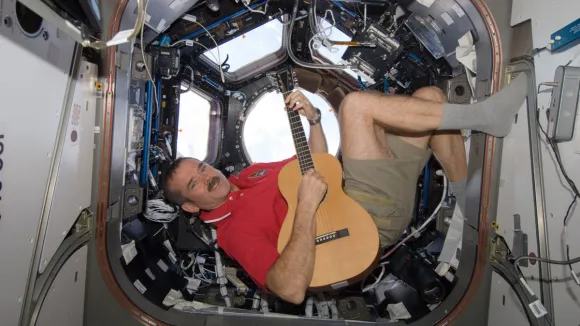
ISS Astronaut, Chris Hadfield, picks out David Bowie’s Space Oddity.
Image credit: NASA
Carberry doesn’t skimp on details, showcasing his matchless research skills.
Near the book’s concluding remarks, the reader will find a nicely explained section on music in “real” space, be it played via harmonicas, guitars, keyboard, flutes, bells, saxophones, even a didgeridoo. Similarly, music in other forms is included, from the Beatles’ song “Across the Universe” broadcast toward the star Polaris to Apollo 17 moonwalkers singing a takeoff of “While Strolling Through the Park.”
I was drawn in by this author comment: “As the pace of real space activities accelerates, it is likely that space-related content will continue. However, the sound of space will also inevitably change,” he writes, “as these stories become less and less the realm of science fiction, and reflect reality.”
The Music of Space is an exceptional treasure on a topic that needed notice – and in chronicling this subject matter, Carberry has struck the right chord.
For more information on this book, go to:

The Asteroid Hunter: A Scientist’s Journey to the Dawn of our Solar System by Dante S. Lauretta; Grand Central Publishing & Hachette Book Group (2024); 336 pages; Hardcover: $30.00
It is not often that a 21st century author is a milestone-making participant that digs billions of years into the past to further the future.
Dante Lauretta is a cosmic “rock hound.” And this book is far from being a tell-all tale of his stellar leadership in the Origins, Spectral Interpretation, Resource Identification, and Security-Regolith Explorer mission, mercifully shortened to OSIRIS-REx.
The Asteroid Hunter is a story of his personal quest in shaping a remarkable scientific career. This very enjoyable, insightful and moving volume is must reading for all that hunger to understand the rough and tumble cosmos at large – along with the delicate nature and audacity of human spirit necessary to tangle with the unknown.
Launched in 2016, OSIRIS-REx reached asteroid Bennu in September 1999, then performed snag, stash, and send-off maneuvers, express delivering those space rock specimens to Earth on Sept. 24, 2023.

Dante Lauretta, OSIRIS-REx’s principal investigator from the University of Arizona holds a mock up of the asteroid collection device – TAGSAM.
Image credit: Barbara David
OSIRIS-REx released its capsule of extraterrestrial goodies over Earth’s atmosphere. That container then parachuted into the Department of Defense’s Utah Test and Training Range as the OSIRIS-REx team – and the author — was on location to welcome it home.
That voyage to asteroid Bennu and back to our planet took seven years. OSIRIS-REx was the first U.S. mission to collect a sample from an asteroid and deliver it to Earth. And that space trek alone – proposing, building, and flying the craft — is a tale in itself.
Starting in 2011, Lauretta served as the principal investigator for OSIRIS-REx asteroid sample return mission. But he offers so much more in this well-written, cleaver and personal prose of a story.
A reader will find his professional and personal memoir instructive. Indeed, as Lauretta notes “the universe is our classroom, our laboratory, our muse” and that “our journey of exploration has only just begun.”
For more information on this remarkable book, go to:
BTW: go to the Amazon offerings to hear the author read a section of the book at:
https://www.amazon.com/Asteroid-Hunter-Scientists-Journey-System/dp/1538722941
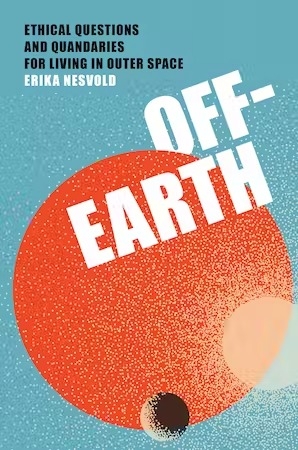
Book Review: Off-Earth Ethical Questions and Quandaries for Living in Outer Space by Erika Nesvold; MIT Press (2023); 304 pages, Hardcover: $27.95
This is a thought-provoking, even controversial for some readers!
Erika Nesvold, an astrophysicist, has worked as a researcher at NASA Goddard and the Carnegie Institution for Science.
As a developer for Universe Sandbox as well as cofounder of the nonprofit organization the JustSpace Alliance, Nesvold is also the creator and host of the podcast Making New Worlds.
The book rests on a stated premise: Can we do better in space than we’ve done here on Earth?
An issue is that we don’t, shouldn’t, or can’t leave our ethics back here on home planet Earth.
As stated by the publisher, Off-Earth includes historical and contemporary examples from outside the “dominant Western/US…and privileged narrative of the space industry.”
What that translates into is the author’s narrative on the potential ethical pitfalls of becoming a multi-planet species.
Bottom line: We won’t be departing our earthly problems and start afresh – even by taking in that space suit, airlock and cramped habitat smell.
Here’s an extract from the book, courtesy of MIT Press titled “The Thorny Ethics of Planetary Engineering – Whenever someone waxes poetic about terraforming alien worlds, it’s worth taking a moment to consider the ethical implications of the proposal.”
Go to:
https://thereader.mitpress.mit.edu/the-thorny-ethics-of-planetary-engineering/
For more information about this book, go to:

