Archive for the ‘Space Book Reviews’ Category
 Author:
  May 11th, 2019
Apollo Leadership Lessons: Powerful Business Insights for Executives by Dick Richardson; Authority Publishing 2019; paperback: 232 pages, $24.99.
As we close in on the July salute of the 50th anniversary of Apollo 11, you’ll find this book an inspiring read – one that captures hope and disappointment, villains and heroes, greed and sacrifice. At every step it’s a story of leadership.
With unique access to key leaders and NASA resources, author Dick Richardson has captured the leadership insights of America’s journey to the Moon and other space projects. These lessons are told through the lens of the people who were there–the executives, flight directors, and astronauts.
As the volume explains: “You may not go to the Moon, but this book will help you apply NASA’s leadership lessons to your company’s mission.”
Twelve chapters take the reader from Wernher von Braun and his adaptive leadership in action, John F. Kennedy’s ability to nurture a vision, the crisis of leadership due to the Apollo 1 pad fire to Apollo 13’s responsive innovation and the changing strategic intent of the Apollo-Soyuz project.
“Many of the leadership insights that came out of NASA are still there, sixty years later,” Richardson writes. “The people who grappled with tough situations, made difficult decisions, and led challenging teams left a lasting legacy from which we all continue to benefit,” he adds.
“Read the book. You may be spurred on to lead others to do things that are hard to do or even imagine. Whether in space or on earth, these are exciting and changing times, and you are a part of them,” explains David Leestma, astronaut and former director, Flight Crew Operations in the book’s foreword. “Dick Richardson is making a difference in helping leaders and his insights may make the journey easier and better.”
I concur.
This unique read is a real plus in helping the reader better appreciate the leadership principals and tactics employed by Apollo’s key decision-makers.
For more information on this book, go to:
 Posted in

Space Launch System (SLS) Credit: NASA/MSFC
The U.S. Government Accountability Office (GAO) has issued Priority Open Recommendations: NASA.
In March 2018, GAO identified 18 priority recommendations for NASA. Since then, NASA has implemented 10 of those recommendations by, among other things, taking actions to better align its strategic sourcing practices with those used by leading commercial companies and improving controls over some of its information systems.

Credit Roscosmos/NASA
SLS and ISS
In April 2019, GAO identified one additional priority recommendation for NASA, bringing the total number to nine. These recommendations involve the following areas: monitoring program costs and execution as well as improving efficiency and effectiveness.
“NASA’s continued attention to these issues could lead to significant improvements in government operations,” the GAO document points out.
Among topics spotlighted in the report is developing a contingency plan for access to the International Space Station, as well as Space Launch System (SLS) Block I, as well as Exploration Mission (EM) 1 and 2.
To read the full GAO document, go to:

Credit: CSIS
The Center for Strategic & International Studies (CSIS) has issued a new report: Spaceports of the World (1957–2018)
Written by Thomas G. Roberts, program manager and research associate at the CSIS Aerospace Security Project, this report is accompanied by an interactive data repository.
With the rate of space launches projected to grow exponentially in the coming years, spaceports will become an increasingly important to the global space industry.
Which countries and private companies operate the world’s most active spaceports?
Active, inactive spaceports
This report analyzes ground-based space launches from 1957 to 2018, including brief histories of all active and inactive orbital spaceports, 10 year launch records for the 22 spaceports still in use today, and the current status of several proposals to create new facilities capable of supporting orbital space launches.
To download a copy of this very informative report, go to:
https://csis-prod.s3.amazonaws.com/s3fs-public/publication/190313__SpaceportsOfTheWorld.pdf
Below, use the play button to discover the history of ground-based space launches around the world. Click a spaceport to learn more about its launch history.
This interactive data repository is a product of the Andreas C. Dracopoulos iDeas Lab, the in-house digital, multimedia, and design agency at the Center for Strategic and International Studies.
Special thanks to Jacque Schrag for her work developing this tool.
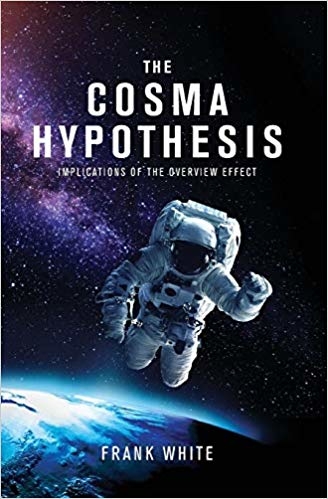
The Cosma Hypothesis: Implications of the Overview Effect by Frank White; Morgan Brook Media (March 2019; paperback: 269 pages, $19.95.
It takes a special kind of person to come up with a special kind of effect.
Frank White coined the term: “The Overview Effect” – the experience of seeing the Earth from orbit or the Moon – on humanity’s perceptions of our home world and our place in the cosmos.
White’s book, The Overview Effect: Space Exploration and Human Evolution, was first published by Houghton-Mifflin in 1987. This trailblazing work is now in its third edition, and is a seminal work in the field of space exploration and development. His just released new book is The Cosma Hypothesis: Implications of the Overview Effect.
In short, this impressive volume puts forward that our purpose in exploring space should transcend focusing on how it will benefit humanity. We should ask how to create a symbiotic relationship with the universe, giving back as much as we take, and spreading life, intelligence, and self-awareness throughout the solar system and beyond.
Given the wistful and wishful space futurism of the day – space tourism, mining space rocks, living on the Moon and occupying cities on Mars — White argues that developing a philosophy of space exploration and settlement is more than an intellectual exercise: it will powerfully influence policy and practices that are now unfolding.
The reader will enjoy pondering a number of themes in the book, from the appropriate approach to mining asteroids and the moon, the possible need to revise the UN 1967 Outer Space Treaty, to the role Artificial Intelligence (AI) will play in helping humans explore and develop the cosmos.
Of special interest are 16 content-specific task forces that are a healthy part of the New Human Space Program chapter – key issues arising out of human expansion into our “solar neighborhood.”
This heartfelt book is thought-provoking. Why has the evolutionary process brought humanity to the brink of becoming a spacefaring species?” The author concludes that our purpose, or ecological function, is to support the universe (Cosma) in reaching a higher level of life, intelligence, and self-awareness.
White adds: “As Cosma become more conscious, the universe will become a more welcoming place for Homo sapiens, and we will evolve together.”
In an author’s note, White requests that a reader can learn more about The Human Space Program, contact him at: Cosmatheory1@gmail.com
For more information on this book, go to:
https://www.amazon.com/Cosma-Hypothesis-Implications-Overview-Effect/dp/173288613X

Shoot for the Moon – The Space Race and the Extraordinary Voyage of Apollo 11 by James Donovan; Little, Brown and Company (2019); 454 pages, $30.00.
This impressive book is a must-read this year given that it’s the 50th anniversary of the Apollo 11 mission – humankind’s first high-stepping trek to Earth’s Moon.
As a space aged old-timer I found author Donovan’s account a memory-jarring read, chock full of details that my fellow page-turners will truly enjoy.
The book is divided into 4 parts that add up to 17 chapters of brilliant reading. Be it “Cossacks in Space,” “Of Monkeys and Men,” to “You’re go, and “Descent to Luna,” Donovan doesn’t skimp on the triumph that was Apollo, how American spunk and spirit made it happen, and how the achievement was sparked by the U.S.-Soviet Union space race.
The connective tissue to Apollo – the single-seat Mercury and Gemini two-seater missions – is expertly detailed and is a solid contribution to the overall book. As the author also points out in the book’s early pages: “Rockets exploded. Systems malfunctioned. Men died. The murder of a visionary president whose bold challenge had fired the program only reaffirmed their dedication to finishing the job.”
Shoot for the Moon carries a number of fresh interviews with space controllers and engineers, as well as Apollo astronauts, further adding to this engaging and very well-researched volume. The book includes three segments of black and white/color images that provide a visual ramp-up to the Apollo 11 adventure.
Donovan is author of the bestselling books A Terrible Glory- Custer and the Little Bighorn, The Last Great Battle of the American West and The Blood of Heroes: The 13-Day Struggle for the Alamo – and the Sacrifice that Forged a Nation.
Being a Wild West historian, I’m thankful Donovan wrote this book of pioneering the space frontier.
For more information on this book, on sale March 12th, go to:
https://www.littlebrown.com/titles/james-donovan/shoot-for-the-moon/9780316341783/
Also, go to this informative video at:
I am pleased to be part of National Geographic’s yearlong journey – Starstruck — exploring the past, present, and future of space exploration.
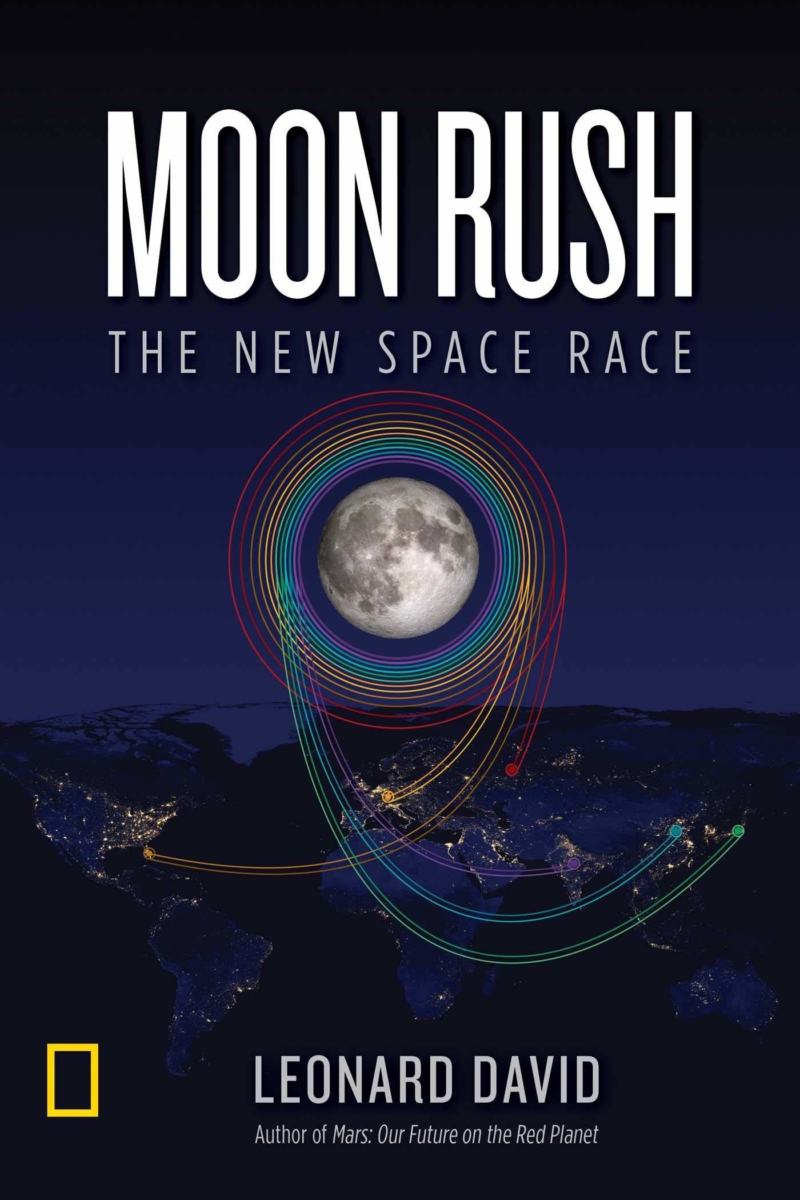
My new book for National Geographic – Moon Rush: The New Space Race – will be launched in May, a volume that explores the Moon in all its facets, from ancient myth to future “Moon Village” plans; inside information about how the United States, allies and competitors, as well as key private corporations like Moon Express and Jeff Bezos’s Blue Origin, plan to reach, inhabit, and even harvest the Moon in the decades to come.
For more information on Moon Rush: The New Space Race, go to:
https://www.barnesandnoble.com/w/moon-rush-leonard-david/1129287265?ean=9781426220050
https://www.amazon.com/Moon-Rush-New-Space-Race/dp/1426220057
https://itunes.apple.com/us/book/moon-rush/id1425691045?mt=11
Official launch
National Geographic has officially launched Starstruck – a celebration of space across its global networks, magazines, books and more.
For starters, MARS: INSIDE SPACEX, premiered Monday, November 12, at 8 p.m. eastern, offering an unprecedented glimpse into SpaceX and Elon Musk’s plans to make Mars home.
For more information, go to:
http://www.natgeotv.com/int/mars-inside-spacex
Season 2 of National Geographic’s TV docudrama MARS premiered on November 12 at 9 p.m. eastern.

Credit: National Geographic
For more information, go to: https://www.nationalgeographic.com/tv/mars/
Please check out my book — Mars: Our Future on the Red Planet — the companion book to the National Geographic Channel MARS TV series that takes a look at the promise, problems, and potential pitfalls as humans land on and learn to live on Mars.
Go to:
https://www.amazon.com/Mars-Our-Future-Red-Planet/dp/1426217587
https://www.barnesandnoble.com/w/moon-rush-leonard-david/1129287265?ean=9781426220050
https://itunes.apple.com/us/audiobook/mars-our-future-on-the-red-planet/id1421162640

Credit: NASA
Apollo 11…and beyond
Culminating with the 50th anniversary of the historic Apollo 11 Moon landing next July and a coinciding week of Apollo programming on National Geographic channel, Starstruck will rally National Geographic’s unrivaled portfolio of storytelling platforms around the spirit of space exploration, and the nostalgia, curiosity and feeling of limitless possibility that it brings.
Join in on all the National Geographic activities… and don’t forget to look up.
For more information, go to:

Credit: DIA Public Affairs
The Defense Intelligence Agency (DIA) has released “Challenges to Security in Space,” a report that examines the space and counterspace programs that could challenge U.S. or partner interests in the space domain.
The report notes that “space-based capabilities provide integral support to military, commercial and civilian applications” and that “longstanding technological and cost barriers to space are falling, enabling more countries and commercial firms to participate in satellite construction, space launch, space exploration and human spaceflight.”

Visualization: DIA, D3 Design • 1812-20432
Modern warfare
Among items detailed, the report notes that:
Chinese and Russian military doctrines indicate they view space as important to modern warfare and counterspace capabilities as a means to reduce U.S. and allied military effectiveness.
Both countries have developed robust and capable space services, including space-based intelligence, surveillance and reconnaissance.
Visualization: DIA, D3 Design • 1811-20013
China and Russia are making improvements to existing systems including space launch vehicles and satellite navigation constellations. These capabilities provide their militaries with the ability to command and control their forces worldwide with enhanced situational awareness, enabling them to monitor, track and target U.S. and allied forces.
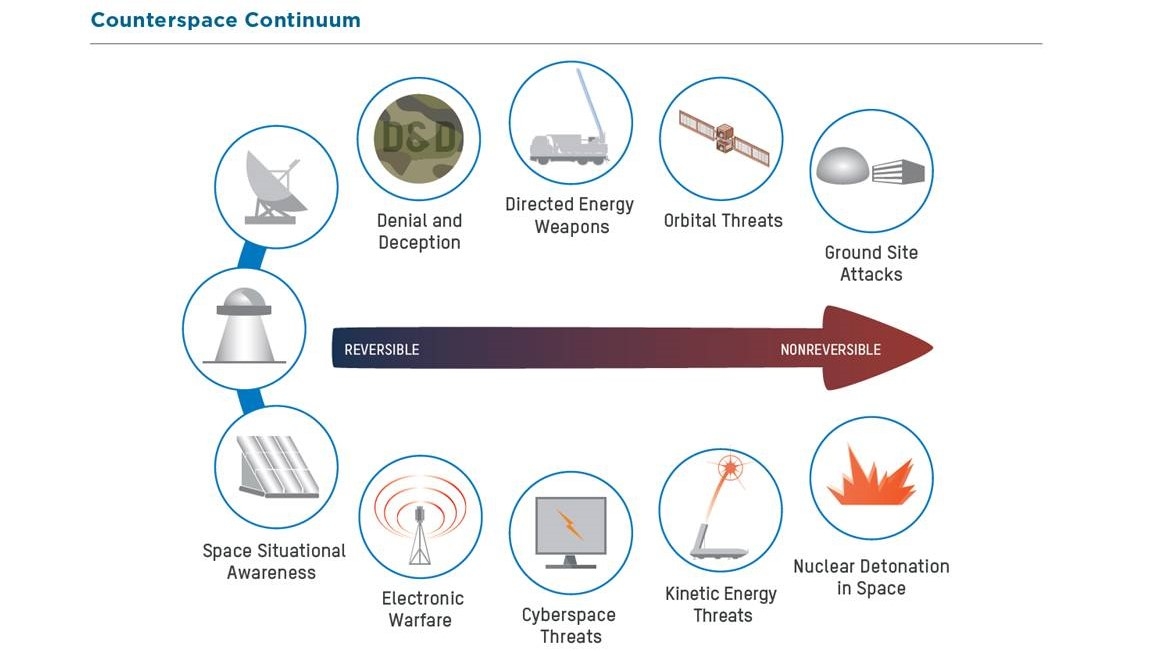
Reversible to non-reversible effects
The DIA report adds that Chinese and Russian space surveillance networks are capable of searching, tracking and characterizing satellites in all earth orbits. This capability supports both space operations and counterspace systems.
Both states are developing jamming and cyberspace capabilities, directed energy weapons, on-orbit capabilities and ground-based antisatellite missiles that can achieve a range of reversible to non-reversible effects.
DIA’s “Challenges to Security in Space” report is available here:

The Definitive Career Guide for Entrepreneurial Space declares that the commercial space revolution is here, and it’s hungry for talent.
Offered by Space Angels, a source of capital for early-stage space ventures, the guide is authored by Justus Kilian and Jessica Holland.
“We’ve created this guide to give you concrete steps to start your journey towards a career in space now,” they explain.
Radical transformation
As detailed in the guide:
“The space industry is in the midst of a radical transformation. When SpaceX started launching its rockets a decade ago–making it far easier for commercial space startups to enter the market–it triggered a wave of entrepreneurial innovation. Today, Space is a $400B market that touches every aspect of our lives, from location-based services to global finance. The next generation of space technology will be responsible for delivering global internet, fighting climate change, and taking humanity to Mars.”

Credit: SpaceX
“To accomplish such audacious goals, the industry will require talent with diverse skills and backgrounds from every walk of life. We spoke with the most influential companies and leaders across entrepreneurial space, who were generous in sharing detailed practical advice, big-picture guidance, and the stories of their own careers.”
Career tips
The guide carries a number of career tips, offered by individuals deep into their own space professions.
To download the guide, go to:
For detailed information on Space Angels, go to:

Outpost in Orbit: A Pictorial & Verbal History of the Space Station by David Shayler and Robert Godwin (Executive Editor Gary Kitmacher), Apogee Books, 2018; 8½ x 11, 320 pages full glossy color, $49.95.
So often above where I live there’s a marvel of space engineering that flies overhead – a finger-pointing exercise into the night sky. There are few that can appreciate the complexity of the International Space Station (ISS), how it was built, by whom, and what are the experiences of the folks that took the high road and roared off to live onboard this unique vessel of the vacuum.
This book is a beautiful illustration of getting a dream done. The volume celebrates the recent 20th anniversary of the astonishing ISS, but more than that details the foundation from which ISS grew.
Lavishly illustrated, and created with the assistance of NASA, Outpost in Orbit is a visual and noteworthy account of why space stations are mandatory for moving forward – not only giving us a leg up on low Earth orbit – but pushing onward.
The reader will find this read incredibly informative, not only about what the ISS represents today, but a great account about the pioneers that pushed the boundaries on why and how a station is needed and can be built. Personally, I found those pages of great benefit. What a legacy of thinking made the ISS what it is today – a heritage that few know, but underscored in this book.
This book is filled with comments from astronauts, engineers, managers, retirees and historians. Adding to the value of the book are interviews with key leaders from NASA, the Russian Space Agency, the European Space Agency, the Canadian Space Agency and the Japanese Space Agency – all of which contributed to making the ISS the triumph it is today.
In this unique anniversary accolade, you’ll be introduced to over 100 space stations designed by German Russians, British and American thinkers – all prelude to planting you onboard the high-flying ISS via hundreds of pictures, many never published before.
For more information on this book, go to:
http://www.cgpublishing.com/Books/9781989044032.html
Also go to this informative interview with author Robert Godwin about the book:
https://www.chch.com/outpost-in-orbit/
In addition, Godwin is interviewed on the popular Space Show to talk about the book, available at:
https://www.thespaceshow.com/show/27-jan-2019/broadcast-3259-rob-godwin

Credit: National Geographic
National Geographic has officially launched Starstruck – a celebration of space across its global networks, magazines, books and more.
For starters, check out MARS: INSIDE SPACEX, premiering Monday, November 12, at 8 p.m. eastern, an unprecedented glimpse into SpaceX and Elon Musk’s plans to make Mars home.
For more information, go to:
http://www.natgeotv.com/int/mars-inside-spacex
Docudrama
Then stay tuned for the start of Season 2 of National Geographic’s TV docudrama MARS premiering on November 12 at 9 p.m. eastern.
MARS Season 2 trailer and Season 1 Recap –
https://www.nationalgeographic.com/tv/mars/clips
MARS Season 1 that premiered in 2016 (six episodes) –
https://www.nationalgeographic.com/tv/mars

Credit: National Geographic
For U.S. and international viewers, look for my book that’s now in six languages and coming out in Chinese shortly: Mars: Our Future on the Red Planet is the companion volume to the National Geographic Channel MARS TV series Season 2, a six-part docudrama that begins on November 12th. The book takes a look at the promise, problems, and potential pitfalls as humans land on and learn to live on Mars.
“This big, welcoming book—brimming with mind-revving photographs and artists’ conceptions and written with verve and precision by David—provides the foundation on which the scientifically rigorous, speculatively imaginative series was built.” —Booklist
Go to these sites or wherever books or sold:
https://shop.nationalgeographic.com/products/mars
https://www.amazon.com/Mars-Our-Future-Red-Planet/dp/1426217587
https://www.barnesandnoble.com/w/mars-leonard-david/1123480431?ean=9781426217586

Credit: National Geographic
International outreach
Here are some links for our international readers to the book in these languages:
German – https://verlagshaus24.de/mensch-und-natur/erde-und-weltall/mars
Italian – http://www.whitestar.it/prodotto/marte-la-storia-del-nostro-futuro-sul-pianeta-rosso
Japanese – http://natgeo.nikkeibp.co.jp/atcl/product/16/101400029
Dutch – http://www.fontaineuitgevers.nl/wp/mars
Portuguese – http://www.marcador.pt/conteudo/373-marte
The book is also available in Greek and forthcoming in Chinese. We will post those direct links as they become available. If you want to read these international websites in English, your browser should have a clickable link to translate them for you.

