Archive for the ‘Space Book Reviews’ Category
 Author:
  October 18th, 2019
Houston: Space City USA by Ray Viator; Texas A&M University Press, College Station, Texas, 2019; hardcover: 224 pp. 222 color, 6 b&w photos, $37.00.
Given the development of new spaceports around the world, this volume celebrates Houston, Texas as “mission control” for America’s on-going spaceflight program.
Recall those words from Apollo 11’s Neil Armstrong on July 20, 1969: “Houston, Tranquility Base here. The Eagle has landed.”
This visually stunning work by Viator, a Houston author and photographer, captures the spirit of Houston’s ties to America’s space program. Beyond the splendid visuals, the book is loaded with gems of knowledge, such as why Houston was the selected site for the $200 million “manned spaceflight laboratory.”
There are a number of refreshing surprises throughout this volume, including an appendix that honors and remembers the human cost in pioneering the space frontier.

Author Ray Viator
Photo by Cynthia Viator
“The book also celebrates the impact of the space program on our city and region,” Viator writes. “The space program raised Houston’s visibility both nationally and around the world.” As the author notes, about 20 percent of the nearly one million annual visitors to Space Center Houston come from other nations.
“This book is also a celebration of the whimsical and humorous, the fancy and the fantastical that surrounds us every day, if we just take the time to look,” Viator adds.
The reader will find a unique blend of imagery and text within the book’s pages, anchoring Houston as mission control over the past decades to today…and the future.
All proceeds from sales of “Houston: Space City USA” benefit Houston Public Media’s programming and news coverage of space, science and technology.
For more information on this book, go to:
https://www.tamupress.com/book/9781623497729/houston-space-city-usa/
 Posted in

Space Dogs: The Story of the Celebrated Canine Cosmonauts by Martin Parr/Text by Richard Hollingham; Laurence King Publishing, New York, 2019; softcover: 128 pages, $16.99
This enchanting book details the Soviet Union’s space dogs, those uncanny canine explorers that blazed the trail for human space travelers. Laika, Belka, Strelka, and other dogs became superstars!
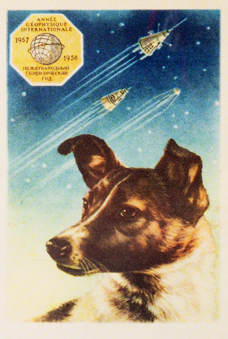
Space Dogs features the collectibles of Martin Parr. Over the past twenty years, Parr has been adding to his assortment of USSR space dog memorabilia, produced during the space race in the 1950s between the USSR and the USA. Mostly perusing the Internet, he has unearthed a variety of exceptional items for his collected works.
“I hope that some of the magic of the space dogs phenomenon will rub off on the reader,” Parr explains in the book’s foreword. From my read…mission success!
Credit: Martin Parr Collection
The “pupniks” were hugely celebrated. With a combination of national pride and propaganda, they began appearing on stamps, postcards, letter holders, wrist watches, porcelain figurines, cigarette cases, clocks and other memorabilia.
Produced to coincide with the 50th anniversary of man landing on the Moon, this book details the story of the space dogs, illustrated with Parr’s collection of vintage space-dog ephemera.

Credit: Martin Parr Collection
The nicely written text is provided by Richard Hollingham, a space journalist and correspondent for BBC future and presenter of the Space Boffins Podcast.
While all the photos are captivating, the reader will gain special insight into the Soviet Union’s pioneering spaceflight exploits, including the true fate of Laika onboard the country’s second orbiting satellite. You’ll find numerous other factoids in this well-illustrated and readable volume.
For more information on this book, go to:
https://www.laurenceking.com/product/space-dogs/

Wally Funk’s Race for Space: The Extraordinary Story of a Female Aviation Pioneer by Sue Nelson; Chicago Review Press, 2019; hardcover: 256 pages, $26.99
This is a wonderful read, one that underscores politics and prejudice in America’s embryonic human spaceflight program.
Wally Funk was a trailblazer, among the Mercury 13, the first group of American pilots to complete NASA’s 1961 Women in Space program.
Sue Nelson’s engaging and personal account of Funk’s lifetime pursuit of becoming an astronaut is also a story of tenacity and dogged perseverance. The book’s preface explains that in 2019, the same year as the fiftieth anniversary of the Apollo 11 Moon landing, Wally Funk will celebrate her 80th birthday.
“During that year,” Nelson writes, “she hopes to finally cash in her ticket with Virgin Galactic for one of the first commercial flights into space. Understandably, she is eager for this new era of space tourism to begin. History, for Wally, will then have come full circle.”
At age 23, Funk and her fellow women astronaut candidates participated in rigorous physical exams – as did the Mercury 7 male candidates. But the program to select female space travelers was suddenly shut down in 1961. NASA declared women could not qualify as astronauts, with the author describing the sexism facing women keen on orbital flight.
Funk went on to become one of America’s first female aviation inspectors and civilian flight instructors, with her dream of being an astronaut never fading and still intact.
The reader will find this book inspirational – a vibrant portrait of Funk’s can-do spirit and stick-to-itness. It’s a retro-fire back into space history and a tell-all tale of the flack that Funk endured.
For more information on Wally Funk’s Race for Space go to:
https://www.chicagoreviewpress.com/wally-funk-s-race-for-space-products-9781641601306.php

Ronald Reagan and the Space Frontier by John M. Logsdon; Palgrave Macmillan, 2019; hardcover: 419 pages, $35.00
Another thumbs up book from John Logsdon, internationally recognized as a consummate historian and analyst of space issues. This volume is another classic regarding presidential space policy.
During Ronald Reagan’s eight years as U.S. president (1981-1989), his administration saw the NASA’s space shuttle program’s first flight, the calamitous loss of Challenger and its 7-person crew, as well as approving space station “Freedom” as the “next logical step” in space development.
The book is divided into 24 expertly written chapters, impeccably researched with notes assigned to each chapter.
Logsdon makes use of a trove of declassified primary source materials and oral history interviews to spotlight Reagan’s civilian and commercial space policies – decision-making that possibly made the man the most pro-space president in American history.
As a side note, this reviewer was resident in Washington, D.C. during the Reagan space years, part of some three decades of covering NASA, Capitol Hill, and presidential space activities. But Logsdon offers a wealth of insider and behind-the-scenes discussions few of us were privy to; the book’s pages offer tell-tale observations that showcase the complexity and personalities involved with establishing space policy.
Logsdon does note up front that Reagan’s Strategic Defense Initiative – often labeled the “Star Wars” plan – is not detailed, nor are other national security space issues. Rather, the book’s focus is on civilian and commercial space policy during the Reagan administration.
This volume is a tutorial on the leadership and legacy of Reagan’s space interests, details that should be instructive to all those in the space community eager to fathom today’s presidential pronouncements about America’s space agenda.
Once again, this new book from Logsdon adds to the author’s legacy of space policy observations. He is the author of John F. Kennedy and the Race to the Moon (Palgrave, 2010) and After Apollo? Richard Nixon and the American Space Program (Palgrave, 2015), both of which are award-winning, definitive accounts of presidential space policy. He is Professor Emeritus at The George Washington University’s Elliott School of International Affairs and founder of its Space Policy Institute.
For more information on Ronald Reagan and the Space Frontier go to:

Credit: ESA
The European Space Agency (ESA) has released two new reports, one on use of space resources and a second document that reviews a strategy for Moon science.
Space resources will be a major topic of activity internationally over the next decade and may become a major motivation for investments in space exploration in the future.
According to this report, Europe has extensive expertise and capabilities to bring to this new field of investigation, from both space and Earth industries. Europe needs to engage now in order to have a role, to influence the way forward and benefit from the endeavor.
This document presents a strategic approach to the space resources opportunity, to enable sustainable human exploration in a way that seeks to optimize the terrestrial benefits, build a community and prepare a way to sustained and cost effective exploration in the future.
For the report — ESA SPACE RESOURCES STRATEGY, go to:
http://exploration.esa.int/moon/61369-esa-space-resources-strategy/
Credit: ESA
Moon science strategy
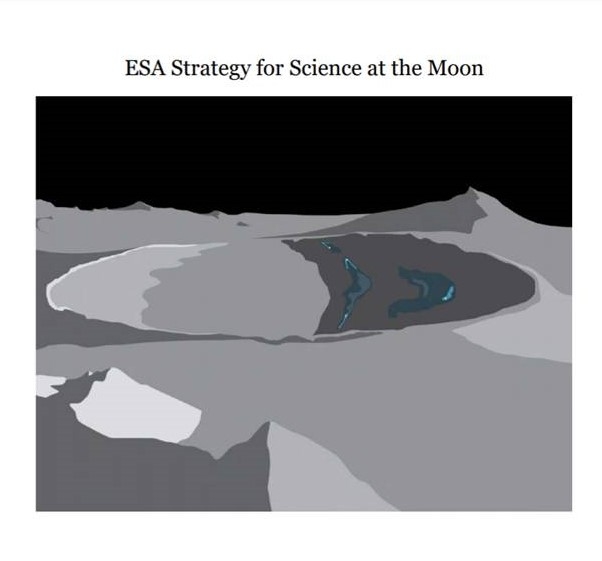
The Moon is a unique scientific resource, just three days from Earth, and whose true potential is only just being realized. The Moon is an archive of Solar System and cosmic history. The Moon preserves a record of the Earth-Moon system’s formation and the context for the emergence of life on Earth. The Moon provides a reference point for planetary science across the Solar System.
This report underscores the fact that the Moon may provide resources for future space exploration missions and to expand a space economy. The Moon provides a platform from which we can observe our Universe as never before. Recent scientific results have shown that we have only just begun to understand science of, on, and from the Moon and that there is a scientific imperative to return.
The document summarizes a strategy for science at the Moon that takes advantage of mission opportunities starting in the early 2020s and prepares for comprehensive scientific activities on European-directed missions.
For the report — ESA STRATEGY FOR SCIENCE AT THE MOON – go to:
http://exploration.esa.int/moon/61371-esa-strategy-for-science-at-the-moon/

Artist’s concept of Restore-L mission.
Credit: NASA
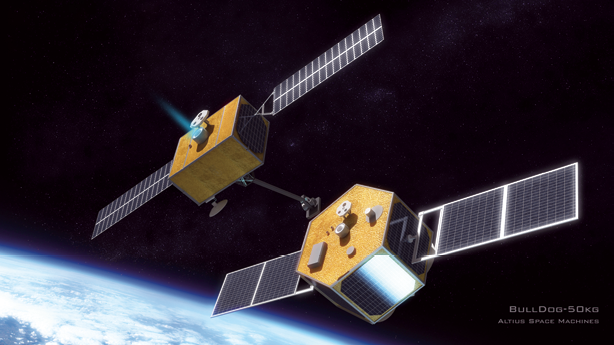
Satellites are tremendously isolated — once launched into orbit, they are left alone to do their work until they lose power or age into obsolescence. But what if satellites could be upgraded, refueled or repaired while in orbit?
The fourth report in The Aerospace Corporation’s Center for Space Policy and Strategy (CSPS) Game Changer series, On-Orbit Servicing: Inspection, Repair, Refuel, Upgrade, and Assembly of Satellites in Space, explores new on-orbit servicing (OOS) capabilities and what this ground-breaking technology could mean for the future of satellite operation, including the potential cost savings of hundreds of millions to salvage satellites and not replace them.
Credit: Altius Space Machines
Possible inhibitors
While the report acknowledges that there are several possible inhibitors to making on-orbit servicing common across the market, OOS is widely viewed as the most viable path forward for continuing to expand space activities beyond their present limitations.
To read this report — On-Orbit Servicing: Inspection, Repair, Refuel, Upgrade, and Assembly of Satellites in Space – go to:
https://aerospace.org/sites/default/files/2019-05/Davis-Mayberry-Penn_OOS_04242019.pdf

The Vinyl Frontier – The Story of the Voyager Golden Record by Jonathan Scott; Bloomsbury Publishing, Inc., New York, May 2019; hardcover: 288 pages, $28.00
As I write this, those long-gone NASA spacecraft, Voyager 1 and Voyager 2 are respectively 13,475,095,569 miles and 11,175,244,034 miles from Earth.
Voyager 2 launched in August 1977, and Voyager 1 soon followed, launching in September 1977. Each spacecraft carries a copy of a “Golden Record” with a protective cover adorned with instructions for playing its contents. For all their supposed intellect, one gathers that aliens recovering the records need a helping hand.
The final playlist contains music written and performed by Bach, Beethoven, Glenn Gould, as well as Chuck Berry and Blind Willie Johnson. There’s music from China, India and more remote cultures. It also contained a message of peace from U.S. President Jimmy Carter. Each song, sound and picture that made the final cut onto the record has a story to tell.
And that story has been captured in a distinctive and fascinating book, written by Jonathan Scott, a music writer and self-confessed astronomy geek. Furthermore, if he’d been in charge of the Voyager Golden Record, he suggests that aliens would deduce that Earthkind was limited to three music chords.
This book tells the story of a team led by astronomers Carl Sagan to put together a record that would travel to the stars on the back of NASA’s Voyager probe. The Vinyl Frontier tells the whole story of how the record was created, nicely presented in a dozen chapters.
Team members for the effort included astronomer Frank Drake, father of the scientific Search for Extraterrestrial Intelligence (SETI), serving as technical director, writer and novelist Ann Druyan was the creative director, science journalist and author Timothy Ferris produced the record, and space artist Jon Lomberg was the designer, with artist Linda Salzman Sagan organizing the greetings.
“This is a story of the summer of 1977 – when science rubbed up against art to create a monument that will, in all probability, outlive us all,” the author explains in the book’s prologue.
The research done in writing this book is exceptional. For instance, how and why the Beatles missed the boat being on the record. “No Dylan. Elvis was discussed but discounted…even Jefferson Starship, who had offered their music for free, weren’t in the running,” Scott writes.
Thanks to the author, scads of little known nearly forgotten, behind-the-record stories are told in a splendid writing style. So many nuggets of information!
BTW: The book points to a YouTube video you’ll find worth a view at: https://www.youtube.com/watch?v=ibByF9XPAPg as well as an associated video at: https://boingboing.net/2017/09/05/how-to-decode-the-images-on-th.html
Also, in celebration of Voyager’s 40th anniversary, The Voyager Interstellar Record was made available on vinyl and can be purchased here:
https://ozmarecords.com/pages/voyager
For more information about The Vinyl Frontier: The Story of the Voyager Golden Record, go to:
https://www.bloomsbury.com/us/the-vinyl-frontier-9781472956132/

Apollo’s Legacy: Perspectives on the Moon Landings by Roger Launius; Smithsonian Books, Washington, D.C., 2019; hardcover: 264 pages, $27.95
Space historian Roger D. Launius has authored this unique and notable book, one that recollects the triumph that was Apollo…but also Apollo’s less positive aspects.
“Each chapter of the book focuses on a major them in our memories of Apollo,” the author explains, “revealing the ways in which it has been seen as a positive endeavor, as well as the ways in which it remains rooted in a time and a place far removed from both our present concerns and our future priorities.”
That piece of prologue sets the reader up for an expertly written retro look at the “feel-good” triumph for America of astronauts on the Moon and high salutes to the U.S. flag.
But Launius then offers provoking chapters, such as: “Applying Knowledge from Apollo to This-World Problems,” “Apollo and the Religion of Spaceflight,” as well as delving into the surrealistic community of those calling Apollo fake news – individuals that deny the Apollo Moon landings.
The chapter on Apollo hoax accusations is chalk-full of insight. Launius reminds the reader: “More than half the world’s population was born after the last of the Moon landings took place in December 1972. Consequently, they had not lived through the excitement of the experience.”
The contents of this book are divided into 10 chapters, with a “Remembering Apollo” conclusion. The author suggests that Apollo increasingly seems to be viewed as a once-upon-a-time situation “for reasons that have receded far into the background.”
Launius goes on to say that in 100 years, “Apollo may be remembered as a singular event, glorious and revered but viewed increasingly as an undertaking without lasting significance.”
There will be those that will argue with that sentiment. Regardless, this volume is a beneficial and essential look at the Apollo space program, one that challenges the status quo of blindly embracing the space past while disregarding the framework of today’s human space exploration planning.
For more information on this book, go to:
https://www.si.edu/newsdesk/releases/smithsonian-books-releases-apollos-legacy

Early praise for Moon Rush – The New Space, published by National Geographic:
“We are in the middle of the ‘New Space’ era, and Moon Rush is the roadmap that shows us how we got here, where we are going, and why. Leonard David’s keen insight into space exploration puts the Moon into its proper context – as the next destination for humans as we take our first steps into the solar system.” — Colonel Terry Virts (ret.), NASA veteran of two spaceflights – a two-week mission onboard the Space Shuttle Endeavour in 2010 and a 200-day flight to the Space Station in 2014-2015

Geologist Harrison Schmitt performs Moon tasks during Apollo 17 mission in December 1972.
Credit: NASA
“Written with Leonard David’s trademark wry humor and the product of thorough research, Moon Rush is a comprehensive, accessible and entertaining book addressing the value of a return to the Moon. Deftly tying together the rich past of U.S. and Russian lunar expeditions (robotic and human) with present developments and an optimistic view of the future, Mr. David lays out the geopolitical case for a return to the Moon for the United States, our international allies, and our competitors, with attention to human space exploration, planetary science, the discovery of lunar resources and the eventual development of a lunar economy.” — Dr. Mary Lynne Dittmar, President & CEO, Coalition for Deep Space Exploration; Member U.S. National Space Council Users’ Advisory Group

Credit: NASA
“Leonard David has now managed to make sense of the new rush to the Moon where scientists, engineers, entrepreneurs, and artists are looking to uncover its hidden secrets, utilize its precious resources, and continue finding inspiration from its otherworldly beauty. And he has done it by skillfully describing how these seemingly contrasting goals fit in humanity’s ‘unquenchable thirst to press onward and outward.’” — Dr. Angel Abbud-Madrid, Director, Center for Space Resources, Colorado School of Mines

A source of water on the Moon could help make future crewed missions more sustainable and affordable.
Credit: RegoLight, visualization: Liquifer Systems Group, 2018
“In Moon Rush, Leonard David has provided a comprehensive, clearly written, and convincing account of why the returning to the Moon, ‘this time to stay,’ will be the central feature of the world’s space activities of the next few decades. He suggests that ‘the United States is hungry to take to lead’ in that return. I hope that he is right about that, and that the country that sent 12 men to the Moon a half-century ago will once again be in the vanguard of a sustained global public-private effort to make the Earth’s off-shore island an essential element of this planet’s future.” — Dr. John Logsdon, Professor emeritus and founder, Space Policy Institute, George Washington University

Credit: NASA
“Leonard David explores multiple dimensions of our Moon: mythology, history, robotic and human exploration, science, technology, utilization, inspiration, education, strategy, national and international programs, governments, and new private space actors. It will enrich everybody’s own personal and collective lunar experience! This book is an amazing resource for learning, reflecting, and engaging towards our next steps to build a ‘MoonVillage’ sustainable community and settlement on our 8th continent, the Moon.” — Professor Bernard H. Foing, Executive Director, The International Lunar Exploration Working Group (ILEWG), European Space Agency Lead scientist for SMART-1 Mission, and EuroMoonMars program

The Case for Space: How the Revolution in Spaceflight Opens Up a Future of Limitless Possibility by Robert Zubrin; Prometheus Books, New York, 2019; hardcover: 395+ pages, $25.00
There is an on-going revolution in spaceflight. But where will this uprising in technological prowess take us?
Robert Zubrin has written a compelling account of the trajectory ahead for humanity. In 14 chapters (divided into a part 1: “How we can” and part 2: “Why we must”), the author puts forward a visionary account of how best to break the bonds of Earth and head for the stars.
“Great things are happening,” Zubrin says in an introduction that kicks off the book. “It’s a grand time to be alive. We are living at the beginning of history. We are present at the creation.”
There’s a new space race afoot; it’s not a replay of rival superpowers that ushered in the Cold War space race. Rather, competing entrepreneurs are the key to transforming our future in space. The author underscores why the spaceflight revolution is a must: for the knowledge, for the challenge, for our survival, for our freedom, and for the future. In the book’s concluding chapter, Zubrin flags what now needs to be done, giving the charge to the reader to become a space activist.
The book is loaded with technical detail on pushing forward to the stars, as well as sweeping and captivating looks at terraforming, mining the asteroids for fun and profit, how to build a Moon base, and colonizing Mars. Zubrin does not skimp on provocative ideas and pulls no punches when critical of ideas promoted by NASA and others.
“Making history is not a spectator sport,” Zubrin concludes. “It’s your turn at the plate.”
The reader will find this mind-stretching volume an absorbing look at the future of space exploration. A great glossary of terms and chapter by chapter notes for delving deeper into topics rounds out this impressive book.
For more information, go to:

