Archive for the ‘Space Book Reviews’ Category
 Author:
  October 14th, 2020
The Magic and Menace of SpaceShipOne by Brian Binnie; Black Sky Enterprise; 500 pages; October 4, 2020; Ordering information at: https://brianbinnie.net/
This is an extraordinary book and it is a true, “can’t put it down” volume. Binnie is a former United States Navy officer and test pilot for SpaceShipOne, the experimental spaceplane created by aeronautical pioneer, Burt Rutan, and his innovative company, Scaled Composites.
On October 4, 2004, with Binnie at the controls of SpaceShipOne, he flew the second suborbital flight in one week’s time to capture the $10 million Ansari X Prize flight purse. That pioneering passage of space and time marked a new era of commercial space flight. How the author claimed his rocket ride into the history books is an entrancing story.
“Spaceships are dangerous things. There are no intentions implied to suggest otherwise,” Binnie writes. And that’s found well before the main text, carried on the “All rights reserved” page.
The author is far from being reticent, scripting an absorbing, humbling and tell-all account of his following Rutan’s “Looking Up… Way Up” credo to his own insights of “Looking Down…Way Down.”
By way of 47 chapters and scads of edifying sidebars, the author steers the reader through a saga of volatile technical challenges encountered in his career, doing so in humorous, often self-effacing writing style.
There’s great historic content in the chapter, “Rotary Unraveled,” describing his 1999 copilot experience in flying Rotary Rocket’s Roton vehicle, built to be a single stage to orbit spaceship.
The three-and-a-half years it took to pull off the milestone-making SpaceShipOne program spared no one, Binnie notes, and by the end, those involved were left exhausted.
Binnie writes in admiring detail about his colleague, Mike Melvill, the person that, among a number of flight test duties, flew SpaceShipOne on its first flight past the edge of space in June 2004, months later to pilot the first competitive flight in the Ansari X Prize competition.
“Burt’s spaceship, like many of his aeronautical designs, was elegant. Simple. Tidy. Reusable. And very, very clever. You could say it was magic,” Binnie points out.
In detailing his December 17, 2003 flight — the craft’s first powered trip skyward that ended in a skid off the runway — he dryly recalls: “There was magic in the air. That is, until I crashed SpaceShipOne,” he explains “And as the grating, grinding noise gradually subsided, the only sound left in the cockpit duly recorded — but thankfully muted in the Discovery Channel documentary — was me practicing my French,” Binnie explains.
Once again, the reader will find this book revealing and riveting.
As Binnie makes clear, this volume was created entirely by an author that has had forty years of “wrestling with recalcitrant machinery” doing its best to be lethal, but proving to be useful training.
That said, he adds “if you’ve got no fears, you’ve got no dreams.”
For more information on this book, go to:
 Posted in

Cover art design by Bryan Versteeg

Credit: NASA
Explore Mars, Inc. has issued its annual report — The Humans to Mars Report (H2MR) — presenting a snapshot of current progress in mission architectures, science, domestic and international policy, human factors, STEAM Education, and public perception regarding human missions to Mars.
The document highlights progress and challenges from year to year.
“The momentum that has been building for many years to send humans to Mars in the 2030s has continued unabated, and indeed grown, during the past year,” the report explains. “The decade of the 2020s is now upon us, and we can now truly say that instead of Mars being two decades away, it is now achievable in the next decade.”

NASA’s robotic Holy Grail mission, a Mars sample return effort to bring back to Earth Martian collectibles.
Credit: NASA/JPL-Caltech
Findings and observations
The report contains a number of “findings and observations.” Among them:
— Stronger collaboration between NASA mission directorates will help assure that the science missions of the 2020s maximize both scientific goals as well as advance human exploration in the 2030s.
— Implementing next-generation orbiters and surface missions in the near future to prospect for resources (notably water ice) will reduce the overall cost of missions to Mars while providing significant science gains.
— A Mars Sample Return project would not only achieve revolutionary science, but would also allow scientists to assess the material characteristics of martian dust and its potential toxicity to human explorers, as well as to develop appropriate planetary-protection measures.

China’s three-in-one mission: An orbiter, lander, and rover.
Credit: Wan, W.X., Wang, C., Li, C.L. et al.
— Multiple additional year-long missions on the International Space Station with diverse populations in low Earth orbit that evolve to the duration of human Mars missions will be required. Consider sending astronauts directly from the ISS to Mars analogs to investigate how self-guided recovery impacts both health and productivity with realistic communications delay.
— As lunar activities are developed, such plans should be constructed in a manner that should feed forward to and therefore advance the goal of human missions to Mars in the 2030s and should not hinder achieving that goal.
— As long as valid security concerns by the United States and its international partners are sufficiently addressed, the role of China in future international efforts to reach Mars should be considered by Congressional and Administration policy makers.
To read the full report, go to:
https://www.exploremars.org/wp-content/uploads/2020/08/H2MR_2020_Web_v1.pdf
Also, go to the group’s virtual conference this week, starting today, at:

In Pursuit of the Moon – The Hunt for a Major NASA Contract by Bill Townsend; iUniverse – a self-publishing imprint; 168 pages; 2019; Softcover; $13.99.
This is a tell-all story that’s rarely told. The author takes the reader deep inside the inner-workings of a real-life aerospace industry pursuit – vying for the ARES I Instrument Unit Avionics contract, released by NASA in 2007. Ares I was the crew launch vehicle that was being developed at the time by NASA as part of the Constellation program, a precursor to today’s Artemis adventure.
After forty-plus years with NASA, the author details his joining of Ball Aerospace in Boulder, Colorado, in 2004, then taking thirty-five top-notch “Birkenstock-wearing engineers” to Huntsville, Alabama, to establish a new Ball Aerospace office designed to champion the chase for the contract. The competition was stiff – an entrenched cabal of aerospace contractors who had dominated NASA’s human space flight program for decades.
You can get a sense of the astronautical angst a person can go through just by noting the titles of this six-part book: “The Situation,” “Before the Storm,” “The Proposal,” “The Down Select,” “The Decision,” and “The Aftermath.”
“So, with the benefit of perfect hindsight,” what did we do well, and what could we have done better?,” Townsend writes.
This is an intimate look at how to work with a major government agency, NASA, and how the space agency behaves and conducts itself with its contractor base…sometimes in ways you would not anticipate.
For those not familiar with the aerospace industry, the author’s intent is to pry your eyes open to what really goes on. And for those in the aerospace industry, “perhaps there is a thing or two that you can learn from my telling of this story,” Townsend explains. Moreover, for those within NASA, he has some select words too!
Townsend has spent more than fifty years in the aerospace industry, a distinguished career with particular expertise in the management of major space flight programs. His reflections about the people, the places, and the paperwork makes it a worthy read for all those out there trying to shape a vibrant, yet-affordable space program for today.
For more information on this book, go to:
https://www.iuniverse.com/en/bookstore/bookdetails/794782-in-pursuit-of-the-moon

Extraterrestrials by Wade Roush; The MIT Press Essential Knowledge series; Cambridge, Massachusetts; 224 pages; published April 2020; $15.95.
This is an engaging and an excellent tutorial on life elsewhere – always anchored in that are we alone in the universe, and if we are not, where are they?
Containing 5 chapters, the book is very straightforward in its details: “Alien Dreams”; “Making SETI into Science”; “Extremophiles and Exoplanets”; “Answering Fermi”; and “Joining the Conversation.”
“Why the search connects us to the cosmos,” is the one driver of this volume, explains Roush, a freelance science and technology writer, columnist at Scientific American, and host and producer of the tech-and-culture podcast Soonish.
For starters, as one subtitle explains, we need to organize our ignorance.
So where is everybody? The author dives in on that Fermi Paradox with a first-rate number of scenarios, from the Drake equation to intelligent life is rare to the possibility that technological civilizations are uncommunicative.
If they are “out there” how best to prepare for contact? Roush responds by saying “let’s not spend too much time speculating about an inherently unknowable event.” But he suggests, prior to potential contact, we Earthlings should ask ourselves what we would contribute to an interstellar society and what we should do to prepare for that occasion.
This nicely written, reader-friendly book ends with a glossary of terms and a very useful notes section for the entire volume.
Again, this is an easy-to-read 101-explanation of the mind-bending excursion to contemplate the often asked, are we alone question…or perhaps start grappling with just how crowded is it in the universe.
For more information on this book, go to:
https://mitpress.mit.edu/books/extraterrestrials
Also, go to “Life as We Don’t Know It – If we’re going to find extraterrestrials, we need to stop assuming they’ll think like humans,” by Wade Roush at:
https://blogs.scientificamerican.com/observations/life-as-we-dont-know-it/
as well as a podcast featuring Roush at:
https://mitpress.podbean.com/e/extraterrestrials-with-wade-roush/

Best space and sci-fi books for 2020
By Space.com Staff
https://www.space.com/28973-best-space-books.html


Space is Open for Business – The Industry That Can Transform Humanity by Robert C. Jacobson; Self-published, Release Date: July 2020; Available by pre-order.
The space industry is experiencing a renaissance, led by private companies who have pushed the boundaries and continue innovating at a rapid pace, explains space investor and entrepreneur, Robert C. Jacobson.
The author underscores the fact that we are “in the middle of a critical turning point: the NewSpace revolution needs public interest, increased investment, improved government policy, and widespread collaboration to propel forward and reach its full potential.”
Divided into seven parts, the reader will enjoy Jacobson’s thoughtful guide to the evolving space industry, such as “Investing in the Cosmos,” “Joining the Movement,” and “The Blueprint of Evolution.” The book offers insightful looks at many of the space entrepreneurs of today that are indeed shaping NewSpace.
“Space is, in fact, a culmination of many disciplines, and it works in tandem with various industries,” the author explains. “The sector’s growth depends on merging different fields with cutting-edge technologies, fantastical ideas with logical applications.”
I found this volume an uplifting read. In addition, Jacobson offers a “non-exhaustive list” of the immediate, necessary changes needed to propel NewSpace forward and achieve its unlimited potential. Culled together are a series of key steps to do so.
“Smart policy, technology and innovation adoption, increased space-entrepreneurship, and timing will all affect the industry’s trajectory,” writes Jacobson.
Space is the unlimited business plan, the author believes. Space can transform the world in ways not possible by the bounds of terrestrial business endeavors. If you can dream it, it may be possible in this space-future.
The book concludes with a comprehensive set of references that adds to this book’s unique contribution to the evolving and expansive world of NewSpace.
For more information on Space is Open for Business – The Industry That Can Transform Humanity go to:

The U.S. Secretary for Defense has released the Defense Space Strategy, which identifies how Department of Defense will advance spacepower to be able to compete, deter and win in a complex security environment characterized by great power competition.
The Department of Defense (DoD) is embarking on the most significant transformation in the history of the U.S. national security space program.
Space is now a distinct warfighting domain, demanding enterprise-wide changes to policies, strategies, operations, investments, capabilities, and expertise for a new strategic environment. This strategy identifies how DoD will advance spacepower to enable the Department to compete, deter, and win in a complex security environment characterized by great power competition.
For the summary of this report, go to:
Also, a fact sheet is available at:

NASA cover artwork credit: Alberto Bertolin/Jacobs Technology Inc.
After LM – NASA Lunar Lander Concepts Beyond Apollo, John Connolly (Editor) 2019; 277-pages, Free NASA PDF.
This NASA-published volume traces the history of human lunar lander concepts developed since Apollo’s Lunar Module (LM).
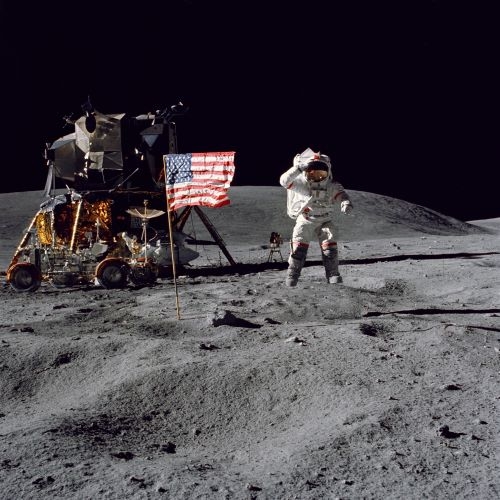
Credit NASA
Editor John Connolly has spent 33 years at NASA, primarily leading development of lunar surface systems, including landers. Given the details provided in this book, his bookshelves are surely bowed by the number of study volumes he has collected and gone through!
This notable volume tells the story of physics, technology, and the desire to return humans to the lunar surface through technical descriptions, imagery and looks at subsystems of more than 100 lunar lander concepts created by NASA and its contractors since the Apollo program.

The concepts are grouped by the human exploration timelines that defined the post-Apollo period, starting post-Apollo and continuing through the Space Exploration Initiative and the Vision for Space Exploration, and concluding with the many lander designs created to support NASA’s Constellation program.
Readers will better appreciate the common “trades” that are explored in crewed landing systems, including propellant types, pressurized volumes, structural mass fractions, mass margins, crew size, and special accommodations for ergonomics and other human factors.
“There is a reason why the Apollo LMs, and many of the subsequent lunar lander designs featured in this book, look the way they do – their shape and form is a response to the simple physics that governs the tasks they are asked to perform,” Connolly explains.
As this document was being compiled in 2019, NASA has once again begun planning a return to the Moon, and new lunar lander designs are being generated.
Compared to Apollo, Connolly notes, crews are projected to be larger and stay times longer.
“However, it is expected that the landers will look much like the designs in this document,” he adds, because lunar lander design is a response to the simple physics that governs the tasks they are asked to perform.

Lander Design Analysis Cycle-4
Credit: NASA
“Design is also a living thing. New crewed lander designs will continue to emerge up until the point that humans return to the Moon, and even beyond, Connolly writes. “New players from different countries and commercial providers will create new designs based on new technologies and new requirements.”
“Until some breakthrough technology or new physics principle is created, each lander will respond to the current physics of lunar landing,” Connolly explains in the concluding pages of the volume.
“There may come a time, generations from now, when future engineers are paging through a digital copy of this catalog and reflecting on the early work of lunar lander designers. “Those Apollo guys were really smart, given that they started with nothing as a reference. The Lunar Module – now THAT was a great lunar lander design.”
After LM – NASA Lunar Lander Concepts Beyond Apollo is free to the public and available for download at:
https://ntrs.nasa.gov/archive/nasa/casi.ntrs.nasa.gov/20190031985.pdf
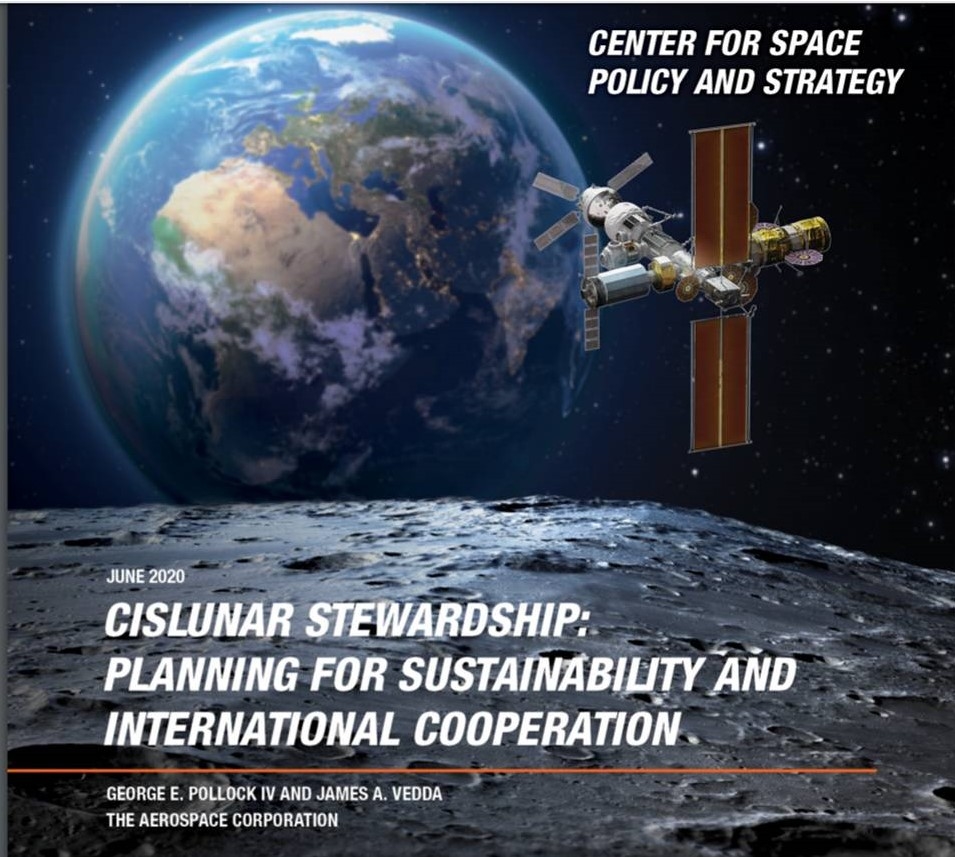
What steps are necessary to establish a cislunar sustainability paradigm?
A new publication underscores the fact that, as more nations become spacefarers and cislunar traffic increases, established and emerging players should employ lessons learned from operations in low Earth orbit and geosynchronous Earth orbit “to be better caretakers of the expanded orbital neighborhood.”
The report — Cislunar Stewardship: Planning for Sustainability and International Cooperation – is available from the Center for Space Policy and Strategy, part of The Aerospace Corporation, a nonprofit organization that advises the government on complex space enterprise and systems engineering problems.
Basic assumptions
Why is cislunar space important? The report notes that, between now and mid-century, some basic assumptions about the state of space operations are reasonable.
— Geosynchronous Earth orbit (GEO) will continue to be valuable and actively used.
— The number of operational satellites, especially in low and medium Earth orbits (LEO and MEO), will increase.
— Space operators will become more numerous and more diverse.
— Orbital debris will continue to be a significant concern.
— A greater variety of cislunar orbits will be used for an assortment of space applications, including communications, navigation, space domain awareness, scientific remote sensing, and human exploration.
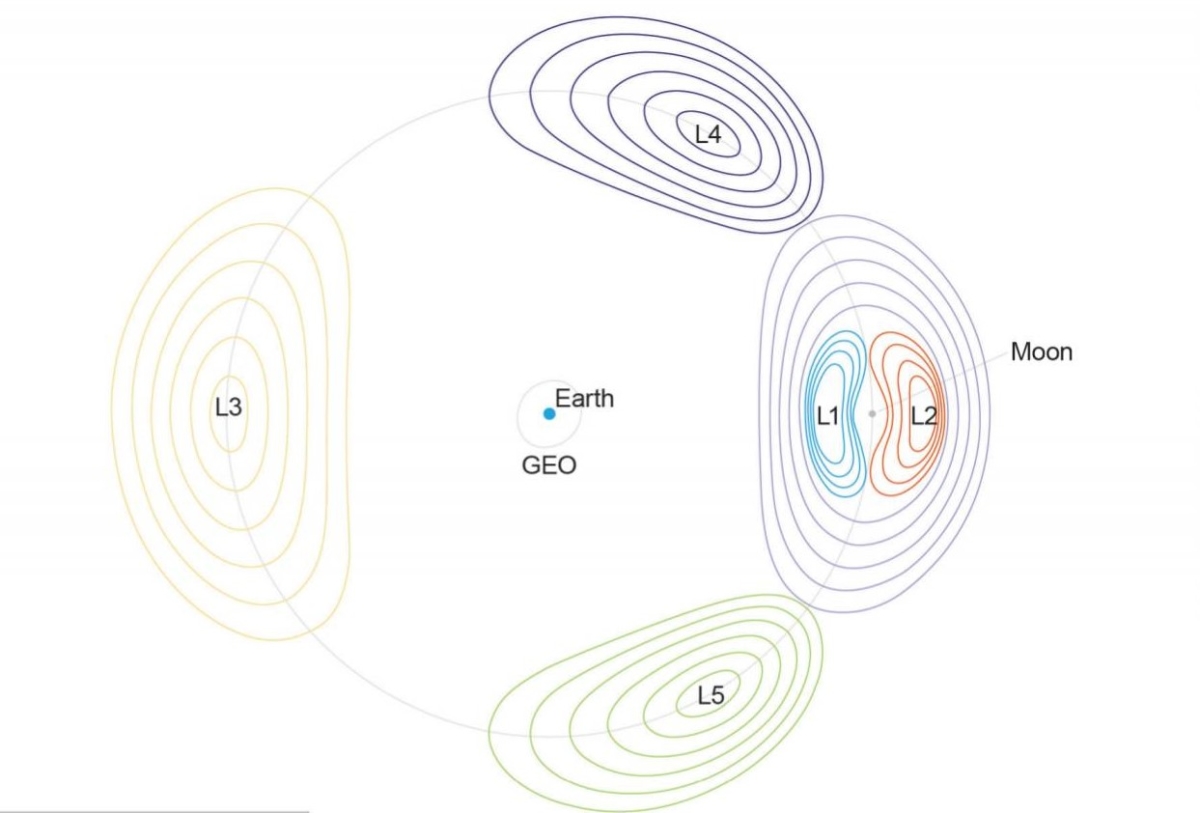
Illustration of several types of cislunar orbits: halo and Lyapunov orbits about the five Lagrange points; distant
retrograde orbits.
Credit: Jonathan Aziz/Center for Space Policy and Strategy
Gravitational and policy stability
“Space operations are expanding beyond the geosynchronous Earth orbit (GEO) to other parts of the Earth-Moon system. As this trend continues, space operators will find preferred orbits and seek to leverage points of relative gravitational stability,” the report explains. “These locations can enable lower-energy transits or provide useful parking places for various types of facilities (e.g., fueling depots, storage sites, and way stations with access to the lunar poles). As cislunar activity grows, a policy framework should be developed to promote the sustainability of operations in these locations.”
To access the report — Cislunar Stewardship: Planning for Sustainability and International Cooperation – go to:
https://aerospace.org/sites/default/files/2020-06/Pollock-Vedda_CislunarStewardship_20200601.pdf

Apollo 17’s Harrison Schmitt
Credit: NASA
The sixth installment of Apollo 17 Astronaut Harrison H. Schmitt’s saga, Apollo 17: Diary of the 12th Man has been published on his website.
This new chapter of the diary – “Contact!” — is now online and recounts the events of the 6th day of the Apollo 17 mission, America’s last deep space manned mission of the 20th century.

At 200 feet altitude, a clear view of both the Challenger shadow with landing struts deployed.
Credit: NASA
“It includes wakeup activities; my entry into [Lunar Module (LM)] Challenger to begin the Challenger’s activation; a complete activation of Challenger’s systems; Descent Orbit Insertion-1 (DOI-1) while still docked with the CSM; preparation for undocking from America; undocking; preparation and implementation of DOI-2 by Challenger; and, of course, Powered Descent on to the lunar surface in the valley of Taurus-Littrow,” Schmitt explains in his author’s note.
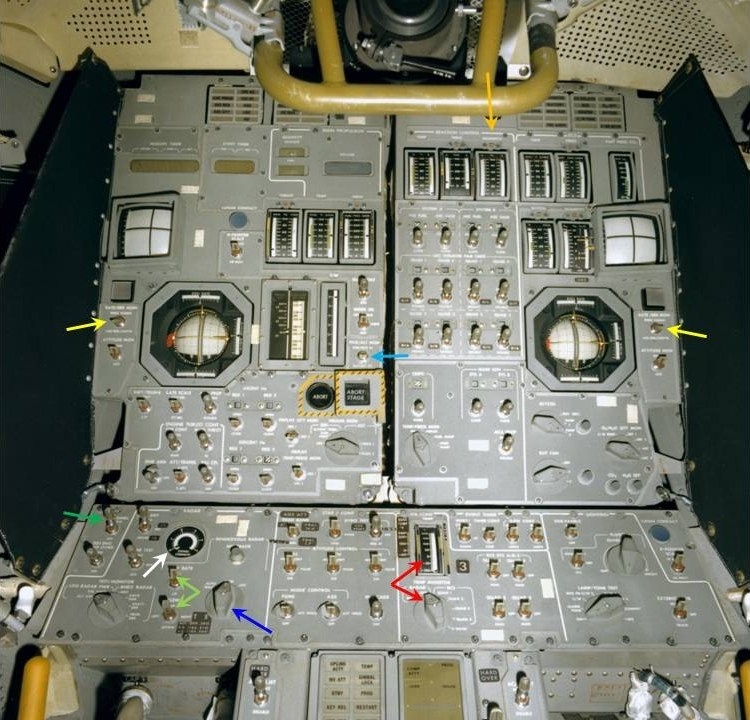
The switches for the LM rendezvous radar settings.
(Base photo NASA/ALSJ/Paul Fjeld)
Complex flying machine
“The reader is taken through the real checkout procedures activating the LM in lunar orbit, and riding with the astronauts down to the lunar surface,” explains Ronald Wells, editor-in-chief of the revealing and instructive website.

The ground track of the flight trajectory of Challenger into the valley of Taurus-Littrow coming from the right.
(Base photo NASA AS17-M-0595)
It has been illustrated with photos of the actual LM instrument panels that Jack Schmitt and Gene Cernan operated in flight, “so the reader hopefully will get a very good idea of how complex flying the LM actually was by seeing all the switches that they had to operate,” Wells told Inside Outer Space. “This very important chapter, of course,” he adds, “is a must read for the Artemis astronauts in training to return to the Moon!”
To view “Contact!” by Apollo 17’s Harrison H. Schmitt, a fascinating read with excellent endnotes, go to:

