Author Archive
 Author:
  February 26th, 2024
Image credit: NASA/GSFC/Arizona State University
Caught on camera!
The troubled Intuitive Machines IM-1 Nova-C Moon lander, known as Odysseus, touched down on the Moon Thursday, February 22.
The arrow indicates the craft’s location. NASA’s Lunar Reconnaissance Orbiter’s (LRO) powerful camera system, the LROC, spotted Odysseus, within a degraded one-kilometer diameter crater “where the local terrain is sloped at a sporty 12 degrees.
Before and after LRO imagery of the IM-1 landing locale shows the craft.
Expiration date: getting the cold shoulder
The LRO imagery confirms that Odysseus completed its landing at 80.13°S and 1.44°E at a 2579 m elevation, explains Intuitive Machines.
“After traveling more than 600,000 miles, Odysseus landed within 1.5 km of its intended Malapert A landing site, using a contingent laser range-finding system patched hours before landing,” the private group adds.
“Flight controllers intend to collect data until the lander’s solar panels are no longer exposed to light. Based on Earth and Moon positioning, we believe flight controllers will continue to communicate with Odysseus until Tuesday morning,” note controllers and the Intuitive Machines mission control.
End-to-End communication requirements
Intuitive Machines also added this update to the situation with Odysseus:

Image credit: Intuitive Machines

Image credit: Intuitive Machines
“Odysseus continues to communicate with flight controllers in Nova Control from the lunar surface. After understanding the end-to-end communication requirements, Odysseus sent images from the lunar surface of its vertical descent to its Malapert A landing site, representing the furthest south any vehicle has been able to land on the Moon and establish communication with ground controllers.”
“As part of Odysseus’ descent onto the lunar surface, Intuitive Machines Hazard Relative Navigation algorithms detected nine safe landing sites within the targeted south pole region, which is an area that contains permanently shadowed regions that may be rich in resources, including water ice that could be used for future propulsion and life support on the Moon.”

Click on for before/after LRO photos. Image credit: NASA/GSFC/Arizona State University

NASA’s Lunar Reconnaissance Orbiter (LRO).
Credit: NASA/GSFC

 Posted in

Steve Altemus, chief executive officer and co-founder, Intuitive Machines uses model to describe lunar lander’s attitude on the Moon’s surface. Image credit: NASA/Inside Outer Space screengrab
Mum’s the word from Intuitive Machines regarding their recently landed Odysseus Moon craft.
Meanwhile, that’s not the case from an Embry‑Riddle team that’s also working around the clock, all in preparation for ejecting their EagleCam from the apparently tipped over lunar lander.
While no go-ahead time has been issued, the device once launched from Odysseus may provide insight as to the overall condition of the lander as its rests on its side on the Moon.

Embry‑Riddle’s Space Technologies Lab developed EagleCam.
Image credit: Embry‑Riddle/Inside Outer Space screengrab
Visual support
The Embry-Riddle team is adapting its original deployment plan to provide the visual support.
EagleCam was to be dispatched from Odysseus prior to lander touchdown. However, that plan was scrapped early due to communication and navigation disruptions the night of the Moon landing on February 22.

Intended deployment of EagleCam. Image credit: Intuitive Machines
Odysseus is in an “unexpected attitude,” reports Intuitive Machines.
The good news is that telemetry data confirms that the Embry‑Riddle EagleCam, a CubeSat, is still fully operational.
Simulations
EagleCam’s team now intends to deploy its camera system to capture imagery of the lander in its current state, “offering valuable data that could help Intuitive Machines refine its plans moving forward,” according to an Embry-Riddle statement.

Image credit: Embry‑Riddle/Inside Outer Space screengrab
“We are currently running simulations which show that EagleCam should deploy a total distance of somewhere between 3 to 5 meters [10 to 16 feet], with a best guess at about 4.1 meters [roughly 13 feet],” said Troy Henderson, faculty lead of the EagleCam team.
If EagleCam travels that distance from the side of the lander, it might snag photographs of Odysseus’ orientation and overall condition
“The imagery would then be transferred via Wi-Fi back to the lander and then transmitted down to engineers on Earth for analysis,” explains the statement.

Image credit: Intuitive Machines
High pressure environment
“We have built-in redundancies into this device, with Wi-Fi antenna diversity both in the payload and the lander, which increases our chances of mission success under these unexpected scenarios,” adds Eduardo Rojas, the Embry‑Riddle assistant professor of Electrical & Computer Engineering who designed EagleCam’s Wi-Fi antennas.
Rojas adds that the 24/7 work underway with the EagleCam crew is being done in a distinctive “high-pressure environment.”
The timeline for deployment of EagleCam from Odysseus remains unknown.
Go to this informative video on EagleCam and the Embry‑Riddle team at:
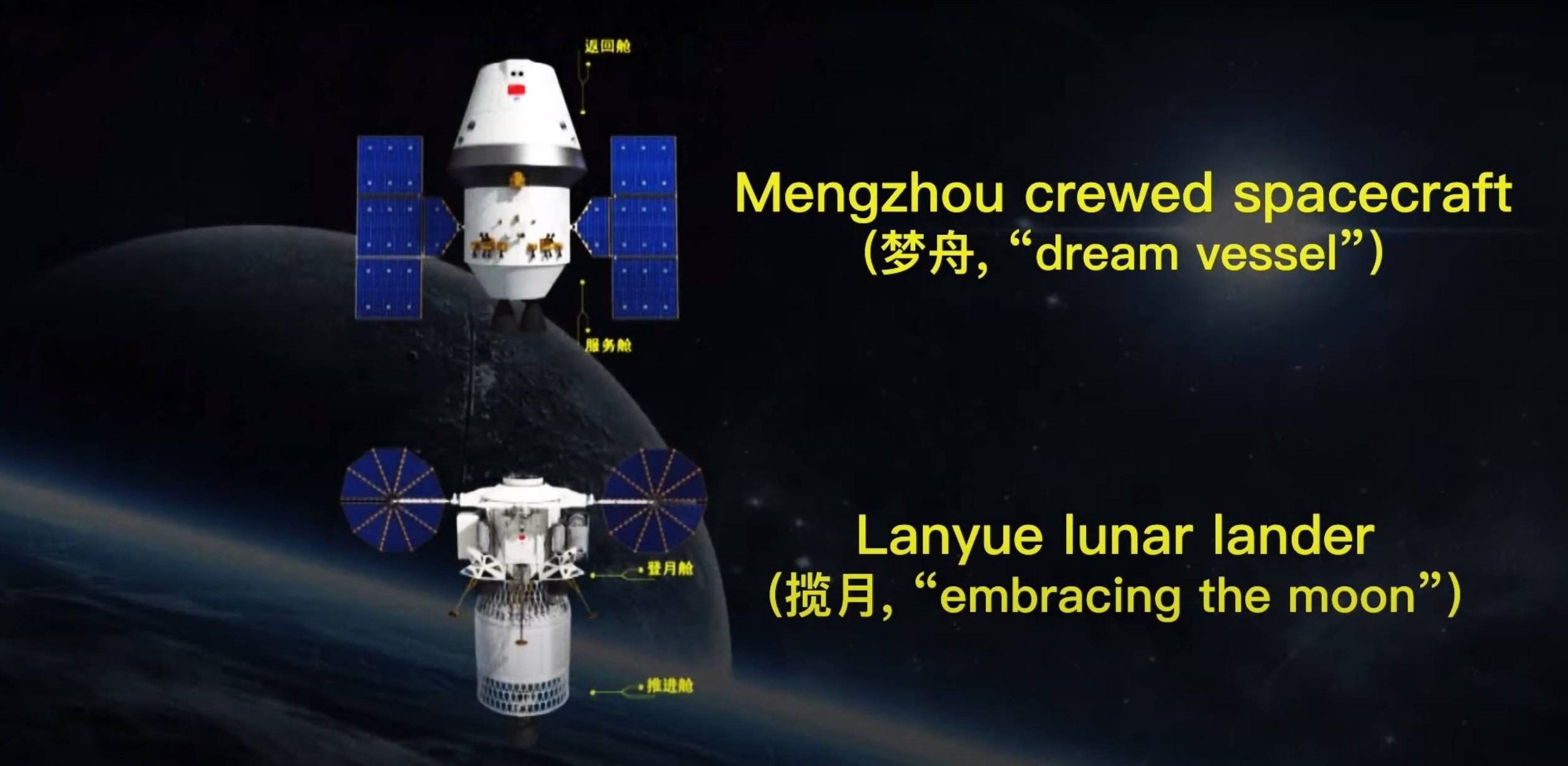
Image credit: China National Space Administration (CNSA)/China Central Television (CCTV)/SciNews.ro/Inside Outer Space screengrab
China has officially named the vehicles that will support that country’s human exploration of the Moon.
A three-seater spacecraft is called “Mengzhou” (Dream Vessel) and the lunar lander is named “Lanyue” (Embracing the Moon), in English translation.
Lanyue first appeared in a poem written by the late Chairman Mao Zedong in 1965, noted the China Manned Space Agency (CMSA) in announced the names, underscoring aspiration and confidence in exploration of the universe and the Moon.

Image credit: CCTV/Inside Outer Space screengrab
Cultural connotations
The names of the new vehicles were solicited from the public in an event launched last August. The two names selected came from nearly 2,000 submissions.
“The names Mengzhou and Lanyue of the two new space vehicles carry distinct characteristics of China and the times, and have rich cultural connotations,” said Ji Qiming, director assistant of the China Manned Space Engineering Office (CMSEO).
These spacecraft, along with development of the Long March-10 carrier rocket, “will carry forward Chinese people’s dream of exploring the vast universe and reaching the moon,” Ji told China Central Television (CCTV).

Successive launches
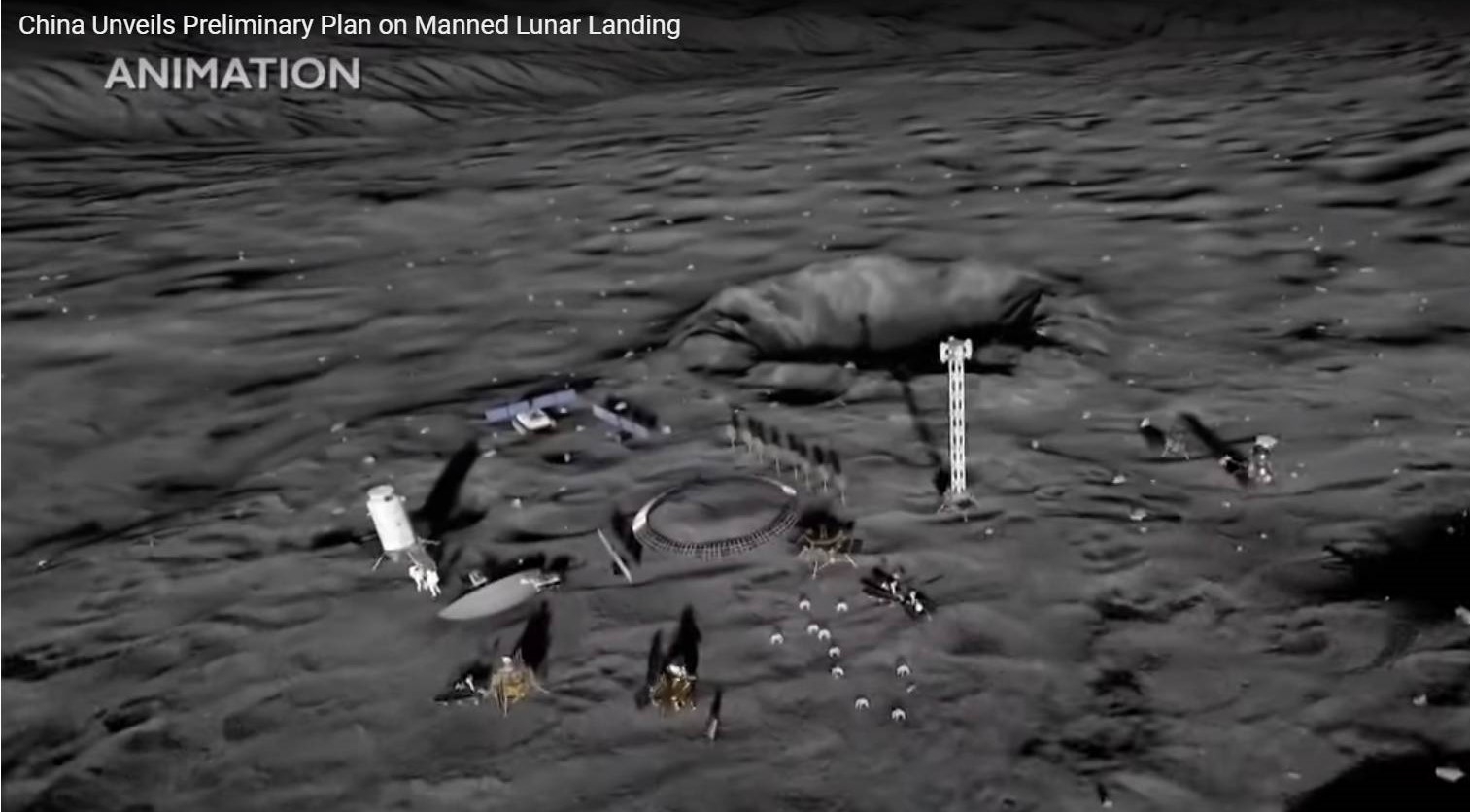
Previously, China space officials have sketched out preliminary plans to land a crew on the Moon by 2030.
As released by China Manned Space Agency that plan makes use of two successive Long March-10 carrier rocket launches, hurling the Lanyue lander and Mengzhou spacecraft separately from the Earth to a trans-lunar injection orbit.
“The two spacecrafts conduct rendezvous and docking in lunar orbit. Then astronauts will enter the lander and the lander will send them to the lunar surface where they’ll carry out scientific investigation and sample collection according to plan,” Ji said.
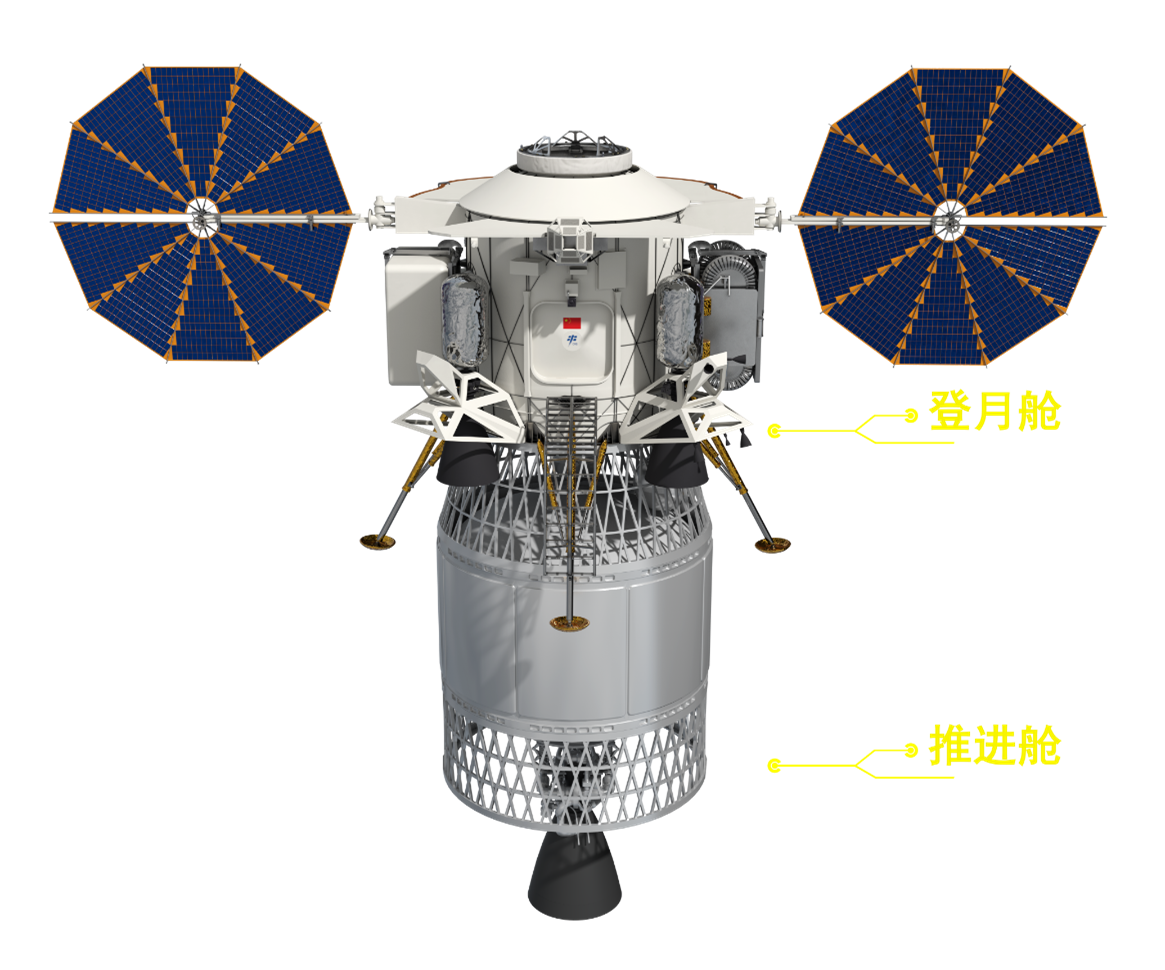
Image credit: CMSA
Back to Earth
After completing the set tasks on the lunar surface, the moonwalkers would then take the Lanyue lander back into to lunar orbit, with the two spacecraft joined again.
“Astronauts are going to transfer the lunar samples they’ve collected to the Mengzhou spacecraft, and the spacecraft will return to the Earth via trans-lunar injection orbit,” said Ji.
“For now, the development of primary spacecrafts such as the carrier rocket Long March-10, Mengzhou manned spacecraft, Lanyue lander and spacesuits are finished,” added Ji.
The overall technical proposal for launching site and landing site is also completed, Ji told CCTV.
The lunar science payload, a human-controlled lunar rover, and lunar activity support system have been under formulation, Ji said. “The setting up of various newly-built facilities and equipment for test launch in Wenchang Spacecraft Launch Site will start later.”
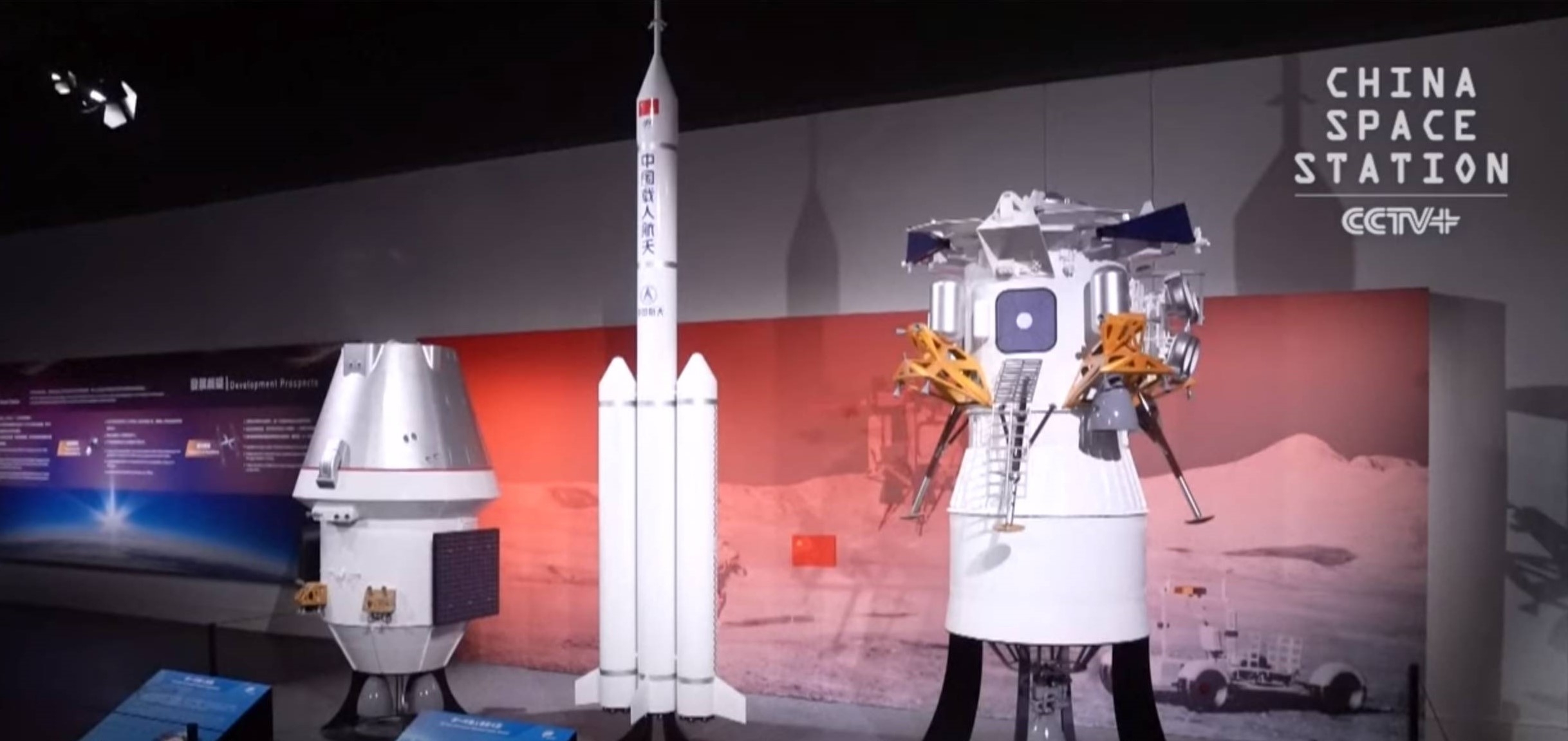
China’s plans for human crews on the Moon are being shaped.
Image credit: CCTV/Inside Outer Space screengrab
Step-by-step
Ji indicated that China’s humans on the Moon endeavor will be implemented “step-by-step,” including uncrewed flight test to piloted lunar flight.
According to the China Manned Space Agency plan, the Lanyue lunar lander will consist of two parts: a lunar module and a propulsion module, with a weight of nearly 26 tons. It is capable of carrying two astronauts and a lunar rover weighing 440 pounds (200 kilograms) to the lunar surface.
China Global Television Network (CGTN) reports that there will be two Mengzhou models. One will be used to transport astronauts to the Moon and the other will replace the current Shenzhou spaceship now in use that transports crew members between Earth and China’s space station that has been orbiting around the Earth for nearly three years.
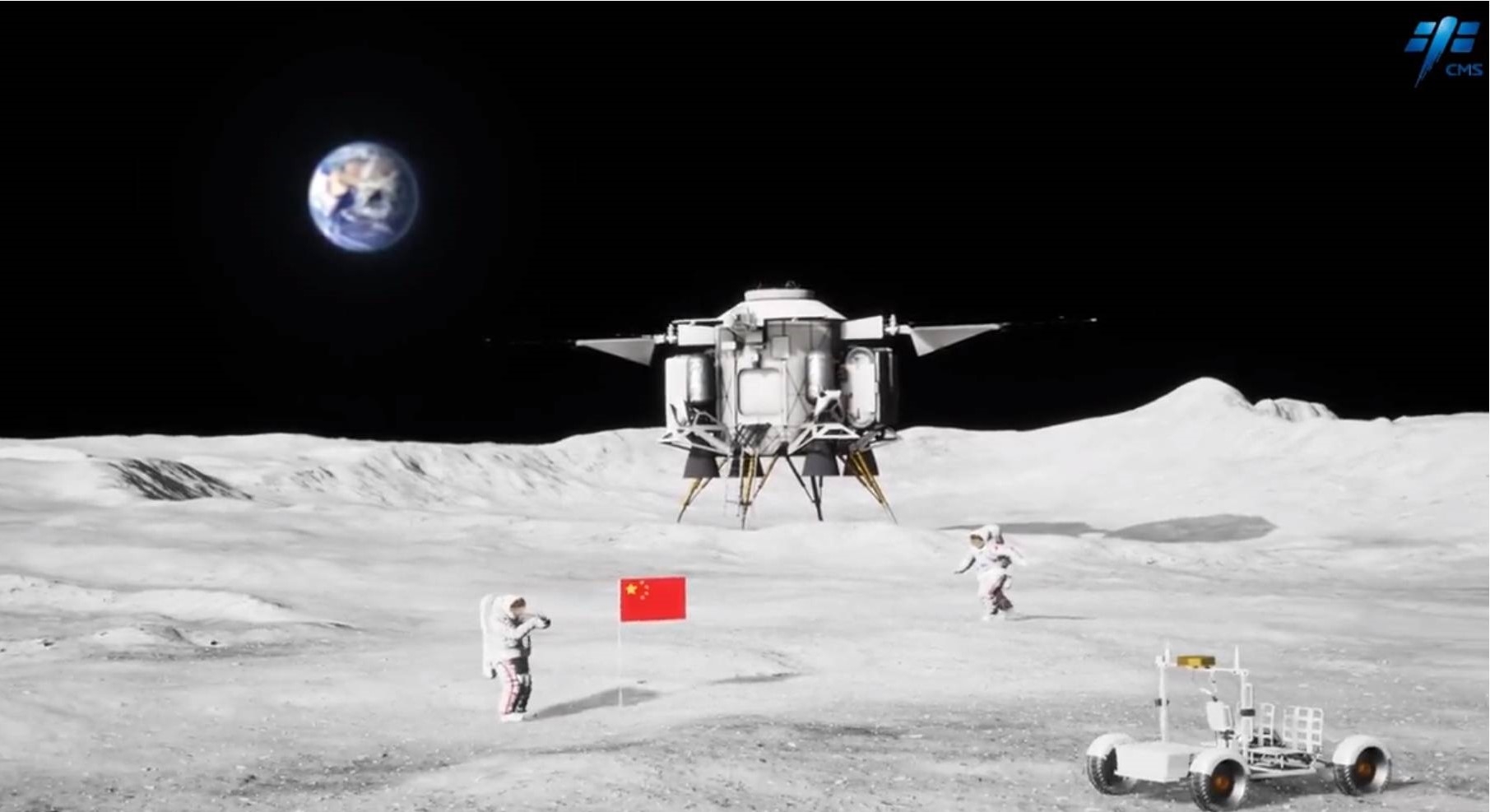
Image credit: China Manned Space Agency
Three-person crew
According to CGTN, the crewed Moon lander has a lightweight design to improve structural efficiency and has a power redundancy function.
The Mengzhou spacecraft will consist of two major components: a reentry module that will house astronauts and serve as the control center during spaceflight, and a service module containing power and propulsion systems.
According to the plan, the Mengzhou will be nearly 30 feet (9 meters) in length, 15 feet (4.5 meters) in diameter, weigh 22 metric tons, and would be capable of housing three astronauts.
Artist’s view of China’s International Lunar Research Station to be completed by 2035. Credit: CNSA
Moon booster
Currently, the research and development of the Mengzhou, the Lanyue, and the Long March-10 heavy-lift carrier rocket are reportedly progressing well.
The Long March-10 carrier rocket has two configuration designs: a standard combination of first, second, and third stage cores, escape tower, and fairing, with boosters or without boosters. The variant with boosters will be used to send the lunar lander and the spacecraft into trans-lunar orbit.
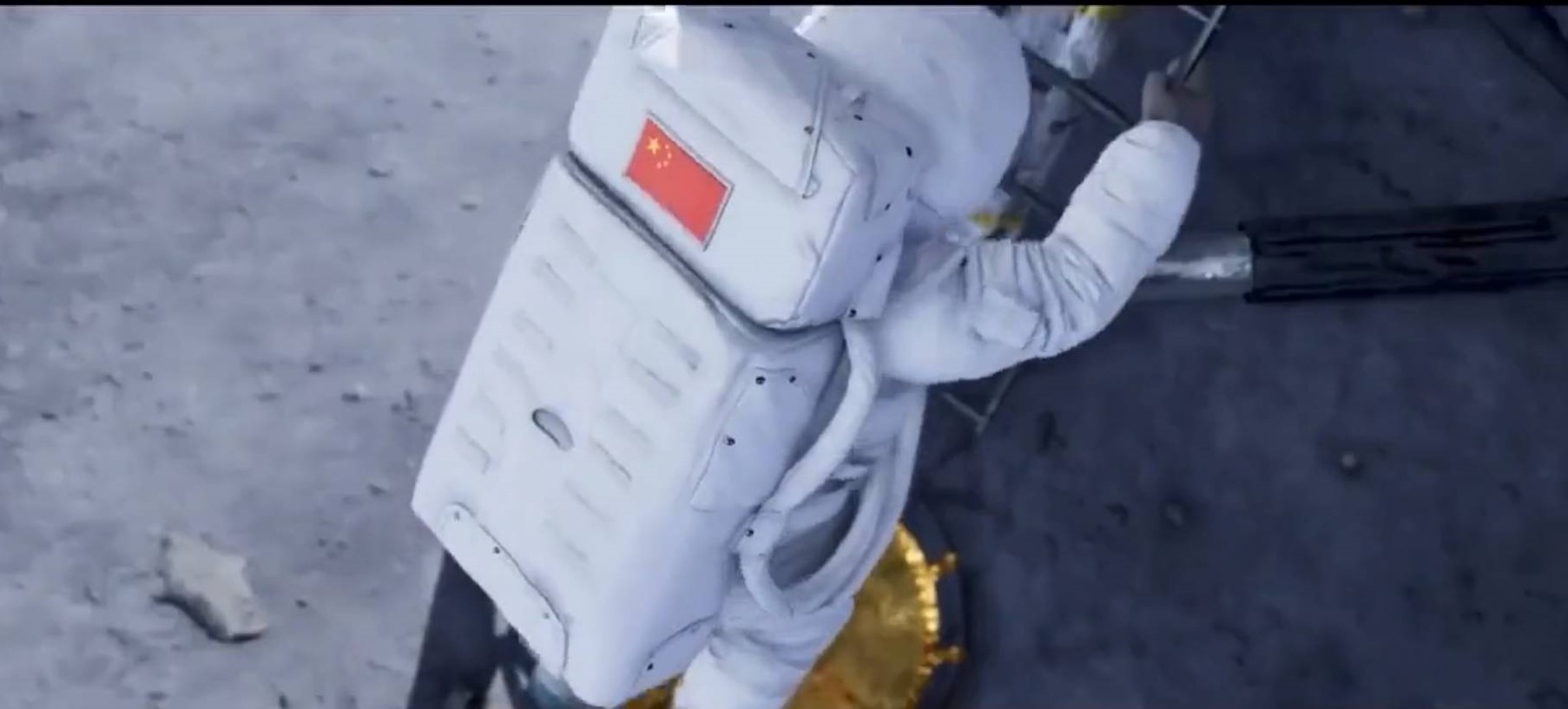
Image credit: CCTV/Inside Outer Space screengrab
Weighing 2,187 tons, the over 300 foot (92 meters)-tall rocket variant is more powerful, with 2,678 tons at liftoff, a significant increase compared to the country’s current most powerful carrier rocket, the Long March-5, with a liftoff thrust of over 1,000 tons.
For a video showcasing China’s humans to the Moon enterprise, go to:

Front Hazard Avoidance Camera Right B photo acquired on Sol 4105, February 22, 2024.
Image credit: NASA/JPL-Caltech
The NASA Curiosity Mars rover at Gale crater is now performing Sol 4107 tasks.
In a report by Natalie Moore, a mission operations specialist at Malin Space Science Systems in San Diego, California, a recent drive by Curiosity was successful.
“It was quickly determined our wheels were stable enough to unstow the arm and put weight on it (like for drilling), and since this is the nicest Gale crater terrain has been in a while the team quickly pivoted from driving away to staying here and trying to drill,” Moore notes. “This plan became our first of the ‘Mineral King’ drill campaign.”

Curiosity Mars Hand Lens Imager (MAHLI) photo produced on February 23, on Sol 4106.
Image credit: NASA/JPL-Caltech/MSSS

Curiosity Mars Hand Lens Imager (MAHLI) photo produced on February 23, on Sol 4106.
Image credit: NASA/JPL-Caltech/MSSS

Two ILO-X precursor imagers mounted near the top of the lander.
Image credit: Intuitive Machines/ILOA
The Intuitive Machines Odysseus lunar lander carries precursor instruments of the International Lunar Observatory Association (ILOA Hawai’i), dedicated to a long-term goal of permanent astronomy from the Moon.
While the lander is apparently tipped over, there are two ILO-X precursor imagers mounted near the top of the lander. Team members of the ILOA remain hopeful to receive images from the Moon.
Steve Altemus, chief executive officer and co-founder, Intuitive Machines, uses model to describe lunar lander’s possible attitude on the Moon’s surface. Image credit: Inside Outer Space screengrab
Cautiously optimistic
In a statement from ILOA director Steve Durst: “We remain cautiously optimistic that ILO-X and our fellow passenger payloads aboard Intuitive Machines’ lander are able to gather as much science and data as possible during this time.”
ILOA is an interglobal enterprise to help realize the multifunctional ILO for long-term astronomy, science and exploration at the Moon’s south pole, and to participate in human lunar base build-out, the group’s statement adds.
“These flagship ILOA Missions will be designed for strategic lunar locations on Malapert Mountain and Shackleton Crater Rim,” Durst noted in an earlier press statement.

Image credit: ILOA/S. Durst
Pre-launch aim
As noted in the IM-1 press kit, ILO-X is a precursor to the ILOA Hawai’i flagship lunar south pole Observatory (ILO-1).
The roughly 0.6 kilogram ILO-X instruments, built for ILOA by Toronto-based Canadensys Aerospace, include a miniaturized dual-camera lunar imaging suite: one wide field and one narrow field.
The aim of ILO-X is to capture some of the first images of the Milky Way Galaxy Center from the surface of the Moon, as well as perform other /Earth/local lunar environment observations and exploration technology validations – including functionality and survivability on the Moon.
Image credit: Intuitive Machines
EagleCam deployment
In other developments, Odysseus ground teams are upbeat on launching from the lander the EagleCam, a camera system from Embry‑Riddle’s Space Technologies Lab.
It was intended to be ejected from the lander on approach to the Moon. While the lander is likely on its side, EagleCam’s deployment is not obstructed for launch.
The EagleCam team at Embry-Riddle is currently running simulations of a deployment. Their current, but tentative estimate, is that the camera gear could land somewhere between 10 to 16 feet (3-5 meters) from the lander. When EagleCam deployment will occur is not known at this time.
Embry‑Riddle’s Space Technologies Lab developed EagleCam.
Image credit: Embry‑Riddle/Inside Outer Space screengrab
EagleCam could capture imagery of the lander on the Moon. Once ejected, the device may observe the lander and help gauge its overall condition upon the lunar surface.
Meanwhile, NASA’s Lunar Reconnaissance Orbiter (LRO) will be flying over the target area on February 24th. Using LRO’s high-powered camera system, the true-whereabouts of Odysseus may be determined.
Also, India’s Chandrayaan-3 lunar orbiter should be able to train its sharp-eyed, camera-toting capability on the Odysseus landing site.

NASA’s Lunar Reconnaissance Orbiter (LRO).
Credit: NASA’s Goddard Space Flight Center Conceptual Image Lab

Image credit: Intuitive Machines
The Intuitive Machines Moon lander carried EagleCam, a camera system from Embry‑Riddle’s Space Technologies Lab, that was to be ejected from the lander on approach to the Moon.
EagleCam was billed and able to capture the first-ever third-person picture of a spacecraft making an extraterrestrial landing.

Artwork of the Intuitive Machines Odysseus Moon lander.. IM-1 mission is targeting Malapert-A crater near the Moon’s south pole.
Image credit: Intuitive Machines
Power down
New information from Troy Henderson, faculty lead of the EagleCam team, points out that due to complications with Odysseus’ internal navigation system, meant to ensure a soft landing, the “decision was made to power down EagleCam during landing and not deploy the device during Odysseus’ final descent.”
However, Henderson added that both the Intuitive Machines and EagleCam teams still plan to deploy EagleCam “and capture images of the lander on the surface as the mission continues.”
That complication with Odysseus’ navigation system specifically involved a software patch to navigation data to include NASA’s NDL (navigation doppler lidar) payload to make sure a soft landing on the Moon occurs.
Embry‑Riddle’s Space Technologies Lab developed EagleCam.
Image credit: Embry‑Riddle/Inside Outer Space screengrab

Over the Moon with Odysseus. Following lunar orbit insertion on February 21, the lander continues to be in excellent health in lunar orbit.
Image credit: Intuitive Machines
The prolonged wait for the true status of the private Moon lander, Odysseus, is indeed a nail-bitter blended in with the sounds of silence
According to Intuitive Machines, the status of the recent arrival on the Moon is that the lander is “alive and well.” At this posting, no surface imagery has been released.
Reportedly, flight controllers are communicating and commanding the vehicle to download science data.
“The lander has good telemetry and solar charging,” according to Intuitive Machines.

Image credit: Intuitive Machines
Overall health
What’s ahead is trying to figure out more about the Odysseus vehicle’s latitude and longitude, overall health, and attitude (orientation).
Intuitive Machines CEO Steve Altemus will participate in a press conference later today, hopefully filling in the blanks.
Facing Earth
But from master satellite tracker, Scott Tilley in an X (Twitter) posting:
“Yes, imagine you are a box. Only one side of you (a box) has a mouth and your voice will only carry for a very limited angular cone and your mouth can’t move much to re-aim. So if you landed in the wrong location or with the wrong side of your box facing Earth…No one hears you.”

Artwork caption credit: Scott Tilley

Image credit: Tim Burton’s Beetlejuice
It is showtime for the commercial Odysseus Moon lander, ready to attempt later today a touchdown on the lunar terrain.
Image credit: Intuitive Machines
Following lunar orbit insertion on February 21st, Intuitive Machines notes its lander is in excellent shape for Odysseus’ “hardest challenge yet” – an expected 1630 Central Standard Time (5:30 p.m. Eastern Time) landing opportunity.
Odysseus is orbiting approximately 57 miles (92 kilometers) above the lunar surface.
Over the Moon with Odysseus. Following lunar orbit insertion on February 21, the lander continues to be in excellent health in lunar orbit.
Image credit: Intuitive Machines
For a detailed rundown of what’s onboard the private Moon lander – backed by NASA’s Commercial Lunar Payload Services (CLPS) initiative, go to:
https://www.leonarddavid.com/next-private-moon-lander-attempt-to-fly-in-february/

Artwork of incoming ERS-2.
Image credit: ESA
The European Space Agency has issued what may be the final update prior to the uncontrolled fiery finale and destruction of the European ERS-2 spacecraft.
Using data acquired in the last few hours, ESA’s Space Debris Office predicts that the reentry of ESA’s ERS-2 satellite will take place today, on Feb. 21 at 15:41 UTC (16:41 CET) .
The uncertainty in this prediction is +/- 1.44 hours.
Go to my new Space.com story – “Big, dead satellite predicted to fall to Earth today. Will any debris survive the fiery reentry?” – at:
https://www.space.com/satellite-ers-2-esa-debris-prediction

Image credit: ESA

Image credit: ESA
Artwork of incoming ERS-2.
Image credit: ESA
A European Space Agency spacecraft is making an uncontrolled nosedive into Earth’s atmosphere – with elements of the 2.3-ton spent satellite likely to survive the plunge into purgatory.
The exact time and place above Earth that the radar-scanning ESA European Remote Sensing (ERS-2) augers in is unknown, but a new prediction of the spacecraft’s demise has been issued.

Image credit: ESA
Using data acquired on February 20, ESA’s Space Debris Office currently predicts that the reentry of ESA’s ERS-2 satellite will take place at 20:53 UTC (21:53 Central European Time) February 21.
The uncertainty in this prediction is now just (+/- 7.48 hours), according to an ESA statement.
“This uncertainty is due primarily to the influence of unpredictable solar activity, which affects the density of Earth’s atmosphere and therefore the drag experienced by the satellite,” ESA adds.

Image credit: ESA
Leftovers
As for the ERS-2 re-entry itself, there’s likely to be post-re-entry spacecraft leftovers.
“It is likely that some parts survive the re-entry, as on average between 10 and 20 percent of the mass for large objects does,” says Simona-Elena Nichiteanu, a media relations officer in the communication department at the European Space Operations Centre (ESOC).
ESOC serves as the main mission control center for ESA in Darmstadt, Germany.

ERS-2 artwork.
Image credit: ESA
Component survival
As for the ERS-2 component survival to Earth’s surface, Nichiteanu told Inside Outer Space that the biggest and heaviest fragments that might survive reentry into the atmosphere are the 4 tanks (heaviest), the 3 internal panels supporting instruments (largest cross section) and the Synthetic Aperture Radar (SAR) antenna structure (largest fragment assuming it does not fragment at all).
A vast majority of ERS-2 will “burn up” in the atmosphere, ESA experts explain. Furthermore, given that the Earth is largely ocean water-rich, chances are for splash down of any remaining spacecraft components.
Orbital debris regulation
The fall of ERS-2 can be viewed both as a calling card from space and a wake-up call.
“While the ESA should be lauded for its efforts to de-orbit the ERS-2, it should be unsurprising that a 2.3-ton satellite launched into Earth orbit without any enforceable orbital debris regulation will then return to Earth’s atmosphere as orbital debris in an explosive uncontrolled reentry,” said Michael Runnels, an assistant professor of business law at California State University, Los Angeles.
“Indeed, these events highlight the continuing need for enforceable orbital debris regulation to support the sustainable exploration and scientific investigation of outer space,” Runnels told Inside Outer Space.

Taking the fall. Space hardware dives into Earth’s atmosphere with some fragments making their way to the ground.
Image credit: ESA/D.Ducros

