Author Archive
 Author:
  September 3rd, 2024
Credit: Orbitz
The belief that aliens are making a bee-line to Earth is a prevalent societal problem.
That assertion is espoused by Anthony Milligan, a research fellow in theology and religious studies at King’s College London. He argues that believing extraterrestrials are trekking to our world is no longer a quirk, but a widespread societal problem.
In a recently published paper, Milligan says that alien visitation claims are a societal problem when they:
- move into the mainstream of discourse to the extent that government policy has to respond to them;
- when they generate background noise which impedes science communication; and
- when they become entangled with indigenous origin narratives, making it hard to recover the latter.
Anti-elite tropes
Taking his case to The Conversation, Milligan points out that the belief is now rising to the extent that politicians, at least in the U.S., feel they have to respond.

GOFAST
Credit: DOD/U.S. Navy/Inside Outer Space screengrab
“The disclosure of information about claimed Unidentified Anomalous Phenomena (UAPs rather than UFOs) from the Pentagon has got a lot of bi-partisan attention in the country,” Milligan notes.
“Much of it plays upon familiar anti-elite tropes that both parties have been ready to use, such as the idea that the military and a secretive cabal of private commercial interests are keeping the deep truth about alien visitation hidden. That truth is believed to involve sightings, abductions and reverse-engineered alien technology,” Milligan writes.
Damaging consequences
It is increasingly clear, Milligan feels, that belief in alien visitation “is no longer just fun speculation, but something that has real and damaging consequences.”
The result: Ultimately, it is encouraging conspiracy theories, Milligan continues, “which could undermine trust in democratic institutions,” citing numerous calls to storm Area 51, the purported spot of concealed UFO reverse engineering work. “And after the storming of the Capitol in 2021, this now looks like an increasingly dangerous possibility.”

Up close and personal! Scene from Earth vs. the Flying Saucers circa 1956.
Credit: Columbia Pictures
Background noise
There is far too much background noise about UFOs and UAPs, Milligan asserts, and that can also get in the way of legitimate scientific communication about the possibility of finding microbial extraterrestrial life.
Periodic debunking looks like a failed paradigm, Milligan explains in his research paper. “Something closer to a scientific research program (SRP) might be called for, at some point.”
However, Milligan concludes, “it is not clear that we are already at the stage where an SRP is required, but such a requirement does seem to be on the near horizon.”
Go to “Belief in alien visits to Earth is spiraling out of control: Why that’s so dangerous” by Tony Milligan in The Conversation at:
Also, go to Milligan’s paper – “Equivocal encounters: alien visitation claims as a societal problem” – at:
https://kclpure.kcl.ac.uk/ws/portalfiles/portal/293600954/IAU_Equivocal_Encounters_Paper_2024.pdf
 Posted in
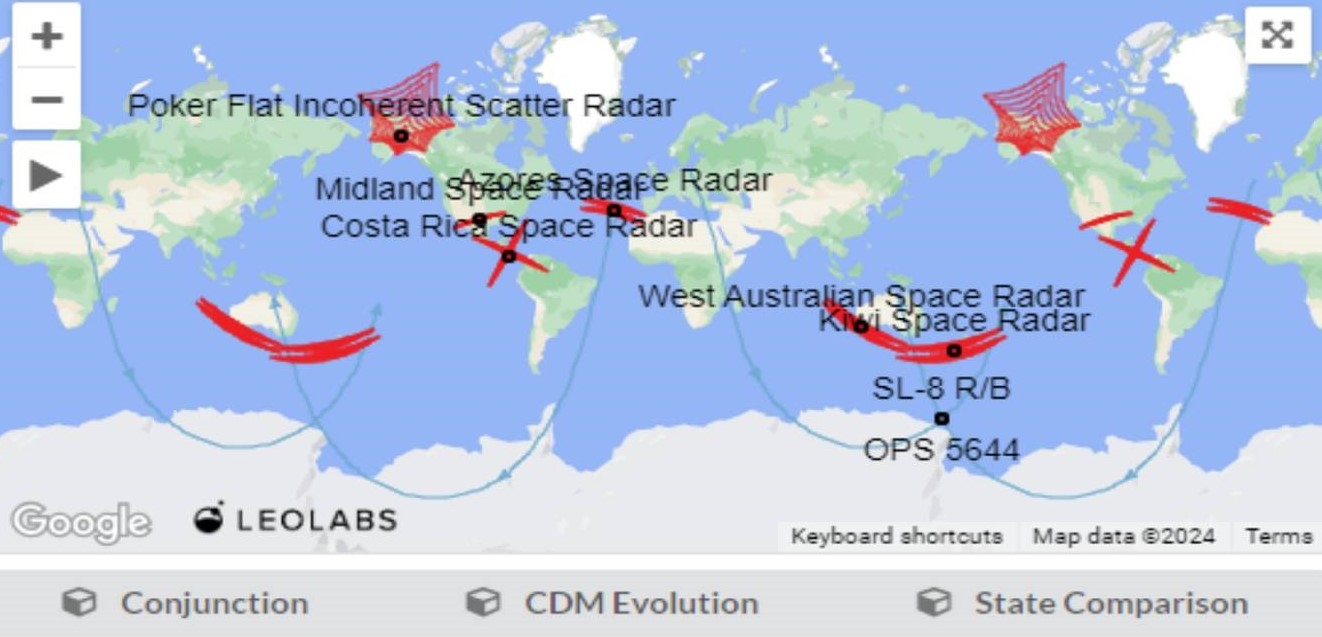
Image credit: LeoLabs/McKnight
Old hardware discarded in Earth orbit is haunting our future hopes for space sustainability.
That’s the word from space debris guru, Darren McKnight, senior technical fellow at LeoLabs, an organization that persistently monitors activity in space to reveal threats to safety and security.
In a September 1 communiqué on near hits of space hardware, McKnight notes that on May 29, a defunct U.S. Defense Meteorological Satellite Program (DMSP) spacecraft crossed paths with an abandoned rocket body from 1971, lofted by the former Soviet Union.

Illustration of a Defense Meteorological Satellite Program (DMSP) spacecraft.
Image credit: U.S. Air Force
“This conjunction was identified by me querying our LeoMap tool as to the conjunction over the last 90 days that involved the two oldest objects,” McKnight notes.
Live long and ponder
In a bit of historical context, the space debris specialist adds that the Soviet SL-8 rocket body was abandoned in 1971, when Richard Nixon was President of the United States.
“Since then, it has orbited the Earth about 290,000 times,” McKnight adds, “the distance traveled by this piece of hardware is greater than the distance from the Sun to Pluto and back.” This enormous distance traveled, he said, puts into perspective the collision risk posed by such long-lived objects deposited in cluttered orbits many decades ago.
The defunct DMSP satellite (called OPS 5644 when launched) was deployed in 1977 by then U.S. President Gerald Ford.

Image credit: Johan Swanepoel/Adobe Stock via RAND
Prolific breakup event
McKnight reports that if the two objects had collided center-of-mass on center-of-mass, it would have likely generated over 3,000 trackable fragments and another 30,000-plus lethal, yet uncatalogued fragments.
This amount of debris generation would have made it the second most prolific breakup event, McKnight points out, behind the 2007 Chinese anti-satellite test involving that country’s own Feng-yun 1C spacecraft.
Hot spot
“This region of low Earth orbit where hundreds of similarly old and massive objects have been abandoned is known as Cluster 775 and is considered one of the three major ‘hot spots’ for collisional risk in LEO, McKnight said.

Image credit: LeoLabs/McKnight
Eying the future, McKnight said he’s positive there are more stories to tell in LEO about the dynamic collision environment. “I think that I have infinite material to work with!”
Lack of adherence
In an earlier statement regarding abandoned rocket bodies, McKnight has an equally unnerving view of the situation.
“In the last 20 years, China has abandoned more rocket body mass in LEO that will not adhere to the 25-year rule than rest of the world combined,” McKnight said, a rule that recommends space operators re-enter their hardware within 25 years following the completion of their mission.
“This is not a part of the space race anyone should try to ‘win,’” McKnight said, “yet they are singling themselves out by their lack of adherence to basic space sustainability norms.”

Under the dome. Inspiration4 crew’s space selfie. Left to right top, Jared Isaacman, Chris Sembroski, and Sian Proctor with hair-hovering Hayley Arceneaux.
Image credit: Inspiration4 Photos
The flight of the Inspiration4 crew back in 2021 marked a milestone as the first privately chartered spaceflight by civilian astronauts.
Inspiration4 crew members flew aboard the SpaceX Crew Dragon capsule Resilience that was lofted on September 16, 2021 and landed on September 18, 2021.
That four-person crew collected a wealth of biological measurements yielding a comprehensive Space Omics and Medical Atlas, or SOMA for short.

Artwork depicts the specially outfitted SpaceX Dragon spacecraft with its viewing dome.
Image credit: SpaceX
Multiple missions
As explained on the SOMA website, “we are performing comprehensive and integrative multiomics analysis of astronauts, including the crew from the Inspiration4, Polaris Dawn, and Axiom missions.”
This sampling will allow for monitoring the impacts of spaceflight and provide a health service to the crew post-mission.

Image credit: Nature
“Furthermore, applying the same core protocols in the sample collection, processing, and analysis across multiple missions will allow us to validate and compare our findings with other investigators and space agencies/companies around the world,” the SOMA website adds.
Synchronized release
NASA has established the Open Science Data Repository (OSDR) in which that Inspiration4 crew data is also hosted. In concert with that data availability, in a “synchronized release,” Nature Press has released 44 publications that document the molecular, cellular, physiological, and phenotypic changes observed during spaceflight.
Observes Nature “this package shows how the modern tools of molecular biology and precision medicine can help guide humanity into more challenging missions, which will be critical for a permanent presence on the Moon, Mars, and beyond.”

Image credit: Nature
Groundbreaking collection
The SOMA initiative is spearheaded by Chris Mason from Weill Cornell Medicine. The public can now engage in the analysis of this groundbreaking collection of civilian commercial astronaut data.
These scientific manuscripts have been jointly released to tackle inquiries regarding spaceflight effects on the whole body, skin, skeletal muscle, and endocrine system.
This work also begins to map differences in how female and male individuals respond to spaceflight and links specific countermeasures to each astronaut.

Image credit: Nature
Ethical considerations
This unprecedented step in making available the Inspiration4 data includes ethical considerations for the age of non-governmental space exploration. Other topic areas include:
Aging and putative frailty biomarkers are altered by spaceflight; spaceflight induces changes in gene expression profiles linked to insulin and estrogen; explainable machine learning identifies multi-omics signatures of muscle response to spaceflight in mice; as well as biomonitoring and precision health in deep space supported by artificial intelligence.”
Now, for the first time, the NASA OSDR hosts processed commercial astronaut data that are publicly available.
Profound insights
According to the OSDR website, “in order to protect the privacy of the astronauts, processed data are publicly available, while private raw data, including genetic sequence data, will require an application process with a board approval to gain access.”

Image credit: NASA OSDR
This comprehensive study includes: whole blood and urine samples, microbial swabs from the crew and the spacecraft cabin, which were collected at different timepoints before, during, and after spaceflight.
“The open access of these datasets in the NASA OSDR provides a unique opportunity for the scientific community, as well as citizen scientists and students, to continue using OSDR resources to further unlock profound insights into the consequences of space travel on the human body,” the website adds.
Resources
To view the Nature portfolio issued in volume 632 issue 8027, August 29, 2024 — “Space Omics and Medical Atlas (SOMA) across orbits – New studies on astronauts and space biology bring humanity one step closer to the final frontier” — go to:
https://www.nature.com/immersive/d42859-024-00009-8/index.html
Also go the SOMA data portal website at:
https://soma.weill.cornell.edu/#main
The NASA Open Science Data Repository (OSDR) can be accessed at:
https://osdr.nasa.gov/bio/news/articles/I4-data/I4-data.html
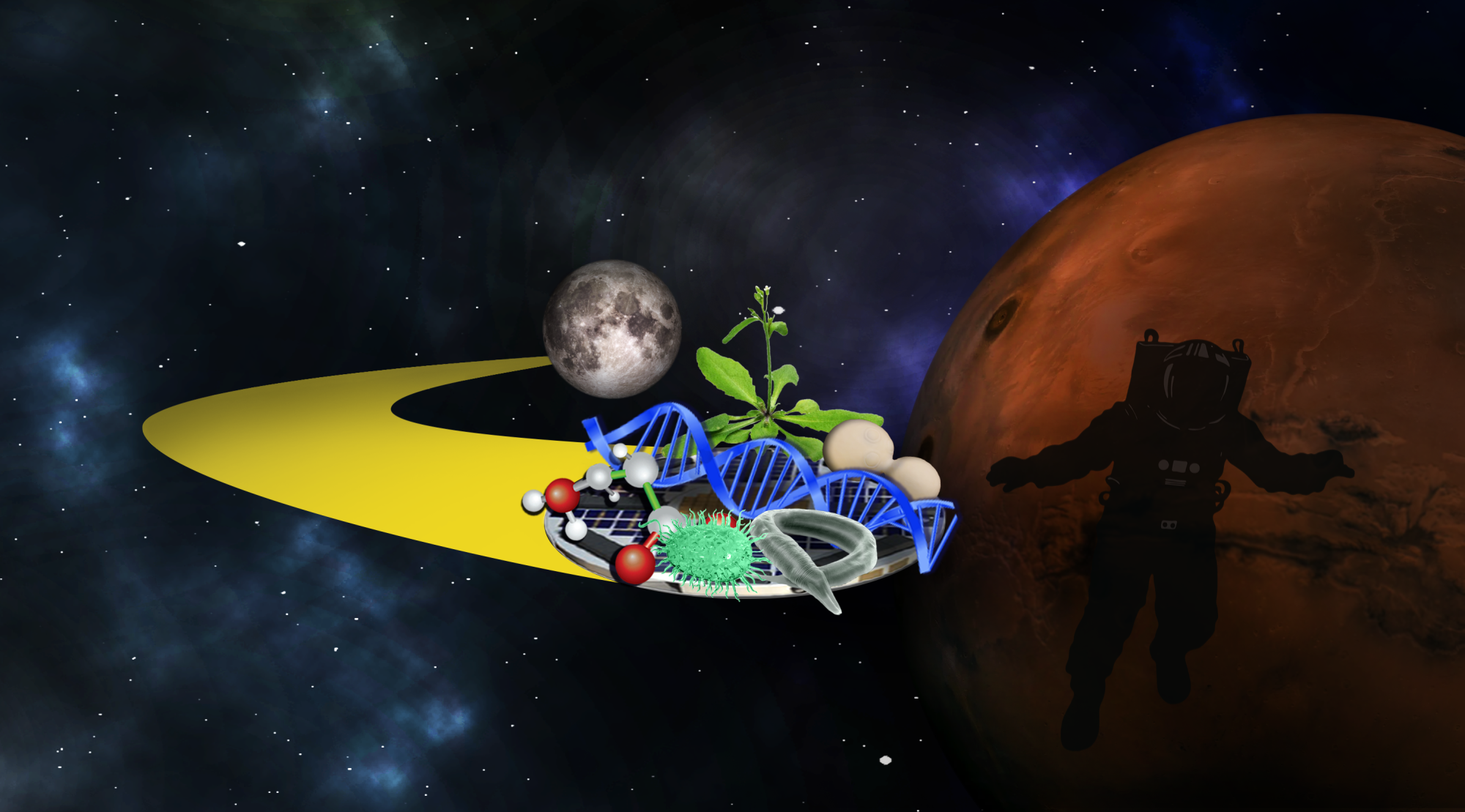
Image credit: SpinSat/NASA Ames Research Center
The impact on the human body from lengthy stints of space travel has put researchers in a spin for decades.
Remaining largely unknown are the effects of deep space radiation and reduced gravity on biological systems.
It’s high-time for “SpinSat” – an innovative platform to rev up some answers and fill in knowledge gaps.
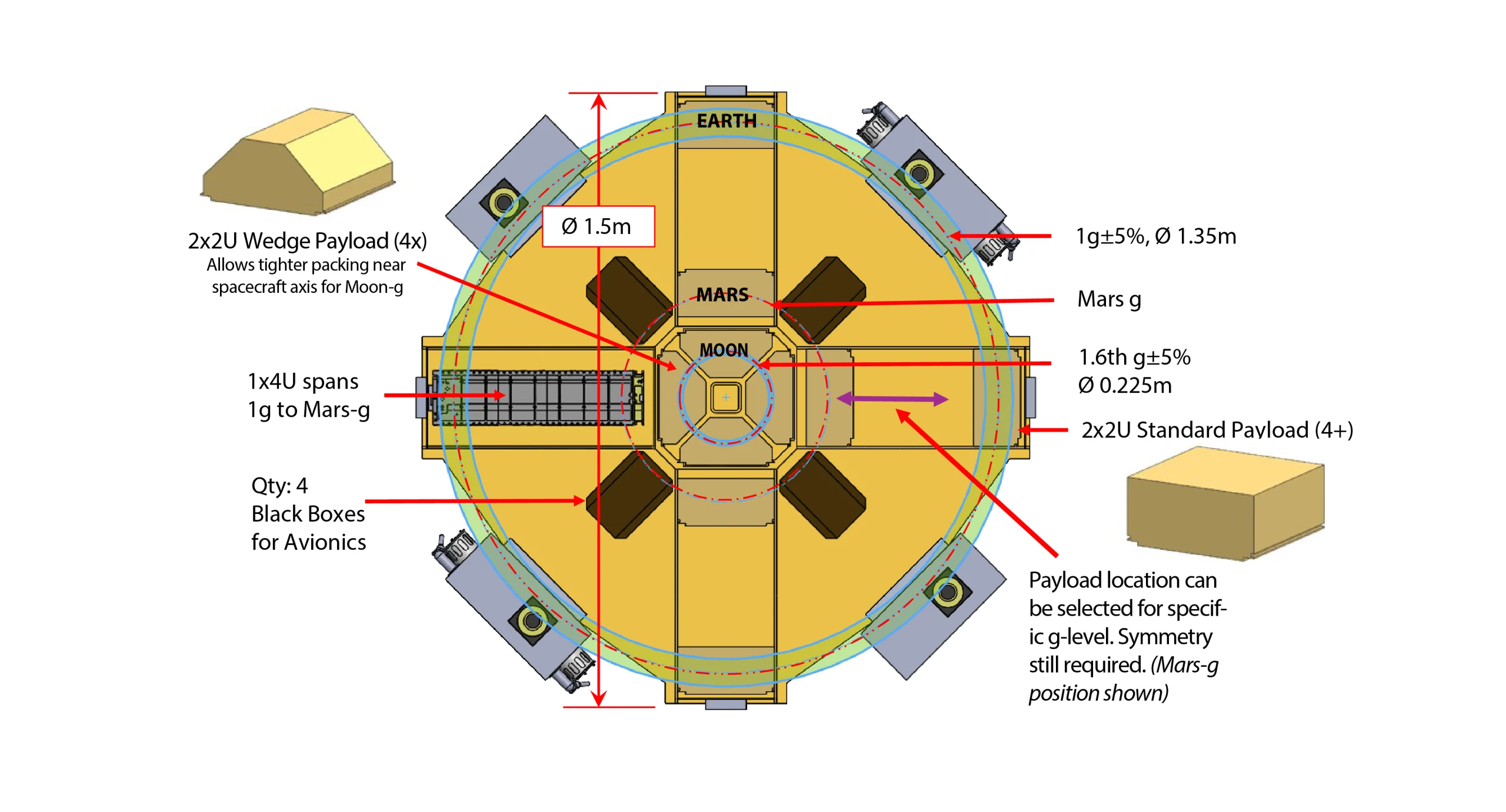
Image credit: SpinSat/NASA Ames Research Center
Survive and thrive
For instance, what are the mechanisms by which organisms sense and respond to physical properties of surroundings, and to applied mechanical forces including gravitational force?
How does the space environment alter interactions between organisms?
What are the important multi-generational effects of the space environment on growth, development, and reproduction?
How does the space environment influence biological mechanisms required for organisms to survive the transitions to and from space, and thrive while off Earth?
Hardware and payloads
Specialists at NASA’s Ames Research Center are moving forward on shaping SpinSat development and science goals.
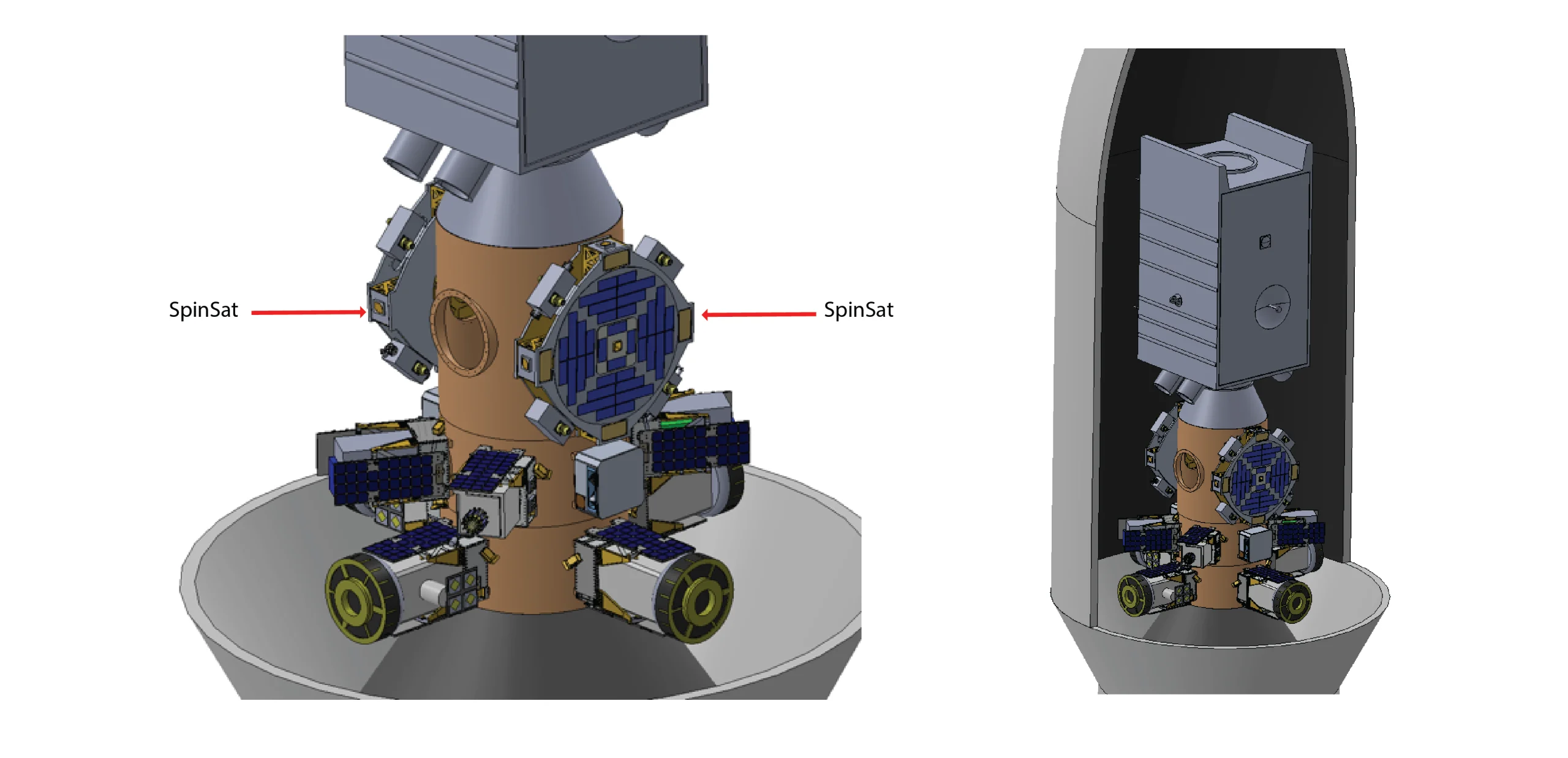
Image credit: SpinSat/NASA Ames Research Center
A spacecraft platform has been blueprinted, optimized for hosting biological payloads to appraise long-duration exposure to the low-dose deep-space radiation environment under conditions of reduced (artificial) gravitation relevant to Earth’s Moon and Mars.
The SpinSat team is seeking input for requirements of potential payloads to enable a spacecraft design that meets the needs of as many researchers as possible.
NASA is also turning to hardware providers, looking for payload systems to accommodate an array of experiments that could be part of the SpinSat capability suite.

Artemis explorers at the Moon.
Image credit: NASA
Plug-n-Play
Drawing from the on-going and growing CubeSat technology world, SpinSat is viewed as a “Plug-n-Play” space platform. It would offer controlled gravity levels from micro-g to Earth g (as a control) and higher. Modification of payload radiation environments via SpinSat would mimic those of the Moon and Mars.
SpinSat is keyed to providing low-cost, reliable, and frequent access to deep space for a wide variety of experiments. The platform design could host a range of experiments from human tissues to microorganisms and “organoids” — small, simplified, 3D copies of organs created outside of a living body – as well as plants, and chemical and physical systems.

Image credit: NASA
Investigation focus areas include the central nervous system, cancer, bone and muscle health to wound healing, pharmacologics, and food sources.
Given a go, SpinSat could be lofted on a variety of launch vehicles into almost any orbit.
For more information on SpinSat, go to:

Image credit: Fraunhofer FHR/Jens Fiege
In an experiment carried out by a large radar facility, Earth’s Moon was “beam bathed” to appraise the equipment’s stability and performance abilities.
The result: high-resolution radar imaging of the lunar surface, made possible by the Tracking and Imaging Radar (TIRA), a central and important part of research at Fraunhofer FHR, and one of the leading and largest European research institutes in the area of high frequency and radar techniques.
The Fraunhofer Institute for High Frequency Physics and Radar Techniques FHR is headquartered in Wachtberg, Germany.

Radar image of the southern hemisphere of the Moon.
Image credit: Fraunhofer FHR

Northern hemisphere of the Moon captured in radar image.
Image credit: Fraunhofer FHR
First light
The experiment is referred to as “First Light” with the Moon illuminated by the powerful 34-meter TIRA antenna. Echoes reflected from the lunar surface were received after roughly 2.6 seconds. Processing of the signals included use of real-time graphics processors using special software methods.

Radar image of crater Tycho with a diameter of about 53 miles (85 kilometers) on the southern hemisphere of the Moon. The image resolution is about 65 feet (20 meters).
Image credit: Fraunhofer FHR
“By utilizing the motion of Earth and the Moon, a significantly larger, virtual aperture was created using the 34-meter antenna of the TIRA facility, thereby achieving high resolution imaging,” explains the institute in an August 22 statement.
This method of generating a synthetic antenna aperture enables coherent imaging of the entire visible Moon’s surface.
Satellite reentry
The Fraunhofer FHR regularly conducts assignments for the German Space Situational Awareness Center (GSSAC). The unique attributes of the institute’s radar work has proven useful for space debris appraisals, collision predictions, fragmentation event appraisals, as well as reentry forecasts.

Radar for Space Situational Awareness.
Image credit: Fraunhofer FHR/Andreas Schoeps
For example, the group’s radar skills were utilized to image the European Space Agency’s European Remote Sensing satellite, ERS-2, prior to it auguring into the Earth’s atmosphere on February 21 of this year. For the first time, changes in the structure during re-entry were also captured in radar images.

Radar image of the ERS-2 spacecraft from February 20, 2024 showing bent solar module.
Image credit: Fraunhofer FHR
ISS battery pallet
Similarly, Fraunhofer FHR kept an eye on the reentry of that discarded 2.6 ton battery pallet unleashed in 2021 from the International Space Station (ISS).
The space observation radar TIRA observed the object during its final days on behalf of the joint GSSAC, providing meaningful radar data during its flyovers above Germany. TIRA likely snagged the final radar image of the battery. On March 8, a leftover from the reentry of that ISS pallet hit a house in Florida, later confirmed by NASA.

The likely last radar image of the ISS battery before its reentry, captured by the space observation radar TIRA on March 8, 2024.
Image credit: Fraunhofer FHR

Artist’s concept of Intuitive Machines’ Nova-C lunar lander on the Moon’s south pole.
Image credit: Intuitive Machines
A U.S. Moon lander provider has a new contract under its belt, awarded monies via the NASA Commercial Lunar Payload Services (CLPS) initiative program.
Intuitive Machines of Houston, Texas is receiving $116.9 million to deliver six NASA payloads to the lunar south pole in 2027.
“This marks the 10th CLPS delivery NASA has awarded, and the fourth planned for delivery to the South Pole of the Moon,” said Joel Kearns, deputy associate administrator for exploration, Science Mission Directorate, NASA Headquarters in Washington.
Timing is everything
Intuitive Machines is in the final assembly phase of its second lunar mission (IM-2) and is scheduled to deliver the completed lander to the launch facility in late 2024.
The IM-2 mission is designed to prospect for water ice and other volatiles on the Moon’s south pole. This lander is aimed at touchdown within an elliptical region on the Shackleton Connecting Ridge. To align with the landing site’s solar power conditions, the mission must be timed between November 2024 and January 2025. IM-2 is currently planned for late 2024.
In parallel, the company is continuing work on its third lunar mission and is preparing for systems integration and testing.

A spectacular, specially produced near-ground level oblique view of the “Connecting Ridge” between Shackleton and Henson craters. The lunar south pole (SP) occurs on the rim of Shackleton crater. The ridge along the rim of the South Pole-Aitken impact basin is a potential Artemis landing site (001) and another (004) occurs on the rim of Shackleton crater. (Image credit: ETHZ\LPI\Valentin T. Bickel and David A. Kring)
Instrument list
The lander will be outfitted with a projected 174 pounds (79 kilograms) of instruments:
NASA’s Lunar Explorer Instrument for Space Biology Applications will deliver yeast to the lunar surface and study its response to radiation and lunar gravity.
Package for Resource Observation and In-Situ Prospecting for Exploration, Characterization and Testing is a suite of instruments led by the European Space Agency that will drill down to 3.3 feet (1 meter) beneath the lunar surface, extract samples, and process them in-situ in a miniaturized laboratory, to identify possible volatiles (water, ice, or gas) trapped at extremely cold temperatures under the surface.

View of ESA’s Prospect robotic drill set to fly to the Moon’s South Polar region in search of volatiles, such as water ice.
Image credit: Leonardo
NASA Laser Retroreflector Array is a collection of eight retroreflectors that will enable lasers to precisely measure the distance between a spacecraft and the reflector on the lander. The array is a passive optical instrument and will function as a permanent location marker on the Moon for decades to come.
NASA Surface Exosphere Alterations by Landers will investigate the chemical response of lunar regolith to the thermal, physical, and chemical disturbances generated during a landing, and evaluate contaminants injected into the regolith by the lander. It will give insight into how a spacecraft landing might affect the composition of samples collected nearby.
NASA Fluxgate Magnetometer will characterize certain magnetic fields to improve the understanding of energy and particle pathways at the lunar surface and is managed by NASA Goddard.
University of Colorado/Boulder’s Lunar Compact Infrared Imaging System will deploy a radiometer – a device that measures infrared wavelengths of light – to explore the Moon’s surface composition, map its surface temperature distribution, and demonstrate the instrument’s feasibility for future lunar resource utilization activities. The imaging system is managed by the University’s Laboratory for Atmospheric and Space Physics (LASP).

Shackleton Crater located on the south pole of the Moon. The Lunar Temple visible as bright dot on the left side.
Credit: Jorge Mañes Rubio/DITISHOE
Successful Blue Origin Blastoff Today: New Shepard crewed suborbital mission NS-26, lifting off from Launch Site One in West Texas on August 29.
Blue Origin Completed its 26th Mission to space with six crew onboard: Nicolina Elrick, Rob Ferl, Eugene Grin, Dr. Eiman Jahangir, Karsen Kitchen, and Ephraim Rabin.
Including today’s crew, the suborbital New Shepard has now flown 43 people into space.
Launch coverage/replay at: https://www.blueorigin.com/live

Image credit: Blue Origin

Image credit: Blue Origin

Image Credit: Blue Origin/Inside Outer Space screengrab

Image Credit: Blue Origin/Inside Outer Space screengrab

Image Credit: Blue Origin/Inside Outer Space screengrab

Image Credit: Blue Origin/Inside Outer Space screengrab

Image Credit: Blue Origin/Inside Outer Space screengrab

Image Credit: Blue Origin/Inside Outer Space screengrab

Image credit: Blue Origin

Image credit: Lockheed Martin
LITTLETON, Colorado – That touted “space is hard” dictate may need a meaning makeover given the use of “softgoods” to fashion inflatable airlocks and habitats for future lunar and Mars exploration needs.
Here at the Waterton Canyon facility of Lockheed Martin, testing of inflatable structures that offer advantages over all-metal counterparts is underway. A pathfinder unit built for airlock applications underwent pressurization and depressurization appraisals on August 14, as witnessed by this reporter.

Under pressure! SpaceNews reporter, Leonard David (left), discusses inflatable testing with Rowan Palmer and Uy Duong of Lockheed Martin’s softgoods test team.
Image credit: Barbara David
The airlock design was put through multiple, gas-in/gas-out cycles to assess “creep” factors of its Vectran material makeup, thus understanding its operational life potential. Test engineers here have also put subscale softgoods habitat designs to the test, purposely bursting them to spotlight their robust nature.
The gas used for the inflation tests is nitrogen, taking only a few minutes to fully pressurize the unit, then becoming as rigid as steel.
Lockheed Martin is engaged in inflatable structure work as part of NASA’s Next Space Technologies for Exploration Partnerships (NextSTEP) program, a public-private joint venture initiative.

Rowan Palmer, a systems engineer within the Lockheed Martin Space softgoods and habitation team, inspects airlock test unit.
Image credit: Barbara David
For more information, go to my new SpaceNews story – “With successful airlock test, Lockheed Martin invests in inflatable space structures” – at:
https://spacenews.com/successful-airlock-test-lockheed-martin-invests-inflatable-space-structures/

Wait-a-Minute!
Image credit: Barbara David
NASA’s Volatiles Investigating Polar Exploration Rover, or VIPER, was cancelled on July 17 by the space agency.
But in a wait-a-minute and ready-to-roll mode the rover continues to inch its way forward.
Commercial/international partners may be selected to fly the moon machine to the lunar south pole. In addition, Congressional lawmakers are taking a budgetary hard-look at the situation, prodded in part, by a save VIPER letter-writing campaign involving 4,800-plus shoot-for-the-Moon supporters.

The VIPER rover heading into the Thermal Vacuum (TVAC) Chamber for testing.
Image credit: Daniel Andrews/LinkedIn
Vacuum chamber
In the interim, VIPER recently entered thermal vacuum chamber testing to be completed by October.
The NASA decision to cancel the VIPER south pole Moon rover continues to stir up lunar exploration advocates, with the open letter to Congress requesting lawmakers to “refuse to authorize” the NASA verdict.

Lights out for NASA’s VIPER ice-hound?
Image credit: NASA
The open letter can be viewed at:
https://forms.gle/bRzoLN5P66Ge2vzN9
At this point in time, NASA had put in $450 million into VIPER.
“Continuation of VIPER would result in an increased cost that threatens cancellation or disruption to other CLPS missions,” the space agency statement explains. “NASA has notified Congress of the agency’s intent.” CLPS IS NASA’s Commercial Lunar Payload Services initiative.

A close-up view of the areas that were to be explored by VIPER, showing a nominal traverse route and highlighting permanently shadowed regions that may contain water ice and other volatiles.
Credit: NASA’s Scientific Visualization Studio/Ernie Wright
Go to the NASA VIPER cancellation statement at:
https://www.nasa.gov/news-release/nasa-ends-viper-project-continues-moon-exploration/
Partnership opportunity
NASA said it’s planning to disassemble and reuse VIPER’s instruments and components for future Moon missions.
Prior to disassembly, NASA’s open to expressions of interest from U.S. industry and international partners for use of the existing VIPER rover system at no cost to the government.
Go to the VIPER Rover Partnership Opportunity request at:
https://sam.gov/opp/ccc3285133aa4dbd877b9dcb53fab99c/view

Wait a Minute!
Image credit: Barbara David

Image credit: JAXA/ISAS
The team for Japan’s Smart Lander for Investigating Moon (SLIM) has issued a notice of the end of spacecraft operations
The SLIM project attempted to communicate again with the long-lived Moon lander on August 22nd and 23rd, but received no response from the probe.
“As a result, it was determined that there was no prospect of communication being restored in the future, and so at around 10:40 pm on the 23rd, the project sent a command to halt SLIM’s activities, shutting down the signal.”
SLIM was an undertaking by specialists at the Japan Aerospace Exploration Agency (JAXA)/Institute of Space and Astronautical Science (ISAS).
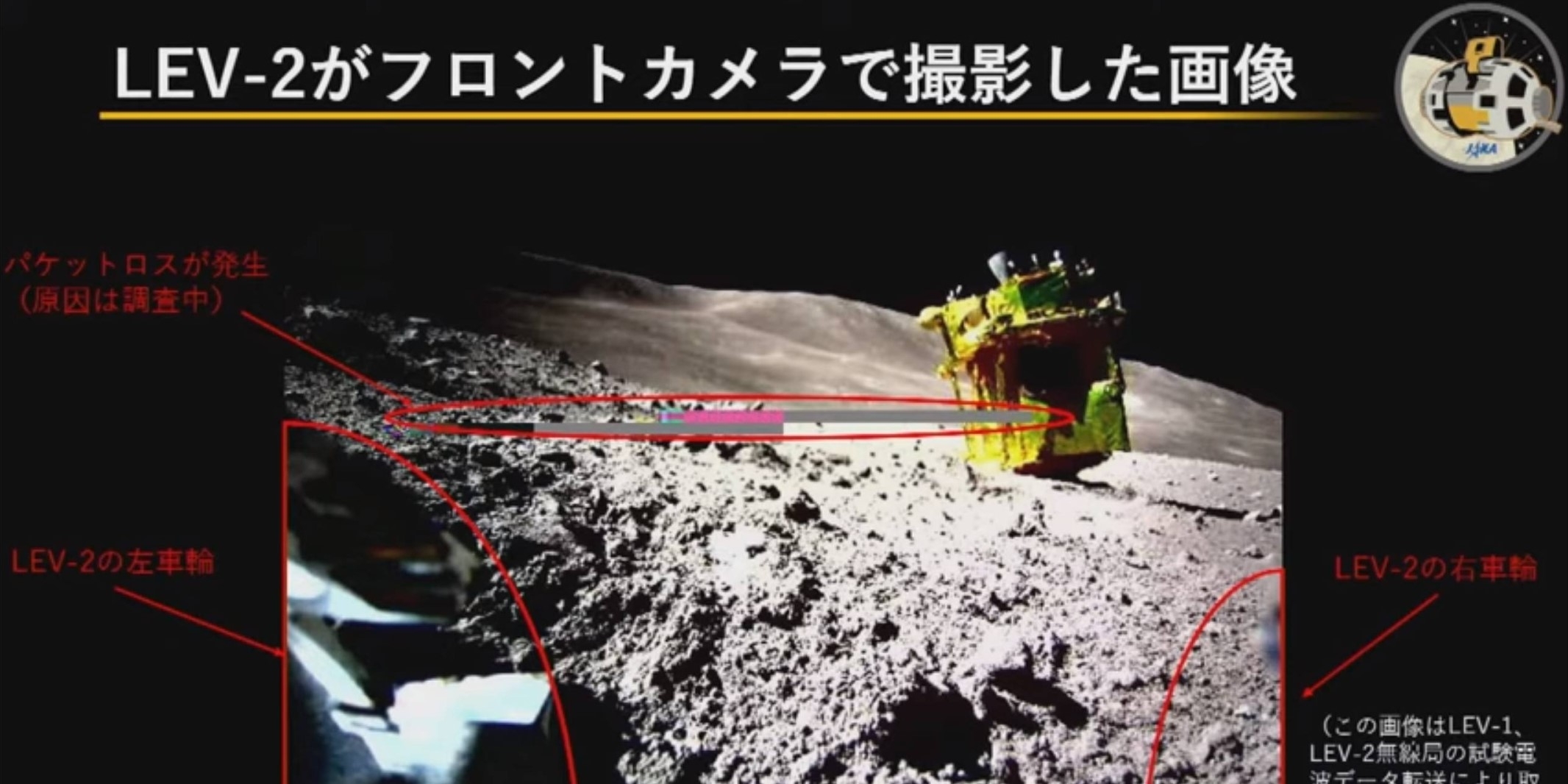
Image taken shortly after landing, the Ultra-small SORA-QI photo of SLIM in nose-down mode. Image credit: JAXA/Inside Outer Space screengrab
Pinpoint landing technology
SLIM was launched last year on September 7, departing Earth atop an H-IIA launch vehicle from the Yoshinobu Launch Complex at JAXA’s Tanegashima Space Center.
SLIM made its lunar landing on January 19, 2024 making Japan the fifth country to soft-land a spacecraft on the Moon.
Surprisingly, the craft repeatedly regained electronic consciousness, surviving stints of super-cold and lengthy lunar nights.
All technical data on the navigation guidance leading to the landing, and navigation camera image data captured during the descent and on the lunar surface, necessary for future pinpoint landing technology, was obtained by the spacecraft mission.

SLIM’s multi-band spectroscopic camera took this lunar landscape image created by synthesizing 257 low-resolution monochrome pictures. Based on this landscape image, the team is sorting out rocks of interest, assigning a nickname to each of them, with intent of communicating their relative sizes smoothly by the names.
Image credit: JAXA/Inside Outer Space screengrab
Engine anomaly
During its lunar landing, the SLIM onboard software autonomously identified an engine anomaly. While controlling the horizontal position as much as possible, SLIM continued the descent with the other engine and moved gradually towards the east.
Subsequently, SLIM landed “upside down.”

SLIM shot after 2nd awakening.
Image credit: JAXA/SLIM
SLIM had reached the Moon’s surface approximately 180 feet (55 meters) east of the original target landing site.
A Lunar Excursion Vehicle (LEV-1), a small robot deployed from SLIM, did carry out activities on the lunar surface. Telemetry data was sent directly to Earth from the small robot.

Image credit: SLIM team/JAXA/ISAS
The LEV-1 executed planned leaping movements and direct communication with ground stations, including inter-robot test radio wave data transmission from the Transformable Lunar Robot (LEV-2, nicknamed “SORA-Q”).
Go to this informative video in Japanese showcasing the Transformable Lunar Robot at:

