Author Archive
 Author:
  January 3rd, 2025
Image credit: KSA
About that possible space debris landing in Africa.
Comment from “Ed”: “Check out the Ariane 5 Space Debris (33155) that reentered around the same time. It was equatorial and more likely to be a candidate at the time of reentry.”

Image credit: CORDS/The Aerospace Corporation
However, the reentry messages from space track, Ed adds, would have both the U.S. Atlas and European Space Agency (ESA) Ariane debris in completely different parts of the world.
Meanwhile, my posting on this incident via Space.com is at:
 Posted in

Image credit: NASA
NASA wants to bring Mars samples to Earth, but budget problems and technical woes have the mission caught between a rock and the Red Planet.
Meanwhile, there appears to be an unofficial robotic space race underway involving the Red Planet.
Both the U.S. and China are scripting a strategy for bringing back to Earth goodies from Mars via their respective Mars Sample Return (MSR) endeavors.

China’s Red Planet plans. Image credit: CCTV/CNAS/Inside Outer Space screengrab
Real-time hand-ringing
For America, things are now happening in real-time on Mars.
The NASA Perseverance rover is busily wheeling about within the ins and outs of Jezero Crater, biting into and snatching primo chunks of Mars for eventual pick-up by a future MSR mission.
But slapped around by independent assessments, the space agency wound up hearing a cash register ka-ching sound for MSR that rang up to upwards of $11 billion.
Also, a time period of 2040 would be needed to inspect any FedEx-like delivery of select Mars dirt, rock, and atmosphere on Earth.

The Mars Ascent Vehicle (MAV) is a major and costly component of NASA’s robotic Holy Grail mission, a Mars sample return effort to bring back to Earth Martian collectibles.
Credit: NASA/JPL-Caltech
For details, go to my new Space.com story – “Can NASA’s troubled Mars Sample Return mission be saved?” – at:
https://www.space.com/the-universe/mars/can-nasas-troubled-mars-sample-return-mission-be-saved

Image credit: KSA
Talk about ring in the New Year!
Kenya Space Agency (KSA) officials in Nairobia, Kenya, East Africa, are reporting that on December 30 a large metallic ring roughly 8 feet (2.5 meters) in diameter and weighing some 1,100 pounds (500 kilograms) fell from the sky, reportedly “red-hot” and crashed into Mukuku village, in Makueni county – in the country’s south.
Investigators think the object is space debris, believed to be rocket leftovers that came crashing down, reportedly within the village at roughly 3 p.m. local time.
The KSA “secured the area and retrieved the debris, which is now under the Agency’s custody for further investigation.”

Early assessments indicate that “the fallen object is a separation ring from a launch vehicle,” reported the KSA.

Image credit: KSA
However, sky watching veteran and reentry tracker, Jonathan McDowell who works at the Harvard–Smithsonian Center for Astrophysics, told Inside Outer Space that there is “no obvious space candidate. I am not convinced it’s not from an airplane. Don’t see obvious evidence of reentry heating.”
On the other hand, Darren McKnight, a space debris expert at LeoLabs, points out that sometimes incoming space debris stays covered by some “sacrificial mass” that burns up and leaves the raw hardware to reenter.
So what is “the object”?
Official statement
Following the discovery of a metallic fragment of a space object in Mukuku Village, Makueni County, the Kenya Space Agency has issued the following statement, as posted on X (formerly Twitter):

Image credit: KSA
The agency thanked the residents of Mukuku Village, local leadership, and media outlets for their swift actions in reporting and disseminating the incident.

Image credit: KSA
Possible link?
An early review by Inside Outer Space of the Aerospace Corporation’s Center for Orbital and Reentry Debris Studies (CORDS) Reentry Database suggested a possible link to an incoming rocket body associated with an Atlas Centaur launch back in 2004.
That rocket body leftover, tagged as object 28385, was predicted to reenter on December 30 at 21:33 UTC ± 2 hours, with a flight path taking it over Africa.
The Atlas Centaur rocketed out of Cape Canaveral Space Force Station on August 31, 2004 carrying a classified USA-179 satellite.
According to the NASA Space Science Data Coordination Archive, USA-179 is an American military satellite for the National Reconnaissance Office (NRO), launched by an Atlas 2AS rocket from Cape Canaveral. It was the last flight of the Atlas 2 models.
However, reentry tracker McDowell said U.S. Space Force data showed the 28385 rocket stage reentered over Lake Baikal in Russia.
So yes, further official, KSA assessment of this speculative space debris prospect is likely forthcoming.

Image credit: CORDS
In an independent review by Inside Outer Space to better identify the nature of the skyfall, there’s an interesting, but still speculative photo comparison – that could point to some design features of manufactured booster-related hardware and techniques used.
Image credit: KSA

Image credit: Roscosmos
As example, Roscosmos enterprise images of upgraded Angara-A5M rocket hardware seem telling, perhaps, or suggest a type of fabrication process commonly used in the booster-making business by various firms.
Specialists from the Khrunichev Center manufacture parts and components for the first two Angara-A5M launch vehicles, as well as test benches for testing and fine-tuning modern rocket manufacturing technologies.
Use of new technologies in the manufacture of key structural elements with improved weight characteristics relative to the standard Angara-A5 design.
Any follow-up suggestions are welcomed.

High-definition images of China’s space station were taken by the departing Shenzhou-16 crew October 30, 2023.
Image credit: CMS
The China Manned Space Agency on Monday released a first-ever progress report on the output from the country’s space station.
This CMSA report provides an overview of the work accomplished over the past two years.
Over those years, China carried out four crewed flights, three cargo resupply missions, and four spacecraft return missions.
Five “taikonaut” crews carried out 15 long-term stays in orbit, with 10 taikonauts performing extravehicular activities.

Image credit: CMSA/CCTV/Inside Outer Space screengrab
According to the report, multiple spacewalk maintenance missions were completed, setting a new world record for the duration of a single spacewalk.
Additionally, the selection of the fourth batch of reserve taikonauts was completed, including two payload specialists from Hong Kong and Macao, according to the report.
Samples returned
As of December 1, 2024, reports China Central Television (CCTV), a total of 181 scientific and application projects have been carried out in orbit, with nearly 2 tons of scientific materials delivered and nearly 100 types of experimental samples returned, producing over 300 terabytes of scientific data.

Image credit: CCTV
Spotlighted in the report are experiments in space life and human research, microgravity physical science research, and new space technology and application research.
As a national space laboratory, China’s orbital outpost is projected to conduct over a thousand research projects during its 10-15 years of operation.

Gu Yidong, chief expert of space science, manned space program.
Image credit: CCTV/Inside Outer Space screengrab
Exceeding expectations
“In my judgment, the results have exceeded my expectations,” said Gu Yidong, chief expert of space science, manned space program.
“Overall, I am encouraged by the progress we’ve made,” Gu told CCTV. “Despite facing time constraints in the early stages, the progress of the first batch of scientific experiments aboard the space station shows that our scientists are capable of achieving even greater results in the future with continued, sustained effort, to truly make a special contribution of the space station application to building China’s strengths in science and technology.”
Go to these newly issued videos that detail China’s space station research activities at:
https://www.facebook.com/share/v/18ahhyZbDf/
https://www.facebook.com/share/v/15NowMGdvU/

Image credit: CCTV/Inside Outer Space screengrab

Credit: Piplsay
It seems fair to say that this year has arguably been a page-turner in defining and refining interest in Unidentified Anomalous Phenomena (UAP), an aerial off-shoot — rightly or wrongly — of Unidentified Flying Objects (UFOs), of alien-flown flying saucers sprinting through our skies.

Image credit: U.S. Congress/Inside Outer Space screengrab
There have been back-to-back open Congressional hearings and several classified gatherings in hush-hush, closed-door sensitive compartmented information facility (SCIF) settings. “Whistleblowers” toot tales of retrieved objects and super-secret reverse engineering efforts to look under the hood of recovered vessels. Even claims of non-human “biologics” being pulled out of the wreckage of crashed craft.
So what should happen in 2025 to move the UAP/UFO story forward? Are we at a dead-end?

Credit: Orbitz
Conversely, is the coming year one of “full disclosure?”
Go to my new Space.com story – “What has to happen in 2025 to move the UAP story forward?” – at:

Image credit: CCTV/Inside Outer Space screengrab
China has approved new lunar sample research applications from institutions, permitting them to borrow samples returned by both the country’s Chang’e-5 and Chang’e-6 missions.
According to China’s Xinhua news agency, a total of 8,550.4 milligrams of lunar samples will be lent to 18 researchers from 16 research institutions, such as the China University of Geosciences (Beijing), the University of Hong Kong, the Macau University of Science and Technology, Beihang University and Wuhan University – among others.

Image taken during the 2020 mission of Chang’e-5 lunar sample mission.
Image credit: CNSA/CLEP
Back-to-back missions
The country’s Chang’e-5 mission in December 2020 brought to Earth about 1,731 grams of lunar samples.
China’s Chang’e-6 lunar mission collected 1,935.3 grams of samples from the far side of the Moon, parachuting those specimens to Earth on June 25 of this year.

China’s Chang’e-6 lander/ascender in far side sampling scenery.
Image credit: CNSA/CLEP
Research station
China is also set to construct an international lunar research station (ILRS) with a network linking the moon’s south pole, equator and far side.
The ILRS is a scientific experimental facility, projected to be built in two phases: a basic model to be built by 2035 within the lunar south pole region, and an extended model to be built by about 2050, according to space planners.
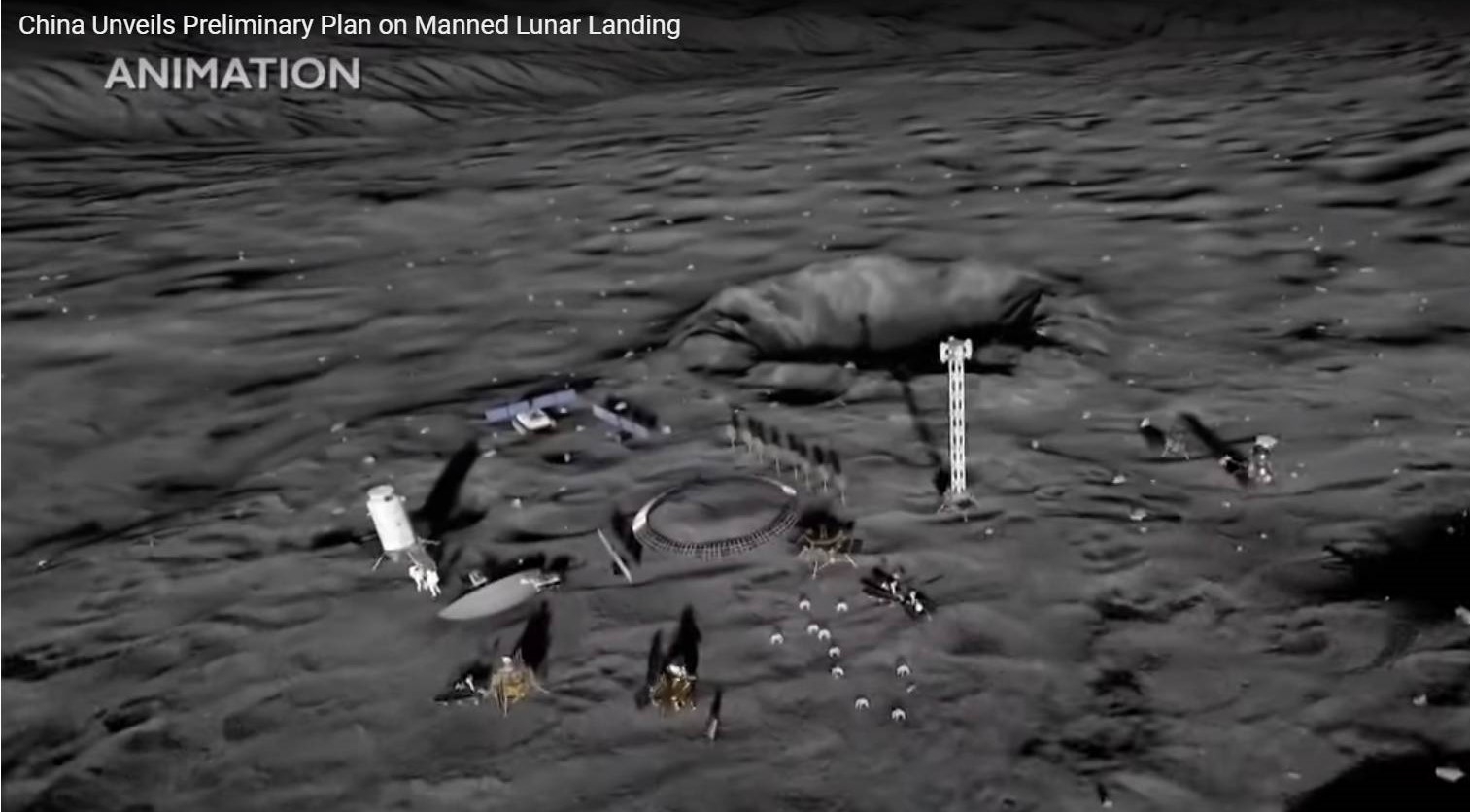
Artist’s view of International Lunar Research Station. Image credit: CNSA
Exhibition opens
Meanwhile, an exhibition featuring Chang’e-5 lunar samples was opened to the public today in Beijing.
In addition to 0.6 grams of lunar soil brought back by the Chang’e-5, the exhibition also showcases lunar samples collected by U.S. Apollo 17 moonwalkers and lunar meteorites from Northwest Africa, highlighting their use in appraising the Moon’s formation and evolution.
Go to this video that spotlights the Beijing lunar exhibit at:

Image credit: Blue Origin
The Federal Aviation Administration (FAA) has given the go for the first launch of the Blue Origin New Glenn mega-booster.
Under the FAA Part 450 commercial space launch license they authorized the maiden flight of New Glenn.
“The FAA determined Blue Origin met all safety, environmental and other licensing requirements. The license allows Blue Origin to conduct orbital missions from the Cape Canaveral Space Force Station in Florida with the reusable New Glenn first stage landing on a barge in the Atlantic Ocean. It is valid for five years,” according to an FAA statement.
“A big thanks to the FAA for the partnership, especially over the holidays. Here’s to NG-1 [New Glenn-1] — we are really close, folks,” posted Dave Limp, CEO of Blue Origin on the Elon Musk/SpaceX-run X site.
Hotfire!
To Limp’s point, Blue Origin’s New Glenn completed on December 27 an Integrated Launch Vehicle hotfire, deemed as the final major milestone for the launchers first flight. The seven-engine hotfire lasted 24 seconds and also marked an earlier set of inert functional and tanking tests.

Image credit: Blue Origin
New Glenn features Blue Origin’s BE-4 engines, “the most powerful liquefied natural gas (LNG)-fueled, oxygen-rich staged combustion engine ever flown,” the entrepreneurial space company explains.

Image credit: Blue Origin

New Glenn’s first and second stage mate . Photo taken November 12, 2024.
Image credit: Blue OriginBlue Origin’s New Glenn completed on December 27 an Integrated Launch Vehicle hotfire, deemed as the final major milestone for the launchers first flight. The seven-engine hotfire lasted 24 seconds and also marked an earlier set of inert functional and tanking tests.
For detailed information on New Glenn, go to:
https://www.blueorigin.com/new-glenn

Image credit: Blue Origin

Image credit: LIQUIFER, based on MidJourney/DLR (CC BY-NC-ND 3.0)
A team of researchers from Germany, Austria, Poland and Italy are hard at work designing and testing a novel extractor technique for the prospect of using water ice found on the Moon.
The LUWEX group’s “downstream” goal is to be able to process kilograms of lunar regolith containing enough water ice to support a purification process.
An Earth-based demonstration system is under appraisal, operating under a similar low pressure and low temperature environment as on the Moon.
LUWEX has been funded by the European Union, focused on validation of lunar water extraction and purification technologies for on-the-spot propellant and consumables production.

Image credit: LUWEX Project
Lab testing
“To test the system in the laboratory, a mix from water ice particles and lunar regolith simulant will substitute for real lunar sand as is expected to be found in some craters at the lunar south polar region,” explain the LUWEX specialists.
“By applying heat, the vaporizing water is extracted and collected. After liquefaction, the raw water is put through a purification process. The purified water is then ready for use in the form of propellant, for energy storage and for life support…or for a glass of Adam’s ale from the Moon,” the researchers point out.

The icy regolith simulant just after mixing in the ice particles. This process is done under cryogenic temperatures.
Image credit: LUWEX Project
Consortium partners
LUWEX technologists involve Deutsches Zentrum für Luft- und Raumfahrt (DLR), Germany, LIQUIFER Systems Group, Austria, Technische Universität Braunschweig, Germany, Scanway sp. z o. o., Poland, Wroclaw University for Science and Technology, Poland, as well as Thales Alenia Space in Italy.
The LUWEX project is developing and validating technologies for extracting, purifying, and monitoring lunar water.
Their intent is to advance In-Situ Resource Utilization (ISRU) on the Moon to support sustainable space exploration.
Fundamental physics and engineering
“By harnessing lunar water for astronaut needs, radiation shielding, and rocket fuel, LUWEX reduces reliance on Earth-bound supplies, paving the way for long-duration missions,” the group points out. “Using icy lunar dust simulants in a thermal-vacuum chamber, the project tests a complete water process chain to elevate its Technology Readiness Level (TRL).”

Paul Zabel examines two samples of extracted water: on the left, cleaned by the Thales Alenia Space processing system, and on the right, still contaminated with regolith
Image credit: TU Braunschweig
Explains Paul Zabel of the German Aerospace Center, “we don’t know yet how the water ice regolith mixture behaves, when we warm it up, and how the water vapor forms where it flows. There is a lot of fundamental research questions involved in this project. And that makes it really exciting because it’s a combination of fundamental physics, and engineering.”
Adds Barbara Imhof of the LIQUIFER Systems Group, “we have to look at what we really need, what we can take from the location we are at, and how we can always keep resources in a loop because it is very cumbersome to source materials, and goods we need for the everyday life. We really need to take good care of what we have.”
For detailed information on the LUWEX work, go to:
https://liquifer.com/wp-content/uploads/2024/12/LUWEX-_brochure_web.pdf
Also, visit the LUWEX website at:

The Hong Kong University of Science and Technology (HKUST) is spearheading an international collaboration project for China’s Chang’e-8 mission. Key research project personnel from HKUST include Prof. Yu Hongyu (3rd left), Prof. Sun Qingping (2nd left), Prof. Shi Ling (2nd right), and Prof. Duan Molong (1st right).
Technologists in China have the go-ahead to engineer a multi-task Moon robot for use in the country’s Chang’e-8 lunar landing mission, now set for launch around 2028.
The Hong Kong University of Science and Technology (HKUST) announced today its appointment by the China National Space Administration (CNSA) to spearhead an international collaboration project for the lunar lander mission.
Reportedly, the extraterrestrial android would weigh roughly 220 pounds (100 kilograms).
International partners
In October 2023, CNSA issued the Opportunity Announcement for International Cooperation on the Chang’e-8 endeavor.
HKUST assembled a team of international partners to submit a proposal to the Lunar Exploration and Aerospace Engineering Center of CNSA and was selected in November this year.

Chang’e-8 south pole Moon lander.
Image credit: CNSA/HKUST
According to China’s Xinhua news service, the Chang’e-8 will constitute, together with Chang’e-7, the basic model of a lunar research station. The Chang’e-7 probe is expected to be dispatched to the Moon around 2026 to implement resource exploration of the lunar south pole.
Dexterous operations
The HKUST-led team, according to the university, is set to produce a multi-functional lunar surface operation robot capable of dexterous operations with a mobile charging station.
“As one of the pioneering initiatives led by China to set up an international lunar research station, this project will pave the way for the establishment of a long-term unmanned facility in the lunar polar regions,” a university statement explains.
The robot is envisioned to conduct scientific exploration, deploy and install instruments in the Moon’s harsh environment. Its mobile wireless charging capability is to energize various devices on the lunar surface. Positioning, navigation and autonomous movement would not rely on satellite navigation systems.
Artist’s view of International Lunar Research Station. Image credit: CNSA
The Hong Kong Space Robotics and Energy Center will be established to drive this mission forward while fostering collaboration across institutions and regions.
Other team members are from Dalian University of Technology, Shenzhen University, Hong Kong Polytechnic University (PolyU), and the South African National Space Agency (SANSA).
Low lunar temperature, highly skilled robot
Professor Yu Hongyu, director of the HKUST Space Science and Technology Institute is also principal investigator of the lunar robot.
“First, our robot venturing into the lunar south pole will encounter extremely low temperatures. To ensure its reliable performance, the use of advanced materials and temperature management systems is essential,” Yu said.
“Secondly, the absence of satellite navigation on the Moon means a smart design is required to effectively address the complexities of positioning, navigation, autonomous movement and operational control,” added Yu. “At the same time, the robot must stay lightweight while handling multiple precision tasks and serving as a charger for other lunar equipment.”

Map of the distribution of subsurface water ice in Cabeo Crater. Image credit: Department of Nuclear Planetology of the Space Research Institute of the Russian Academy of Sciences.
New views of water ice resident in polar craters of the Moon have been issued by the Space Research Institute of the Russian Academy of Sciences.
The data has been collected by the Russian Lunar Exploration Neutron Detector (LEND), an experiment on board NASA’s Lunar Reconnaissance Orbiter (LRO) that was launched back in June 2009.
Based on measurements taken by the Russian neutron telescope onboard LRO, the features of water ice occurrence in the lunar polar craters Cabeo and Galimov were studied.
Large volume of data
According to a December 24 posting on the Press Service Bulletin of the Space Research Institute of the Russian Academy of Sciences (IKI RAS), LEND has accumulated a large volume of neutron mapping data over 15 years of work.
In the soil of the polar crater Cabeo, the mass fraction of water ice is on average about 0.5%, and in some areas even 0.7%. Polar crater Cabeo coordinates are 35.5 W, 84.9 S.
“Such an area ‘enriched’ with water ice is located at the deepest point of the permanently shadowed section of the crater Cabeo,” the website explains. “The mass fraction of ice in the soil of this crater increases with depth, and ice is present in both sunlit and permanently shadowed areas of the surface.”

Galimov Crater. Image credit: Department of Nuclear Planetology of the Space Research Institute of the Russian Academy of Sciences.
Crater ages
Russia’s LEND also observed the polar crater Galimov located closer to the equator at coordinates 126.59° W, 64.32° S. This feature is comparable to the Cabeo crater in age – 3.85 billion years. However, Galimov is nearly three times smaller in diameter than crater Cabeo, roughly 21 miles (34 kilometers) across.
“It turned out that there are no signs of water ice in the soil at its bottom. At the same time, the soil in the immediate vicinity of the crater contains water ice,” the posting adds.
The research work was carried out by a team of the Department of Nuclear Planetology of the Space Research Institute of the Russian Academy of Sciences under the supervision of Igor Mitrofanov. Also cited in the research, Maxim Litvak, Anton Sanin, and Maya Dyachkova.

Installing Russia’s LEND device on the Lunar Reconnaissance Orbiter (LRO) by NASA Goddard Space Flight Center specialists.
Image credit by IKI RAS
History of lunar permafrost
The scientists explain that the absence of ice in the Galimov crater basin is due to the eruption of hot magma, which took place between 0.2 and 1.0 billion years ago, as evidenced by cracks on the bottom of the crater.
“Thus, a comparison of these two craters showed that the polar glaciers on the Moon formed between 3.85 billion and 1.0 billion years ago,” the IKI RAS specialists point out.
The researchers add that additional study of the lunar soil using neutron orbital mapping data “will help to reconstruct in even greater detail the history of the appearance of permafrost on the Moon and also solve the practical problem of choosing the optimal location for a future lunar base.”

NASA’s Lunar Reconnaissance Orbiter (LRO).
Credit: NASA/GSFC
Fairly “wet” place
According to an overview of the work of LEND, maps of the prevalence of water in the lunar regolith at the north and south poles of the Moon have been developed.
“As its measurements show, the Moon turned out to be a fairly ‘wet’ place: in certain areas, under a layer of dry soil from several tens of centimeters to one meter thick, the content of water ice can be up to 5% by weight of the soil, which is more than in the Sahara Desert on Earth,” the IKI RAS website explains.

