Author Archive
 Author:
  October 9th, 2014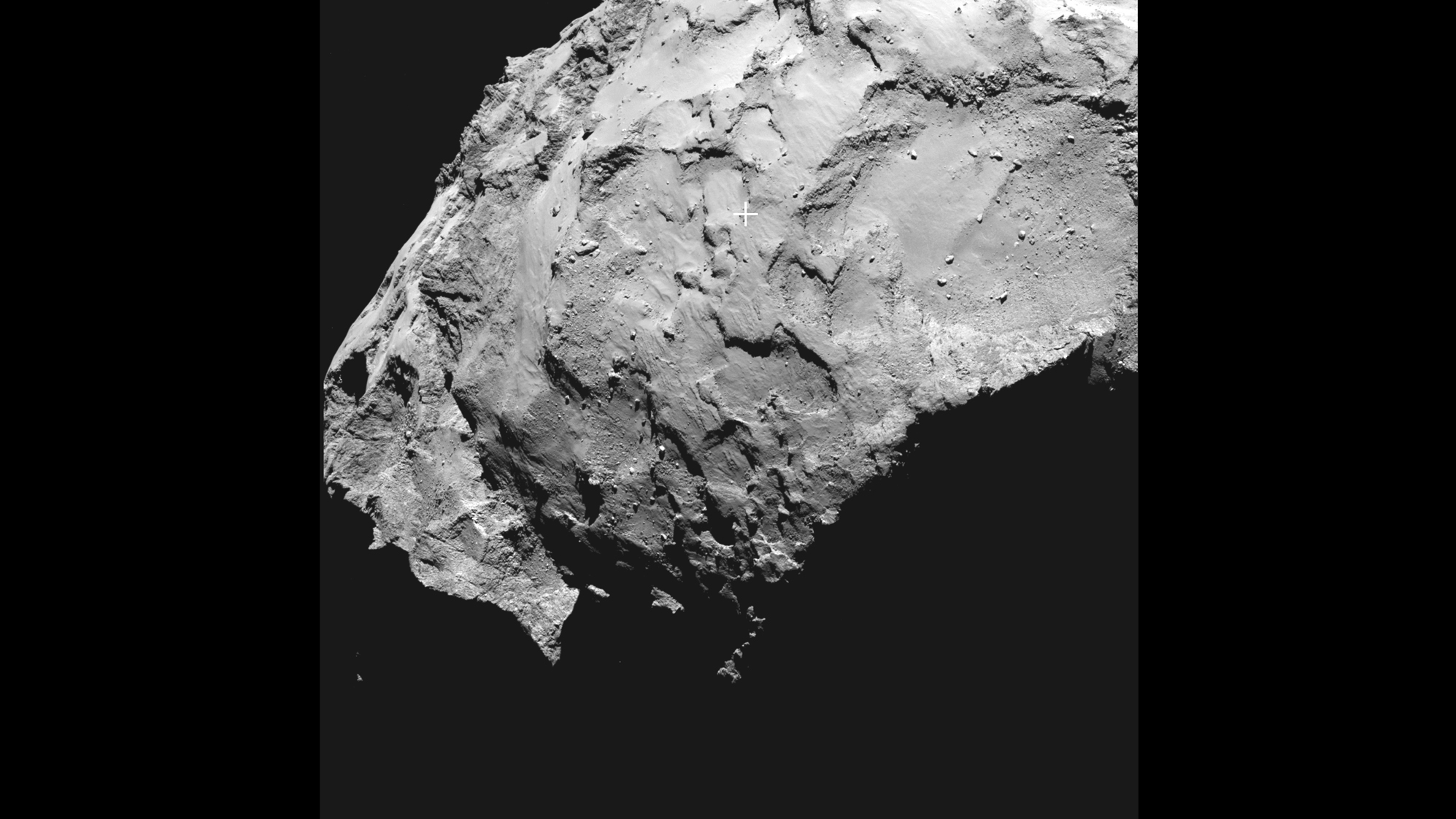
Credit: ESA/Rosetta/MPS for OSIRIS Team MPS/UPD/LAM/IAA/SSO/INTA/UPM/DASP/IDA.
Europe’s Rosetta mission to Comet 67P/Churyumov-Gerasimenko is nearing a nail-biting moment – when the Philae lander is to be unleashed for a touchdown on the celestial wanderer.
The primary landing site is landing site “J” – a spot that has relatively flat terrain and good solar illumination.
There is a detailed timetable for the descent of Philae.
On October 14, the primary landing site and the schedule will be finally confirmed or a decision made to descend on the backup landing site – landing site “C”.
If a go is given for landing site “J” the lander will undock from the Rosetta spacecraft at 09:35 Central European Time (CET) on November 12 at a distance of approximately 14 miles (22.5 kilometers) from the center of the comet and land on the surface about seven hours later.
The first confirmation of the landing is expected at around 17:00 CET.

The group of boulders in the center of this image reminded scientists of the Giza Necropolis. The largest boulder has therefore been named Cheops.
Credit:
ESA/Rosetta/MPS for OSIRIS Team MPS/UPD/LAM/IAA/SSO/INTA/UPM/DASP/IDA
The landing will be controlled from the German Aerospace Center (Deutsches Zentrum für Luft- und Raumfahrt; DLR) Lander Control Center (LCC) in Cologne.
If spacecraft engineers decide to use the backup site, Philae will undock from Rosetta at 14:04 CET on November 12 at a distance of only about 8 miles (12.5 kilometers) from the center of the comet.
In this case, the descent will only take about four hours. A first signal from the surface would be expected at about 18:30 CET.
The signal travel time between Rosetta and Earth is 28 minutes and 20 seconds.
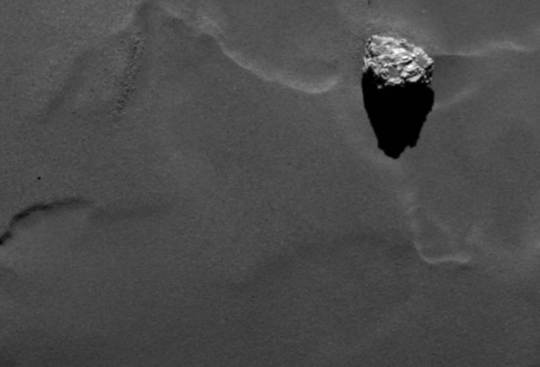
Close-up of the boulder Cheops as it casts a long shadow on the surface of comet 67P/Churyumov-Gerasimenko. Cheops has a size of approximately 45 meters and is the largest structure within an a group of boulders located on the lower side of the comet’s larger lobe.
Credit:
ESA/Rosetta/MPS for OSIRIS Team MPS/UPD/LAM/IAA/SSO/INTA/UPM/DASP/IDA
“Tension is mounting,” says DLR scientist Stephan Ulamec, Project Manager for the Philae lander in a press statement.
Rosetta is a European Space Agency (ESA) mission with contributions from its member states and NASA. Rosetta’s Philae lander is funded by a consortium headed by German Aerospace Center (Deutsches Zentrum für Luft- und Raumfahrt; (DLR), the Max Planck Institute for Solar System Research (MPS), CNES and the Italian Space Agency (ASI).
 Posted in

Credit: Martha Sewall/Purestock/Thinkstock/Johns Hopkins University Press
Why Mars – NASA and the Politics of Space Exploration by W. Henry Lambright; Johns Hopkins University Press, Baltimore, Maryland; $49.95 (hardcover); 2014.
Wondering when humans will set boot on Mars?
Author W. Henry Lambright has written an absorbing and detailed look at the long trail of robotic Mars exploration program from its origins to today. This is an excellent review of the politics and policies behind NASA’s multi-decade quest at exploring the Red Planet, the roles of key individuals and institutions, including a look at triumphs and defeats in reaching Mars.
Lambright tells of the quest for Mars, one that stretches out over decades and involves billions of dollars. The book is up-to-date in that it also includes the big ticket rover now scouting about on Mars – Curiosity – and how it took more than seven minutes of terror to get its wheels down and dirty.
Don’t look to this book to give you the technical needs for sustaining humans on that faraway world. However, this book details what’s needed to mount and give coherence to a multi-mission, big science program. In that light, Lambright’s look at robotic Mars probing suggests a number of lessons learned that might apply to large-scale national endeavors in science and technology.
Why Mars details what’s required to formulate missions, establish priorities, followed by the hard part: “Get the funds to accomplish technical miracles,” Lambright notes in the book’s preface.
Lambright is a professor of public administration, international affairs, and political science at the Maxwell School of Citizenship and Public Affairs at Syracuse University. He is also author of Powering Apollo: James E. Webb of NASA and Space Policy in the Twenty-First Century, both published by Johns Hopkins.
The last page of his new book is the kicker: “Robots are there today and will continue to forge a trail,” Lambright writes. “Robots go first as pioneers. Ultimately, men and women will bring life to the Red Planet. Mars calls because we want to know about ourselves,” he concludes.
For more information on this book, go to:
https://jhupbooks.press.jhu.edu/content/why-mars
Note:
Tune into David Livingston’s The Space Show and listen to Lambright discuss this book. Go to Broadcast 2274 (Special Edition) at:
http://www.thespaceshow.com/detail.asp?q=2274

Credit: Mars One
Those signed up and patiently waiting for your trek to the Red Planet via the Mars One program, you might put on the speed brakes a bit and read a new analysis of the effort by a team of MIT students.
Flagged by Marcia Smith at SpacePolicyOnline.com News, the MIT review paints a picture of the outcome. The appraisal was delivered at the recent International Astronautical Congress held last week in Toronto, Canada.
The MIT study was supported by grants from NASA and the Josephine de Karman Fellowship Trust.
Go to Smith’s “MIT Analysis Paints Bleak Outcome for Mars One Concept” at:
For the full MIT paper, “AN INDEPENDENT ASSESSMENT OF THE TECHNICAL FEASIBILITY OF THE MARS ONE MISSION PLAN,” go to:
http://web.mit.edu/sydneydo/Public/Mars%20One%20Feasibility%20Analysis%20IAC14.pdf
Additional information on the Mars One mission plan – and likely a response to the MIT assessment at some point — can be found here:
Meanwhile, what do you think?

XCOR Aerospace of Mojave, California reports they are making progress on their Lynx suborbital craft.
The Lynx is a two-seat, piloted space transport vehicle that will take humans and payloads on a half-hour suborbital flight to 100 km (330,000 feet) and then return safely to a landing at the takeoff runway.
XCOR is busy at work on the vessel and has integrated the cockpit to the fuselage on the Lynx spacecraft. With the fuselage, pressure cabin and other segments, XCOR is bonding these structures together and integrating sub-assemblies, such as the landing gear, at its hangar in Mojave.
The Lynx rocket propulsion system continues to be tested on a first generation fuselage used to perform cold-flow and hot fire tests with XCOR’s proprietary rocket propellant piston pump technology.

Credit: XCOR Aerospace
In a press statement, XCOR said that they preparing for the final stretch leading up to test flights.
XCOR Aerospace is based in Mojave, California. It is currently creating a research and development center in Midland, Texas, and will be establishing an operational and manufacturing site at the Kennedy Space Center in Florida with the assistance of Space Florida.
The Lynx family of vehicles serves three primary missions: research and scientific missions and private spaceflight in the Lynx Mark I and Lynx Mark II, and micro satellite launch on the Lynx Mark III.

Credit: Turner Enterprises, Inc
Virgin Galactic, the privately-funded space company owned by Sir Richard Branson’s Virgin Group and Abu Dhabi’s aabar Investments PJS, has announced that it has partnered with Ted Turner’s Sierra Grande Lodge and Spa as it continues to expand its New Mexico accommodation options for Future Astronauts and their families.
Located in Truth or Consequences, New Mexico, Sierra Grande Lodge & Spa was built in 1929 and is on the National Register of Historic Places.
The Lodge was fully restored in 2001, with a new spa added in 2006 and a fitness center adjacent to the Lodge in 2013. The Lodge and Spa was purchased by Ted Turner in 2013.
Located in the heart of historic downtown Truth or Consequences, Sierra Grande is within walking distance to shops, restaurants, entertainment, galleries, as well as a short drive to the Gila National Forest, beautiful Elephant Butte Lake, and soon-to-be-completed Virgin Galactic Spaceport.

Credit: Virgin Galactic
Virgin Galactic’s test flight program of the SpaceShipTwo and WhiteKnightTwo carrier plane is in its final stages leading to commercial suborbital operations, which will be based at Spaceport America in New Mexico.
Hundreds of passengers have signed up for the suborbital treks. The seat price per person: $250,000.
Credit: IAU/L. Calçada
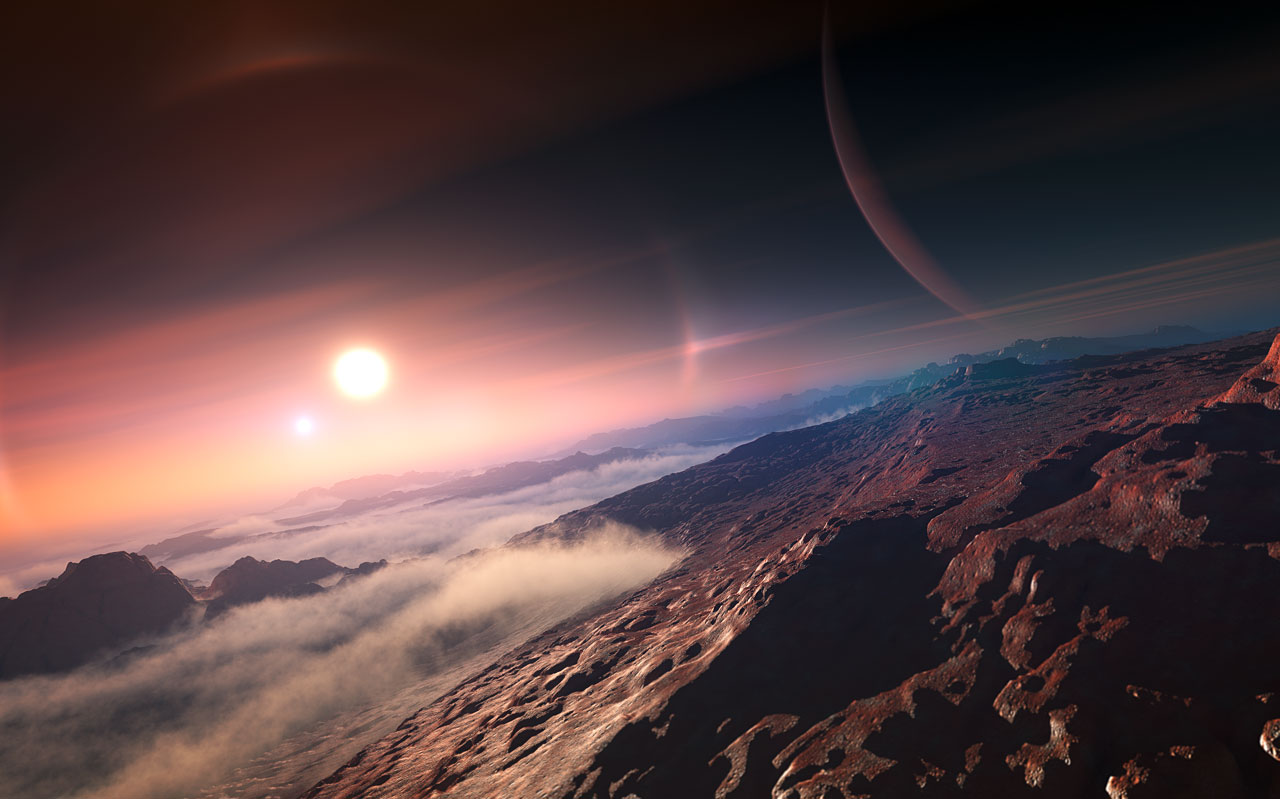
For the first time in history the public will be able to vote for the official name of stars and planets.
The International Astronomical Union (IAU) is inviting all public organizations with an interest in astronomy to register on the IAU Directory for World Astronomy website for the NameExoWorlds contest.
Those participating can in early 2015 suggest names for exoplanets and their host stars.
The International Astronomical Union (IAU) was founded in 1919. Its mission is to promote and safeguard the science of astronomy in all its aspects through international cooperation.
NOTE: The deadline for registration for the contest is December 31, 2014.
Eligible organizations include: planetariums, science centers, amateur astronomy clubs, online astronomy platforms, but also non-profit organizations such as high schools or cultural clubs interested in astronomy.
A list of 305 well-characterized exoplanets, discovered prior to December 31, 2008, has been selected for naming by the IAU Exoplanets for the Public Working Group.
For more details about the contest, go to:
Credit: Ted Molczan
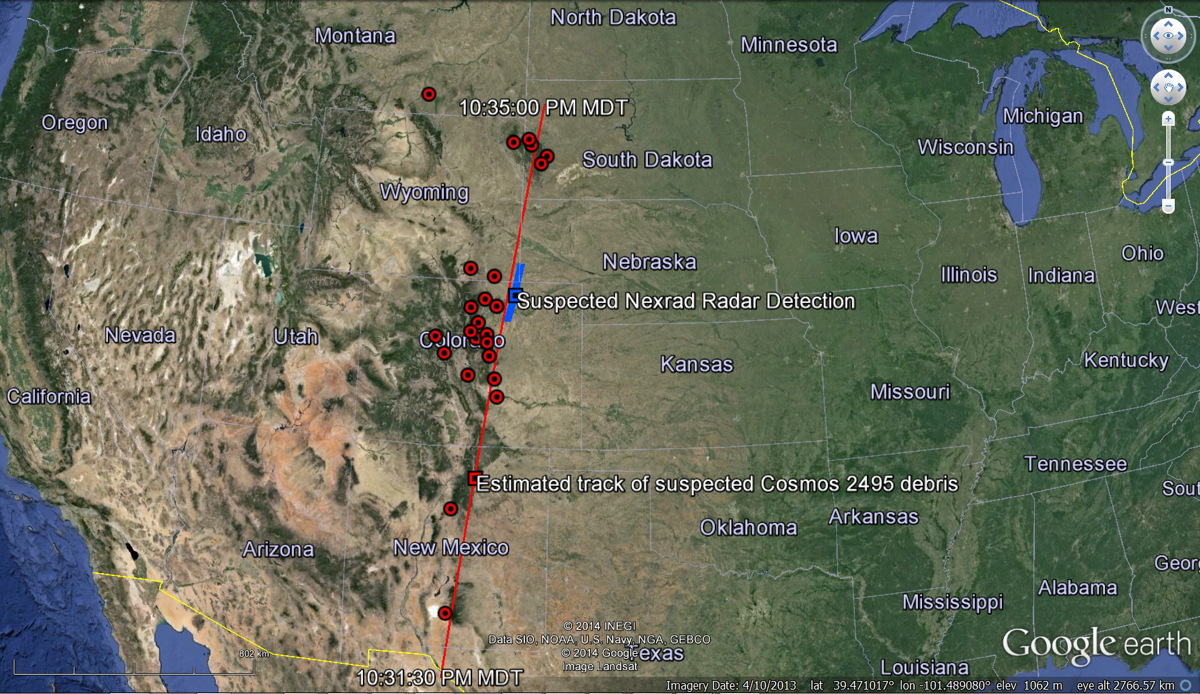
Here’s a new one from me up today on Space.com. Eyes to the skies!
Space Sleuths Piece Together Fiery Fall of Russian Spy Satellite Debris
By Leonard David, Space.com’s Space Insider Columnist
October 02, 2014 07:01am
http://www.space.com/27318-russian-military-spy-satellite-fall.html

Credit: Springer International Publishing
Given that the surrounding Universe may be awash in worlds, the expectations of finding ET out there is growing.
If the rate of discovery keeps up its current pace, one estimate has it that astronomers will have identified more than a million exoplanets by the year 2045.
Vanderbilt Professor of Astronomy David Weintraub has written a thought provoking new book: Religions and Extraterrestrial Life. It will be issued next month by Springer International Publishing.
Weintraub decided to find out what the world’s major religions have to say about the matter of ET, detailed in a recent Vanderbilt press release.
Weintraub’s book describes what religious leaders and theologians have to say about extraterrestrial life in more than two dozen major religions, including Judaism, Roman Catholicism, the Eastern Orthodox churches, the Church of England and the Anglican Communion, several mainline Protestant sects, the Southern Baptist Convention and other evangelical and fundamentalist Christian denominations, the Religious Society of Friends (Quakers), Seventh Day Adventism and Jehovah’s Witnesses, the Church of Jesus Christ of Latter-Day Saints (Mormons), Islam and several major Asian religions including Hinduism, Buddhism and the Bahá’í Faith.
Public opinion
Public opinion polling indicates that about one fifth to one third of the American public believes that extraterrestrials exist, Weintraub reports. However, this varies considerably with religious affiliation.
Belief in extraterrestrials varies by religion:
— 55 percent of Atheists
— 44 percent of Muslims
— 37 percent of Jews
— 36 percent of Hindus
— 32 percent of Christians

Vanderbilt Professor of Astronomy David Weintraub.
Credit: Daniel Dubois/ Vanderbilt
Reincarnated as aliens
According to Weintraub, Asian religions would have the least difficulty in accepting the discovery of extraterrestrial life. Some Hindu thinkers have speculated that humans may be reincarnated as aliens, and vice versa, while Buddhist cosmology includes thousands of inhabited worlds.
Weintraub found very little in Judaic scriptures or rabbinical writings that bear on the question.
The few Talmudic and Kabbalistic commentaries on the subject do assert that space is infinite and contains a potentially infinite number of worlds and that nothing can deny the existence of extraterrestrial life.
At the same time, Jews don’t believe the discovery of extraterrestrial intelligence would have much effect on them.
Are we ready?
Among Christian religions, the Roman Catholics have done the most thinking about the possibility of life on other worlds, the astronomer discovered.
Weintraub also identified two religions – Mormonism and Seventh-day Adventism – whose theology embraces extraterrestrials.
All this and other information in the book leads to the big question: Are we ready?
In answer to that question Weintraub concludes, “While some of us claim to be ready, a great many of us probably are not… very few among us have spent much time thinking hard about what actual knowledge about extraterrestrial life, whether viruses or single-celled creatures or bipeds piloting intergalactic spaceships, might mean for our personal beliefs [and] our relationships with the divine.”
Are the world’s religions ready for E.T.?
Check out this video:

Credit: NASA
Windows on Earth is an educational project that features photographs taken by astronauts on the International Space Station.
Astronauts take hundreds of photos each day, for science research, education and public outreach. The photos are often dramatic, and help us all appreciate home planet Earth.
Windows on Earth also operates software on the International Space Station, as a window-side aide to help astronauts identify priority targets for photography.
Recently, nearly two dozen of these photos were selected for their artistic appeal, and displayed at Gallery Seven in Maynard, Massachusetts.
For a personal tour of the displayed images, go to:
http://www.youtube.com/watch?v=uz-cGB2fzy8&feature=youtu.be
Another web site provides free public access to virtually all of these photos, updated at least weekly.
That site is operated by TERC, an educational non-profit, in collaboration with the Association of Space Explorers (the professional association of flown astronauts and cosmonauts), the Virtual High School, and CASIS (Center for Advancement of Science in Space).
Also engaged is technical support from NASA’s Crew Earth Observation Program.
Take a look at:

Credit: NASA
The developer of the Dream Chaser –Sierra Nevada Corporation (SNC) — has filed a legal challenge to the award of contracts to Boeing and SpaceX under NASA’s Commercial Crew Transportation Capability (CCtCap) program.
SNC’s filing seeks a further detailed review and evaluation of the submitted proposals and capabilities.
Dream Chaser was the only vehicle remaining in the Commercial Crew Program that was not a capsule.
“In its 51 year history SNC has never filed a legal challenge to a government contract award,” the company stated in a press release. “However, in the case of the CCtCap award, NASA’s own Source Selection Statement and debrief indicate that there are serious questions and inconsistencies in the source selection process.”
Because of these factors, SNC “feels that there is no alternative but to institute a legal challenge.”
SNC Space Systems filed a bid protest with the Government Accountability Office (GAO).
According to SNC, the official NASA solicitation for the CCtCap contract prioritized price as the primary evaluation criteria for the proposals, setting it equal to the combined value of the other two primary evaluation criteria: mission suitability and past performance.
“SNC’s Dream Chaser proposal was the second lowest priced proposal in the CCtCap competition. SNC’s proposal also achieved mission suitability scores comparable to the other two proposals.”
SNC believes the result of further evaluation of the proposals submitted “will be that America ends up with a more capable vehicle, at a much lower cost, with a robust and sustainable future.”

