Author Archive
 Author:
  October 25th, 2014
Credit: OECD
The Organization for Economic Cooperation and Development (OECD) has unveiled their new report: The Space Economy at a Glance 2014.
This new report provides a statistical overview of the global space sector and its contributions to economic activity.
The new edition provides indicators and statistics based on both official and private data, in over forty countries with space programs, and identifies new dynamics in the space sector.
Globalization
The report notes that globalization is affecting the space economy at different levels.
In the 1980s, only a handful of countries had the capacity to build and launch a satellite. Many more countries and corporate players across a wide range of industrial sectors are now engaged in space-related activities, a trend that is expected to strengthen in the coming years.
Supply chains for the development and operation of space systems are also increasingly evolving at the international level, even if the space sector remains heavily influenced and shaped by strategic and security considerations. Many space technologies are dual use, i.e. employed for both civilian and military programs, which tends to constrain international trade in space products.
Nonetheless, as evidenced by recent OECD research on global value chains, product and service supply chains for space systems are internationalizing at a rapid pace.
Space budgets
Among key findings, the report states:
Countries with long-established space programs face growing challenges as lower costs and technological advances draw more countries and companies into the sector and give rise to a burgeoning commercial space industry.
The Space Economy at a Glance 2014 shows that while space budgets in the 34 OECD countries totaled USD 50.8 billion in 2013, down from USD 52.3 billion in 2008, the combined space budget of the BRICs (Brazil, Russia, India and China) swelled to USD 24.0 billion from USD 16.5 billion over the same period.
To view this new OECD (2014) report, go to:
 Posted in

Long March-3C rocket lifts off from the Xichang Satellite Launch Center carrying China’s new Moon test spacecraft.
Credit: China Space
An advanced Long March-3C rocket from the Xichang Satellite Launch Center in southwest China’s Sichuan Province has hurled toward the Moon China’s robotic test vehicle.
Launched early Friday (local China time), the spacecraft will fly around the Moon for half a circle and return to Earth in a test of reentry technologies to be used for China’s lunar return sample program.
On its return to Earth, the test spacecraft will make a “skip reentry” to progressively slow down before landing in north China’s Inner Mongolia Autonomous Region.
Dubbed by China observers as the Chang’e-5 Test 1 (CE5-T1), the mission is to take some 8 days, according to China news outlets.
Well-controlled reentry
“Earthbound experiments can’t effectively simulate the complexity of the atmospheric environment,” Hao Xifan, deputy chief designer of the CE5-T1 and Chang’e-5 missions told China’s S&T Daily shortly before the launch, according to the AAAS ScienceInsider.
Hao said the spacecraft’s skip reentry must be well-controlled. “If it’s too low, the probe may be burnt. If too high, it won’t be able to land in the targeted area.”
Also on the China booster: Hitchhiking payloads 4M, developed by LuxSpace in Luxembourg and PS86X1 from Pocket Spacecraft – a virtual organization situated in the United Kingdom.
This current Moon mission by China is to gather experimental data and confirm re-entry technologies such as guidance, navigation and control, heat shield and trajectory design. That knowledge will be rolled into a future touch-down on the Moon by Chang’e-5, now targeted for a 2017 flight to land on the lunar surface and snag samples for return to Earth.
For an interesting look at China’s current and future robotic lunar missions, go to:
— Video: Launch of Chang’e 5 test mission
http://www.youtube.com/watch?v=SfIBUlflRM0
— Video describing the mission.
http://www.ecns.cn/video/2014/10-23/139651.shtml
— Video: Chang’e 5 moon return test mission
http://www.youtube.com/watch?v=GkgG_SzXHVw
According to LuxSpace:
After a thunderstorm two hours before liftoff, the skies cleared to see the Long March 3C booster rocket “through” the Orion constellation and head toward the Moon.
Here is a movie of the liftoff:
https://cloud.luxspace.lu/public.php?service=files&t=c7cc065cd4757e1ba570521e3f40b4c2&download
The LuxSpace 4M spacecraft has been successfully activated and has started to transmit to Earth with data received from stations all over the world (so far from Argentina, Brazil, USA, and Australia).
Temperature variations of the 4M spacecraft indicate that the last stage of the rocket is smoothly rotating, “making 4M’s journey to the moon and back so far not too harsh,” LuxSpace reports.
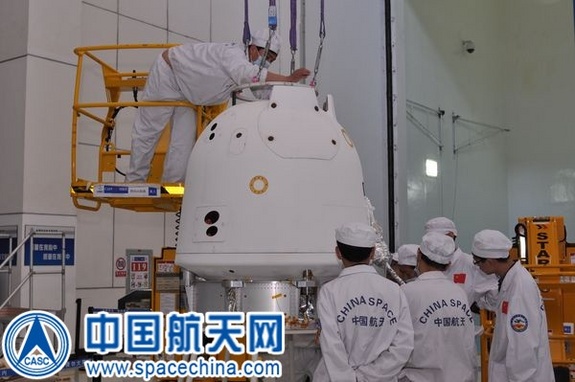
China’s next robotic mission to the Moon will test key technology for a future lunar sample return program.
Credit: CASC
Here’s my new story and update on China’s next robotic trek to the Moon – while technical details are skimpy, this mission should sharpen the country’s lunar sample return program:
China Poised to Launch Next Moon Mission on Thursday
By Leonard David, Space.com’s Space Insider Columnist
October 22, 2014 07:00am ET
http://www.space.com/27503-china-moon-mission-launch-thursday.html

China’s Hainan launching site is approaching operational status. Early work on China’s newest spaceport is shown here in full swing with rocket assembly towers in view.
Credit: China Space Website
China’s new launch complex is the Wenchang Satellite Launch Center in Hainan province.
Construction of that facility began in 2009 and is now completed. It will soon become operational, China’s People’s Daily reported last week.
The center is designed to handle next-generation rockets, the lofting of large space station modules – as well as deep space missions.
Coastal launch base
The new launch facility is situated on the northeast coast of Hainan Island, about 37 miles (60 kilometers) from Haikou, the provincial capital. The center is the country’s first coastal satellite launch base – no danger of discarded booster parts sailing into residential areas.
Wenchang adds to a trio of other Chinese launch sites: the heavily used Jiuquan Satellite Launch Center in the Gobi Desert, Taiyuan in the Shanxi province, and in Xichang, Sichuan province.
Space city with trams!
Wenchang is built to loft the Long March 5 rocket, China’s most powerful booster, which is now under development.
According to Qi Faren, former chief designer of the Shenzhou spaceships, the Long March 5 will be launched from the new center next year.

Hainan is site of China’s newest launch center, complete with trams to visit the complex.
Credit: TravelChinaGuide.com
The launch site will be used primarily for dispatching heavy geostationary telecommunications satellites.
As China’s fourth “space city,” Wenchang also includes a space theme park where visitors will be given tram tours of the launch pads.
By the way, the third annual Hainan Wanning Riyue Bay International Surfing Festival will take place on Hainan from November 23-28.
Surf and space are up!
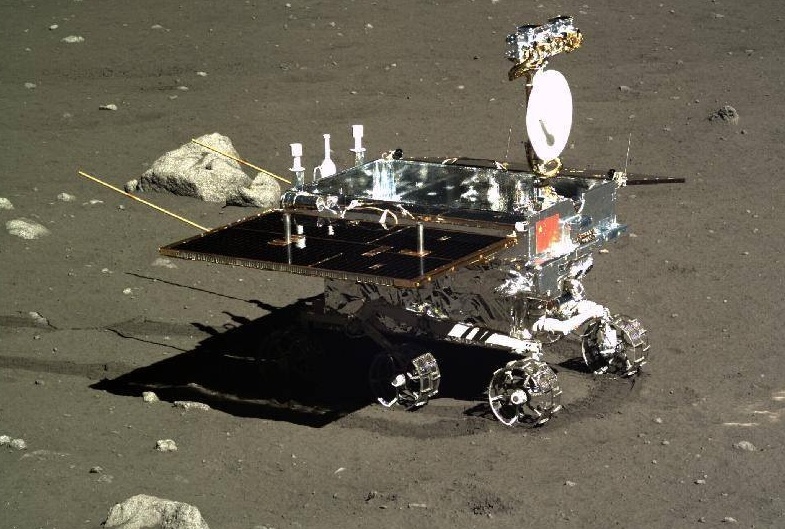
China’s Yutu Moon rover.
Credit: Chinese Academy of Sciences
Feeble but hanging on.
That’s the diagnosis from China regarding the country’s Yutu moon rover.
According to China’s Xinhua news agency, the lunar robot has undergone 11 periods of dormancy with its functions “gradually degrading,” said Yu Dengyun, deputy chief designer of China’s lunar probe mission.
“Yutu has gone through freezing lunar nights under abnormal status, and its functions are gradually degrading,” Yu told Xinhua.
China’s Chang’e 3 mission – a lander and rover – touched down on the lunar surface in mid-December of 2013.
Deployed from the lander, the Yutu rover performed several science duties before control problems struck the robot prior to experiencing a second lunar night of 14 days duration on January 25, 2014.
China space engineers are trying to deduce why the robot ran into problems via ground-based simulations, Yu said. That research is intended to be used in China’s robotic lunar sampling program – scooping up and rocketing back to Earth selected specimens of the Moon.
A new story from me on China’s space program and potential for international cooperation:

China presses forward on its space station work.
Credit: CMSE

ESA and its Rosetta mission partners are inviting you to suggest a name for the site where lander Philae will touch down on Comet 67P/Churyumov–Gerasimenko on November 12.
Got a name for the spot that the first soft landing of a human-made object on a comet will occur?
The European Space Agency and its Rosetta mission will deploy on November 12 the Philae lander to touch down on Comet 67P/Churyumov–Gerasimenko.
The site now has a less than glamorous name: Site J.
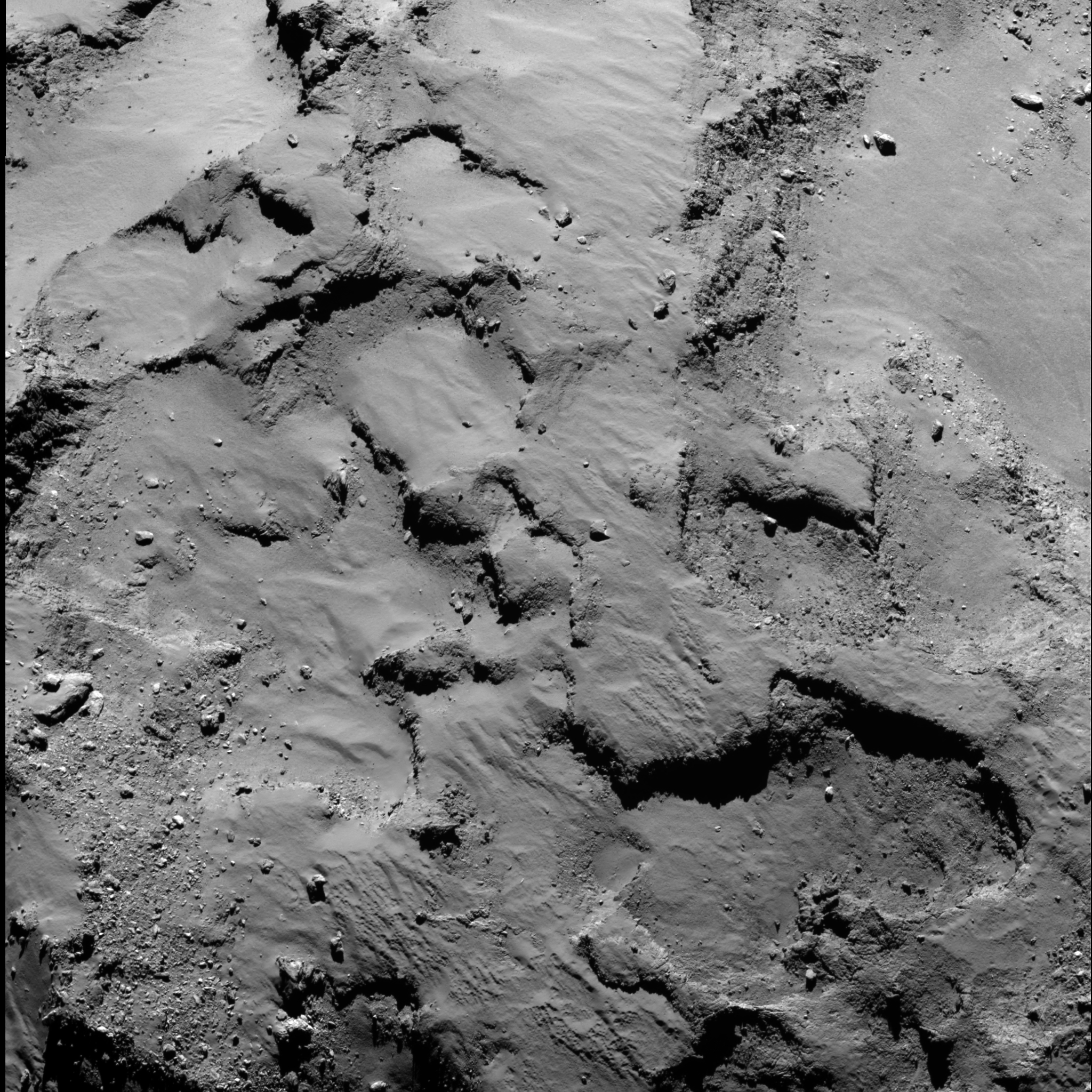
Philae’s primary landing site from about 30 kilometers distance. Close-up of the region containing Philae’s primary landing site J, which is located on the ‘head’ of Comet 67P/Churyumov–Gerasimenko. The image was taken by Rosetta’s OSIRIS narrow-angle camera.
Credits: ESA/Rosetta/MPS for OSIRIS Team MPS/UPD/LAM/IAA/SSO/INTA/UPM/DASP/IDA
That locale deserves a meaningful and memorable name that captures the significance of the occasion.The rules are simple: any name can be proposed, but it must not be the name of a person. The name must be accompanied by a short description (up to 200 words) explaining why this would make the ideal name for such an historic location.
A jury comprising members of the Philae Steering Committee will select the best name from the entries, and the winning proposer will be invited to follow the landing in person from ESA’s mission control centre in Darmstadt, Germany.
Note: The competition opens today and runs until 23:59 GMT on October 22. The winner will be announced on November 3.
Full rules, terms and conditions can be found at:
Credit: CASC
A new story of mine up on Space.com. I’ve tried to piece together an upcoming China mission – little on official details at the moment:
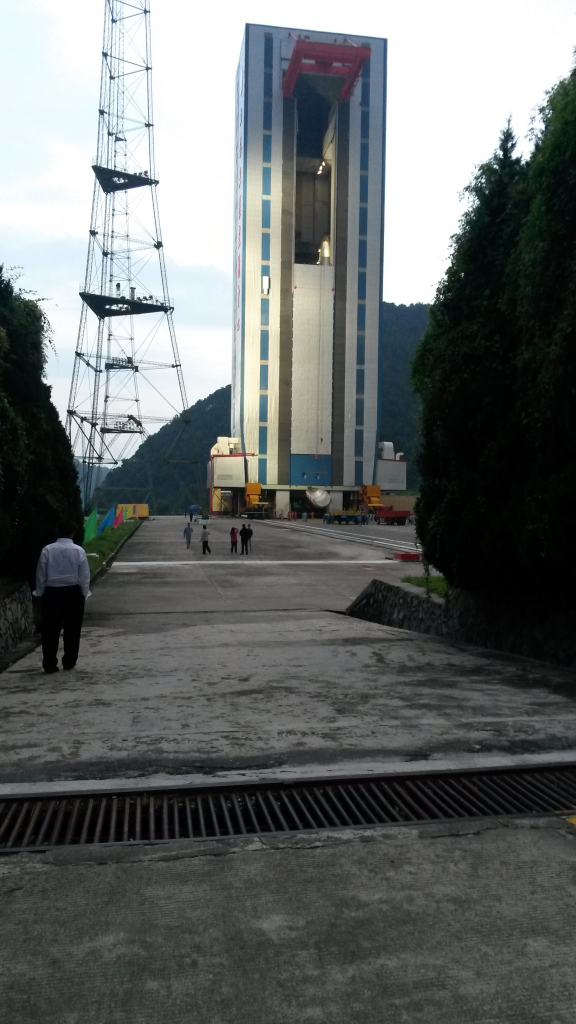
China prepares next Moon mission – a test of reentry technology needed for future sample return program.
Credit: LuxSpace
China Readies Moon Mission for Launch Next Week
http://www.space.com/27422-china-moon-mission-launch-october.html
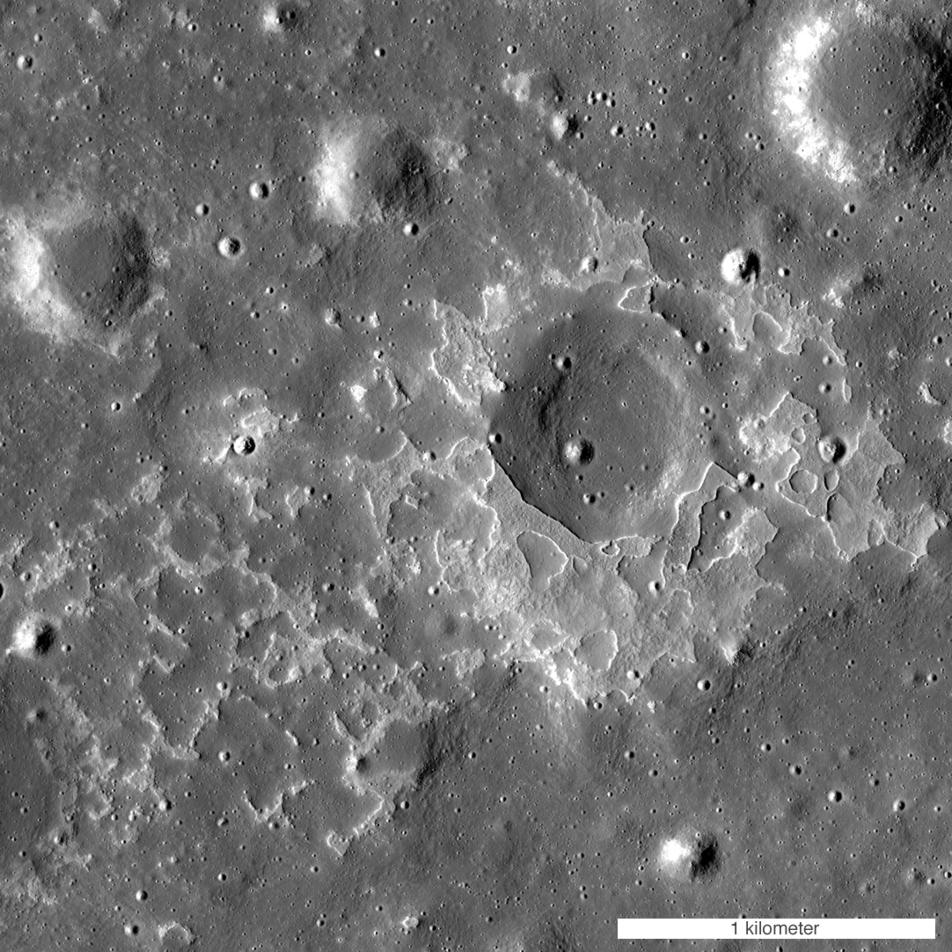
One of many newly-discovered young volcanic deposits on the Moon (4.330°N, 33.750°E), this example is near the crater Maskelyne. The direction of sunlight is from the right and north is up.
Credit: NASA/GSFC/Arizona State University
The Earth’s own Moon never fails to disappoint.
New data made possible by the NASA Lunar Reconnaissance Orbiter (LRO) spacecraft has identified many young volcanic deposits.
A new paper, published in Nature Geoscience, presents 70 topographic anomalies, informally called Irregular Mare Patches, or IMPs. Furthermore, most of these occurrences were previously undocumented.
The new discovery has been made by a group of geologists at Arizona State University’s School of Earth and Space Exploration (SESE) and shows that the Moon has seen small, but widespread eruptions of basaltic lava during the last 50 million years. That’s a geologically recent period.
According to co-author Mark Robinson, the principal investigator for the LRO Camera (LROC) on NASA’s Lunar Reconnaissance Orbiter spacecraft:
“Their sharp nature and general lack of impact craters greater than 20 meters in diameter indicate these deposits probably formed in the last 100 million years, perhaps even more recently than 50 million years ago. An amazing result!”
Changing the way we think
Robinson also noted that the images are changing the way we think about the Moon.
“Not only are the IMPs striking landscapes, they also tell us something very important about the thermal evolution of the Moon,” Robinson said on the LROC website.
“The nearside has extensive mare basalt flows covering much of its surface, however we know from analysis of Apollo samples and crater counts that the bulk of lunar volcanism occurred from 3.9 to 3.1 billion years ago, and shut-off sometime around 1billion years ago,” Robinson said. “However the IMPs seemed to have formed significantly after the canonical cessation of lunar mare basalt volcanism indicating the interior of the Moon is perhaps hotter than previously thought.”
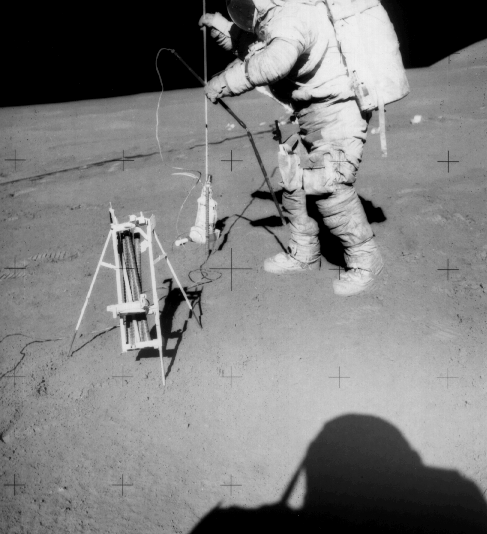
Apollo 15 astronaut Dave Scott deploying heat flow probe.
Credit: NASA
Future lunar exploration
Lastly, the IMPs are a fascinating part of the story of lunar volcanism over time, and now they must be considered high priority targets for future exploration, Robinson added.
“A sample return mission from one of these enigmatic deposits would tell us so much about the Moon as a whole. When did these lavas erupt? Is their chemistry different than the basalts returned by the Apollo astronauts? Is it likely that volcanic eruptions may occur at some point in the future? A highly accurate age date for the IMPs would also serve as a much needed calibration point for the lunar cratering chronology,” Robinson said.
Understanding the IMPs is a “crucial improvement” not only for studying and understanding the Moon, but also for Mars and Mercury investigations, Robinson added.
Sarah Braden, a recent SESE graduate, is the lead author; the others are Julie Stopar, Samuel Lawrence, and Mark Robinson (all of SESE) and Carolyn van der Bogert and Harald Hiesinger of the Westfälische Wilhelms-Universität Münster in Germany.
For a sweeping review of the new evidence for young lunar volcanism, go to:
http://lroc.sese.asu.edu/posts/818
The full paper in Nature Geoscience is available here:
http://www.nature.com/ngeo/journal/vaop/ncurrent/full/ngeo2252.html
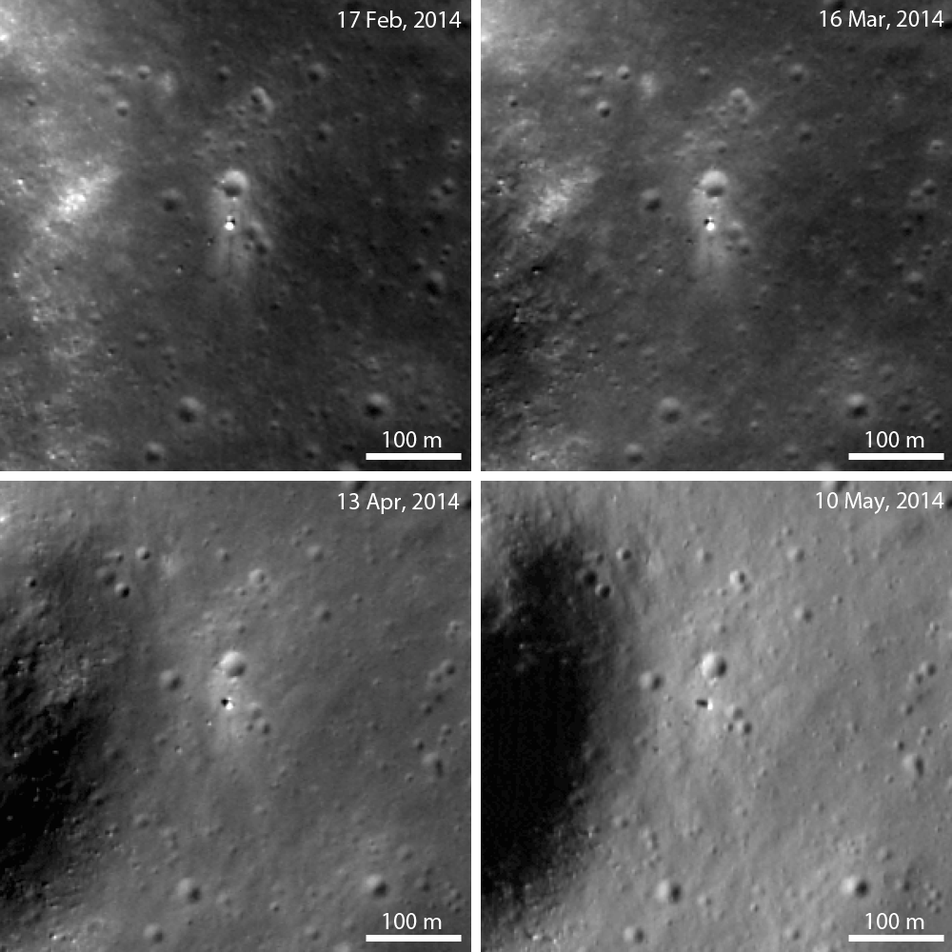
The shadow knows! China’s Chang’e 3 landing site.
Credit: NASA/GSFC/Arizona State University
NASA’s Lunar Reconnaissance Orbiter (LRO) continues to circle the Moon, with the LRO Camera (LROC) team snagging impressive images of the lunar terrain.
Posted by J. Stopar of Arizona State University on October 9, a set of impressive images of China’s Chang’e 3 landing site is now available for your own surveillance.
In December 2013, the one-ton Chinese lander set down in Mare Imbrium near Laplace F crater, then dispatched the Yutu rover.
LROC imaged the China lander and Yutu rover once each month from February to May of this year.
In the May 10, 2014 image, the lander casts a long shadow to the northwest. Yutu’s shadow (located some 55 feet (17 meters) southwest of the lander) can just barely be discerned in this image, and the blast zone around the lander is nearly indistinguishable from its surroundings.
An animated time-series of shadows is also posted – those shadows cast by the lander and rover as they trace the Sun’s position in the sky. The first image of July 15, 2009 was taken before Chang’e 3 arrived on the surface. Between the second and third frames (December 25, 2013 and January 21, 2014, the Yutu rover can be seen in different positions along its traverse.
Also check out a pan and zoom capability that takes you around the Chang’e 3 landing site.

Image of China’s Chang’e 3 lunar lander taken by Yutu rover.
Credit: Chinese Academy of Sciences
As LROC continues imaging the landing zone, researchers will be able to assess small changes in the surface around the lander and rover over time.
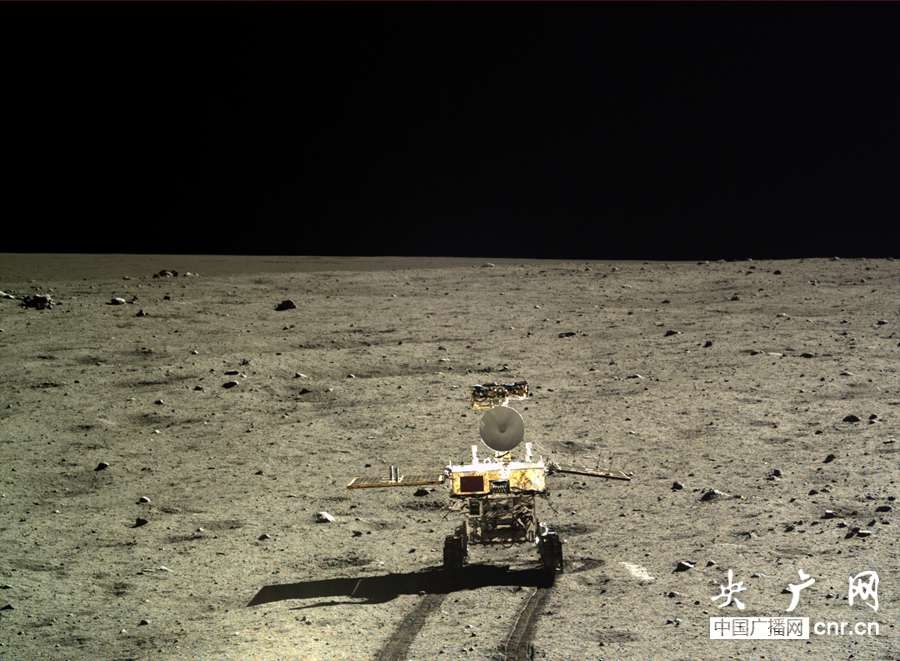
Yutu Rover wheels across Moon.
Credit: Chinese Academy of Sciences
To see these unique images credited to NASA/GSFC/Arizona State University go to:
http://lroc.sese.asu.edu/posts/813
and

